J. Range Manage.
56: 455-460 September 2003
Initial beaked hazel growth responses following protection from ungulate browsing
JODY N. BESTI, EDWARD W. BORK2, AND NORMAND L. COOL
Authors are former Graduate Research Assistant and Associate Professor, Department of Agricultural, Food, and Nutritional Science, 410E, AgFor Centre, University of Alberta, Edmonton, Alberta, Canada T6G 2P5; Senior Park Biologist, Elk Island National Park, Box 7, Site 4, R.R. 1, Fort Saskatchewan, Alberta, Canada T8L 2N7.
'Present address is Alberta Sustainable Resource Development, Box 3092, High Prairie, Alberta, TOG 1 EO. 2Author for correspondence.
Abstract
Beaked hazel (Corylus
cornuta Marsh) dominates the understo- ry of many Boreal
Mixedwood forests incentral Alberta
includ- ing those in ElkIsland National Park, where this
species demon-strates
ahigh tolerance to browsing. This research quantified
changes in beaked hazel stem morphology (total twiglength and number) and leaf and
twig biomass ofcurrent annual growth, both
insideand
outside 4 newlyestablished exclosures during the growing
seasonsof
1999and
2000.At
2 sites,leaf and
twigcur- rent annual growth of beaked hazel shrubs recently protected from herbivory increased
significantly (P < 0.05) by 85 to 114%relative
tothat of browsed shrubs. At another
site,the removal of browsing changed the morphology of beaked hazel shrub growth
(P < 0.05), withprotected shrubs producing
26%more
twigsthat
wereshorter
in aggregate length by 27%. The final site exhibited no significant (P > 0.05) changes incurrent annual growth at the individual shrub
stem level,potentially due to intense intra-spe-
cific competition. These results indicatethat at several locations
in thePark, the recent history of intense browsing appears
to be limitingthe annual growth of beaked hazel, including browse production.
Despite thegeneral increase in growth of individual beaked
hazel stems, however, no changes inproduction
were evi-dent at the community level (P
>0.05) with the removal of browsing after
2years. Protection from browsing did increase
average beaked hazel height by 40% over the same period.Key
Words: boreal forest, browsing release,
Coryluscornuta, current annual growth, exclosures, shrub morphology
Beaked hazel (Corylus cornuta Marsh.)
is acommon understo-
ry shrub within theLower Boreal Mixedwood
(LBM) forestsof
western Canada, occurring mainly on moderately well-drained, moist sites (Willoughby 2000). Beaked hazel is a prolific shrub capableof producing vegetative clones via underground stems that produce new roots and aerial stems along their length
This research was funded by Elk Island National Park, the University of Alberta, the Friends of Elk Island Society, and the Alberta Sports, Recreation, Parks, and Wildlife Foundation, along with Norwest Labs and the Throlson American Bison Foundation. The authors would like to thank numerous field assis- tants who helped with various components of data collection, and the staff at EINP who provided logistical support, along with Peter Blenis, and Laki Goonewardene who aided with data analysis. We also thank Bob Hudson, Ellen Macdonald, Evelyn Merrill, Walter Willms, and 2 anonymous reviewers, who provided helpful comments on earlier versions of the manuscript.
Manuscript accepted 9 Oct. 02.
Resumen
El
"Beaked hazel"
(Coryluscornuta Marsh) domina
elestrato arbustivo
de muchos bosques Boreales Mixtos de la region cen-tral
deAlberta, incluyendo
los deElk Island National Park, donde esta
especiedemuestra una alta tolerancia al ramoneo.
Esta investigacion cuantifico
los cambios en la morfologia de tal- los(longitud total
ynumero
deramas
) y la biomasa dehojas
yramas
delcrecimiento anual actual
del"Beaked hazel", tanto dentro
comofuera
de 4 exclusionesrecientemente establecidas durante
las estaciones decrecimiento de
1999 y 2000.En
2 sitios, elcrecimiento anual actual de hojas
ytallos de arbustos
de"Beaked hazel" recinn protegidos de la
herviboria
seincremento significativamente
(P < 0.05) de 85a
114% encomparacion
con losarbustos ramoneados. En otro
sitio, la remocion delramoneo cambio la morfologia de crecimiento
del"Beaked hazel"
(P <0.05), los
arbustos protegidos produjeron
26%mas ramas
quefueron
27% mascortas
en lalongitud agregada.
El sitio final nomostro cambios
significativos (P > 0.05) en el crecimiento anualactual
al nivelindividual
detallo
delarbusto,
debido potencial- mente a laintensa competencia intraespecifica.
Esto resultados indican, que envarias
localidades delParque,
lahistoria
reciente deramoneo intenso parece ser limitante
delcrecimiento anual
del"Beaked hazel", incluyendo
laproduccion
deforraje para ramoneo.
Sinembargo, a pesar
delincremento general
de crec- imiento de los tallos individuales del"Beaked hazel",
a nivel decomunidad,
nohubo cambios evidentes
en laproduccion (P>
0.05) 2 anos despues de la remocion del ramoneo.
En
el mismoperiodo
de tiempo laproteccion contra
elramoneo incremento
en 40% laaltura promedio
del"Beaked hazel".
(Tappeiner
and John 1973). Clones are typically less than 2 m indiameter (Tappeiner
1971). As standsof beaked hazel
age, the totalphytomass
andproportion of
young stems in the population increases. However, beaked hazel density eventually declines asthe tree overstory and shading increases (Kurmis and Sucoff
1989).Beaked hazel can influence forest ecology, with high
den- sities inhibiting tree reproduction and reducing the abundanceof
more palatable browse species, as well as changing light intensity and the compositionof litter
in the understory (Tappeiner 1979, 1971).Elk Island National Park (EINP)
islocated
ineast-central Alberta and has
anunderstory dominated
bydense stands of beaked hazel (Hardy Associates
Ltd. 1986).Despite
the abun- danceof beaked hazel
and its role inproviding
the majorityof
JOURNAL OF RANGE MANAGEMENT 56(5) September 2003 455
available browse
tonative ungulates (Blyth et
al. 1994),little
information exists on the intra-specific responseof
this shrub tocurrent levels of herbivory within the Park. Studies on other
shrub species have found browsing may lead toreduced foraging opportunities for wildlife
(e.g.Wambolt and Sherwood
1999, Bork et al. 1997a). Given that previous research has shown stem mortality may eventually lead to an increase inbeaked hazel
den- sity (Tappeiner 1979), heavy browsingof
this species may lead to unexpected increases in browse production.This study assessed the effect of browsing
onbeaked hazel shrubs within EINP. To accomplish this, we employed the
approachof Yokoyama
andShibata (1998)
andquantified rela- tive changes
in themorphology and biomass of current annual
growth within individual shrub stems for 2 successive years fol- lowing the cessationof
browsing. We hypothesized thatif current
levelsof
browsing suppress beaked hazel growth, stems recentlyprotected from browsing would have greater current annual
growth. Conversely, should intensive browsingfacilitate beaked hazel current annual growth, individual stem growth would be lower
inprotected shrubs over the same period.
Asecondary
objective was to compare beaked hazel growth at thepopulation (i.e. per unit area) level with that at the individual stem (i.e.
ramet) level,
asprevious growth responses have been found
todiffer depending on the biological scale of investigation
(Tolvanen et al. 1992,
Wambolt
et al. 1998).Methods
Study Site
Elk Island National Park is a 194 km2 area situated 37
km east of Edmonton, Alberta (53°37'N, 112°58'W) within the Beaver Hills-Cooking Lake Moraine. The Park
iselevated
up to 60 m above the surrounding plains (710 to 760 m ASL), and is com-posed of knob and kettle topography, with slopes up to 20%.
Upland
soils are mostly well-drained Orthic Gray Luvisols underforest (Crown
1977),while Dark Gray Luvisols occupy open
areas. Soil textures vary from loam to loamy sand.Located in the cool continental climatic region, the Park receives about 450 mm of precipitation annually, with 75%
falling as summer rain (Environment Canada 1993).
Temperatures vary from
-40°
C in winter to 32° C in summer.Uplands are dominated by aspen (Populus tremuloides Michx.) forests, which cover approximately 80%
of
the Park. The under- story consistsof
a varietyof
herbs and shrubs,of
which beaked hazel and marsh reedgrass(Calamagrostis canadensis
(Michx.) Beauv.) are the most abundant (Bork et al. 1997a). These stands produce up to 1,700 kgha
1of
total new growth in the understory,of
which 47 to 68% is browse.Elk Island is the only fenced national park in Canada and lacks major predators such as wolves. These conditions have resulted in
high ungulate populations and intense use of vegetation.
In 1999,aerial ungulate surveys estimated there were
3,493 large ungulates within the Park, including 340 moose, 1,870 elk, 1,043 bison, and 210 deer (Parks Canada 1999). Based on the year-longherbivore regime within the Park, these numbers
are equivalent to anannual stocking rate of approximately
2AVMs ha' (Best
2001).Prescribed fire and herbivory
are 2of
the main factors affectingvegetation within the Park (Parks Canada
1999,Bork et
al.1997a). Specifically, intense year-long herbivory over the past 80
years has reduced the abundance of preferred browse species such
asaspen, chokecherry (Prunus virginiana
L.), saskatoon(Amelanchier alnifolia Nutt.),
aswell
asred-osier dogwood (Cornus stolonifera Michx.),
andreduced
the remaining shrubs to ahedged growth form (Parks Canada
1999,Bork
et al. 1997a, 1997b). Aspen regeneration has also declined (Bork et al. 1997b).Although beaked hazel provides
up to 75%of
allbrowsed
twigs, this species is the mostabundant understory
shrub (34%of
all stems) and has been reported to be increasing in proportion to other understory species (Blyth et al. 1994). Specific utilizationdata for beaked hazel within
thePark between
1991 and 1994indicated annual winter twig use ranged from
40 to 55% (Blyth et al. 1994).Experimental Design
In
October
1998, 4ungulate-proof exclosures,
each 20 by 50 m indimension
and 2.2 m high, wereconstructed throughout
the Park. Eachexclosure
waspositioned locally
to include aforest community, the understory of which consisted of beaked hazel along with various other
shrubs.Plot pairs therefore consisted of an aspen-beaked hazel community divided by the exclosure
fence, initially resulting in 2 areasof
similar plant species compo-sition and structure,
aswell
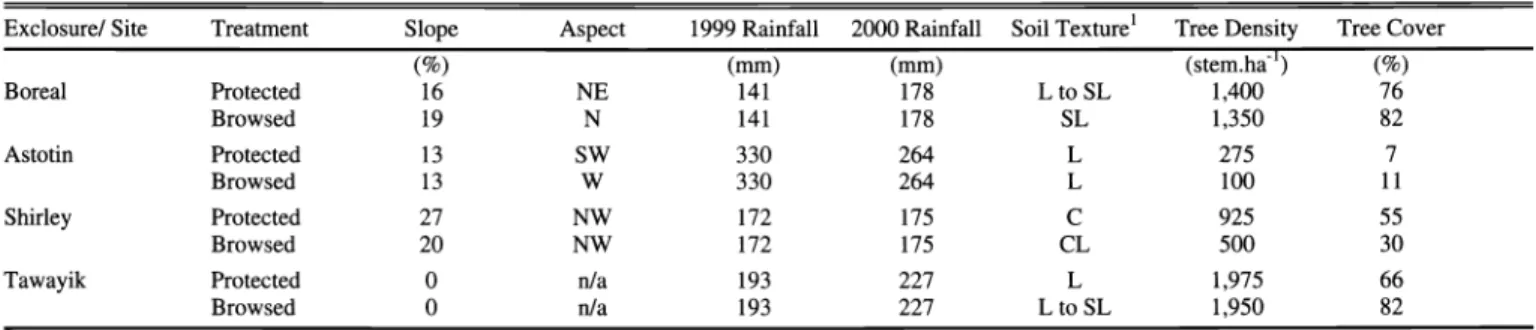
assite characteristics (Table
1).Communities outside
theexclosure were exposed
toyear-long, native ungulate herbivory, while enclosed communities were
pro-tected from browsing. Given that most browsing
occurs during winter when alternative herbage is largely unavailable (Danell et al. 1994) and no evidenceof
summer browsing was apparent on the new growthof protected beaked hazel
stems at the timeof exclosure establishment
(i.e. October), plants sampled the follow- ing summer were considered restedfor
1 growing season.Vegetation Sampling
Within each plant community inside
and outside each exclo- sure, shrubs were sampled along a 15 m transect. At eachof
20 sample points, 2beaked hazel
stems were systematically selectedand tagged 0.75
mapart (n
=40 shrubs per community).
Table 1. Summary site descriptions for protected and unprotected forest communities at each of the 4 locations investigated.
Exclosure/ Site Treatment Slope Rainfall Rainfall Textures Density Cover
(%) (mm) (mm)
Boreal Protected 16 to SL
Browsed 19 N
Astotin Protected 13 L 7
Browsed 13 W L
Shirley Protected 27 C
Browsed 20 NW
Tawayik Protected 0 L
Browsed 0 n/a to SL
L = loam, SL = sandy loam, C = clay, CL = clay loam.
456 JOURNAL OF RANGE MANAGEMENT 56(5) September 2003
Individual stems were defined
asthose free-standing
at the soil surface.During
Augustof
1999, one shrub stem at everypoint
wassampled, with
20shrubs har-
vested inside and 20 outside at eachof
the 4 exclosures (n = 160). The remaining 20 shrubs were sampled in each community during August 2000. Sampling in the firstyear was assumed to have
anegligible effect
onneighboring shrubs sampled
in thesecond year, particularly given that
sampling removed current annual growth only and affected a maximumof
0.3%of
shrubs at any one location.
Parameters measured on each stem included the number of current annual growth (CAG) twigs per shrub and their total length, together with twig and leaf biomass. All new growth was clipped,
sorted to twigs and leaves, dried at 50°Cfor
48hours, and weighed. The samples
were later pooled to theplant community level
(i.e. the 20 shrubs) and analysedfor crude protein
(CP) and aciddetergent fibre (ADF). Crude protein analysis was done using
aNitrogen Determinator (LECO Corporation, St. Joseph, Mich., USA)
while ADF wasmeasured using the filter
bag technique (ANKOM Company 1993).Community Attributes
In
the second year,
2additional
15 mtransects were located in each of the
8plant communities
tomeasure overstory
tree canopy cover and density, total shrubdensity and maximum shrub height,
as well asbeaked hazel cover, density, and
current annual growth (CAG) per unit area atpeak growth during August of 2000.
Tree canopy cover was estimated using
the line intercept method (Bonham 1989), while tree density wasdetermined
in a 20by 20
marea overlying the transects.
Beaked hazel cover (Daubenmire
1959) and density, along with total shrub density and maximum shrub height, were sampled at 2 m intervals along both transects with- in 1 m2quadrats
(n = 16).Beaked hazel total leaf and twig CAG (per unit area)
within the plant community was measuredwithin
2,0.25
m2quadrats harvested at systematic locations along each transect.
All samples were
oven-dried
and weighed, withdata from the
4individual quadrats
averaged toprovide
a value for the plant community.Within each plant community, data were also
collected on slope gradient, aspect,
and soils, as well as growing season pre-cipitation (May to August) within each
yearof
the study (Table 1).Although win- ter precipitation
isimportant for determin- ing moisture recharge
inboreal systems
(Bork et al. 2001) and for regulating browsing intensity by herbivores during winter, local snow depth data for the
exclosures were not available for the study period. Data from a central weather station within the Park, however, indicated winter (i.e.September through April) snowfall accumulations during 1998-99 and 1999-2000
were 111 and 105 cm, respec-tively, very similar to the 20-year mean for the area (107 cm) (Environment
Canada, unpublished data). Four soil cores (0-15 cm) were randomly collected at each plant community in October 2000, bulked,
and analysed for soil texture using the hydrometer method described by McKeague
(1978).Data Analysis
All shrub data were checked for normal- ity
and homogeneity of variances using Shapiro-Wilkes and Levenes statistics, respectively (SAS Institute Inc. 1991).
Beaked hazel CAG
at theplant communi-
ty level wastransformed using
a log trans-formation,
aswere individual beaked hazel stem CAG twig counts, total twig
length, andleaf
and twig CAG.In this investigation,
plant communities were considered the primary experimental unit
at each exclosure with sitestreated
asblocks because individual shrubs repre- sented sub-samples, and thus, pseudo- replication (Hurlburt
1984). As aresult, the interaction of site by herbivory was used
as the primary error term for all maineffects. Where significant interactions between herbivory
and site werefound
onindividual beaked hazel stem parameters, variation
among sub-samples (i.e. individ- ual stems) was used as the error term in a final step to more fully assess the natureof the interaction. Additionally, year was incorporated
into the model as a split-plot totest for temporal differences
inbeaked hazel shrub recovery during the first and second years following protection from
herbivory.Total shrub density and maximum shrub height for each community were analysed using ANOVA procedures for a
random- ized complete block design (Steel et
al.1997), with the
interaction of
site and pro-tection from herbivory
asthe error term.
Beaked hazel cover, density,
and produc-tion per unit area were analyzed using
ANCOVA, where non-hazel shrub density was used as a covariate. In no case was the covariate significant (P > 0.10).Individual beaked hazel stem current annual growth (CAG) parameters were analyzed similarly using ANOVA (leaf
and twig CAG, as well as browse quality).Significant interaction effects were
assessed in more detail using the variation
provided by sub-sampled shrubs within each plant community. ANCOVA was used
toassess morphological changes
inshrub growth in order to account for
uneven twig numbers and/or length among shrubs and isolate treatment effects. Twig numbers per shrub were adjusted for twig length, and viceversa
in the ANCOVA, with significant covariate effects found in all cases (P < 0.0001). Incorporationof
thecovariate, however, did not alter the
sig-nificance of
anytreatment effects. Post-
hoc mean comparisons were conducted on allsignificant variables
(P < 0.05) usingTukey's
test, emphasizing those between protected and browsed areas.Results and Discussion
Beaked Hazel Population Responses
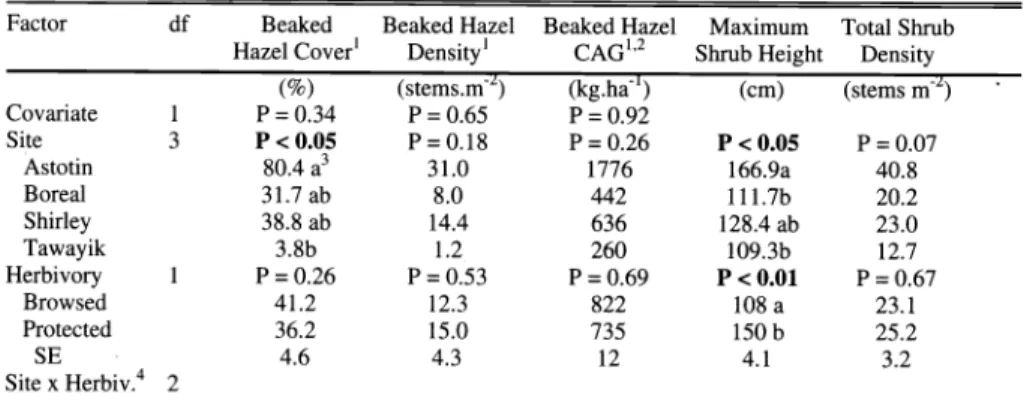
The cover
of
beaked hazel varied amongthe exclosure sites
(P <0.05), but was similar between browsed and protected
treatments in 2000 (Table 2). Among the 4 sites, Astotin had the greatest beaked hazelpopulation, followed by the Shirley and Boreal sites, with Tawayik having rela- tively less. Although the greater abun-
danceof beaked hazel
atAstotin may be the result of increased summer rainfall
during the 2 yearsof
this study, a relative- ly open tree canopy may also account forthis trend (Table
1).Open canopies
areconducive to maintaining high beaked
hazel densities (Kurmis and Sucoff 1989,Buckman
1964).At least
1other site (Tawayik) had
asimilar precipitation level (Table
1),but markedly less beaked hazel (Table
2).Unlike Astotin, the Tawayik site had
awell-developed, relatively closed forest canopy (Table
1),indicating that light rather than moisture may regulate beaked hazel densities within the communities
investigated. Regardlessof
the cause, thevariation in density of beaked hazel
among the 4 locations is important ecolog-
ically
asit may influence other plants through inter-specific competition (Lauer
andGlover
1999), as well as its own popu- lation through strong intra-specific compe- tition,particularly
at Astotin (Table 2).The lone significant
(P <0.01) differ- ence between browsed
and protected treat-ments observed at the population level was an increase of 40% in the average maximum shrub height within
the exclo- sures following the removalof herbivory (Table
2).The increase in shrub height might be expected
asprevious studies
JOURNAL OF RANGE MANAGEMENT 56(5) September 2003 457
Table 2. Effects of site (i.e. exclosure location) and protection from herbivory on mean beaked hazel population and plant community characteristics in 2000.
Factor df Beaked Beaked Hazel Beaked Hazel Maximum Total Shrub Hazel Cover' Density' CAG"2 Shrub Height Density
(%) (stems.m") (kg.ha) m2)
Covariate 1 P = 0.34 0.65 0.92
Site 3
P<0.05
Astotin 80.4 a3 31.0
Boreal 31.7 ab 8.0
Shirley 38.8 ab 14.4 ab
Tawayik 3.8b 1.2
Herbivory 1 P=0.26
Browsed 41.2 12.3
Protected 36.2 15.0
SE 4.6 4.3
2
Data analyzed using ANCOVA with non-hazel shrub density as a covariate.
3Current annual growth data transformed (log) prior to analysis. Original means presented for clarity.
Within a factor, column means with different letters differ significantly (P < 0.05).
4Error term for Site and Herbivory.
have implicated herbivory within the Park as a
cause of reduced structure in the
understory (Bork et al. 1997b).Individual Beaked Hazel Stem Growth
Initial analysis indicated there were sig-
nificant (P
<0.001) site by herbivory interaction effects for all beaked hazel
parameters assessed (Table 3). As a result, individual sites were further analysed sep-arately using the variation among sub- sampled stems. This process was under- taken
toprovide
amore detailed under-
standingof
beaked hazel shrub responses to thepresence or removal of herbivory.
We also recognize, however, that although the
paired (browsed
andprotected) plant
communities were initially established on similar ecosites, the lackof
complete inde-pendence among individual shrub stems
within each community constitute pseudoreplication, and thus, inferences
within each site must be tempered accord- ingly.Examination of the individual beaked hazel growth responses among
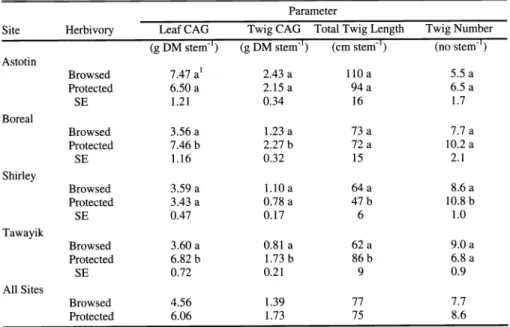
sites indi- cated that shrubs protected from browsing at both Boreal and Tawayik increased (p <0.05) their
leaf
and twig growth relative to those outside the exclosure, ranging from 85 to 114%(Table
4).At Tawayik, this
increase could be attributed, at least in part, to a significant increase (P < 0.05) in the lengthof
new twig growthrather
than the numberof
new twigs produced (Table 4).Although year significantly (P < 0.001)
affected both leaf current annual growth
(CAG) and the numberof
twigs producedper
shrub stem (Table 3), few interactions were evident betweenyear
and herbivory.Shrub growth was generally greater in 2000 than
1999, asleaf CAG increased
Table 3. Significance values of the effects of site (i.e. exclosure location), protection from her- bivory, and their interaction, on individual hazel shrub stem CAG characteristics in 1999 and 2000.
Factor df Leaf CAG' CAG' Twig Length Number of
per Shrub"2 Twigs per Shrub"2
Covariate3 1 P<0.0001
Site 3 P=0.51
Herbivory 1 P=0.28
Site x Herbivory3 3 P < 0.001 0.0001
Error 1 152
Year 1 P<0.001
SitexYear 3 P=0.10
Herbivory x Year 1 P=0.65
Site x Herbivory x Year4 3 P = 0.16 0.05
Error 2 152
'Data transformed prior to analysis using a log transformation.
2Data analyzed using ANCOVA, with twig numbers per shrub adjusted for twig length, and twig length adjusted for twig numbers.
4Error term for Site and Herbivory effects.
Error term for Year and its interactions.
from 4.92
g.stem'
in 1999 to 5.69g.stem'
in2000. Similarly, the mean number of twigs increased from
7.0twigs.stem"
to 9.3over this same period. The increase over
the 2 years may be due to more favor- able growing conditions for beaked hazel, aswell
asthe increases
inbeaked hazel growth described earlier within protected exclosures.
Twig CAG
was alsoaffected
by a sig-nificant
(P <0.05) interaction between
site, herbivory, and year (Table 3). Further examinationof
these results indicated this interaction was caused by variation in theyear during which differences in twig growth were evident among sites. For example, at the Boreal exclosure the increase
intwig growth within protected beaked hazel
shrubs was evident in 1999,immediately following protection from herbivory. In contrast, newly protected shrubs at Tawayik did not generate
anincrease
intwig growth until the second
year. The delayed increase in CAG withinprotected beaked hazel
shrubs at the latter site maybe indicative of
amore intense browsing history prior
to exclosure estab-lishment, which would have weakened
shrubs by reducing photosynthetic capaci- ty,plant carbohydrates
andplant vigour
(Briske and Richards 1995).
Beaked hazel shrubs
at the Shirley sitedemonstrated
nochanges
inleaf or twig current annual growth (CAG), but dis- played evidence of changes
in the mor- phologyof
new growth. In particular, pro- tected beaked hazel shrubs produced a sig-nificantly
(P <0.05) greater number of new twigs, but which were shorter
(P <0.05) in aggregate length (Table 4).
Although these changes did not coincide with significant differences
inleaf
or twigCAG (Table 4), they may signal future
changes in growth as the recoveryof
pro-tected beaked hazel
shrubs progresses at this location.Protected beaked hazel shrubs at several sites
displayed either
anon-significant or even weak trend towards reduced growth during the first year of recovery from
browsing, before increasing more marked- ly during the second year (data not shown).We speculate that annual herbivory may stimulate individual beaked hazel growth by forcing stems
toregenerate sufficient
photosynthetic area to survive. Increases in the root:shoot ratioof
plants immediately following defoliation is thought to account for positive responses in the above-groundgrowth of browsed shrubs (Bryant et
al.1991).
With protection during the fall of 1998, beaked hazel shrubs may have
reduced their above-ground growth the fol-458 JOURNAL OF RANGE MANAGEMENT 56(5) September 2003
Table 4. Mean leaf and twig CAG, as well as total length and number of twigs, within individual beaked hazel shrub stems of plant communities protected and exposed to browsing at each of 4 sites in Elk Island National Park.
Parameter
Site Herbivory Leaf CAG Twig Number
i
(g DM stem') (g DM
stem)
(cm stem") Astot nBrowsed al
Protected 6.50 a 2.15a
SE 1.21 0.34
Boreal
Browsed 3.56 a
Protected 7.46 b 2.27b
SE 1.16 0.32
Shirley
Browsed 3.59 a
Protected 3.43 a 0.78a
SE 0.47 0.17 6
Tawayik
Browsed 3.60 a
Protected 6.82 b 1.73b
SE 0.72 0.21 9
All Sites
Browsed 4.56
Protected 6.06 1.73
Within a parameter and column, means with different letters differ significantly at P < 0.05 using sub-samples as the experimental error term.
lowing summer because new growth pro-
duced the previous growing season
remained intact. In turn, this would allowmore photosynthates to be allocated to other important biological processes for plant recovery, including root develop-
ment. As much as 39%of beaked hazel biomass
isbelow-ground (Tappeiner
and John 1973) and plays a key role in deter- mining hazel survival.The variable response
between protected and browsed beaked hazel stems among
the 4 sites may beattributable
toseveral factors, including variability
inprecipita-
tion, overstory cover,historical browsing pressure, or intra-specific competition. For example, high summer rainfall and an
open tree canopy at Astotin (Table 1) may allow beaked hazel shrubs to more easily tolerate defoliation, leading to the absenceof differences between protected and browsed shrubs
atthis site (Table
4). In addition, although shrubs at Astotin were clearlybrowsed
(asevidenced by
a well-defined hedge-line), they were consider-
ably taller than shrubs at other sites (Table 2), which may allow them to restoreleaf
area more readily. Moreover, the unusual- ly high densityof
beaked hazel at this site(Table
2)may maximize intra-specific
competition. Beaked hazel plants compete veryeffectively with other shrub species by reducing light at the forest floor (Tappeiner 1979, Tappeiner and John
1973). The results observed here suggestbeaked hazel stems may also compete with each other for resources and limit
growth at high stand densities, thereby negating any potential growth response
following the removalof
browsing. Under these circumstances, removalof browsing may lead to stagnation and reduced
growth
of beaked hazel shrubs within
theAstotin exclosure. There was also weak evidence of reductions
inleaf and twig CAG within protected shrubs
atthis site (Table
4), which may continue to increase asshrub competition intensifies in the
absenceof
browsing.Beaked Hazel Browse Quality Overall, there were few significant impacts of removing herbivory on the quality of beaked hazel growth
in 2000.The lone significant effect (P < 0.01) was an
interaction between exclosure
site andprotection from herbivory
onleaf crude protein
(CP), arising from areduction
(P <0.05) in
leaf
CP at the Boreal and Shirleysites from 14.2 to 12.8%, and 11.2 to 9.8%, respectively, when protected from browsing. The decrease
inleaf
CPof
pro-tected beaked hazel shrubs within the Boreal exclosure coincided with an increase
inleaf CAG (Table 4), thereby exemplifying
the typical inverse relation- shipbetween forage quantity and quality (e.g.,Van der Wal
et al. 2000).Management Implications and Conclusion
At the scale
of individual beaked hazel stems, responses
tothe removal of her-
bivory were evident
at 3of
4 sites over the 2-year sampling period within shrubs pro- tected from browsing. These results indi- cate current levelsof
herbivory within Elk Island National Park tend to be impactingsome stands of beaked hazel by either reducing twig and leaf current annual
growth, or altering their morphology. The documented changes in individual beaked hazel shrub growth afterprotection
indi- cates that although this shrub is relatively tolerantof
defoliation, particularly in com- parison with more palatable species (Bork etal.1997b), current levels of herbivory continue to affect, and in some cases
reduce, beaked hazel growth. In contrast, other than an increase in maximum shrubheight, no plant community or beaked hazel population characteristic changed
following protection. It is also notable that despite thepositive responses observed
at theindividual
shrub level, these changes failed to translate into greater browse pro-duction
at thepopulation level (data not shown). Thus, factors other than shrub competition
may be preventing individualstem responses from translating into increased browse production,
at least with-in the 2-year period examined here.
Further vegetation changes
are also likelyfollowing the removal of herbivores
andtheir associated action on ecosystem processes,
asseveral studies indicate browsing affects
soil chemistry and nutri-ent cycling (e.g., Kielland and Bryant
1998, Ruess et al. 1998).
In summary, the results
of
this research support the notion that the overall effectof
intensive ungulate browsing in Elk Island is to reduce individualbeaked hazel
stemgrowth and production. The variable nature of
theresponses among
sites indi- cates factors such as precipitation, micro-climate, plant species composition and resulting
competition, overstory character- istics, and previous disturbance may also regulate beaked hazel growth. Our results for beaked hazel also parallel the findingsof Wambolt
et al.(1998) for bitterbrush (Purshia tridentata Pursh)
on the impor- tanceof
scale (e.g., shrub stem vs popula-tion) in quantifying and interpreting the impact of
defoliation, as several individualbeaked hazel stem responses were observed in this study despite minimal changes within the plant community.
In conclusion,year-long browsing
by nativeungulates has reduced the number and
aggregate twig length, as well asleaf
andtwig biomass, of beaked hazel current
annual growth at several sitesthroughout the Park. However, these changes also appear reversible with the cessation of
browsing.JOURNAL OF RANGE MANAGEMENT 56(5) September 2003 459
Literature Cited
Best, J.N. 2001. Assessing rangeland resilience to herbivory in Elk Island National Park.
M.Sc. thesis. Dept of Agr., Food, and Nutr.
Sci., Unive. of Alberta, Edmonton, Alberta, Canada 154 pp.
Blyth,
C.B., N.L. Cool, A.Dickinson,
R.Kaye, W.E. Olson, T. Osko, D.S. Madsen, and B. McDougall. 1994. Ecosystem status and management
recommendations-Elk
Island National Park. Heritage Resource Conservation, Elk Island National Park, Alberta, Canada. 95 pp.Bonham, C.D.1989. Measurements for terres- trial vegetation. John Wiley & Sons Inc., New York, N.Y.
Bork, E.W., R.J. Hudson, and A.W. Bailey.
1997a. Upland plant community classifica- tion in Elk Island National Park, Alberta, Canada, using disturbance history and physi- cal site factors. Plant Eco1.130:171-190.
Bork, E.W., R.J. Hudson, and A.W. Bailey.
1997b. Populus forest characterization in Elk Island National Park relative to herbivory, prescribed fire and topography. Can. J. Bot.
75:1518-1526.
Bork, E.W., T. Thomas, and B. McDougall.
2001. Herbage response to precipitation in central Alberta boreal grasslands. J. Range Manage. 51:243-248.
Briske, D.D. and J.H. Richards. 1995. Plant responses to defoliation: a physiologic, mor- phologic and demographic evaluation. pp.
635-710, In: D.J. Bedunah and R.E. Sosebee (eds) Wildland Plants: Physiological Ecology and Developmental Morphology, Soc. for Range Manage., Denver, Colo.
Bryant, J.P.,
K. Danell, F.Provenza,
P.B.Reichardt, T.A. Clausen, and R.A.
Werner. 1991 Effects of mammal browsing on the chemistry of deciduous woody plants.
pp 135-154, In: Tallamy, D.W., and M.J.
Raupp (eds) Phytochemical induction by her- bivores. John Wiley and Sons, New York.
Buckman, R.E. 1964. Effects of prescribed
burning
onhazel
inMinnesota.
Ecol.45(3):626-629.
Crown, P.H. 1977. Soil survey of Elk Island National Park. Alberta Institute of Pedology Pub. No. 5-77-38.128 pp.
Danell, K., R. Bergstrom, and L. Ledenius.
1994. Effects of large mammalian browsers on architecture, Biomass, and nutrients of woody plants. J. Mammal., 75:833-844.
Daubenmire, R.F. 1959. A canopy-coverage method of vegetational analysis. Northwest Sci., 33:43-64.
Environment Canada.
1993. Canadian cli- mate normals: 1961-1990. Canadian Climate Program, Atmospheric Environment Service, Minister of Supply and Services Canada.Hardy Associates Ltd. 1986. Ecological land classification of Elk Island National Park, Resource Conserv., Canadian Parks Serv., Elk Island National Park.
Hurlburt,
S.H. 1984. Pseudoreplication and the design of ecological field experiments.Ecol. Monogr. 54:187-211.
Kielland, K.
and J.P. Bryant.
1998. Moose herbivory in taiga: effects on biogeochem- istry and vegetation dynamics in primary succession. Oikos, 82:377-383.Kurmis, V. and E. Sucoff. 1989. Population density and height distribution of Corylus cornuta in undisturbed forests of Minnesota:
1965-1984. Can. J. Bot. 67:2409-2413.
Lauer,
D.K.and
G.R. Glover. 1999. Stand level pine response to occupancy of woody shrub and herbaceous vegetation. Can. J. For.Res. 29: 979-984.
LECO Corporation. Nitrogen Determinator, Model FP-428. LECO
Corporation,
St.Joseph, Mich., USA.
McKeague, J.A., Ed. 1978. Manual of soil sampling and methods of analysis. 2nd Ed.
Subcommittee
on Methods of Analysis, Canada Soil Survey Committee, Canadian Soc. of Soil Sci. 212 pp.Parks Canada.
1999. Elk Island National Park-
ungulate issue analysis. Elk Island National Park, Fort Saskatchewan, Alberta, Canada 22 pp.Ruess, R.P., R.L. Hendrick, and J.P. Bryant.
1998. Regulation of fine root dynamics by mammalian browsers in early successional Alaskan taiga forests. Ecol. 79: 2706-2720.
SAS Institute Inc. 1991. SAS system for linear models. 3rd ed. SAS Institute Inc., Cary, N.C.
Steel, R.G.D., J.H. Torrie, and D.A. Dickey.
1997. Principles and procedures of statistics: a biometrical approach. 3rd Ed. WBC/McGraw- Hill Co. Inc., New York, N.Y.
Tappeiner II, J.C. 1971. Invasion and devel- opment of beaked hazel in red pine stands in northern Minnesota. Ecol. 52(3):514-519.
Tappeiner II, J.C. 1979. Effect of fire and 2,4- D on the early stages of beaked hazel (Corylus cornuta) understories. Weed Sci., 27(2):162-166.
Tappeiner II, J.C. and
H.H.John.
1973.Biomass and nutrient content of hazel under- growth. Ecol. 54(6):1342-1348.
Tolvanen, A., K. Laine, T. Pakonen, E Saari, and P. Havas.1992. Compensatory respons- es of a deciduous dwarf shrub, the bilberry (Vaccinium myrtillus L.) to stimulated her- bivory: some comparisons with the evergreen lingonberry (Vaccinium vitis idaea L). Acta Oecologica. 13:607-615.
Van
der
Wal, R., N. Nadan, S. van Lieshout, C.Dormann,
R.Langvatn, and
S.D.Albon.
2000. Trading forage quality for quantity? Plant phenology and patch choice by Svalbard reindeer. Oecologia.123:108-115.Wambolt, C.L.
and
H.W. Sherwood. 1999.Sagebrush response to ungulate browsing in Yellowstone. J. Range Manage..52(4):363-369.
Wambolt, C.L.,
W.W.Wyatt, and M.R.
Frisina.1998.
Bitterbrush (Purshia tridenta- ta Pursh) growth in relation to browsing.Great Basin Nat. 58:28-37.
Willoughby, M.G. 2000. Guide to range plant community types and carrying capacity for the dry and central mixedwood subregions of Alberta. Alberta Environ., and Alberta Agr., Food and Rural Dev. Pub. No. T/526.
Yokoyama,
S.and
E.Shibata.
1998. The effects of sika-deer browsing on the biomass and morphology of a dwarf bamboo, Sasa nipponica, in Mt. Ohdaigahara, central Japan.For. Ecol. Manage., 103:49-56.
460 JOURNAL OF RANGE MANAGEMENT 56(5) September 2003