Recovery of Uranium and Plutonium from Waste Matrices
Using Supercritical Fluid Extraction
Krishnamurthy Sujatha, Kancharlapalli Chinaraga Pitchaiah, Nagarajan Sivaraman*, Thandankorai Ganapathi Srinivasan, Polur Ranga Rao Vasudeva Rao
Chemistry Group, Indira Gandhi Centre for Atomic Research, Kalpakkam, India Email: *[email protected]
Received October 19, 2012; revised November 19, 2012; accepted November 29, 2012
ABSTRACT
Supercritical fluid extraction (SFE) of plutonium in its nitrate form from actual waste, i.e. plutonium bearing cellulose matrix was demonstrated using 0.1 litre capacity extraction vessel. Complete recovery of plutonium was demonstrated using modified supercritical carbon dioxide (Sc-CO2), i.e. Sc-CO2 containing octylphenyl-N, N-diisobutyl-carbamoyl-
methylphosphine oxide (φCMPO). Near complete recovery of uranium was demonstrated from simulated waste matri- ces, i.e. uranium bearing teflon, glass and cellulose matrices using preparative scale SFE, i.e. from 1 litre capacity ex- traction vessel. The recovery of uranium was established using Sc-CO2 modified with acetyl acetone.
Keywords: Supercritical CO2; SFE; Uranium; Plutonium; φCMPO; Cellulose Matrix
1. Introduction
In recent years, Supercritical fluid extraction (SFE) has emerged as a powerful technique in the extraction of various metal ions from diverse waste matrices and as an alternative technique to solvent extraction. Liquid like density and gas like transport properties of supercritical fluids make them unique to act as special solvents. Supercritical fluids offer faster, efficient and cleaner extraction of compounds of interest with minimum gen- eration of secondary liquid waste as CO2 escapes as gas
after the extraction, leaving the solute in its pure form [1-3]. CO2 has a low critical temperature (31.2˚C) and a
moderate critical pressure of 73.8 bar. It is non-flam- mable, non-toxic and environmentally friendly. CO2
being a non polar molecule, can be mainly employed for the extraction of non-polar and moderately polar com- pounds. Direct extraction of metal ions with supercritical carbon dioxide (Sc-CO2) is not possible because of weak
solute-solvent interactions and charge neutralization re- quirement [4]. The extraction of metal ions is achieved by modifying the properties of carbon dioxide, i.e. mixing carbon dioxide with appropriate extractants or chelating agents. A major requirement for the use of a ligand as chelating agent in SFE is that the ligand and resulting metal chelate should have sufficient solubility in Sc-CO2
medium [4,5].
Removal of various long lived radionuclides from
waste is of major concern in nuclear industry. Various organic materials such as polymers, rubbers and cellulose, widely used in nuclear industry and research facilities are prone to be contaminated with various radioactive ma- terials. Several techniques such as solid phase extrac- tion, solvent cleaning etc., are used for decontamination of radionuclide from waste matrices. However, these techniques result in the generation of secondary liquid waste, which requires further treatment. SFE is an al- ternative and attractive technique for recovery of ac- tinides from such waste matrices since it reduces the generation of secondary liquid waste.
Supercritical carbon dioxide modified with ligands was employed for the extraction of various metal ions such as transition metal ions, lanthanides and actinides from different media [4-20]. The extraction of lantha- nides and actinides was carried out using Sc-CO2
modified with β-diketones [7]. Supercritical fluid extrac- tion of uranium and plutonium from nitric acid medium was examined using Sc-CO2 containing tri-n-butyl pho-
sphate (TBP) [8]. Quantitative dissolution of uranium dioxide in Sc-CO2 containing TBP with nitric acid was
reported [9-10]. Uranium dioxide and its solid solutions with neptunium, plutonium and americium dioxides were dissolved using Sc-CO2 modified with TBP/nitric acid
[11]. Supercritical fluid extraction of plutonium and americium from surrogate soil was investigated using Sc-CO2 modified with theonyltrifluoroacetone (TTA)
and TBP [12]; the extraction efficiencies of Pu and Am
were found to be 69% and 88%, respectively. Sc-CO2
containing hexafluoroacetylacetone and pyridine was employed for the removal of actinides from stainless steel surface [13].
Complete removal of uranium from simulated solid waste matrices, e.g. tissue paper matrix was demons- trated in our laboratory using modified Sc-CO2 [18]. In
our earlier studies, complete recovery of plutonium from simulated waste matrices such as tissue, glass, teflon and stainless steel was demonstrated using Sc-CO2 modified
with octylphenyl-N, N-diisobutyl-carbamoylmethylphos- phine oxide (φCMPO) in methanol [19]. In all these in- vestigations, an analytical scale SFE was carried out, i.e. extraction from 1 mL capacity vessel. The actual waste generated in the laboratory, when subjected to SFE for the recovery of actinides resulted in an incomplete ex- traction. It was observed that the extraction efficiency of actinides from actual waste matrices (e.g. cellulose matrix) was highly influenced by the parameters such as storage period, nature of actinide species, moisture content etc.
In the present study, SFE of plutonium was carried out from the actual waste i.e. cellulose based waste matrix using a 0.1 litre capacity extraction vessel. The extraction efficiency was investigated as a function of ligand and its content in modifier, temperature, HNO3 content in the
Sc-CO2 phase and extraction time. Initially the recovery
of plutonium was carried out using a 1 mL extraction vessel and methods were evolved for the complete re-moval of plutonium from actual cellulose matrix. Subse-quently, the plutonium bearing waste was processed us-ing a 0.1 litre capacity extraction vessel. Similarly, the recovery of uranium was investigated in a preparative scale SFE facility, extraction vessel of 1 litre capacity. The recovery of uranium was investigated from different simulated waste matrices viz., cellulose, teflon and glass, which are generally encountered in various process steps in a radioactive laboratory. The results on the recovery of actinides from these waste matrices are discussed.
2. Experimental
2.1. Lab Scale SFE System Employed for the Recovery of Plutonium from Actual Waste
The SFE system (M/S Jasco) used consists of two reci- procating pumps, one with peltier cooling for pumping carbon dioxide and another pump for the delivery of modifier, a constant temperature oven (±1˚C) and a backpressure regulator. Carbon dioxide gas used was of supercritical grade i.e. 99.9%. The SFE system was set- up in a glove box for the recovery of plutonium from waste matrices [20]. Extraction vessels of 1 mL and 0.1 litre capacities were employed for loading the sample. The 0.1 litre capacity (11 cm height × 4 cm dia) extra- ction vessel was designed and fabricated at our labo-
ratory. The glove box facility was developed incor- porating modifications required for handling high pre- ssures and isolated electrical connections. A secondary container accommodated the primary extraction vessel so that any accidental pressure release can be contained causing no disturbance to the maintenance of an approp- riate negative pressure of the glove box. Various in-built safety measures and associated alarm annunciation fa- cilities were established to avoid over-pressurising of the system during its operation [20]. The two pumps used for the delivery of liquid carbon dioxide and the modifier (extractant in methanol) were placed outside the glove box. However the backpressure regulator and heating oven, which accommodated the extraction vessel were kept inside the glove box. The “extracted sample co- llection system” was also arranged inside the glove box and plutonium was sampled for assay.
In the initial experiments, 1 mL capacity extraction vessel was employed to optimize the SFE conditions for efficient recovery of plutonium from waste matrix. The cellulose based matrix containing plutonium in its nitrate form was cut into small pieces, typical dimension being 5 × 10 cm. The cut pieces were inserted into a 1mL extrac- tion vessel, 1N HNO3 (100 μL) was sprinkled and ex-
traction was carried out under typical conditions viz., pressure: 250 bar, temp: 45˚C, Sc-CO2 flow rate: 3
mL/min, methanol flow rate: 0.15 mL/min; ligand con- tent: ~5 wt% ligand in methanol, about 1.8 mL of HNO3
added to 100 mL solution of methanol containing suit- able ligand. The extraction was carried out for a period of 2 hrs. The plutonium present in extract was collected in small volume of dil.HNO3 + isopropanol medium. The
plutonium contents of the extract after the SFE experi- ment was assayed by liquid scintillation technique. The remains i.e. un-extracted plutonium in cellulose waste matrix was estimated by leaching with 4N HNO3. The
leaching efficiency using ultrasonication was established earlier in our laboratory and was found to be >98% [19]. After the initial studies, the plutonium bearing waste was taken after cutting it into small pieces in to a 0.1 litre SFE vessel and extraction was carried out.
2.2. Experiments with Preparative Scale SFE System
The supercritical fluid extraction system (M/S Inexus) consisted of the following: high pressure CO2 pump ca-
was delivered at a flow rate of 1 - 2 mL/min. Typical pressure employed for the recovery of uranium from cel- lulose waste was 200 bar and extraction was carried out at 50˚C. The extracts were collected in 0.01 N HNO3.
The simulated uranium waste from cellulose, teflon and glass matrices was prepared by spiking known quantities (~2 grams) uranyl nitrate onto these matrices followed by drying at room temperature for about 24 hrs. About 90% volume of the 1 litre capacity extraction vessel was filled with simulated waste matrices. The uranium content in the extract and the remains were analysed by HPLC techni- que using reversed phase chromatographic technique [21].
3. Results and Discussion
3.1. Recovery of Plutonium from Actual Waste
In our earlier studies, we have demonstrated complete recovery (>99 %) of plutonium in its Pu(IV) nitrate form from simulated waste matrices (paper, glass, stainless steel and teflon) using Sc-CO2 modified with 2 wt%
φCMPO in methanol containing 0.16 N HNO3 under super-
critical experimental conditions [19]. Simulated waste containing plutonium stored for several months require addition of nitric acid for its effective removal. Super- critical fluid extraction of plutonium was subsequently carried out from actual waste, which was generated over a period of 5 years. However, the above SFE procedure, when applied to the actual waste resulted in only ~70% recovery, emphasizing the fact that the procedure needs modification depending upon the physical conditions to which the actual waste was subjected to as they are responsible for the degree of interaction with tissue paper matrix. The incomplete extraction behaviour suggested a possible chemical binding between cellulose present in tissue matrix with plutonium. In our earlier studies, we have established evidence for the enhanced chemical interaction of actinide ions (e.g. uranyl nitrate) with cellulose and dextrose matrix. The cellulose is poly- hydroxy compound, which can possibly interact with plutonium/uranium and form compounds through exch- ange of “H” in the hydroxide group. Thus the poor ex- traction of plutonium present in the long-time stored cellulose waste can be attributed to the possible for- mation of some non-extractable species. Hence inves- tigations were carried out in the present study to over- come the plutonium-matrix interaction as well as to convert the plutonium into its soluble species, nitric acid was added to the modified Sc-CO2 phase; similarly, nitric
acid was also sprinkled onto the matrix prior to the extraction of plutonium. To improve the plutonium re- covery from waste matrix, extraction efficiency was investigated as a function of 1) ligand and its content in modifier; 2) HNO3 content in mobile CO2 phase; 3)
temperature; and also 4) extraction time.
Recovery of plutonium from cellulose waste was ca- rried out using 2 - 5 wt% φCMPO in methanol; similarly, HNO3 concentration was varied from 0.16 to 0.8 N.
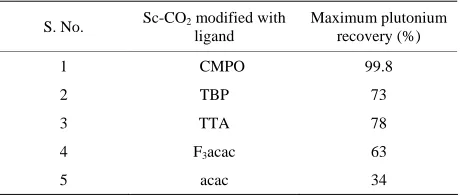
Subsequently, Sc-CO2 modified with various ligands
such as φCMPO, TBP, acetyl acetone, trifluoroacetyl acetone and TTA were employed. In these experiments, the cellulose based matrix was cut into small pieces, the cut piece was placed into a 1 mL extraction vessel, 1 N HNO3 (100 μL) was sprinkled and extraction was carried
out using suitable experimental conditions and the results are shown in Table 1. The typical experimental condi- tions were, pressure: 250 bar, temp: 45˚C, Sc-CO2 flow
rate: 3 mL/min, modifier (5 wt% ligand in methanol with 1.8 mL of HNO3) flow rate: 0.15 mL/min. The extraction
[image:3.595.309.539.609.707.2]was carried out for a period of 2 hours. The maximum plutonium recovery was found to be ~99.8% when
Table 1. Recovery of plutonium from cellulose based waste matrix; (a) Influence of φCMPO concentration; (b) Influ- ence of HNO3 concentration; (c) Influence of ligands.
(a)
S. No.
Sc-CO2 modified φCMPO
containing 0.3 N HNO3 (wt%
φCMPO)
Plutonium recovery* (%)
1 2 65 - 80
2 3 69 - 85
3 4 71 - 90
4 5 86 - 99.8
*
6 independent experiments with each concentration performed modifier (φCMPO in methanol); Sample: Pu from cellulose matrix kept in 1 mL vessel; Sc-CO2: 3 mL/min, modifier: 0.15 mL/min, P: 250 bar, Temp.: 45˚C.
(b)
S. No. Sc-CO2 modified with 5 wt% φCMPO in
methanol HNO3 (molarity) used
Plutonium recovery* (%)
1 0.16 84
2 0.3 99
3 0.5 96
4 0.8 90
*Average of three independent experiments; Sample: Pu from cellulose
matrix present in 1 mL vessel; SC-CO2: 3 mL/min, modifier: 0.15 mL/min, P:
250 bar, Temp.: 45˚C.
(c)
S. No. Sc-CO2 modified with
ligand
Maximum plutonium recovery (%)
1 CMPO 99.8
2 TBP 73
3 TTA 78
4 F3acac 63
5 acac 34
F3acac: trifluoro acetyl acetone; acac: acetyl acetone; Experimental condi-
tions: Sc-CO2: 3 mL/min; modifier (5 wt% ligand in methanol): 0.15 mL/
Sc-CO2 modified with 5 wt% φCMPO in methanol con-
taining 0.3 N HNO3 was employed. Sc-CO2 modified
with TBP resulted in a maximum plutonium recovery of about 73%, whereas extraction with TTA resulted in a recovery of about 78%. Extraction with trifluoroacetyl acetone resulted in ~63% recovery whereas extraction with acetyl acetone resulted only in about 34%. 25 inde- pendent experiments were performed to establish the extraction efficiency of plutonium from waste using Sc-CO2 modified with φCMPO. The extraction efficiency
was found to vary from 88% to 99.8% in these experi- ments, averaging about 96% (Figure 1). The total amount of plutonium in the cut-piece (4 × 10 cm) was varying from 10 μg to 60 µg. Hence φCMPO was chosen as the ligand for the recovery of plutonium from the bulk cel- lulose waste.
The extraction efficiency of plutonium recovery from cellulose matrix was also studied at 45˚C, 50˚C and 55˚C; similary, extraction was also carried out at pressure 200 and 250 bar; there was no significant change in the ex- traction efficiency of plutonium in these studies.
The cellulose waste with plutonium was taken up in a 0.1 litre capacity extraction vessel and SFE was carried out using Sc-CO2 modified with 5 wt% φCMPO in me-
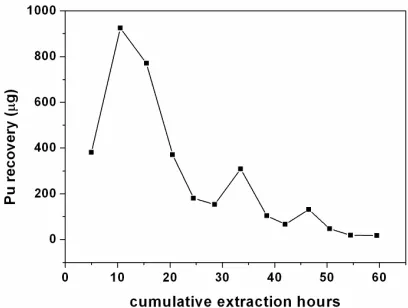
thanol. The plutonium bearing cellulose waste was pro- cessed in five different batches; SFE was carried out for about 40 to 80 hrs duration; after every 5 hrs, the vessel was opened and fresh HNO3 (1N) was sprinkled on to the
[image:4.595.320.524.86.240.2] [image:4.595.65.277.510.665.2]waste followed by SFE to improve the extraction effi- ciency. Typical result from a particular batch is shown in
Figure 2. About 30 mg of plutonium was recovered from cellulose waste matrix during these five campaigns.
The extraction from 0.1 litre extraction vessel needed longer duration because of the low pumping rate of CO2
Figure 1. Recovery of plutonium from actual cellulose waste matrix using SFE. Experimental Conditions: Sc-CO2: 3 mL/min; modifier (5 g φCMPO and 1.8 mL 16N HNO3 in 100 mL methanol): 0.15 mL/min; P: 250 bar; Temperature: 45˚C. Extraction period: 2 hours; Extraction vessel capacity: 1 mL. Sample: cellulose waste containing plutonium.
Figure 2. Extraction and recovery of plutonium from cellu- losic waste matrix. Sc-CO2: 3.5 mL/min; modifier: (5 g
φCMPO and 1.8 mL 16 N HNO3 in 100 mL methanol): 0.15 mL/min; P: 200 bar, Temp: 50˚C, Extraction vessel capac- ity: 0.1 litre; Sample: cellulose waste containing plutonium (~3.5 mg of plutonium was recovered in this batch).
i.e. only a maximum flow rate of 3.5 mL/min was em- ployed with the existing SFE facility. Extraction kinetics was found to be slow because ~30 minutes are required to affect one CO2 change in the extraction vessel. A fa-
cility for higher flow rates e.g. 25 - 50 mL/min is essen- tial for a faster extraction and recovery.
The delivery of φCMPO into CO2 phase in the absence
of co-solvent, e.g. methanol results in further reduction of secondary liquid waste, an added advantage to SFE technique. It may be also useful to minimize the phase perturbation, if co-solvent (e.g. methanol) is not added, which will preserve the integrity of supercritical fluid phase of carbon dioxide. In our earlier studies [22] we have demonstrated the co-solvent free addition of various ligands to Sc-CO2 for extraction of metal ions. In the
present study, φCMPO was added to Sc-CO2 and the
modified phase was employed for the recovery of Pluto- nium from cellulose waste matrix(Figure 3).
Near complete recovery of plutonium from waste was established in these studies from a 1 mL capacity extrac- tion vessel. These studies have established the potential use of co-solvent free delivery of ligands for larger scale supercritical fluid extraction and recovery of actinides from waste matrices.
3.3. Recovery of Uranium from Simulated Waste Matrices Using Preparative Scale SFE Facility
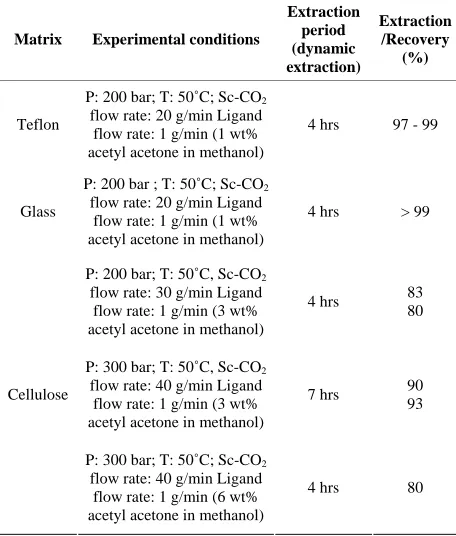
The results on the extraction and recovery of uranyl ion from various matrices are shown in Table 2. Sc-CO2
Highest recovery of uranyl ion, i.e. ~99% was observed from teflon and glass matrices. The extraction efficiency was found to be ~80% - 83% from cellulose matrix when Sc-CO2 was delivered at flow rate of 30 g/min with a
modifier (3 wt% acetyl acetone in methanol) flow rate of 1 mL/min at 200 bar pressure. In these studies, four
[image:5.595.84.260.169.314.2]Figure 3. Co-solvent-free delivery of φCMPO for super- critical fluid extraction and recovery of plutonium from cellulose waste matrix. Experimental: Sc-CO2: 3 mL/min; P: 250 bar; Temperature: 45˚C; Extraction vessel capacity: 1 mL; Sample: cellulose waste with plutonium. Co-solvent method: Modifier (5 g φCMPO and 1.8 mL 16N HNO3 in 100 mL methanol) flow rate: 0.15 mL/min; Co-solvent free method: φCMPO (equilibrated with 4N HNO3) delivery ~50 mg/hr.
Table 2. Recovery of uranium from simulated waste matri-ces. In each run, ~2 g uranyl nitrate was loaded on to vari- ous matrices.
Matrix Experimental conditions
Extraction period (dynamic extraction)
Extraction /Recovery
(%)
Teflon
P: 200 bar; T: 50˚C; Sc-CO2
flow rate: 20 g/min Ligand flow rate: 1 g/min (1 wt% acetyl acetone in methanol)
4 hrs 97 - 99
Glass
P: 200 bar ; T: 50˚C; Sc-CO2
flow rate: 20 g/min Ligand flow rate: 1 g/min (1 wt% acetyl acetone in methanol)
4 hrs > 99
P: 200 bar; T: 50˚C, Sc-CO2
flow rate: 30 g/min Ligand flow rate: 1 g/min (3 wt% acetyl acetone in methanol)
4 hrs 83
80
P: 300 bar; T: 50˚C, Sc-CO2
flow rate: 40 g/min Ligand flow rate: 1 g/min (3 wt% acetyl acetone in methanol)
7 hrs 90
93 Cellulose
P: 300 bar; T: 50˚C; Sc-CO2
flow rate: 40 g/min Ligand flow rate: 1 g/min (6 wt% acetyl acetone in methanol)
4 hrs 80
hours extraction was carried out for the recovery. In another set of experiments, the extraction was carried out at a Sc-CO2 flow rate of 40 g/min for about seven hours;
[image:5.595.58.286.467.735.2]the extraction efficiency was found to be between 90% - 93%. In another experiment, the concentration of acetyl acetone was doubled i.e. 6 wt% acetyl acetone in me- thanol and extraction was done for 4 hrs duration. In these experiments, extraction efficiency of about 80% - 85% was achieved. The extraction profile for the re- covery of uranium from cellulose matrix is shown in
Figure 4. These studies have established that Sc-CO2
flow rate and acetyl acetone composition in the methanol can be varied to achieve near complete recovery of uranium from waste matrix. The complete recovery of u- ranium from teflon and glass matrices (~99%) compared to cellulose matrix has established interaction between uranyl ion with cellulose matrix, leading to some re- duction in the extraction efficiency under identical con- ditions.
Our future endeavors include minimization, recovery and reuse of extractans, which are employed with CO2
for the recovery of actinides from various waste matrices. Our future investigations include use of optimum/mini- mum pressure and temperature with the preparative scale SFE facility for the recovery of actinides from various matrices.
4. Conclusion
Preparative scale supercritical fluid extraction method was developed and demonstrated for the recovery of ura- nium from simulated waste matrices. Similarly, complete recovery of plutonium was demonstrated from actual cel-
[image:5.595.312.533.486.666.2]lulose waste. These studies established that SFE based- technique provides an excellent alternative to recover the actinides with minimum generation of secondary liquid waste. The investigations to establish the complete ex- traction of actinides from waste matrices can lead to various other possible applications in the fuel cycle pro- gram.
5. Acknowledgements
T.G. Srinivasan would like to acknowledge with thanks The Department of Atomic Energy, India for the award of Raja Ramanna Fellowship.
REFERENCES
[1] M. Caude and D. Thiebaut, “Practical Supercritical Fluid Chromatography and Extraction,” Harwood Academic Publishers, Switzerland, 1999.
[2] M. A. Mc-Hugh and V. J. Krukonis, “Supercritical Fluid Extraction: Principle and Practice,” 2nd Edition, Butter- worth-Heinamann, Boston, 1994.
[3] C. Erkey, “Supercritical Carbon Dioxide Extraction of Metals from Aqueous Solutions: A Review,” Journal of
Supercritical Fluids, Vol. 17, No. 3, 2000, pp. 259-287. doi:10.1016/S0896-8446(99)00047-9
[4] K. E. Laintz, C. M. Wai, C. R. Yonker and R. D. Smith, “Extraction of Metal Ions from Liquid and Solid Materi- als by Supercritical Carbon Dioxide,” Analitical Chemis-
try, Vol. 64, No. 22, 1992, pp. 2875-2878. doi:10.1021/ac00046a039
[5] Y. Lin, N. G. Smart and C. M. Wai, “Supercritical Fluid Extraction and Chromatography of Metal Chelates and Organometallic Compounds,” Trend Analitical Chemis- try,Vol. 14, No. 3, 1995, pp. 123-133.
doi:10.1016/0165-9936(95)94045-G
[6] C .M. Wai, “Supercritical Fluid Extraction of Trace Me- tals from Solid and Liquid Materials for Analytical Ap- plications,” Analitical Sciences, Vol. 11, No. 1, 1995, pp. 165-167. doi:10.2116/analsci.11.165
[7] Y. Lin, R. D. Brauer, K. E. Laintz and C. M. Wai, “Su- percritical Fluid Extraction of Lanthanides and Actinides from Solid Materials with a Fluorinated β-Diketone,”
Analitical Chemistry, Vol. 65, No. 18, 1993, pp. 2549- 2551. doi:10.1021/ac00066a027
[8] S. Iso, S. Uno, Y. Meguro, T. Sasaki and Z. Yoshida, “Pressure Dependence of Extraction Behaviour of Plu- tonium (IV) and Uranium (VI) from Nitric Acid Solution to Supercritical Carbon Dioxide Containing Tributyl- phosphate,” Progress in Nuclear Energy, Vol. 37, No. 1-4, 2000, pp. 423-428. doi:10.1016/S0149-1970(00)00082-2 [9] O. Tomioka, Y. Meguro, Y. Enokida, I. Yamamoto and Z.
Yoshida, “Dissolution Behaviour of Uranium Oxides with Supercritical CO2 Using HNO3-TBP Complex as a Reac-
tant,” Journal of Nuclear Science and Technology, Vol. 38, No. 12, 2001, pp. 1097-1102.
doi:10.1080/18811248.2001.9715141
[10] Y. Meguro, S. Iso, Z. Yoshida, O. Tomioka, Y. Enokida
and I. Yamamoto, “Decontamination of Uranium Oxides from Solid Wastes by Supercritical CO2 Fluid Leaching
Method Using HNO3-TBP Complex as a Reactant,” Jour-
nal of Supercritical Fluids, Vol. 31, No. 2, 2004, pp. 141- 147. doi:10.1016/j.supflu.2003.10.005
[11] T. I. Trofimov, M. D. Samsonov, Y. M. Kulyako and B. F. Myasoedov, “Dissolution and Extraction of Actinide Ox- ides in Supercritical Carbon Dioxide Containing the Com- plex of Tri-n-Butylphosphate with Nitric Acid,” Comptes Rendus Chimie, Vol. 7, No. 12, 2004, pp. 1209-1213. doi:10.1016/j.crci.2004.04.010
[12] B. J. Mincher, R. V. Fox, R. G. G. Holmes, R. A. Rob-bins and C. Boardman, “Supercritical Fluid Extraction of Plutonium and Americium from Soil Using Theonytri- fluoroacetone and Tributylphosphate Complexation,” Ra-
diochimica Acta, Vol. 89, No. 10, 2001, pp. 613-617. doi:10.1524/ract.2001.89.10.613
[13] A. A. Murzin, V. A. Babain, A. Yu. Shadrin, V. A. Ka- machev, V. N. Romanovskii, V. A. Starchenko, S. V. Podoinitsyn, Yu. A. Revenko, M. V. Logunov and N. G. Smart, “Deactivation in Sub and Supercritical Carbon Dioxide,” Radiochemistry, Vol. 44, No. 4, 2002, pp. 410- 415. doi:10.1023/A:1020641431291
[14] M. Shamsipur, A. R. Ghiasvand and Y. Yamini, “Ex- traction of Uranium from Solid Matrices Using Modified Supercritical Fluid CO2,” Journal of Supercritical Fluids,
Vol. 20, No. 2, 2001, pp. 163-169. doi:10.1016/S0896-8446(01)00052-3
[15] Y. Lin, C. M. Wai, F. M. Jean and R. D. Brauer, “Super- critical Fluid Extraction of Thorium and Uranium Ions from Solid and Liquid Materials with Fluorinated beta- Diketones and Tributyl Phosphate,” Environmental Sci-
ence and Technology, Vol. 28, No. 6, 1994, pp. 1190- 1193. doi:10.1021/es00055a034
[16] P. Kumar, A. Pal, M. K. Saxena and K. L. Ramakumar, “Supercritical Fluid Extraction of Uranium and Thorium from Solid Matrices,” Desalination, Vol. 232, No. 1-3, 2008, pp. 71-79. doi:10.1016/j.desal.2007.08.022
[17] A. Rao, P. Kumar and K. L. Ramakumar, “Separation of Uranium from Different Uranium Oxide Matrices Em- ploying Supercritical Carbon Dioxide Extraction,” Jour- nal of Radioanalytical Nuclear Chemistry, Vol. 285, No. 2, 2010, pp. 247-257. doi:10.1007/s10967-010-0568-7 [18] R. Kumar, N. Sivaraman, E. Senthil Vadivu, T. G. Srini-
vasan and P. R. Vasudeva Rao, “Complete Removal of Uranyl Nitrate from Tissue Matrix Using Supercritical Fl- uid Extraction,” Radiochimica Acta, Vol. 91, No. 4, 2003, pp. 197-201. doi:10.1524/ract.91.4.197.19966
[19] R. Kumar, N. Sivaraman, K. Sujatha, T. G. Srinivasan and P. R. Vasudeva Rao, “Removal of Plutonium and Americium from Waste Matrices by Supercritical Carbon Dioxide Extraction,” Radiochimica Acta, Vol. 95, No. 10, 2007, pp. 577-584. doi:10.1524/ract.2007.95.10.577 [20] V. Suresh Kumar, R. Kumar, N. Sivaraman, G. Rav-
[21] A. Datta, N. Sivaraman, T. G. Srinivasan and P. R. Vasu- deva Rao, “Liquid Chromatographic Behaviour of Acti- nides and Lanthanides on Monolith Supports,” Radiochi- mica Acta, Vol. 99, No. 5, 2011, pp. 275-283.
[22] R. Kumar, N. Sivaraman, K. Sujatha, T. G. Srinivasan and P. R. Vasudeva Rao, “A Novel Technique for Modi-