ISSN Online: 2164-5175 ISSN Print: 2164-5167
DOI: 10.4236/ajibm.2017.711086 Nov. 20, 2017 1209 American Journal of Industrial and Business Management
A Study on the Influence of Team Members’
Social Media Interaction Perception on
Employee Creativity
Zhiqiang Huang, Saichao Chang, Jianhua Wu
*School of Business Administration, South China University of Technology, Guangzhou, China
Abstract
Based on the questionnaire of 252 employees, this paper explores the rela-tionship between social media interaction and employee creativity, which is influenced by the mediating effect of colleagues’ trust and the moderating role of supporting organizational culture. The study found that: 1) Social media interaction among team members has a significant positive impact on em-ployee creativity; 2) Social media interaction among team members indirectly influences employee creativity through trust; 3) The supporting organization culture regulates the relationship between social media interaction among team members and trust among them. That is to say, the higher level of the supporting organizational culture the employees perceive, the more obvious the influence of social media interaction among team members on the trust of colleagues is. This research not only enriches the theoretical research on the relationship between social media interaction and the internal stakeholders (employees) of the enterprise, but also has important guiding significance to the practice of organization management.
Keywords
Social Media Interaction, Employee Creativity, Colleague Trust, Supportive Organizational Culture
1. Introduction
With the rapid development of Internet technology, people in the enterprise use social media to communicate with each other more and more frequently, which enables the trans-time, cross-regional and all-weather information transmission and interaction realize. Social media interaction makes the dissemination of
How to cite this paper: Huang, Z.Q., Chang, S.C. and Wu, J.H. (2017) A Study on the Influence of Team Members’ Social Media Interaction Perception on Employee Creativity. American Journal of Industrial and Business Management, 7, 1209-1228. https://doi.org/10.4236/ajibm.2017.711086
Received: October 10, 2017 Accepted: November 17, 2017 Published: November 20, 2017
Copyright © 2017 by authors and Scientific Research Publishing Inc. This work is licensed under the Creative Commons Attribution International License (CC BY 4.0).
DOI: 10.4236/ajibm.2017.711086 1210 American Journal of Industrial and Business Management knowledge and information, the sharing of resources and the exchange of ideas become very instant and easy. The convenience of social media communication platform strengthens the contact and interaction among colleagues. In the aspect of emotion and work, the interaction among employees on the social platform has a great influence on the attitude and behavior of the colleagues in practical work. At present, the research on the relationship between social media and en-terprises in the academic circle usually regards the external stakeholders such as enterprises or entrepreneurs and consumers as the research object. It explores how to use social media to establish good corporate or entrepreneurial image and brand image, cultivate customers’ loyalty, attract consumer groups and so on. However, the study on the relationship between social media and internal stakeholders (employees) has begun to be paid attention by scholars.
Employee creativity is the cornerstone of organizational innovation and sus-taining vitality (Amabile, 1988) [1]. The changing business environment re-quires the organization’s internal staff to continually innovate (Christina et al., 2004) [2]. Previous studies have explored the impact on employee creativity from their personal factors such as emotion (George et al., 2007), active perso-nality (Kim et al., 2002) [3], Intrinsic motivation (Zhang & Bartol, 2010), and creativity self-efficacy. But scholars have found that the internal causes of em-ployees can contribute to creativity. At the same time, the external cause of the employee’s environment is also an important factor.
Many studies have examined their impact on employee creativity from the perspective of interpersonal interaction such as leader-member interaction, team-member interaction, and team communication. But most of the existing research focuses on the formal interactive processes and interactive content of organizations and ignores members’ perception of the quality of the communi-cation and interaction. At the same time, these studies do not examine the im-pact of interaction between team members through social media on employee creativity from the perspective of individual perceptions of communication. Whether social media interaction between team members can affect their crea-tivity requires further study. In addition, the impact of organizational culture on staff creativity has been verified by many scholars. But it also needs empirical testing to incorporate organizational culture and team members’ social media interaction and employee creativity into a model to examine their internal me-chanisms.
DOI: 10.4236/ajibm.2017.711086 1211 American Journal of Industrial and Business Management
2. Literature Review and Research Hypothesis
2.1. Team Members’ Social Media Interaction and Employee
Creativity
Due to the relatively short time of emerging media, scholars have done relatively little research on these emerging media, and their definitions of concepts are vague. Western scholar Antony Mayfield (2007) pointed out that social media is regarded as one of the online platform which integrates the functions of user participation, interaction, openness and transparency, conversation, connectivity and communication, etc. Then Andreas Kaplan and Michael Haenlein (2010) made a new definition of social media—based on the information content and interactive information model, it gives the user rights so that they can indepen-dently generate content and makes exchanging content. Whatever the concept, social media essentially emphasizes the exchange and interaction of information or emotional freely and voluntary voluntariness. Social media interaction refers to the dynamic process of the participants’ (people or communication media’s) communication, exchanging, acquiring and sharing for information or emotion through the online social media platform.
Based on the previous scholars’ research, we choose the four dimen-sions—perceived usefulness, bi-directionality, responsiveness and mutual-aid as the focus of this study. Perceived usefulness refers to the value judgement on the acquired emotion or information from the colleague through the social media interaction; Bi-directionality means that both sides understand the meaning of each other’s expression and willingness to interact with each other when inte-racting with colleagues through social media; Responsiveness refers to the per-ceived timeliness and relevance of colleagues’ responses to his or her own ques-tions or ideas when a person communicates with colleagues through social me-dia; Mutuality means that a person is aware of the ability to share information, knowledge, resources and experience with your colleagues online and get some help or advice through social media interaction.
DOI: 10.4236/ajibm.2017.711086 1212 American Journal of Industrial and Business Management and the overall level of collaboration and vitality. But it is not to say that the more social media interaction there is, the more favorable it will be to individual creativity. Excessive communication may cause information flooding, increase the cost of information processing time and conceal possible innovative ideas (Smith et al., 1994) [6]. Similarly, lack of communication hinders team creativity by not being able to fully and effectively integrate the team’s expertise and in-formation resources (Denison, D et al., 1996) [7]. In the past, few scholars have explored the impact of communication on their creativity from the perception of the quality of interaction among members. Hurt et al. (1977) [8] argue that em-ployee satisfaction and preference for communication quality is also an impor-tant factor influencing employee creativity.
According to the theory of social exchange, the relationships between indi-vidual and team colleagues, such as mutual trust, information sharing, mutual assistance and mutual benefit, can positively affect individual attitudes and be-haviors (Seers A, 1989) [9]. On the one hand, individuals who interact with team members can get information, resources, knowledge support. In the process, the stronger the willingness of individuals to share knowledge or communicate with others is, the more likely they will acquire the new knowledge needed for inno-vation (Woodman, 1993) [10]. On the other hand, a good interaction between team members can be used to promote mutual trust and even offer psychological support, such as encouragement, affirmation, self-efficacy, security, etc., which is conducive to relieve psychological stress caused by breaking the convention and innovation failure in the process of innovation. The Scott et al. (1994) [11] also found that the quality of relationships between individuals and team members have positive effects on individual creativity. Therefore, this paper makes the following assumptions:
H1: Social media interaction perception has a positive impact on employee creativity.
2.2. The Intermediary Role of Employee Trust
Trust is one’s unguarded state of mind based on the positive judgement of the trustee’s motivation and behavior (Rousseau et al., 1998) [12]. At present, most of the researches recognizes that trust can be divided into two dimensions: cog-nitive trust and emotional trust. Some scholars have found that there is a clear correlation between interaction and interpersonal trust. For example, the study of McAllister (1995) found that the interaction between team members will have a significant impact on the establishment of mutual trust. When communication increases, the positive beliefs will be enhanced. Meanwhile, the perceived trust between employees and the likelihood of cooperation will also increase (Ander-son et al., 2004) [13].
informa-DOI: 10.4236/ajibm.2017.711086 1213 American Journal of Industrial and Business Management tion or knowledge from the interaction to help them do their work better, but also the psychological emotional support from the other side also allows indi-viduals to perceive the goodwill of colleagues. When feeling the help from oth-ers, the individuals will be more inclined to trust others. Second, when col-leagues interact through social media, positive bi-directionality perception will allow members to perceive that colleagues are willing to interact with them-selves. Even-more, when their problems are well understood and communicated, the individual’s acceptance and the sense of trust will affect their trust in the treatment of colleagues. Third, the positive response will make people feel that colleagues respect or attach importance to them and are willing to communicate with them, which reduce the sense of distance between members. At the same time, the effective and timely response can help them to answer doubts and then enhance the trust. Fourth, the mutual perception in the process of interaction not only makes both the two sides of communication get their place, but also in-crease the opportunities to communicate and even enhance mutual trust through the exploration of problems. A positive judgment on colleagues can be formed through these positive perceptions, such as accepting each other’s sin-cerity, goodness, communication skills, knowledge reserve capacity, ability to work and so on, and an emotional dependency relationship will be gradually formed.
A large number of studies have found that trust can positively influence indi-viduals’ attitudes and behaviors (Dirks, 2002; Dyer, 2003) [14]. The impact of trust on employee creativity is mainly through three ways. First, good interper-sonal trust between team members can promote better communication among members, the sharing and collaborating of knowledge information, and mean-while, the gathering of different knowledge and collision of ideas can inspire good ideas and programs. Second, good interpersonal trust can reduce the sense of insecurity of members. When members feel the trust between the members of the team, they are more willing to accept the views, express ideas, share their own resources and even bear the risk that knowledge sharing may bring. Con-servation of resource theory argues that when individuals feel that their re-sources may be at risk for harm, they will take measures to protect or hide the value of resources. So he is less willing to share his knowledge, information or ideas with others (Hobfoll, 2002) [15], which is not conducive to the emergence of innovation. To sum up, this paper makes the following assumptions:
H2: Trust relationship has mediating effect between the social media interac-tion percepinterac-tion of colleagues and employee creativity.
2.3. The Moderating Effect of Supporting Organizations’ Cultural
Perception
DOI: 10.4236/ajibm.2017.711086 1214 American Journal of Industrial and Business Management activities. Wallach (1983) [16] divides organizational culture into bureaucratic culture, innovation culture, supportive culture, and organizational culture based on the interaction between members of the organization. And pointed out that the bureaucratic culture is characterized by the organizational hierarchy and the division of powers and responsibilities is very clear, clear, most of the nature of the work of standardization or immobilization; Innovative culture is characte-rized by creativity and risk, emphasis on members of the challenges and innova-tion, respect for uniqueness, to allow members to risk culture; Supportive cul-ture of the organization of its environment more freedom and harmony, em-ployees can feel the same home atmosphere, the organization has a higher de-gree of trust and support, pay attention to team spirit and interpersonal rela-tionships. Different organizational cultures have different degrees of influence on the psychological perception and behavior of the members of the organiza-tion in different ways (Taylor S et al., 2008) [17].
Although the interaction of employees through social media interaction to usability, two-way, responsiveness and mutual help is beneficial to the im-provement of team members’ mutual trust, the social media interaction between employees depends on the perception of organizational culture, When em-ployees perceive a high level of supportive culture, on the one hand, they will think that the use of emerging social media communication can be accepted and trusted by the organization, and can actively use social tools to improve the in-terpersonal relationship between members of the work team, and believe that such behavior will be recognized by the organization; on the other hand, when the organization’s cultural atmosphere emphasizes harmonious trust and fami-ly-like warmth, employees tend to think that the relationship between members of the organization is harmonious and trustworthy (Wallach, 1983; Quinn R, 1991) [18]. Because of the shared values, social interaction between colleagues reduces communication anxiety, which in turn enhances employee trust. How-ever, when employees perceive the supportive culture of the organization is not obvious, they are not sure that the organization’s attitude towards social media interaction, the pressure of their own value resources threatens to stimulate the job safety of employees (Hobfoll, 2002) There may be a risk of damage to the value of the resource, which will take the appropriate action (Ren & Zhang, 2015) [19], so that employees may respond accordingly by reducing the active interaction or symbolic response. Thus, the impact of social media interaction on the trust of team members is relatively reduced. In addition, when employees perceive the weak cultural atmosphere, will think that the cultural atmosphere of trust within the organization is also not prominent, the social media interaction between members of the organization on the degree of trust will also be relative-ly weakened. To sum up, this paper makes the following assumptions:
me-DOI: 10.4236/ajibm.2017.711086 1215 American Journal of Industrial and Business Management dia interaction perception on employee trust is stronger.
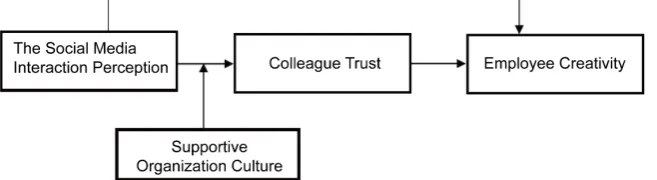
In summary, the theoretical model of this paper is shown in Figure 1.
3. Research Methods
3.1. Data Collection
In this study, the research data were collected by questionnaire.
This research questionnaire is collected in two ways, the first is to go to the research enterprise to issue the questionnaire and the recovery; the second is to ask the person in charge of the enterprise to help organize the employees to fill in it on the internet, so this study uses the questionnaire software to collect some Data, but the link is not shared to the public, but targeted to send links to the employees of the business being investigated.
The survey covers 18 companies in 5 provinces but mainly focuses on the Pearl River Delta and the Yangtze River Delta and other places. Questionnaires are targeted at working people who use social media tools such as micro switch-es, QQ, microblogging, e-mail and so on. In the selection of target enterprisswitch-es, because of taking the frequency of social media used at work , application and other factors into account, our main choice is the companies of Internet, com-puter, media and management consulting and some research institutions. A total of 350 questionnaires were distributed in this survey. After validating the in-complete and invalid questionnaires, the number of valid questionnaires was 252 and the effective rate was 72%.
The respondents surveyed were roughly balanced in sex ratio, with men (55.6%) and women (44.4%). The age of the respondents was between 26 - 35 years old (70.2%), belonging to the young and middle-aged groups. The survey was mainly based on undergraduate and master’s degree education (76.6%). In addition, the length of service is mainly concentrated between 3 and 9 years (65.9%).
3.2. Variable Measurement
[image:7.595.212.541.604.694.2]By reading a lot of literature, we can see that the researchers have defined the va-riables in this paper from different perspectives. Based on this background, ac-cording to the research situation of this paper, the author makes a clear defini-tion of the variables studied in this paper, as shown in Table 1. The scale of the selected variables in this study is derived from the mature scale of the existing
Figure 1. The relationship model of team members’ social media interaction perception,
DOI: 10.4236/ajibm.2017.711086 1216 American Journal of Industrial and Business Management
Table 1. Definition of variable.
Variable Definition
Social Media After combing social media literature, the social media explored in this study is defined as a network, media tools or platforms that is similar to we-chat, QQ, micro-blogs, etc. that enable participants to inte-ract or share information, ideas, resources, and emotions.
Interaction
Through the relevant literature review, we can see that the current scholars divide Interaction into several dimensions in the following ways: one is based on interactive attribute dimension division, and the other is based on interactive content dimension division, the third is based on the interactive direction of the dimension division.
Social Media Interaction Perception This study explores the interpersonal interaction between colleagues based on the perspective of perceptual interaction, and thus the interaction of social media is appraised by measuring the employees’ perception of each interactive factor [20].
Trust By combing the literature of trust and the need for this study, this paper explores interpersonal trust relationships between people in the organization and regards trust as a personal mental state or attitude.
Employee Creativity
The definition of creativity, although different opinions, but through a large number of representative scholars of the creative process of the definition of finishing, can be divided into the following four points: personality theory, process theory, results theory and ability theory. On this basis, this article defines employee creativity as the ability of individuals to generate new ideas or new products.
Supporting organization culture
Support-oriented culture emphasizes participation, collaboration, people-centered, social, mutual trust, group cohesion and personal growth, often in an oral, informal way of communication; communication and making decisions to encourage employees to express their views on work and others. Pay attention to each employee’s recognition of the organization.
Emphasizing the collection of new information in the external environment, creativity, prediction, testing and openness to change, often take informal, in all directions to communicate, top-down control is neither possible nor necessary, In the management of staff expectations of the work and organizational objectives of the recognition and participation [21].
studies. The scores used in this study are given by Likert 5 points, in which “1” means “totally disagree”, “5” totally agree”. To ensure the accuracy of the trans-lation of the scale, the scale used in this study made situational adaptability un-der the guidance of two management professor on the basis of the amendments of a PhD in psychology and a master’s English translation. The scale is as fol-lows:
Measurement of Social Media Interactive Perception. This study explores the interpersonal interaction between colleagues based on the perspective of per-ceptual interaction, and thus the interaction of social media is appraised by measuring the employees’ perception of each interactive factor. Among them, the measurements of the dimensions are: perceived usability (Gefen et al., 2003) [22], responsiveness (Ruyter et al., 2000; Yin, 2002) [23], bidirectionality (bur-goon et al., 2000; Yin, 2002). The measurement of mutual aid uses the scale compiled by Jiageng Tang (2006) [20] according to the domestic situation, adapts the relevant items and then determines the dimensions and related items of the interactive part of the social media. There are four items in each dimen-sion, 16 items in total. By data analysis, the Cronbach’s α of the scale was 0.899.
sec-DOI: 10.4236/ajibm.2017.711086 1217 American Journal of Industrial and Business Management tion of the scale used a total of 10 items, of which there are five items on the emotional trust and five items on the cognitive trust. The scale of Cronbach’s α was 0.835.
Measurement of employee creativity. The scale developed by Farmer et al. (2003) [24] was used, four items included. For example, “he can come up with innovative ideas or methods to solve problems at work.” The scale of Cronbach’s α was 0.801.
Supportive organizational culture perception. The scale developed by Quinn
et al. (1991) and Wallach (1983) was applied. A total of six items were included, such as “working in the company can give people a sense of security”, “the com-pany can give employees a considerable autonomy and freedom” and so on. The scale of the Cronbach’s α was 0.813.
Control variable. This study selected gender, age, degree of education and years of working as control variables.
3.3. Principles of Questionnaire Design
First of all, the scales used in this paper are all mature scales published in the first-class journals, and to disrupt the order of the title in the design of the ques-tionnaire, as much as possible to ensure the subjects fill in the questionnaire sincerely; Using the reverse design to prevent the subject to fill out, but also through this way to filter out invalid questionnaires;
Secondly, this paper carries out pre-test analysis (including project analysis, reliability analysis and validity analysis) of the questionnaire through the rele-vant data collected to test the scientificity of the relerele-vant scale of this study.
Finally, the three scales used in this study were pre-tested to form the final formal questionnaire.
3.4. Verify the Hypotheses
In this paper, the author use three types of intermediary effect test method pro-posed by Mackinnon (2002) to verify t intermediary effect of the colleagues’ trust in the model:
① casual steps approach ② difference in coefficients ③ products of coefficients
As these test methods all have flaws in some aspects, therefore,we use
MPLUS6.0 do the mediating effect Bootstrap test methods.
4. Research Result
4.1. Confirmatory Factor Analysis and Common Method Variance
Test
DOI: 10.4236/ajibm.2017.711086 1218 American Journal of Industrial and Business Management
Table 2. The result of confirmatory factor analysis (N = 252).
Model χ2 df χ2/df RMSEA IFI TLI CFI AIC
4-factors model 747.564 562 1.330 0.036 0.950 0.943 0.949 955.564
3-factors model A 1161.091 583 1.992 0.063 0.844 0.829 0.842 1327.091
3-factors model B 1243.390 588 2.115 0.067 0.822 0.807 0.820 1399.390
3-factors model C 1324,124 589 2.195 0.069 0.809 0.794 0.807 1446.982
2-factors model 1456,522 593 2.456 0.076 0.766 0.749 0.763 1602.522
1-factors model 1688.710 594 2.843 0.086 0.703 0.682 0.700 1832.710
Annotation: In model A we combine supportive culture and colleague trust; In model B we combine colleague trust and employee creativity; In model C we combine social media interaction and employee creativity; We combine social media interaction and supportive culture as one factor and combine colleague trust and employee creativity as the other factor in 2-factors model.
adopted in this study mainly include 6 indicators such as χ2, df, χ2/df, RMSEA, IFI, TLI, CFI and AIC. (Χ2/df = 1.330, less than 3; RMSEA = 0.036, less than 0.05; IFI, TLI, CFI three indicators are greater than 0.9). The results show that the predictive variables have good discriminant validity by the comparison of the benchmark model and the alternative model.
4.2. Descriptive Statistics
The mean and standard deviation of each variable and the correlation coeffi-cients between the variables are shown in Table 3. The results show that there is a significant positive correlation between social interaction between colleagues and colleagues’ trust and employee creativity, and that there is also a significant positive correlation between colleague trust and employee creativity.
4.3. Hypothesis Text
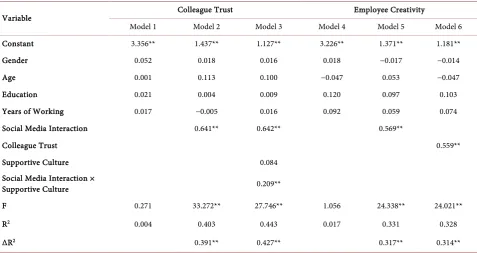
(1) As can be seen from Table 4:
The social media interaction between team members has a significantly posi-tive influence on employee creativity (β = 0.569, p < 0.01). As shown in Model 5, the better the perception of social media interaction among members is, the stronger the effect on the individual’s creativity is. So, the hypothesis 1 has been supported.
DOI: 10.4236/ajibm.2017.711086 1219 American Journal of Industrial and Business Management
Table 3. The means, standard deviation and the correlation coefficients.
Variable M SD 1 2 3 4 5 6 7 8
1 Gender 1.44 0.498 1
2 Age 2.62 1.005 −178** 1
3 Education 1.94 0.641 0.003 −0.181** 1
4 Years of Working 2.05 0.857 −0.119 0.703** −0.198** 1
5 Social Media Interaction 3.48 0.526 0.085 −0.152* 0.061 −0.08 1
6 Supportive Culture 3.45 0.535 0.044 −0.117 −0.003 −0.096 0.697** 1
7 Colleague Trust 3.50 0.451 0.053 0.008 0.023 0.020 0.626** 0.455** 1
8 Employee Creativity 3.47 0.49 0.078 −0.105 0.150* −0.043 0.561** 0.371** 0.562** 1
Annotation: n = 252; *denote p < 0.05; **denote p < 0.01, the same below.
Table 4. The result of multiple regression.
Variable Colleague Trust Employee Creativity
Model 1 Model 2 Model 3 Model 4 Model 5 Model 6
Constant 3.356** 1.437** 1.127** 3.226** 1.371** 1.181**
Gender 0.052 0.018 0.016 0.018 −0.017 −0.014
Age 0.001 0.113 0.100 −0.047 0.053 −0.047
Education 0.021 0.004 0.009 0.120 0.097 0.103
Years of Working 0.017 −0.005 0.016 0.092 0.059 0.074
Social Media Interaction 0.641** 0.642** 0.569**
Colleague Trust 0.559**
Supportive Culture 0.084
Social Media Interaction ×
Supportive Culture 0.209**
F 0.271 33.272** 27.746** 1.056 24.338** 24.021**
R2 0.004 0.403 0.443 0.017 0.331 0.328
ΔR2 0.391** 0.427** 0.317** 0.314**
the mediating effect size was 0.2028. In addition, the influence of self-variable social media interaction perception on employee creativity is also significant (LLCT = 0.2036, ULCI = 0.4376, p < 0.01). As a result, colleague trust plays a mediating role between social media interaction perception and employee crea-tivity. So, hypothesis 2 has been supported.
[image:11.595.60.538.289.542.2]suppor-DOI: 10.4236/ajibm.2017.711086 1220 American Journal of Industrial and Business Management tive culture perception (β = 0.209, p < 0.001) on the trust of colleagues is also significant. In order to further test the regulation effect, this study also used Mplus6.0 to calibrate the percentage of the Bootstrap test, selected the sample size of 5000 and the confidence interval whose coefficient is 95%. The results show that the first half of the model, that is, the impact of social media interac-tion percepinterac-tion on colleague trust, is significantly regulated by the percepinterac-tion of supportive organizational culture (LLCT = 0.047, ULCI = 0.227).
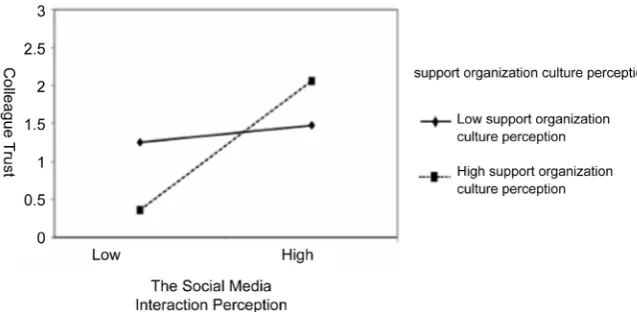
In order to explain the regulation effect more intuitively, this study uses the Simple slope test to analyze. As shown in Figure 2, under the high supportive organizational culture perception, the social media interaction among the team members has stronger effect on the trust of the colleagues. Thus, Hypothesis 3 is supported.
5. Discussion and Conclusion
5.1. Research Conclusions
[image:12.595.211.530.525.681.2]Based on the theory of social exchange and conservation of resources, this study explores the impact of positive social media interaction perception on employee creativity. At the same time, this paper also examines the intermediary effect of the trust among colleagues. Research shows that social media interaction among colleagues is also an important antecedent of employee creativity. This conclu-sion verifies that the social media interaction perception can enhance the crea-tivity of the employees in the local context. Second, trust in colleagues plays a mediating role between social media interaction perceptions and employee crea-tivity. This conclusion shows that employees’ perceptions of the quality of social media interaction between co-workers can affect the trust relationship between colleagues and that the trust among team members can significantly affect em-ployees’ creativity. This provides a new way of explaining how social media in-teraction affects employees’ creativity. Interactive perceptions of social media have a significant impact on the trust of colleagues. But when the organizational
Figure 2. The Diagram on the regulatory effect of supportive organizational culture
DOI: 10.4236/ajibm.2017.711086 1221 American Journal of Industrial and Business Management culture that employees perceive is supportive, employees have an enhanced role in the relationship between social media interaction perceptions and trust. This conclusion shows that the relationship between social media interaction percep-tion and employee creativity will show the differences in different organizapercep-tional environments.
5.2. Theoretical Contribution
The theoretical significance of this study mainly includes three aspects. First, the antecedents of employee creativity have been validated by many studies (Ama-bile, 2004) [27], but the research on the impact of employee creativity is rela-tively scarce from the perspective of communication and interaction between colleagues. At the same time, the conclusions of these studies are inconsistent. In this paper, social media interaction is identified as a predictor variable to explore the influencing mechanism of employees’ perception of the communication quality on the attitude and behavior of employees. It also validates that social media interaction among colleagues can positively influence employee creativity in the context of social media usage. Therefore, this study expands and enriches the understanding of the factors influencing the creativity of employees in the local context.
Secondly, this study, based on the theory of social exchange and conservation of resources, puts forward that the trust of colleagues is the intermediary varia-ble of the influence of the social media interaction perception on employee crea-tivity. In the past, most studies have suggested that knowledge sharing is an in-termediary mechanism of the influence of team members’ communication on employee creativity. But we think that these explanations are not very good for understanding the relationship between team members’ communication and employee creativity. Because most of these studies, according to the theory of social exchange, are sharing behavior based on communication relation between members within a team and between members and managers. However, in addi-tion to the simple exchange between members and supervisors, there is also an emotional trust relationship (Barnett M, 2007) [28]. The theory of resource con-servation holds that employees may take the risks of their behaviors into account when making decisions about knowledge sharing. This risk is reduced only when team members form a close relationship of trust.
DOI: 10.4236/ajibm.2017.711086 1222 American Journal of Industrial and Business Management reduced, which ultimately contributed to the promotion of staff creativity. This study has a certain theoretical significance for further revealing the relationship between social media interaction and staff creativity.
Finally, this study also explores the moderating effect of organizational culture on the relationship between social media interaction and trust. It explains why the same social media interaction can have a different impact on employees’ be-haviors. And using data to validate the supportive organizational culture can enhance the intermediary role of peer trust in social media interaction percep-tion and employee creativity model.
5.3. Practical Significance
How to improve the creativity of employees and the performance, adaptability and competitiveness of enterprises has received many concerns by the organiza-tions and managers (Nonaka, 1991; Zhou, 2003) [29]. Companies are taking a number of steps to try to boost employee creativity (Hirst et al., 2015) [30], but the effect is not ideal. On the one hand, enterprises actively encourage team members to communicate and collaborate with each other, and trust and help each other. They share knowledge, resources and knowledge in order to promote innovation. On the other hand, the organization is worried that too much com-munication interaction increases the time cost and reduces the efficiency of de-cision-making. Even this accumulation of information can result in the drown-ing of value information. In the end, this creates an ineffective interaction. Therefore, under the dilemma, most organizations will seize the initiative in their own hands, and limit the communication medium between team members as far as possible. However, through empirical research, social media interaction among team members can also promote the improvement of staff creativity. Therefore, in the practice of management, managers should pay attention to the quality of social media interaction among team members. At the same time, they should actively encourage and guide members to communicate and interact properly. Managers should abandon the idea of absolute control and give em-ployees trust and care to weaken the speculative notion of members on the inef-fective interaction, combined with appropriate assessment mechanisms.
DOI: 10.4236/ajibm.2017.711086 1223 American Journal of Industrial and Business Management
5.4. Research Limitations and Future Research Directions
Firstly, the measurement of all variables in this study was measured at the same time point. Technically speaking, there is the deviation of data common method in this paper. Confirmatory factor analysis verifies that there is a good distinc-tion between the variables of validity, but it is still not possible to pinpoint the intrinsic relationship between social media interaction and employee trust and employee creativity. In addition, the trust between members and the formation of staff creativity requires a course to go through, in which there may be time lag. Therefore, future research can further examine the causal relationship be-tween variables through longitudinal design.
Secondly, this study chooses the mediating role of colleagues’ trust between social media interaction and staff creativity. But the discussion of intermediary mechanism is far from enough. The future research can be examined from the aspects of employee self-efficacy and team identification. This will reveal more fully the unknown relationship between the two.
References
[1] Amabile, T.M. (1988) A Model of Creativity and Innovation in Organizations. Re-search in Organizational Behavior, 10, 123-167.
[2] Shalle, C.E. and Gilson, L.L. (2004) What Leaders Need to Know: A Review of Social and Contextual Factors That Can Foster or Hinder Creativity. The Leadership Quarterly, 15, 33-53.https://doi.org/10.1016/j.leaqua.2003.12.004
[3] Bock, G.W. and Kim, Y.G. (2002) Breaking the Myths of Rewards: An Exploratory Study of Attitudes about Knowledge Sharing. Information Resources Management Journal, 15, 14-23.https://doi.org/10.4018/irmj.2002040102
[4] Mohammed, S. and Dumville, B.C. (2001) Team Mental Models in a Team Know-ledge Framework: Expanding Theory and Measurement across Disciplinary Boun-daries. Journal of Organizational Behavior, 22, 89-106.
https://doi.org/10.1002/job.86
[5] Patrashkova-Volzdoska, R.R., Mc Comb, S.A., Green, S.G. and Compton, W.D. (2003) Examining a Curvilinear Relationship between Communication Frequency and Team Performance in Cross-Functional Project Teams. IEEE Transactions on Engineering Management, 50, 262-269.https://doi.org/10.1109/TEM.2003.817298 [6] Smith, K.G., Smith, K.A., Olian J.D., Sims Jr., H.P., O’Bannon, D.P. and Scully, J.A.
(1994) Top Management Team Demography and Process: The Role of Social Inte-gration and Communication. Administrative Science Quarterly, 39, 412-438. https://doi.org/10.2307/2393297
[7] Denison, D.R., Hart, S.L. and Kahn, J.A. (1996) From Chimneys to Cross-Functional Teams: Developing and Validating a Diagnostic Model. Academy of Management Journal, 39, 1005-1023.https://doi.org/10.2307/256721
[8] Hurt, H.T. and Teigen, C.W. (1977) The Development of a Measure of Perceived Organizational Innovativeness. Sage, Newcastle upon Tyne, 377-385.
[9] Seers, A. (1989) Team-Member Exchange Quality: A New Construct for Role-Making Research. Organizational Behavior and Human Decision Processes, 43, 118-135. https://doi.org/10.1016/0749-5978(89)90060-5
Orga-DOI: 10.4236/ajibm.2017.711086 1224 American Journal of Industrial and Business Management nizational Creativity. Academy of Management Review, 18, 293-321.
[11] Scott, S.G. and Bruce, R.A. (1994) Determinants of Innovative Behavior: A Path Model of Individual Innovation in the Workplace. Academy of Management Jour-nal, 37, 580-607.https://doi.org/10.2307/256701
[12] Rousseau, D., Sitkin, S., Burt, R., et al. (1998) Not So Different after All: A Cross Discipline View of Trust. Academy of Management Review, 23, 393-404.
https://doi.org/10.5465/AMR.1998.926617
[13] Anderson, L.R., Jennifer, M.M. and Jeffrey, M. (2004) Social Capital and Contribu-tions in a Public Goods Experiment. American Economic Review Papers and Pro-ceedings, 94, 373-376.https://doi.org/10.1257/0002828041302082
[14] Dirks, K.T. and Ferrin, D.L. (2002) Trust in Leadership: Meta-Analytic Findings and Implications for Research and Practice. Journal of Applied Psychology, 87, 611-628.https://doi.org/10.1037/0021-9010.87.4.611
[15] Hobfoll, S.E. (2002) Social and Psychological Resources and Adaptation. Review of General Psychology, 6, 307-324. https://doi.org/10.1037/1089-2680.6.4.307
[16] Wallac, E. (1983) Individuals and Organizations: The Cultural Match. Training and Development Journal, 37, 29-36.
[17] Taylor, S., Levy, O., Boyacigiller, N.A., et al. (2008) Employee Commitment in MNCs: Impacts of Organizational Culture, HRM and Top Management Orienta-tions. The International Journal of Human Resource Management, 19, 501-527. https://doi.org/10.1080/09585190801953491
[18] Quinn, R. and Spreitzer, R.G. (1991) The Psychometrics of the Competing Values Culture Instrument and an Analysis of the Impact of Organizational Culture on Quality of Life. Research in Organizational Change and Development, 5, 115-142. [19] Ren, F. and Zhang, J. (2015) Job Stressors, Organizational Innovation Climate, and
Employees’ Innovative Behavior. Creativity Research Journal, 27, 16-23. https://doi.org/10.1080/10400419.2015.992659
[20] Tang, J. (2006) Research on the Influence of Interaction on Trust and Purchasing Behavior in B2C Environment. Fudan University, Shanghai.
[21] Den Hartog, D.N., Van Muijen, J.J. and Koopman, P.L. (1996) Linking Transforma-tional Leadership and OrganizaTransforma-tional Culture. The Journal of Leadership Studies, 3, 106.https://doi.org/10.1177/107179199600300407
[22] Gefen, D., Karahanna, E. and Straub, D.W. (2003) Trust and Tam in Online Shop-ping: An Integrated Model. MIS Quarterly, 27, 51-90.
[23] Yin, J. and Straub, D. (2002) Interactivity of Internet-Based Communications: Im-pacts on E-Business Consumer Decisions. ICIS 2002 Proceedings, Barcelona, 15-18 December 2002, Paper 62.
[24] Farmer, S.M., Tierney, P. and Kung-Mcintyre, K. (2003) Employee Creativity in Taiwan: An Application of Role Identity Theory. Academy of Management Journal, 46, 618-630.https://doi.org/10.2307/30040653
[25] Hayes, A.F. (2013) Introduction to Mediation, Moderation, and Conditional Process Analysis: A Regression-Based Approach. Sage, Newcastle upon Tyne. [26] Zhao, X., Lynch Jr., J.G. and Chen, Q. (2010) Reconsidering Baron and Kenny:
Myths and Truths about Mediation Analysis. Journal of Consumer Research, 37, 197-206.https://doi.org/10.1086/651257
[27] Amabile, T.M. (2004) Leader Behaviors and Work Environment for Creativity: Perceived Leader Support. Leadership Quarterly, 5, 5-32.
DOI: 10.4236/ajibm.2017.711086 1225 American Journal of Industrial and Business Management [28] Shareholder, B.M. (2007) Influence Capacity and the Variability of Financial Re-turns to Corporate Social Responsibility. Academy of Management Review, 32, 794-816.https://doi.org/10.5465/AMR.2007.25275520
[29] Zhou, J. (2003) When the Presence of Creative Coworkers Is Related to Creativity: Role of Supervisor Close Monitoring, Developmental Feedback, and Creative Per-sonality. Journal of Applied Psychology, 88, 413-422.
https://doi.org/10.1037/0021-9010.88.3.413
[30] Hirst, G., Van Knippenberg, D., Zhou, J., Quintane, E. and Zhu, C. (2015) Heard It through the Grapevine: Indirect Networks and Employee Creativity. Journal of Ap-plied Psychology, 100, 567-574.https://doi.org/10.1037/a0038333
DOI: 10.4236/ajibm.2017.711086 1226 American Journal of Industrial and Business Management
Appendix
The Questionnaire about Team Members’ Social Media
Interaction Perception, Colleagues’ Trust and Employee Creativity
Dear Sir/Madam:
Hello! First of all, thank you for taking the time to fill out the questionnaire. This is a questionnaires about team members’ social media interaction percep-tion, colleague trust and employee creativity. The purpose of the survey is to examine the intrinsic relationship between the three variables. The survey data is only used for academic research, the answer to the question does not matter right or wrong, the questionnaire is filled with anonymous form, it will never bring you any inconvenience and disadvantage. If it caused any adverse effects on you, I am willing bear all the consequences.
Finally, I sincerely hope that you can truthfully fill in it.
South China University of Technology, Institute of Business
Administration
1. Please fill in the following questions according to your personal situation and play √ in the corresponding box.
2. Team Members’ Social Media Interaction Perception.
1. Gender □Male □ Female
2. Age □25 years old and below □26 - 30 □31 - 35 □36 - 40 □41 - 50 3. Education level □College Graduated and below □Bachelor □Master □Doctor
4. Years of entry □Less than 2 years □2 - 6 years □6 - 9 years □More than 9 years
Serial number
This section covers the actual experience of interacting with your team or departmental colleagues through social media (micro-blogging,, QQ, MSN, email, forums, etc.)
Strongly
Disagree Disagree Comment Agree No Totally Agree
1 Through social media interaction, the information I can get from my colleagues is useful.
2 Through social media interaction, the information obtained from colleagues increases the efficiency of my access to information.
3 Through social media interaction, I can get the information I want from my colleagues.
4 Through social media interaction, information obtained from colleague has helped raise work.
5 In the social media interaction process, I can immediately answer my question.
6 In the social media interaction process, colleagues will use the complete statement rather than just “yes” or “no” to reply to my question.
7 In the process of social media interaction, my colleagues can provide relevant information for my inquiry.
8 In the process of social media interaction, colleagues responded closely to my questions.
9 In the social media interaction process, my colleagues are happy to communicate with me.
DOI: 10.4236/ajibm.2017.711086 1227 American Journal of Industrial and Business Management Continued
11 In the process of social media interaction, my colleagues can understand my problems very well.
12 During the social media interaction, I felt that I could understand the replies from my colleagues.
13 In the process of social media interaction, we can get a lot of good advice and suggestions from my colleagues.
14 In the process of social media interaction, we can share knowledge, experience and information with each other.
15 n the social media interaction process, if a lack of understanding of something, always get help from colleagues there.
16 In the process of social media interaction, we encourage our own experiences, opinions and suggestions.
3. Colleagues’ Trust
Serial
number This section is about your trust in your colleagues Strongly Disagree Disagree Comment Agree No Totally Agree
17 I and my colleagues are a shared relationship, we are free to share a variety of ideas, feelings and expectations of the heart.
18 I can talk to my colleagues with no hesitation about the difficulties I encountered in my work and I know he/she is willing to listen.
19 If one of my colleagues and my colleagues were transferred and could not work together, I would have a sense of loss.
20 If I talk to my colleagues about my question, I know that he/she will care about me and give me constructive advice.
21 In my working relationship with my colleagues, we have put a lot of emotion.
22 My colleague’s attitude towards work is professional and devoted.
23 According to my contact with my colleagues, I have no reason to doubt his/her ability and attitude.
24 I can believe that my colleagues will not carelessly at work, so that my job becomes more difficult to complete.
25 I believe that even if there is no personal interaction, most people will believe and respect my colleagues.
26 My superiors also believe that my colleagues are trustworthy people.
4. Supporting Organizational Culture
Serial
number This section covers your perception of your company’s corporate culture Disagree Strongly Disagree Comment Agree No Totally Agree 27 The Company treats employees equally.
28 The company’s work can give people a sense of security.
DOI: 10.4236/ajibm.2017.711086 1228 American Journal of Industrial and Business Management 5. Employee Creativity
Serial
number This section covers your true assessment of your creativity Disagree Strongly Disagree Comment Agree No Totally Agree 33 Tries new ideas or methods first.