88
Constrained Sequence-to-sequence Semitic Root Extraction for Enriching
Word Embeddings
Ahmed El-Kishky†∗, Xingyu Fu†∗, Aseel Addawood†, Nahil Sobh†, Clare Voss‡, and Jiawei Han†
†Department of Computer Science, The University of Illinois at Urbana Champaign ‡Computational & Information Sciences Directorate, Army Research Laboratory
†Urbana, IL, USA,‡Adelphi, MD, USA
{elkishk2,xingyuf2,aaddaw2,sobh,hanj}@illinois.edu [email protected]
Abstract
In this paper, we tackle the problem of “root extraction” from words in the Semitic lan-guage family. A challenge in applying natural language processing techniques to these lan-guages is the data sparsity problem that arises from their rich internal morphology, where the substructure is inherently non-concatenative and morphemes are interdigitated in word for-mation. While previous automated methods have relied on human-curated rules or multi-class multi-classification, they have not fully lever-aged the various combinations of regular, se-quential concatenative morphology within the words and the internal interleaving within tem-platic stems of roots and patterns. To address this, we propose a constrained sequence-to-sequence root extraction method. Experimen-tal results show our constrained model outper-forms a variety of methods at root extraction. Furthermore, by enriching word embeddings with resulting decompositions, we show im-proved results on word analogy, word similar-ity, and language modeling tasks.
1 Introduction
The Semitic languages are a language family com-monly spoken throughout North Africa, the Horn of Africa, the Arabian peninsula, and the regions between. With approximately 500 million speak-ers, the proliferation of large online text collec-tions of such news articles, social media, digitized literature, and web blogs has created a wealth of data offering challenges and opportunities for se-mantic understanding of Semitic texts. In these languages, a majority of words are derived from a small number of mostly triliteral consonantal roots, with some quadriliteral roots and a trace number of biliteral and quintliteral roots. It is es-timated that two of the most prominent Semitic
∗
*Equal contribution
languages, Arabic and Hebrew, possess approxi-mately 10,000 and 3,000 roots, respectively ( Dar-wish, 2002; Daya et al., 2008). As such, root identification of a given Semitic word is often an important task in morphological analysis and the first step to morphological decomposition. Mor-phological analysis of Semitic languages poses a unique challenge to traditional NLP techniques due to the non-contiguous morphology inherent in these languages. This morphology is best de-scribed as the application of a pattern resulting in the interdigitation of morphemes within a sin-gle root to form derivative words (Habash,2010). This fusional morphology allows for many sur-face form words derived from the same single root, but with different, yet abstractly-related se-mantic meanings depending on constituent mor-phemes. Because many surface words can be formed through this root and pattern word forma-tion process, and the root’s characters may not necessarily be contiguously situated within each resultant surface word, morpheme boundaries are often difficult to identify.
Unlike other fusional languages, the Semitic languages are unique in that the word forma-tion process follows a highly-structured process of adding vowels and consonants to roots. This word formation process consists of a fixed num-ber of slots for different morphemes, which are fixed in their position and order relative to each other. As such, these languages contain significant sequential (albeit not necessarily contiguous) sub-structure. In this work, we propose to leverage this sequential substructure to improve the root extrac-tion process and morphological decomposiextrac-tion.
1 2 3 4 >4
Words by Frequency
0% 10% 20% 30% 40% 50% 60%
[image:2.595.310.522.61.150.2]Percentage of Words
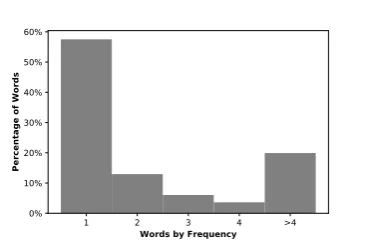
Figure 1:Word distribution in Arabic Wikipedia corpus.
relation to word frequency. This long-tail often re-sults in corpora with many infrequent words, with
40%−60% of words appearing just once ( Kor-nai,2007). We can verify this for Arabic in Fig-ure1, where, on a Wikipedia monolingual Arabic corpus (described in Section 5.1), approximately 80% of words occur fewer than five times and 60% occur once. To process such long-tailed corpora, it is necessary to exploit finer-granularity, highly-shared substructures between words that can be used to infer semantic meaning. In Table 1, we look at a selection of Arabic words sharing the common root –
H. H ¼
– (transliteration K-T-B), which means to“write”. These words are formed by appending different prefixes, suffixes, and other templatic interleavings of morphemes within the root. Despite the many surface words, the deriva-tions share a semantic reladeriva-tionship based on the root, as well as other concatenative and interdigi-tated templatic morphemes. Additionally, as seen in the example, the root word’s characters are not necessarily contiguous within the word; this is due to the non-concatenative templatic process whereby morphemes are inserted between char-acters of the root as part of the word formation process. Finally, not all characters in the root are necessarily found in the final surface-form of the word as some root characters can be dropped. Traditional concatenative morphological analyz-ers struggle to identify and extract roots precisely because root word characters are not necessarily contiguous or even present in the surface word.To address these challenges, we present a su-pervised root extraction algorithm that, given a word, directly extracts the root with high accu-racy. Given this root and the original word, we demonstrate how the templatic pattern-based word formation process that transforms the root to the original word can be used for further morpholog-ical decomposition. Our root extraction method differentiates itself from other methods in three
Word Translit. Meaning Pref. Suff. R-1 R-2
I.J» KTBT she wrote N/A T N/A N/A
I.KA¿ KA¯TB writer N/A N/A A¯ N/A
H.AJ» KT ¯AB book N/A N/A N/A A¯
H.AJºË@ ALKT ¯AB the book AL N/A N/A A¯
I.JºÓ MKTB desk M N/A N/A N/A
[image:2.595.89.272.62.182.2]
éJ.JºÓ MKTBA library M A N/A N/A
Table 1: Common Roots
ways: (1) It is fully data-driven, without any re-liance on human-curated patterns; (2) it directly extracts word roots without stripping dictionary affixes, which can lead to incorrect roots when false affixes are stripped; and (3) by applying a novel sequence-to-sequence (seq2seq) model with a constrained decoding mechanism that leverages shared sequential semantics in the label (root) and input (word) space, it outperforms standard multi-class multi-classification algorithms and achieves better generalization performance.
We demonstrate that our method outperforms unsupervised rule-based root extraction meth-ods (Taghva et al.,2005;Khoja and Garside,1999;
Zerrouki,2010) and our seq2seq classifier outper-forms general multiclass classifiers (Kim, 2014;
Chung et al.,2014). As a testament to the utility of root extraction, we demonstrate how one can leverage the root information alongside a simple slot-based morphological decomposition to im-prove upon word embedding representations as evaluated through word similarity, word analogy, and language modeling tasks.
2 Related Work
With the growth of the internet and the digitiza-tion of Arabic and other Semitic corpora, prior work has extensively studied root extractors with the goal of improving document retrieval (Larkey et al.,2002;Aljlayl and Frieder,2002).
This method, however, may incorrectly remove many letters that are part of the root. Another of these models achieves high accuracy by in-corporating sentence-level context and inferred syntactic categories into a parametric Bayesian model (Lee et al., 2011). Our model forgoes these context features as it attempts to identify the root solely on the word itself. Additionally, this method cannot model non-contiguous roots, of which Semitic languages have many. Other un-supervised methods utilize dictionaries to select the characters from within words (Darwish,2002;
Boudlal et al.,2011;Alhanini and Ab Aziz,2011). Another line of research leverages the templatic nature for human-constructed rule-based con-straints (Elghamry, 2005; Rodrigues and Cavar,
2007; Choueka, 1990). Finally, methods have been proposed that utilize both a root dictionary and rule-based templatic constraints (Yaseen and Hmeidi,2014).
Supervised methods have been developed for identifying Hebrew roots by combining various multiclass classification models with Hebrew-specific linguistic constraints (Daya et al.,2004). This same technique was extended to extract both Arabic and Hebrew roots (Daya et al., 2008). While these supervised methods effectively ad-dress the non-contiguous nature of Semitic roots, they fail to leverage the sequential structure of the root label space. We show that such methods that forgo the sequential structure in the label space un-derperform on words with rare roots. Additionally, these methods are only applied to triconsonantal leaving out many biconsonantal and quadriliteral roots.
Sequence-to-sequence models have been uti-lized for learning to map sequences to other se-quences and predominantly applied to machine translation (Sutskever et al., 2014), with later variations of these models enhanced with atten-tion mechanisms (Luong et al., 2015). While LSTM variants have been dominant, previous work has shown that GRU-based models perform comparably to LSTM-based models with supe-rior train time (Chung et al., 2014). More re-cent work has investigated character-level lan-guage models in order to handle the many out-of-vocabulary (OOV) words in morphologically rich languages (Gerz et al., 2018). Such meth-ods have shown large improvements in language modeling across many morphologically rich lan-guages. While such methods share the same
character-level input space as does our own method, they ignore the sequential nature in the target class. Closely related to our model, con-strained sequence-to-sequence models have been used for sentence simplification forcing the model to select simple words (Zhang et al.,2017). Simi-lar approaches have been used for constrained im-age captioning (Anderson et al.,2017). Our model differs in that it constrains not only on specific vo-cabulary, but on specific sequences.
3 Root Extraction Framework
We introduce a framework for extracting the root from templatic words within the Semitic family. The proposed framework leverages the shared se-quential semantics in both the word and root space to more accurately extract root morphemes.
3.1 Preliminaries
The input is a set of word-root pairsW,R, consist-ing of|W|words and|R|roots where|W|=|R|
and W = w1, . . . , w|W| and R = r1, . . . , r|R|.
In addition, the jth word wj is a sequence of
|wj|characters: cwj,i, i = 1, . . . ,|wj|. For
con-venience we index all the unique characters that compose the input vocabulary with C characters andcw,i = x, where x ∈ {1, . . . , C} means that
theithcharacter inwth word is thexthcharacter
in the character vocabulary. Similarly thekthroot,
rkcorresponding to thejthwordwjis a sequence
of|rk|characters:crk,i, i= 1, . . . ,|rk|. Given the
input, the goal is to learn a function,F :W → R
that maps an input word onto its correct Semitic root.
encoder representation (e)
GRU GRU GRU GRU
GRU GRU GRU GRU
concat concat concat concat
K T A B
average
(a) Encoder Network
GRU
enc
ode
r
re
pr
es
ent
at
io
n
(e
)
<sow>
GRU
K
GRU
T
softmax softmax softmax
K T B
GRU
B
softmax
<eor>
(b) Decoder Network
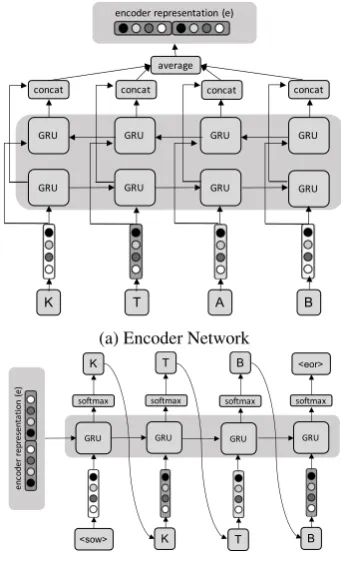
Figure 2: Sequence-to-sequence root extraction.
3.2.1 Encoder Network
As seen in Figure 2a, we begin with an encoder network that takes a word as input. Each of the input word’s characters (from a total of C possi-ble characters) is associated with a vectorc∈Rd.
Using word, KT ¯AB from Table 1, the input be-comes vector[c0, c1, c2, c3]∈Rd×4. We then run
this sequence of embedding vectors through both directions of a bi-directional GRU (BiGRU) and concatenate the resulting hidden vectors from each pass. Finally, we average the concatenated hidden vectors of the BiGRU across all time-steps. This serves as the encoder representation of the input word, which we denote ase. The encoding is then fed into a decoder network that attempts to gener-ate the most likely root for the word.
3.2.2 Decoder Network
In Figure2b, the decoder takes the encoder repre-sentation ethat captures the input word and pre-dicts a root word. This is done by feeding eand a special “start-of-word” character hsowi as the input. A GRU computes the next hidden state
h0 ∈ Rh. A scoring function is then applied,
re-sulting in an output the size of the character vo-cabulary, C. This function: g : Rh → RC, is
then softmaxed to obtain a valid probability distri-bution over characters for each hidden state. The decoding stops when the predicted root is termi-nated with a special “end-of-root” tokenheori.
3.2.3 Constrained Beam Search
Traditional decoders select the best character at each step to feed into the next time step of the RNN. However, this decoding maps the input se-quence into an infinite space of possible output sequences and, as such, may result in an invalid rootthat is not part of the dictionary set of roots. As such, we propose an alternative output that re-stricts the decoder, forcing the decoded sequence to map onto a root within the valid roots set.
We realize this constraint by modifying the de-coding scheme itself. During dede-coding, a greedy approach is often used where the single best char-acter output is selected and propagated to later time steps. This greedy approach may not only lead to suboptimal output sequences, but also re-sult in invalid sequences (not corresponding to any class). This can be circumvented using a beam search decoding scheme. When decoding to ob-tain the predicted roots, instead of utilizing the character with the highest probability at each step, the top k characters are considered at each step. As such, at each new time-step, for each of the
k hypotheses, there areC possible choices. The top k are then once again selected and this pro-cess is applied to each time step. Once all candi-date roots reach their specialheoritoken, the most probable root is selected. To tailor beam search to
B B R B
T B D
K
R
(a) Constraint Trie
Candidate Roots
K - T - A K - T - B K - T - A - B
K - T - R K - T - B - B
[image:4.595.98.269.62.344.2](b) Candidate root pool. Figure 3: Constrained beam search.
during the decoding process. For example, as seen in Figure 3b, during a typical beam-search pro-cess, the top kcandidate characters are selected. By cross-referencing the current prefix of the root with the trie storing all valid roots, many invalid roots can be pruned. As such, we can enforce that the top-k selections all correspond to valid prefixes present in the target roots. This strictly improves overall extraction accuracy over traditional beam search.
4 Templatic Word Embeddings
As the Semitic languages are templatic, there ex-ist fixed slots that can contain morphemes. Given the correct root for a word identified as described in Section 3, we introduce a simple slot-based template. We indicate how to identify these slots within a word utilizing the Semitic root. Finally, we demonstrate how the morphemes within these slots, along with the root, can be utilized to enrich distributed word representations.
4.1 Morphological Decomposition
We posit that each word possesses a fixed number of slots allocated to certain morphemes, whereby the slots are fixed in their position and order rel-ative to each other. As demonstrated in Table 1, in addition to the root word, we propose a sim-plified template that consists of four slots – two concatenative (prefixes and suffixes) and two non-concatenative (morphemes interdigitated within the stem). While we demonstrate the simplic-ity of identifying these within Arabic, this same template-based structure can, without loss of gen-erality, be trivially created for other members of the Semitic family.
Example 1 (Stem, Prefix, and Suffix Identification) For the root K-T-B, we can identify the consecutive characters that encompass the full root.
AL + [KT ¯AB] + EEN
áK
+ [H.A
J»
] +È@
The characters grouped together by[]form the stem, the smallest consecutive set of characters containing the full root. Any characters not falling within the stem are, respectively, the prefixes and suffixes.
As seen in Example1, given the root, the stem can be identified as the shortest contiguous sub-string containing the root in correct order. Once the stem is identified, the two concatenative slots containing prefix and suffix are trivially identi-fied by selecting the remaining affixes after remov-ing the stem. The non-concatenative slots can be found interdigitated within the word stem whose boundary is demarcated by the root. Given the
stem (as shown in square brackets in Example1) and the root, these interdigitated slots can be iden-tified as follows:
Example 2 (Interdigitated Slots) Given a stem containing the core root K-T-B, the candidate slots are as follows.
In stem, K ¯ATB, ¯A occurs in the first slot. In stem, KT ¯AB, ¯A occurs in the second slot. If a contiguous morpheme occurs after the first character in the root by before middle characters, it is a slot-1 addition. If after the middle character(s) of the root, it is slot-2.
Example2shows the identification of interdig-itated slots within the stem. Once again, it is evi-dent that correct extraction of the root is essential to correct identification of the slot positions within the word. In the next subsection we demonstrate how these extractions can be systematically lever-aged to enrich distributed word representations in these templatic languages.
4.2 Morpheme-Enriched Embeddings
To demonstrate the utility of templatic subword extractions, we demonstrate how enriching word embeddings with these morphemes can improve word representations by providing parameter-sharing between words parameter-sharing common substruc-ture. With this motivation, we propose Tem-platicVec, an intuitive extension to FastText ( Pi-otr Bojanowski and Mikolov, 2017), that uti-lizes the templatic decomposition of semantically-meaningful roots, affixes, and interdigitated mor-phemes for representation enrichment. By using these structures as embedding base units by and combining them to construct a word’s distributed vector representation, the resultant word embed-dings are robust to infrequent word-induced data-sparsity and can be constructed on many out-of-vocabulary (OOV) words. We begin with a brief review of FastText, and then demonstrate how one can naturally integrate roots as well as concate-native and templatic morphemes in place of Fast-Text’s standard naive subwords. FastText utilizes the skip-gram objective with negative sampling yielding the following objective (for simplicity,
`(x) = log(1 +exp(−x))):
|W|
X
x=1
h X
c∈Cx
`(s(wx, wc)) + X
t∈Nx,c
`(−s(wx, t))
i
In the above equation, wx is the xth word in the corpus,Cxdenotes the set of context words within a predefined window of word wx, and Nx,c
The scoring function is then adapted to incorpo-rate subword information as follows:
s(wx, wc) =
X
m∈wx z|mvc
In the above equation, each zm denotes a
sub-word embedding vector, so that the scoring func-tion equates to the inner product of the summa-tion each over subword embedding vector with the context word vector. While FastText incorpo-rates all contiguous substrings of lengths three to seven as morphemes in the scoring function, be-cause Semitic roots are not necessarily contigu-ous, two words sharing the same root may not share the same subwords using FastText. Because this important semantic morpheme is not shared among words, we posit that FastText’s indiscrimi-nate enumeration of contiguous subwords does not capture the essential semantic substructure. We claim that directly incorporating the root embed-ding and each slot’s morpheme embedembed-dings that have been extracted for each word and summing over these embeddings results in higher quality distributed representations. As such, similar to the approach in (El-Kishky et al., 2018), we modify the scoring function to incorporate the extracted root and slot-based templatic information:
s(wx, wc) = (zr+zp+zs+zr1+zr2)|vc
This modification yields a scoring function that is the inner product of the summation over the root word embedding (zr), prefix embedding (zp),
suf-fix embedding (zs), as well as the two possible
in-root interdigitated morphemes (zr1andzr2).
5 Experiments
We introduce the datasets and methods for com-parison used. We then describe evaluations for root extraction and embedding quality.
5.1 Datasets and comparison methods
We use the following datasets and ground-truth la-bels for evaluation purposes:
• Arabic Word & Root Pairs: 140K words along associated with 11K roots from dictio-nary (al Zabidi and Murthada,1886).
• Hebrew Word & Root Pairs. 11.5K words associated with approximately 500 roots from Wiktionary1and human curation.
• Arabic Wikipedia Corpora. Wikipedia cor-pus with 274K articles and 62.5M tokens and 1.26M unique words.
1wiktionary.org
For baseline methods to compare against our proposed constrained seq2seq (Constrain-S2S), we evaluate against three standard multiclass clas-sification models: (1) a standard convolutional neural network, CNN-Class, (Kim,2014), a GRU model, GRU-Class, and a bi-directional GRU model, BiGRU-Class. In addition, we com-pare against two unconstrained seq2seq models, encoder-decoder models using GRUs, GRU-S2S and bi-directional GRUs, BiGRU-S2S. Finally, for Arabic, we evaluate against three unsupervised Arabic root-extraction algorithms from the litera-ture: Tashaphyne, ISRI, and Khoja. To evaluate on the quality of the resultant morphological decom-position, we compare against three variants of em-beddings: (1) SkipGram (2) FastText (3) RootVec (Embedding enriched with solely the root) .
5.2 Root Extraction Accuracy
To evaluate the effectiveness of our proposed seq2seq extraction of roots, we perform five-fold cross-validation evaluation of our method compared to a variety of supervised and rule-based root-extraction methods. During each cross-validation, each supervised method is trained on four-fifth of the dictionary mappings of word to rootpairs, and evaluated on a held-out 20%.
5.2.1 General Root Extraction
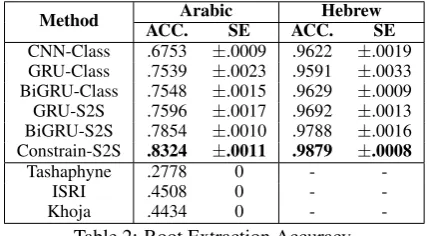
We first compare the performance of each super-vised extraction method on extracting roots irre-spective of root frequency. In Table 2, we
re-Method Arabic Hebrew
ACC. SE ACC. SE
CNN-Class .6753 ±.0009 .9622 ±.0019
GRU-Class .7539 ±.0023 .9591 ±.0033
BiGRU-Class .7548 ±.0015 .9629 ±.0009
GRU-S2S .7596 ±.0017 .9692 ±.0013
BiGRU-S2S .7854 ±.0010 .9788 ±.0016
Constrain-S2S .8324 ±.0011 .9879 ±.0008
Tashaphyne .2778 0 -
-ISRI .4508 0 -
-Khoja .4434 0 -
-Table 2: Root Extraction Accuracy.
[image:6.595.309.523.489.607.2]mor-phemes. Additionally, both the CNN-based and four RNN-based multiclass classification methods severely under-perform compared to our proposed constrained seq2seq model. This verifies our in-tuition that leveraging the shared semantic space between the words and the target roots is essential in extraction.
5.2.2 Rare Root Extraction
We claimed earlier that by decomposing root clas-sification into seq2seq clasclas-sification, sequential patterns within the roots can be leveraged for root extraction. This can be useful for identifying the correct root, even when the root is infrequent or even absent from the training data. To support this claim, we report the performance of each su-pervised extractor at successfully identifying the ground-truth of infrequent roots (appear three or fewer times in training) and a zero-shot case where the root is not present in the training data. As our Hebrew dataset consists of frequent roots, and per-formance is near perfect, we report results for the Arabic dataset.
Method Infreq. Zero-Shot
ACC. SE ACC. SE
CNN-Class .4823 ±.0096 -
-GRU-Class .5697 ±.0103 -
-BiGRU-Class .5706 ±.0091 -
-GRU-S2S .6074 ±.0166 .5389 ±.0188
BiGRU-S2S .6231 ±.0191 .5532 ±.0141
Constrain-S2S .6929 ±.0164 .6292 ±.0160
Table 3: Arabic Rare Root Extraction Accuracy
As seen in Table3, the seq2seq methods greatly outperform all multiclass methods with Constrain-S2S outperforming all methods on the infrequent roots. This effect is amplified in the zero-shot case, with only the seq2seq models handling un-seen roots. This demonstrates the utility in jointly learning the sequential structure in semantically-shared label (root) and word space.
5.3 Word Analogy Evaluation
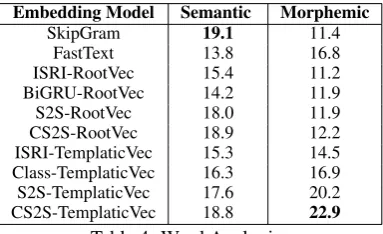
Given our comprehensive dataset of Arabic roots and human-curated evaluation set of Arabic word embeddings, we show the effectiveness of enrich-ing Arabic word embeddenrich-ings with their morpho-logical decompositions via a word analogy task. The goal of said task is to identify the best value forDin analogies of the form “Ais toB asCis toD”. After training each embedding model on the Arabic Wikipedia dataset, we use an analogy dataset (Elrazzaz et al.,2017) curated for method-ological evaluation of Arabic word embeddings.
We further differentiate the analogies into two cat-egories: (1) morphemic analogies (e.g. plurals, tense or gender) where a derivational or inflec-tional morpheme is inserted, removed, or replaced while the root remains unchanged, and (2) seman-tic analogies where the root itself changes between the analogous pairs (e.g. bird is to fly as fish is to swim).
Embedding Model Semantic Morphemic
SkipGram 19.1 11.4
FastText 13.8 16.8
ISRI-RootVec 15.4 11.2
BiGRU-RootVec 14.2 11.9
S2S-RootVec 18.0 11.9
CS2S-RootVec 18.9 12.2
ISRI-TemplaticVec 15.3 14.5
Class-TemplaticVec 16.3 16.9
S2S-TemplaticVec 17.6 20.2
[image:7.595.321.513.182.299.2]CS2S-TemplaticVec 18.8 22.9
Table 4: Word Analogies
As seen in Table 4, embeddings that utilize morphemes or subword-level features perform sig-nificantly better at morphemic analogies than do SkipGram word embeddings. This does not ex-tend to semantic analogies where all methods ap-pear to degrade with the use of morpheme and subword-level enrichment. This is not surprising since, under the vector algebra that is used to com-pute the word analogies, the summation of the morphemes used to enrich the embeddings cap-tures morphemic relationships but not necessarily semantic ones. This can be seen in the perfor-mance gap between the morpheme-enriched em-beddings and SkipGram. Unlike the other meth-ods, Templatic embeddings based on constrained roots maintains comparable performance to Skip-Gram on the semantic analogies while demon-strating superior performance on the morphemic analogies.
5.4 Word Similarity
The next embedding evaluation we consider is a word similarity task. The ground truth data con-sists of pairs of words and a human-annotated sim-ilarity score averaged across all human evaluations from a translation of the WS-353 dataset (Freitas et al.,2016). The scores are computed via the co-sine similarity between the vector representation of each word in a pair. Their results are quanti-fied through Spearman and Pearson rank correla-tion coefficients.
Embedding Model Pearson Spearman
SkipGram 0.496 0.520
FastText 0.459 0.468
ISRI-RootVec 0.491 0.518
BiGRU-RootVec 0.492 0.510
S2S-RootVec 0.508 0.516
CS2S-RootVec 0.507 0.514
ISRI-TemplaticVec 0.482 0.501
Class-TemplaticVec 0.474 0.491
S2S-TemplaticVec 0.514 0.529
[image:8.595.313.520.60.226.2]CS2S-TemplaticVec 0.512 0.533
Table 5: Word Similarity
morphemes substantially improves embeddings in capturing word similarity. This is in contrast with lower correlation coefficients from FastText em-bedding vectors, likely due to the indiscriminate generation of subwords that may degrade the over-all embedding. On this task, template-based de-composition using unconstrained and constrained root extraction appears to perform similarly, yet both greatly outperform the other baselines.
5.5 Language Modeling Perplexity
Finally, we evaluate the effect of utilizing the extracted root and templatic decomposition on a downstream language modeling task. On each lan-guage model, the model quality is evaluated by computing the perplexity on a held-out portion of the corpus. The model used for language mod-eling is an LSTM with three hidden layers, 600
hidden units per layer, regularized with0.2 proba-bility drop-out, unrolled for 35 steps with a batch of20. Parameters are learned using Adagrad with a gradient clipping of1. We evaluate on two sub-sets of the Wikipedia dataset: (1) LM-1, a small subset (2) LM-2, a larger subset. LM-1 consists of 3.3M tokens and a vocabulary of 260K words while LM-2 consists of 7.6M tokens and a vo-cabulary of 400K unique words. Each language model instance is trained for 5 epochs on the train-ing data. Evaluation of perplexity was computed for each model on the independent test set con-sisting of 900K tokens where 62K tokens were OOV in LM-1 and 27K in LM-2. Evaluation is performed after selecting the best performing iter-ation of the model on a validiter-ation set. While the morpheme-enriched method can generate embed-ding vectors for many OOV tokens, for SkipGram and instances when they cannot, an unknown to-ken with fixed embedding is used.
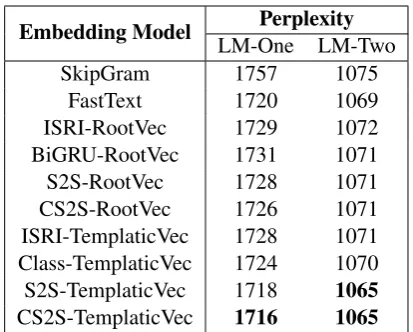
The results are summarized in Table 6.
Al-Embedding Model Perplexity
LM-One LM-Two
SkipGram 1757 1075
FastText 1720 1069
ISRI-RootVec 1729 1072
BiGRU-RootVec 1731 1071
S2S-RootVec 1728 1071
CS2S-RootVec 1726 1071
ISRI-TemplaticVec 1728 1071
Class-TemplaticVec 1724 1070
S2S-TemplaticVec 1718 1065
[image:8.595.74.291.62.221.2]CS2S-TemplaticVec 1716 1065
Table 6: Language Modeling
though perplexity is high, this is common for morphologically-rich languages such as Arabic as shown in (Gerz et al.,2018). It appears our con-strained model’s extracted roots yield a benefit over other baseline roots, yet utilizing the full de-composition outperforms all other methods, yield-ing lower held-out perplexity. The results also verify the intuition that morphemic decomposi-tion is necessary to handle data-sparsity and OOV words when little training data is present, whereby perplexity is greatly reduced through the use of morpheme-based embeddings.
6 Conclusions
We proposed leveraging the shared semantic space between Semitic words and their roots for more effective root extraction. This was accomplished through a novel constrained sequence-to-sequence classifier. Experiments show a performance boost over unsupervised and supervised extraction mod-els. We introduce a simple template-based mor-phological decomposition, and by enriching word embeddings with this decomposition, we show im-proved results on word analogy, word similarity, and language modeling tasks.
References
Yasir Alhanini and Mohd Juzaiddin Ab Aziz. 2011. The enhancement of arabic stemming by using light stemming and dictionary-based stemming.JSEA.
Mohammed Aljlayl and Ophir Frieder. 2002. On arabic search: improving the retrieval effectiveness via a light stemming approach. InCIKM.
Peter Anderson, Basura Fernando, Mark Johnson, and Stephen Gould. 2017. Guided open vocabulary im-age captioning with constrained beam search. In
Abderrahim Boudlal, Mohamed Ould Abdallahi Ould Bebah, Abdelhak Lakhouaja, Azzeddine Mazroui, and Abdelouafi Meziane. 2011. A markovian ap-proach for arabic root extraction. Int. Arab J. Inf. Technol.
Yaacov Choueka. 1990. Mlim-a system for full, exact, on-line grammatical analysis of modern hebrew. In
ICCE.
Junyoung Chung, Caglar Gulcehre, KyungHyun Cho, and Yoshua Bengio. 2014. Empirical evaluation of gated recurrent neural networks on sequence model-ing.arXiv preprint arXiv:1412.3555.
Kareem Darwish. 2002. Building a shallow arabic morphological analyzer in one day. In ACL-02 workshop on Computational approaches to semitic languages.
Ezra Daya, Dan Roth, and Shuly Wintner. 2004. Learn-ing hebrew roots: Machine learnLearn-ing with lLearn-inguistic constraints. InEMNLP.
Ezra Daya, Dan Roth, and Shuly Wintner. 2008. Iden-tifying semitic roots: Machine learning with linguis-tic constraints.Computational Linguistics.
Ahmed El-Kishky, Frank Xu, Aston Zhang, Stephen Macke, and Jiawei Han. 2018. Entropy-based sub-word mining with an application to sub-word embed-dings. InSCLeM 2018.
Khaled Elghamry. 2005. A constraint-based algorithm for the identification of arabic roots. In Proceed-ings of the Midwest Computational Linguistics Col-loquium. Indiana University. Bloomington, IN.
Mohammed Elrazzaz, Shady Elbassuoni, Khaled Sha-ban, and Chadi Helwe. 2017. Methodical evaluation of arabic word embeddings. InACL.
Andr´e Freitas, Siamak Barzegar, Juliano Efson Sales, Siegfried Handschuh, and Brian Davis. 2016. Se-mantic Relatedness for All (Languages): A Compar-ative Analysis of Multilingual Semantic Relatedness Using Machine Translation.
Daniela Gerz, Ivan Vuli´c, Edoardo Ponti, Jason Narad-owsky, Roi Reichart, and Anna Korhonen. 2018. Language modeling for morphologically rich lan-guages: Character-aware modeling for word-level prediction.TACL.
Nizar Y Habash. 2010. Introduction to arabic natural language processing. Synthesis Lectures on Human Language Technologies.
Shereen Khoja and Roger Garside. 1999. Stemming arabic text.Lancaster, UK, Computing Department, Lancaster University.
Yoon Kim. 2014. Convolutional neural net-works for sentence classification. arXiv preprint arXiv:1408.5882.
Andras Kornai. 2007. Mathematical linguistics. Springer Science & Business Media.
Leah S Larkey, Lisa Ballesteros, and Margaret E Con-nell. 2002. Improving stemming for arabic infor-mation retrieval: light stemming and co-occurrence analysis. InACM SIGIR.
Yoong Keok Lee, Aria Haghighi, and Regina Barzilay. 2011. Modeling syntactic context improves mor-phological segmentation. InCoNLL.
Minh-Thang Luong, Hieu Pham, and Christopher D Manning. 2015. Effective approaches to attention-based neural machine translation. arXiv preprint arXiv:1508.04025.
Mohanned Momani and Jamil Faraj. 2007. A novel algorithm to extract tri-literal arabic roots. In Com-puter Systems and Applications, 2007. AICCSA’07.
Armand Joulin Piotr Bojanowski, Edouard Grave and Tomas Mikolov. 2017. Enriching word vectors with subword information.TACL.
Paul Rodrigues and Damir Cavar. 2007. Learn-ing arabic morphology usLearn-ing statistical constraint-satisfaction models. Amsterdam studies in the the-ory and histthe-ory of linguistic science. Series 4.
Ilya Sutskever, Oriol Vinyals, and Quoc V Le. 2014. Sequence to sequence learning with neural net-works. InNIPS.
Kazem Taghva, Rania Elkhoury, and Jeffrey Coombs. 2005. Arabic stemming without a root dictionary. InInformation Technology: Coding and Computing.
Qussai Yaseen and Ismail Hmeidi. 2014. Extracting the roots of arabic words without removing affixes.
Journal of Information Science.
Muhammad Murtada al Zabidi and Sayyid Muhammad Murthada. 1886. Taj al-‘arus min jawahir al-qamus.
Dar al-Hidayah.
Taha Zerrouki. 2010. Tashaphyne, arabic light stem-mer/segment.