Proceedings of the 55th Annual Meeting of the Association for Computational Linguistics, pages 221–231 Vancouver, Canada, July 30 - August 4, 2017. c2017 Association for Computational Linguistics Proceedings of the 55th Annual Meeting of the Association for Computational Linguistics, pages 221–231
Vancouver, Canada, July 30 - August 4, 2017. c2017 Association for Computational Linguistics
An End-to-End Model for Question Answering over Knowledge Base with
Cross-Attention Combining Global Knowledge
Yanchao Hao1,2, Yuanzhe Zhang1,3, Kang Liu1, Shizhu He1, Zhanyi Liu3, Hua Wu3 and Jun Zhao1,2 1 National Laboratory of Pattern Recognition, Institute of Automation,
Chinese Academy of Sciences, Beijing, 100190, China
2 University of Chinese Academy of Sciences, Beijing, 100049, China 3 Baidu Inc., Beijing, 100085, China
{yanchao.hao, yzzhang, kliu, shizhu.he, jzhao}@nlpr.ia.ac.cn {liuzhanyi, wu hua}@baidu.com
Abstract
With the rapid growth of knowledge bases (KBs) on the web, how to take full advan-tage of them becomes increasingly impor-tant. Question answering over knowledge base (KB-QA) is one of the promising ap-proaches to access the substantial knowl-edge. Meanwhile, as the neural network-based (network-based) methods develop, NN-based KB-QA has already achieved im-pressive results. However, previous work did not put more emphasis on question representation, and the question is con-verted into a fixed vector regardless of its candidate answers. This simple represen-tation strategy is not easy to express the proper information in the question. Hence, we present an end-to-end neural network model to represent the questions and their corresponding scores dynamically accord-ing to the various candidate answer aspect-s via croaspect-saspect-s-attention mechaniaspect-sm. In ad-dition, we leverage the global knowledge inside the underlying KB, aiming at inte-grating the rich KB information into the representation of the answers. As a result, it could alleviates the out-of-vocabulary (OOV) problem, which helps the cross-attention model to represent the question more precisely. The experimental result-s on WebQueresult-stionresult-s demonresult-strate the effec-tiveness of the proposed approach.
1 Introduction
As the amount of the knowledge bases (KBs) grows, people are paying more attention to seeking effective methods for accessing these precious in-tellectual resources. There are several tailor-made languages designed for querying KBs, such as
SPARQL (Prudhommeaux and Seaborne, 2008).
However, to handle such query languages, users are required to not only be familiar with the partic-ular language grammars, but also be aware of the architectures of the KBs. By contrast, knowledge
base-based question answering (KB-QA) (Unger
et al., 2014), which takes natural language as query language, is a more user-friendly solution, and has become a research focus in recent years.
Given natural language questions, the goal of KB-QA is to automatically return answers from the KB. There are two mainstream research direc-tions for this task: semantic parsing-based
(SP-based) (Zettlemoyer and Collins, 2009,2012;
K-wiatkowski et al.,2013;Cai and Yates,2013; Be-rant et al., 2013; Yih et al., 2015, 2016; Red-dy et al., 2016) and information retrieval-based
(IR-based) (Yao and Van Durme, 2014; Bordes
et al.,2014a,b,2015;Dong et al.,2015;Xu et al.,
2016a,b) methods. SP-based methods usually fo-cus on constructing a semantic parser that could convert natural language questions into structured expressions like logical forms. IR-based methods usually search answers from the KB based on the information conveyed in questions, where ranking techniques are often adopted to make correct se-lections from candidate answers.
Recently, with the progress of deep learning, neural network-based (NN-based) methods have
been introduced to the KB-QA task (Bordes et al.,
2014b). Different from previous methods, NN-based methods represent both of the questions and the answers as semantic vectors. Then the com-plex process of KB-QA could be converted into a similarity matching process between an input question and its candidate answers in a semantic space. The candidates with the highest similarity score will be selected as the final answers. Be-cause they are more adaptive, NN-based methods have attracted more and more attention, and this
paper also focuses on using end-to-end neural net-works to answer questions over knowledge base.
In NN-based methods, the crucial step is to compute the similarity score between a question and a candidate answer, where the key is to learn their representations. Previous methods put more emphasis on learning representation of the answer
end. For example, Bordes et al. (2014a)
consid-er the importance of the subgraph of the candidate
answer. Dong et al. (2015) make use of the context
and the type of the answer. However, the repre-sentation of the question end is oligotrophic. Ex-isting approaches often represent a question into a single vector using simple bag-of-words (BOW) model (Bordes et al.,2014a,b), whereas the relat-edness to the answer end is neglected. We argue that a question should be represented differently according to the different focuses of various an-swer aspects1.
Take the question “Who is the president of France?” and one of its candidate answers “Fran-cois Hollande” as an example. When dealing
with the answer entity Francois Holland,
“president” and “France” in the question is more focused, and the question representation should
bias towards the two words. While facing
the answer type/business/board member,
“Who” should be the most prominent word. Meanwhile, some questions may value answer type more than other answer aspects. While in some other questions, answer relation may be the most important information we should consider, which is dynamic and flexible corresponding to d-ifferent questions and answers. Obviously, this is an attention mechanism, which reveals the mutual influences between the representation of questions and the corresponding answer aspects.
We believe that such kind of representation is
more expressive. Dong et al. (2015) represents
questions using three CNNs with different param-eters when dealing with different answer aspect-s including anaspect-swer path, anaspect-swer context and an-swer type. The method is very enlightening and achieves the best performance on WebQeustion-s at that time among the end-to-end approach-es. However, we argue that simply selecting three independent CNNs is mechanical and inflexible. Thus, we go one step further, and propose a cross-attention based neural network to perform
KB-1An answer aspect could be the answer entity itself, the
answer type, the answer context, etc.
QA. The cross-attention model, which stands for the mutual attention between the question and the answer aspects, contains two parts: the answer-towards-question attention part and the question-towards-answer attention part. The former help learn flexible and adequate question representa-tion, and the latter help adjust the question-answer weight, getting the final score. We illustrate in sec-tion 3.2 for more details. In this way, we formulate the cross-attention mechanism to model the ques-tion answering procedure. Note that our proposed model is an entire end-to-end approach which only depends on training data. Some integrated systems which use extra patterns and resources are not di-rectly comparable to ours. Our target is to explore a better solution following the end-to-end KB-QA technical path.
Moreover, we notice that the representations of the KB resources (entities and relations) are also limited in previous work. specifically, they are of-ten learned barely on the QA training data, which results in two limitations. 1) The global infor-mation of the KB is deficient. For example, if question-answer pair (q, a) appears in the train-ing data, and the global KB information implies us thata0is similar to a2, denoted by (a∼a0), then
(q,a0) is more probable to be right. However,
cur-rent QA training mechanism cannot guarantee (a
∼a0) could be learned. 2) The problem of
out-of-vocabulary (OOV) stands out. Due to the limited coverage of the training data, the OOV problem is common while testing, and many answer enti-ties in testing candidate set have never been seen before. The attention of these resources become the same because they shared the same OOV em-bedding, and this will do harm to the proposed at-tention model. To tackle these two problems, we additionally incorporates KB itself as training data for training embeddings besides original question-answer pairs. In this way, the global structure of the whole knowledge could be captured, and the OOV problem could be alleviated naturally.
In summary, the contributions are as follows. 1) We present a novel cross-attention based NN model tailored to KB-QA task, which considers the mutual influence between the representation of questions and the corresponding answer aspects. 2) We leverage the global KB information, aiming at represent the answers more precisely. It also
al-2The complete KB is able to offer this kind of
leviates the OOV problem, which is very helpful to the cross-attention model.
3) The experimental results on the open dataset WebQuestions demonstrate the effectiveness of the proposed approach.
2 Overview
The goal of KB-QA task could be formulated as
follows. Given a natural language questionq, the
system returns an entity set A as answers. The
architecture of our proposed KB-QA system is shown in Figure 1, which illustrates the basic flow of our approach. First, we identify the topic enti-ty of the question, and generate candidate answer-s from Freebaanswer-se. Then, a croanswer-sanswer-s-attention baanswer-sed neural network is employed to represent the ques-tion under the influence of the candidate answer aspects. Finally, the similarity score between the question and each corresponding candidate answer is calculated, and the candidates with highest score will be selected as the final answers3.
Cross-Attention based Neural Network q: Who is the president of France?
Topic entity
France Candidate generation
Candidate Answers
Paris 𝑎1
French 𝑎2 Semi-presidential system
⋮
Answer Aspects
answer entity:/m/05qtj answer relation: capital answer type: /location/city town
answer context:/m/0276jx2, /m /0jd4j, /m/0f3vz, …
⋮ S(𝑞, 𝑎1) S(𝑞, 𝑎2)
⋮ ⋮
⋯
A Ranking
[image:3.595.75.294.368.491.2]Freebase
Figure 1: The overview of the proposed KB-QA system.
We utilize Freebase (Bollacker et al., 2008)
as our knowledge base. It has more than 3
billion facts, and is used as the supporting KB for many QA tasks. In Freebase, the facts are represented by subject-predicate-object triples
(s, p, o). For clarity, we call each basic
el-ement a resource, which could be either an
entity or a relation. For example,(/m/0f8l9c,
location.country.capital,/m/05qtj)4
describes the fact that the capital of France is
Paris, where /m/0f8l9c and /m/05qtj are
entities denotingFranceandParis
respective-3We also adopt a margin strategy to obtain multiple
an-swers for a question and this will be explained in the next section.
4Note that the Freebase prefixes are omitted for neatness.
ly, and location.country.capital is a
relation.
3 Our Approach
3.1 Candidate Generation
All the entities in Freebase should be candidate an-swers ideally, but in practice, this is time
consum-ing and not really necessary. For each questionq,
we use Freebase API (Bollacker et al., 2008) to
identify a topic entity, which could be simply un-derstood as the main entity of the question. For ex-ample, France is the topic entity of question “Who is the president of France?”. Freebase API method is able to resolve as many as 86% questions if we
use the top1 result (Yao and Van Durme, 2014).
After getting the topic entity, we collect all the en-tities directly connected to it and the ones
connect-ed with 2-hop5. These entities constitute a
candi-date setCq.
3.2 The Neural Cross-Attention Model We present a cross-attention based neural network, which represents the question dynamically accord-ing to different answer aspects, also consideraccord-ing their connections. Concretely, each aspect of the answer focuses on different words of the question and thus decides how the question is represented. Then the question pays different attention to each answer aspect to decide their weights. Figure 2 is the architecture of our model. We will illustrate how the system works as follows.
3.2.1 Question Representation
First of all, we have to obtain the representation of each word in the question. These representa-tions retain all the information of the question, and could serve the following steps. Suppose question
qis expressed asq = (x1, x2, ..., xn), wherexi
de-notes theith word. As shown in Figure 2, we first
look up a word embedding matrixEw ∈Rd×vw to
get the word embeddings, which is randomly ini-tialized, and updated during the training process.
Here, dmeans the dimension of the embeddings
andvwdenotes the vocabulary size of natural
lan-guage words.
Then, the embeddings are fed into a long
short-term memory (LSTM) (Hochreiter and
Schmidhu-ber, 1997) networks. LSTM has been proven to
5For example, (/m/0f8l9c, governing officials,
𝑥1
𝑞 𝑥2 𝑥3 𝑥4 𝑥5 𝑥6 𝑎𝑒 𝑎𝑟 𝑎𝑡 𝑎𝑐
Word Embedding Matrix 𝐸𝑤 KB Embedding Matrix 𝐸𝑘
ℎ1 ℎ2 ℎ3 ℎ4 ℎ5 ℎ6 𝑞
𝛼1𝛼2𝛼3𝛼4𝛼5𝛼6
𝑞1
A-Q Attention Model
𝑒𝑐
+ + + = 𝑆(𝑞, 𝑎)
𝛽1 𝛽2 𝛽3 𝛽4
Q-A Attention Model
Mean over time Bidirectional LSTM
𝑒𝑡
𝑒𝑟
[image:4.595.75.297.63.223.2]𝑒𝑒
Figure 2: The architecture of the proposed cross-attention based neural network. Note that only one aspect(in orange color) is depicted for clarity. The other three aspects follow the same way.
be effective in many natural language processing
(NLP) tasks such as machine translation (
Sutskev-er et al., 2014) and dependency parsing (Dyer et al., 2015), and it is adept in harnessing long sentences. Note that if we use unidirectional L-STM, the outcome of a specific word contains on-ly the information of the words before it, whereas the words after it are not taken into account. To avoid this, we employ bidirectional LSTM as
Bah-danau (2015) does, which consists of both forward
and backward networks. The forward LSTM han-dles the question from left to right, and the back-ward LSTM processes in the reverse order. Thus, we could acquire two hidden state sequences, one from the forward one(−→h1,h→−2, ...,−h→n)and the other
from the backward one(←h−1,h←−2, ...,←h−n). We
con-catenate the forward hidden state and the
back-ward hidden state of each word, resulting inhj =
[−→hj;←h−j]. The hidden unit of forward and backward
LSTM is d
2, so the concatenated vector is of
di-mensiond. In this way, we obtain the
representa-tion of each word in the quesrepresenta-tion.
3.2.2 Answer aspect representation
We directly use the embedding for each answer
aspect through the KB embedding matrix Ek ∈
Rd×vk. Here, v
k means the vocabulary size of
the KB resources. The embedding matrix is ran-domly initialized and learned during training, and could be further enhanced with the help of glob-al information as described in Section 3.3. Con-cretely, we employ four kinds of answer
aspect-s: answer entity ae, answer relation ar, answer
typeatand answer contextac6. Their embeddings
are denoted as ee, er, et andec, respectively. It
is worth noting that the answer context consist-s of multiple KB reconsist-sourceconsist-s, and we denote it aconsist-s
(c1, c2, ..., cm). We first acquire their KB
embed-dings(ec1, ec2, ..., ecm)throughEk, then calculate
an average embedding byec= m1
m
P
i=1
eci.
3.2.3 Cross-Attention model
The most crucial part of the proposed approach
is the cross-attention mechanism. The
cross-attention mechanism is composed of two parts: the answer-towards-question attention part and the question-towards-answer attention part.
The proposed cross-attention model could also be intuitively interpreted as a re-reading
mecha-nism (Hermann et al.,2015). Our aim is to select
correct answers from a candidate set. When we judge a candidate answer, suppose we first look at its type, and we will reread the question to find out which part of the question should be more fo-cused (handling attention). Then we go to next aspect and reread the question again, until the all the aspects are utilized. After we read all the an-swer aspects and get all the scores, the final sim-ilarity score between question and answer should be a weighted sum of all the scores. We believe that this mechanism is beneficial for the system to better understand the question with the help of the answer aspects, and it may lead to a performance promotion.
•Answer-towards-question(A-Q) attention
Based on our assumption, each answer aspect should focus on different words of the same ques-tion. The extent of attention can be measured by the relatedness between each word
representa-tion hj and an answer aspect embedding ei. We
propose the following formulas to calculate the weights.
αij= nexp(ωij)
P
k=1
exp(ωik)
(1)
ωij=f(WT[hj;ei] +b) (2)
Here,αij denotes the weight of attention from
an-swer aspect ei to the jth word in the question,
whereei ∈ {ee, er, et, ec}.f(·)is a non-linear
ac-tivation function, such as hyperbolic tangent
trans-formation here. Let nbe the length of the
ques-tion. W ∈R2d×dis an intermediate matrix andb
6Answer context is the 1-hop entities and predicates
is the offset. Both of them are randomly initialized and updated during training. Subsequently, ac-cording to the specific answer aspectei, the
atten-tion weights are employed to calculate a weighted sum of the hidden representations, resulting in a semantic vector that represent the question.
qi= n
X
j=1
αijhj (3)
The similarity score of the question q and this
particular candidate answer aspect ei (ei ∈
{ee, er, et, ec}) could be defined as follows.
S(q, ei) =h(qi, ei) (4)
The scoring function h(·) is computed as the
in-ner product between the sentence representation
qi, which has already carried the attention from the
answer aspect part, and the corresponding answer
aspectei, and is parametrized into the network and
updated during the training process.
•Question-towards-answer(Q-A) attention
Intuitively, different question should value the four answer aspect differently. Since we have al-ready calculated the scores of (q,ei), we define the
final similarity score of the question q and each
candidate answeraas follows.
S(q, a) = X
ei∈{ee,er,et,ec}
βeiS(q, ei) (5)
βei =
exp (ωei)
P
ek∈{ee,er,et,ec}
exp (ωek)
(6)
ωei=f W
T[q;e
i] +b (7)
q= 1 n
Xn
jhj (8)
Hereβei denotes the attention of question
toward-s antoward-swer atoward-specttoward-s, indicating which antoward-swer atoward-s-
as-pect should be more focused in one (q, a) pair.
W ∈ R2d×d is also a intermediate matrix as in
the answer-towards-question attention part, andb
is an offset value.7 q is calculated by averagely
pooling all the bi-directional LSTM hidden state sequences, resulting a vector which represents the question to determine which answer aspect should be more focused.
7Note that theWandbin the two attention part is
differ-ent and independdiffer-ent.
3.2.4 Training
We first construct the training data. Since we have
(q, a) pairs as supervision data, candidate set Cq
can be divided into two subsets, namely,
correc-t answer secorrec-t Pq and wrong answer set Nq. For
each correct answer a ∈ Pq, we randomly select
kwrong answers a0 ∈ Nq as negative examples.
For some topic entities, there may be not enough
wrong answers to acquirekwrong answers.
Un-der this circumstance, we extend Nq from other
randomly selected candidate setCq0. With the
gen-erated training data, we are able to make use of pairwise training. The training loss is given as fol-lows, which is a hinge loss.
Lq,a,a0 = [γ+S(q, a0)−S(q, a)]+ (9)
where γ is a positive real number that ensures a
margin between positive and negative examples. And[z]+meansmax(0, z). The intuition of this
training strategy is to guarantee the score of posi-tive question-answer pairs to be higher than nega-tive ones with a margin. The objecnega-tive function is as follows.
minX
q
1 |Pq|
X
a∈Pq
X
a0∈Nq
Lq,a,a0 (10)
We adopt stochastic gradient descent (SGD) to minimize the learning process, shuffled mini-batches are utilized.
3.2.5 Inference
In testing stage, given the candidate answer setCq,
we have to calculateS(q, a)for eacha∈Cq, and
find out the maximum valueSmax.
Smax= arg max a∈Cq
{S(q, a)} (11)
It is worth noting that many questions have more than one answer, so it is improper to set the can-didate answer which have the maximum value as the final answer. Instead, we take advantage of the
margin γ. If the score of a candidate answer is
within the margin compared withSmax, we put it
in the final answer set.
A={ˆa|Smax−S(q,aˆ)< γ} (12)
3.3 Combining Global Knowledge
end, we adopt TransE model (Bordes et al.,2013) and integrate its outcome into our training process. In TransE, relations are considered as translations in the embedding space. For consistency, we
de-note each fact as (s, p, o). TransE utilizes
pair-wise training strategy as well. Randomly sampled corrupted facts (s0, p, o0) are the negative
exam-ples. The distance measured(s+p, o) is defined
asks+p−ok22. And the training loss is given as
follows.
Lk= X
(s,p,o)∈S X
(s0,p,o0)∈S0
[γk+d(s+p, o)−d s0+p, o0]+
(13)
WhereS is the set of KB facts andS0 is the
cor-rupted facts. In our QA task, we filter out the com-pletely unrelated facts to save time. Specifically, we first collect all the topic entities of all the ques-tions as initial set. Then, we expand the set by adding directly connected and 2-hop entities. Fi-nally, all the facts containing these entities form the positive set, and the negative facts are random-ly corrupted. This is a compromising solution due to the large scale of Freebase. To employ the glob-al information in our training process, we adop-t a muladop-ti-adop-task adop-training sadop-traadop-tegy. Specifically, we perform KB-QA training and TransE training in turn. The proposed training process ensures that the global KB information acts as additional su-pervision, and the interconnections among the re-sources are fully considered. In addition, as more KB resources are involved, the OOV problem is relieved. Since all the OOV resources have exact-ly the same attention towards a question, it will weaken the effectiveness of the attention model. So the alleviation of OOV is able to bring addi-tional benefits to the attention model.
4 Experiments
To evaluate the proposed method, we conduct
ex-periments on WebQuestions (Berant et al.,2013)
dataset that includes 3,778 question-answer pairs for training and 2,032 for testing. The question-s are collected from Google Suggequestion-st API, and the answers are labeled manually by Amazon MTurk. All the answers are from Freebase. We use three-quarter of the training data as training set, and the
left as validate set. We useF1 score as evaluation
matric, and the average result is computed by the
script provided by Berant et al. (2013).
Note that our proposed approach is an en-tire end-to-end method, which totally depends
on training data. It is worth noting that Yih et
al. (2015; 2016) achieve much higher F1 scores
than other methods. Their staged system is able to address more questions with constraints and aggregations. However, their approach applies numbers of manually designed rules and features, which come from the observations on the training set questions. These particular manual efforts re-duce the adaptability of their approach. Moreover, there are some integrated systems such as Xu et
al. (2016a;2016b) achieve higherF1scores which
leverage Wikipedia free text as external knowl-edge, so their systems are not directly comparable to ours.
4.1 Settings
For KB-QA training, we use mini-batch stochastic gradient descent to minimize the pairwise train-ing loss. The minibatch size is set to 100. The learning rate is set to 0.01. Both the word
embed-ding matrixEwand KB embedding matrixEvare
normalized after each epoch. The embedding size d = 512, then the hidden unit size is 256.
Mar-ginγ is set to 0.6. Negative example number k =
2000. We set the embedding dimension to 512 in TransE training process, and the minibatch size is
also 100.γkis set to 1. All these hyperparameters
of the proposed network is determined according to the performance on the validate set.
4.2 Results
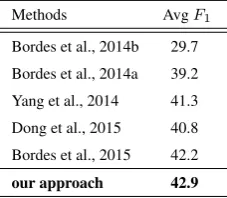
The effectiveness of the proposed approach To demonstrate the effectiveness of the pro-posed approach, we compare our method with state-of-the-art end-to-end NN-based methods.
Methods AvgF1
[image:6.595.359.473.550.649.2]Bordes et al., 2014b 29.7 Bordes et al., 2014a 39.2 Yang et al., 2014 41.3 Dong et al., 2015 40.8 Bordes et al., 2015 42.2 our approach 42.9
Table 1: The evaluation results on WebQuestions.
Table 1 shows the results on WebQuestions
dataset. Bordes et al. (2014b) apply BOW method
to obtain a single vector for both questions and
answers. Bordes et al. (2014a) further improve
sub-graph contains all the entities and relations con-nected to the answer entity. The final vector is also obtained by bag-of-words strategy. Yang et
al. (2014) follow the SP-based manner, but uses
embeddings to map entities and relations into K-B resources, then the question can be converted into logical forms. They jointly consider the
t-wo mapping processes. Dong et al. (2015) use
three columns of Convolutional Neural Network-s (CNNNetwork-s) to repreNetwork-sent queNetwork-stionNetwork-s correNetwork-sponding to three aspects of the answers, namely the answer context, the answer path and the answer type.
Bor-des et al. (2015) put KB-QA into the memory
net-works framework (Sukhbaatar et al., 2015), and
achieves the state-of-the-art performance of end-to-end methods. Our approach employs bidirec-tional LSTM, cross-attention model and global K-B information.
From the results, we observe that our approach achieves the best performance of all the end-to-end
methods on WebQuestions. Bordes et al. (2014b;
2014a;2015) all utilize BOW model to represent the questions, while ours takes advantage of the at-tention of answer aspects to dynamically represent
the questions. Also note that Bordes et al. (2015)
uses additional training data such as Reverb (
Fad-er et al., 2011) and their original dataset
Simple-Questions. Dong et al. (2015) employs three fixed
CNNs to represent questions, while ours is able to express the focus of each unique answer aspec-t aspec-to aspec-the words in aspec-the quesaspec-tion. Besides, our ap-proach employs the global KB information. So, we believe that the results faithfully show that the proposed approach is more effective than the other competitive methods.
Model Analysis
In this part, we further discuss the impacts of the components of our model. Table 2 indicates the effectiveness of different parts in the model.
Methods AvgF1
LSTM 38.2
[image:7.595.310.530.511.561.2]Bi LSTM 39.1 Bi LSTM+A-Q-ATT 41.6 Bi LSTM+C-ATT 41.8 Bi LSTM+GKI 40.4 Bi LSTM+A-Q-ATT+GKI 42.6 Bi LSTM+C-ATT+GKI 42.9
Table 2: The ablation results of our models.
LSTM employs unidirectional LSTM, and
us-es the last hidden state as the quus-estion
repre-sentation. Bi LSTM adopts a bidirectional
LST-M.A-Q-ATTdenotes the answer-towards-question attention part, and C-ATT stands for our
cross-attention. GKI means global knowledge
informa-tion.Bi LSTMS+C-ATT+GKIis our full proposed
approach. From the results, we could observe the following.
1)Bi LSTM+C-ATT dramatically improves the
F1 score by 2.7 points compared with Bi LSTM,
0.2 points higher thanBi LSTM+A-Q-ATT.
Simi-larly,Bi LSTM+C-ATT+GKIsignificantly
outper-forms Bi LSTM+GKI by 2.5 points, improving
Bi LSTM+A-Q-ATT+GKI by 0.3 points. The re-sults prove that the proposed cross-attention mod-el is effective.
2) Bi LSTM+GKI performs better than
Bi LSTM, and achieves an improvement of 1.3
points. Similarly, Bi LSTM+C-ATT+GKI
im-proves Bi LSTM+C-ATT by 1.1 points, which
indicates that the proposed training strategy successfully leverages the global information of the underlying KB.
3) Bi LSTM+C-ATT+GKI achieves the best performance as we expected, and improves the
o-riginalBi LSTMdramatically by 3.8 points. This
directly shows the power of the attention model and the global KB information.
To illustrate the effectiveness of the atten-tion mechanism clearly, we present the attenatten-tion weights of a question in the form of heat map as shown in Figure 3.
where is the carpathian mountain range located answer entity
answer type answer relation answer context
Figure 3: The visualized attention heat map.
An-swer entity: /m/06npd(Slovakia), answer
relation: partially containedby, answer
type: /location/country, answer context:
(/m/04dq9kf, /m/01mp, ...)
From this example we observe that our meth-ods is able to capture the attention properly. It is instructive to figure out the attention part of the question when dealing with different answer as-pects. The heat map will help us understand which parts are most useful for selecting correct answer-s. For instance, from Figure 3, we can see that
to “Where”, indicating that “Where” is much more important than the other parts in the question when dealing with this type. In other words, the other parts are not that crucial since “Where” is strongly implying that the question is asking about a loca-tion. As for Q-A attention part, we see that answer type and answer relation are more important than other answer aspects in this example.
4.3 Error Analysis
We randomly sample 100 imperfectly answered questions and categorize the errors into two main classes as follows.
Wrong attention
In some occasions (18 in 100 questions, 18%), we find the generated attention weights unrea-sonable. For instance, for question “What are the songs that Justin Bieber wrote?”, answer type
/music/composition pays the most atten-tion on “What” rather than “songs”. We think this is due to the bias of the training data, and we be-lieve these errors could be solved by introducing more instructive training data.
Complex questions and label errors
Another challenging problem is the complex questions (35%). For example, “When was the last time Knicks won the championship?” is actu-ally to ask the last championship, but the predicted answers give all the championships. This is due to that the model cannot learn what “last” mean in the training process. In addition, the label mis-takes also influence the evaluation (3%), such as, “What college did John Nash teach at?”, where the
labeled answer is Princeton University,
but Massachusetts Institute of Technologyshould also be an answer, and the proposed method is able to answer it correctly. Other errors include topic entity generation error and the multiple answers error (giving more answers than expected). We guess these errors are caused by the simple implementations of the related steps in our method, and we will not explain them in detail.
5 Related Work
The past years have seen a growing amount of re-search on KB-QA, shaping an interaction paradig-m that allows end users to profit froparadig-m the expres-sive power of Semantic Web data while at the same time hiding their complexity behind an intuitive and easy-to-use interface. At the same time the
growing amount of data has led to a heterogeneous data landscape where QA systems struggle to keep up with the volume, variety and veracity of the un-derlying knowledge.
5.1 Neural Network-based KB-QA
In recent years, deep neural networks have been applied to many NLP tasks, showing promising re-sults. Bordes et al. (2014b) was the first to intro-duce NN-based method to solve KB-QA problem. The questions and KB triples were represented by vectors in a low dimensional space. Thus the co-sine similarity could be used to find the most pos-sible answer. BOW method was employed to ob-tain a single vector for both the questions and the answers. Pairwise training was utilized, and the negative examples were randomly selected from
the KB facts. Bordes et al. (2014a) further
im-proved their work by proposing the concept of subgraph embeddings. The key idea was to in-volve as much information as possible in the an-swer end. Besides the anan-swer triple, the subgraph contained all the entities and relations connected to the answer entity. The final vector was also ob-tained by bag-of-words strategy.
Yih et al. (2014) focused on single-relation
questions. The KB-QA task was divided into t-wo steps. Firstly, they found the topic entity of the question. Then, the rest of the question was represented by CNNs and used to match
relation-s. Yang et al. (2014) tackled entity and relation
mapping as joint procedures. Actually, these two methods followed the SP-based manner, but they took advantage of neural networks to obtain inter-mediate mapping results.
The most similar work to ours is Dong et
al. (2015). They considered the different aspects
of answers, using three columns of CNNs to repre-sent questions respectively. The difference is that our approach uses cross-attention mechanism for each unique answer aspect, so the question repre-sentation is not fixed to only three types. More-over, we utilize the global KB information.
Xu et al. (2016a; 2016b) proposed integrated
systems to address KB-QA problems incorporat-ing Wikipedia free text, in which they used multi-channel CNNs to extract relations.
5.2 Attention-based Model
The attention mechanism has been widely used
in different areas. Bahdanau et al. (2015) first
the encoder-decoder Neural Machine Translation (NMT) framework by jointly learning align and translation. They argued that representing source sentence by a fixed vector is unreasonable, and proposed a soft-align method, which could be
understood as attention mechanism. Rush et
al. (2015) implemented sentence-level
summa-rization task. They utilized local attention-based model that generated each word of the summa-ry conditioned on the input sentence. Wang et
al. (2016) proposed an inner attention
mechanis-m that the attention was imechanis-mposed directly to the input. And their experiment on answer selection showed the advantage of inner attention compared with traditional attention methods.
Yin et al. (2016) tackled simple question
an-swering by an attentive convolutional neural net-work. They stacked an attentive max-pooling above convolution layer to model the relationship between predicates and question patterns. Our ap-proach differs from previous work in that we use attentions to help represent questions dynamical-ly, not generating current word from vocabulary as before.
6 Conclusion
In this paper, we focus on KB-QA task. Firstly, we consider the impacts of the different answer aspects when representing the question, and pro-pose a novel cross-attention model for KB-QA. Specifically, we employ the focus of the answer aspects to each question word and the attention weights of the question towards the answer aspect-s. This kind of dynamic representation is more precise and flexible. Secondly, we leverage the global KB information, which could take full ad-vantage of the complete KB, and also alleviate the OOV problem for the attention model. The ex-tensive experiments demonstrate that the proposed approach could achieve better performance com-pared with state-of-the-art end-to-end methods.
Acknowledgments
This work was supported by the Natural Sci-ence Foundation of China (No.61533018) and the National Program of China (973 program No. 2014CB340505). And this research work was al-so supported by Google through focused research awards program. We would like to thank the anonymous reviewers for their useful comments and suggestions.
References
Dzmitry Bahdanau, Kyunghyun Cho, and Yoshua Ben-gio. 2015. Neural machine translation by jointly learning to align and translate. Proceedings of I-CLR,2015.
Jonathan Berant, Andrew Chou, Roy Frostig, and Percy Liang. 2013. Semantic parsing on free-base from question-answer pairs. In Proceed-ings of the 2013 Conference on Empirical Meth-ods in Natural Language Processing. Association for Computational Linguistics, pages 1533–1544. http://aclweb.org/anthology/D13-1160.
Kurt Bollacker, Colin Evans, Praveen Paritosh, Tim S-turge, and Jamie Taylor. 2008. Freebase: a collab-oratively created graph database for structuring hu-man knowledge. In Proceedings of the 2008 ACM SIGMOD international conference on Management of data. ACM, pages 1247–1250.
Antoine Bordes, Sumit Chopra, and Jason We-ston. 2014a. Question answering with sub-graph embeddings. In Proceedings of the 2014 Conference on Empirical Methods in Nat-ural Language Processing (EMNLP). Association for Computational Linguistics, pages 615–620. https://doi.org/10.3115/v1/D14-1067.
Antoine Bordes, Nicolas Usunier, Sumit Chopra, and Jason Weston. 2015. Large-scale simple question answering with memory networks. arXiv preprint arXiv:1506.02075.
Antoine Bordes, Nicolas Usunier, Alberto Garcia-Duran, Jason Weston, and Oksana Yakhnenko. 2013. Translating embeddings for modeling multi-relational data. In Advances in neural information processing systems. pages 2787–2795.
Antoine Bordes, Jason Weston, and Nicolas Usunier. 2014b. Open question answering with weakly su-pervised embedding models. In Joint European Conference on Machine Learning and Knowledge Discovery in Databases. Springer, pages 165–180.
Qingqing Cai and Alexander Yates. 2013. Large-scale semantic parsing via schema matching and lexicon extension. InProceedings of the 51st An-nual Meeting of the Association for Computation-al Linguistics (Volume 1: Long Papers). Associa-tion for ComputaAssocia-tional Linguistics, pages 423–433. http://aclweb.org/anthology/P13-1042.
Chris Dyer, Miguel Ballesteros, Wang Ling, Austin Matthews, and A. Noah Smith. 2015. Transition-based dependency parsing with stack long short-term memory. InProceedings of the 53rd Annual Meeting of the Association for Computational Lin-guistics and the 7th International Joint Conference on Natural Language Processing (Volume 1: Long Papers). Association for Computational Linguistic-s, pages 334–343. https://doi.org/10.3115/v1/P15-1033.
Anthony Fader, Stephen Soderland, and Oren Etzioni. 2011. Identifying relations for open information extraction. In Proceedings of the 2011 Conference on Empirical Methods in Natural Language Processing. Association for Computational Linguistics, pages 1535–1545. http://aclweb.org/anthology/D11-1142.
Karl Moritz Hermann, Tomas Kocisky, Edward Grefenstette, Lasse Espeholt, Will Kay, Mustafa Su-leyman, and Phil Blunsom. 2015. Teaching ma-chines to read and comprehend. InAdvances in Neu-ral Information Processing Systems. pages 1693– 1701.
Sepp Hochreiter and J¨urgen Schmidhuber. 1997. Long short-term memory. Neural computation 9(8):1735–1780.
Tom Kwiatkowski, Eunsol Choi, Yoav Artzi, and Luke Zettlemoyer. 2013. Scaling semantic parser-s with on-the-fly ontology matching. In Proceed-ings of the 2013 Conference on Empirical Meth-ods in Natural Language Processing. Association for Computational Linguistics, pages 1545–1556. http://aclweb.org/anthology/D13-1161.
Eric Prudhommeaux and Andy Seaborne. 2008. Sparql query language for rdf. w3c recommendation, jan-uary 2008.
Siva Reddy, Oscar T¨ackstr¨om, Michael Collins, Tom Kwiatkowski, Dipanjan Das, Mark Steed-man, and Mirella Lapata. 2016. Transform-ing dependency structures to logical forms for semantic parsing. Transactions of the Asso-ciation of Computational Linguistics 4:127–141. http://aclweb.org/anthology/Q16-1010.
M. Alexander Rush, Sumit Chopra, and Jason We-ston. 2015. A neural attention model for ab-stractive sentence summarization. In Proceed-ings of the 2015 Conference on Empirical Meth-ods in Natural Language Processing. Associa-tion for ComputaAssocia-tional Linguistics, pages 379–389. https://doi.org/10.18653/v1/D15-1044.
Sainbayar Sukhbaatar, Jason Weston, Rob Fergus, et al. 2015. End-to-end memory networks. InAdvances in neural information processing systems. pages 2440–2448.
Ilya Sutskever, Oriol Vinyals, and Quoc V Le. 2014. Sequence to sequence learning with neural network-s. InAdvances in neural information processing sys-tems. pages 3104–3112.
Christina Unger, Andr´e Freitas, and Philipp Cimiano. 2014. An introduction to question answering over linked data. InReasoning Web International Sum-mer School. Springer, pages 100–140.
Bingning Wang, Kang Liu, and Jun Zhao. 2016. In-ner attention based recurrent neural networks for answer selection. In Proceedings of the 54th An-nual Meeting of the Association for Computational Linguistics (Volume 1: Long Papers). Association for Computational Linguistics, pages 1288–1297. https://doi.org/10.18653/v1/P16-1122.
Kun Xu, Yansong Feng, Songfang Huang, and Dongyan Zhao. 2016b. Hybrid question answering over knowledge base and free text. InProceedings of COLING 2016, the 26th International Conference on Computational Linguistics: Technical Papers. The COLING 2016 Organizing Committee, pages 2397–2407. http://aclweb.org/anthology/C16-1226. Kun Xu, Siva Reddy, Yansong Feng, Songfang Huang, and Dongyan Zhao. 2016a. Question answering on freebase via relation extraction and textual evidence. In Proceedings of the 54th Annual Meeting of the Association for Computational Linguistics. Associ-ation for ComputAssoci-ational Linguistics, pages 2326– 2336.https://doi.org/10.18653/v1/P16-1220. Min-Chul Yang, Nan Duan, Ming Zhou, and
Hae-Chang Rim. 2014. Joint relational embeddings for knowledge-based question answering. In Proceed-ings of the 2014 Conference on Empirical Methods in Natural Language Processing (EMNLP). Associ-ation for ComputAssoci-ational Linguistics, pages 645–650. https://doi.org/10.3115/v1/D14-1071.
Xuchen Yao and Benjamin Van Durme. 2014. Infor-mation extraction over structured data: Question an-swering with freebase. InProceedings of the 52nd Annual Meeting of the Association for Computation-al Linguistics (Volume 1: Long Papers). Associa-tion for ComputaAssocia-tional Linguistics, pages 956–966. https://doi.org/10.3115/v1/P14-1090.
Wen-tau Yih, Ming-Wei Chang, Xiaodong He, and Jianfeng Gao. 2015. Semantic parsing via staged query graph generation: Question answering with knowledge base. InProceedings of the 53rd Annual Meeting of the Association for Computational Lin-guistics and the 7th International Joint Conference on Natural Language Processing (Volume 1: Long Papers). Association for Computational Linguistics, pages 1321–1331. https://doi.org/10.3115/v1/P15-1128.
Wen-tau Yih, Xiaodong He, and Christopher Meek. 2014. Semantic parsing for single-relation ques-tion answering. In Proceedings of the 52nd An-nual Meeting of the Association for Computation-al Linguistics (Volume 2: Short Papers). Associa-tion for ComputaAssocia-tional Linguistics, pages 643–648. https://doi.org/10.3115/v1/P14-2105.
semantic parse labeling for knowledge base ques-tion answering. In Proceedings of the 54th An-nual Meeting of the Association for Computation-al Linguistics (Volume 2: Short Papers). Associa-tion for ComputaAssocia-tional Linguistics, pages 201–206. https://doi.org/10.18653/v1/P16-2033.
Wenpeng Yin, Mo Yu, Bing Xiang, Bowen Zhou, and Hinrich Sch¨utze. 2016. Simple question answering by attentive convolutional neural net-work. In Proceedings of COLING 2016, the 26th International Conference on Computation-al Linguistics: TechnicComputation-al Papers. The COLING 2016 Organizing Committee, pages 1746–1756. http://aclweb.org/anthology/C16-1164.
Luke Zettlemoyer and Michael Collins. 2009. Learn-ing context-dependent mappLearn-ings from sentences to logical form. InProceedings of the Joint Confer-ence of the 47th Annual Meeting of the ACL and the 4th International Joint Conference on Natu-ral Language Processing of the AFNLP. Associa-tion for ComputaAssocia-tional Linguistics, pages 976–984. http://aclweb.org/anthology/P09-1110.