1
Predicting Brain Activation with WordNet Embeddings
Jo˜ao Ant´onio Rodrigues, Ruben Branco, Jo˜ao Ricardo Silva, Chakaveh Saedi, Ant´onio Branco University of Lisbon
NLX-Natural Language and Speech Group, Department of Informatics Faculdade de Ciˆencias
Campo Grande, 1749-016 Lisboa, Portugal
{joao.rodrigues, ruben.branco, jsilva, chakaveh.saedi, antonio.branco}@di.fc.ul.pt
Abstract
The task of taking a semantic represen-tation of a noun and predicting the brain activity triggered by it in terms of fMRI spatial patterns was pioneered byMitchell et al. (2008). That seminal work used word co-occurrence features to represent the meaning of the nouns. Even though the task does not impose any specific type of semantic representation, the vast majority of subsequent approaches resort to feature-based models or to semantic spaces (aka word embeddings). We address this task, with competitive results, by using instead a semantic network to encode lexical se-mantics, thus providing further evidence for the cognitive plausibility of this ap-proach to model lexical meaning.
1 Introduction
Neurosemantics studies the mapping between con-cepts and the corresponding brain activity, bring-ing together neuroscientists dobring-ing brain imagbring-ing research and linguists doing research on the se-mantics of natural language expressions.
The task introduced by Mitchell et al. (2008) consists of taking a semantic representation of a noun and predicting the functional magnetic res-onance imaging (fMRI) spatial activation patterns in the brain triggered by that noun. That is, given a meaning representation of a word, it should be the basis to predict the activation strength at each point (voxel) in the 3D volume of the brain asso-ciated to the cognitive handling of that word. This allows to make testable predictions of fMRI activ-ity, even for nouns for which there is no fMRI data available, as long as there is some way to model and represent the semantics of a lexicon.
In lexical semantics, three broad families of ap-proaches have emerged to model meaning, namely (i) semantic networks, (ii) feature-based models, and (iii) semantic spaces. The models of the lex-icon produced under these approaches have been embedded in wider models of the whole grammar or in language technology applications and tasks, including synonym identification, analogies detec-tion a.o., were they have been tested on behav-ioral data sets. The prediction of brain activation considered here is agnostic regarding the approach used to model lexical meaning, thus providing an-other way of assessing the cognitive plausibility of lexical semantic representations of different sorts. While most approaches to this task have re-sorted to feature-based models or to semantic spaces (aka word embeddings), here we address the task of prediciting the brain activation triggred by nouns rather by using a semantic network, thus providing further evidence for the cognitive plau-sibility of this approach to model lexical meaning. In this paper, we report on the competitive results of resolving the brain activation task by taking a mainstream lexical semantics network, WordNet (Fellbaum,1998), and resorting to inter-mediate word embeddings obatined with a novel methodology (Saedi et al.,2018) for generating se-mantic spaces from sese-mantic networks.
2 The brain activation prediction task
The seminal work ofMitchell et al.(2008) intro-duced the task consisting of predicting the fMRI activation patterns triggered by a noun-picture pair from a semantic representation of that noun. The language of the data used was English.
(Brants and Franz,2006), using then-grams up to length 5 generated from 1 trillion tokens of text.
The 25 verbs were manually selected due to their correspondence to basic sensory and motor activities.1 Sensory-motor features should be par-ticularly relevant for the representation of objects and, in fact, alternative features based on a random selection of 25 frequent words performed worse.
The fMRI activation pattern at every voxel in the brain is calculated as a weighted sum of each of the 25 semantic features, where the weights are learned by regression to maximum likelihood esti-mates given observed fMRI data.
To produce the fMRI data, 9 participants were shown 60 different word-picture pairs,2 the stim-uli, each presented 6 times. For each participant, a representative fMRI image for each stimulus was calculated by determining the mean fMRI re-sponse from the 6 repetitions and subtracting from each the mean of all 60 stimuli.
Separate models were learned for each of the 9 participants. These models were evaluated us-ing leave-two-out cross-validation, where in each cross-validation iteration the model was asked to predict the fMRI activation for the two held-out words. The two predictions were matched against the two observed activations for those words using cosine similarity over the 500 most stable voxels.
Randomly assigning the two predictions to the two observations would yield a 0.50 accuracy. The models in the seminal paper (Mitchell et al.,2008) achieve a mean accuracy of 0.77, with all individ-ual accuracies significantly above chance.
These results support the plausibility of the two key assumptions underlying the task, namely that (i) brain activation patterns can be predicted from semantic representations of words; and that (ii) lexical semantics can be captured by co-occurrence statistics, the assumption underlying semantics space models of the lexicon.
3 Related work
Several authors have addressed this brain activa-tion predicactiva-tion task, keeping up with its basic as-sumptions and resorting to the same data sets for
1The verbs are: approach,break,clean,drive, eat, en-ter,fear,fill,hear,lift,listen,manipulate,move,near,open, push,ride,rub,run,say,see,smell,taste,touch, andwear.
2The 60 pairs are composed of 5 items from each of the 12 concrete semantic categories (animals, body parts, buildings, building parts, clothing, furniture, insects, kitchen items, tools, vegetables, vehicles, and other man-made items).
the sake of the comparability of the performance scores obtained.
In an initial period, different authors sought to explore the experimental space of the task by fo-cusing on different ways to set up the features.
Devereux et al.(2010) find that choosing the set of verbs used for the semantic features under an automatic approach can lead to predictions that are equally good as when using the manually selected set of verbs.Jelodar et al.(2010) use the same set of 25 features to represent a word, but instead of basing the features on co-occurrence counts they resort to relatedness measures based on WordNet. Fernandino et al.(2015) use instead a set of fea-tures with 5 sensory-motor experience based at-tributes (sound, color, visual motion, shape, and manipulation). The relatedness scores between the stimulus word and the attributes are based on hu-man ratings instead of corpus data.
Subsequently, as distributional semantics be-came increasingly popular, authors moved from feature-based representations of the meaning of words to experiment with different vector based representation models (aka word embeddings).
Murphy et al.(2012) compare different corpus-based models to derive word embeddings. They find the best results with dependency-based em-beddings, where words inside the context window are extended with grammatical functions. Binder et al. (2016) use word representations based on 65 experiential attributes with relatedness scores crowdsourced from over 1,700 participants. Xu et al. (2016) present BrainBench, a workbench to test embedding models on both behavioral and brain imaging data sets.Anderson et al.(2017) use a linguistic model based on word2vec embeddings and a visual model built with a deep convolutional neural network on the Google Images data set.
dependency-based word2vec achieves the best performance among the approaches resorting to word embed-dings, while the seminal approach resorting to 25 features “is doing slightly better on average” with respect to all the approaches experimented with.
The rationale guiding the various works pre-sented in this Section is that the better the per-formance of the system the higher is the cogni-tive plausibility of the lexical semantics model re-sorted to. It is also important to note, however, that there is not always a clearly better method since results show that different methods have different error patterns (Abnar et al.,2018).
4 WordNet embeddings
The previous Sections indicate that approaches to the brain activation task typically resort to feature-based models or to semantic spaces to represent the meaning of words.
In this paper, we address this task by using in-stead a semantic network as the base repository of lexical semantic knowledge, namely WordNet. We then resort to a novel methodology developed by us (Saedi et al., 2018) for generating seman-tic space embeddings from semanseman-tic networks, and use it to obtain WordNet embeddings. This method is based on the intuition that the larger the number of paths and the shorter the paths connect-ing any two nodes in a network the stronger is their semantic association.
The conversion method begins by representing the semantic graph as an adjacency matrix M, where elementMij is set to 1 if there is an edge between word wi and wordwj, and 0 otherwise. Then, this initial relatedness of immediately adja-cent words is “propagated” through the matrix by iterating the following cumulative addition
MG(n)=I +αM +α2M2+· · ·+αnMn (1)
whereI is the identity matrix, then-th power of the transition matrix, Mn, is the matrix where eachMij counts the number of paths of lenghtn between nodesiandj, andαis a decay factor.
The limit of this sum is given by the following closed expression (seeNewman,2010, Eq. 7.63):
MG =
∞
X
e=0
(αM)e= (I−αM)−1 (2)
MatrixMGis subsequently submitted to a Pos-itive Point-wise Mutual Information transforma-tion, each line is L2-normalized and, finally, Prin-cipal Component Analysis is applied, reducing
each line to the size of the desired embedding space. Rowiof matrix MG is then taken as the embedding for wordwi.
Using the methodology outlined above, embed-dings with size 850 were extracted from a subset of 60k words in version 3 of English WordNet.3 When run on the mainstream semantic similarity data set SimLex-999 (Hill et al., 2016), the sulting embeddings showed highly competitive re-sults, outperforming word2vec by some 15% We refer to our embeddings as wnet2vec.4
5 Experiment
The good results obtained with wnet2vec in the semantic similarity task lead to experiment with them also in the brain activation prediction task.
5.1 System training
We resorted to the framework implementation5by Abnar et al.(2018). Training ran for 1,000 epochs, with a batch size of 29 and a learning rate of 0.001. The loss function is calculated by adding the Hu-ber loss, the mean pairwise squared error and the L2-norm (on weights and bias). Like in previ-ous works, only the 500 most stable voxels are se-lected. Training was done on a Tesla K40m GPU and took 54 hours (6 hours per subject).
Figure 1 shows an example for Participant 1, with the model prediction and the observed fMRI activation pattern for the wordeye. The brain acti-vation images were generated with Nibabel (Brett et al.,2017) and Nilearn (Abraham et al.,2014).
5.2 Evaluation and discussion
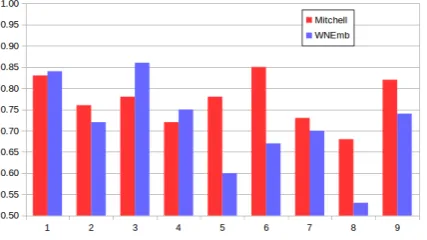
We followed the usual evaluation procedure for this framework. The cross-validated, leave-two-out mean accuracy was 0.71. The full scores, to-gether with the scores from the original paper, are summarized in Table1 and shown graphically in Figure2(0.50 corresponds to chance).6
This indicates that wnet2vec has a competitive performance in this task as the mean score ob-tained is in the range of the scores found for all
ap-3
We used less than half of the ˜150k words in WordNet due to computational limitations as the matrix inverse in (2) faces substantial challenges in terms of the memory footprint.
4
Available athttps://github.com/nlx-group/ WordNetEmbeddings
5
https://github.com/samiraabnar/ NeuroSemantics/
(a) predicted (b) observed
Figure 1: fMRI activations for Participant 1, wordeye
Embeddings P1 P2 P3 P4 P5 P6 P7 P8 P9 mean
[image:4.595.89.511.199.251.2](Mitchell et al.,2008) 0.83 0.76 0.78 0.72 0.78 0.85 0.73 0.68 0.82 0.77 wnet2vec 0.84 0.72 0.86 0.75 0.60 0.67 0.70 0.53 0.74 0.71
Table 1: Accuracy results for the 9 subjects
Figure 2: Accuracy results for the 9 subjects
proaches resorting to word embeddings, systemat-ically tested by (Abnar et al.,2018).
In line with all approaches resorting to word embeddings (Abnar et al., 2018), the mean score obtained is also not outperforming the original 25 verb-based co-occurrence features model reported in the seminal paper (Mitchell et al.,2008).
When comparing the scores per participant, the bulk of the wnet2vec losses are due to P5, P6 and P8. For the other subjects, results are close or, in three cases, even better than those from the semi-nal paper. This highlights the point already made in (Abnar et al.,2018), that different methods have different error patterns, which suggests that an en-semble of classifiers could lead to better overall accuracy. And also, that a dataset with only 9 sub-jects — the dataset used in the literature on this task since (Mitchell et al., 2008) — may be hin-dering better empirically grounded conclusions.
Finally, it should be noted that these competitive results were obtained with wnet2vec generated on the basis of 60k words only, thus less than half of
WordNet. It will be very interesting to see how the performance of this approach progresses when larger portions of WordNet are taken into account as computational limitations can be overcome.
6 Conclusions
We report on an experiment with the task of pre-dicting the fMRI spatial activation patterns in the brain associated with a given noun.
We resorted to a semantic network of lexical knowledge, viz. WordNet, and thus to a represen-tation of the meaning of the input nouns as ele-ments of concept nodes in a graph of semantically related edges. We also resorted to a derived inter-mediate vectorial semantic representation (word embeddings) for the input nouns that was obtained by a novel methodology to convert semantic net-works into semantic spaces, applied to WordNet.
The results indicate that this model has a com-petitive performance as its scores are within the range of the results obtained with state of the art models based on corpus-based word embeddings reported in the literature. Though for one third of the 9 subjects this model surpassesMitchell et al. (2008), on average it did not outperform that sem-inal model, which used hand-selected features.
[image:4.595.76.290.298.418.2]References
Samira Abnar, Rasyan Ahmed, Max Mijnheer, and Willem Zuidema. 2018. Experiential, distributional and dependency-based word embeddings have com-plementary roles in decoding brain activity. In Pro-ceedings of the 8th Workshop on Cognitive Model-ing and Computational LModel-inguistics (CMCL 2018) , pages 5766.
Alexandre Abraham, Fabian Pedregosa, Michael Eick-enberg, Philippe Gervais, Andreas Mueller, Jean Kossaifi, Alexandre Gramfort, Bertrand Thirion, and GaelVaroquaux. 2014. Machine learning for neu-roimaging with scikit-learn. Frontiers in Neuroin-formatics, 8:14.
Andrew J. Anderson, Douwe Kiela, Stephen Clark, and Massimo Poesio. 2017. Visually grounded and tex-tual semantic models differentially decode brain ac-tivity associated with concrete and abstract nouns. Transactions of the Association of Computational Linguistics, 5(1):17–30.
Jeffrey R. Binder, Lisa L. Conant, Colin J. Humphries, Leonardo Fernandino, Stephen B. Simons, Mario Aguilar, and Rutvik H. Desai. 2016. Toward a brain-based componential semantic representation. Cog-nitive neuropsychology, 33(3-4):130–174.
Piotr Bojanowski, Edouard Grave, Armand Joulin, and Tomas Mikolov. 2016. Enriching word vec-tors with subword information. arXiv preprint arXiv:1607.04606.
Thorsten Brants and Alex Franz. 2006. Web 1T 5-gram version 1.
Matthew Brett, Michael Hanke, et al. 2017. nipy/nibabel: 2.2.0.
Barry Devereux, Colin Kelly, and Anna Korhonen. 2010. Using fMRI activation to conceptual stim-uli to evaluate methods for extracting conceptual representations from corpora. In Proceedings of the NAACL HLT 2010 First Workshop on Compu-tational Neurolinguistics, pages 70–78. Association for Computational Linguistics.
Manaal Faruqui and Chris Dyer. 2015. Non-distributional word vector representations. arXiv preprint arXiv:1506.05230.
Christiane Fellbaum, editor. 1998. WordNet: An Elec-tronic Lexical Database. MIT Press.
Leonardo Fernandino, Colin J. Humphries, Mark S. Seidenberg, William L. Gross, Lisa L. Conant, and Jeffrey R. Binder. 2015. Predicting brain activation patterns associated with individual lexical concepts based on five sensory-motor attributes. Neuropsy-chologia, 76:17–26.
Felix Hill, Roi Reichart, and Anna Korhonen. 2016. Simlex-999: Evaluating semantic models with (gen-uine) similarity estimation. Computational Linguis-tics, 41:665–695.
Ahmad Babaeian Jelodar, Mehrdad Alizadeh, and Shahram Khadivi. 2010. WordNet based features for predicting brain activity associated with mean-ings of nouns. InProceedings of the NAACL HLT 2010 First Workshop on Computational Neurolin-guistics, pages 18–26. Association for Computa-tional Linguistics.
Omer Levy and Yoav Goldberg. 2014. Dependency-based word embeddings. InProceedings of the 52nd Annual Meeting of the Association for Computa-tional Linguistics (ACL), volume 2, pages 302–308.
Tomas Mikolov, Kai Chen, Greg Corrado, and Jef-frey Dean. 2013. Efficient estimation of word representations in vector space. arXiv preprint arXiv:1301.3781.
Tom M. Mitchell, Svetlana V. Shinkareva, Andrew Carlson, Kai-Min Chang, Vicente L. Malave, Robert A. Mason, and Marcel Adam Just. 2008. Predicting human brain activity associated with the meanings of nouns.Science, 320(5880):1191–1195.
Brian Murphy, Partha Talukdar, and Tom Mitchell. 2012. Selecting corpus-semantic models for neu-rolinguistic decoding. In Proceedings of the First Joint Conference on Lexical and Computational Se-mantics, pages 114–123. Association for Computa-tional Linguistics.
Mark Newman. 2010.Networks: An Introduction. Ox-ford University Press.
Jeffrey Pennington, Richard Socher, and Christopher Manning. 2014. GloVe: Global vectors for word representation. In Proceedings of the 2014 Con-ference on Empirical Methods in Natural Language Processing (EMNLP), pages 1532–1543.
Chakaveh Saedi, Antnio Branco, Joo Antnio Ro-drigues, and Joo Ricardo Silva. 2018. Wordnet embeddings. In Proceedings of the ACL2018 3rd Workshop on Representation Learning for Natural Language Processing (RepL4NLP). Association for Computational Linguistics.
Alexandre Salle, Marco Idiart, and Aline Villavicencio. 2016. Matrix factorization using window sampling and negative sampling for improved word represen-tations.arXiv preprint arXiv:1606.00819.