Learning Tag Embeddings and Tag-specific
Composition Functions in Recursive Neural Network
Qiao Qian, Bo Tian, Minlie Huang, Yang Liu*, Xuan Zhu*, Xiaoyan ZhuState Key Lab. of Intelligent Technology and Systems, National Lab. for Information Science
and Technology, Dept. of Computer Science and Technology, Tsinghua University, Beijing 100084, PR China *Samsung R&D Institute Beijing, China
[email protected], [email protected] [email protected], [email protected] [email protected], [email protected]
Abstract
Recursive neural network is one of the most successful deep learning models for natural language processing due to the compositional nature of text. The model recursively composes the vector of a parent phrase from those of child words or phrases, with a key compo-nent named composition function. Al-though a variety of composition func-tions have been proposed, the syntactic information has not been fully encoded in the composition process. We pro-pose two models,TagGuided RNN (TG-RNN for short) which chooses a compo-sition function according to the part-of-speech tag of a phrase, andTagEmbedded RNN/RNTN (TE-RNN/RNTN for short) which learns tag embeddings and then combines tag and word embeddings to-gether. In the fine-grained sentiment classification, experiment results show the proposed models obtain remarkable improvement: TG-RNN/TE-RNN obtain remarkable improvement over baselines, TE-RNTN obtains the second best result among all the top performing models, and all the proposed models have much less parameters/complexity than their counter-parts.
1 Introduction
Among a variety of deep learning models for nat-ural language processing, Recursive Nenat-ural Net-work (RNN) may be one of the most popular mod-els. Thanks to the compositional nature of natu-ral text, recursive neunatu-ral network utilizes the re-cursive structure of the input such as a phrase or sentence, and has shown to be very effective for many natural language processing tasks including
semantic relationship classification (Socher et al., 2012), syntactic parsing (Socher et al., 2013a), sentiment analysis (Socher et al., 2013b), and ma-chine translation (Li et al., 2013).
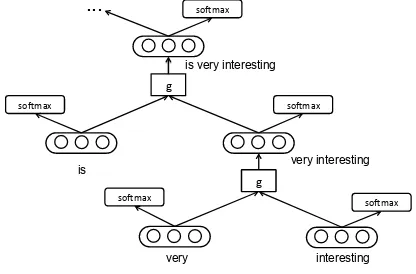
The key component of RNN and its variants is the composition function: how to compose the vector representation for a longer text from the vector of its child words or phrases. For instance, as shown in Figure 2, the vector of‘is very inter-esting’can be composed from the vector of the left node‘is’and that of the right node‘very interest-ing’. It’s worth to mention again, the composition process is conducted with the syntactic structure of the text, making RNN more interpretable than other deep learning models.
so#max so#max
so#max
so#max
so#max
...
g g
very interesting
is very interesting
[image:1.595.312.520.429.566.2]is very interesting
Figure 1: The example process of vector composi-tion in RNN. The vector of node‘very interesting’
is composed from the vectors of node‘very’ and node‘interesting’. Similarly, the node‘is very in-teresting’is composed from the phrase node‘very interesting’and the word node‘is’.
There are various attempts to design the com-position function in RNN (or related models). In RNN (Socher et al., 2011), a global matrix is used to linearly combine the elements of vectors. In RNTN (Socher et al., 2013b), a global tensor is used to compute the tensor products of dimen-sions to favor the association between different
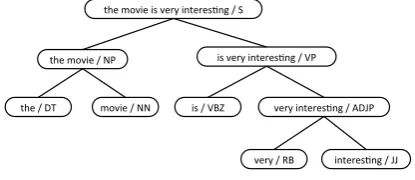
ements of the vectors. Sometimes it is challeng-ing to find a schalleng-ingle function to model the compo-sition process. As an alternative, multiple com-position functions can be used. For instance, in MV-RNN (Socher et al., 2012), different matrices is designed for different words though the model is suffered from too much parameters. In AdaMC RNN/RNTN (Dong et al., 2014), a fixed number of composition functions is linearly combined and the weight for each function is adaptively learned. In spite of the success of RNN and its variants, the syntactic knowledge of the text is not yet fully employed in these models. Two ideas are moti-vated by the example shown in Figure 2: First, the composition function for the noun phrase‘the movie/NP’ should be different from that for the adjective phrase‘very interesting/ADJP’since the two phrases are quite syntactically different. More specifically to sentiment analysis, a noun phrase is much less likely to express sentiment than an ad-jective phrase. There are two notable works men-tioned here: (Socher et al., 2013a) presented to combine the parsing and composition processes, but the purpose is for parsing; (Hermann and Blunsom, 2013) designed composition functions according to the combinatory rules and categories in CCG grammar, however, only marginal im-provement against Naive Bayes was reported. Our proposed model, tag guided RNN (TG-RNN), is designed to use the syntactic tag of the parent phrase to guide the composition process from the child nodes. As an example, we design a function for composing noun phrase (NP) and another one for adjective phrase (ADJP). This simple strategy obtains remarkable improvements against strong baselines.
is / VBZ
very / RB
very interes/ng / ADJP
interes/ng / JJ is very interes/ng / VP
the / DT the movie / NP
movie / NN
[image:2.595.77.285.560.650.2]the movie is very interes/ng / S
Figure 2: The parse tree for sentence‘The movie is very interesting’built by Stanford Parser.
Second, when composing the adjective phrase
‘very interesting/ADJP’ from the left node
‘very/RB’and the right node ‘interesting/JJ’, the right node is obviously more important than the left one. Furthermore, the right node
‘interest-ing/JJ’ apparently contributes more to sentiment expression. To address this issue, we propose
Tag embedded RNN/RNTN (TE-RNN/RNTN), to
learn an embedding vector for each word/phrase tag, and concatenate the tag vector with the word/phrase vector as input to the composition function. For instance, we have tag vectors for
DT,NN,RB,JJ,ADJP,NP, etc. and the tag vectors are then used in composing the parent’s vector. The proposedTE-RNTNobtain the second best re-sult among all the top performing models but with much less parameters and complexity. To the best of our knowledge, this is the first time that tag em-bedding is proposed.
To summarize, the contributions of our work are as follows:
• We propose tag-guided composition func-tions in recursive neural network, TG-RNN. Tag-guided RNN allocates a composition function for a phrase according to the part-of-speech tag of the phrase.
• We propose to learn embedding vectors for part-of-speech tags of words/phrases, and integrate the tag embeddings in RNN and RNTN respectively. The two models, TE-RNN and TE-RNTN, can leverage the syn-tactic information of child nodes when gen-erating the vector of parent nodes.
• The proposed models are efficient and effec-tive. The scale of the parameters is well con-trolled. Experimental results on the Stanford Sentiment Treebank corpus show the effec-tiveness of the models. TE-RNTN obtains the second best result among all publicly re-ported approaches, but with much less pa-rameters and complexity.
The rest of the paper is structured as follows: in Section 2, we survey related work. In Section 3, we introduce the traditional recursive neural net-work as background. We present our ideas in Sec-tion 4. The experiments are introduced in SecSec-tion 5. We summarize the work in Section 6.
2 Related Work
and Lapata, 2007) are considered. In order to distinguish antonyms with similar contexts, neu-ral word vectors (Bengio et al., 2003) are pro-posed and can be learnt in an unsupervised man-ner. Word2vec (Mikolov et al., 2013a) introduces a simpler network structure making computation more efficiently and makes billions of samples feasible for training.
Semantic composition deals with representing a longer text from its shorter components, which is extensively studied recently. In many previ-ous works, a phrase vector is usually obtained by average (Landauer and Dumais, 1997), addition, element-wise multiplication (Mitchell and Lap-ata, 2008) or tensor product (Smolensky, 1990) of word vectors. In addition to using vector repre-sentations, matrices can also be used to represent phrases and the composition process can be done through matrix multiplication (Rudolph and Gies-brecht, 2010; Yessenalina and Cardie, 2011).
Recursive neural models utilize the recursive structure (usually a parse tree) of a phrase or sen-tence for semantic composition. In Recursive Neural Network (Socher et al., 2011), the tree with the least reconstruction error is built and the vectors for interior nodes is composed by a global matrix. Matrix-Vector Recursive Neural Network (MV-RNN) (Socher et al., 2012) assigns matri-ces for every words so that it could capture the relationship between two children. In Recursive Neural Tensor Networks (RNTN) (Socher et al., 2013b), the composition process is performed on a parse tree in which every node is annotated with fine-grained sentiment labels, and a global tensor is used for composition. Adaptive Multi-Compositionality (Dong et al., 2014) uses multiple weighted composition matrices instead of sharing a single matrix.
The employment of syntactic information in RNN is still in its infant. In (Socher et al., 2013a), the part-of-speech tag of child nodes is considered in combining the processes of both composition and parsing. The main purpose is for better pars-ing by employpars-ing RNN, but it is not designed for sentiment analysis. In (Hermann and Blunsom, 2013), the authors designed composition functions according to the combinatory rules and categories in CCG grammar. However, only marginal im-provement against Naive Bayes was reported. Un-like (Hermann and Blunsom, 2013), our TG-RNN obtains remarkable improvements against strong
baselines, and we are the first to propose tag em-bedded RNTN which obtains the second best re-sult among all reported approaches.
3 Background: Recursive Neural Models In recursive neural models, the vector of a longer text (e.g., sentence) is composed from those of its shorter components (e.g., words or phrases). To compose a sentence vector through word/phrase vectors, a binary parse tree has to be built with a parser. The leaf nodes represent words and in-terior nodes represent phrases. Vectors of inin-terior nodes are computed recursively by composition of child nodes’ vectors. Specially, the root vector is regarded as the sentence representation. The com-position process is shown in Figure 1.
More formally, vector vi ∈ Rd for node i is
calculated via:
vi =f(g(vil, vri)) (1)
wherevl
i andvir are child vectors,g is a
compo-sition function, and f is a nonlinearity function, usually tanh. Different recursive neural models mainly differ in composition function. For exam-ple, the composition function for RNN is as below:
g(vl
i, vir) =W [
vl i vr i
]
+b (2)
whereW ∈Rd×2dis a composition matrix andb
is a bias vector. And the composition function for RNTN is as follows:
g(vil, vri) =
[ vl
i vr i ]
T[1:d] [
vl i vr i ]
+W [
vl i vr i ]
+b (3)
whereW andbare defined in the previous model andT[1:d] ∈ R2d×2d×d is the tensor that defines
multiple bilinear forms.
The vectors are used as feature inputs to a soft-max classifier. The posterior probability over class labels on a node vectorviis given by
yi=softmax(Wsvi+bs). (4)
The parameters in these models include the word table L, a composition matrix W in RNN, andW andT[1:d]in RNTN, and the classification
4 Incorporating Syntactic Knowledge into Recursive Neural Model
The central idea of the paper is inspired by the fact that words/phrases of different part-of-speech tags play different roles in semantic composition. As discussed in the introduction, a noun phrase (e.g.,
a movie/NP) may be composed different from a verb phrase (e.g., love movie/VP). Furthermore, when composing the phrasea movie/NP, the two child words, a/DT and movie/NN, may play dif-ferent roles in the composition process. Unfor-tunately, the previous RNN models neglect such syntactic information, though the models do em-ploy the parsing structure of a sentence.
We have two approaches to improve the compo-sition process by leveraging tags on parent nodes and child nodes. One approach is to use different composition matrices for parent nodes with differ-ent tags so that the composition process could be guided by phrase type, for example, the matrix for
‘NP’is different from that for‘VP’. The other ap-proach is to introduce ‘tag embedding’ for words and phrases, for example, to learn tag vectors for
‘NP, VP, ADJP’, etc., and then integrate the tag vectors with the word/phrase vectors during the composition process.
4.1 Tag Guided RNN (TG-RNN)
We propose Tag Guided RNN (TG-RNN) to re-spect the tag of a parent phrase during the com-position process. The model chooses a composi-tion funccomposi-tion according to the part-of-speech tag of a phrase. For example,‘the movie’has tagNP,
‘very interesting’ has tagADJP, the two phrases have different composition matrices.
More formally, we design composition func-tionsgwith a factor of the phrase tag of a parent node. The composition function becomes
g(ti, vli, vir) =gti(vli, vir) =Wti [
vl i vr i ]
+bti (5)
whereti is the phrase tag for nodei,Wti andbti
are the parameters of function gti, as defined in
Equation 2. In other words, phrase nodes with various tags have their own composition functions such as gNP, gV P, and so on. There are
to-tallyk composition function in this model where
kis the number of phrase tags. When composing child vectors, a function is chosen from the func-tion pool according to the tag of the parent node.
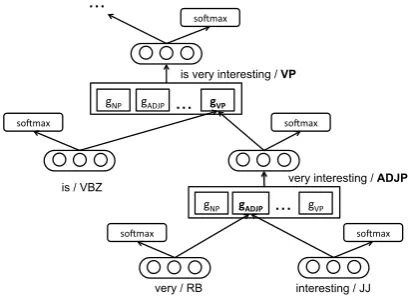
The process is depicted in Figure 3. We term this model Tag guided RNN, TG-RNN for short.
so#max so#max
so#max
so#max
so#max ...
very / RB interesting / JJ
is / VBZ very interesting / ADJP
is very interesting / VP
gNP gADJP gVP
gNP gADJP gVP
[image:4.595.313.519.108.258.2]... ...
Figure 3: The vector of phrase‘very interesting’
is composed with highlightedgADJP and‘is very interesting’withgV P.
But some tags have few occurrences in the cor-pus. It is hard and meaningless to train compo-sition functions for those infrequent tags. So we simply choose topkfrequent tags and traink com-position functions. A common comcom-position func-tion is shared across phrases with all infrequent tags. The value of k depends on the size of the training set and the occurrences of each tag. Spe-cially, whenk= 0, the model is the same as the traditional RNN.
4.2 Tag Embedded RNN and RNTN (TE-RNN/RNTN)
In this section, we propose tag embedded RNN (TE-RNN) and tag embedded RNTN (TE-RNTN) to respect the part-of-speech tags of child nodes during composition. As mentioned above, tags of parent nodes have impact on composition. How-ever, some phrases with the same tag should be composed in different ways. For example,‘is in-teresting’and‘like swimming’ have the same tag
VP. But it is not reasonable to compose the two phrases using the previous model because the part-of-speech tags of their children are quite different. If we use different composition functions for chil-dren with different tags like TG-RNN, the number of tag pairs will amount to as many ask×k, which makes the models infeasible due to too many pa-rameters.
In order to capture the compositional effects of the tags of child nodes, an embeddinget ∈Rde is
created for every tagt, wheredeis the dimension
concatenated during composition as illustrated in Figure 4.
Formally, the phrase vector is composed by the function
g(vl i, etl
i, v
r i, etr
i) =W
vl i etl i vr i etr
i
+b (6)
where tl
i andtri are tags of the left and the right
nodes respectively,etl
i andetri are tag vectors, and W ∈ Rd×(2de+2d)is the composition matrix. We
term this model Tag embedded RNN, TE-RNN for short.
so#max
so#max ...
very / RB interesting / JJ
is / VBZ very interesting / ADJP
is very interesting / VP
g
g so#max
so#max
so#max
Figure 4: RNN with tag embedding. There is a tag embedding table, storing vectors forRB, JJ, and
ADJP, etc. Then we compose the phrase vector
’very interesting’from the vectors for ’very’ and
’interesting’, and the tag vectors forRBandJJ.
Similarly, this idea can be applied to Recursive Neural Tensor Network (Socher et al., 2013b). In RNTN, the tag vector and the phrase vector can be interweaved together through a tensor. More specifically, the phrase vectors and tag vectors are multiplied by the composed tensor. The composi-tion funccomposi-tion changes to the following:
g(vl i, etl
i, v
r i, etr
i) = vl i etl i vr i etr
i T
[1:d]
vl i etl i vr i etr
i
+W
vl i etl i vr i etr
i
+b
(7)
where the variables are similar to those defined in equation 3 and equation 7. We term this model Tag embedded RNTN, TE-RNTN for short.
The phrase vectors and tag vectors are used as input to a softmax classifier, giving the posterior probability over labels via
yi=softmax(Ws [
vi eti
]
+bs) (8)
4.3 Model Training
Letyi be the target distribution for node i, yˆi be
the predicted sentiment distribution. Our goal is to minimize the cross-entropy error between yi and
ˆ
yi for all nodes. The loss function is defined as
follows:
E(θ) =−∑
i ∑
j
yijlog ˆyij+λ||θ||2 (9)
wherejis the label index,λis aL2-regularization
term, andθis the parameter set.
Similar to RNN, the parameters for our mod-els include word vector table L, the composition matrixW, and the sentiment classification matrix
Ws. Besides, our models have some additional
pa-rameters, as discussed below:
TG-RNN: There arekcomposition matrices for
top k frequent tags. They are defined as Wt ∈ Rk×d×2d. The original composition matrixW is
for all infrequent tags. As a result, the parameter set of TG-RNN isθ= (L, W, Wt, Ws).
TE-RNN: The parameters include the tag
em-bedding table E, which contains all the em-beddings for part-of-speech tags for words and phrases. And the size of matrixW ∈Rd×(2d+2de)
and the softmax classifierWs ∈ RN×(de+d). The
parameter set of TE-RNN isθ= (L, E, W, Ws).
TE-RNTN: This model has one more tensor
T ∈R(2d+2de)×(2d+2de)×dthan TE-RNN. The
pa-rameter set of TE-RNTN isθ= (L, E, W, T, Ws)
5 Experiment
5.1 Dataset and Experiment Setting
using the latest version of Stanford Parser. Be-cause the newer parser generated trees different from those provided in the datasets, 74/11/11 re-views in train/dev/test datasets are ignored. Af-ter removing the broken reviews, our dataset con-tains 10566 reviews (train: 8,470, dev: 1,090, test: 2,199).
The word vectors were pre-trained on an unla-beled corpus (about 100,000 movie reviews) by word2vec (Mikolov et al., 2013b) as initial val-ues and the other vectors is initialized by sampling from a uniform distribution U(−ϵ, ϵ) where ϵ is 0.01in our experiments. The dimension of word vectors is 25 for RNN models and 20 for RNTN models. Tanhis chosen as the nonlinearity func-tion. And after computing the output of node i
withvi = f(g(vil, vir)), we setvi = ||vvii|| so that
the resulting vector has a limited norm. Back-propagation algorithm (Rumelhart et al., 1986) is used to compute gradients and we use mini-batch SGD with momentum as the optimization method, implemented with Theano (Bastien et al., 2012). We trained all our models using stochas-tic gradient descent with a batch size of 30 exam-ples, momentum of 0.9, L2-regularization weight
of 0.0001 and a constant learning rate of 0.005.
5.2 System Comparison
We compare our models with several methods which are evaluated on the Sentiment Treebank corpus. The baseline results are reported in (Dong et al., 2014) and (Kim, 2014).
We make comparison to the following base-lines:
• SVM.A SVM model with bag-of-words rep-resentation (Pang and Lee, 2008).
• MNB/bi-MNB. Multinomial Naive Bayes
and its bigram variant, adopted from (Wang and Manning, 2012).
• RNN. The first Recursive Neural Network model proposed by (Socher et al., 2011).
• MV-RNN. Matrix Vector Recursive Neural
Network (Socher et al., 2012) represents each word and phrase with a vector and a ma-trix. As reported, this model suffers from too many parameters.
• RNTN. Recursive Neural Tenser
Net-work (Socher et al., 2013b) employs a tensor
Method Fine-grained Pos./Neg.
SVM 40.7 79.4
MNB 41.0 81.8
bi-MNB 41.9 83.1
RNN 43.2 82.4
MV-RNN 44.4 82.9
RNTN 45.7 85.4
AdaMC-RNN 45.8 87.1
AdaMC-RNTN 46.7 88.5
DRNN 49.8 87.7
TG-RNN (ours) 47.0 86.3
TE-RNN (ours) 48.0 86.8
TE-RNTN (ours) 48.9 87.7
CNN 48.0 88.1
DCNN 48.5 86.8
Para-Vec 48.7 87.8
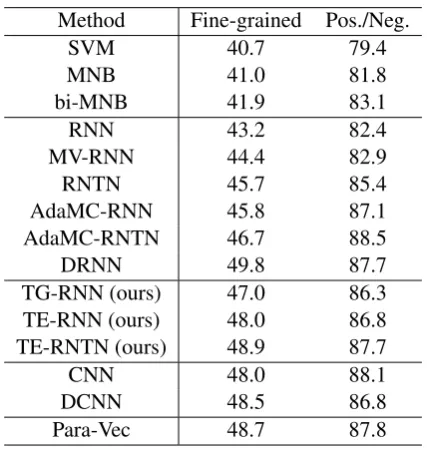
Table 1: Classification accuray. Fine-grained
stands for 5-class prediction andPos./Neg. means binary prediction which ignores all neutral in-stances. All the accuracy is at the sentence level (root).
for composition function which could model the meaning of longer phrases and capture negation rules.
• AdaMC. Adaptive Multi-Compositionality
for RNN and RNTN (Dong et al., 2014) trains more than one composition functions and adaptively learns the weight for each function.
• DCNN/CNN. Dynamic Convolutional
Neu-ral Network (Kalchbrenner et al., 2014) and a simple Convolutional Neural Network (Kim, 2014), though these models are of different genres to RNN, we include them here for fair comparison since they are among top per-forming approaches on this task.
• Para-Vec. A word2vec variant (Le and
Mikolov, 2014) that encodes paragraph in-formation into word embedding learning. A simple but very competitive model.
• DRNN.Deep Recursive Neural Network
(Ir-soy and Cardie, 2014) stacks multiple recur-sive layers.
[image:6.595.311.525.62.287.2]Compared with RNN, the fine-grained accuracy and binary accuracy of TG-RNN is improved by 3.8% and 3.9% respectively. When compared with AdaMC-RNN, the accuracy of our method rises by 1.2% on the fine-grained prediction. The results show that the syntactic knowledge does facilitate phrase vector composition in this task.
As forTE-RNN/RNTN, the fine-grained accu-racy of TE-RNN is boosted by 4.8% compared with RNN and the accuracy of TE-RNTN by 3.2% compared with RNTN. TE-RNTN also beat the AdaMC-RNTN by 2.2% on the fine-grained clas-sification task. TE-RNN is comparable to CNN and DCNN, another line of models for this task. TE-RNTN is better than CNN, DCNN, and Para-Vec, which are the top performing approaches on this task. TE-RNTN is worse than DRNN, but the complexity of DRNN is much higher than TE-RNTN, which will be discussed in the next sec-tion. Furthermore, TE-RNN is also better than TG-RNN. This implies that learning the tag em-beddings for child nodes is more effective than simply using the tags of parent phrases in com-position.
Note that the fine-grained accuracy is more convincible and reliable to compare different ap-proaches due to the two facts: First, for the bi-nary classification task, some approaches train an-other binary classifier for positive/negative clas-sification while other approaches, like ours, di-rectly use the fine-grained classifier for this pur-pose. Second, how the neutral instances are pro-cessed is quite tricky and the details are not re-ported in the literature. In our work, we sim-ply remove neural instances from the test data be-fore the evaluation. Let the 5-dimension vector
y be the probabilities for each sentiment label in a test instance. The prediction will be positive if arg maxi,i̸=2yi is greater than 2, otherwise
nega-tive, wherei∈ {0,1,2,3,4}means very negative, negative, neutral, positive, very positive, respec-tively.
5.3 Complexity Analysis
To gain deeper understanding of the models pre-sented in Table 1, we discuss here about the pa-rameter scale of the RNN/RNTN models since the prediction power of neural network models is highly correlated with the number of parameters.
The analysis is presented in Table 2 (the opti-mal values are adopted from the cited papers). The
parameters for the word table have the same size
n×dacross all recursive neural models, wheren
is the number of words anddis the dimension of word vector. Therefore, we ignore this part but fo-cus on the parameters of composition functions, termed model size. Our models, TG-RNN/TE-RNN, have much less parameters than RNTN and AdMC-RNN/RNTN, but have much better perfor-mance. Although TE-RNTN is worse than DRNN, however, the parameters of DRNN are almost 9 times of ours. This indicates that DRNN is much more complex, which requires much more data and time to train. As a matter of a fact, our TE-RNTN only takes 20 epochs for training which is 10 times less than DRNN.
Method model size # of parameters
RNN 2d2 1.8K
RNTN 4d3 108K
AdaMC-RNN 2d2×c 18.7K
AdaMC-RNTN 4d3×c 202K
DRNN d×h×l
+2h2×l 451K
TG-RNN (ours) 2d2×(k+ 1) 8.8K
TE-RNN (ours) 2(d+de)×d 1.7K
TE-RNTN (ours) 4(d+de)2×d 54K
Table 2: The model size. d is the dimension of word/phrase vectors (the optimal value is 30 for RNN & RNTN,25 for AdaMC-RNN, 15 for AdaMC-RNTN,300 for DRNN). For AdaMC,c
is the number of composition functions (15 is the optimal setting). For DRNN,landhis the number of layers and the width for each layer (the optimal valuesl= 4,h= 174). For our methods,kis the number of unshared composition matrices andde
the dimension of tag embedding, for the optimal setting refer to Section 5.4.
5.4 Parameter Analysis
We have two key parameters to tune in our pro-posed models. ForTG-RNN, the number of com-position functions k is an important parameter, which corresponds to the number of distinct POS tags of phrases.
composi-Phrase tag Frequency composi-Phrase tag Frequency
NP 60,239 ADVP 1,140
S 33,138 PRN 976
VP 26,956 FARG 792
PP 14,979 UCP 362
ADJP 7,912 SSINV 266
[image:8.595.68.310.68.164.2]SBAR 5,308 others 1,102
Table 3: The distribution of phrase-type tags in the training data. The top 6 frequency tags cover more than 95% phrases.
tion function for the infrequent phrase tags. Each of the top k frequent phrase tags corre-sponds to a unique composition function, while all the other phrase tags share a same function. We compare differentkfor TG-RNN. The accuracy is shown in Figure 5. Our model obtains the best per-formance whenkis 6, which is accordant with the statistics in Table 3.
0 2 4 6 8 10 12
k 0.42
0.43 0.44 0.45 0.46 0.47 0.48
accuracy
TG-RNN AdaMC-RNN RNN
Figure 5: The accuracy for TG-RNN with differ-entk.
ForTE-RNN/RNTN, the key parameter to tune
is the dimension of tag vectors. In the corpus, we have 70 types of tags for leaf nodes (words) and in-terior nodes (phrases). Infrequent tags whose fre-quency is less than 1,000 are ignored. There are 30 tags left and we learn an embedding for each of these frequent tags. We varies the dimension of the embeddingdefrom 0 to 30.
Figure 6 shows the accuracy for TE-RNN and TE-RNTN with different dimensions ofde. Our
model obtains the best performance when de is
8 for TE-RNN and 6 for TE-RNTN. The re-sults show that too small dimensions may not be sufficient to encode the syntactic information of tags and too large dimensions damage the
perfor-mance.
0 5 10 15 20 25 30
de 0.42
0.43 0.44 0.45 0.46 0.47 0.48 0.49
accuracy TE-RNTN
[image:8.595.321.501.98.234.2]TE-RNN AdaMC-RNTN AdaMC-RNN RNTN RNN
Figure 6: The accuracy for RNN and TE-RNTN with different dimensions ofde.
5.5 Tag Vectors Analysis
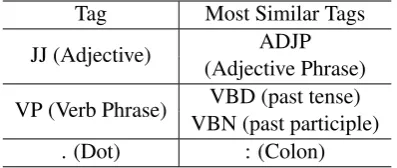
In order to prove tag vectors obtained from tag embedded models are meaningful, we inspect the similarity between vectors of tags. For each tag vector, we find the nearest neighbors based on Eu-clidean distance, summarized in Table 4.
Tag Most Similar Tags JJ (Adjective) (Adjective Phrase)ADJP
VP (Verb Phrase) VBN (past participle)VBD (past tense) . (Dot) : (Colon)
Table 4: Top 1 or 2 nearest neighboring tags with definition in brackets.
Adjectives and verbs are of significant impor-tance in sentiment analysis. Although ‘JJ’ and ‘ADJP’ are word and phrase tag respectively, they have similar tag vectors, because of playing the same role ofAdjectivein sentences. ‘VP’, ‘VBD’ and‘VBN’ with similar representations all repre-sent verbs. What is more interesting is that the nearest neighbor of dot is colon, probably because both of them are punctuation marks. Note that tag classification is none of our training objectives and surprisingly the vectors of similiar tags are clus-tered together, which can provides additional in-formation during sentence composition.
6 Conclusion
[image:8.595.87.265.368.503.2] [image:8.595.319.518.400.484.2]The first way is to use different composition func-tions for phrases with different tags so that the composition processing is guided by phrase types (TG-RNN). The second way is to learn tag em-beddings and combine tag and word emem-beddings during composition (TE-RNN/RNTN). The pro-posed models are not only effective (w.r.t com-peting performance) but also efficient (w.r.t well-controlled parameter scale). Experiment results show that our models are among the top perform-ing approaches up to date, but with much less pa-rameters and complexity.
Acknowledgments
This work was partly supported by the Na-tional Basic Research Program (973 Program) un-der grant No.2012CB316301/2013CB329403, the National Science Foundation of China under grant No.61272227/61332007, and the Beijing Higher Education Young Elite Teacher Project. The work was also supported by Tsinghua University Bei-jing Samsung Telecom R&D Center Joint Labora-tory for Intelligent Media Computing.
References
Fr´ed´eric Bastien, Pascal Lamblin, Razvan Pascanu, James Bergstra, Ian J. Goodfellow, Arnaud Berg-eron, Nicolas Bouchard, and Yoshua Bengio. 2012. Theano: new features and speed improvements. Deep Learning and Unsupervised Feature Learning NIPS 2012 Workshop.
Yoshua Bengio, R´ejean Ducharme, Pascal Vincent, and Christian Janvin. 2003. A neural probabilistic
lan-guage model. The Journal of Machine Learning
Re-search, 3:1137–1155.
Li Dong, Furu Wei, Ming Zhou, and Ke Xu. 2014. Adaptive multi-compositionality for recursive neu-ral models with applications to sentiment analysis.
InAAAI. AAAI.
Karl Moritz Hermann and Phil Blunsom. 2013. The role of syntax in vector space models of
composi-tional semantics. InACL, pages 894–904.
Associa-tion for Computer Linguistics.
Ozan Irsoy and Claire Cardie. 2014. Deep recursive neural networks for compositionality in language.
InNIPS, pages 2096–2104.
Nal Kalchbrenner, Edward Grefenstette, and Phil Blun-som. 2014. A convolutional neural network for
modelling sentences. InACL, pages 655–665.
As-sociation for Computer Linguistics.
Yoon Kim. 2014. Convolutional neural networks for
sentence classification. In EMNLP, pages 1746–
1751. Association for Computational Linguistics.
Thomas K Landauer and Susan T Dumais. 1997. A solution to plato’s problem: The latent semantic analysis theory of acquisition, induction, and
rep-resentation of knowledge. Psychological Review,
104(2):211.
Quoc V Le and Tomas Mikolov. 2014. Distributed
rep-resentations of sentences and documents. InICML,
volume 32, pages 1188–1196.
Peng Li, Yang Liu, and Maosong Sun. 2013. Re-cursive autoencoders for ITG-based translation. In
EMNLP, pages 567–577. Association for Computer Linguistics.
Tomas Mikolov, Kai Chen, Greg Corrado, and Jeffrey Dean. 2013a. Efficient estimation of word
represen-tations in vector space.CoRR.
Tomas Mikolov, Ilya Sutskever, Kai Chen, Greg S Cor-rado, and Jeff Dean. 2013b. Distributed representa-tions of words and phrases and their
compositional-ity. InNIPS, pages 3111–3119.
Jeff Mitchell and Mirella Lapata. 2008. Vector-based
models of semantic composition. In ACL, pages
236–244.
Sebastian Pad´o and Mirella Lapata. 2007.
Dependency-based construction of semantic space
models. Computational Linguistics, 33(2):161–199.
Bo Pang and Lillian Lee. 2008. Opinion mining and
sentiment analysis. Foundations and Trends in
In-formation Retrieval, 2(1-2):1–135.
Sebastian Rudolph and Eugenie Giesbrecht. 2010. Compositional matrix-space models of language.
In ACL, pages 907–916. Association for Computer
Linguistics.
David E Rumelhart, Geoffrey E Hinton, and Ronald J Williams. 1986. Learning representations by
back-propagating errors.Nature, 323:533–536.
Paul Smolensky. 1990. Tensor product variable bind-ing and the representation of symbolic structures
in connectionist systems. Artificial intelligence,
46(1):159–216.
Richard Socher, Jeffrey Pennington, Eric H Huang, Andrew Y Ng, and Christopher D Manning. 2011. Semi-supervised recursive autoencoders for
predict-ing sentiment distributions. InEMNLP, pages 151–
161. Association for Computational Linguistics. Richard Socher, Brody Huval, Christopher D
Man-ning, and Andrew Y Ng. 2012. Semantic composi-tionality through recursive matrix-vector spaces. In
Richard Socher, John Bauer, Christopher D Manning, and Andrew Y Ng. 2013a. Parsing with
compo-sitional vector grammars. InACL, pages 455–465.
Association for Computer Linguistics.
Richard Socher, Alex Perelygin, Jean Y Wu, Jason Chuang, Christopher D Manning, Andrew Y Ng, and Christopher Potts. 2013b. Recursive deep mod-els for semantic compositionality over a sentiment
treebank. In EMNLP, pages 1631–1642.
Associa-tion for ComputaAssocia-tional Linguistics.
Peter D Turney, Patrick Pantel, et al. 2010. From frequency to meaning: Vector space models of
se-mantics. Journal of Artificial Intelligence Research,
37(1):141–188.
Sida I Wang and Christopher D Manning. 2012. Base-lines and bigrams: Simple, good sentiment and topic
classification. InACL, pages 90–94. Association for
Computational Linguistics.