1
A Virtual Billiard Assistant
Joris van Balen Student Number: 9810986
Masters Thesis
Supervisors/Graduation Committee:
dr. M. Poel
ir. H. van Welbergen dr. Z.M. Ruttkay prof.dr.ir. A. Nijholt
2
Abstract
This thesis describes the development of a virtual billiard assistant (VBA), that should
ultimately be able to replace a qualified human trainer. The scope of the project is the tactical part of three cushion billiards, where players have to solve a ball configuration, and play it accordingly, in order to score a point.
The VBA proposed in this thesis has two main tasks:
1. Find a best solution for any possible ball configuration 2. Present this solution to the user
A solution is considered best when a human trainer would recommend the same solution in the same situation.
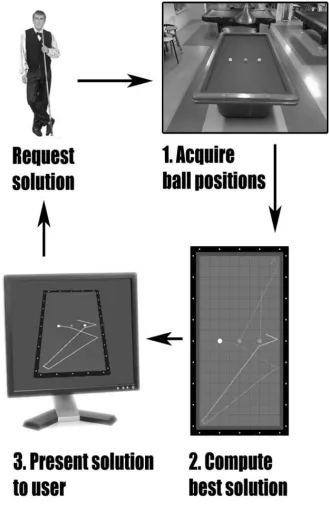
When a user is exercising, it can ask the VBA to solve a ball configuration whenever he desires. The ball configuration is retrieved using a webcam and image processing
techniques, and presented to the VBA. The VBA then systematically tries out a vast amount of shot parameter combinations, and detects which are successful. To achieve this it makes use of a physical model, which is implemented in such a way that it can accurately simulate a great amount of shots in limited time. This will typically result in a set of solutions, which are first clustered and then sorted. The top solution of this sorted set should be the same solution as a human expert trainer would recommend. The resulting solutions are presented to the user via a computer screen, using a 3d model of a billiards table, with a white line indicating the path along which the cue ball should travel.
3
Index
Abstract ... 2
Index ... 3
1. Introduction ... 5
1.1 Defining The Virtual Billiard Assistant ... 5
1.1.1 Typical scenario ... 5
1.1.2 VBA specifications ... 6
1.1.3 Target user group ... 8
1.2 Research Questions ... 9
1.2.1 How should the VBA calculate a solution to recommend to a player for any given ball configuration? ... 9
1.2.2 How to communicate a solution with the user? ... 10
1.3 Literature Review ... 11
1.4 Personal Motivation ... 12
1.5 Document Overview ... 13
1.6 Acknowledgements ... 14
2. Physical Model of Billiards ... 15
2.1 Cue-Ball Impact ... 15
2.2 Ball Motion ... 19
2.2.1 Friction Coefficients ... 20
2.3 Ball-Ball Impact ... 21
2.4 Ball-Cushion Impact ... 22
3. Simulation of Billiards ... 26
3.1 Time of Motion State Transition ... 26
3.2 Time of Ball-Cushion Collision ... 27
3.3 Time of Ball-Ball Collision ... 28
3.4 Numerical Simulation ... 29
3.5 Test Application ... 29
4. Finding Solutions for Ball Configurations ... 30
4.1 Generating Possible Solutions ... 30
4.1.1 Limiting Input Shot Parameters Values ... 31
4.1.2 Shot Generation ... 34
4.1.3 Clustering of Solutions ... 34
4.1.4 Evaluation of Solution Generation ... 36
4.2 Ordering the Set of Possible Solutions ... 38
4.2.1 Sorting Solutions Using Cluster Size ... 38
4.2.2 Evaluation of Shot Recommendation ... 38
4
5. Assisting Players ... 46
5.1 Inputting Ball Configurations... 46
5.1.1 System Calibration ... 46
5.1.2 Acquiring Ball Configuration ... 47
5.1.3 Evaluation of Detection Method... 49
5.1.4 Discussion ... 50
5.2 Demonstrating Solutions ... 50
5.2.1 Visualization of Shot Parameters ... 51
5.2.2 Interaction ... 52
5.3 User Tests: System Evaluation ... 53
5.3.1 Preliminary User Test ... 54
5.3.2 User Tests Setup ... 55
5.3.3 Results ... 56
5.3.4 Discussion ... 61
6. Conclusions and Future Work ... 66
6.1 The Physical Model ... 66
6.2 Finding Solutions for Ball Configurations ... 67
6.4 Interaction ... 68
Bibliography ... 69
Appendices ... 70
Appendix A: Three Cushion Billiard Game Rules ... 70
Appendix B: Terminology ... 72
Appendix C: Brief Evaluation of Physical Model ... 73
Appendix D: Test Application ... 76
Appendix E: Reproducibility Results... 77
5
1.
Introduction
Billiards is a game that has appealed to many over the last centuries. It's precise origin is unknown, but it is believed that it originated from home table versions of golf and croquet. Several accounts of famous historical figures can be found being fascinated by the game, ranging from Shakespeare to Blaise Pascal. It is even believed [1] that Mozart's permanent state of bankruptcy can, for a great part, be accredited to his love for the game, combined with the vast amount of money people used to play for at that time in Vienna. On the one hand one can argue that this was a good thing, urging Mozart to share his music to support his other addiction, on the other hand he probably would have benefited from some kind of personal billiard trainer.
Three cushion billiards1 is a type of billiard game that is perceived as complex and difficult to master. Beginning billiard players are advised to start off with an easier form of billiards called libre, to gain basic insight, precision and technique. When players want to start learning the three cushion game, this normally happens by explanation and demonstration. The ambitious player can either watch the more skilled play their game, train for themselves or be trained by a coach. Although the latter presumably would be the best option, it is also the most expensive one.
An interesting topic in the field of Human Media Interaction is that of digital assistants. The aim of this project is to explore the possibilities for a Virtual Billiard Assistant (VBA), that should assist players wanting to master the game of three cushion, and ultimately be able to replace a human billiards trainer.
This chapter first discusses how a VBA should work, and for whom it is meant. Next the scope of the project will be defined by stating the research questions and requirements in section 1.2. Section 1.3 will gave an overview of related work and literature. Section 1.4 will explain a personal motivation for the project, and section 1.5 will give an overview of the remainder of this document.
1.1 Defining The Virtual Billiard Assistant
The ultimate goal of this project would be a complete Virtual Billiard Assistant (VBA), able to assist average three cushion players in improving their tactical insights in the game, as good as or even better than a human billiard trainer would. This goal obviously is not reachable within the limited time span of the project. In this section is presented nevertheless, what an ultimate VBA should look like. This is done by first describing a typical use case scenario, followed by a more detailed description and explanation of the specifications of the VBA. Finally the term user is specified in the scope of the project.
1.1.1 Typical scenario
Player John is an average billiards player, specialized in pool, but desiring to become a skilled three cushion player. He has mastered all the technical skills needed to aim a ball and play it fluently with the desired amount of spin applied, but he has no idea about how to solve
1
6 a ball configuration, in a manner that provides him the best odds for success. In other words, John lacks the tactical skill needed for successful three cushion billiard play.
Although he wants to do something about that, he is reluctant to spend money on a personal trainer, and does not want to bother other three cushion players too much. He knows that probably the best option for learning how to solve typical ball configurations, is to watch others play them. This has the downside that, while watching others play, John himself cannot play, and has to remember the different decisions the players make. Moreover, he will not be sure whether these decisions are the right ones, not knowing about the level of
expertise of the players he is observing.
What John wants, is a Virtual Billiard Assistant. Whenever John is exercising the game of three cushion, the VBA is there to decide how each ball configuration should be solved. During the first sessions, John might just place the balls randomly on the table, and ask the VBA how to solve the shot. Or he might remember a ball configuration he wasn't able to solve successfully in last night‟s match, and feed it to the VBA.
After a while John becomes more skilled, and will be able to solve most configurations himself. Now when he is exercising he tries to figure out most configurations on his own, but every once in a while a configuration comes along which leaves him clueless. At that point John can address the VBA again.
Another task the VBA could carry out to assist John occurs when John misses a ball during his exercise play, but does not know what went wrong. The VBA could now provide feedback about how and why the shot carried out by John does not match the ideal shot as calculated and recommended by the VBA.
Tracking the player's skills could also be a desirable option. When the VBA is able to analyze what went wrong during a shot carried out by the player, it could accumulate this data into a profile. It would then be able to indicate shortcomings to the player, possibly advising some practice shots. The VBA might for example notice, that the player has difficulties playing draw shots. The VBA then provides some tips on draw shots, and provide exercise shots, or pick similar ball configurations from the player profile that have had a low success rate.
1.1.2 VBA specifications
In order to accomplish a scenario as described in section 1.2, the VBA should go through several steps every time the balls lay still on the table. The process consists of four main components:
1. acquire current ball configuration
2. decide how the ball configuration should be solved
3. provide advice to the player on how to solve the configuration
4. when asked for, provide feedback explaining why the last shot was not carried out (un-) successfully by the player
When balls are moving, the VBA should: 5. track the movement of the balls
7 7. compare the shot actually being carried out by the player to the shot the VBA
advised, and, if different, deduce why
8. gather data on played shots in a player profile
[image:7.595.127.457.211.718.2]It is easy to see that steps 4..8 are very complicated, as (near) real-time analysis of the moving balls is required. They were not realized within the project's time span, but are recommended as future work. This thesis focuses on the first 3 main points. The aim of this project is a system that is able to recommend a solution to a player for any given ball configuration present on a billiards table as depicted in figure 1.1.
8
1.1.3 Target user group
Throughout the project, the person addressed as the user is the one that will be enjoying the VBA‟s services. By definition, the user is interested in improving his2 billiards skills. However,
different players have a different level of expertise to start with, and may desire different types of assistance/advice from a real life trainer or VBA.
Billiard skills can be split up in tactical and technical skills. By tactical skills we simply mean the insight in how to solve a ball configuration, giving the best odds for success. Technical skills consider the actual physical process of being able to carry out a solution by the player. This includes things as body posture, fluid striking technique and aiming accuracy.
Although an ultimate VBA should be able to assist the user on improving his technical skills, it will be a very complicated task, as fine details are to be detected and considered. How a VBA could assist in improving technical skills of a player is discussed very briefly in chapter 6 as possible future work. Solving ball configurations, the tactical part, is the task of the VBA this project focuses on.
Therefore the range of users that the VBA is designed for is limited to players that have a decent amount of technical skill, but lack (a full) understanding of the tactical part of the game. Typically this will be players that already have experience in other types of billiards, or players that play three cushion billiards already on an intermediate level, but wish to improve their tactical insight.
Players lacking technical skills are not expected to be able to reproduce a shot within a reasonable margin of error. On the other hand, expert three cushion players probably will not benefit from a VBA, as long as it is not incredibly fine grained and accurate.
During a match of three cushion billiards, players annotate their scores on a scoreboard. Not only are their scores annotated, also the amount of turns taken. By dividing the amount of points by the amount of turns, a player‟s average (or moyenne) is calculated. These averages are collected for example during the period of a year, and are a fairly solid indication of a player‟s level of skill. The average of the players the VBA is designed will typically be in the range of 0.25 to 0.5 points per turn. This may seem a small interval, but looking at the averages of three cushion players of the Twente District 3, most of the players fall into this category. It is not unthinkable however that players outside this range could also benefit from the services of a VBA.
The averages are also an indication of the difficulty of three cushion billiards, as an average of 0.5 implies that a player only solves and carries out successfully 1 out of 3 ball
configurations, as every turn includes a miss. Players with an average of 1 are already regionally considered top players, whereas the absolute world‟s best players typically have an average between 2 and 3 (albeit on a match size table).
2
The user will be addressed as male throughout the project. Obviously a user could also be female.
3
9
1.2 Research Questions
In section 1.1 the scope for this project was established. A user should, for any possible ball configuration encountered, have the possibility to ask the VBA for advice on how to play the shot in such a way that it will result in a successful carombole. In order to develop a VBA as depicted in figure 1.1, focusing on the tactical part of three cushion play, two main research questions are explored:
R.Q. 1: How should the VBA calculate a solution to recommend to a player for any given ball configuration?
R.Q. 2: How should the VBA interact with a user?
Several general requirements are posed, that the VBA should meet:
Req. 1.1: The VBA should be able to advice the player as fast as possible. The time between a request from the user and the presentation of the recommended solution should not be perceived as too long.
Req. 1.2: The VBA should be able to give an advice for every possible ball configuration it is presented.
Req. 1.3: The VBA should be little obtrusive, and enable the player to move freely, serving as tool, that a player can use whenever he wants.
Req. 1.4: The VBA should run robustly within the testing environment. Req. 1.5: The user should trust the VBA.
Several aspects that could be explored are left out of the project. The most important are: The VBA will be developed and tested using the same billiards table all the time.
Therefore conditions are reasonably controlled and no explicit requirements are posed on robustness outside the testing environment.
Although the ultimate goal of a VBA would be to improve skills of a player, there is no way to accurately measure the effect of using a VBA in this regard on a short term. Therefore it is not an explicit requirement. However, in 1.4 it is reasoned why using a VBA, even a basic implementation, is expected to improve a player‟s skills.
The two main research questions are very general, and therefore should be split up in several sub questions.
1.2.1 How should the VBA calculate a solution to recommend to a player for any
given ball configuration?
The number of possible ways to strike a cue ball is infinite. Therefore, every ball
configuration has an infinite amount of possible solutions. Obviously, a VBA should limit the amount of solutions that it presents to the user to one best, or a couple of good solutions. In order to solve a ball configuration, the VBA should first be able to determine what solutions are possible.
10 The method that will be used to generate possible solutions should meet the following
requirements:
Req. 1.1.1: The method to generate the shots should be reasonably fast.
Req. 1.1.2: Solutions that are generated should be accurate, i.e. reproducible by a user on a real table.
Req. 1.1.3: All solutions that an expert would assess as reasonable for a particular ball configuration should be present.
Req. 1.1.4: If two solutions are considered the same by an expert, the method should cluster them and select one representative of the cluster.
Now that the VBA has a certain amount of possible solutions at its disposal, it needs to find one that should be recommended to the user.
R.Q. 1.2: How to select one solution from the set of all possible solutions that is to be recommended to the user?
The following requirements have to be met when selecting recommendable shots:
Req. 1.2.1: One solution should be recommended as the best one. The solution is considered best, when an expert trainer would recommend the same solution when he is presented the same ball configuration.
Req. 1.2.2: The VBA should be able to present good alternatives, if the user desires. An alternative solution is considered good, when an expert trainer would agree to the alternative being a plausible solution.
1.2.2 How to communicate a solution with the user?
Communication between the VBA and the outside world consists of two parts. Upon a user‟s request, the ball configuration should be acquired. The positions of the three balls within the table frame can then be fed to the solving algorithm. This poses the first sub-question of research question 2, dealt with in section 5.1.
R.Q. 2.1: How to present a ball configuration from a real world table to the VBA?
Several requirements have to be taken in to account while finding an answer to this question: Req. 2.1.1: The method should be reasonably accurate, with a maximum deviation of a ball‟s radius. This is considered acceptable for the game of three cushion (explicitly not for other billiard games, especially libre).
Req. 2.1.2: The method should be as little obtrusive as possible, not restricting the freedom of movement for the user too much.
When the input is processed, the resulting recommended solution has to be presented to the user. The sub-question regarding this aspect is dealt with in section 5.2 and 5.3:
R.Q. 2.2: How to present a solution to a user?
11 Req. 2.2.1: A billiards shot could be defined by several parameters, for example the velocity at which the cue hits the cue ball upon impact. These parameters should be chosen and presented so that the user is able to reproduce a shot accurately.
Req. 2.2.2: The user should be able to interact freely and intuitively with the VBA, he should not feel restricted by the interface.
1.3 Literature Review
A good amount of literature and related work is available, but no work was found specifically on assisting players by computationally solving three cushion shots. However projects were found that show overlap.
Lars Bo Larson describes an automated pool trainer platform [2]. This is a platform used at the university of Aalborg to experiment with multi modal user interaction. The basis of the system is a training method called Target Pool, which consists of sets of predefined practice shots. Users of the system have to carry out the practice shots, and get rewarded points for the outcome. This differs substantially from the goal of the VBA, where shots are not
predefined but calculated from an input ball configuration. Furthermore, the project considers the game of pool, not the game of three cushion billiards.
However the modalities used are interesting and could be applied to the VBA. For example, input modalities range from computer vision (an interface is projected on the table, the user‟s hands are tracked to determine when the user interacts with this interface) to speech
recognition. Output modalities tested are projection on the table cloth using a beamer, and an embodied conversational agent giving feedback.
Assisting the player by visualizing a shot using augmented reality is explored by T. Jebara et al [3]. A pool player is given a head mounted display, with a camera attached to it. The camera retrieves the ball configuration on the table, calculates a shot to recommend, and recommends it by drawing a virtual (via the display) line on the table, indicating the path the cue ball and object ball should travel. Unfortunately no usability tests were done, and no follow-up was found. The game used in the project is pool, which means the shot
recommendation is more straightforward than finding three cushion solutions.
Solving shots for the game of pool billiards (which differs greatly from three cushion billiards in terms of game logic) computationally, was covered during the 10th and 11th ICGA
Computer Olympiads. A physical model of a pool table was implemented by M. Greenspan and W. Leckie [4], on which contestants used different techniques to play a game of
computational pool. This spawned some interesting game strategy techniques, most notably [5] by M.Smith. However, there is a fundamental difference in tactics between pool and three cushion billiards; pool involves looking ahead one or more shots. This implies the generation of a search tree, which is not necessary for three cushion billiards.
Multiple arithmetic shot solving systems exist that make use of the diamonds, the markers on the wooden frame surrounding the playfield. Jean Verworst presents several of these
12 the need for categorizing of ball configurations into different types, needing their own
system.
there are irregularities in the systems that need to be fixed with complicated modifications.
the systems are designed for a „match‟-size billiard table (2.845m x 1.4225m). The table used by most three cushion players, and throughout this project, is of smaller size (2.30m x 1.15m). This results in the need for even more modifications.
These difficulties led to the decision not to implement Verworst‟s systems but look for a more generic and flexible way to solve ball configurations (discussed in chapter 4). It should be noted however, that the book is highly respected and used by many (expert) three cushion players.
1.4 Personal Motivation
I will use this space to express my personal motivation for this project, which will be subjective and claims are speculative, but it does provide a broader context.
For years now I have been an enthusiastic three cushion player myself. Many things about three cushion I learned from an expert human trainer, Jelle Pijl (who was consulted several times during the project), but the bulk of improvement came from practicing with other players, or even alone. We would like to call this “training”, but it just came down to playing matches, seldom reasoning about the choices that were made, and why things went wrong when they did.
One of the things that struck me during these sessions, was that when a BC had to be solved, I‟d purely rely on my gathered expertise, by taking a quick glance and immediately choose a solution. Then I would walk up to the table, line up for the shot, estimate where to hit the first cushion and shoot. When successful, the process repeated, when unsuccessful, the chair awaited, from where I could watch my opponent play until he in turn misses. Now let‟s split up the performing of a shot into a tactical part, that is the solution thought up (what path the cue ball should travel, and how to achieve this), and a technical part. The technical part is considered perfect when a shot is exactly produced as planned. The tactical part is considered perfect if the solution would result in a carombole if the technical part is perfect.
When a shot is successful, several things could have happened: The tactical part was perfect, as was the technical
The tactical part was imperfect, as was the technical part, cancelling each other out Either the tactical part or the technical part or both were imperfect, but the carombole
13 This phenomenon also works the other way around. When a shot is unsuccessful, it could either be due to failure in the technical part, as well as the tactical, or both. Often it is hard to conclude afterwards which part was wrong.
I became fascinated by the idea of using a computer to conduct either the technical part, or the tactical part, so that one of these two variables could be eliminated. Eliminating the technical part would require a robot conducting the shots perfectly. This happens to be explored for the game of pool, but is more of an electrical engineering issue. But developing a virtual assistant taking care of solving shots and recommend a solution fits well within the field of Human Media Interaction.
If the VBA is able deliver a best solution, and the user can trust to take it as „ground truth‟, the user can concentrate on conducting the shot as advised, and draw conclusions
afterwards. Furthermore, the less experience user that is unable to figure out for himself how to solve a shot, can now learn by playing good solutions, instead of “just trying”. Also, if the recommendation would always be the „best‟ according to certain measures, every player could test his own hypothetical „best‟ solution to it.
Often I was told by the expert trainer, that before I conduct a shot, I should mentally project the complete shot being played out on the table, before attempting it. This mental trick is used in a lot of different sports where action has to be taken from a static situation, for example tennis, soccer (free kick) or golf. One of the reasons for this probably is also to factor out any doubt concerning the tactical part, so that the player can fully commit to conducting the technical part: scoring an ace, a goal, or a putt. This mental projection beforehand could also be greatly enhanced by the aid of a VBA.
1.5 Document Overview
The remainder of this document will discuss the different parts that were explored and tested, in order to enable the first prototype of a VBA. Chapter 2 describes the physical model that was established using the work of [4] and [7]. The physical model is key to the project, as its implementation enables the VBA to simulate billiard shots, in order to find solutions.
Chapter 3 discusses the analytical approach used for the implementation of the physical model, that ensures the implementation to be both fast and accurate.
The method that is used to find solutions to present to the user is described and discussed in chapter 4.
Now that the VBA is able to provide one or more solutions for any input ball configuration, a means has to be established to provide the VBA with the required input and to present the found solution(s) to the user. This interaction layer is explored in chapter 5.
Chapter 6 finally assesses the results collected during the project, and recommends possible improvements and paths for continuation.
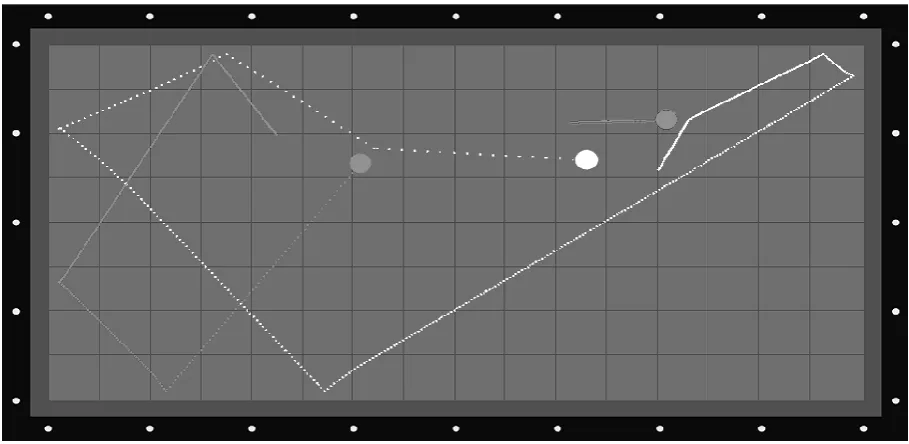
Throughout the document, examples of billiard shots will be depicted like in figure 1.5.1. These images should be interpreted as follows:
14 not really necessary. Originating from the white ball is a white dotted line. The dots are a plot of the position of the white ball over time, in this case drawn at a resolution of 100 dots per second. The dotted line thus indicates the path the white travels from moment of impact, until stationary.
[image:14.595.70.525.166.388.2]The same is done for the two object balls, which start moving immediately upon impact with the cue ball.
Figure 1.5.1: Example of an illustration of a three cushion shot
1.6 Acknowledgements
15
2. Physical Model of Billiards
In order to generate solutions, the VBA should be able to simulate billiard shots. In order to simulate billiard shots computationally, a physical model needs to be established. The
requirements state that the user must be able to trust the advice of the VBA. This implies that the solutions the VBA produces need to be accurately reproducible on a real table. Therefore the physical model should be accurate enough to not violate this requirement.
To this extent, several literature resources were consulted. The most important are [7] and [4], in which the authors describe how they implemented a physical model to simulate
billiard/pool shots. The ideas and principles used by the authors of [7] and [4] are used in this section to construct a model of the physics involved with billiards.
From the moment that the cue ball is struck with a cue until all balls are stationary again, several events can occur which need to be treated separately. This chapter starts with the modeling of the cue striking the ball, and the resulting initial velocities. Immediately after impact the ball will begin sliding. After a while, due to table friction, the sliding will evolve into a rolling motion. This and other aspects of the ball‟s motion will be discussed in section 2.2. Inherent to the rules of the game, the cue ball eventually has to collide with the other two balls on the table. Response to this collision is discussed in 2.3. Collision with a cushion is a different, more complicated subject as it cannot be treated as a near-perfect elastic collision. It‟s dealt with in section 2.4.
Three different coordinate reference frames are used in this chapter. The first is a three-dimensional ball-centric reference frame adopted from [4], which has axes (𝑖 , 𝑗 , 𝑘 ) originating from the ball‟s center of mass (see figure 2.1.1), at t=0. This frame is used for the description of ball motion. After the ball is struck by a cue, it will start to move along the 𝑖 -axis.
Second is the 2-dimensional table reference frame, depicted in figure 2.1.2, with axes 𝑥 and
𝑦, originating in the top left corner. This frame is used for the absolute position of the balls. The third reference frame is adopted from [7], and is used to describe the collision of a ball with a cushion (figure 2.4.1). Here the 𝑦-axis is always tangential to the cushion, the 𝑥-axis perpendicular to the cushion and the 𝑧-axis perpendicular to the table cloth.
Vectors are indicated with an arrow, for example 𝑣 . Vector components are indicated by a subscript defining which component is meant, for example 𝑣 𝑖 . Normalized and unit vectors are indicated with a caret, for example 𝑢 . Initial values for a vector are denoted with a subscript 0, for example 𝑣 0 for velocity at time t=0.
2.1 Cue-Ball Impact
In [4] a method to model the impact of the cue on the ball is described. A ball is set in motion when it is struck with a cue. Let (𝑖 , 𝑗 , 𝑘 ) be the ball-centric coordinate reference frame. Five impact parameters are used to describe the impact, depicted in figure 2.1.1:
16 2. 𝑉0: The velocity of the cue at time of impact
3. 𝑎, 𝑏: the distance (horizontally, vertically) of the point of impact from the centre of the ball
[image:16.595.72.469.105.374.2]4. 𝜃: the angle of the cue relative to the table plane, i.e. how much the cue is tilted
Figure 2.1.1: Taken from [4],visualization of parameters
Figure 2.1.2: Table reference frame. Axes x and y originate in upper left corner. ψ is the aiming angle, relative to the line that intersects the center of the cue ball and is parallel to the x-axis.
Parameters 𝑎 and 𝑏 are used to control the initial rotational velocity of the ball around the 𝑘 and 𝑗 axes. This gives the player several „tools‟ at his disposal:
[image:16.595.71.524.404.637.2]17 angle of the cue ball after it hit the cushion. In three cushion play, this type of spin is used almost always (for example, see [6]).
Variable 𝒃; Top spin (follow) or back spin (draw): increasing the distance 𝑏 results in a greater amount of angular velocity around the 𝑗 -axis. This is particularly useful for
manipulating the path of the cue ball after a collision with the first object ball. This is further explained in section 2.3.
Shots with 𝜃 > 0, where the cue is tilted, induce a rotation around the 𝑖 -axis which results in a curvilinear path. Because of the greater difficulty shots with an elevated cue are very rarely used by three cushion players. Therefore the parameter θ is set to 0 throughout the project. A cue striking the cue ball will now be defined by four parameters, annotated as the tuple
[𝑎, 𝑏, 𝑉, 𝜓].
The impact of the tip of the cue is modeled in [4] as an instantaneous point impact. After impact the ball will be moving along a linear path defined by the 𝑖 -axis of the ball reference frame.
For calculation of the magnitude F of the force imparted on the ball by the cue impact, the following equation is used in [4]:
Eq.2.1.1 𝐹 =
2𝑚𝑉0
1 +𝑚𝑀+2𝑅52+ 𝑎2+ 𝑏2𝑐𝑜𝑠2𝜃 + 𝑐2𝑠𝑖𝑛2𝜃 − 2𝑏𝑐 cos 𝜃𝑠𝑖𝑛 𝜃
R is the ball‟s radius (0.031m), m = the ball‟s mass (0.21kg), M = the cue‟s mass (~0.5kg), and c is the 𝑘 -component of impact point Q , defined by (𝑎, 𝑏, 𝑐).
Note that F in this case is an integration of Newton‟s second law, the change in velocity is treated as instantaneous.
Due to the restriction that 𝜃 = 0, eq. 2.1.1 is rewritten to:
Eq.2.1.2 𝐹 = 1 +𝑚 2𝑚𝑉0
𝑀+2𝑅52+ 𝑎2+ 𝑏2
The impact is assumed instantaneous. Integrating Newton‟s second law gives 𝐹 = 𝑚𝑣 , where 𝑣 is the initial translational velocity of the cue ball. Expressed in the ball-centric reference frame:
Eq.2.1.3 𝑣 = −𝐹
𝑚 , 0,0
The initial rotational velocity of the cue ball, immediately after impact, is (also expressed in the ball-centric reference frame):
Eq.2.1.4 𝜔 =1
𝐼 0, 𝑏𝐹, −𝑎𝐹
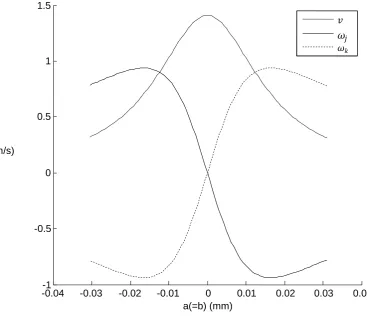
18 The equation used to calculate F suggests a strong relationship between the amount of spin applied (𝑎, 𝑏), and the initial velocities of the cue ball. This is visualized for the initial
velocities in figure 2.1.3. It shows that increasing 𝑎 and 𝑏 results in a strong decrease of initial translational velocity 𝑣 . This behavior wasn‟t observed in real life. Furthermore it is more convenient when generating shots for finding solutions to have initial translational velocities uniform, independent of a or b. Therefore eq.2.1.2 was simplified further to
Eq.2.1.5 𝐹 = 2𝑚𝑉0
1 +𝑚𝑀+2𝑅52
[image:18.595.72.440.287.607.2]
Although this may seem oversimplified, it was decided to use eq.2.1.5 for modeling cue impact, as the exact relation between cue velocity,𝑎,𝑏 and initial ball velocity is not very relevant for the tactical part of three cushions.
Figure 2.1.3: relation between a,b and initial velocities
-0.04 -1 -0.03 -0.02 -0.01 0 0.01 0.02 0.03 0.04 -0.5
0 0.5 1 1.5
a(=b) (mm)
𝑣
𝜔𝑗 𝜔𝑘
19
2.2 Ball Motion
According to [4], a ball in motion can be in one of four different motion states: sliding, rolling, spinning or stationary. Immediately after the ball is struck, it will begin sliding along a
rectilinear path along the 𝑖 -axis, with a translational velocity 𝑣 and rotational velocity 𝜔 . These velocities are combined into an equation representing the concept of relative velocity,
introduced by [8]:
Eq.2.2.1 𝑢 𝑡 = 𝑣 𝑡 + 𝑅𝑘 × 𝜔 𝑡
Which can be rewritten as:
Eq.2.2.2 𝑢 𝑡 =
𝑣𝑖 − 𝑅𝜔𝑗 𝑣𝑗 + 𝑅𝜔𝑖 𝑣𝑘
R is the ball radius (0.031m), the reference frame is the same ball-centric frame as in fig. 2.1.1. Note that the relative velocity has a zero 𝑘 -component, because 𝑣𝑘 = 0 (shots that include a „flying‟ ball are not encountered in normal three cushion play).
While 𝑢 𝑡 ≠ 0 the ball will be in a sliding state. When 𝑢 𝑡 = 0 the ball is said to be in rolling state. Immediately after cue impact the ball will be in sliding state, with a translational velocity along the 𝑖 -axis, and a rotational velocity around the 𝑗 -axis. Following from eq.2.2.2, the ball will be in rolling motion when
Eq.2.2.3 𝑣𝑖 = 𝑅𝜔𝑗
which corresponds to a point P on the surface of the ball traveling at the same velocity (𝑅𝜔𝑗 ) as the center of the ball (𝑣𝑖 ). The restriction 𝜃 = 0 already ensures 𝑣𝑗 = 0 = 𝑅𝜔𝑖 (this is different after a collision with another ball or a cushion occurs).
During the sliding state, the motion equations governing the ball‟s motion are [4]:
Eq.2.2.4 𝑟 𝐵 𝑡 = 𝑣0𝑖𝑡 − 1
2𝜇𝑠𝑔𝑡2𝑢 0𝑖
𝑣0𝑗𝑡 − 1
2𝜇𝑠𝑔𝑡2𝑢 0𝑗
Eq.2.2.5 𝑣 𝐵 𝑡 = 𝑣 0− 𝜇𝑠𝑔𝑡𝑢 0
Eq.2.2.6 𝜔 𝐵 𝑡 = 𝜔 0−5𝜇𝑠𝑔
2𝑅 𝑡(𝑘 × 𝑢 0)
Eq.2.2.7 𝜔𝑘 𝑡 = 𝜔𝑘0−
5𝜇𝑠𝑝𝑔
2𝑅 𝑡
20 Eq.2.2.4 expresses the displacement 𝑟 𝐵 𝑡 of the ball after time 𝑡. It shows that when the normalized vector 𝑢 0 has a non-zero 𝑗 -component, the ball moves in a non-rectilinear path. As explained earlier, this is not possible immediately after cue-impact (as 𝜃 = 0). However in section 2.3 and 2.4 it is explained that it is possible after ball-ball or ball-cushion impact. As shown in eq.2.2.7 the motion around the 𝑘 -axis is treated separately, while it is the same in both sliding as rolling state. The separate treatment of 𝜔𝑘also implies that there‟s another state, spinning, when the ball has no translational velocity, but is spinning around it‟s vertical axis.
During the rolling state the motion equations are:
Eq.2.2.8 𝑟 𝐵 𝑡 = 𝑣 0𝑖 𝑡 − 1 2𝜇𝑟𝑔𝑡2
0
Eq.2.2.9 𝑣 𝐵 𝑡 = 𝑣 𝑜 − 𝜇𝑟𝑔𝑡𝑣 0
From the definition of rolling state follows that: Eq.2.2.10 𝜔𝑗 𝑡 = 𝑣𝑖
𝑅
Eq. 2.2.1 to 2.2.10 are the equations needed to update all motion variables of the balls after time 𝑡. As the displacement 𝑟 𝐵is within the ball-centric frame, it needs to be converted to a displacement within the table frame (figure 2.1.2). This is done using the following translation and rotation:
Eq.2.2.11 𝑟 𝑡 = 𝑟 0 𝑡 + cos(𝜓) − sin(𝜓)sin(𝜓) cos(𝜓) 𝑟 𝐵 𝑡
2.2.1 Friction Coefficients
In [4] the authors use friction coefficient determined by W. Marlow in [8]. Friction during the sliding state, denoted as µ𝑠 is determined to be 0.2, friction during rolling state (µ𝑟) is said to be 0.016. These values, when implemented, resulted in a „slow‟ table. Three cushion billiard tables generally have a smoother cloth than pool tables. One of the reasons for this is that the surface beneath the cloth is heated at all times, preventing moisture in the cloth. For the evaluations discussed in chapter 4 (solving shots), a value of 0.008 was empirically
determined for friction during the rolling state, by comparing simulated shots with the same shots conducted on the real table.
21
2.3 Ball-Ball Impact
The author of [7] states that it is sufficient to treat the collision between two billiard balls as an almost perfect elastic rigid-body collision (𝑒 = 0.98), neglecting frictional effects and using the principle of momentum conservation. It should be noted however that in reality the impact is not frictionless, see for example [9].
Figure 2.3.1 shows what happens when a moving cue ball (CB) collides with a stationary object ball (OB). The CB has an initial velocity (vector) 𝑣1, and final velocity 𝑉1, the OB has an initial velocity 𝑣2 and final velocity 𝑉2. The principle of momentum conversation states that
𝑚1𝑣1+ 𝑚2𝑣2= 𝑚1𝑉1+ 𝑚2𝑉2. As the balls masses 𝑚1 and 𝑚2 are equal, and 𝑣2= 0, this rewrites to 𝑣1 = 𝑉1+ 𝑉2. The direction of the post-impact CB velocity vector 𝑉1 will be tangential to the collision surface, 𝑉2 will be perpendicular to the collision surface. The magnitudes of 𝑉1and 𝑉2are now found by splitting 𝑣1into its components tangential and perpendicular to the collision surface.
Figure 2.3.1: Ball-ball Collision Response
After collision, the ball-centric reference frame is reset so that the 𝑖 -axis is again defined by the direction of the ball immediately after impact, and 𝜓 is updated.
Only collisions where the cue ball is moving and the object ball lies still are resolved. There is no need to resolve collisions between two moving balls, as producing valid three cushion shots involving two moving balls colliding is not considered normal practice, and thus should not be recommended as a solution by the VBA.
As a result of a ball-ball collision, the translational velocity will change in magnitude as well as direction (relative to the table frame). Because of the frictionless impact the angular velocities don‟t change relative to the table frame. Therefore the rotational velocities do change relative to the ball-centric reference frame. This results in a non-zero angular velocity around the 𝑖 -axis.
22 to the rotated reference frame. If for example 𝜔 =
0 30 15
before impact, the new rotational
velocities within the ball reference frame are: 𝜔′ =
cos(𝜋
2) − sin( 𝜋 2) 0
sin(𝜋
2) cos( 𝜋 2) 0
0 0 1
300 15
=
−30 0 15
The cue ball will be in a sliding state again, because the relative velocity is non-zero. During this sliding state, the angular velocity around the 𝑗 -axis influences the direction of the
displacement due to friction with the table cloth (see eq.2.2.4), resulting in a curvilinear path. This phenomenon is used frequently by billiard players, especially pool, snooker or libre players, but also in three cushion billiards.
A way to manipulate the path of the cue ball after impact with the first object ball is for example the draw shot, where b<0. A draw shot will result in an angular velocity of the ball that is opposed to the translational velocity of the ball. After impact this angular velocity will result in the ball being “drawn back” to the player. This is illustrated in figure 2.3.2.
Figure 2.3.2: draw shot
2.4 Ball-Cushion Impact
The modeling of the collision between a ball and a cushion is described in [7] by Prof. Inhwan Han. The research is the only one found on this specific topic. The results of the
implemented model in [7] are said to agree well with experimental data.
The collision between the ball and a cushion is treated in [7] as a three dimensional near instantaneous point-impact, at point 𝑎 (figure 2.4.1). The model draws upon earlier work in the field of impact analysis of rigid body dynamics where different cases of impact are considered, depending on relative sliding and compressive velocities. Two cases are considered, „Sticking and Sliding‟ as well as „Forward Sliding‟. Both are implemented for the VBA, but it is observed that the case of „Forward Sliding‟ rarely occurs. Therefore only the case of „Sticking and Sliding‟ will be discussed here.
23
Figure 2.4.1: Taken from [HAN05], Impact between ball and cushion rail
Linear and angular impulse-momentum laws govern the motion of the bodies during the small impact period:
Eq.2.4.1 𝑚 𝑣𝑋− 𝑣𝑋0 = 𝑃𝑥, 𝑚 𝑣𝑌 − 𝑣𝑌0 = 𝑃𝑌, 𝑃𝑍 = 0 Eq.2.4.2
𝐼 𝜔𝑋− 𝜔𝑋0 = −𝑅𝑃𝑌sin(𝜃𝑎)
𝐼 𝜔𝑌− 𝜔𝑌0 = 𝑅𝑃𝑋sin 𝜃𝑎 − 𝑅𝑃𝑍cos(𝜃𝑎)
𝐼 𝜔𝑍− 𝜔𝑍0 = 𝑅𝑃𝑦cos(𝜃𝑎)
For the sticking and sliding case the impulses are obtained using the following equations:
Eq.2.4.3
𝑃𝑋 = −
𝑠𝑥0
𝐴 sin 𝜃𝑎 − 1 + 𝑒 𝑐0 𝐵cos 𝜃𝑎 𝑃𝑌 = −𝑠𝑦0
𝐴
𝑠𝑥0,𝑠𝑦0 and 𝑐 are the relative velocity of sliding and compression of the points in contact (a) :
Eq.2.4.4
𝑠𝑥 = −𝑣𝑎𝑥 = 𝑣𝑋sin 𝜃𝑎 − 𝑣𝑍𝑐𝑜𝑠 𝜃𝑎 + 𝑅𝜔𝑌
𝑠𝑦 = −𝑣𝑎𝑦 = −𝑣𝑌− 𝑅𝜔𝑍𝑐𝑜𝑠 𝜃𝑎 + 𝑅𝜔𝑋𝑠𝑖𝑛 𝜃𝑎
𝑐 = −𝑣𝑋𝑐𝑜𝑠 𝜃𝑎 − 𝑣𝑍𝑠𝑖𝑛 𝜃𝑎
𝐴 and 𝐵 are constants (𝐼 is the moment of inertia of a solid sphere: 25𝑚𝑅2 ):
𝐴 = 1 𝑚+
𝑅2
𝐼 = 7 2𝑚
Combining the above equations gives outgoing translational and rotational velocities. These are transformed back to the ball-centric reference frame. As with ball-ball collision, a cushion collision often results in a rotational velocity of the ball around the 𝑖 -axis of the ball reference frame, resulting in a curvilinear path. See for example figure 2.4.2.
24
Figure 2.4.2: Slight curvilinear path after (second) ball-cushion collision
In eq. 2.4.3 𝑒 is the coefficient of restitution between ball and cushion, experimentally determined by Prof. Inhwan Han as the following relation:
𝑒 = 0.39 + 0.257𝑣𝑥0− 0.044𝑣𝑥02
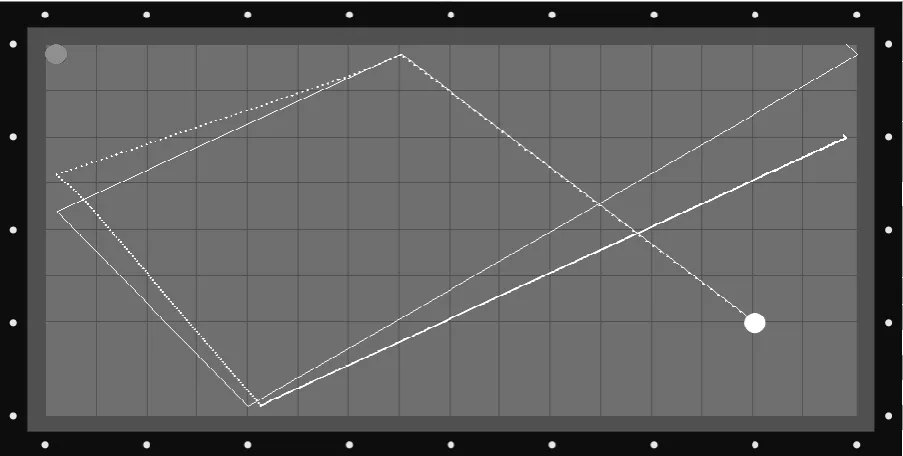
I.e., the coefficient depends on the relative normal velocity of the ball at time of impact. However, this relation did not lead to good simulation results. A test set of 15 three cushion paths was constructed on the real table, and projected on a simulated table that implemented the model. Figure 2.4.3 depicts the result of one simulated shot using the 𝑒-coefficient as derived from [7].
The straight line is the path the cue ball traveled on the real table, the dotted line shows the path the cue ball travels within the simulation.
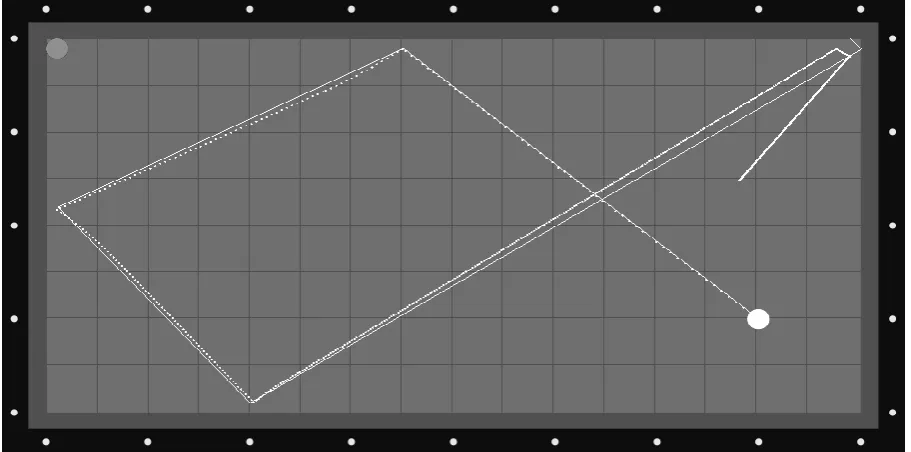
[image:24.595.71.523.520.748.2]25 Using the test set several values for the parameters of the cubic equation used to establish e in [7] were tried, but leaving dependency on relative normal velocity 𝑣𝑥0 out of the equation and just using a static value of 𝑒 = 0.85 yielded much better results altogether. It is unknown why this is. It could be the formulae from [7] were misinterpreted/wrongly implemented by me. However, it could also be that the billiard table used to determine the equation for e in [7] differs too much from the table used for this project. The path simulated in 2.4.3 resembles a shot on an old table, on which the rubber cushions are worn out. However, if this is the case for the table used to determine 𝑒 in [7] remains speculation. Using 𝑒 = 0.85 however was found to yield sufficient accuracy, enough to continue the project with. Figure 2.4.4 shows the same shot as in figure 2.4.3, with 𝑒 = 0.85. Appendix C shows more shots from the
[image:25.595.70.526.243.469.2]evaluation, all are played with left-hand side spin.
26
3. Simulation of Billiards
In [4] the authors present an event-based approach to simulate a game of pool. Instead of numerically simulating a pool shot, recalculating and updating motion variables and ball positions after a fixed time interval ∆𝑡 repeatedly until all balls are stationary, the authors define all events that can occur, and calculate analytically the time these events occur. The time of the first event to occur is determined, and all motion variables are updated. After that, the next event is determined and processed, repeating until all balls are stationary.
This method offers various benefits over the classical numerical approach, namely: Greater accuracy. The numerical approach can detect whether an event occurred
during a particular time step. This can then be refined using smaller time steps, but the exact time of occurrence still can only be approximated. Using the analytical approach results in exact times of event occurrence, accuracy is only dependent on round-off errors.
Less calculations needed to process a complete shot, from moment of cue impact until all balls are stationary, thus less computational cost4.
Requirement 1.1.1, generation of shots should be fast, is met by using the event based approach of simulating shots.
The implementation of the model detects the following events: Motion state transition
Ball-ball collision Ball-cushion collision
The remainder of this chapters discusses these events and how their time of occurrence is calculated.
3.1 Time of Motion State Transition
Calculating the time of the first motion transition is done the same way as in [4]. Equations 2.2.1, 2.2.5 and 2.2.6 are combined to eq.3.1.1. Using eq. 3.1.1 the equation to calculate the time that the relative velocity 𝑢 𝑡 = 0, which by definition is the time the ball enters the rolling motion state. This time is given by eq.3.1.2.
Eq.3.1.1 𝑢 𝑡 = 𝑢 0−72𝜇𝑠𝑔𝑡𝑢 0 Eq.3.1.2 𝜏𝑆 =2 𝑢 0
7𝜇𝑠𝑔
4
27 The ball will be in rolling state until 𝑣 𝑡 = 0. Using equation 2.2.9 the equation for the
duration of the rolling state is derived to equation 3.1.3.
Eq.3.1.3 𝜏𝑅= 𝑣 0
𝜇𝑟𝑔
Again, the rotational velocity around the 𝑘 -axis is treated separate, following from equation 2.2.7:
Eq.3.1.4 𝜏𝑆𝑃 =
2𝑅𝜔𝑘 5𝜇𝑠𝑝𝑔
3.2 Time of Ball-Cushion Collision
To determine when a ball will hit a cushion the collision time of the ball with all of the four cushions is determined. The smallest non-zero value this produces is the time of the first cushion collision.
To determine when, for example, the ball will hit the left short cushion, we simply calculate the time at which the 𝑥-component of the position of the ball in the table frame equals R: Eq.3.1.5 𝑟 0 𝑡 + cos(𝜓) − sin(𝜓)sin(𝜓) cos(𝜓) 𝑟 𝐵 𝑡 = 𝑅
. .
Which boils down to solving the equation (assuming the ball is in rolling state, see eq.2.2.8):
Eq.3.1.6 𝑟 0 𝑡 + cos(𝜓) − sin(𝜓)sin(𝜓) cos(𝜓) 𝑣 0𝑖 𝑡 − 1 2𝜇𝑟𝑔𝑡
2
0 = 𝑅. .
Eq.3.1.7 cos 𝜓 𝑣 0𝑖 𝑡 − 12𝜇𝑟𝑔𝑡2 − sin 𝜓 𝑣 0𝑖 𝑡 − 12𝜇𝑟𝑔𝑡2 − 𝑅 + 𝑟 0𝑥 𝑡 = 0
This results in a quadratic equation:
Eq.3.1.8 − (cos 𝜓 − sin 𝜓 )12𝜇𝑟𝑔𝑡2+ (cos 𝜓 − sin 𝜓 ) 𝑣 0𝑖 𝑡 + 𝑟 0𝑥 𝑡 − 𝑅 = 0
Which can be solved computationally using standard techniques. The outcome will be one or 2 real roots. If two solutions are provided, the smallest positive one is picked. No positive roots indicates the ball is moving away from the cushion.
The same method is used for finding collision times with the upper, right and lower cushion. From these four again the smallest positive one is picked, representing the time of the first cushion collision.
28
3.3 Time of Ball-Ball Collision
The time of ball-ball collision is somewhat more complicated, as we need to find a time 𝑡 at which the distance between two balls is exactly 2𝑅:
Eq.3.1.9 2𝑅 = 𝑟1 𝑡 − 𝑟2 𝑡
R is the ball radius, 𝑟1 𝑡 , 𝑟2 𝑡 represent the positions of the two balls within the table frame at time 𝑡. Rewriting this equation like in 3.1.2 would result in a quartic equation (as done in [4]), which is more computationally complex and costly to solve than a quadratic equation. In the next chapter it is explained that the event-based simulation is used to simulate a great amount of shots. Only a small percentage of these simulated shots will result in a valid three cushion shot. Because of the vast amount, and the requirement that shots should be
generated fast, the simulation should be fast. Therefore a trick is applied, enabling calculation of ball-ball collision using a quadratic solver.
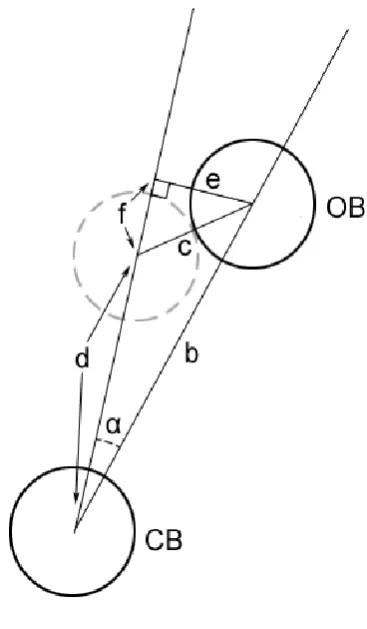
Assuming one ball is moving on a straight line, and one ball is stationary, we can make use of a common collision detection technique to find the distance the cue ball travels before it collides with the object ball (see figure 3.1.1):
The angle 𝛼 between the direction of the motion of the cue ball (CB) and a straight line between CB and the object ball (OB) is known. 𝑒 is the line originating from and
perpendicular to the balls motion direction to the center of the OB. The length of 𝑒 can be calculated: 𝑒 = sin 𝛼 𝑏. When 𝑒 > 2𝑅, with 𝑅 the ball radius, the two balls will not collide and further calculation can be discarded. If not the next step is to determine 𝑓. Because 𝑐 is also known, 𝑐 = 2𝑅, 𝑓 can be determined by: 𝑓 = 𝑒2+ 𝑐2. The last step is to determine 𝑑.
𝑑 + 𝑓 = cos 𝛼 𝑏, 𝑓 = cos 𝛼 𝑏 − 𝑑.
Now that the distance to point of impact 𝑑 is known (as far as a collision will occur), the time the collision will take place can easily be determined. For example, when the ball is in rolling motion the following quadratic equation should to be solved:
Eq.3.1.10 − 12𝜇𝑟𝑔𝑡2+ 𝑣 0𝑖 𝑡 − 𝑑 = 0
This method is only precise when the ball is following a rectilinear path, however slight curves in the ball‟s path caused for example by a cushion collision did not result in much loss of accuracy. Stronger curves caused by ball collision however result in failing to correctly predict a collision.
Another downside of this method is that only one ball must be moving, the other must be stationary.
29
Figure 3.1.1: Distance to Impact
3.4 Numerical Simulation
The analytical simulation is used to simulate a great amount of shots fast, numerical simulation is implemented for 3 purposes:
Checking for ball-ball collisions that were not detected by the analytical simulation Plotting the path of the ball
Animating the path of the ball
Numerical simulation makes use of the event-based approach, by predicting the time of a next event and then find the positions of the balls in steps of size ∆𝑡 from 𝑡0 until the time of the next event. This process repeats until all balls are stationary and no new event will occur.
3.5 Test Application
The physics discussed in chapter 2 were implemented using the event based method. An application was built to test the implementation of the model, simulate shots and try out different friction and elasticity coefficients, comparing simulated shots to shots carried out on the real table. A screen shot of the application can be found in Appendix D. The test
30
4. Finding Solutions for Ball
Configurations
Now that an implementation of a billiards physics model is available, it can be used to simulate three cushion shots in order to find valid ones, that can be presented to the user. The research questions that are answered in this chapter are: How to generate possible solutions for any given input ball configuration? and How to select one solution from the set of all possible solutions that is to be recommended to the user?
In an earlier attempt to solve three cushion shots some ideas from [6] were implemented. The solving method implemented was the so called LKL-system, but this system could only be applied to a limited faction of all possible ball configurations. A short evaluation was carried out, by playing 50 shots. Of these, 21 could possibly be solved using the LKL-system, and in many cases these would not have been a preferable solution (according to own expertise). Therefore generating solutions using these already available solving methods was found not suitable, as it does not meet the requirement that state that the VBA should be able to recommend a solution for every possible ball configuration, nor the requirement that the shot recommended as best is the same as a human expert would recommend.
It was decided a more generic approach is preferred. The method now used is discussed in this chapter and consists of two steps. The first step is generating a set of possible solutions using the possibility to simulate shots fast and accurately, the second step is ordering this set and selecting a shot that a real life trainer would advice a player to play. This chapter first deals with the generation of solutions in section 4.1, followed by the sorting of found solutions in section 4.2.
4.1 Generating Possible Solutions
As explained in chapter 2, the implementation of the physical model using an event based approach enables the VBA to simulate a great amount of shots in a short time. A
straightforward approach to shot generation would be using every possible combination
[𝑎, 𝑏, 𝑉, 𝜓] as input shot parameters, and select the ones that result in a valid 3-cushion carombole.
However, because there is an infinite amount of possible shots due to the continuous nature of the shot parameters 𝑎, 𝑏, 𝑉 and 𝜓, it is impossible to just simulate all possible shots and select only the shots that are successful three cushion solutions.
Therefore, the amount of different input shot parameters values needs to be limited. Section 4.1.1 will discuss the decisions made on limiting and discretizing the parameters.
The limited input shot parameters are combined into a finite amount of input [𝑎, 𝑏, 𝑉, 𝜓]
31
4.1.1 Limiting Input Shot Parameters Values
This section discusses the discretization and limiting of the input shot parameter (ISP) values.
Initial cue velocity (𝑽)
During the construction/testing of the physical model, comparing it with shots played on a real table, it was empirically determined that most three cushion shots are struck with an impact velocity between 2.5 and 4.0 𝑚/𝑠. Generating shots with 𝑉 less than 2.5 𝑚/𝑠 thus is not very useful, as it would result in few valid three cushion shots. Generating shots with
𝑉 > 4.0 𝑚/𝑠 produces solutions that will be very hard if not impossible to reproduce. Although these boundaries are not exact, intuitively searching for shots outside the boundaries will not result in more/better solutions.
For the generation of shots, one or more different values for 𝑉 should be chosen within these boundaries.
Initial direction (𝝍)
The range of 𝜓 is – 𝜋 < 𝜓 <= 𝜋. A crude approach would be to define a number of steps to cycle through the possible values of 𝜓. A smarter approach is to make use of an existing heuristic in three cushion billiards:
1. If OB1 and OB2 are positioned close to each other, a cushion first solution could be an option (see 4.1.1a).
2. If they are not positioned close to each other, the CB should be played first hitting one of the two object balls (see 4.1.1b).
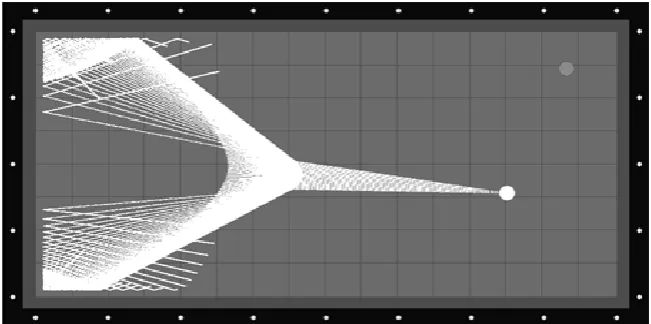
In the cushion first case, the value 𝜓 is cycled from –π to π in 𝑛𝑐𝑓 steps of size 2𝜋/𝑛𝑐𝑓. (Note that for certain values of 𝜓 the cue ball will hit an object ball first instead of a cushion, however these could result in valid solutions and don‟t need to be discarded).
For the object ball first case, the yellow ball is chosen as the ball to hit first. A minimum and maximum value are chosen for 𝜓, representing the full range of 𝜓 where the yellow ball is hit directly. This value is then discretisized into 𝑛𝑏𝑓steps. The same is done for the red ball as the ball to aim at.
32
Figure 4.1.1a: Cushion First Example
Figure 4.1.1b: Ball First Example
33
Figure 4.1.2b: 180 steps of 𝝍, with small initial velocity
Figuur 4.1.2c: 180 steps of 𝝍, with big initial velocity
Amount of side spin (a) applied
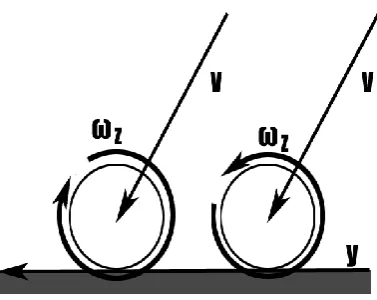
Side spin is an important part of three cushion play. Side spin has little effect on the outcome of a ball-ball collision. In the model it has no effect at all, due to the frictionless treatment. However, equations 2.4.4, 2.4.3 and 2.4.1 show that the spin (𝜔𝑍 in the cushion reference frame) induced by a non-zero 𝑎 does influence the 𝑌-component (in the cushion reference frame) of the outgoing velocity. It is also clear from these equations that 𝜔𝑍 is of no influence on the 𝑋-component of the outgoing velocity. So side spin can be used to influence the outgoing angle of a ball immediately after impact with a cushion.
Figure 4.1.2 shows two different situations. The left situation is called „contra-effect‟ or contra spin, the right situation „mee-effect‟. On the left the ball hits the cushion with 𝜔𝑍 < 0, the right ball with 𝜔𝑍> 0. Observing equations 4.3.4, 4.3.3 and 4.3.1, we see that the situation on the left will result in a smaller outgoing velocity in the direction tangential to the cushion (Y-component) when compared with the situation on the right. As the perpendicular velocity is the same for both situations, the translational velocity of the ball directly after impact will be the greatest for a cue ball played with „mee-effect‟.
34
Figure 4.1.2: Spin direction illustrated, view from above. Left is contra-effect, right is mee-effect.
Amount of top/bottom spin (b) applied
Whereas side spin is mainly used to influence the outgoing angle of the cue ball after impact with a cushion, top spin (𝑏 > 0) or draw (𝑏 < 0) is used to influence the path of the white after collision with the first object ball, as explained in section 2.1. Draw shots are extensively used in libre, and can be used in three cushion shots. The main reason for using draw or top spin, is to be able to hit the first object ball thicker or thinner, in order to prevent a kiss. However, most shots can be performed without top spin or draw, and although the implemented model can simulate it, it was chosen not to include these kind of spin in the recommendation system.
It could be added easily, but this would add complexity and cost to the shot generation, as well as difficulties to the shot sorting. Therefore it is recommended as future work.
4.1.2 Shot Generation
The shot generation now takes place by combining the different possible values for the input shot parameters and simulate the shots resulting from these parameters. For every
simulated shot it is evaluated whether the result is a valid three cushion shot. This is done using a straightforward method. A counter keeps track of the amount of cushion collision events for the cue ball. At the moment the cue ball hits the second object ball, if the number of cushion collisions is 3 or more, the shot is valid, otherwise not. What happens after the collision with the second object ball is irrelevant.
As explained in chapter 3 a trade off was made in the event based simulation regarding collision detection: collision between moving balls is not predicted.
The situation where two moving balls collide before the shot is a valid three cushion is called a kiss, and usually prevents a successful carombole. Therefore the resulting set of shots should be filtered, removing shots where a kiss occurred. At the moment this is established by numerically simulating the solutions, and check for a kiss at each step. It could be useful to simulate the shots again analytically, making use of a quartic solver to detect ball-ball collision. This is expected to be faster and more accurate, however is considered future work.
4.1.3 Clustering of Solutions
35 Experienced billiard players will categorize shot solutions into different types, often giving them names like “lang kort lang”, or “renversé” (for examples of such types see [6]). Therefore it seems intuitively correct to organize the found solutions into clusters,
representing variations on a type of shot. The clustering is done in a straightforward manner. The assumption is made that solutions of which the first 4 cushions the white collides with are equal, are perceived as of the same type. The amount of 4 cushions might appear to be strange in the context of 3 cushion billiards. However, it was determined that less meant too little distinction between shots. See for example figure 4.1.3a and figure 4.1.3b. These two are considered to be of different types, but would be clustered together when the criterion would be only the first 3 cushions. More would result in too many clusters. The amount of 4 resembled the way humans would cluster the shots closest.
[image:35.595.71.523.280.508.2]An example of a solution cluster containing 4 solutions is shown in fig. 4.1.4. (The path of the white is drawn only until the yellow ball is hit, for clarity).
36
Figure 4.1.3b: Cluster criteria example
Figure 4.1.4: Solution Cluster example
4.1.4 Evaluation of Solution Generation
[image:36.595.72.523.330.556.2]37
4.1.4.1 Experimental setup
10 random ball configurations were generated. The BC‟s are fed to the shot generator. The shot generator was also fed with the following combination of shot parameters:
𝑉 = 3.0
𝑛𝑏𝑓 = 90
𝑎 = −0.005 and 𝑎 = 0.005 b = 0
As can be seen only ψ and the direction of side spin are varied. For the ball-first shots the amount of simulations (i.e. different input shot parameters tuples) now adds up to 360. Cushion-first shots (where yellow and red are less then 25cm apart) were not part of the 10 random ball configurations.
The generated shots were stored. Then for each of these solutions attempts were made by the author to reproduce the path of the white. The amount of random BC‟s chosen seems quite low. However, for each of the 72 resulting solution clusters an average 10 to 15 real shots were performed, before a conclusion was drawn. Note that it is impossible to exactly reproduce the shot parameters, but the goal of this evaluation was to find out whether it would be useful to show the path the white should travel to a user, i.e. the user can be expected to reproduce this path. Therefore sometimes it took a great amount of attempts before a conclusion could be drawn, as some shots are very difficult to reproduce. All solutions then are labeled with one of three classifications:
Exactly reproducible
Approximately reproducible Not reproducible
When not reproducible, a note is made why.
4.1.4.2 Results and Discussion
Appendix E shows the results for the 10 random ball configurations, along with an example solution cluster for each. For the 10 random BC‟s, the amount of solution clusters found per BC ranged from 3 to 15, averaging 7,2. The sum of all clusters thus was 72. The amount of time needed to generate the solutions ranged from 266ms to 742ms, averaging 530ms. Of The 72 solution clusters 23 were found to be reproducible. 3 were approximately reproducible, the remaining 46 were not reproducible.
From the notes of the shots that were not reproducible or difficult the following reasons were extracted:
Contra-spin on the first cushion reacts very different in real life, when compared to the simulated shots. This indicates a flaw in the model. This was the cause for failure in 23 of the 46 not reproducible solutions.
Prediction of kisses does not work good enough. Kisses caused failure in 10 cases.
38 This method of generating solutions, with a basic configuration, is found sufficient to find solutions that are reproducible in most cases. Moreover the algorithm is reasonably fast, which is a requirement as the VBA is supposed to be interactive.
4.2 Ordering the Set of Possible Solutions
A real life trainer will figure out what shots are possible, and select a shot from the set of possible solutions for his pupil to carry out. The decision which shot is to be selected is made intuitively, and heuristics-based.
An attempt has been made to find these heuristics, in order to attribute a score to the solutions. This score is used to sort the set of solutions, the shot with the highest score is chosen as the solution the player should be recommended to play.
This section first describes a simple sorting algorithm, using only solution cluster size. An evaluation of this baseline algorithm is carried out on several random ball configurations. The same ball configurations, and their solutions, are shown to an expert, who is asked to
comment on the solutions and also sort them. Results are compared. Based on the results, the sorting algorithm is improved.
When the prototype of the VBA was finished it was tested during a real training session, by comparing the solutions recommended by the trainer to the ones found and recommended by the VBA. This evaluation is discussed in section 4.2.3.
4.2.1 Sorting Solutions Using Cluster Size
Whereas the physical model implementation can apply shot parameters exactly, a shot carried out by a human player will always introduce inaccuracies. Therefore a solution with a bigger margin of error for the shot parameters would be more preferable.
Conveniently, the method of clustering solutions offers an obvious way to detect the margin of error for the parameter psi. The bigger the cluster size, the bigger the margin of error is for the center solution, as can be seen in figure 4.1.3, where the white can hit the first cushion with a margin of approx. 12cm., while still producing a valid 3-cushion shot. It is expected that this margin of error will be the most important factor for a human trainer to decide which shot is selected as most favorable for his trainee.
So now solution clusters are sorted according to their sizes. From each cluster the center solution (in terms of 𝜓) is picked to represent the solution cluster.
4.2.2 Evaluation of Shot Recommendation
The goal of the shot solution finder is to recommend a solution that also would be
recommended by an expert. This would be the top solution from a sorted solution set. To evaluate the simple sorting method, as well as the solution finder in general, an expert human trainer was consulted.
39 expert. The expert then is asked to select, rank and motivate a top 3 of solutions, and assert whether the set of solutions is complete.
The rankings as provided by the expert are compared to the results of the automated sorting using the baseline protocol.
Ge
![Figure 2.1.1: Taken from [4],visualization of parameters](https://thumb-us.123doks.com/thumbv2/123dok_us/1215396.645273/16.595.71.524.404.637/figure-taken-from-visualization-of-parameters.webp)