Crustaceans can be found in a wide range of habitats, in which environmental conditions and physiological states vary considerably. This may involve dramatic changes in environmental variables such as temperature, water pH, oxygenation, salinity and exposure to toxic substances such as sulphide or changes in physiological states such as activity and moulting. Within changing environments, the functional role of haemocyanin has been a source of interest over many years and numerous reviews have appeared (Mangum, 1980; Mangum, 1983a; Morris, 1990; Truchot, 1992; Terwilliger, 1998). Mangum’s review in 1980 pointed out that we were at the beginning of investigating ‘environmental plasticity’ and over 10 years later Truchot reiterated this point (Truchot, 1992). This short review of the modulation of crustacean haemocyanin oxygen affinity will briefly summarise the known effects of various factors that influence haemocyanin function and provide the reader with information on more recent discoveries that illustrate the flexibility of the respiratory pigment in a changing world. It is written in tribute to the pioneering work of Jean Paul Truchot who has been more than instrumental in revealing some of this evidence.
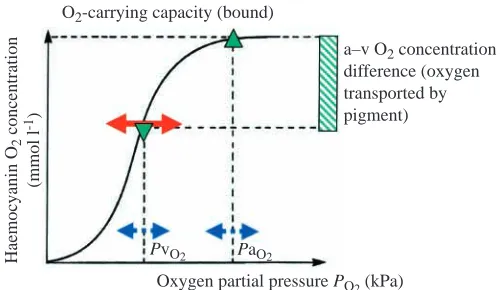
The biological role of respiratory pigments in oxygen transport can be summarized as the requirement to increase the amount of oxygen that can be delivered to the tissues above the normal level that would be delivered purely in a dissolved form (Fig. 1). A typical oxygen dissociation curve, as shown in this figure, may in its optimum form be sigmoidal. The model assumes two specific constants, the arterial (a; PaO∑) and
venous (v; PvO∑) oxygen partial pressures, although these may vary considerably under physiological load (for a review see McMahon, 1985). Using PaO∑and PvO∑to determine the a−v O2concentration difference, the amount of oxygen transported by the respiratory pigment can be calculated. As can be seen from Fig. 1, any change in oxygen affinity, expressed as a change in the half-saturation or P50, will affect oxygen transport. A decrease in oxygen affinity (negative influence) or a shift to the right will decrease the loading on the arterial side at the gill but will improve unloading at the venous side or at the tissues. A shift to the left, in contrast, or an increase in oxygen affinity (positive), will favour loading at the gills but inhibit unloading at the tissues. Other mechanisms besides respiratory protein oxygen affinity must also play a role to maintain oxygen supply. These may involve an increase in the extraction efficiency for oxygen at the gills, thereby increasing PaO∑or decreasing PvO∑to unload more oxygen. The limiting factors for both systems, oxygen uptake and oxygen unloading, are the ventilation/extraction efficiency on the one hand and the mitochondrial/venous arterial pressure gradient on the other.
The model may be carried one step further using the ‘Fick equation’:
M˙O∑= Q˙ (Ca– Cv) , (1) where M˙O∑is the mass-specific rate of oxygen consumption, Q is the cardiac output and (Ca–Cv) is the oxygen content difference between arterial and venous blood. The rationale of Printed in Great Britain © The Company of Biologists Limited
JEB3202
Crustacean haemocyanin oxygen affinity may be modified through changes in concentration of various inorganic and organic allosteric modulators. These may act in both positive and negative directions, increasing or decreasing haemocyanin oxygen affinity, and assist both in oxygen loading at the gills and oxygen release in the tissues. Inorganic ions, except for Mg2+, do not normally influence
cooperativity or the Bohr effect, whereas most of the organic modulators decrease cooperativity without affecting the Bohr coefficient. Several new findings on the
influence of sulphide and thiosulphate are reviewed together with evidence for unidentified factors that decrease haemocyanin oxygen affinity. The physiological implications of all these findings are discussed in the context of maintaining a flexible response to a changing environment.
Key words: P50, oxygen affinity, hemocyanin, crustacean,
modulator, intrinsic, lactate, urate, purine, neurohormone. Summary
Introduction
MODULATION OF HAEMOCYANIN OXYGEN AFFINITY: PROPERTIES AND
PHYSIOLOGICAL IMPLICATIONS IN A CHANGING WORLD
C. R. BRIDGES
Institut für Zoophysiologie, Lehrstuhl für Stoffwechselphysiologie, Heinrich-Heine Universität Düsseldorf, Germany
e-mail: [email protected]
possessing a flexible oxygen dissociation curve then becomes more important than using only frequency/amplitude or distribution changes to satisfy cardiac output. Changes in oxygen-carrying capacity can be mediated through changes in the moulting stage and in the nutritional status.
Inorganic modulators of haemocyanin oxygen affinity
Truchot (Truchot, 1992) pointed out that oxygen affinity
might be changed by modifying the intrinsic structure of the haemocyanin or by adding effectors or modulator substances. Morris (Morris, 1990) defined effectors as having a constant influence over oxygen affinity under normal conditions, whereas modulators respond to environmental conditions or stress by a change in concentration, thereby influencing haemocyanin oxygen affinity. In Fig. 2, the modulators, which can influence intrinsic haemocyanin oxygen affinity, are shown as either negative (right shift of the oxygen dissociation curve) or positive influences (left shift of the oxygen dissociation curve). Temperature effects are not shown but these involve both pH changes and intrinsic changes in enthalpy of the haemocyanin. Truchot (Truchot, 1992) has suggested the following criteria for defining physiological modulation: (i) the involvement of a concentration response of the modulator to changes in conditions, (ii) these concentration changes should cause substantial changes in the affinity, and (iii) the modulation of oxygen affinity should be advantageous to oxygen transport. However it has become increasing clear that even small changes in oxygen affinity may be important for ‘fine tuning’ (Morris, 1990), and flexibility at both ends of the oxygen transport cascade must be considered.
Inorganic ions
It has long been known that the ionic composition of the haemolymph affects haemocyanin oxygen affinity. In his thorough study, Truchot was able to show that both Mg2+and Ca2+ increased oxygen affinity in Carcinus maenas, and that Mg2+increased the Bohr effect at physiological levels at the same time (shown as positive effectors of haemocyanin oxygen affinity in Fig. 2) (Truchot, 1975). Other ions such as Cl−have O2-carrying capacity (bound)
H
aem
ocyanin O
2
conc
entration
(mm
o
l
l
-1)
Oxygen partial pressure PO2 (kPa)
PvO2 PaO2
a–v O2 concentration
[image:2.612.43.293.72.217.2]difference (oxygen transported by pigment)
Fig. 1. Oxygen transport function of haemocyanin shown as an oxygen dissociation curve with haemocyanin oxygen content (mmol l−1) plotted against oxygen tension (PO∑) in kPa. Arterial (䉱) and venous (䉲) oxygen tensions PaO∑and PvO∑respectively are also
shown. Variations (blue broken line) in these parameters and in the
P50 (red solid line) confer flexibility to the response for increased
oxygen demands. The arterial–venous (a–v) oxygen concentration difference is shown as a green cross-hatched bar.
[image:2.612.82.524.458.701.2]a variable effect, increasing oxygen affinity in some species such as Penaeus setiferus (Brouwer et al., 1978) and C. maenas (Truchot, 1975) and decreasing it in others, e.g. Limulus polyphemus (Brouwer et al., 1977). In Carcinus maenas, however, the chloride effect only became significant at high extraphysiological values (Truchot, 1992).
pH
When organisms are subjected either to activity or to environmental hypoxia then tissue anoxia occurs at some stage, either through an increase in the oxygen consumption or through a decrease in oxygen transport. This, in turn, leads to tissue anaerobiosis with the consequent formation of metabolites, which in turn may provide H+ that affects the acid–base status of the haemocyanin. The number of protons formed depends upon the length and severity of the hypoxia.
The influence of pH through the classic normal ‘Bohr effect’ has been reviewed many times (see Mangum, 1983a; Truchot, 1992). The presence of protons has a negative effect on haemocyanin oxygen affinity, as shown in Fig. 2. They are one of the few modulators that can act in a negative direction, together with the effect of increasing temperature. The magnitude of this effect, i.e. the Bohr coefficient, is large in decapod crustaceans compared with vertebrate haemoglobins (for values, see Mangum, 1983a; Truchot, 1992), and is dependent upon the physiological pH range. The pH difference between arterial and venous blood is small, so it is not envisaged as having any direct function in aiding tissue unloading, as seen in higher vertebrates. At the same time, environmental hypoxia may cause hyperventilation and thus raise haemolymph pH. The dual role of pH together with metabolite production is discussed below. Together with the role of pH, the presence of molecular CO2can also increase oxygen affinity (for a review, see Bridges and Morris, 1989) in some species, but this effect is entirely absent in others, especially those that are semi-terrestrial or terrestrial.
Salinity changes or dessication
When a crustacean is exposed to salinity changes, the magnitude of change in haemolymph ion levels will be dependent on its osmoregulatory ability. Four mechanisms of change in haemocyanin oxygen affinity can be associated with salinity changes. (i) Affinity changes directly correlated with ion concentration changes in Ca2+, Mg2+ and Cl− concentrations, as shown for Carcinus maenas (Truchot, 1975) and for Callinectes sapidus (Mason et al., 1983). In those species that regulate ionic concentrations, little change in oxygen affinity occurs until extreme values of salinity above 40 ‰ are reached, as in Palaemon elegans (Taylor et al., 1985), when both oxygen affinity and the Bohr coefficient then increase. In semi-terrestrial and terrestrial species, the effect of Ca2+ may be more important than that of Mg2+ (Morris and Bridges, 1994; Morris et al., 1996; Adamczewska and Morris, 1998). (ii) Compensatory increases in pH may occur with declining salinity in Carcinus maenas and Callinectes sapidus (Truchot, 1973; Weiland and Mangum, 1975). (iii) Changes in
haemocyanin subunit composition in low salinity populations have also been observed and correlated with a lowering of oxygen affinity (Mason et al., 1983; Mangum and Rainer, 1988) in Callinectes sapidus, thereby bringing about an intrinsic change in oxygen affinity. (iv) Changes in levels of dialyzable substances other than H+ and divalent cations, as implicated from studies of hypersaline exposure in the freshwater crayfish (Wheatly and McMahon, 1982), induce a right shift of the oxygen dissociation curve.
Sulphide and thiosulphate
In hydrogen-sulphide-rich environments such as marine sediments or hydrothermal vents, the internal detoxification of sulphide often leads to the production of thiosulphate (Vetter et al., 1987). Sanders and Childress (Sanders and Childress, 1992) were able to show that the oxygen affinity of haemocyanin of the hydrothermal vent brachyuran Bythograea thermydron, which lives where thiosulphate levels may be >1 mmol l−1(Vetter et al., 1987), was increased in the presence of 1.5 mmol l−1 thiosulphate. This effect was also pH-dependent (Fig. 3A), with increased oxygen affinity occurring at higher pH values. A similar pH-dependent increase in the oxygen affinity of the benthic isopod Saduria entomon (Fig. 3B) was observed both in vitro and in vivo (Hagerman and Vismann, 1999). Not all crustacean haemocyanins show this response; there was no evidence for such a response in the ghost shrimp Callianassa californiensis or in the two brachyurans Cancer anthonyi and Cancer antennarius (Sanders and Childress, 1992). In Crangon crangon, again no evidence was found for a thiosulphate effect on oxygen affinity (Hagerman and Vismann, 1999). In a detailed study, three benthic species, Calocaris macandreae, Nephrops norvegicus and Carcinus maenas, exposed to varying degrees of environmental sulphide, were examined (Taylor et al., 1999). Only in C. macandreae was a specific effect of thiosulphate observed (Fig. 3C). It would appear that haemocyanin thiosulphate sensitivity is found only in those species that are exposed to high, long-term concentrations of sulphide, such as in hydrothermal vents and mud sediments, and that possess the ability to oxidise sulphide to thiosulphate. These species also seem to be characterized by a high initial oxygen affinity of 0.067–0.267 kPa (0.5–2 Torr) at pH 7.9. In those species that are more free-living or maintain a semi-permanent ventilated burrow, this response appears to be lacking (Taylor et al., 1999). In Bythograea thermydron and Saduria entomon the effect is pH-dependent, and there also appears to be a decrease in cooperativity. Since pH decreases with sulphide exposure (Hagerman and Vismann, 1999) and there is a negative correlation between decreasing pH and the magnitude of the thiosulphate effect, the role of modulation may be negligible in comparison with those of organic modulators such as lactate.
Implications for future research
conditions of moderate hypoxia. The role of protons is also beneficial under conditions of increased pH. The synergistic effect on haemocyanin oxygen affinity of various ions has not been studied in detail, however, and the individual binding sites and their interactions need to be examined at both the molecular and physiological levels to obtain a full picture.
Organic factors modulating haemocyanin oxygen affinity
Inorganic factors modulating haemocyanin oxygen affinity have long been extensively studied (for reviews, see Redfield, 1934; Truchot 1992), but the role of organic modulators has only been investigated relatively recently, as a result of experiments where haemolymph was dialysed against a
Ringer’s solution containing in vivo inorganic ion concentrations, revealing the presence of modulators whose influence on haemocyanin oxygen affinity could not be accounted for. In his early work, Truchot also suggested that other factors were important (Truchot, 1975). He found that the oxygen affinity of haemocyanin from C. maenas was influenced by dialysable substances, present in the serum, which could be expressed as an undetermined coefficient k´ that was dependent on the biological history of the animal from which the serum was drawn. ‘The temperature-dependent variation of k´ appears mainly due to the action of an unknown dialysable substance, normally present in serum and whose concentration increases as temperature rises’ (Truchot, 1975). The role of organic factors in modulating haemocyanin oxygen affinity has been extensively reviewed (Morris, 1990; Truchot, 1992), and the present study reports additional data supporting these findings and briefly reviews some of the characteristics of the modulation.
Lactate
From previous studies (Truchot, 1975; Harris et al., 1975) it was clear that not only inorganic factors were responsible for changes in haemocyanin oxygen affinity. Truchot made the breakthrough with his work on the effect of lactate on Carcinus maenas and Cancer pagurus (Truchot, 1980), providing evidence that lactate is the positive effector shown in Fig. 2, as oxygen affinity increases with increasing L-lactate concentrations. This is also shown for Callinectes sapidus haemocyanin (Fig. 4A). The magnitude of the lactate effect in terms of the coefficient ∆logP50/∆log[L-lactate] ranges from
No thiosulphate
1.5 mmol l-1 thiosulphate
7.0 7.2 7.4 7.6 7.8 8.0 8.2
-0.40
-0.80
-1.2
-1.6
-2.0
Bythograea thermydron
A
pH
log
P50
B
Saduria entomon
100
10
1
7.3 7.4 7.5 7.6 7.7 7.8 7.9 8.0 8.1 8.2 pH
2.0 1.8 1.6 1.4 1.2 1.0 0.8 0.6 0.4 0.2 0
P50
log
P
50
C
Calocaris macandreae
0.7
0.6
0.5
0.4
0.3
0.2
0.1
0
7.3 7.4 7.5 7.6 7.7 7.8 7.9
pH
log
P
50
Fig. 3. (A) Effect at 15 °C of thiosulphate on haemocyanin O2
binding in dialysed haemolymph from Bythograea thermydron. The regression line for haemolymph without thiosulphate was
y=7.469–1.083x, r2=0.98; for haemolymph with 1.5 mmol l−1
thiosulphate, y=12.774–1.083x, r2=0.99 (significant difference at
P<0.005). (Modified from Sanders and Childress, 1992, with
permission from the authors and Springer Verlag.) (B) Haemocyanin
P50 (Torr; 1 Torr=0.133 kPa) in haemolymph of Saduria entomon
plotted against pH. (䉱) Untreated haemolymph, y=−1.36+11.55x,
r2=0.94; (䊏) haemolymph with 30µmol l−1 thiosulphate added in
vitro, y=−1.82+14.92x, r2=0.92 (significant difference at P>0.01);
(䊉) after 8 h in vivo exposure to hypoxia (0.68 kPa) and 50µmol l−1
thiosulphate in water at pH 8.0 (10 °C, sea water 10 ‰). (Modified from Hagerman and Vismann, 1999, with permission of the authors and Springer Verlag.) (C) Effect of thiosulphate on the relationship between oxygen affinity and pH for the haemocyanin of Calocaris
macandreae. The data are for (䊊) untreated haemocyanin, (ⵧ) haemocyanin with saline, and haemocyanin with saline containing 0.5 mmol l−1(䉱), 1 mmol l−1(䊏) and 1.5 mmol l−1(䊉) thiosulphate.
The physiological saline contained Na+, 518 mmol l−1; K+,
11.9 mmol l−1; Ca2+, 10.6 mmol l−1; Mg2+, 20.5 mmol l−1; Cl−,
548 mmol l−1. Oxygen dissociation curves were constructed at 10 °C.
The calculated regression lines fitted to the data for haemolymph with saline (y=8.09–1.10x, r2=0.97) and 1.5 mmol l−1 thiosulphate
(y=8.49–1.07x, r2=0.98) added are also shown and are significantly
[image:4.612.49.294.73.555.2]–0.56 to values around zero (Bridges et al., 1984; Bridges and Morris, 1986; Morris and Bridges, 1994). A number of studies have shown that the lactate effect is quite widespread (Mangum, 1983b; Bridges et al., 1984; Bridges and Morris, 1986; Morris and Bridges, 1994) but there are also exceptions (Mangum, 1983b; Morris and Bridges, 1994), and in one case a reverse effect (Adamczewska and Morris, 1998). In general, the transition to a more terrestrial way of life and aerial ventilation is correlated with a decrease in the sensitivity of haemocyanin to lactate (Morris and Bridges, 1994; Morris et al., 1996).
In the earliest studies, no effect of lactate on the Bohr coefficient was observed (Truchot, 1980; Bridges et al., 1984; Johnson et al., 1984; Lallier and Truchot, 1989a; Lallier and Truchot, 1989b) and Mangum (1983b) suggested that lactate effects were large where the Bohr shift was large and normal. Bridges and Morris (Bridges and Morris, 1986) found no close correlation and pointed out that even if the efflux rate of H+ and lactate was stoichiometric, the protons are buffered and the magnitude of the two effects must not be correlated.
A number of workers (Graham et al., 1983; Graham, 1985; Johnson et al., 1984) showed that the lactate effect was very
specific, with the lactate-binding site interacting with the fourth position of the chiral carbon of L-lactate, and this explains the binding difference between L- and D-lactate and various other structural analogues. The number of lactate-binding sites appears to vary, with high values of around 2.8 lactate binding sites per hexamer in Callinectes sapidus (Johnson et al., 1984), 1.2 binding sites per hexamer in Panulirus interruptus (Johnson et al., 1987) and two binding sites per dodecamer in Homarus vulgaris (Nies et al., 1992).
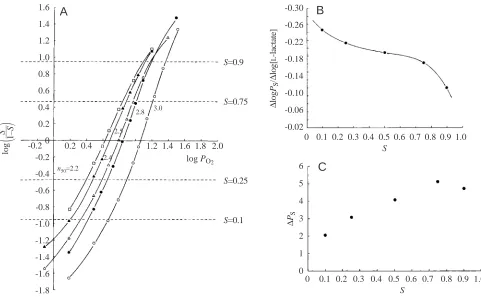
Lactate is an allosteric effector, so it could be assumed that this would also affect cooperativity. Mangum suggested that effects on cooperativity were difficult to perceive in some species (Mangum, 1983b), but there was a small effect in Cancer magister (Graham et al., 1983), and this was clearly shown in Callinectes sapidus (Johnson et al., 1984). The available data was reviewed (Bridges and Morris, 1984), and it is clear from Fig. 4A for Callinectes sapidus that with increasing lactate concentration cooperativity expressed as n50, decreased from 3.0 to 2.2 with a 17.7 mmol l−1 increase in [lactate]. Fig. 4B indicates that the coefficient ∆logPS/∆log[L -lactate], decreases from low haemocyanin fractional saturation values (S) to high saturation values with an ‘S-shaped curve’. 1.6
1.4
1.2
1.0
0.8
0.6
0.4
0.2
0
-0.2
-0.4
-0.6
-0.8
-1.0
-1.2
-1.4
-1.6
-1.8
A
S=0.9
S=0.75
S=0.25
S=0.1
log PO2
1.2 1.4 1.6 1.8 2.0
n50=2.2
2.4 2.5
2.8 3.0
-0.30
-0.26
-0.22
-0.18
-0.14
-0.10
-0.06
-0.02
0 0.1 0.2 0.3 0.4 0.5 0.6 0.7 0.8 0.9 1.0
S
B
∆
log
PS
/
∆
log[
L
-lactate]
6
5
4
3
2
1
0
0 0.1 0.2 0.3 0.4 0.5 0.6 0.7 0.8 0.9 1.0
S
C
∆
PS
-0.2 0.2 0.4
log –
–
–
S 1–S
冣
冢
Fig. 4. (A) Hill plot of oxygen dissociation curves for dialysed Callinectes sapidus haemocyanin at 20 °C and pH 7.65 (Ca2+=16.7 mmol l−1) at
varying lactate concentrations (in mmol l−1 L-lactate:䊊, 0.1; 䊉, 2.5; 䉭, 4.5; 䉱, 8.7 and ⵧ, 17.8). Fractional saturation levels are depicted as S and PO∑ in Torr (1 Torr=0.133 kPa). The slopes of the oxygen dissociation curve at P50 for each [lactate], expressed as the slope of the
haemocyanin variable n50, are 3.0, 2.8, 2.5, 2.4 and 2.2 for increasing [lactate], respectively. (B) Magnitude of the lactate effect expressed as
∆logPS/∆log[L-lactate] calculated from Fig. 4A plotted against the fractional saturation S of Callinectes sapidus haemocyanin. Conditions are the same as in A. (C) Calculated change in oxygen tension (∆PS) in Torr, i.e. change in oxygen affinity, at a given haemocyanin fractional
[image:5.612.67.548.69.366.2]This ultimately leads to a greater shift in oxygen affinity at higher saturation values (Fig. 4C) around arterial oxygen pressures (see Fig. 1).
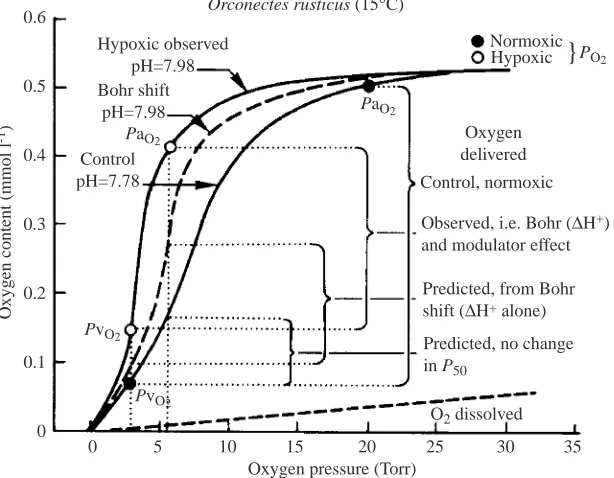
The physiological role of lactate in counteracting the strong Bohr effect was put forward initially for C. sapidus (Booth et al., 1982), in which activity caused a marked decease in pH, and this has been successfully modelled for Orconectes rusticus (McMahon, 1985). Fig. 5 shows that oxygen delivery, expressed as the a–v difference, is maximum under control conditions. It decreases partially during hypoxia when arterial oxygen partial pressure (PaO∑) changes, Bohr shift and lactate modulation are taken into account. A further decrease would be observed if only the Bohr shift alone was present and finally the largest decrease would be observed with no change in P50. In this model for the crayfish Orconectes rusticus, hypoxic exposure causes hyperventilation, thereby increasing haemolymph pH in apposition to the acidification by lactate. Morris (Morris, 1990) modelled two forms of the lactate response. In moderate hypoxia, there was no change in arterial/venous values of PO∑. Here, acid fluxes caused a decrease in oxygen affinity, thereby reducing the venous reserve that is compensated for by the presence of lactate. In the second case, where severe hypoxia was modelled and arterial and venous values of PO∑markedly declined, the lactate effect marginally increases venous reserve and markedly increases loading at the gills. The integration of both pH changes and lactate production may also be coupled with reduction in overall metabolism, as shown in Cherax destructor (Morris and Callaghan, 1998), to lower the need for regulated haemocyanin oxygen affinity. The ultimate role of lactate depends upon the extent of acid–base changes and the values for arterial and venous blood oxygen tension (for a review, see Truchot, 1992), but in all cases the amount of oxygen delivered (Fig. 1) to the tissues is increased.
Urate and purines
In the search for other organic effectors Morris et al. (Morris et al., 1985) were first able to show that urate increased haemocyanin oxygen affinity in the freshwater crayfish Austropotamobius pallipes. This led to a more intensive study (Morris et al., 1986a), which showed that specificity was low, as other plant analogues such as caffeine and theobromine could also markedly increase haemocyanin oxygen affinity. The effects of the different purines were not additive. However, when the purine ring was cleaved, little response was found. The presence of a urate effect was confirmed in other species (Morris and Bridges, 1986; Lallier et al., 1987; Lallier and Truchot, 1989a; Lallier and Truchot, 1989b; Zeis et al., 1992), and the magnitude of the urate effect in terms of the coefficient ∆logP50/∆log[urate] ranges from –0.48 to values around zero in some of the species studied (Bridges, 1990; Morris and Bridges, 1994). The Bohr effect remains unchanged in the presence of urate and, as with lactate, cooperativity decreased in the presence of urate (Zeis et al., 1992). Comparatively speaking, the affinity of Homarus vulgaris haemocyanin is 40 times larger for urate than for lactate, but again two binding sites are present per dodecamere (Nies et al., 1992; Menze et al., 2000).
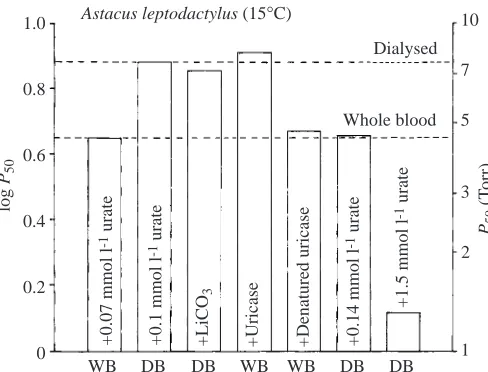
Fig. 6 shows that the complete response to urate in Astacus leptodactylus can be explained by the presence of urate or lactate. Haemocyanin oxygen affinity is reduced in dialysed blood, where both urate and lactate are removed. Treatment of whole blood with uricase removed the urate effect, as did treatment with lactate dehydrogenase (not shown). Control measurements of haemocyanin oxygen affinity in whole blood with denatured uricase added were the same as for whole blood. Haemocyanin oxygen affinity was further elevated by adding 1.5 mmol l−1 urate (using lithium carbonate to aid dissolution) to dialysed blood. Haemolymph urate
PvO2
PvO2
PO2
PaO2
PaO2
0.6
0.5
0.4
0.3
0.2
0.1
0
Oxygen content (mmol l
-1)
Orconectes rusticus (15°C)
Hypoxic observed pH=7.98 Bohr shift
pH=7.98
Control pH=7.78
Oxygen delivered
Control, normoxic
Observed, i.e. Bohr (∆H+) and modulator effect
Predicted, from Bohr shift (∆H+ alone)
Predicted, no change in P50
Oxygen pressure (Torr)
0 5 10 15 20 25 30 35
Normoxic Hypoxic
}
[image:6.612.255.562.75.314.2]O2 dissolved
concentrations are clearly linked to tissue oxygenation levels (Dyken, 1991) and therefore hypoxia and exercise, as shown in Fig. 2, should involve the formation of urate or other purines. This has specifically been shown for hypoxia in Astacus leptodactylus (Czytrich et al., 1987); Carcinus maenas (Lallier et al., 1987; Lallier and Truchot, 1989a) and Penaeus japonicus (Lallier and Truchot, 1989b). The urate concentration increase is correlated with the depth of hypoxia (Lallier et al., 1987), and during hyperoxia purine levels decline (Lallier et al., 1987). When Carcinus maenas was exposed to hypoxia (PO∑=0.23 kPa (30 Torr) for 3–72 h), Lallier and Truchot (Lallier and Truchot, 1989a) calculated a 55–60 % increase in oxygen affinity due to the increased pH (alkalosis via hyperventilation), a 28–32 % increase due to urate and an 8–18 % increase due to lactate. The left shift of the oxygen dissociation curve therefore primarily maintained loading at the gills and helped to conserve some of the venous reserve that was depleted by lowered venous oxygen partial pressure (PvO∑) values.
During exercise the picture is not as clear. There was no detectable increase in urate after activity in Birgus latro (Greenaway et al., 1988), nor in Callinectes sapidus (Lallier and Walsh, 1990). However, in Gecarcoidea natalis, a small increase occurred in urate with exercise (Adamczewska and Morris, 1998), and in two freshwater crustaceans, the crayfish Astacus leptodactylus (Czytrich et al., 1989) and the brachyuran Potamon warreni (C. R. Bridges, personal observations) levels of two other purine derivatives, hypoxanthine and inosine, rose considerably during exercise, although urate levels remained constant. A lack of any lactate effect has also been reported in Potamon warren haemocyanin (Adamczewska et al., 1997), but haemocyanin oxygen affinity was increased after 20 min of fast exercise, perhaps indicating
the modulating role of the other purine derivatives (as suggested by Morris et al., 1986b). Since molecular oxygen seems to regulate uricase activity (Dyken, 1991) the role of other purine derivatives in flexible oxygen affinity control during exercise needs to be studied.
No clear difference or correlation can be seen between the magnitude of the lactate and urate effects because they may be additive and/or synergistic (Morris et al., 1986a), depending upon the actual concentrations of the modulators. The effects were clearly shown to be additive in Homarus vulgaris for concentrations between 0.5 and 11 mmol l−1 for lactate and 0.06 and 0.39 mmol l−1for urate (Zeis et al., 1992). In previous reviews (Morris, 1990; Truchot, 1992) the authors suggest that the effects are not additive, citing evidence from reduced urate effects in the presence of lactate and Ca2+in Austropotamobius pallipes (Morris et al., 1986a; Morris et al., 1986b) and a discrepancy between calculated and measured effects in Carcinus maenas (Lallier and Truchot, 1989). However, when the haemocyanin oxygen affinity nears the level of the intrinsic haemocyanin oxygen affinity (Fig. 2) through the addition of different effectors or modulators, then a finite level must be reached at some stage whereby the different binding sites for ligands are occupied and can no longer positively influence the allosteric structure of the oxygen-binding site. In Fig. 6 this level is nearly reached for Astacus leptodactylus haemocyanin when 1.5 mmol l−1urate is added to dialysed haemolymph. The intrinsic haemocyanin oxygen affinity will therefore play a crucial role in determining how far modulation and additive or synergistic responses can occur.
Neurohormones
A variety of monoamines, acting as neurohormones, are released from the pericardial organ of crustaceans during stress situations (for a review, see Morris and Airriess, 1998). Morris and McMahon (Morris and McMahon, 1989a) first showed that these could increase haemocyanin oxygen affinity in Cancer magister. Dopamine was the most active of these positive effector substances. In a more detailed study (Morris and McMahon, 1989b), they showed that the effects of dopamine were additive to those of lactate in Cancer magister but could be abolished by pre-incubation with the dopamine agonist butaclomol. At high dopamine concentrations (400µmol l−1) cooperativity decreased, indicating a binding of dopamine to the deoxygenated form, and the Bohr coefficient became larger, although between 40 nmol l−1 and 4µmol l−1the pH-dependence of P50 remained unchanged. The potentiating effect of dopamine could be quantified as ∆logP50/ ∆log[dopamine]=−0.10, which is similar to values for lactate and urate (see above), but at much lower concentrations of 10−9–10−3mol l−1compared with 10−4–10−2mol l−1for lactate (Morris and McMahon, 1989b). Although these findings (Morris and McMahon, 1989a; Morris and McMahon, 1989b) are over 10 years old, little progress has been made in investigating the role of neurohormones in oxygen affinity. There was no response to dopamine for the haemocyanin of Hemigrapsus nudus (Morris et al., 1996).
Astacus leptodactylus (15°C) 1.0
0.8
0.6
0.4
0.2
0
10
7
5
3
1
P50
(T
orr)
log
P50
Dialysed
Whole blood
WB DB DB WB WB DB DB
+0.07 mmol l
-1
urate
+0.1 mmol l
-1
urate
+LiCO
3
+Uricase +Denatured uricase +0.14 mmol l
-1 urate
+1.5 mmol l
-1 urate
[image:7.612.52.296.70.256.2]2
Fig. 6. Summary of the effect of various treatments at 15 °C on the oxygen affinity expressed as the P50 (Torr; 1 Torr=0.133 kPa) of
Astacus leptodactylus haemocyanin in whole blood (WB) and
dialysed blood (DB) at pH 7.8. Whole blood contains 1.3 mmol l−1
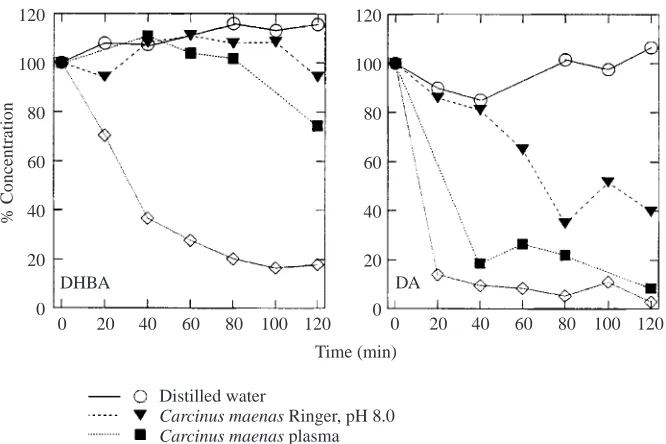
The resting levels of dopamine, epinephrine and norepinephrine ranged. in Carcinus maenas, Cancer pagurus, Homarus americanus and Hyas aranaeus from 2 to 69 nmol l−1 (Hanke, 1993). No significant long-term changes in dopamine and norepinephrine levels were observed in Carcinus maenas and Cancer pagurus exposed to hypoxia (PO∑=0.23–0.30 kPa; 30–40 Torr) or in Carcinus maenas exposed to hyperoxia and hyposalinity (Hanke, 1993). One of the major problems pointed out by Morris (Morris, 1990) is the instability of the monoamines. Fig. 7 illustrates the stability of catecholamines in various solutions. Within 20 min of addition to Carcinus maenas haemolymph, dopamine levels had decreased by 90 % with similar results for Carcinus maenas plasma (Hanke, 1993). Morris (Morris, 1990), however, suggests that haemocyanin may bind natural breakdown products of dopamine, thus changing its oxygen affinity and that haemocyanin itself may catalyse the breakdown and bind the products.
The role of neurohormones may be a short-term response coupled with changes within the ventilatory and cardiovascular system (Morris and Airriess, 1998). The true modulation effect of these substances and their physiological function therefore remains to be resolved.
Implications for future research
Although the role of organic factors in the modulation of haemocyanin oxygen affinity was one of the last areas to be investigated, the growth of our knowledge in this area at both the physiological and molecular levels has been rapid. As with inorganic modulators, synergistic effects must be considered and in future studies the interaction of both inorganic and organic modulators must be investigated in more detail. In some crustaceans lactate or urate effects on haemocyanin oxygen affinity are either small or absent. The reason for this may be at both the molecular and physiological levels, but for
the moment this remains unknown. Many aspects of organic oxygen affinity modulation are linked with hypoxia or exercise; we know little about the role of other environmental ‘stress factors’ on the response and, as with the neurohormones, much work remains to be done.
Unidentified factors influencing haemocyanin oxygen affinity
It is difficult to account fully for changes in oxygen affinity when comparing dialysed blood with whole blood because of the complexity and interactions of the various effectors, and the search for more may continue (Morris, 1990; Truchot, 1992; Terwilliger, 1998). The only known negative effectors of haemocyanin oxygen affinity are H+ ions. In one study, however, on the deep-sea caridean Notostomus gibbosus (Sanders et al., 1992), both oxygen affinity and cooperativity were reduced in the presence of ammonia and trimethylamine. In this species, very high levels of these ions may be maintained in the haemolymph for buoyancy purposes (Sanders and Childress, 1988). In the same study, ammonia reduced C. magister haemocyanin oxygen affinity at low pH only and trimethylamine increased oxygen affinity and cooperativity.
Dialysed haemocyanin of Ocypode saratan had a higher oxygen affinity than whole haemolymph at the same lactate concentration (Morris and Bridges, 1985) and dialysis increased oxygen affinity in Birgus latro haemocyanin (Morris et al., 1988). The presence of an unknown factor that reduced haemocyanin oxygen affinity was determined in two ghost crab species (Ocypode ryderi and Ocypode saratan) (Bridges and Taylor, 1992). Further work (Bridges et al., 1997; Fig. 8A), identified a low molecular mass (<5 kDa) plasma factor whose influence on logP50 was proportional to log(% of native plasma), yielding a positive coefficient of 0.13 but with similar values to those for lactate (−0.12 to –0.19; Morris and Bridges,
DHBA DA
120
100
80
60
40
20
0
120
100
80
60
40
20
0
0 20 40 60 80 100 120 0 20 40 60 80 100 120
Distilled water
Carcinus maenas Ringer, pH 8.0 Carcinus maenas plasma Carcinus maenas hemolymph
Time (min)
[image:8.612.228.561.70.292.2]% Concentration
Fig. 7. Percentage change in concentrations of the catecholamines dihydroxybenzylamine (DHBA) and dopamine (DA) plotted against time after addition to distilled water, Carcinus
maenas Ringer; Carcinus maenas plasma and Carcinus maenas haemolymph, at an initial
concentration of 125 nmol l−1 for each
1985). The decrease in Ocypode ryderi haemocyanin oxygen affinity could also be correlated with the area of the peak, corresponding to the low molecular mass factor, separated by fast protein liquid chromatography (FPLC) from individual crabs, and this decrease in oxygen affinity reached 40 % in some specimens.
It was suggested that the physiological function of this plasma factor decreasing haemocyanin oxygen affinity counteracts high haemolymph bicarbonate levels (Bridges et al., 1997). In Ocypode species, ‘CO2retention’ occurs during air breathing, thus raising haemolymph pH and bicarbonate levels. The plasma factor may compensate for this alkalosis by lowering oxygen affinity and allowing a better unloading at the tissues (Fig. 2). During aerial respiration, loading at the gills is not a problem. More recent work has shown that the plasma factor obtained by FPLC is extremely stable, resisting acid hydrolysis and temperatures of 100 °C. It also is able to facilitate the transport of carbon dioxide by buffering H+ions, thereby increasing bicarbonate transport capacity by almost 100 % compared to Ringers (C. R. Bridges, personal observations). Toulmond et al. (Toulmond et al., 1994) reported the unusual carbon dioxide combining properties of the body fluids of the hydrothermal vent tubeworm Riftia pachyptila, which come from a high carbon dioxide environment. The coelomic fluid shows similar properties to that of the Ocypode ryderi plasma, e.g. a low molecular mass factor is present that increases the buffering of protons, thereby raising the carbon dioxide transport capacity by a fivefold factor (C. R. Bridges personal observations). Its influence on haemoglobin oxygen affinity in Riftia pachyptila has not been
studied. Lallier and Truchot, working on a vent crustacean Rimcaris exoculata, verified that dialysis in this species caused an increase in oxygen affinity (Lallier and Truchot, 1997; Fig. 8B) that could be reversed by the addition of ultra-filtrate (cut-off = 10,000 Da). Based on the assumption that plasma lactate levels mirrored the plasma factor concentrations they calculated a positive coefficient of 0.3, but their gel-filtration profiles did not reveal the presence of any low molecular mass components. They postulate either an effector role for this factor, decreasing the high oxygen affinity from 0.02 kPa (2.6 Torr) up to 0.05 kPa (6.8 Torr), or a role as a counteracting modulator against lactate. This would lead in both cases to the depletion of the venous reserve. Similar results after dialysis have been observed in another hydrothermal vent decapod Cyanograea praedator but not in Chorocaris chacei or Bythograea thermydron (Lallier et al., 1998).
Implications for future research
Since we have been unable as yet to identify the substance/substances which decrease oxygen affinity and at the same time increase the ability to transport carbon dioxide, this task must be a major priority. A number of plasma-exchange experiments between the different crustacean species from hydrothermal vents and the hydrothermal vent tubeworms themselves remain to be carried out, and any influence on haemocyanin oxygen affinity investigated. The presence of a substance that appears to be highly resistant to temperature and acidification but at the same time can increase the capacity for carbon dioxide transport/and or proton buffering may have significant value for biotechnological processes.
Fig. 8. (A) Haemocyanin oxygen affinity (logP50) as a function of pH for Ocypode ryderi whole haemolymph (䊉), 25 % replacement of the
plasma with Ringer (䉱), 50 % replacement (ⵧ), 75 % replacement (䉲), 100 % replacement ( ) and dialysed haemolymph (䊏). (Modified from Bridges et al., 1997, with permission from the authors and the Marine Biological Association UK.) (B) logP50versus pH for an untreated pool
of Rimcaris exoculata haemolymph (native), after dialysis (Dialysed) and partial reconstitution (Reconst.). The reconstituted sample was obtained by concentrating the dialysed sample twofold and adding an equivalent volume of ultrafiltrate (Ultrafree MC, molecular cut-off 10 kDa) from native samples. L-lactate concentrations were 11.4, 0.5 and 6.4 mmol l−1 in native, dialysis and reconstituted samples,
respectively. (Modified from Lallier and Truchot, 1997, with permission of the authors and Wiley Press.)
j
A
P50
(T
orr)
log
P50
B
1.91.8
1.7
1.6
1.5
log
P50
65
50
35
1.0
0.5
P50
(T
orr)
28°C Ocypode ryderi
Rimcaris exoculata
Native Dialysed Reconst.
10
7
3
1
0.7
7.0 7.1 7.2 7.3 7.4 pH
7.4 7.6 7.8
pH 0
[image:9.612.91.528.69.275.2]Concluding remarks
Crustaceans have successfully colonized a wide variety of habitats, some of which are characterized by extreme environmental changes. They exist in both aquatic and terrestrial biotopes and extend from the deep sea, through sublittoral and intertidal areas, onto ‘dry land’. Part of this success has without doubt been due to the presence of the respiratory pigment haemocyanin, which increases their ability to transport bound oxygen manyfold above that of dissolved oxygen. To withstand the survival pressures of the extremes of oxygen availability and ionic concentration changes, and to satisfy oxygen demand, a flexible response has developed that is mediated by the change in concentration of both inorganic and organic modulators. This response is supported by the presence of ‘off-sets’ for ‘fine-tuning’, which help to determine the thresholds and direction of the responses.
The present study has dealt with neither the evolution of the inorganic, organic or unknown substances as modulators of oxygen affinity nor with the effects at the subunit level, although the latter has begun to be approached using molecular techniques. The complexity of the haemocyanin molecule and its response to a changing world may require a more multi-disciplinary approach. More work is now needed to extend our knowledge in these areas for the full physiological implications to be understood.
Haemocyanins have certainly proved to be as complex if not more complex than the vertebrate haemoglobins in their flexibility and plasticity, and truly represent the ‘molecular/environmental interphase’ for crustacean physiology of the future.
I should like to thank the Deutsche Forschungsgemeinschaft (D.F.G.) and the Ministry of Science and Research North-Rhein – Westphalia for financial support for this work. A number of colleagues and publishers kindly gave their permission to reproduce their published figures. I should like to thank the Nia M. Whiteley and Jean-Charles Massabuau for their efforts and the COB and SEB for their financial support. Lastly I thank my good friend Jean-Paul Truchot for his wonderful work, encouragement and his humour over the many years I have known him.
References
Adamczewska, A. M. and Morris, S. (1998). The functioning of the haemocyanin of the terrestrial Christmas Island red crab
Gecarcoidea natalis and roles for organic modulators. J. Exp. Biol.
201, 3233–3244.
Adamczewska, A. M., van Aardt, W. J. and Morris, S. (1997). Role of lungs and gills in an African fresh-water crab, Potamon warreni (Decapoda: Potamoidea), in gas exchange with water, with air and during exercise. J. Crust. Biol. 17, 596–608.
Booth, C. E., McMahon, B. R. and Pinder, A. W. (1982). Oxygen uptake and the potentiating effects of increased hemolymph lactate on oxygen transport during exercise in the blue crab, Callinectes
sapidus. J. Comp. Physiol. 148,111–121.
Bridges, C. R. (1990). Purines and their interaction with other factors
controlling haemocyanin oxygen affinity. In Invertebrate Dioxygen
Carriers (ed. G. Preaux and R. Lontie), pp. 401–405. Leuven:
Leuven University Press.
Bridges, C. R. and Morris, S. (1986). Modulation of haemocyanin oxygen affinity by L-lactate – a role for other cofactors. In
Invertebrate Oxygen Carriers (ed. B. Linzen), pp. 341–352.
Heidelberg: Springer Verlag.
Bridges, C. R. and Morris, S. (1989). Respiratory pigments: interactions between oxygen and carbon dioxide transport. Can. J.
Zool. 67, 2971–2985.
Bridges, C. R., Morris, S. and Grieshaber, M. K. (1984). Modulation of haemocyanin oxygen affinity in the intertidal prawn
Palaemon elegans (Rathke). Respir. Physiol. 57,189–200.
Bridges, C. R., Hupperts, V., Eshky, A. A. and Taylor, A. C. (1997). Haemocyanin Oxygen Transport in Ocypode spp: Modulation of Oxygen Affinity? J. mar. Biol. Ass. UK 77. 145–158.
Bridges, C. R. and Taylor, A. C. (1992). Ecophysiological adaptations of the haemocyanin of Ocypode spp. to an aquatic and terrestrial mode of life. Verh. Dth. Zool. Ges. 85, 10.
Brouwer, M., Bonaventura, C. and Bonaventura, J. (1977). Oxygen binding by Limulus polyphemus hemocyanin: allosteric modulation by chloride ions. Biochemistry 16, 3897–3902. Brouwer, M., Bonaventura, C. and Bonaventura, J. (1978).
Analysis of the effect of three different allosteric ligands on oxygen binding by the hemocyanin of the shrimp, Penaeus setiferus.
Biochemistry 12, 2148–2154.
Czytrich, H. M., Bridges, C. R. and Grieshaber, M. K. (1987). Purine metabolism of the crayfish Astacus leptodactylus. Verh. Dth.
Zool. Ges. 80, 207.
Czytrich, H. M., Bridges, C. R. and Grieshaber, M. K. (1989). Adenine nucleotide metabolism of the freshwater crayfish Astacus
leptodactylus. Verh. Dth. Zool. Ges. 82, 296
Dyken, J. A. (1991). Purineolytic capacity and origin of hemolymph urate in Carcinus maenas during hypoxia. Comp. Biochem. Physiol. 98B, 579–582.
Graham, R. A. (1985). A model for L-lactate binding to Cancer
magister hemocyanin. Comp. Biochem. Physiol. 81B, 885–887.
Graham, R. A., Mangum, C. P., Terwilliger, R. C. and Terwilliger, N. (1983). The effect of organic acids on oxygen binding of hemocyanin from the crab Cancer magister. Comp.
Biochem. Physiol. 74A, 45–50.
Greenaway, P., Morris, S. and McMahon, B. R. (1988). Adaptations to a terrestrial existence by the robber crab Birgus
latro. II. In vivo respiratory gas exchange and transport. J. Exp. Biol. 140, 493–509.
Hagerman, L. and Vismann, B. (1999). Effects of thiosulphate on haemocyanin oxygen affinity in the isopod Saduria entomon (L.) and the brown shrimp Crangon crangon (L.). J. Comp. Physiol. B 169, 549–554.
Hanke, O. L. (1993). Einfluß von Plasmafaktoren auf die Sauerstoffaffinität des Hämocyanins von Crustaceen. Diplomarbeit, University of Düsseldorf. pp 1–55.
Harris, R. R., Chantler, E. N., Bannister, W. H. (1975). The oxygen affinity of Carcinus mediterraneus haemocyanin – a calcium insensitive, dialysis induced decrease in O2 affinity. Comp.
Biochem. Physiol. 52A,189–191.
Johnson, B. A., Bonaventura, C. and Bonaventura, J. (1984). Allosteric modulation of Callinectes sapidus hemocyanin by binding of L-lactate. Biochemistry 23, 872–878.
Determination of L-lactate binding stoichiomtery and differences in allosteric interactions of structurally distinct homohexamers from
Panulirus interruptus hemocyanin. Biochim. Biophys. Acta 916,
376–380.
Lallier, F. and Truchot, J.-P. (1989a). Hemolymph oxygen transport during environmental hypoxia in the shore crab, Carcinus maenas.
Respir. Physiol. 77, 323–336
Lallier, F. and Truchot, J.-P. (1989b). Modulation of haemocyanin oxygen-affinity by L-lactate and urate in the prawn Penaeus
japonicus. J. Exp. Biol. 147, 133–146.
Lallier, F. and Truchot, J.-P. (1997). Hemocyanin oxygen-binding properties of a deep-sea hydrothermal vent shrimp: Evidence for a novel cofactor. J.Exp. Zool. 277, 357–364
Lallier, F. H. and Walsh, P. J. (1990). Short communication: urate does not accumulate in the haemolymph of exercised blue crab,
Callinectes sapidus. J. Exp. Biol. 154, 581–585.
Lallier, F., Boitel, F. and Truchot, J.-P. (1987). The effect of ambient oxygen and temperature on haemolymph L-lactate and urate concentrations in the shore crab Carcinus maenas. Comp.
Biochem. Physiol. 86A, 255–260:
Lallier, F., Campus, L., Chausson, F. and Truchot, J.-P. (1998). Structure and function of hydrothermal crustacean haemocyanin: an update. Cah. Biol. Mar. 39, 313 –316.
Mangum, C. P. (1980). Respiratory function of the hemocyanins.
Am. Zool. 20, 19–38.
Mangum, C. P. (1983a). Oxygen transport in the blood. In The
Biology of the Crustacea Vol. 5. Internal Anatomy and Physiological Regulation (ed. L. H. Mantel), pp. 373–429. New
York, London: Academic Press.
Mangum, C. P. (1983b). On the distribution of lactate sensitivity among haemocyanins. Mar. Biol. Lett. 4, 139–149.
Mangum, C. P. and Rainer, J. S. (1988). The relationship between subunit composition and O2binding of blue crab hemocyanin. Biol.
Bull. 174, 77–82.
Mason, R. P., Mangum, C. P. and Godette, G. (1983). The influence of inorganic ions and acclimation salinity on haemocyanin oxygen affinity in the blue crab Callinectes sapidus. Biol. Bull. 164, 104–123.
McMahon, B. R. (1985). Functions and functioning of crustacean hemocyanin. In Respiratory Pigments in Animals – Relation,
Structure, Function (ed. J. Lamy, J.-P. Truchot and R. Gilles), pp.
35–58. Berlin, Heidelberg: Springer-Verlag.
Menze, M. A., Hellmann, N., Decker, H. and Grieshaber, M. K. (2000) Binding of urate and caffeine to hemocyanin of the lobster
Homarus vulgaris (E.) as studied by isothermal titratian
calorimetry. Biochemistry 39, 10806–10811.
Morris, S. (1990). Organic ions as modulators of respiratory pigment function during stress. Physiol. Zool. 63, 253–287.
Morris, S. and Airriess, C. N. (1998). Integration of physiological responses of crustaceans to environmental challenge. S. Afr. J. Zool. 33, 87–106.
Morris, S. and Bridges, C. R. (1985). An investigation of haemocyanin oxygen affinity in the semi-terrestrial crab Ocypode
saratan Forsk. J. Exp. Biol. 117, 119–132.
Morris, S. and Bridges, C. R. (1986). Novel non-lactate cofactors of haemocyanin oxygen affinity in crustaceans. In Invertebrate
Oxygen Carriers (ed. B. Linzen), pp. 353–356. Heidelberg:
Springer Verlag.
Morris, S. and Bridges, C. R. (1994). Properties of respiratory pigments in bimodal breathing animals: Air and water breathing by fish and crustaceans Amer. Zool. 34, 216–228.
Morris, S. and Callaghan, J. (1998). Respiratory and metabolic responses of the Australian Yabby Cherax destructor to progressive and sustained environmental hypoxia. J. Comp. Physiol. B 168, 377 – 388.
Morris, S. and McMahon, B. R. (1989a). Neurohumor effects on crustacean haemocyanin oxygen affinity. J. Exp. Zool. 249, 334–337.
Morris, S. and McMahon, B. R. (1989b). Potentiation of hemocyanin oxygen affinity by catecholamines in the crab Cancer
magister: A specific effect of dopamine. Physiol. Zool. 62,
654–667.
Morris, S., Bridges, C. R. and Grieshaber, M. K. (1985). A new role for uric acid: modulator of haemocyanin oxygen affinity in crustaceans. J. Exp. Zool. 235, 135–139.
Morris, S., Bridges, C. R. and Grieshaber, M. K. (1986a). The potentiating effect of purine bases and some of their derivatives on the oxygen affinity of haemocyanin from the crayfish
Austropotamobius pallipes. J. Comp. Physiol. 156, 431–440.
Morris, S., Greenaway, P. and McMahon, B. R. (1988). Adaptations to a terrestrial existence in the robber crab, Birgus latro L. I. An in vitro investigation of blood gas transport. J. Exp. Biol. 140, 477–491.
Morris, S., Greenaway, P. and McMahon, B. R. (1996). Air breathing by the purple shore crab, Hemigrapsus nudus (Dana). III. Haemocyanin function in respiratory gas transport. Physiol. Zool. 69, 839–863.
Morris, S., Tyler-Jones, R. and Taylor, E. W. (1986b). The regulation of haemocyanin oxygen affinity during emersion of the crayfish Austropotamobius pallipes. I. An in vitro investigation of interactive effects of calcium and L-lactate on oxygen affinity. J.
Exp. Biol. 121, 315–326.
Nies, A., Zeis, B., Bridges, C. R. and Grieshaber, M. K. (1992). Allosteric modulation of haemocyanin oxygen-affinity by L -lactate and urate in the lobster Homarus vulgaris. II. Characterization of specific effector binding sites. J. Exp. Biol. 168, 111–124.
Redfield, A. C. (1934). The haemocyanins. Biol. Bull. 9, 175–212. Sanders, N. K. and Childress, J. J. (1988). Ion replacement as a
buoyancy mechanism in a pelagic deep-sea crustacean. J. Exp. Biol. 138, 333–343.
Sanders, N. K. and Childress, J. J. (1992). Specific effects of thiosulphate and L-lactate on hemocyanin-O2 affinity in a
brachyuran hydrothermal vent crab. Mar. Biol. 113, 175–180. Sanders, N. K., Morris, S., Childress, J. J. and McMahon, B. R.
(1992). Effects of ammonia, trimethylamine, L-lactate and CO2on
some decapod crustacean haemocyanins. Comp. Biochem. Physiol. 101, 511–516.
Taylor, A. C., Morris, S. and Bridges, C. R. (1985). Modulation of haemocyanin oxygen affinity in the prawn, Palaemon elegans (Rathke) under environmental salinity stress. J. Exp. Mar. Biol.
Ecol. 94, 167–180.
Taylor, A. C., Johns, A. R., Atkinson, R. J. A. and Bridges, C. R. (1999). Effects of sulphide and thiosulphate on the respiratory properties of the haemocyanin of the benthic crustaceans Calocaris
macandreae Bell, Nephrops norvegicus (L.) and Carcinus maenas
(L.). J. Exp. Mar. Biol. Ecol. 233, 163–179.
Terwilliger, N. B. (1998). Functional adaptations of oxygen-transport proteins. J. Exp. Biol. 201, 1085–1098.
hydrothermal vent tubeworm Riftia pachyptia. Deep Sea Res. 41, 1447–1456.
Truchot, J.-P. (1973). Fixation et transport de l’oxygene par le sang de Carcinus maenas: variations en rapport avec diverses conditions de temperature et de salinite. Neth. J. Sea Res. 7, 482–495. Truchot, J.-P. (1975). Factors controlling the in vitro and in vivo
oxygen affinity of the haemocyanin in the crab Carcinus maenas (L.). Respir. Physiol. 24, 173–189.
Truchot, J.-P. (1980). Lactate increases the oxygen affinity of crab haemocyanin. J. Exp. Zool. 214, 205–208.
Truchot, J.-P. (1992). Respiratory function of arthropod hemocyanins. Adv. Comp. Env. Physiol. 13, 377–410.
Vetter, R. D., Wells, M. E., Kurtsman, A. L. and Somero, G. N. (1987). Sulfide detoxification by the hydrothermal vent crab
Bythograea thermydron and other decapod crustaceans. Physiol. Zool. 60, 121–137.
Weiland, A. L. and Mangum, C. P. (1975). The influence of environmental salinity on haemocyanin function in the blue crab,
Callinectes sapidus. J. Exp. Zool. 193, 265–274.
Wheatly, M. G. and McMahon, B. R. (1982). Response to hypersaline exposure in the euryhaline crayfish. Pacifastacus
leniusculus. II. Modulation of haemocyanin oxygen affinity. J. Exp. Biol. 99, 447–467.
Wilkes, P. R. H. and McMahon, B. R. (1982). Effect of maintained hypoxic exposure on the crayfish Orconectes rusticus. II. Modulation of haemocyanin oxygen affinity. J. Exp. Biol. 98, 139–149.