2 plata and 13 figures
Printed in Great Britain
ON THE RUNNING OF THE GNU {CONNOCHAETES
TAURINUS) AND OTHER ANIMALS
BY C. J. PENNYCUICK* Serengeti Research Institute, Tanzania
(Received 17 May 1975) SUMMARY
1. A simple optical method was used to observe speed, stride length and stepping frequency in undisturbed walking or running wild animals. Most measurements were made on the gnu (adult and young calf) and Thomson's gazelle.
2. The hypothesis that stepping frequency is independent of speed is not tenable for any gait.
3. The data are discussed in terms of N, the average number of feet in contact with the ground. It is suggested that the value required of N by the animal is the main consideration determining its choice of gait.
4. The height of the vertical jumps in galloping does not need to increase indefinitely with speed, and the power needed for the jumps is not likely to limit the maximum galloping speed.
5. Stepping frequency observations in the walk, trot and canter were ana-lysed for 14 mammal species plus the gnu calf. Stepping frequency was found to vary with about the — 0-5 power of the linear dimensions in all three gaits.
6. It is suggested that only three gaits should be recognized, the walk, trot and canter, and that they should be distinguished on the basis of (a) the symmetry or otherwise of the stepping pattern, (5) the range of N over which the gait can be used, and (c) the nature of the energy transformations which occur at each step.
INTRODUCTION
This paper is based almost entirely on field observations made in the Serengeti National Park, Tanzania, in 1971-3. This celebrated wildlife area supports 24 species of large herbivorous mammals (counting artiodactyls, perissodactyls and probosci-deans), nearly all of which are numerous enough to be easily seen in their known localities. The biomass is far from being evenly distributed among the different species, however. Three of them, the gnu or wildebeest (Corniochaetes taurinus), the common zebra {Equus burchelii) and Thomson's gazelle (Gazella thomsona) are much more numerous than the others, and have between them more biomass than all the rest put together. These three species (and most especially the gnu) are distinguished by their well-developed migratory habits, by virtue of which they are able to use habitats which intermittently provide rich grazing, but are unusable during dry spells. The ecological basis of this migration system has been described by Bell (1971).
Fig. i. Method of measuring distance run (see text).
All three species use a walking gait for much of their migratory activity, but the gnu differs from the other two species in that it also frequently migrates at a canter. Gnus never trot for more than a few steps, and then only in emotionally charged circumstances. The zebra and Thomson's gazelle show three main gaits - walk, trot and canter - but normally migrate at a walk, seldom using the faster gaits unless provoked.
This project consisted mainly of collecting data on the speeds, stride lengths and stepping frequencies of undisturbed wild animals, with the emphasis on the three main migratory species. The motive for this was partly to provide information required by others studying the ecology of these species, but also to investigate the way in which these attributes of locomotion vary, both in the same species at different speeds, and between species of different size.
METHODS
Optical measurements
Measurements were made from a stationary vehicle, parked in such a position that a column of migrating animals could be observed passing at a convenient distance usually 80-150 m. Two arbitrary markers were chosen, as shown in Fig. 1, subtending an angle at the vehicle of around 5-100, or up to 25° if the animals were travelling fast. These markers might be small objects close at hand, such as termite mounds or conspicuous plants, or more distant trees or rocks, or hills on the skyline.
the same distance before or after the second. The number of steps counted was in most cases between 7 and 25, and the count was taken to the nearest hah0 step.
(2) Time (T). A Heuer wrist chronograph was used to measure the time between starting and finishing the step count.
(3) Distance (D). The distance travelled by the animal between passing the two markers was calculated from the angle (6) subtended by the markers at the observer's position, and animal's ranges (rx and rgjwhen in line with the first and second markers,
from the formula
D = ^(rl+rl-zr^cosd). (1) The angle 6 was measured with a pocket sextant, nominally to the nearest arc minute, whilst the ranges were measured with a Wild optical rangefinder of 25 cm base. Whenever possible the markers were chosen so that the animal's direction of travel was approximately perpendicular to the observer's line of sight between the markers. In this case, provided that the angle 6 was small, it could be assumed that rx •= r2, and furthermore that the range was approximately constant throughout the
observation, so that a single observation of range (r) would suffice. Equation (1) then reduces to
D ^^zr^i-cosd)). (2) In the case of walking animals it was normally possible to make a range measure-ment simultaneously with timing the animal past the markers and counting its steps. With a cantering animal there was often not time to carry out all these operations at once, and in this case the range measurement was made on a different animal, as it passed the same markers. This was feasible by virtue of the tendency of migrating ungulates to travel in single file, following the same path (Figs. 14 and 15). Some errors may have been introduced by this procedure, as several parallel paths may be in use at once when a large herd is on the move. However, it was usually possible to check that an immediately following animal was at about the same range as the one used for the measurement, within a metre or two, by noting where it passed relative to vegetation or other ground features.
The data used in the rest of this paper are in the form of three derived observations which were calculated from the above three primary observations, as follows:
Speed (V): V =j. (3)
Stride length (S): 5 = j . (4)
Stepping frequency (F): F =^=. (5)
Further observations, in which only stepping frequency was recorded, were made on a wide variety of species. This did not, of course, call for any special conditions of observation.
Shoulder heights
The shoulder heights of the animals used in compiling Fig. 13 were obtained by •totographing standing animals from the side, and recording the range with the
rangefinder. The measurements were made on black-and-white prints enlarged from 35 mm negatives, most of which were on black-and-white film, but some on colour negative film. If the range was r, the focal length of the lens/, and magnification ratio of the enlarger M, then the scale (ji) of the photograph was
? <«>
where ft is defined as the ratio of the linear dimensions of the image on the photograph to those of the animal.
Two cameras were used, a Nikon F and a Nikkormat Ftn. On most occasions the lens was a 500 mm f8 Reflex-Nikkor, but in a few cases very large animals were photographed with a 200 mm fy Auto-Nikkor. Most of the photographs were taken in Ngorongoro Crater, where the animals proved less reluctant to stand and be photo-graphed than those of the Serengeti.
Measurements from cine film
Some 16 mm cine film was taken of gnus, zebras and Thomson's gazelles walking and running, using a Bolex H-16 Reflex cine camera with clockwork drive and 75 mm Switar lens. The camera was mounted on a pan-tilt head clamped to the side of a stationary vehicle, and was not moved whilst filming. Instead, it was started as one or more animals were about to enter the field of view, so that when the film is projected, the animals are seen running against a stationary background. The camera speed was nominally 64 frames/s, and the actual speed was determined by filming a stopwatch. For analysis the films were back-projected on to a sheet of graph paper using a Specto Mk III analysis projector. Step (as opposed to stride) lengths were determined by this method, and also the proportion of the stride occupied by the unsupported phase in cantering. The film was also used to supplement the direct observations of speed, stepping frequency and stride length for trotting and cantering Thomson's gazelles, and trotting zebras, as not many direct measurements were obtained on these gaits. Distances measured on the film were converted to actual distances by reference to average shoulder heights for the different species, obtained in the way described above.
Sex and age of animals
In the zebra and Thomson's gazelle, observations were made on adult animals only. The sex was recorded in the case of Thomson's gazelle, but the data for both sexes have been combined in the analysis of the results.
VARIATION OF MEASURED QUANTITIES WITH SPEED Stride length
The first relationship investigated was that between stride length and speed, within one gait. The stride length is the distance the animal moves forward between successive footfalls of the same foot (any foot), and is not to be confused with the step length, which is the distance the animal moves forward whilst a particular foot is in contact with the ground. The step length, unlike the stride length, may be different for different feet.
If it is assumed that a particular function relates stride length to speed, then this implies that another function is assumed to relate stepping frequency to speed. The latter will be referred to as the complementary function. It must be related to the first function in such a way that the equation
. , • « . , (7)
is always satisfied.
In the present instance no theory has been invoked to justify the fitting of one function rather than another through the data. As it was not clear what type of function should be used, three different regression functions were tried, and compared for goodness of fit, as follows:
Function 1 S=a1 + a2V. (8)
The constants ax and Oj were calculated by a linear regression of S on V. The
comple-mentary function in this case is
Function 2
V
S • Tr (10)
The constants Og and aK were found by a linear regression of F on V, i.e. by fitting the
complementary function, which is
F=a2 + alV. (11)
Function 3
S=a6V"*. (12)
The constants Oj and aa were found by a linear regression of hi S on In V, i.e. by
fitting the function
hi 5 = In a , ^ ^ In V. The complementary function is
F = - VV-O'K (13) The calculated regression constants are shown for different animals and gaits in Table 1. The table also shows the percentage of the variance which is accounted for by each regression equation. This quantity (q) is used as an index of goodness of fit, and is defined as
Table 1. Regression coefficients relating stride length (m) to speed (mjs) Species
Gait ... Walk
Function i :
Gnu (adult) Gnu (calf) Thomson's gazelle
Canter Walk Canter Walk Trot Canter
9 0457 0-689 665 Function a: a, <U 0348 g 673 Function 3: 9 No. oba. 115 0-611 66-8 318 0437 0415 94-2 1-68 0-0605 943 0-643 0848 943 196 0145 0-755 678 0-933 0193 681 0895 0813 68-3 0441 0370 841 1-85 00674 84-5 0590 0843 844 63 0-0483 —0-135 O737 0454 75-4
1 0 9 O-3O5
736
7
0-855 73-8
3 5 8 — 0-0426 1-47 1 05 0398 0-300 3-31 OO86O 167 0811 Zebra Walk 0337 0-835 64-5 0675 0-193 648 115 0740 648
7 (4) 16 (13) 79
Figures in brackets after the number of observations show the number derived from cine film. The meanings of the variables are defined by equations (8)-(i4).
where ** x is the mean square of the deviations of the dependent variate (that is, S,
irrespective of the way in which the curve was fitted) from the regression line, and sr
is the total variance of the dependent variate. The notation follows that of Snedecor (1946).
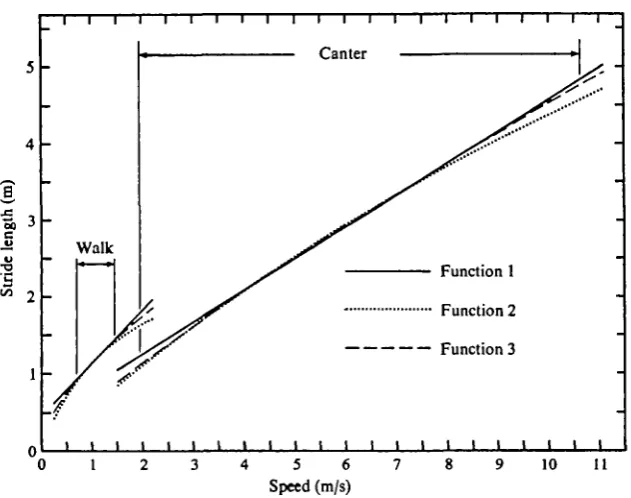
It can be seen from the table that for any particular animal and gait there is very little to choose between the three functions. In some cases Function 2 and in others Function 3 gives marginally the best fit. From Fig. 2 it can be seen that the curves of the three functions are barely distinguishable in the region occupied by most of the data points, but diverge rapidly when extrapolated outside this region.
Relative contributions of stride length and frequency to speed
As equation (7) shows, to increase its speed an animal must increase its stride length, or its stepping frequency, or some combination of both. It can be seen from Table 1 that, within any gait, change of stride length makes a greater contribution to the increase of speed than change of stepping frequency. This is most easily seen when the data are fitted by Function 3. For instance, in the adult gnu stride length varied with V*61 and V0"8* for walking and cantering respectively, implying that stepping frequency varied only with F0"89 and V^1* respectively. o-6i was the lowest exponent found for the variation of S with V in any of the cases investigated.
Could stepping frequency be independent of speed?
1 1 1 1 1
Canter
Function 1
Function 2
Function 3
1 1 1 1 1
4 5 6 Speed (m/s)
[image:7.451.69.385.80.329.2]10 11
Fig. 2. Three regression functions fitted through the data of stride length on speed (see text and Table 1). The extreme limits of observed speed in each gait are marked: the full distribu-tion of speeds is shown in Fig. 3.
the data, there is a testable null hypothesis which corresponds to this possibility. The null hypotheses are as follows: Function 1, a1 = 0 ; Function 2, at = 0 ; Function 3,
<h = 1.
Standard deviations for each of the coefficients emerge from the regression calcula-tions, and a *-test can be applied to the above null hypotheses in the normal way. The results are listed in Table 2, from which it will be seen that out of 18 tests only two (both for walking) were not significant at the 5% probability level, while in 13 cases the null hypothesis was rejected beyond the o-i% probability level. The conclusion is that stepping frequency is not independent of speed within a gait, even though the dependence is mostly weak.
COMPARISONS BETWEEN DIFFERENT ANIMALS Adult gnu compared with Thomson's gazelle
In Figs. 3, 4 and 5 the speeds, stride lengths and stepping frequencies seen in walking and cantering adult gnus are compared with corresponding observations for adult Thomson's gazelles. It can be seen that the mean stride length in walking is longer in the gnu than in the gazelle, but the stepping frequency is lower. The speed is slightly higher. The differences between corresponding means are highly significant (P < io"3) in all three cases.
Table 2. Tests of the hypothesis that stepping frequency is independent of speed Null hypothesis a , >=> 1
Gnu (adult) Gnu (adult) Gnu (calf) Gnu (calf)
Thomson's gazelle Walk (adult) Zebra (adult) Gait Walk Canter Walk Canter 11-50 18-19 841 709 1-14 0-05
Walk 4-63 < io~*
t
1293 1068 1 9 9 4-02 2 6 3
v86 P < io-« < io-* > 0-05 < IO~* < o-oi < 10-' t -1289 — 10-32 -2-35
- 3 8 6
- 3 0 7
-426
P
< 10-* < IO"1 < 0-05 < IO~*
< o-oi
< IO-* d.f 217 194 49 61 83 7 7 Canter Thomson's gazelle Speed (m/s)
Fig. 3. Distribution of observed speeds in adult gnu and Thomson's gazelle. The vertical lines are the means of the distributions.
gnu, but not much confidence can be attached to this result. The difference was statisti-cally significant at the 5% level, but was based on only 16 observations of canter-ing gazelles, 13 of which were obtained from film.
The comparisons can be made more explicit if the ratios of the means of the different locomotor variables are expressed as powers of the ratio of shoulder heights (R^. RF is defined as the ratio of mean stepping frequency in the gnu to that in Thomson's
gazelle, and similarly with Rs and Rv for the stride length and speed ratios respectively.
Then, from the means of the observations shown in Figs. 3-5, the relationships for walking are,
Ry = Rf™, Rs =
RF = i
The corresponding ratios for cantering are,
Ry = j Rs = Ri
60 50 40 30 20 » 10
1 0
[image:9.451.104.349.55.290.2] [image:9.451.112.345.337.510.2]Walk
| (Trot)
783
Canter
n - 8 5 Thomson's gazelle
2 3 Stride length (m)
Fig. 4. Distribution of observed stride lengths in adult gnu and Thomson's gazelle. The vertical lines are the means of the distributions.
o
3
oThomson's (Trot)! 8 a Z e"C
Canter
70 60 50 40 30 20 10
0
>- J 1, J h
" 1111111111 i i i 111 n 11111 i~i 111111111 0 05 10 1-5 20 2-5 3010 1-5 20 2-5Stepping frequency (s"1)
Fig. 5. Distribution of observed stepping frequencies in adult gnu and Thomson's gazelle. The vertical lines are the means of the distributions. A few more observations are plotted than for speed and stride length, as there were occasions when no distance measurement was obtained.
The fact that these estimates do not conform exactly to equation (7) is a consequence of the way in which the means were obtained.
It is also of interest to show the relationship between the step length ratio (/?„.) and the shoulder height ratio. In walking the relationship was
and in cantering it was
The comparison shows that both the step and the stride are relatively longer in the gazelle than in the gnu, but the difference is much more pronounced in cantering than in walking. These observations will later be interpreted in terms of the average number of feet in contact with the ground, but first another size comparison must be introduced.
Adult female gnu compared with calf
Newborn gnus get up and walk within a few minutes of birth, as is usual in ungulates. In the migratory gnu population of the Serengeti the calves are usually born in January and February on the open Serengeti Plains. The plains are normally green and productive at this time, but rain showers are apt to be local and erratic. Because of this the gnus with their newborn calves have to be constantly on the move, in search of the new grass growth which suits them best. The mothers walk and canter as usual in these irregular movements, and the calves must be able to keep up with them, irrespective of any dimensional relationships that may normally apply. Thus the comparison between very young gnus and their mothers differs from that between adult gnus and gazelles, in that here both the large and the small animal must go at the same speed.
In Figs. 6, 7 and 8 the speeds, stride lengths and stepping frequencies observed in adult females walking and cantering are compared with corresponding figures for calves less than 2 months old. Table 3 gives an approximate comparison between shoulder heights and body masses of adult females and calves of this age.
The calves' mean walking speed was 4-5 % less than that of the adult females, whilst their mean cantering speed was 12% more. Both of these differences were just significant at the 5% probability level, but should presumably not be taken too literally, since it seems to be the case that calves on the whole keep up with their mothers.
In walking the mean stride length of the calves was 23 % less than that of the adult females, and this difference was highly significant (P < io"3), whereas in cantering the calves' mean stride length was i-6% greater than that of the adult females, but the difference was not significant. The mean stepping frequencies of the calves were 24% and 12% greater than those of the adult females in walking and cantering respectively, and both differences were highly significant (P < io"3).
In the walk, the ratios of speed, stride length, stepping frequency and step length, as defined above, were related to the shoulder height ratio as follows:
R
8 =*,«*,
In the canter, the corresponding relationships were,
Ry =
RT™,
R8 =
R
T™,
Rjr
=Rj™,
-- Walk Canter
Gnu (calf)
0
[image:11.451.109.352.44.246.2]Speed (m/s)
Fig. 6. Distribution of observed speeds in adult female gnu and gnu calf (less than a months old). The vertical lines are the means of the distributions.
Walk Canter
Gnu (calt)
2 3 4 5 Stride length (m)
Fig. 7. Distribution of observed stride lengths in adult female gnu and gnu calf (less than 2 months old). The vertical lines are the means of the distributions.
Referring to the corresponding comparisons between the adult gnu and Thomson's gazelle, it can be seen that here too both step and stride lengths are disproportionately long in the smaller animal. The relative lengthening of the stride (although not of the step) is much more marked in the gnu calf than in the gazelle, however. In an average canter the calves' strides were about as long as those of the adults. They bounced along in huge bounds, and so were able to keep up with the adults, with a stepping frequency much less than would be expected from their size.
[image:11.451.112.345.286.495.2]786
C. J. PENNYCUICKWalk Canter
I [ 1 J 1 Gnu(ad?)
i i i i i i i l l i l i u i i i i I i i i i i L i i i i i i i i i t 0-5 1-0 1-5 2 0 2-5
Stepping frequency (s"1)
[image:12.451.113.346.68.276.2]3-0
Fig. 8. Distribution of observed stepping frequencies in adult female gnu and gnu calf (less than 2 months old). The vertical lines are the means of the distributions. A few more observations are plotted than for speed and stride length, as there were occasions when no distance measure-ment was obtained.
Table 3. Body measurements from dead animals and calibrated photographs
Species Gnu (adult?) Gnu (adult <J)
No. speci-mens averaged 1 1 Gnu (Calf, ca. 2 weeks) 1 Thomson's gazelle (adult ?) Thomson's gazelle (adult (J) 3 Body mass (kg)
1 4 1
163 1 8 3 1 6 8
Leg mass
(kg) 44'4 4 9 9 7-48 4 6 3
(Leg mass/ Body mass)
0 3 1 0 3 1 0-41 0 2 8
Shoulder height
from photos
(m)
1 1 4 I'3I 0 7 6 O-58 o-6i No. photos measured 7 6 2 6 9
The mass measurements are from animals killed in the course of other projects. Leg masses are for both sides, and include the scapula and femur, and their attached muscles. The shoulder heights are from calibrated photographs of standing animals. Further body measurements for a range of species are given by Sachs (1967).
C H A R A C T E R I S T I C S OF GAITS Average number of feet on the ground
Changes of stride length with speed can be represented in terms of the average number of feet in contact with the ground (N). This variable is closely related to the ratio of the stride to the step, and it has much to recommend it as a descriptive variable for characterizing different gaits. For an animal with N legs,
[image:12.451.55.407.357.473.2]No-Table 4. Step lengths measured from cine film
Walk Canter
Step No. of Step No. of Species length (m) observations length (m) observations
Gnu (adult $) 0 7 6 20 O'8a 10 Gnu (calf) 0-53 20 0-62 10 Thomson's gazelle °'43 11 0 6 0 15
(adult)
where <r is the step length. Thus for a quadruped,
W=f. (.6)
It was not possible to measure step lengths directly in the course of the field observations, but a small number of such measurements was obtained from cine film. The amount of data is too small to attempt to determine a relationship between step length and speed within a gait, but step lengths in walking and cantering can be distinguished. The results are listed in Table 4 for adult gnus and calves, and adult Thomson's gazelles.
Combining these step lengths with the regression equations allows the stride-to-step ratios, and hence N, to be calculated as a function of speed. Figs. 9 and 10 have been plotted using Function 3 to represent the stride length. The step length has been assumed constant within each gait, for want of better information. This may have introduced some errors, as Gray (1968) states that step length decreases with speed in cantering animals. If this is the case in the gnu, then there would be a somewhat greater decline in N than is indicated.
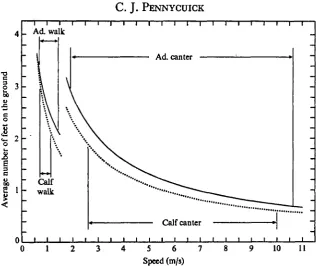
The speed ranges recorded for walking and cantering in the gnu are shown in Fig. 9. It can be seen that in a very slow walk both adult gnu and calf have 3 feet, or even a little more, on the ground on average. In both cases, N can be reduced down to about 2-i feet as speed is increased, and when this point is reached, the animal changes to a canter.
There is a gap between the highest walking speed and the lowest cantering speed in both the adult gnu and calf. If the walking and cantering speed ranges overlapped, then the stride length would be shorter in cantering than in walking at the same speed, because of the higher stepping frequency. In fact the effect of changing to a canter is to increase speed and stepping frequency together, so that the stride length, and hence also N, remains about the same. As speed is further increased in the canter, the stride length progressively increases, and N correspondingly declines, until in a fast canter or gallop there is in the calf about o-6 foot on the ground on average, and in the adult about 0*7 foot.
. Ad. walk
•o
I 3
o
2 1
Ad. canter
Calf canter
S 6 Speed (m/s)
[image:14.451.65.384.44.310.2]10 11
Fig. 9. The gnu calf (dotted lines) has less feet in contact with the ground at any given speed than the adult (continuous lines). The lines are calculated from equation (15), with S replaced by the regression function 3, using the coefficients listed in Table 1.
lengths may have been longer than the overall mean assumed. Because of this the minimum number of feet on the ground in walking is probably nearer 2 than i-8. Also if a greater number of cantering observations had been obtained, the slowest observed cantering speed might well have been extended downwards, giving a higher minimum N for the canter. On the other hand, a wider gap between walking and cantering is to be expected in gazelles, as they cover part of the intervening speed range with the trot, a gait which is not used by gnus.
Forces exerted on the ground by the legs
If W is the body weight, the average upward force P exerted on each foot by the ground must evidently be:
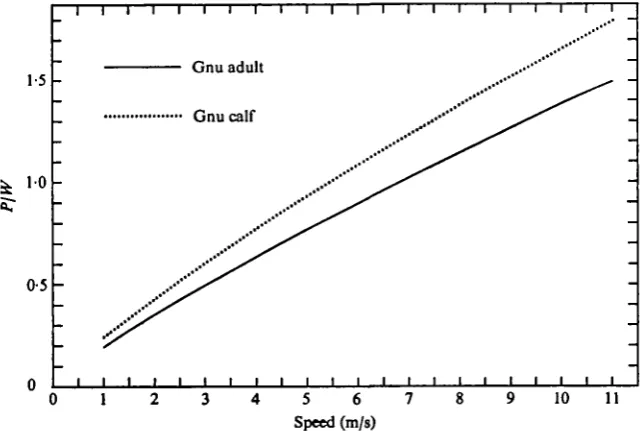
P = W/N. (17) If N < 1, this implies that there is an unsupported period at some stage in the cycle. P then exceeds W during the contact period, causing the animal to accelerate upward. (An unsupported period may also occur with N > 1, as considered in the next section, but in this case there are more feet on the ground to share the force and P, being the force exerted on each foot, remains less than W.)
The running of the gnu
789
I
3"5 2
00
2 Walk
Canter
Trot
4 5 6 Speed (m/s)
[image:15.451.58.379.78.345.2]10
Fig. 10. N for Thomson's gazelle, with the extreme range of observations in each gait marked. Note that the regression functions for the trot and canter are based on very few observations (Table 1).
1-5
10
0-5
4 5 6 7 Speed (m/s)
10 11
[image:15.451.55.377.398.613.2]energy can be recovered to propel the animal upward for the next unsupported phase. Once the elastic structures are fully deflected, then a further increase of P would presumably call for a sharp increase in the energy expenditure required for imparting upward momentum at each stride.
Some figures on the strengths of the elastic ligaments in the legs of a domestic horse (Equus caballus) are given by Camp & Smith (1942) in their pioneering study of the mechanics of this system. They found that when they progressively increased the force applied to the forefoot of a recently killed horse, the first ligament to break (the metacarpal check ligament) did so when the force was 1-35 times the body weight. The main elastic storage element, the interosseous ligament, broke when the force applied to the foot was I - 8 I times the body weight. The corresponding values of N would be 0-74 and 0-55 foot respectively. These values are quite similar to the minimum values of N, around o-6 foot, seen in the galloping gnu, which presumably has a mechanically similar arrangement of ligaments.
The fact that the gnu calf achieves the same speed as its mother by running with less feet on the ground, means that the ratio PjW has to be greater in the calf at any given speed. Hence, to attain the same top speed, the calf needs relatively stronger legs. This is reflected in the fact that the legs contain a greater proportion of the total body mass in the gnu calf than in the adult (Table 3). This disproportionate develop-ment of the legs is a common feature of very young ungulates (see Fig. 16).
Jump height in cantering
When unsupported periods occur in cantering, some vertical excursion of the centre of gravity must take place, implying that a certain amount of potential energy must be gained and lost at each stride. One cannot go so far as to estimate the power required to maintain the vertical movements, since the potential energy present at the top of each jump is presumably converted first into downward kinetic energy, then into elastic energy of deformation of body structures. Part at least of this elastic energy can then be converted into upward kinetic energy on the next jump, and finally back into potential energy. If these conversions were loss-free, then no work would have to be done to maintain the oscillation. In fact there is bound to be some loss, and it is of interest to set limits to the height of the jumps, in order to gain some idea of the amounts of energy involved. This can be done if N can be estimated as a function of speed.
If there a.re two unsupported phases in the cycle, as can occur in some types of gallop, and in symmetrical gaits, then the jump height in each of them will be less than if there is only a single unsupported period, other variables being equal. The following discussion is restricted to the case in which there is only one unsupported period, and therefore leads to maximum estimates for the jump height needed under the conditions specified.
Before the jump height can be calculated, a variable must be introduced to express the degree of synchronization of the legs. Initially, this will be done in terms of a variable C, which is defined as the proportion of the cycle (time or distance) during which one or more feet are in contact with the ground. At any given speed, C has a minimum value ar/S, when all four legs are completely synchronized. Its maximum value is 1, or 40-/S, whichever is the less, when the legs are maximally desynchronized. Considering any case in which C < 1, the time t during which one or more feet are in contact with the ground is
The average force R applied by the feet to the ground can also be calculated, since the upward momentum imparted to the animal while the feet are on the ground must equal the downward momentum acquired while they are not. Hence, if W is the body
wei
ght> (R-W)C = W(i-C), (19)
W
so that R = —. (20) The upward acceleration (A) imparted to the animal is proportional to the excess of this force over the weight, and is
where g is the acceleration due to gravity. To get the upward take-off velocity (u), this must be multiplied by half the time that the feet are on the ground (as the first hah0 of this period is occupied in annulling the downward landing velocity). Thus,
The maximum height (H) by which the centre of gravity will be raised in the jump can now be calculated, since
( 2 3 )
Equation (23) is actually not a very convenient form for computing the limits of H, since the upper limit of C is itself a function of S, and hence of V. For most purposes it is more convenient to re-express the relationship in terms of another variable (v), the ' dispersion' of the footfalls. This is defined as
15
no
-o.
3
5
-- 1 I
-1 -1
1 1 1 1 1 1
Gnu calf
/ /
S 1
/J
i i i
" m a x
i i I 1
'
...A.-"*""
1 1 1 1 1 1 1 1
^
" m l n
i - i — — r ^ i I I I I I _ -1 I 1 1 1 I 5 6 Speed (m/s) 10 11
Fig. 12. Minimum and maximum jump heights (i/min and Hmu) in the cantering adult gnu and calf. The curves are calculated from equation (26), using the values for a, and a, listed in Table 1, and step lengths from Table 4. Note that ft,, does not increase indefinitely with increasing speed.
The minimum value of v is 1, which means that all four legs are completely syn-chronized, and the maximum value is 4, which means that they are desynchronized to the extent that there is never more than one foot on the ground at any one time. This condition can, of course, be attained only when 5 ^ 40-.
Equation (23), re-expressed in terms of footfall dispersion, becomes
v>o*g(S V
(25) At any speed the maximum jump height, required when all the legs are synchronized, is found by setting v = i. If Sj<r < 4, then no unsupported periods need necessarily occur, and the minimum jump height is zero. If not, it is found by setting v — 4.
The graph of maximum and minimum jump heights versus speed, shown in Fig. 12, was calculated by substituting the regression equation of Function 3 (equation 12) for S, so that equation (25) becomes
(26)
It has been assumed in the above argument that the step length remains constant, irrespective of speed. If this is not so, then cr in equation (26) would have to be made a function of V, in some such way as has been done for S. If, as Gray (1968) asserts, step length decreases in a fast gallop, this would lead to jump heights somewhat greater than the modest values plotted in Fig. 12.
heights are only a few centimetres, and furthermore they do not continue to increase indefinitely as speed is increased. Instead they rise to a very flat peak, and then slowly decline. This conclusion, of course, depends on extrapolation of the regression equa-tion used to represent S (equaequa-tion 12), and should not be regarded with a high degree of confidence.
STEPPING PATTERNS AND GAITS
The patterns of leg movements used by various animals in different gaits have been the subject of scientific study since the time of Marey (1874) and Muybridge (1887). Everything about a 'stepping pattern' can be specified by stating the lengths of the stride and the step, the stepping frequency, and the phase differences between the footfalls of different feet. A vast range of stepping patterns have been distinguished on this basis in the surveys undertaken by Howell (1944) and Hildebrand (1965), and this literature has been reviewed by Gray (1968).
The actual term 'gait' has not always been very explicitly defined. An attempt will be made here to classify functionally equivalent stepping patterns together into 'gaits', by using only a part of the information required to specify a stepping pattern in full.
A 'gait' is here defined, in relation to an individual animal, as a continuous series of stepping patterns. Continuity is the essential feature distinguishing a single gait from a series of gaits. For example in the horse the pattern of movement of the legs is quite different in a very slow and a very fast walk, but the horse can change smoothly from one to the other by progressively changing the above variables. The extreme patterns, and all the intermediates, belong to a continuous series, which is therefore regarded as one gait, the walk. When the horse changes from a walk to a trot, however, there is a discontinuous change, without intermediates. This makes the trot by definition a different gait from the walk. The same criterion distinguishes the canter as a third gait, but one which, like the walk, contains a wide range of (continuous) variation within the one gait.
The choice of variables to be used in classifying gaits depends on the amount of information about the stepping pattern which is required. The more information is rejected, the more patterns are lumped together under one 'gait'.
Analyses such as those of Hildebrand (1959, 1961) take account of all the informa-tion about stride and step lengths, and phase differences between footfalls. That has not been done in the present study. The variable N, the average number of feet on the ground, takes account only of stride and step lengths, and neglects phase informa-tion. The variable v, the dispersion of the footfalls, which was needed above to calcu-late the jump height in cantering, takes account of some, but not all of the phase information. For instance the distinction between a transverse and a rotatory canter cannot be made by specifying v, nor is it required in order to calculate the jump height. For the present purposes it would appear that all phase information can be neglected, except as regards the symmetry or otherwise of the stepping pattern. Three criteria are now suggested for classifying gaits, as follows:
(1) A symmetrical gait, in which pairs of feet move together, is distinguished from an asymmetrical one, in which they do not. This is the only phase information to be
(2) The range of N over which the necessary coordination can be maintained is to be specified. It is postulated that this is the main factor determining when an animal makes the discontinuous shift from one gait to another.
(3) The nature of the energy transformations which take place at each step is to be specified.
On this basis, three gaits can be provisionally distinguished, as follows. Walk
This is an asymmetrical gait without unsupported periods, in which energy is exchanged at each step between potential and horizontal kinetic forms, in the fashion of the ' stiff-legged' walk studied experimentally in man by Cavagna & Margaria (1966), and analysed by Alexander (1975). Alexander's analysis refers to bipedal walking, but the same principles should apply to quadrupedal walking also. At each step the centre of mass rises up over a diagonal pair of feet, losing horizontal speed as potential energy is gained, and then accelerates again and descends as the legs pass the vertical position. This acceleration is produced by gravity, operating in effect on an inverted pendulum. Thus the speed attainable for a particular step length is limited by the acceleration due to gravity. Alexander shows that the maximum speed should be about V(#0> where / is the leg length, for a biped rotating its legs through a reason-ably small angle. Human walking speeds up to about 1 -j *J(gl) can be attained by modifying the 'stiff-legged walk' towards the 'level non-pitching walk', which Alexander analyses separately.
If / for the gnu is taken as the height of the shoulder joint above the ground in the standing animal (0-76 m), then ^J(gl) = 2-73 m/s for an average adult. This is more than twice the maximum speed actually observed in walking. Evidently the gnu changes to a canter at a relatively early stage.
Alexander's biped increases its walking speed by increasing the stepping frequency, but in a quadruped a decrease in the average number of feet on the ground also contri-butes to an increase of speed. It is suggested here that the co-ordination of the legs required for any particular gait is only feasible over a limited range of N, and that this determines the speeds at which the animal shifts from one gait to another. From the field data it would appear that the walk is used over a range from N > 3 down to N x 2. This rule should apply irrespective of the size of the animal, if this inter-pretation is correct.
Trot
The trot is a symmetrical gait in which diagonal pairs of legs move together. How-ever, the mechanical criteria used in this paper would not distinguish between the different symmetrical gaits described by Hildebrand (1965). For instance the pace, in which ipsilateral pairs of legs move together, is considered here to be mechanically equivalent to a trot. Energy is exchanged at each step between potential energy as the centre of mass moves up, and elastic energy stored in ligaments of the legs as it comes down. The basic mechanics of this system were discovered by Camp & Smith (1942) in the domestic horse, and there is no doubt that artiodactyls have a mechanic-ally similar system, albeit in a different morphological manifestation.
in relation to jumping locomotion in the kangaroo by Dawson & Taylor (1973). As applied to quadrupeds, it differs from the walk in that the possible range of stepping frequencies attainable is more limited, as the system is to some extent 'tuned'. The animal therefore has to rely relatively more on varying the average number of feet on the ground to effect changes of speed.
The symmetrical action of the trot or pace limits the range of N which can be used from about 2 feet down to about 1-2 feet. This gait is not used by those antelopes, including the gnu, which have long neural spines in the thoracic region, giving a 'sloping-backed' appearance in profile. Other animals with a similar characteristic, such as the giraffe and spotted hyaena, also change directly from a walk to a canter, and do not trot. On the other hand animals with horizontal backs, such as gazelles, dogs, buffaloes, lions, rhinoceroses etc do use the trot.
Canter
The energy exchanges at each step in cantering are of the 'pogo-stick' type as in the trot, but the co-ordination of the legs is different, being asymmetrical. Instead of moving pairs of legs together, a cantering animal in effect passes its weight around from one leg to another, using all four legs in turn. In this way the animal can travel a long distance between successive footfalls of the same foot, without excessively long unsupported periods, so achieving long strides, and a low value of N. The canter is used in the gnu for speeds requiring an average of about i-8 down to about 0 6 feet on the ground. The minimum value for N is set by the strength of the legs, as ex-plained above, and this in turn determines the maximum speed.
The term 'gallop' refers to a canter in which there is at least one unsupported period in each stepping cycle, but this condition is achieved without any discontinuous change in the pattern of leg movements. On the definitions used in this paper the gallop is therefore not distinguished as a separate gait from the canter, but is a synonym for a fast canter.
As with the trot, this description of the canter lumps together variants which are considered mechanically equivalent, as for instance transverse and rotatory gallops with similar values of the descriptive variables used above.
SCALING OF VARIABLES
Stepping frequency in animals of different size
The limited comparisons presented above do not provide a very solid basis for investigating scale relationships in the different locomotion variables. The most easily observed variable was stepping frequency, and observations of this were obtained for 14 different mammal species, from Thomson's gazelle to elephant (Loxodonta africana), plus the gnu calf.
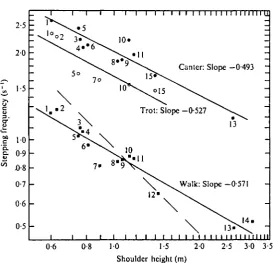
Fig. 13 is a double-logarithmic plot of the mean stepping frequency observed in walking, trotting and cantering, versus shoulder height. The shoulder height is the height above the ground of the top of the back over the shoulder, measured from photographs of standing animals, as explained above. The straight lines in Fig. 13 are calculated regression lines for each gait. In all three gaits the slopes of the lines highly significantly different from —i(P< io"3), but the slopes do not differ
796
a. a. 2-5 2 0 1-5 10 0-9 .0-8 0-7 0-6 0-5_ i I I
5o '- \ : ^ -i 7° T i i i 10« 8»*9^ 10^ 8"9\ l i
1 1 1 1 1 1 1 1 1 1 1 II 1 1 1 111 II 1 U
11
^ ^ ^ Canter: Slope 0493
-'5*w :
\<
15^ \ ^ :
Trot: Slope -0527 ^ " - ^ • \ -13
11
\ " \ W a l k : Slope -0-571
\ I3>\ "
l l l i i i i i i i i i i i i i i 11 n i l l
[image:22.451.90.365.59.322.2]0-6 0-8 10 1-5 20 2-5 3 0 3-5 Shoulder height (m)
Fig. 13. Double logarithmic plot of stepping frequency versus shoulder height in 14 species of mammals, plus the gnu calf. Solid squares, walk; open circles, trot; solid circles, canter. The dashed line is at a slope of — 1, as would be predicted from Hill's (1950) analysis. The numbers refer to species, as follows:
1. Thomson's gazelle (Gassella
thomsorm).
2. Warthog (Phacochoerus aethiopicus). 3. Gnu (Cormochaetes tattrinut) - calf. 4. Spotted hyaena (Crocuta Croatia).
5. Grant's gazelle (Gaxdla granti).
6. Impala (Aepyceros melampus).
7. Lion {Panthera leo).
8. Kongoni (AUelapkus buselaphus). 9. Topi (Damalitcui korrigum). 10. Zebra {Equut burchelli).
1 x. Gnu (Cotmochaetes taurinui) - adult. 12. Black rhinoceros (Dicerot bicomU). 13. Giraffe {Girqffa camelopardalit). 14. Elephant (Loxodonta qfricana). 15. Buffalo (Syncerus coffer).
significantly from —0-5 at the 5% probability level. The slope of — 1 is predicted by Hill's (1950) classical dimensional analysis for geometrically similar animals, which is based on the assumption that stepping frequency is limited by the strengths of body parts. This may still apply at the maximum galloping speed, but evidently does not apply at the mean speed in any gait. The slope of — C5 is predicted by Alexander (1975) from his analysis of bipedal walking. The agreement of this value with the observed results suggests that the basic principles, on which Alexander's analysis is based, apply also to quadrupedal walking, although it is less clear why the same law should apply to the two faster gaits also.
It may be noted that the regression line for walking in Fig. 13 represents the natural frequency of a simple pendulum, whose length is about one third of the shoulder height.
Methods of applying scale relationships
using the same gait. A different approach has been used by Heglund et al. (1974), who used instead the transition frequency as an individual animal, running on a treadmill, changed from one gait to another, and similarly with stride length and speed. The use of this quantity implies that the animal can change from one gait to another without a discontinuous jump in the stepping frequency. It is not obvious that this must be the case - and if it were not the case, then no ' transition frequency' could be defined. The point is of considerable interest, and it should be possible to settle it from the analysis of treadmill observations. Indeed, Heglund et al. show a graph of frequency versus speed, of which the slope changes discontinuously at the transitions between gaits, but without any frequency discontinuities. Some further information on the statistical basis of this graph would help to clarify the nature of the transitions.
As with 'transition frequency', the 'transition stride length' is a quantity whose existence may be questioned. It is not self-evident that there must be some speed at which the stride length would be the sa me in two different gaits. However, if such a quantity does exist, then Heglund et al. find that it scales with the 0-38 power of the body mass. According to T.A. McMahon (pers. comm.) this relation-ship can be combined with the elastic similarity criteria for body proportions developed by McMahon (1973), and would then lead to the conclusion that N a t the transition from trot to gallop should vary with the — 0-25 power of the body mass. If this point of view can be sustained, then some modification may be needed to the suggestion made above, that an animal's choice of gait depends primarily on the value required of N.
LIST OF SYMBOLS A Upward acceleration
ax-a6 Regression coefficients
C Proportion of cycle during which 1 or more feet on the ground F Stepping frequency
/ Focal length
g Acceleration due to gravity H Jump height in cantering J Number of steps
/ Leg length M Enlarger ratio N Number of legs
N Average number of feet in contact with the ground n Number of observations
P Average force exerted on ground by each foot during contact period (Probability in significance statements)
q Percentage of variance accounted for by regression
R Total force applied by feet to ground, averaged over contact period RF Stepping frequency ratio
Ri Shoulder height ratio Rs Stride length ratio
Rv Speed ratio
Step length ratio
r
S
V • X
T
t u
V W
e
V
<T
Range Stride length
Variance of dependent variate Variance from regression Time for step count
Time during which i or more feet in contact with the ground, within i cycle Upward take-off velocity
Speed Body weight
Viewing angle in speed observations Scale of photograph
Dispersion of footfalls Step length
It is a pleasure to thank the Director of Tanzania National Parks for allowing me facilities to undertake this research, and the Ford Foundation for supporting me at the Serengeti Research Institute, where the field work was carried out. I am deeply indebted to all my former colleagues at the Institute for their interest and sup-port whilst the field work was in progress, and also to the many colleagues and students with whom I have subsequently discussed the principles involved. I am particularly indebted to Professor R. McN. Alexander, Professor C. R. Taylor and Dr T. McMahon for helpful discussion during the writing-up period.
REFERENCES
ALEXANDER, R. M C N . (1975). Mechanics of bipedal locomotion. In Experimental Animal Biology (ed. P. Spencer Davis). Oxford: Pergamon.
BELL, R. H. V. (1971). A grazing ecosystem in the Serengeti. Scient. Amer. 335, (1), 86-93.
CAMP, C. L. & SMITH, N. (194a). Phylogeny and functions of the digital ligaments of the horse.
Mem. Univ. Calif. 13 (2), 69-124.
CAVAGNA, G. A. (1970). Elastic bounce of the body. J. appl. Phytiol. 39, 279-82.
CAVAGNA, G. A. & MAHGARIA, R. (1966). Mechanics of walking. J. appl. Phytiol. a i , 271-8.
DAWSON, T. J. & TAYLOR, C. R. (1973). Energetic cost of locomotion in kangaroos. Nature, Lond. 346,
313-4-GRAY, SIR J. (1968). Animal Locomotion. London: Weidenfeld & Nicolson.
HEGLUND, N. C , TAYLOR, C. R. & MCMAHON, T. A. (1974). Scaling stride frequency and gait to animal size: mice to horses. Science, N.Y. 186, 1112-3.
HILDEBRAND, M. (19S9). Motions of the running cheetah and horse. J. Mammal. 40, 481—95. HILDEBRAND, M. (1961). Further studies on locomotion of the cheetah. J. Mammal. 4a, 84-91. HILDEBRAND, M. (1965). Symmetrical gaits of horses. Science, N.Y. 150, 701-8.
HILL, A. V. (1950). The dimensions of animals and their muscular dynamics. Science Progr. 38,
209-30.
HOWELL, A. B. (1944). Speed in animals-their specialization for running and leaping. University of Chicago Press.
MAREY, E. J. (1874). Animal mechanism: a treatise on terrestrial and aerial locomotion. London: King. MCMAHON, T. (1973). Size and shape in biology. Science, N.Y. 179, 1201-4.
MUYBRIDGE, E. A. (1887). Animal locomotion. University of Pennsylvania.
SACHS, R. (1967). Liveweights and body measurements of Serengeti game animals. E. Afr. Widl. J. 5, 24-36.
Figs. 14-15
*•'•:•• . '
17
Fig. 14. A column of migrating gnus leaving the Serengeti Plains for the woodlands during a spell of dry weather.
Fig. 15. A vertical photograph of migrating gnus, showing closely spaced braided paths. Fig. 16. Adult female gnu with calf. The forelegs of calves of this age are too long to allow grazing in the standing position, and the calf has to kneel on the carpal joints in order to graze. Scale 1 m.