A METHOD FOR CONTROLLING THE FEEDING
BEHAVIOUR OF AQUATIC BIRDS: HEART RATE AND
OXYGEN CONSUMPTION DURING DIVES OF DD7FERENT
DURATION
BY R. M. BEVAN1, E. KEIJER2 AND P. J. BUTLER1
1
School of Biological Sciences, The University of Birmingham, Edgbaston, Birmingham, B15 2TT, UK and 2Boeg 94, Groningen, The Netherlands
Accepted 6 September 1991
Summary
Tufted ducks, Aythya fuligula, were trained to dive for different durations in shallow tanks using a computer-controlled system of lights. The birds were rewarded with food for a correct response, i.e. performing a dive of the required duration. When dive durations (td) elicited by the system were longer than the
durations required, the extra time was spent feeding. As the required duration was increased, so the time spent feeding decreased, and the required and actual dive durations approached equality. This occurred at approximately 40 s, although some birds did perform dives of up to 45 s.
Heart rate (/H) and oxygen consumption (VO2) were measured from the birds
during voluntary diving using an implanted radiotransmitter and respirometry, respectively. The oxygen consumption during submersion decreased with increas-ing mean (d, and may reflect a reduction in aerobic metabolism as a dive
progressed, possibly as a result of reduced buoyancy or through a gradual switch to anaerobic metabolism.
Over a total dive cycle (the time spent submerged plus that spent on the surface between dives), fn proved to be a very good predictor of VQ2, with an error of only
+7.9%. This compares favourably with other methods used to determine the energy expenditures of animals, e.g. the doubly labelled water and the time energy budget methods, and shows that the electronic acquisition of fn could be a useful tool for estimating the energy usage of free-living, aquatic birds.
Introduction
When the tufted duck (Aythya fuligula) dives for a mean dive duration (td) of
14.4s, the overall aerobic energy expenditure is similar to that whilst swimming on the surface at maximum sustainable speed (Woakes and Butler, 1983). The oxygen stored within the body (in the lungs, blood and tissues) is sufficient to maintain this elevated metabolic rate for a calculated maximum td of approximately 51s
(Woakes and Butler, 1983). So, for dives of normal duration (10-20s; Dewar, 1924; Draulans, 1982), there should be no need for the ducks to resort to anaerobic metabolism. However, td increases with depth of water or distance travelled under
water (Dewar, 1924; Stephenson etal. 1986). During winter, when the ducks may have to dive under ice to obtain food, td may increase, thus increasing the demands
made on the oxygen stores.
Stephenson et al. (1986) monitored heart rates (/H) in ducks under conditions that simulated those encountered by birds diving under ice. They found that / H started to decrease towards the end of long dives (>35s), possibly indicating that there is a gradual shift from an exercise response (tachycardia and peripheral vasodilatation) to the 'classical' dive response (bradycardia, peripheral vasocon-striction and an increasing dependence on anaerobic metabolism; Irving, 1939). Alternatively, the depressed /H during the long dives may indicate that there is a reduction in the amount of energy that the duck needs to expend in order to remain submerged. Whether the reduction in heart rate is caused by a progressive shift to the 'classical' dive response or by a decrease in work load, it will, presumably, be accompanied by a reduction in the oxygen consumed during the dive. Indeed, Woakes and Butler (1983) reported that, for six tufted ducks, the oxygen consumption during submersion tended to decrease with increasing mean
td. Although the overall trend was not statistically significant, the Vo2 during
submersion of the animal performing the longest dives was significantly lower than that of the animal performing the shortest dives.
Woakes and Butler (1983) also monitored / H during diving and found that, although it was significantly higher than that at rest, it was significantly lower than that when the birds were swimming and consuming oxygen at the same rate. Stephenson (1987) re-analysed the data of Woakes and Butler (1983) and calculated the mean Vo2 and mean/H over the total dive cycle (i.e. the time spent
diving plus the time spent at the surface before the next dive, tc). He found that the
data fell on the oxygen uptake/heart rate line obtained from birds swimming at the surface (Woakes and Butler, 1983). This suggests that heart rate can be used as an indicator of the oxygen consumption of aquatic birds in the field during different activities, not perhaps on a time scale of a few seconds, where heart rate can fluctuate rapidly (Stephenson, 1987), but certainly over complete dive cycles (cf.
Fedak etal. 1988).
V02 and/k of these tufted ducks over dives of long duration; (3) to investigate the relationship between VOl and/h over the total dive cycle.
Materials and methods
Seven tufted ducks of either sex (mean mass±s.E. of mean=571g±14) were held in an outside aviary where they had free access to a pool (10mx4.5mx 1.9-2.8m deep).
When required, birds were transferred indoors, where they were kept on individual tanks (0.6 mxO.6mX 1.0 m; water depth 0.6 m). Water temperature was not controlled and varied throughout the year (mean water temperature=14.4°C). A thin film of one-way plastic (Scotchtint solar control film) was fixed onto the front of the glass of the tanks to avoid any disturbance to the ducks caused by movements in the room. To elicit dives of long duration in these shallow tanks, a system of computer-controlled lights was used to train ducks to dive on command and to remain submerged for food.
The diving tanks and training procedure
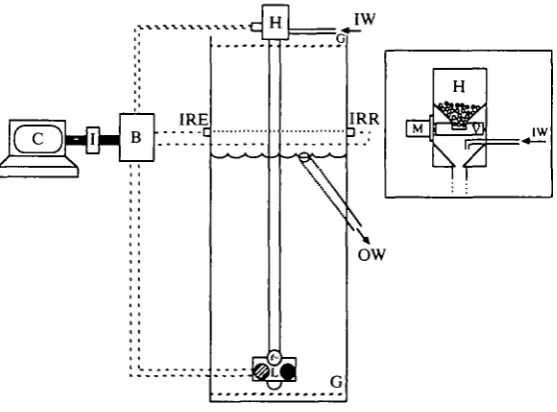
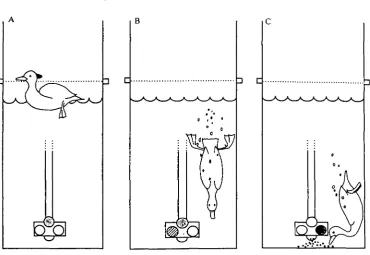
The requirements of the training system were that the bird should dive in relatively shallow water for extended durations and not be able to obtain food unless it remains submerged for the required duration. This was achieved by using a computer and interface coupled with a set of eight infrared light emitters on one side of the tank 2.5 cm above the water surface and a complementary set of eight sensors on the other side. When the duck was on the surface, at least one of the infrared light beams was interrupted. A computer program set the required duration of each dive and the duration of the interval between dives, achieved by controlling lights situated at the bottom of the tank and a food-dispensing system (Fig. 1). At the start of a training session, which lasted for 2-3h, data for dive duration, duration of the interval at the surface and time allowed for the duck to respond to the stimulus were entered into the program and could be adjusted to suit each individual.
IRE
r.
IRR
OW
["M"
[image:4.451.88.367.77.283.2]H
Fig. 1. A diagrammatic representation of the tank and accessories used to train tufted ducks to dive for different durations. The inset represents a more detailed view of the food delivery system. B, control box; C, computer; G, grids; H, hopper containing corn; I, interface; IRE, infrared emitter; IRR, infrared receiver; IW, inflowing water; L, light box comprising three different coloured lights; M, motor; OW, outflowing water; V, rotating valve, used to deposit a set amount of corn. The dashed lines emanating from the control box represent electrical connections.
corn (Heygates Ltd) and was supplemented by growers pellets (Heygates Ltd) given at least once a week. By regulating the pellet supplement, the body mass of the birds was maintained at a steady level.
With a naive duck, the time allowed to react to the stimulus was set very long to allow the animal to get used to the illumination of the lights. This also ensured that there was a large chance that any dives made by the duck would fall within one of these periods, thus triggering the illumination of the red light. By setting the required dive duration to a few seconds only, operation of the feeding system would also occur frequently. For each stimulus, the time it took for the duck to respond and the duration of the dive were stored on disc for later analysis.
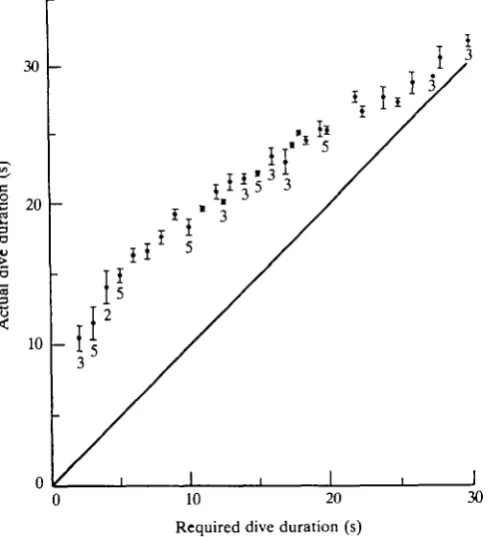
Fig. 3 illustrates the effectiveness of the system for the first five ducks (three males and two females) that were trained. It took these animals 1-5 days to learn what was expected of them, and dives of 10-15 s duration were achieved within 2 weeks. It can be seen from Fig. 3 that, as the required dive duration increased, the difference between actual and expected dive durations decreased, i.e. the time spent feeding decreased. These data predict that actual dive duration should equal required duration at 39 s. The maximum dive duration achieved with this system was 43.6s.
3 C 3 C
Fig. 2. Sequence of lights used to train the ducks. (A) Yellow light illuminated to elicit diving. (B) Red light also switched on when duck dives. (C) Green light lit and food dispenser activated. For further details see text.
under halothane anaesthesia, with a pulse interval modulated radiotransmitter (Butler and Woakes, 1989) to monitor heart rate. Details of the implantation procedure are given by Stephenson etal. (1986). After recovering from the implantation of the radiotransmitter, the ducks were further trained until they were able to dive for durations close to the observed maximum of 45 s (Dewar, 1924; Stephenson etal. 1986).
Oxygen consumption was measured by respirometry as described previously (Woakes and Butler, 1983; Butler and Woakes, 1984). The birds were trained to dive from within a respirometer (internal volume=22.821), which housed two fans to ensure that the gases within it were well mixed. Air was drawn through the box at a rate of 15-201 min"1. The concentrations of the gases leaving the respirometer were continuously monitored by a rapidly responding mass spectrometer (MGA200, Airspec) that had been calibrated with gas mixtures prepared by a precision gas-mixing pump (Wostoff Pumps, Bochum). A rotary valve automati-cally switched the gas being sampled from the outflowing to the inflowing air every 60s for 2s. The signal from the implanted radiotransmitter was picked up by a receiver (Sony 5090), and was converted into an electrocardiogram (ECG) by a purpose-built decoder (Woakes, 1980).
Experimental protocol
0 10 20 Required dive duration (s)
Fig. 3. Response of five tufted ducks (3 cf, 2 9) to training on the system illustrated in Figs 1 and 2, showing mean values (±S.E.) of actual durations of dives performed at different required durations. The number of ducks contributing to each point is four, except where indicated otherwise. The line from the origin indicates actual dive durations equal to required durations.
were taken. They were well accustomed to the respirometer and settled down within a few minutes, as indicated by a low resting heart rate. The training program was then started and was set to elicit dives of between 25 and 40 s. As not all dives were of sufficient duration to be rewarded with food, shorter dives were also recorded. Each feeding session lasted 3h. The mass spectrometer was calibrated before and after each experiment. Air temperature and relative humidity were measured within the respirometer box and in the inlet air; water temperature was also measured, /H was determined by passing the ECG through an instantaneous rate meter (Devices Ltd), / H , ECG and the output from the mass spectrometer were displayed on a four-channel pen recorder (Lectromed Ltd).
The traces from the pen recorder were digitized using a digitizer (GTCO Digipad 5, S.S.I. Ltd) connected to a computer (BBC model B). A BASIC program converted the traces into the oxygen uptake during the interval spent at the surface between dives (O2up); and measured the duration of this interval (t\),
the duration of the dive (td) and the duration of the total dive cycle (tc). O2 u p
The oxygen consumption during diving activity was calculated by the mathemat-ical technique described by Woakes and Butler (1983). The same technique was also applied to the resting measurements. Briefly, the air in the respirometer is mixed in a very short time ( r < l s ) by two fans and, because of this very good mixing, the measurements of oxygen and carbon dioxide in the outlet gas are effectively a measure of the mean concentrations of these gases inside the respirometer. By treating the box as both an open- and a closed-circuit system, and by measuring differences in gas concentration to within 0.001%, gas exchange over periods as short as 2s could be calculated, though this was usually done for the complete interdive interval. If the O2Up of the duck is equivalent to the amount
consumed whilst at the surface plus the amount consumed during the preceding dive, then a linear multiple regression analysis can be performed between td, t\ and
C>2up (see Woakes and Butler, 1983, for the assumptions made). The format of the regression equation is:
y = a + bylx1 + by2x2,
where, in the present study, y is O2 u p in ml, x\ is td in s, x2 is t; in s, a is the y
intercept, £>yl is the partial regression coefficient of y on xlt representing the
average rate of oxygen consumption during submersions of mean duration td in
m i s "1 (Vo2d), and by2 is the partial regression coefficient of y on x2, representing
the average rate of oxygen consumption during the surface intervals of mean duration t; in m i s "1 (Vo^i).
Analysis of a dive was only carried out if the dive itself lasted longer than 10 s and if the next dive occurred within 60s.
The volumes of all gases were converted to STPD. Mean values are given±s.E. for N animals. To avoid animal bias, mean values were obtained for each duck and these means were used to obtain the final mean. A significant difference between means was tested with Student's f-test (assuming unequal variance) or the paired t-test, as appropriate, using the MINITAB statistical package. Significance was tested at the 95 % confidence level.
Summary of symbols used
td dive duration (s).
t\ duration of the interval spent at the surface between dives (s). tc duration of the dive cycle, td+ti (s).
O2uP oxygen uptake during t{ (ml).
VOl rate of oxygen consumption ( m i s "1) .
VO2C rate of oxygen consumption over tc ( m i s "1) .
^Ozd average rate of oxygen consumption during submersions of mean duration td ( m i s "1) .
V ^ j average rate of oxygen consumption for surface intervals of mean duration t-x ( m i s "1) .
fa heart rate (beats m i n "1) .
/ H5 heart rate over the last 5 s of a dive (excluding the 1 s prior to
Results
Heart rates were obtained from five ducks and resting values ranged from 95 to 129 beats min"1, with a mean of 119±6 beats min"1. Resting VOl (N=7) of the
individual ducks ranged from 0.162 to 0.294mis"1, with a mean of 0.218±0.029mls~1.
It was possible to train ducks to dive from within a respirometer box for a maximum fd of 43.6 s. The total number of dives recorded (n) was 1012. The dive
durations for individual birds were normally distributed about the mean. Mean O2up was 23.49±2.18ml, at a mean td of 24.3+1.7s and a mean t-x of 30.0±1.9s (N=7). Mean Vo^ w a s 0.441 ±0.035mis"1. Mean diving/k5, measured over the
last 5 s of each dive (but excluding the final second, which contains the pre-surface increase), had values for each animal of between 111 and 186beats min"1, with a mean of 145±17beatsmin"1 (A/=5).
From the linear multiple regression analysis, the mean VO2(i and Vo^ of the
seven ducks were 0.374±0.044mls~1 (range 0.182-0.545 ml s~J) and 0.442± 0.044mis"1 (range 0.255-0.567mis"1), respectively (see Table 1). For each duck, the multiple regression between O2up, td and t\ was highly significant. The partial
correlation coefficients (r), however, were low, ranging from 0.35 to 0.59 for the dives and from 0.50 to 0.73 for the surface intervals. There was a tendency for Vo^
to decrease as mean dive duration increased (dashed line, Fig. 4), although for the present data the relationship was not significant. If, however, the data from the present study are pooled with those from Woakes and Butler (1983), the relationship is significant, and 87 % of the variation in VO2A can be predicted from
the mean dive duration (solid line, Fig. 4). The relationship between the two variables is described by the equation:
VOld = 0.838-0.019 (±3.34xl(T3)rd, ^=0.87.
The data for/H and O2 u p from all the dives were subdivided, on the basis of dive
duration, into classes at 5 s intervals (10-14.9s etc.). The results of the analysis subsequently performed are shown in Table 2 and Fig. 5. / H , both throughout the dive cycle and over the final 5 s of a dive, was significantly correlated with the mean
Table 1. Mean (±S.E.) of measured variables in seven tufted ducks at rest and during diving
Duration Oxygen consumption Heart rate (s) (mis"1) (beatsmin"1)
0.218±0.029 119±6 0.374±0.044* 174±21t 0.442±0.044*
0.441±0.035 202±17 7 5
* Estimated oxygen consumption for events of the stated mean duration. t Heart rate during the whole period spent under water.
Rest Dives
Surface, between dives Total dive cycle A'
24 30 54
— .3±1 .0±l .4±3 7
Table 2. Means of measured variables at different dive durations from the pooled
data for seven tufted ducks
Range of
dive durations (s)
10-14.9 15-19.9 20-24.9 25-29.9 30-34.9 35 + 'd (s) 12.0 17.8 22.5 27.2 32.2 37.2 /i (s) 25.0 29.4 29.4 31.0 32.6 36.3 (s) 37.0 47.3 52.0 58.2 64.9 73.4
o
2 u p (ml) 17.49 22.54 24.04 26.09 27.65 30.01(mis"1)
0.489 0.479 0.464 0.448 0.425 0.408
fa
(beats min L)
181 174 169 146 136 115 n 56 159 309 292 121 46
td, mean dive duration; t\, mean time at the surface between dives; tc, mean total dive cycle duration; O2,up, mean total oxygen uptake during surface interval; Vo^, mean rate of oxygen consumption over total dive cycle; / H5, heart rate over last 5 s of dive (excluding the 1 s prior to surfacing); n, number of dives recorded at that duration range.
Figures given are the mean values.
B •a ,_, a a 0.8 0.6 0.4 8~
a 0.2
° 0.0 10 15 20 25 30
Mean dive duration (s)
35
Fig. 4. Relationship between the average rate of oxygen consumption during submer-sion (V'ojd) and mean dive duration (td). The filled circles are the values obtained from the seven ducks used in the present study. The regression line of these data (dashed line) is described by the equation _y=0.80—0.017x, ^ = 0 . 4 7 , where y is V"o2d and x is td. The open circles are the values from the six ducks used by Woakes and Butler (1983). The regression line through the pooled data (solid line) is described by the equation y=0.838-0.019x, r2=0.87.
td of each class, with /H decreasing as td increased. Similarly, as class tA increases
there is a decrease in VOlf:. Mean /H over the total dive cycle and VO2C are well
correlated with the different class td, and the derived regression line is not
250
200
CO
t-i
150
100
50
B Mean heart rate over total dive cycle 0 Mean heart rate over last 5 s of a dive
10-14.9 15-19.9 20-24.9 25-29.9 30-34.9
Dive duration (s)
[image:10.451.107.350.81.259.2]35 +
Fig. 5. Heart rate over the total dive cycle and over the last 5 s of a dive (excluding the final second prior to surfacing), at different mean dive durations. The values are the means+s.E. The means were obtained from the pooled data for all the ducks, the data having been split into dives of different durations.
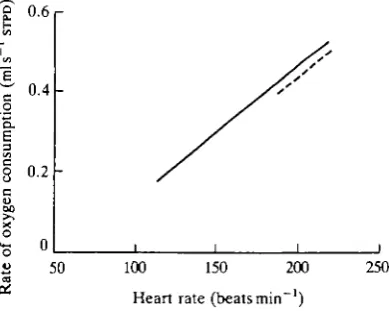
If the regression equation of VOl against / H , derived from the swimming data of
Woakes and Butler (1983), is used to predict the VOl of the ducks in the present
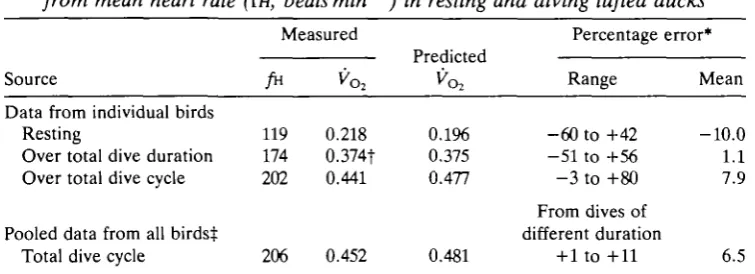
study from their measured heart rates, the error involved in applying it to individual birds can be considerable (Table 3). If, however, the equation is applied to the mean heart rate data (i.e. that from all the birds), there is remarkably good agreement between the predicted and the measured oxygen consumptions, with a
? 0.6
c o
E
0.4
8 0.2
i> 50 100 150 200 ed
Heart rate (beats min"1)
250
[image:10.451.131.326.419.574.2]Table 3. Errors involved in predicting mean oxygen consumption (Vo2> from mean heart rate ffw, beats min~J) in resting and diving tufted ducks
Measured Percentage error*
Source
Data from individual birds Resting
Over total dive duration Over total dive cycle
Pooled data from all birdst Total dive cycle
119 174 202
206
0.218 0.374t 0.441
0.452
r ituiLicu
0.196 0.375 0.477
0.481
Range
-60 to +42 -51 to +56 - 3 to +80
From dives of different duration
+ 1 to +11
Mean
-10.0 1.1 7.9
6.5
The equation used to predict oxygen consumption from heart rate was y=0.003271*—0.193, where y is oxygen consumption (mis"1) and x is heart rate (beats min"1) (Woakes and Butler, 1983).
* The percentage error between the measured oxygen consumption and that predicted from the heart rate.
t Estimated from multiple regression analysis. tFrom data in Fig. 5 and Table 2.
mean algebraic error of only - 1 0 % in resting birds and of +7.9 % over a complete dive cycle (Table 3). Interestingly, if the pooled data are used (Table 2 and Fig. 5), the mean error between predicted and measured oxygen consumption is +6.49% (Table 3).
Discussion
The mean resting oxygen consumptions of the tufted ducks in the present study were higher than those found in previous studies (Woakes and Butler, 1983, 1986; Butler et al. 1988). The temperature of the water was, however, approximately 5°C lower in this study than in the others, which would cause an increase in the metabolic rate in order to enhance heat production to maintain body temperature (Stahel and Nicol, 1988; Bevan and Butler, 1989).
The partial correlation coefficients obtained from the linear multiple regression analyses were not as high as those obtained by Woakes and Butler (1983), and this may have been due to the duration of the interval between dives being controlled by the training apparatus. t\ in the present study was approximately twice that found in other studies on spontaneously diving tufted ducks (Butler and Woakes, 1979; Woakes and Butler, 1983), allowing the ducks to perform other activities between the dives (cf. Stephenson etal. 1988). The td:t; ratio increased as td
increased, reflecting the fairly constant t{ imposed by the training system. A
minimum tx of 25 s was allowed in the present study before the ducks were
prompted to dive again, on the assumption that this would allow them to recover fully from the previous dive. This would be especially relevant for the longer dives, during which anaerobic metabolism may have been brought into play. When using the training system in the future, it may be advisable to activate the training cycle immediately after the ducks have surfaced, thus allowing the animal to determine the time it spends at the surface.
The mean VO2d from all the ducks was significantly lower than that found by
Woakes and Butler (1983). This is not surprising as the dives were 70 % longer and one of the findings of this study is that birds diving for longer durations have a lower VO2(i than those that dive for shorter durations. At first sight, this might
suggest that some birds are more efficient than others and can, therefore, remain submerged for longer periods. It might also be indicative of what happens to oxygen consumption during a single dive. Consequently, Fig. 4 may be illustrating the actual change in oxygen consumption that occurs in each duck during a dive, i.e. aerobic metabolism decreases throughout a dive. It is interesting to note that, for dives longer than 35 s duration, / H over the last 5 s was nearly at the resting level, even though the ducks were still beating their legs to remain submerged. This may reflect a lower oxygen demand during the later portion of a dive.
To elicit dives of up to 45 s duration, the ducks had to be trained over several weeks. Stephenson et al. (1989) found that ducks trained to dive for long distances and long durations had a reduced end-expiratory lung/air sac volume compared with that of control birds. Consequently these birds should have had a lower metabolic requirement during diving as their buoyancy, and hence the work required to remain submerged, would have been reduced. It may be that the training of the ducks in the present study contributed to their ability to withstand submergence with low energy costs (cf. Woakes and Butler, 1983).
swimming at maximum sustainable speed, they redistribute blood away from the inactive pectoral muscles and parts of the gastrointestinal tract (Butler et al. 1988). During long dives there may be a more severe vasoconstriction occurring in these areas coupled with an adequate supply to the active leg muscles, central nervous system and heart. There is, of course, a possibility that during the later portion of the long dives the ducks gradually increase the amount of energy obtained through anaerobic metabolism, leading to an accumulation of lactate, and conserving the dwindling oxygen stores for the oxygen-dependent tissues. However, until the levels of blood lactate are measured during a dive, this can only be surmised. Before the animal resorts to net anaerobic metabolism, there could well be an increase in lactate production in some parts of the body, matched by an increase in lactate oxidation in the active skeletal muscle, i.e. there might be an increase in the turnover of lactic acid but not a net accumulation (Brooks, 1985). The ability of diving mammals to oxidise lactate has been demonstrated for Weddell seals. A high level of lactate in the blood after a long dive did not deter the seals from making shorter dives immediately afterwards, during which the levels of lactate actually fell, indicating that the seals were utilizing the lactate as a substrate for ATP production (Castellini et al. 1988).
In measuring the energetics of free-living animals, two main techniques have been used - time energy budgets (TEB) and the doubly labelled water (DLW) method (Weathers and Nagy, 1980; Walsberg, 1983; Weathers et al. 1984; Bryant and Tatner, 1986; Costa and Prince, 1986; Obst et al. 1987; Westerterp et al. 1988; Schulz et al. 1989). The former is very laborious and time-consuming, whereas the latter only gives an average energy expenditure over the sampling period. With the advent of radiotelemetry and data storage techniques, it is possible to monitor heart rate in freely behaving animals, so it would be useful if heart rate could be used to estimate the energy expenditure of the animals. This is especially true with the arrival of data-logging devices which could store heart rates over long periods before being recovered and the data retrieved (Hill, 1986).
From the Fick equation, Vo2=rieart ratexcardiac stroke volumexthe difference
consumption, mean heart rate over a complete dive cycle increased linearly with mean oxygen consumption, a result similar to that found in the present study.
Under all the conditions in which mean heart rate and mean oxygen consump-tion were determined in the present study, the values of the two variables produced a regression line that was not significantly different from that obtained from swimming ducks (Woakes and Butler, 1983). It would, therefore, appear that heart rate can be used in the field to determine the energetics of free-living aquatic birds with the same level of accuracy as the DLW and TEB techniques (Nagy, 1989). It should be noted that the variability found in the individual birds was fairly large (cf. Gessaman, 1980) so, when looking at animals in the field, recordings of heart rate must not be restricted to a few individuals, but extended to as many as possible.
In almost all other studies that have investigated the use of heart rate for predicting oxygen consumption, the investigators have used conversion factors derived from the individual subjects or from the group of which the individual was a member (Gessaman, 1980; Schulz et al. 1989). The present study may be the only one where the relationship between heart rate and oxygen consumption has been derived from one group of animals and then applied to a totally different group. This probably explains the very high variability when trying to predict the oxygen consumption of individual birds. However, since almost all studies in the field will be carried out on different groups of animals, the accuracy of applying the equation to group data could make this an extremely useful tool for environmental biologists.
This work was supported by a research grant from the SERC to P.J.B. R.M.B. was in receipt of an SERC studentship.
References
ARMSTRONG, R. B., DELP, M. D., GOUAN, E. F. AND LAUGHLIN, M. H. (1987). Distribution of blood flow in miniaturized swine during exercise. J. appl. Physiol. 62, 1285-1298.
BAMFORD, O. S. AND MALOIY, G. M. O. (1980). Energy metabolism and heart rate during treadmill exercise in the marabou stork. /. appl. Physiol. 49, 491-496.
BARNAS, G. M., GLEESON, M. AND RAUTENBURG, W. (1985). Cardiovascular and respiratory responses of exercising domestic fowl to spinal cord cooling at different ambient temperatures. I. Cardiovascular responses and blood gases. J. exp. Biol. 114, 415—426. BECH, C. AND NOMOTO, S. (1982). Cardiovascular changes associated with treadmill running in
the Pekin duck. J. exp. Biol. 97, 345-358.
BEVAN, R. M. AND BUTLER, P. J. (1989). Oxygen consumption during voluntary diving in the tufted duck, Aythya fuligula, acclimated to summer and winter temperatures. J. Physiol.,
Lond. 418, 132P.
BROOKS, G. A. (1985). Glycolytic end product and oxidative substrate during sustained exercise in mammals: The iactate shuttle'. In Circulation, Respiration and Metabolism (ed. R. Gilles), pp. 208-218. Berlin: Springer-Verlag.
BRYANT, D. M. ANDTATNER, P. (1986). Energetics of the annual cycle of dippers Cincluscinclus.
Ibis 130, 17-38.
BUTLER, P. J., WEST, N. H. AND JONES, D. R. (1977). Respiratory and cardiovascular responses of the pigeon to sustained level flight in a wind tunnel. J. exp. Biol. 71, 7-26.
BUTLER, P. J. AND WOAKES, A. J. (1979). Changes in heart rate and respiratory frequency during natural behaviour of ducks, with particular reference to diving. /. exp. Biol. 79, 283-300. BUTLER, P. J. AND WOAKES, A. J. (1984). Heart rate and aerobic metabolism in Humboldt
penguins, Spheniscus humboldti, during voluntary dives. J. exp. Biol. 108, 419-428.
BUTLER, P. J. AND WOAKES, A. J. (1989). Telemetry. In Techniques in Comparative Respiratory
Physiology: an Experimental Approach (ed. C. R. Bridges and P. J. Butler), pp. 139-170.
Cambridge, New York: Cambridge University Press.
CASTELLINI, M. A., DAVIS, R. W. AND KOOYMAN, G. L. (1988). Blood chemistry regulation during repetitive diving in Weddell seals. Physiol. Zool. 61, 379-386.
COSTA, D. P. AND PRINCE, P. A. (1986). Foraging energetics of grey-headed albatrosses
Diomeda chrysostoma at Bird Island, South Georgia. Ibis 129, 149-158.
DEWAR, J. M. (1924). The Bird as a Diver. London: H.F.and G. Witherby.
DRAULANS, D. (1982). Foraging and size selection of mussels by the tufted duck, Aythya
fuligula. J. Anim. Ecol. 51, 943-956.
FARACI, F. M. (1986). Circulation during hypoxia in birds. Comp. Biochem. Physiol. 85A, 613-620.
FEDAK, M. A., PULLEN, M. R. AND KANWISHER, J. (1988). Circulatory response of seals to periodic breathing during exercise and diving in the laboratory and open sea. Can. J. Zool. 66, 53-60.
GESSAMAN, J. A. (1980). An evaluation of heart rate as an indirect measure of daily energy metabolism of the American kestrel. Comp. Biochem. Physiol. 65A, 273-289.
GRUBB, B. R. (1982). Cardiac output and stroke volume in exercising ducks and pigeons. J. appl.
Physiol. 53,207-211.
GRUBB, B. R., JORGENSEN, D. D. AND CONNER, M. (1983). Cardiovascular changes in the exercising emu. /. exp. Biol. 104,193-201.
HILL, R. D. (1986). Microcomputer monitor and blood sampler for free-diving Weddell seals.
J. appl. Physiol. 61,1570-1576.
IRVING, L. (1939). Respiration in diving mammals. Physiol. Rev. 19,112-134.
KILEY, J. P., FARACI, F. M. AND FEDDE, M. R. (1985). Gas exchange during exercise in hypoxic ducks. Respir. Physiol. 59, 105-115.
MUSCH, T. I., FREIDMAN, D. B., PITELLI, K. H., HAIDET, G. C , STRAY-GUNDERSEN, J., MITCHELL, J. H. AND ORDWAY, G. A. S. (1987). Regional distribution of blood flow of dogs during graded dynamic exercise. J. appl. Physiol. 63, 2269-2277.
NAGY, K. A. (1989). Field bioenergetics: accuracy of models and methods. Physiol. Zool. 62, 237-252.
OBST, B. S., NAGY, K. A. AND RICKLEFS, R. E. (1987). Energy utilization by Wilson's storm-petrel (Oceanites oceanites). Physiol. Zool. 60, 200-210.
SCHULZ, S., WESTERTERP, K. R. AND BRUCK, K. (1989). Comparison of energy expenditure by the doubly labeled water technique with energy intake, heart rate, and activity recording in man. Am. J. din. Nutr. 49, 1146-1154.
STAHEL, C. D. AND NICOL, S. C. (1988). Temperature regulation in the Little penguin Eudyptyla
minor, in air and water. J. comp. Physiol. 148, 93-100.
STEPHENSON, R. (1987). The physiology of voluntary diving behaviour in the tufted duck
{Aythya fuligula) and the American mink (Mustela vison). PhD thesis, University of
Birmingham.
STEPHENSON, R., BUTLER, P. J., DUNSTONE, N. AND WOAKES, A. J. (1988). Heart rate and gas exchange in freely diving American mink (Mustela vison). J. exp. Biol. 134, 435-442. STEPHENSON, R., BUTLER, P. J. AND WOAKES, A. J. (1986). Diving behaviour and heart rate in
tufted ducks (Aythya fuligula). J. exp. Biol. 126, 341-359.
STEPHENSON, R., TURNER, D. L. AND BUTLER, P. J. (1989). The relationship between diving activity and oxygen storage capacity in the tufted duck (Aythya fuligula). J. exp. Biol. 141, 265-275.
WEATHERS, W. W., BUTTEMER, W. A., HAYWORTH, A. M. AND NAGY, K. A. (1984). An
evaluation of time-budget estimates of daily energy expenditure in birds. Auk 101, 459—472. WEATHERS, W. W. AND NAGY, K. A. (1980). Simultaneous doubly labeled water (3HH1 8O) and
time-budget estimates of daily energy expenditure in Phainopepla nitens. Auk 97, 861-867.
WESTERTERP, K. R., BROUNS, F., SARIS, W. H. M. AND HOOR, F. T. (1988). Comparison of
doubly labelled water with respirometry at low- and high-activity levels. J. appl. Physiol. 65, 53-56.
WOAKES, A. J. (1980). Biotelemetry and its application to the study of avian physiology. PhD. thesis, University of Birmingham.
WOAKES, A. J. AND BUTLER, P. J. (1983). Swimming and diving in tufted ducks, Aythyafuligula, with particular reference to heart rate and gas exchange. J. exp. Biol. 107, 311-329.