Faculty of Behavioural, Management School of Business and Management and Social Sciences
Double Degree MSc Business Administration
MSc Economics and Business Administration Purchasing and Supply Management
Master Thesis 2018
Topic: Supply Base Reduction – Development and Application of a possible Reduction Process
Submitted by: Jennifer Schönau Student Number: s1355147/ 0511673
Supervisors: Prof. Dr. habil Holger Schiele University of Twente
Prof. Dr. Veli Matti Virolainen Lappeenranta University of Technology
Number of pages: 81 pages in total/ 63 text pages
Number of words: 23.662 in total/ 20.983 on text pages
Acknowledge
This thesis is part of my master studies in Economics and Business Administration with a focus on purchasing and supply management at the University of Twente and Lappeenranta University of Technology. Herewith, I would like to thank everyone who has supported me during my student life and encouraged me to be curious, open-minded and critical. Special thanks are owed to those persons who have supported me in the process of this thesis.
First, I would like to thank both my universities, University of Twente and Lappeenranta University of Technology, for the time during my studies. With this double degree, I was able to experience two completely different cultures, enabling me to get to know myself better. Furthermore, both universities always supported me in my studies and helped whenever a problem arose. Both my supervisors, Prof. Dr. habil Schiele and Prof. Dr. Veli Matti Virolainen supported me during the thesis project and gave valuable insights and feedback that helped me to create and improve this thesis over time.
Secondly, I would like to thank the company Schuler Pressen GmbH, especially the technical purchasing department in Weingarten for their commitment and support.
Management Summary
With the increased importance of the purchasing department, supply management has evolved into a strategic function that has an important stake at the company’s success. For an efficient purchasing department, the supply base needs to be managed carefully and wisely and thus, many companies have concluded to keep the supply base small but qualitative. Thus, the term supply base reduction has increased its awareness in the past years. This study aims to create a supply base reduction process for the case company Schuler Pressen GmbH.
Schuler Pressen GmbH is a high-quality press manufacturer and the industry leader. Currently, the company is facing a too large supply base with the associated disadvantages, like high administrative cost and an unclear structure. Consequently, Schuler Pressen GmbH tries to reduce its supply base in an efficient way but struggles in finding a solution. The purpose of this master thesis is hence to create a process guideline that explores the possibility of a supply base reduction based on the example of one sub commodity group. As only few suppliers control 80 percent of the total purchasing volume and value, many listed suppliers only deliver low values and volumes and thus, there is a chance of improving the situation. The chance of reducing the supply base offers advantages, among others a restructuring of the supply base, so that the purchasing department can work in a more efficient way. Moreover, cost and quality advantages can be realised.
List of Abbreviations
07 Commodity Group “Machined Parts and Machining” 0709 Sub-Commodity Group “Small Parts Machining”
e.g. exempli gratia
ERP Enterprise Resource Planning
i.e. id est
KPI Key Performance Indicator
Schuler Schuler Pressen GmbH
List of Figures
Figure 1 Production and Service Map of Schuler Group p.3
Figure 2 Corporate Procurement Divisions p.4
Figure 3 Systematic Elimination Approach p.21
Figure 4 Supplier Categorisation p.22
Figure 5 Tiering Process p.23
Figure 6 Pareto Classification p.26
Figure 7 4-Step Supplier Categorisation p.43
Figure 8 Summary of the Supply Base Reduction Process p.47 Figure 9 Order Quantity and Order Value Distribution p.53
Figure 10 Overview of Supplier Categorisation p.54
Figure 11 Supply Base Reduction Process in Numbers p.60
List of Tables
Table 1 Summary of Spend Analysis Steps p.25
List of Appendices
Appendix A Questionnaire Group Discussion Technical Purchasing Appendix B Semi-Structured Interview Questions
Table of Contents
Acknowledge ... I Management Summary ... II List of Abbreviations ... III List of Figures ... III List of Tables ... III List of Appendices ... IV
1. Introduction: From Traditional to Strategic Purchasing ... 1
2. Case Company ... 2
2.1. Introduction to Schuler Group and the Corporate Procurement ... 2
2.1.1. Schuler Group ... 2
2.1.2. Corporate Procurement Organization ... 3
2.2. Technical Purchasing Machined Parts and Machining ... 5
3. Research Problem and Research Question ... 5
4. Theoretical Background: Supply Base Management ... 6
4.1. Introduction to Supply Base Management ... 6
4.2. Sourcing Strategies: Single Sourcing vs. Multiple Sourcing ... 7
4.3. Supplier Selection: Choosing the best Suppliers ... 11
4.4. The Preferred Customer Status: Cooperating with the best Suppliers ... 13
5. Theoretical Background: Supply Base Reduction ... 14
5.1. Introduction to Supply Base Reduction ... 14
5.2. Benefits and Risks related to Supply Base Reduction ... 16
5.3. Critical Success Factors: Making the Supply Base Reduction a Success ... 19
5.4. Approaches of Supply Base Reduction ... 21
5.5. Tools for Supply Base Reduction ... 23
5.5.1. Spend Analysis ... 23
5.5.2. Pareto Classification ... 25
5.6. Supply Base Reduction Processes: Comparing different Processes ... 26
6. Methodology ... 30
6.1. Research Design ... 30
6.2. Data Collection ... 33
6.2.1. Group Discussion – Operative Purchasing ... 33
6.2.2. Semi-Structured Interviews within Team Meeting – Lead Buyers ... 37
6.3. Theoretical Framework: Supply Base Reduction Process ... 39
6.4. Comparison of the proposed Process and the reviewed Processes ... 48
7.1. Introduction to the Supply Base Reduction of Schuler Pressen GmbH ... 50
7.2. Preparation Phase ... 50
7.3. Information Phase ... 52
7.4. Action Phase ... 56
8. Discussion and Conclusion: How to successfully reduce the Supply Base? ... 58
9. Limitations ... 62
10. Further Research ... 63
11. References ... i
1.
Introduction: From Traditional to Strategic Purchasing
Today’s business environment has changed over the past years and the level of global competition has increased, leading to demanding customers and a harsh business environment.1 Moreover, the global market place is changing and evolving enormously and companies started concentrating on their core competencies in order to create competitive advantage. As companies reduced their scope, the role of purchasing transformed from operative to strategic and thus, strategic purchasing became more important than ever since products and services that are not the core competencies of a firm are sourced from suppliers.2 Consequently, strategic purchasing became a significant part of the overall business strategy and requires careful preparation and evaluation. Nevertheless, strategy creation and “implementation is often not that simple”3.
With the strategic orientation of the purchasing function the role of purchasing managers has changed as well. Instead of having a large supply base and buying required items from any possible supplier, nowadays it is aimed to develop close long-term relationships with a limited number of suppliers.4 Consequently, “purchasing managers need to understand and analyze the suppliers’ market and develop connections with them”5. Hereby, the decision of the right supply base size and which suppliers to keep is of great importance as, according to Ogden (2006), preferred suppliers should be responsible for 95 percent of the spend.6 However, many businesses still have large supply bases and aim to optimise their supply base to reduce their administrative cost and pool their demand to less suppliers.7 As this is a huge undertaking with many issues to consider, many firms are not sure how to exactly tackle the supply base reduction process.8 Subsequently, this research focuses on analysing a possible supply base reduction of the case company Schuler Pressen GmbH and giving a guideline on how to reduce the company’s supply base.
The thesis is structured as follows. First, a short introduction to the overall topic was presented. The next section will introduce the case company and the specified department. Followed by this, the problem and the resulting research question as well as sub questions
1 see Handfield & Nichols Jr. (2004), p. 29. 2 see Berger et al. (2004), p.14.
3 Hesping & Schiele (2016), p.101. 4 see Sakar & Mohapatra (2006), p.148. 5 Úbeda et al. (2015), p.181.
6 see Ogden (2006), p.34.
are given. Section four focuses on a literature review, summarising the current state-of-art literature regarding supply base management and supply base reduction. Fifth, the methodology applied to this research will be outlined and defined. After this, the results of the study are presented and analysed. The seventh part of this thesis discusses the findings and a conclusion will be drawn. Finally, the thesis closes with limitations and suggestions for further research.
2.
Case Company
2.1.
Introduction to Schuler Group and the Corporate Procurement
2.1.1.
Schuler Group
The case company Schuler Pressen GmbH, in the following Schuler, is the “technological and global market leader in the metalforming industry”9 and worldwide the largest manufacturer of presses. Founded 1839 in Göppingen, Germany, nowadays, the company employs more than 6.000 employees in 15 countries. The main offers are high-tech press systems, automation, and services for the metal forming industry while the main customers are located in the area of car manufacturing, packaging, aerospace, and minting.10 With the two slogans “innovation by technology: our key to success”11 and “forming the future”12, Schuler shows that the company’s focus lies on being an innovative firm that aims to set market standards and being a big part of creating the new tomorrow.
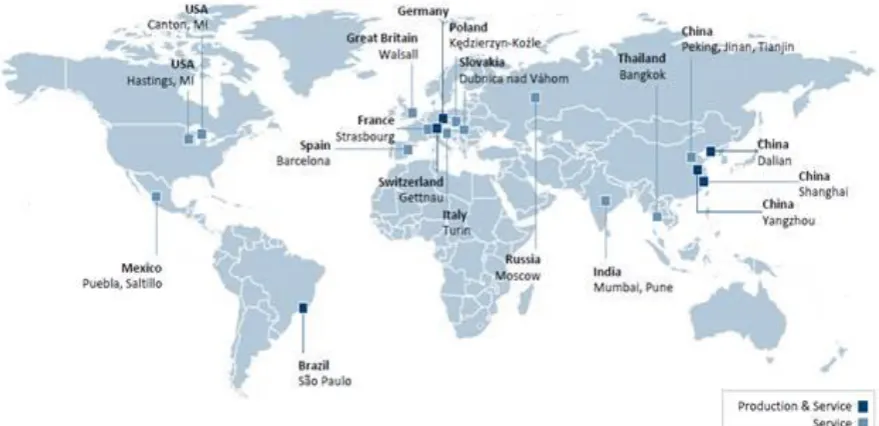
The company is positioned in the premium price segment offering high-end solutions. As a result, Schuler was lacking market share in the mid-price segment and thus, acquired in 2015 the Chinese press manufacturer Yadon.13 This acquisition offers access to over 1000 new customers in China as well as new customers interested in presses with lower forces.14 As shown in figure one, service facilities are located around the world while the production plants are located in Germany, China, and Brazil. Moreover, there are no service or production sites in Australia and Africa. The service sites are close to important customer regions to be able to react fast in case of service needs. Production takes mainly place in
9 Schuler Group Company Presentation (2017), p.3. 10 see Schuler Group Company Presentation (2017), p.3. 11 Schuler Group Company Presentation (2017), p.3 12 see Schuler Group (2018).
13 see Schuler Group (2017).
Germany due to the focus of delivering high quality products. The Chinese production plants are mainly responsible for producing parts for the acquired company Yadon.
Figure 1: Production and Service Map of Schuler Group. Source: Schuler Group Company Presentation (2017)15.
2.1.2.
Corporate Procurement Organization
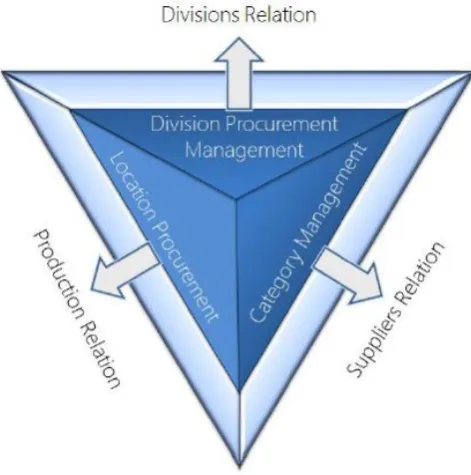
The corporate procurement of Schuler is divided into three different areas – division procurement management, category management, and location procurement – each area with different orientations to guarantee the best outcomes16, as can be seen in figure 2. Each area has its own role and responsibility towards a successful course of business. The division procurement management “ensures early and close involvement of procurement competencies in the product and project creation process”17. The main task is to assure a stable and economical supply chain within a corresponding division. Additionally, this department is responsible for make-or-buy decisions, design-to-cost optimisation, definition of material costs targets and budgets, and the creation of transparent material forecasts.18
15Schuler Group Company Presentation (2017), p.7
16 see Schuler Group Intranet (2018) (not publicly available). 17 Schuler Group Intranet (2018) (not publicly available).
The area of category management provides the global procurement strategy for the company and thus, the main task lies in supplier relations. “It is oriented towards the supplier market and is responsible for proactive and comprehensive management of the costs of materials for one or more material groups, taking into account the total cost.”19 Consequently, the main areas of responsibility are the international material group strategy, sustainable supplier management, utilisation of key performance indicators, and the definition and implementation of the corresponding procurement leverages in cooperation with the relevant departments.20
[image:11.595.161.397.431.669.2]The third area of the corporate procurement is the location procurement which is the service provider for production. This department is “responsible for provisions of the required materials or services on time and at a required quality level”21. Guidelines and the action framework for the location procurement are defined by the category management. The main tasks of this department are the efficient order processing, the development of a cost-effective and quality-controlled supplier portfolio, the secure of supply, and the supplier development in collaboration with the quality assurance department.22
Figure 2: Corporate Procurement Division. Source: Schuler Group Intranet (2018a)23.
19 Schuler Group Intranet (2018a) (not publicly available). 20 see Schuler Group Intranet (2018a) (not publicly available). 21 Schuler Group Intranet (2018a) (not publicly available). 22 see Schuler Group Intranet (2018a) (not publicly available).
2.2.
Technical Purchasing Machined Parts and Machining
The department most relevant for this research is the Technical Purchasing and the managed commodity group “07 – Machined Parts and Machining” as the focus of this research will be on this commodity group, focussing on the sub category “0709 –Small Parts Machining”, in the latter referred to as 0709. The technical purchasing of machined parts and machining is located in Weingarten, Germany and consists of seven purchasers, each of them having a technical background and experience in production and engineering. The team is responsible for the whole ordering process, technical expertise and the purchase of service parts that are required from the after-sales service. Each member of the team is responsible for a different sub category of the commodity group. In total, the commodity group machined parts and machining consists of ten sub categories, namely (1) control blocks, (2) ledges, (3) gear parts, (4) milling, (5) bar machining, (6) weldments, (7) sheet metal work parts, (8) special operations, (9) small parts machining, and (10) signs. The focus of this research will be on this commodity group, especially for the sub category small parts machining as the accompanying internship is executed in this commodity group and thus, best insights are given. Furthermore, the head of location procurement sees here the first tackling point since the supply base of this commodity group and sub group is the largest.
3.
Research Problem and Research Question
The above-mentioned problem set leads to the following research question:
“How can the company Schuler Pressen GmbH efficiently reduce its supply base, especially in the area of machined parts and machining?”
To find an appropriate solution for the supply base reduction problem, the following sub-questions aim to support the research question.
1. What is the current state of the supply base at Schuler Pressen GmbH? 2. What is the desired future state of the supply base at Schuler Pressen GmbH? 3. How can the desired state be reached?
4.
Theoretical Background: Supply Base Management
4.1.
Introduction to Supply Base Management
In recent years, supply base management has become one of “the most strategic areas of responsibility in the purchasing and supply function”24 as it is an essential part of the overall purchasing strategy and enables a company to successfully manage its suppliers.25 According to Ogden and Carter (2008), the creation, management and development of the supply base are connected to the most fundamental decisions in supply management.26 Consequently, managing the supply base makes or breaks the success of the purchasing function as a firm can only produce high quality products with high quality supplies that are delivered in time. Choi and Krause (2006) defined the supply base as “the total number of suppliers that are actively management by the focal firm, through contracts and purchase of parts, materials and services”27. Here, it is important to note that only active suppliers are considered to belong to the supply base, not those who are listed but are inactive.28 To successfully manage the supply base, Gadde and Hakansson (1994) divided the supply base into two dimensions – the number of suppliers and how these suppliers are organised.29 Depending on the size of the supply base, different strategies and targets can be set as smaller supply bases have different complexities than larger ones. The aspect of
the suppliers’ organisation needs to carefully be considered as well as depending on the working style and company structure the future relationship is determined. Choi and Krause (2006) found similar dimensions in their research. Next to the number of suppliers, the authors added the differentiation of each supplier and the level of relationships between suppliers.30 The differentiation of each supplier needs to be considered in supply base management as similar suppliers need to be categorised into the same area. If the company wants to keep similar suppliers, strategies can be developed that concentrate on how to manage those comparable suppliers. On the other hand, the supply base could be reduced by some suppliers if there are many similar ones. The last dimension, relationships between suppliers, determines whether there are possible partnerships or agreements between suppliers. Rivals might have secret agreements in terms of price or customer segmentation while other suppliers might be in a cooperation with suppliers that produce supporting products.
Not only is supply base management of great strategic importance but it also leads to many benefits and helps a company to advance and progress. Ziggers and Henseler (2006) mention that with the help of strong suppliers, the focal company can reposition itself in the competitive surrounding, increase customer responsiveness with the help of close cooperation with suppliers, and increase long-term relationships with knowledge exchange and mutual interests.31 Moreover, closer relationships and cooperation lead to deeper trust and thus, even closer cooperation. This in turn, encourages suppliers to increase their efforts in terms of resources and thus, quality and flexibility might increase leading to greater innovation as vendors and the focal firm work more closely together.32 However, the most important benefit of a strategically managed supply base is that the focal firm gets a “greater understanding of how to coordinate and synchronize activities within its network of suppliers and [creates] a context that fosters collaboration.”33
4.2.
Sourcing Strategies: Single Sourcing vs. Multiple Sourcing
30 see Choi & Krause (2006), p.641. 31 see Ziggers & Henseler (2016), p.19.
In the last decades, different sourcing strategies and how to use them has been in the focus of researchers.34 Sourcing itself is diverse, complex as well as complicated and thus, issues
arise when companies start deciding on their sourcing strategies. The most important difficulty is to decide from whom the required products should be obtained, i.e. the identification of possible suppliers, the quantity of suppliers per category and the order volumes per supplier.35 Most commonly, single and multiple sourcing strategies are used
by companies, each approach having different benefits and drawbacks. Moreover, a variety of aspects influence the execution of the chosen strategy and its outcome.36
The first approach, single sourcing, evolved with the growing usage of the just-in-time principle37 and is used when “firms have consolidated their supply bases”38. According to
Wetzstein et al. (2016), the goal of single sourcing is to find “one supplier [who] meets all buyer demands and executives have to make only one decision: Which supplier is the best?”39. Subsequently, this sourcing strategy identifies only one supplier per product and
the company engages in a long-term strategic relationship with the particular supplier.40
Generally, there are three central reasons for choosing single sourcing rather than other sourcing strategies. First, the buyer decides to single source the required product because the item is of great strategic importance.41 Being of strategic importance, quality standards
and delivery times need to be considered and thus, companies might decide to single source this specific product to ensure the quality and continuous supply. The second reason for single sourcing is that the product is highly specialised and thus, there is only one supplier who is able to produce the item.42 In this case, the company is forced to single
source the specific products as no other possibility exists. Lastly, the final customer of the end-product “has explicitly required the firm to work with a particular sub-supplier’s product”43. Having mandated suppliers for particular products leaves no space for other
sourcing strategies than single sourcing and consequently, is not chosen by the company itself. However, Song et al. (2014) proposes that this sourcing approach should only be
34 see e.g. Berger & Zeng (2006); Burke et al. (2007); Heese (2015). 35 see Song et al. (2014), p.522.
36 see Cousins et al. (2008), p.47. 37 see Berger et al. (2004), p.10. 38 Heese (2015), p.125.
39 Wetzstein et al. (2016), p.306.
40 see Cousins et al. (2008), p.52; see Wetzstein et al. (2016), p.306. 41 see Cousins et al. (2008), p.52.
used when the capability of one single supplier is sufficiently better than the capacity of several suppliers.44
Three areas of benefit have been identified by several authors – reduced total cost, higher quality, and an increased level of cooperation.45 As Heese (2015) recognised, there are
three explanations for the reduction of the total cost. First, the administrative costs can be minimised since orders are automatically sent to only one supplier. Therefore, searching for suppliers and the whole tendering process are obsolete. The second reason for cost reduction is economies of scale as the order volume is pooled to one supplier. The third reason is the learning effect of the supplier.46 Moreover, increased quality is a second
benefit of using single sourcing. Here, continuous improvement and cooperative redesigning of the product or process are the main influencing factors for the enhanced quality.47 Next to this, the quality is constant as only one supplier is responsible for the
production and thus, the same raw materials, production facilities and processes are utilised. Lastly, using single sourcing leads to a higher level of cooperation between the focal firm and the supplier. Through the close partnership, communication and responsiveness increases which makes it easier to discuss ideas regarding possible redesign and improvement as well as new product development.48
However, single sourcing has two main disadvantages that need to be considered when choosing this strategy. The key argument against this sourcing type is that the focal firm is dependent on the supplier which might lead to a weak position and the longer the relationship lasts, the more dependent the focal firm becomes.49 This occurs as comparative
suppliers are ignored over time and hence, the focal firm is not in the focus of these vendors anymore. Moreover, choosing just one supplier to cooperate with might lead to a lock-in situation, limiting the focal firm’s ability to get into contact with new technologies and innovations within the broader network of suppliers.50
The second major form of sourcing is called multiple sourcing and is a more tactical than strategic approach. Cousins et al. (2008) defined multiple sourcing as a way of using
44 see Song et al. (2014), p.535.
45 see e.g. Berger et al. (2004), p.10.; Choi & Krause (2006), p.647; Cousins et al (2008), p.53; Heese (2015),
p.125.
46 see Heese (2015), p.125.
47 see Cousins et al. (2008), p.53; see Heese (2015), p.125.
48 see Choi & Krause (2006), p.647; see Cousins et al. (2008), p.53. 49 see Cousins et al. (2008), p.53; see Heese (2015), p.126.
several suppliers to order identical parts.51 This includes the negotiation with a number of
suppliers and splitting the order quantities among them.52 However, different suppliers
have different qualities, prices and production capabilities. Consequently, purchasers have to carefully balance these constraints when placing their orders. Multiple sourcing is used to maintain the “continuity of supply in the short term, whilst enabling the buyer to achieve price reductions.”53 As numerous suppliers offer the same product, buying companies are
able to negotiate heavily and decrease the purchasing price. It is proposed that multiple sourcing is mostly used to prevent supply uncertainty and ensure a continuous supply as well as to maintain and increase competition among suppliers.54
Literature has found four major areas of benefits when using multiple sourcing, which can be categorised into (1) purchasing price, (2) performance improvement, (3) independence, and (4) continuous supply.55 As several suppliers are offering the same product they are competing against each other to be the chosen supplier. Therefore, prices and shipping cost drop leading to cheaper purchasing prices for the focal company.56 Another important
benefit of the increased competition is that the performance of competing suppliers improves and the quality of products increases.57 As suppliers want to make sure to get the
order, they are improving their products and processes in order to compete against their rivals. As a result, the overall quality of the product increases as most of the suppliers do the same. Thus, the buying company gets a better quality with lower prices. A third advantage of having multiple suppliers per product is that emergency situations and shortages can be avoided.58 As the product is sourced from different suppliers and
accordingly different production plants, the continuous supply is guaranteed and natural disasters, strikes, or production shortages in one plant do not lead to a complete disruption.59 Finally, the greatest benefit of multiple sourcing is that the focal firm is not
dependent on one supplier but can choose among a variety of suppliers.60 Thus, suppliers
can be interchanged or deleted from the supply base without losing whole product lines.
51 see Cousins et al. (2008), p.53; see Wetzstein et al. (2016), p.306 52 see Wetzstein et al. (2016), p.306.
53 Cousins et al. (2008), p.54.
54 see Cousins et al. (2008), p.54; see Song et al. (2014), p.522.
55 see e.g. Berger et al. (2004), p.10; Cousins et al. (2008), p.54; Sarkar & Mohapatra (2009), p.124; Heese
(2015), p.126.
56 see Berger et al. (2004), p.10; see Cousins et al. (2008), p.53-54. 57 Heese (2015), p.126.
58 see Sarkar & Mohapatra (2009), p.124. 59 see Heese (2015), p.125.
On the other hand, multiple sourcing offers some disadvantages that need to be considered when deciding for this strategy. Even though the purchasing price decreases, the total cost might increase or do not change but stay at the same level. Due to more suppliers, the administrative workload increases, e.g. quality management, supplier relationship management or keeping track of the master data which leads to higher fixed costs.61
Another administrative disadvantage is that more and longer negotiations are necessary as different offers need to be compared and discussed to find the best deal. This requires more workforce and might lead to delays in production schedules when negotiations take longer than expected.62
4.3.
Supplier Selection: Choosing the best Suppliers
After a company decided that it does not produce a required material or product but buys it from a supplier, an adequate supplier needs to be selected. Supplier selection is a “decision-making process to select the best supplier(s) from a prequalified pool based on predefined objectives and decision criteria”63. This process has always been of great
strategic significance and due to globalisation and thus, increased competition, it became even more important to work together with high quality vendors to create a competitive advantage. Already Lewis (1937) discussed the importance of the correct supplier selection and stated that “it is probable that of all the responsibilities which may properly be said belonging to the purchasing managers, there is none important than the selection of suppliers.”64 This indicates that even before purchasing was seen from a strategic
perspective, it was known that the right supplier is key to a high-quality product and thus, competitive advantage. According to Zeydan et al. (2011), choosing the right supplier is crucial for increasing the quality, reducing operational expenditures and shaping the company’s future.65 However, the supplier selection process is both complicated and
complex as many different factors have an impact on the decision-making process, making it risky for companies to use this process without careful preparation and research.66
61 see Sarkar & Mohapatra (2009), p.124; see Song et al. (2014), p.523. 62 see Berger et al. (2004), p.10.
63 Wetzstein et al. (2016), p.306. 64 Lewis (1937), p.186.
65 see Zeydan et al. (2011), p.2741.
According to Cousins et al. (2008), the supplier selection process can be subdivided into four different categories – the initial supplier identification, determination of measurement criteria, information gathering, and the final selection.67 Nevertheless, defining and measuring the appropriate selection criteria are the most important steps as these are the outcome of the strategic identification of the key activities, processes and values that are expected from a company’s suppliers.68
When companies want to engage in the supplier selection process, literature suggests different factors that need to be considered. First of all, there are two different types of selection criteria, quantitative and qualitative criteria.69 Both types have different forms of
measurement systems whereas it is easier to measure quantitative criteria as those are easier to visualise and analyse. Usually both measurement types are combined during the selection process in order to get the best result possible. Next to measurable criteria, some companies have minimum standards that need to be reached by suppliers in order to be considered for the selection process at all. One example of these minimum standards is the sustainability of a vendor. According to Reuter et al. (2010) companies expect certain standards in sustainability from their suppliers to ensure that these suppliers are in line with the company’s guidelines and rules. If a supplier does not follow those predefined standards, he will not be considered for any cooperation at all.70 After a supplier fulfils the
ethical requirements, the focal company needs to decide on measurement criteria to evaluate the suppliers fit to the firm. The eleven most common and important criteria are 1) quality, 2) price, 3) delivery standards, 4) degree of flexibility, 5) service, 6) certificates, 7) level of know-how, 8) production volumes, 9) equipment, 10) commitment, 11) trust and communication.71 However, next to each criterion, the whole performance should be considered during the measurement process.72
Reuter et al. (2010) propose in their research different approaches for new and already established suppliers. New suppliers should be asked to hand in a self-assessment questionnaire, consisting of semi-structured and structured questions, to evaluate whether the supplier is eligible to be considered in the selection process. If the supplier is eligible, an auditing team with internal and external experts should visit the suppliers’ facilities and
67 see Cousins et al. (2008), p. 60.
68 see Nair et al. (2015), p.6264-6265/6271.
69 see Ho et al. (2010), p.16; see Wetzstein et al. (2016), p.309. 70 see Reuter et al. (2010), p.54.
ensure that the supplier fits in terms of quality, safety and regulatory standards.73 For
already established suppliers, Reuter et al. (2010) has another method towards supplier selection. Here, the suppliers are categorised into non-critical, critical, and very critical vendors depending on their previous performance. While non-critical suppliers should sign a self-declaration that company guidelines and rules are followed, critical and very critical suppliers have to answer a similar questionnaire as new suppliers. When the questionnaire provides a satisfactory outcome, the supplier will still be considered for selection. If any issues arise, audits are required to re-evaluate the supplier. Very critical suppliers should directly be audited where then it will be decided whether to develop or delete the supplier from the supply base.74 These audits include several areas to be reviewed, e.g. the
manufacturing process or how raw materials are sourced.
4.4.
The Preferred Customer Status: Cooperating with the best Suppliers
As companies nowadays tend to focus on their core activities and increase their outsourcing, the best suppliers possible need to be contracted.75 However, as buying firms are competing for those suppliers the dynamics between suppliers and buyers have changed.76 Consequently, suppliers are able to decide about their resource division between their customers and thus, define for themselves less and more important customers. As Bemelmans et al. (2015) mention, “a supplier should treat all customers equally, [yet,] some customers are business-wise clearly more important than others”77. These preferred customers are mostly treated better by the supplier than their competitors, e.g. in prices, support or material availability.78 Here, mutual interest, long-term partnerships as well as the strategic importance are factors that decide on the suppliers’ decision. Generally, customers are positioned as preferred customer when the supplier is more than satisfied with the relationship, e.g. when the buying firm is highly attractive, however, if better matches arise, suppliers might drop the status again.79 Consequently, buying firms constantly need to put effort in this relationship to be able to continue
successfully. To be acknowledged as preferred customer, a shift from an analytical to a network perspective needs to happen within the buying company as they need to understand that the preferred customer status is about relationship and mutual trust rather than pure numbers.80 Once this shift has happened, buying companies are more open for changes in their behaviour and strategic decisions, which might lead to an increased attractiveness for the targeted supplier. Schiele et al. (2012) found that both supplier satisfaction and customer attractiveness are factors that have a great impact on the preferred customer status and its retention. While supplier satisfaction is related to the outcomes of the relationship, customer attractiveness is related to hard facts of the buying company, e.g. future growth potentials, payment reliability or the company’s success.81 Once the status is achieved, several advantages are created and can be utilised by the buying firm as well as the supplier. According to Nollet et al. (2012), the main advantages are an increased product quality, increased collaboration in innovation, higher level of support and communication, greater reliability as well as lower prices in total.82 These advantages are supported by Bemelmans et al. (2015) who found that suppliers tend to offer new innovations firstly to their preferred customers before offering them to anyone else.83
5.
Theoretical Background: Supply Base Reduction
5.1.
Introduction to Supply Base Reduction
In the past, most companies used to have large supply bases with many suppliers on stock and only minor reductions within the supply base occurred when necessary.84 However, nowadays, research has emphasised on the necessity of supply base reduction and optimisation.85 Literature has focused on this topic and consequently, consultancies adopted the theme and started using it in the early 1990s to “enable a leveraging strategy”86. The issue of supply base reduction can be categorised into purchasing and supply chain management, more in depth to supply management, and is one of the first
80 See Schiele et al. (2012), p.1183; see Hüttinger et al. (2014), p.705. 81 See Schiele et al. (2012), p.1181; see Tanskanen & Aminoff (2015), p.135. 82 See Nollet et al. (2012), p.1187.
83 See Bemelmans et al. (2015), p.193. 84 see Lemke et al. (2000), p.46.
steps, i.e. belongs to the prequalification stage.87 Nevertheless, “empirical evidence for the reduction in the supplier base is rare”88 and thus, companies are not sure whether and how to implement and use this approach.89 Generally, the idea for supply base reduction is based on the premise that resources are limited and with a reduced supply base, companies are able to better manage their own resources.90
Literature has many different definitions for the term supply base reduction. According to Ogden (2006), “supply base reduction is defined as the process of and activities associated with reducing the number of suppliers that an organization utilizes.”91 Moreover, supply base reduction is concerned with retaining the best suppliers out of a large base and is thus, a highly strategic approach.92 When it is seen as a strategic long-term approach, there are three key activities associated with supply base reduction – reduction of the number of suppliers, reconfiguration of the existing supply base, and involvement in supplier development.93 On the other hand, supply base reduction can be seen as a one-time strategy that aims to reduce the number of suppliers in the short-term to realise cost reductions and strategic targets.94 Consequently, two different goals can be reached with the reduction of suppliers – long-term strategic issues and short-term cost reductions. Depending on what the organisation focuses on, different approaches are necessary, however, the short-term reduction is easier manageable as suppliers are reduced according to prices and delivery times. Reducing the supply base over the long-term on the other hand, needs more preparation and careful selection and management. Nevertheless, it is not an easy decision as these choices cannot be turned back easily.95 The process puts pressure both on suppliers and the company itself. Suppliers need to improve their performance to stay competitive and in the supply base as otherwise they might be excluded, while the organisation might face extra cost and the burden of deciding which supplier to terminate the partnership with.96 Once the buying company has successfully minimised its supply base, the selected suppliers might be taken into a contractual relationship to ensure that the
87 see Sarkar & Mohapatra (2006), p.150/153; see Song et al. (2014), p.524 88 Lemke et al. (2000), p.46.
89 see Ogden & Carter (2006), p.8. 90 see Cousins et al. (2008), p.44. 91 Ogden (2006), p.29.
92 see Talluri & Narasimhan (2005), p.130; see Sarkar & Mohapatra (2006), p.150. 93 see Talluri & Narasimhan (2005), p.130.
94 see Cousins (1999), p.147; see Sarkar & Mohapatra (2006), p.150. 95 see Cousins (1999), p.153.
determined goals are reached.97 As a result, many businesses are nowadays engaged in long-term relationships with fewer suppliers even though the “term ‘supply base reduction’ is to an extent a misnomer.”98 The company itself has reduced its number of suppliers but many of the excluded suppliers are now indirect suppliers, leading to an extended supply network.99
5.2.
Benefits and Risks related to Supply Base Reduction
Reducing the number of suppliers has several advantages as well as drawbacks a company needs to consider and evaluate. Both risks and benefits can be found in the literature; however, companies tend to not measure the achieved benefits.100 There are six key areas
of benefits and four key areas of risks that are most mentioned by literature which will be highlighted in this section.
The identified key benefits are: 1) cost-effectiveness, 2) negotiation power, 3) logistical improvement, 4) information sharing and cooperation, 5) increased quality, and 6) benefits for suppliers.101 Having fewer responsible suppliers’ cuts different cost types and thus, the
overall costs are decreasing, leading to a better cost-effectiveness and cost reduction. Reasons for this cost reduction are varied and both connected to specific suppliers and the focal company. According to Song et al. (2014), suppliers are able to reduce their unit costs as volumes are bundled and thus, more quantities are ordered from one supplier.102
When more quantities are ordered, suppliers normally offer lower prices than when less items are ordered as it is as well easier and more profitable for a supplier to produce more pieces. Lower unit costs lead to lower ordering cost in general, which decreases the overall cost. Another source of cost reduction are the administrative costs. With less suppliers, less administrative work needs to be handled, e.g. sourcing for suppliers, tendering or negotiations, and thus, less resources of the focal company are required.103 Consequently,
better ordering conditions due to larger volumes and less administrative cost decrease the overall cost when using a reduced supply base. Another advantage of using fewer suppliers
97 see Ogden (2006), p.36 98 Cousins et al. (2008), p.46.
99 see Berger et al. (2004), p.10; see Cousins et al. (2008), p.46. 100 see Lemke et al. (2000), p.54; see Ogden & Carter (2006), p.7.
101 e.g. see Cousins (1999), p.153; see Lemke et al. (2000), see p.45/52-52; see Nam et al. (2011), p.333; see
Song et al. (2014), p.524/526.
is that the negotiation power increases. As one supplier produces a higher volume for the company, the focal company might become more important for the supplier.104 Hence, the
focal company has a greater impact and is able to better negotiate its terms regarding e.g. prices, delivery or ordering schemes. Next to cost-reduction and an increased negotiation power, the logistical improvement is of great importance. Logistical issues can be standardised when products are regularly ordered from specific suppliers. Here, advantages in the logistics occur as each person involved knows the process and deliveries can be forecasted.105 Moreover, deliveries are more reliable as the ordering and delivery process
will change into an improved, continuous process.106 Additionally, information sharing and
cooperation between the buying firm and supplier will increase. There is according to Lemke et al. (2002) a “more intense and direct contact”107 with the supplier which enables
cooperation and information sharing. This information sharing is accompanied by “a desire for continuous improvement and innovation”108 where supplier and buyer engage in shared
innovation projects to increase the quality of the product or innovate new products. Additionally, information sharing offers the transfer of know-how and enables the supplier to increase his performance, or the other way around, the focal firm to increase its quality and performance.109 The increased quality results from the previous mentioned advantages.
As the logistics can be improved as well as information sharing and collaboration increase, the quality of different factors increases, too. First, the quality of the components increases which in turn increases the quality of the end product. Second, the coordination quality increases, leading to an enlarged overall performance of the company.110 An increased
quality of the product and the overall performance leads to more efficiency, less defective goods and a better image of the company. When taking a look at the supplier side, there are some benefits related to the suppliers who were not excluded from the supply base. According to Song et al. (2014), the selected suppliers get larger orders and thus, higher sales.111 This increases the suppliers’ revenues and might lead to a better financial
104 see Lemke et al. (2000), p.51. 105 see Lemke et al. (2000), p.52.
106 see Nam et al. (2011), p.333; see Song et al. (2014), p.525. 107 Lemke et al. (2000), p.52.
108 Nam et al. (2011), p.333. 109 see Lemke et al. (2000), p.52.
performance of the supplier. Additionally, demands can be forecasted more easily leading to better production planning and thus, a more efficient workflow for the supplier.112
Even though the reduction of the supply base offers many benefits for the focal firm, there are as well drawbacks that need to be carefully considered. The main issues to reflect on are 1) supplier opportunism, 2) reduced flexibility, 3) increased dependency, and 4) increased supply risk.113 According to Nam et al. (2011), some suppliers could try to take
advantage of the situation and show an opportunistic behaviour.114 This risk needs to be
taken seriously as opportunistic suppliers might damage the production, quality or relationship between themselves and the focal company. Moreover, this behaviour leads to a lack of trust which in turn might terminate the relationship with this supplier and a new supplier needs to be sourced which is both time and cost intensive. Another issue is the reduced flexibility. Fluctuating demand occurs suddenly and companies with few suppliers might not be able to respond accordingly. Here, flexibility cannot be guaranteed as the chosen suppliers might not have enough capacities to meet the changing demand.115 This
lack in flexibility might lead to the situation that the focal firm is not able to produce anymore and thus, misses potential revenues and customers. Moreover, with a smaller supply base, the dependency on each supplier increases for the focal firm.116 As suppliers
are reduced and thus, only few suppliers are responsible for the product, the focal firm depends on these suppliers to meet the required demands in terms of quality, delivery and capacity. Here, suppliers might again show opportunistic behaviour as they know that the focal firm is to some degree dependent on them. However, relationship management and partnerships can decrease this risk. Another problem of the increased dependency is a possibly lock-in situation. Suppliers might lock the focal company into certain technologies that are only available from specific providers.117 This lock-in situation leads
to high dependency as well as high switching cost and needs to be prevented. The last possible risk, the increased supply risk, occurs as there are chances of shortages due to demand fluctuations, sudden failures or other disruptions.118 In these situations, the
capacities of the selected suppliers are not large enough to meet the demand and thus,
112 see Song et al. (2014), p.524.
113 e.g. see Talluri & Narasimhan (2005), see Choi & Krause (2006), p.640; see Sarkar & Mohapatra (2009),
p.124-125; p.130; see Nam et al. (2011), p.333; see Ates et al. (2015), p.205.
114 see Nam et al. (2011), p.333.
115 see Cousins (1999), p.147; see Nam et al. (2011), p.333. 116 see Choi & Krause (2006), p.640.
117 see Ates et al. (2015), p.205.
continuous supply is not guaranteed.119 Each of these risks needs to be carefully considered
and evaluated and back-up plans need to be developed to ensure the continuous supply of the nominated suppliers.
5.3.
Critical Success Factors: Making the Supply Base Reduction a Success
When a company aims to reduce its supply base, it has to consider specific factors that help achieving sufficient results. These so-called success factors are next to benefits and risks of great importance and need to be carefully considered. According to Ogden (2006), only few academic literatures are available about critical success factors of supplier base reduction and the available literature is rather conceptual and general.120 However, some critical success factors have been identified by literature. The identified key issues are 1) information systems, 2) involvement of key personnel, 3) supplier evaluation, 4) relationship management, and 5) slow change of supply base.121
One of the most important success factors is an effectively working information system.122 All supply base management efforts depend on the correctness and completeness of data and the underlying information systems.123 Information systems deliver, save and communicate important data and information which are required for the decision making in the supply base reduction process. Furthermore, communication and data exchange with suppliers as well as capability issues of suppliers can be managed via these information systems.124 Consequently, having an efficiently working information system in place is the first step to start with the reduction of a company’s supply base. The second key success factor is to involve all the important key personnel. Each employee who might be vital should be involved to be able to hand in information, critical thoughts or experiences. Though, key personnel “may not necessarily be top managers within the organization, but those with influence”125. Without the involvement of crucial employees, important insights are missed or information are misunderstood and wrong decisions might be made. Trent and Monczka (1999) mention in their paper that persons with experience in contract
119 see Choi & Krause (2006), p.640. 120 see Ogden (2006), p.30.
121 see Cousins (1999), p.146; see Trent & Monczka (1999), p.938; see Talluri & Narasimhan (2005), p.130;
see Ogden (2006), p.33-34/36.
122 see Ogden (2006), p34. 123 see Ogden (2006), p.33.
management, quality management, total cost management, negotiation, and value analysis should definitely be included in the supply base reduction process.126
Starting with the actual supplier reduction process, the first critical success factor is the supplier evaluation. As suppliers are reduced and the remaining ones get larger volumes to produce, a company has to make sure that the possible chosen suppliers are able to produce the required volumes in both quality and quantity in the required lead times.127 To evaluate suppliers correctly, Talluri and Narasimhan (2005) determined that the supplier evaluation has to be of strategic nature and using quantitative and qualitative measures.128 As both short and long-term issues need to be fulfilled, the supplier evaluation factors should focus on both the long and short-term. Evaluation factors that should be included in the performance process are the total cost of supplier quality, checking historical supplier performance data and doing an extensive supply chain benchmarking.129 After suppliers have been evaluated and categorised, the relationship management needs to be critically reviewed. According to Cousins (1999), “a reduced supply base requires a different supplier management style”130 as the scope of the supply management changes to a more strategic direction rather than operative. Consequently, more cross-functional thinking is required for the management and development of key suppliers.131 Thus, it is essential that the relationship management is adapted to the planned supply base reduction. Lastly, Ogden (2006) identified that one of the most important factors in supply base reduction is to not change the base too fast and abruptly.132 Taking more time for this process allows both the focal company and the suppliers to adapt to the new situation and change their management habits. Moreover, production capabilities can be increased by the supplier and improvements can be done. Another factor of not rushing through the reduction process is that fast changes could result in quality and capacity problems as the remaining suppliers did not have enough time to re-plan their production schedule accordingly.133
126 see Trent & Monczka (1999), p.938. 127 see Ogden (2006), p.34.
128 see Talluri & Narasimhan (2005), p.130. 129 see Trent & Monczka (1999), p.938. 130 Cousins (1999), p.146
131 see Cousins (1999), p.146; see Trent & Monczka (1999), p.938. 132 see Ogden (2006), p.36.
5.4.
Approaches of Supply Base Reduction
As already mentioned in the previous chapter, the process of reducing the supply base should be done carefully and thought through where both short-term and long-term issues are evaluated.134 To reach this, Ogden and Carter (2008) state that it is of great importance to identify potential suppliers and then, evaluate those carefully.135 This process is supported by Sarkar and Mohapatra (2006) who determined in their paper that the two most important phases are the identification of the optimal number of suppliers and the selection of suppliers that should stay in the supply base.136 In order to take actions, several approaches have been suggested by literature. In the following, the three most known approaches of supply base reduction will be highlighted. These are namely systematic elimination, standardisation, and tiering.137
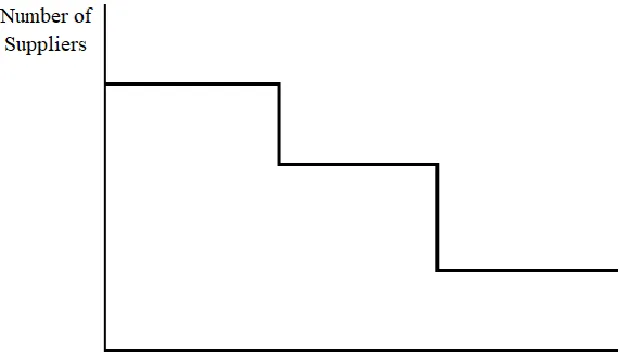
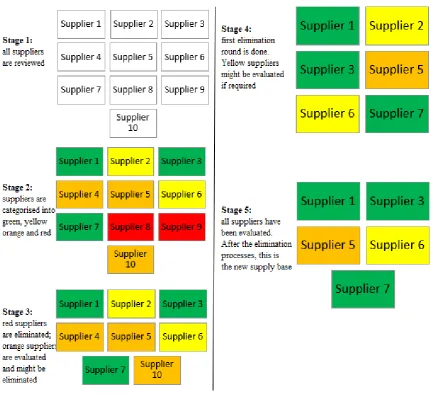
[image:28.595.126.439.449.628.2]The approach of systematic elimination of suppliers works with the underlying principle of “gradually phasing out suppliers”138. Consequently, suppliers are eliminated over a certain period of time according to several selection criteria. Here, suppliers are not eliminated all at once but in several steps, as can be seen in figure 3.
Figure 3: Systematic Elimination Approach. Source: Based on Ogden (2006)139.
134 see Sarkar & Mohapatra (2006), p.151. 135 see Ogden & Carter (2008) p.15. 136 see Sarkar & Mohapatra (2006), p.150. 137 see Ogden & Carter (2008), p.8. 138 Ogden (2006), p.36.
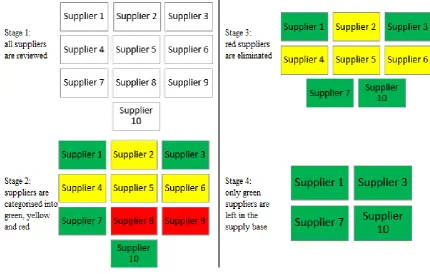
Within the systematic elimination, Ogden and Carter (2008), divide the supply base into three different categories – red, yellow and green suppliers.140 While suppliers who are categorised into red are eliminated directly at the beginning of the reduction process, yellow and green suppliers stay in the supply base. However, yellow suppliers are also meant to be eliminated while the green category shows suppliers that are meant to stay in the supply base in the long-term. This process is visualised in figure 4.
Figure 4: Supplier Categorisation.
Source: Based on Ogden & Carter (2008)141.
The second approach, standardisation, decreases the number of suppliers by reducing the complexity of products, i.e. standardising several similar parts into one part. This helps creating a consistency in the perception between the focal firm and the supplier and homogenises the demand of the focal company.142 During the standardisation process, suppliers can actively help the focal firm and provide necessary input on how to improve or standardise certain parts.143 This in turn gives the buying company hints on which
140 for the subsequent description see Ogden & Carter (2008), p.13. 141 see Ogden & Carter (2008), p.13
suppliers to keep in the supply base. Furthermore, processes need to be redefined and can be at the same time improved which leads to better efficiency and lower costs.
The third approach is called tiering and “involves restructuring the supply base into direct and indirect suppliers.144 As can be seen in figure 5, the focal firm reduces its direct suppliers, however, the number of indirect suppliers increases as suppliers are simply shifted in the supply chain.145 Even though the total number suppliers in the whole supply chain did not decrease, the focal company created a smaller and thus, easier manageable supply base for itself.
Figure 5: Tiering Process.
Source: Based on Ogden & Carter (2008)146.
5.5.
Tools for Supply Base Reduction
5.5.1.
Spend Analysis
All expenditures a company has can be categorised into direct and indirect spending, i.e. spending that has an impact on the product and expenses that are not related to the product.147 Direct spending is managed by the procurement or purchasing department and the spends can “run into billions of dollars for Fortune 500 companies to hundred of millions for mid size oganizations.”148 Consequently, it is of great interest for each firm to get an overview of what is paid and where it is spent. Nevertheless, getting the right information through these spends is highly complicated and depends on the ability to
effectively organise and analyse the available data.149 This organisation and analysis of the available data is called spend analysis and is of existential importance for the purchasing department. The goal of this analysis is to get a better overview what a company actually spends as well as to improve this expenditure and identify possible opportunities for cost savings.150 According to Renge (2005), the result of a spend analysis is “a complete, documented understanding of the organization’s past and future purchases for supplies and services, segregated by users and suppliers”151.
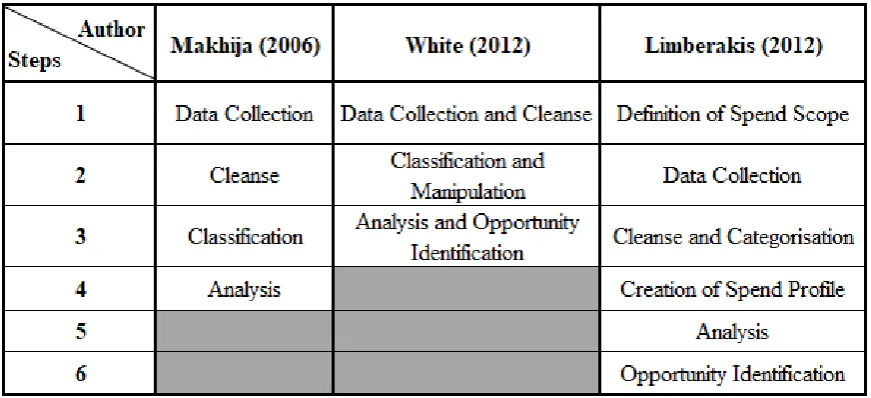
Literature has identified several key processes and steps in undertaking a spend analysis. Three of these key processes have been reviewed and they are all similar to each other but differ to some extent. Makhija (2006) selected four key processes while undertaking a spend analysis while White (2012) summarised the key steps into three categories and Limberakis (2012) found six steps.152 A summary of the three different approaches can be found in table 1. Generally, data needs to be collected from various different sources and cleansed, so that only trustworthy and reliable data is used. This collected and cleaned data needs to be classified and analysed to get the needed information. Finally, cost saving opportunities can be identified and realised.153 According to White (2012), there are three different forms of opportunities – short-term, medium-term, and long-term opportunities. Consequently, there are issues that can be changed and implemented relatively quickly, contracting requirements take some more time and are thus, medium-term goals and finally, strategic issues that influence the sourcing strategy and need to be changed in the long-term.154
Benefits of this approach are various as a spend analysis helps the purchasing department highlighting areas of cost savings, improvement and changes. Generally, a correctly performed spend analysis can lead to cost savings from 20 to 35 percent and gives valuable insights for sourcing decisions.155 Furthermore, buying power can be capitalised, spending patterns found, and a constant improvement is made.156 Accordingly, when used in the supplier base reduction process, this analysis helps to get an overview of the actual
149 see Limberakis (2012), p.10.
150see Makhija (2006), p.1; see Limberakis (2012), p.17.
151 Renge (2005), p.10.
152 see Makhija (2006), p.1; see White (2012), p.1; see Limberakis (2012), p.14. 153 see White (2012), p.1.
154 see White (2012), p.1.
situation of suppliers, ordering volumes and expenses per supplier. Thus, it is the first step that needs to be undertaken when a company wants to reduce its supply base.
Table 1: Summary of different Spend Analysis Steps. Source: Own elaboration.
5.5.2.
Pareto Classification
In order to classify a company’s suppliers and sourced products into categories, the pareto method is one of the most used strategies. This classification method is quickly visualised and an inexpensive way to gather data and create summaries of information regarding critical items and suppliers.157 Pareto’s method is also called 80/20 rule and is based on the idea that 20% of a company’s suppliers or sourced products are responsible for 80% of the cost.158
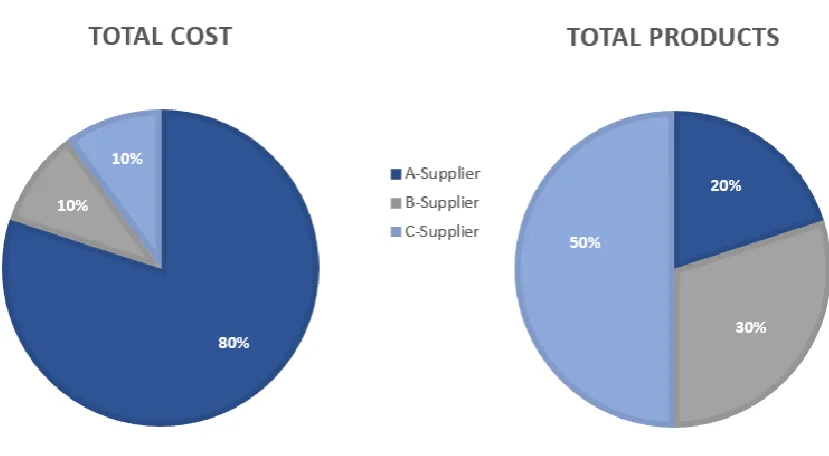
Generally, suppliers are categorised into three different classes – A, B and C. While A-suppliers represent the strategically important vendors who account for approximately 80% of the cost, B-suppliers are in the middle and C-suppliers account for high volumes with low ordering cost.159 Aim of this classification is to be able to concentrate on the strategically important few and spend less time with low-cost suppliers.160 According to Grosfeld-Nir et al. (2007), A-suppliers account for 80% of the cost and B-suppliers as well
157 see Grosfeld-Nir et al. (2007), p.2317/2320
as C-Suppliers for 10% of the cost while A-suppliers only deliver 20% of the products, B-suppliers 30% of the supplies and C-B-suppliers deliver 50% of the needed resources.161 As can be seen in figure 6, the distribution differs highly between the left and the right pie chart, i.e. the distribution of total costs and total ordered products. With this categorisation, companies can easily identify their key and weak suppliers, which is supportive for supply base reduction efforts.
Figure 6: Pareto Classification.
Source: Based on Grosfeld-Nir et al. (2007)162.
5.6.
Supply Base Reduction Processes: Comparing different Processes
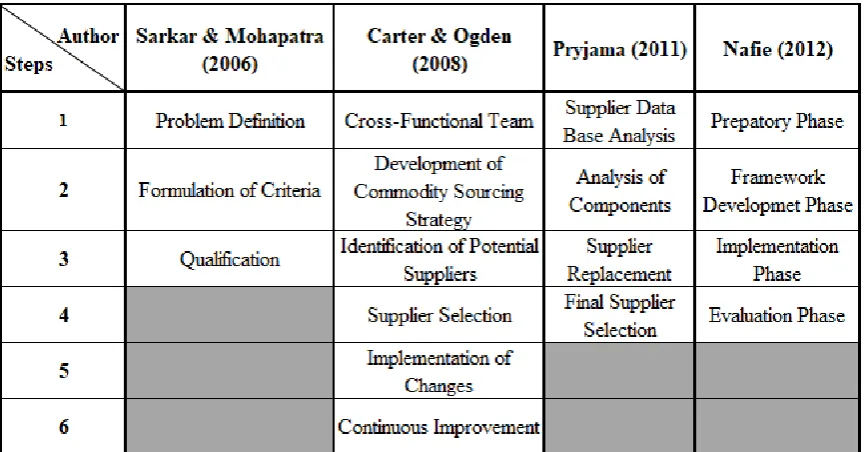
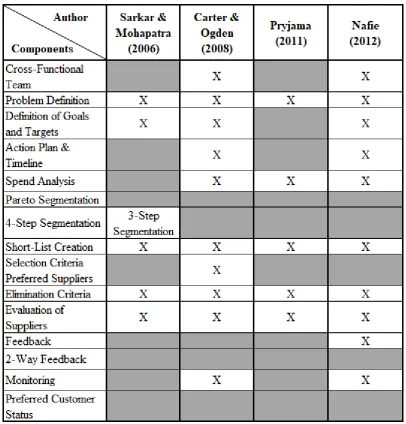
To be able to conduct a supply base reduction, companies need to establish a process of how to proceed, so that all issues are covered, and nothing is left out. Literature has conducted several researches to define such a process.163 In the following, the processes from Sarkar and Mohapatra (2006), Carter and Ogden (2008), Pryjma (2011) and Nafie (2012) will be highlighted. An overview of these four different processes can be found in table 2. What can be seen at the first glance is that the first process found by Sarkar and
161 see Grosfeld-Nir et al. (2007), p.2317. 162 see Grosfeld-Nir et al. (2007), p.2317
163 see e.g. Sarkar & Mohapatra (2006), p.155; Carter & Ogden (2008), p.15; Pryjma (2011), p.46; Nafie
Mohapatra in 2006 has three steps while Carter and Ogden defined six different steps in 2008. Further, both Pryjama (2011) and Nafie (2012) shortened the process back to four steps.
Table 2: Overview of Supply Base Reduction Processes. Source: Own elaboration.
Sarkar and Mohapatra (2006) developed a three-step process within their research and defined several sub missions within each stage.164 The first step is the problem definition, where the focal company should conduct an in-depth analysis of the supply market and the nature of the firm’s purchases. Furthermore, objectives and goals need to be defined. The second step, the formulation of criteria, is about identification and classification. Here, the focal firm has to identify the different factors that might have an influence on the defined objectives. The second sub step is the classification of the identified factors into capability and performance factors. The final step, the qualification, is the main part of the supply base reduction process and includes several sub steps to conduct. In this phase, potential suppliers are screened and identified, and supplier data is collected. Moreover, a cross-functional team is established in this phase, where experts from different departments are brought together to discuss the importance of the defined factors, possible problems, and the conducted supplier evaluation. This cross-functional team should then create two separate rankings of all suppliers – one ranking for the suppliers’ performance and another one for their capabilities. Based on these two rankings, a capability-performance matrix should be created where suppliers are ranked accordingly. The final sub step of the