This paper is made available online in accordance with publisher policies. Please scroll down to view the document itself. Please refer to the repository record for this item and our policy information available from the repository home page for further information.
To see the final version of this paper please visit the publisher’s website. Access to the published version may require a subscription.
Author(s): Haigh, S.N. and Robinson, E.J
Article Title: What children know about the source of their knowledge without reporting it as a source
Year of publication: 2007 Link to published version:
Running head: Knowing about sources of knowledge.
What Children Know About the Source of their Knowledge
Without Reporting it asthe Source.
S.N. Haigh,
Keele University , U.K.
E.J. Robinson,
Warwick University, U.K.
IN PRESS EUROPEAN JOURNAL OF DEVELOPMENTAL PSYCHOLOGY
Author note. Experiments 1 and 2 were conducted in partial fulfilment of the
degree of PhD for the first author. Experiment 3 was supported by a grant from the
Economic and Social Research Council, U.K. (RES000220825).
Correspondence concerning this article should be addressed to E.J. Robinson,
Department of Psychology, Warwick University, Coventry CV4 7AL, U.K.
Abstract
We argue that, amongst 3- to 5- year-olds, failure to report the source of
knowledge recently acquired in answer to “How do you know…?” is due to a specific
failure to make a causal inference, in line with source monitoring theory but not fuzzy
trace theory. In three Experiments, children (N = 37; 30; 59) identified a hidden toy
by seeing, feeling, or by being told, having had two modes of access on each trial, one
informative (e.g. seeing a toy identified by colour) and the other uninformative (e.g.
being told the toy’s colour by the Experimenter who had only felt it). Children who
answered the know question wrongly nevertheless reported accurately who saw and
who felt the toy, and what the well-informed player had said. They also realised when
the Experimenter’s uninformative access implied their own knowledge was
What Children Know About the Source of their Knowledge
Without Reporting it asthe Source.
Knowing how we know plays a central role in many aspects of adult
decision-making (Johnson, Hashtroudi & Lindsay, 1993), and inaccurate beliefs about the
sources of our knowledge can have serious consequences for our assessments of the
reliability of our knowledge. For example, a person who believes he has seen for
himself something he was only told about, may over-estimate the likely truth of that
belief. Adults sometimes make such errors of source attribution, but young children
have a much greater problem and make surprising errors under conditions that would
be trivially easy for adults. In particular, we have known for twenty years that
children aged three to four years are poor at reporting the source of knowledge they
have only just acquired (Gopnik & Graf, 1988; Wimmer, Hogrefe & Perner, 1988),
and interpretations made on the basis of these early studies remain largely
unchallenged. In a typical study children gain knowledge about an object by seeing it,
or feeling it, or being told about it. Shortly afterwards they are asked to report back
what they know, and how they know it. Children aged 3- to 4- years are usually
accurate at reporting the content of their knowledge, but relatively poor at saying how
they know, how they found out, or how they learned the item in question (e.g.
Drummey & Newcombe, 2002; Gopnik & Graf, 1988; O'Neill & Gopnik, 1991;
Perner & Ruffman, 1995; Taylor, Esbensen & Bennett, 1994; Wimmer, Hogrefe &
Perner, 1988).
Within the literature on children’s developing conceptions of the mind, such
connection between information access and knowledge state. As such, they are
considered to be qualitatively different from adults’ source attribution errors.
Importantly, errors suggesting a similar failure to understand about the knowing
process occur in a number of quite different tasks, suggesting that children do not
simply misunderstand the intended meaning of the question “How do you know…?”
(e.g. Naito, 2003; O'Neill, Astington & Flavell, 1992; O'Neill & Chong, 2001; Pillow,
1993). For example, 3- to 4- year olds make incorrect decisions about whether to look
at or feel an object to find out its colour (O'Neill, Astington & Flavell, 1992; Pillow,
1993), and they are poor at re-enacting what they just did to find out an object's smell
or feel (O'Neill & Chong, 2001).
Although there is widespread agreement that young children’s errors in
reporting how they know arise from failure to understand the causal connection
between information access and knowledge state, it remains unclear precisely what
their difficulty comprises. We consider two possibilities and relate these to two
contrasting theoretical accounts: Source monitoring theory and fuzzy trace theory.
First, children’s difficulty answering “How do you know….?” could be
confinedto making the causal inference. O’Neill & Gopnik (1991) seem to take this
view: “....Many 3-year-old children had difficulty identifying which experience led to
their beliefs. … Presumably, they could remember them as events, since they had
taken place only moments before. However, many of the 3-year-olds failed to relate
these activities to the beliefs that they led to.” (p 395). This view could readily be
accommodated by source monitoring theory (Johnson, Hashtroudi & Lindsay, 1993)
according to which decision processes, whether automatic or deliberate, take place at
the time of remembering, resulting in an attribution of source. That is, there is a
processes upon that information. This makes it possible for the theory to
accommodate the case of recollection of relevant source information (what was
experienced) yet failure to make the appropriate source attribution (inferring the
experience as causally connected to the knowledge state). Johnson et al.’s account
does not take a developmental perspective and so they do not consider the case of an
individual who lacks understanding of a causal connection between information
access and consequent belief. In fact the account assumes that this underlying
understanding is in place. What is important for our purposes is that there is an
explicit separation between memory of a knowledge-gaining episode, and the
subsequent inference based on that memory of the knowledge source. These authors
state, for example: “…..source monitoring depends not only on the quality of the
information as encoded but also on the quality of the decision processes when
source-monitoring judgments are made….” (Johnson et al., 1993, p.6 ) In principle it would
be possible therefore, within this account, to recollect the source, for example “I saw
it,” without necessarily treating itasthe source “I know because I saw it.”
A second possibility is that children’s difficulty answering “how do you
know…?” arises from a broader failure to encode or remember the events that
surrounded the acquisition of knowledge. Perner and Ruffman (1995) make an
argument along these lines: Because children do not understand the causal connection
between information access and knowledge state, they fail to lay down episodic
memories of the relevant experiences. Similarly, the characterisation of children as
suffering from source amnesia (O’Neill & Chong, 2001) seems to be consistent with
this second possibility. The broader deficit specified in this second possibility could
be accommodated by fuzzy trace theory (Brainerd & Reyna, 2004). This treats source
retained in gist form once verbatim memory has decayed, leading to loss of source
information. The important point for our purposes is that fuzzy trace theory leaves no
room for a distinction between recall of what happened (e.g. “I saw it”) and
interpreting thisasthe source of one’s knowledge.
To summarize: The possibility of children remembering accurately what
happened during a knowledge-gaining episode, while failing to realise how their
knowledge was acquired, follows readily from source monitoring theory, but is hard
to accommodate within fuzzy trace theory. Fuzzy trace theory conflates source
memory (for example, “I saw it”) with treating the sourceasa source (“I know
because I saw it”), while source monitoring theory specifies an inferential process
distinct from the laying down of memories of what happened. Given these different
ways of conceiving of source memory, it is of theoretical interest to find out whether
children who fail to report how they know, can indeed, as O’Neill and Gopnik (1991)
assumed, recall the relevant events leading to knowledge acquisition. Note that
although in the above discussion we have sometimes implied a simple dichotomy
between being able to report the source of one’s knowledge or not, we do not
envisage that children make a sudden leap from complete failure to understand, to
adult-like understanding of the causal connection between information access and
knowledge state. For experimental purposes it is often convenient to place children
into categories even if we assume an underlying continuum in development.
Children and adults clearly do make errors in reporting events which led up to
knowledge acquisition under some circumstances. For example, in research on
children’s suggestibility and eye witness testimony, participants are typically asked to
report whether they saw or were told about an event, and of course it is the errors
& Blades, 2000). The complexity of events and the timescales involved are much
greater than in research on children’s developing understanding about the mind, and
so the fact that children commonly make errors of source recall in such research tells
us little about the likely accuracy of immediate recall in simpler situations. In any
case, we do not know whether or not children would make the same errors if asked
“How do you know…?” rather than, for example “Did you see it…?” Interestingly, in
this literature reporting one’s source and reporting itasa source are not differentiated.
One aim of the research reported here was to examine empirically this distinction:
Just what, if anything, can children report about the sources of their knowledge
without reporting themassources?
We were particularly interested in children’s realisation of when their
knowledge was gained from another person’s utterances. It can be important to realise
when we gained knowledge indirectly via another person, rather than from our own
direct experience. For example, a person who wrongly assumed they had direct
experience of an event might give too much weight to their knowledge, and hold on to
it in the face of subsequent contradicting information. This person might be overly
confident in passing on the knowledge to others, perpetuating what might be false
rumour. She might provide inaccurate evidence in a legal setting in which she is
required to report only direct experience (Principe & Ceci, 2002; Principe & Kanaya,
2003; Principe, Kanaya, Ceci & Singh, 2006).
So far we have considered only verbally explicit reports about sources and the
bases of knowledge. However, as Johnson et al. (1993) point out, much of our source
monitoring activity is automatic rather than deliberate. Children might revealworking
understanding of the causal connection between information access and knowledge
reported below, we investigated that possibility in order to characterise more precisely
just what children’s difficulty was in answering the explicit question “How do you
know….?”
In all three experiments reported below the procedures were modifications of
one used previously (Whitcombe & Robinson, 2000; Robinson & Whitcombe, 2003).
In those studies, on each of a series of trials child and experimenter played a game to
identify which one of a pair of toys was hidden inside a tunnel, in an elaboration of
O’Neill, Astington and Flavell’s (1992) procedure. Toys within the pair either felt the
same but looked different, or looked the same but felt different. On each trial one
player felt the toy and the other saw it, so one had informative access and the other
did not. Both players said which toy they thought it was, the experimenter’s
suggestion contradicting the child’s. Then the child made the final judgment about the
toy’s identity. When the chid had uninformative access she therefore had the
opportunity to revise her judgment based on the well-informed experimenter’s
suggestion. Children aged 3- and 4- years performed near ceiling at accepting the
experimenter’s suggestion when she was the better informed, but rejecting it when she
was less well informed than the child. Importantly, when both players had
uninformative access, children were less likely to accept the experimenter’s
suggestion than when the experimenter was well-informed and the child was poorly
informed: Children did not believe the experimenter simply because they themselves
were unsure, but took into account the speaker’s information access.
In the experiments reported below we assumed that children would show this
correct pattern of gaining knowledge from their own direct experience when that was
informative, and gaining knowledge from the experimenter when he was
understood, or could report, about their process of gaining knowledge. In all three
experiments children were asked the standard question used in theory of mind
research to assess children’s understanding of the source of their knowledge: “How do
you know it’s (the hard one)?” This assessed their verbally explicit understanding of
the causal connection between information access and knowledge state.
Importantly, unlike the classic research cited above (e.g. Wimmer, Hogrefe &
Perner, 1988; Gopnik & Graf, 1988) on each trial children experiencedtwopotential
knowledge sources. For example, they both saw the toy and were told which one the
Experimenter, who had felt it, thought it was. Hence to answer the “How do you
know…?” question correctly, children had to realise which of those two potential
sources they in fact relied on. In the procedure typically used, children experience
only a single source on each trial and so in principle could report correctly, for
example, “I saw it” without necessarily understanding “I know because I saw it.”
In Experiments 1 and 2 we examined the relation between (i) the accuracy of
children’s reporting of how they got to know which toy was in the tunnel, and (ii) the
accuracy of their reports of the relevant surrounding events: Who looked and who felt
in Experiment 1, and who had said the right thing and what the well-informed player
had said in Experiment 2.
One possibility was that performance on (i) and (ii) would be associated in
that children who could not report how they knew which toy was in the tunnel also
failed to report these events relevant to the knowing process. If so this would suggest
a problem of attention to sources either at input or at recall, associated with or as part
of identification of sourcesassources. Another possibility was that children might fail
at (i) but succeed at (ii). If so, this would pin-point children’s errors in answer to
In the final experiment, Experiment 3, in addition to asking children to report
how they knew the hidden toy’s identity, we examined their working understanding of
the source of their knowledge. We gave children the opportunity to express
uncertainty about their knowledge after the Experimenter doubted that he had seen or
felt the toy adequately. The Experimenter’s expression of doubt about his access had
implications for the accuracy of the child’s belief about the toy’s identity when the
child had relied on the Experimenter’s suggestion. In contrast it was irrelevant when
the child herself had had informative access (Robinson, Haigh & Nurmsoo, 2006).
Children who correctly realised when the Experimenter’s doubt about his access had
implications for their own belief, revealed working understanding of the source of
their knowledge. We were interested in the relationship between children’s explicit
reports of how they knew which toy was in the tunnel, and their working
understanding.
Taken together, the results of the three experiments would help us to
characterise more precisely what children’s difficulty is when they fail to report how
they know.
Experiment 1
We began by comparing children’s ability to report the source of their
knowledge in answer to “Who saw, who felt….”, and their ability to report itasa
source in answer to “How do you know…?” As mentioned above, logically a child
might realise how she had experienced an object without inferring that that experience
is causally related to her knowledge state. Such a distinction is readily accommodated
by source monitoring theory, but not by fuzzy trace theory.
Materials. We used a tunnel (150mm x 150mm x 350mm), open at both ends
with a viewing window (120mm x 120mm) cut into one side. The viewing window
was covered by transparent Perspex to prevent inquisitive fingers feeling inside and
had a curtain that could be drawn to obscure the view inside when necessary. Each
end of the tunnel also had a curtain through which an arm could be placed to feel
inside, but which prevented children from seeing inside. Eight pairs of toys were
used, one pair for each of the 2 warm-up and 6 experimental trials. The toys within a
pair differed either in how they felt or in colour: Four pairs (stylised cats, lions,
teddy bears and frogs) looked the same but one felt hard and the other soft; the other
4 pairs (bears, ducks, cats and rabbits) felt the same but differed in colour. A mole
glove puppet, called ‘Mole’, operated by the experimenter, was used to place the pairs
of toys in a bag and then secretly place one of the pair into the tunnel. Mole also
asked the identity questions.
Participants.We tested 37 children (15 boys and 22 girls; age range, 3;6 to 5;5
mean = 4;7). Eighteen were from a nursery class: age range, 3;6 to 4;4 mean = 4;1.
Nineteen were from a reception class: age range, 4;4 to 5;5 mean = 4;11. All children
attended schools serving mixed white and Asian, working and middle class catchment
areas of Staffordshire, U.K, and had adequate command of English.
Design and procedure.On two warm-up trials, children were introduced to
Mole, the pairs of toys and their properties, and the tunnel, and practised looking at
and feeling a toy placed inside the tunnel. The Experimenter told children that
sometimes they would know which toy was inside the tunnel because they had seen or
felt it and sometimes they would know because he had told them.
Four experimental trials followed. On two of these (direct trials) the child
trial and feeling on the other, while the Experimenter had uninformative access. On
the other two experimental trials (tell trials) the child had uninformative access and
the Experimenter had informative access, again once through feeling and once
through seeing. All possible orders of trial types were cycled across children. In
addition, half the children received the “How do you know…?” question before the
being asked to report each player’s experience, and half received the other order.
What follows is the procedure for atell trialon which the Experimenter was
well informed by feeling inside the tunnel and the child was poorly informed by
looking.
1. The child saw and felt both toys in a pair and agreed that they looked the same but
one was hard and one was soft. Both toys were placed in a bag, shaken up, and
Mole, operated by the experimenter, slipped one of them in secret into the tunnel.
2. The Experimenter invited the child to look inside and said “Tell me which [frog]
you think it is”. The child replied.
3. The curtain was lowered over the viewing window and the experimenter felt
inside saying “I’ll feel and tell you which [frog] I think it is.” The Experimenter
gave a suggestion that contradicted the child’s, even if the child happened to guess
correctly. Since children made no direct check at the end of the trial, any
deception was undetected. At this point we relied on the previous findings
mentioned above, that children usually believe what they are told by a
informed Experimenter, and rely on their own experience when they are
well-informed.
4. The Experimenter asked theknow question:“Now you know which toy is inside.
How do you know which one it is?” with counterbalanced prompts if necessary
5. For half the children the know question was followed by theexperience questions,
and the remaining children had the reverse order. Theexperience questionsasked
them to report each player’s direct experience: “Who looked inside that time?”
and “Who felt inside that time?” (counterbalanced).
The procedure was similar with appropriate modifications on tell trials when the
Experimenter was well informed by seeing, and ondirect knowledgetrials, when the
child was well informed by seeing or by feeling. When the Experimenter was poorly
informed he always gave the incorrect identity (by unobtrusively checking which toy
was placed inside the tunnel) so that the child would always contradict him on the
basis of her informative access. On all experimental trials the player with
uninformative access went first. This was to avoid the circumstance of the
Experimenter hearing a well-informed child’s suggestion but then contradicting it on
the basis of uninformative access. Such irrational behaviour on the part of the
Experimenter could call his trustworthiness into question or confuse the child as to the
purpose of the game.
Results and Discussion
Preliminary analyses of order effects revealed no systematic differences or
interactions between order of questions and age, trial or question, so order was not
considered further. We used a strict criterion for success at reporting experience:
Children had to report accurately both their own and the Experimenter’s experience
on a particular trial to gain a score of 1. Children were given a score of 1 for each
correct answer to the know question. Each child gained a score of 0, 1 or 2 for: (i)
experience reports on direct trials; (ii) experience reports on tell trials, (iii) know
A 2 x 2 x 2 ANOVA was carried out on the within-child variables of question
(experiencevs. know question) and trial type (directvs. tell) and the between-child
variable of age (oldervs. younger). The use of a more stringent rejection region of
0.025 due to heterogeneity of variance did not affect any significant results.
Significant main effects of age, question and trial type were found:F(1, 35) = 22.42,
MSe = 0.88,p< .001,F(1, 35) = 11.14, MSe = 0.55,p= .002 andF(1, 35) = 18.27,
MSe = .49,p< .001 respectively. No other significant effects were found.
The main effect of age arose because older children performed better than
younger children. The main effect of question type arose because children were better
at recalling who had looked and who had felt than they were at answering how they
knew. The main effect of trial type arose because children were better on the direct
knowledge trials than on the tell trials.
It is clear from these results that children performed better at reporting their
own and the Experimenter’s sources of knowledge than they did at reporting their
sourceasa source of knowledge. One possibility is that children simply failed to
understand the know question, despite really understanding how they knew the toy’s
identity. We can argue against this. Children’s answers to the know question were
more accurate when the correct answer was “I know because I saw it” or “I know
because I felt it”, than when the correct answer was “I know because you told me.”
This suggests that some children understood the know question, and also understood
when their knowledge arose from seeing or feeling the hidden toy, without yet
understanding when their knowledge came from the Experimenter. Hence the
difference between accuracy of answers to the know and experience questions on tell
trials at least cannot be explained in terms of failure to understand what the know
A more likely possibility is that children could recollect how each person had
accessed the hidden toy without yet being able to infer how they got to know the toy’s
identity. This is in line with source monitoring theory, which treats source judgments
as inferences. The finding cannot, however, be accommodated by fuzzy trace theory,
which treats source information as directly encoded.
Finally, we consider why children found it more difficult to report accurately
“I know because you told me” than “I know because I saw it” or “I know because I
felt it.” Additional reasoning may be involved in attributing an utterance as a source,
compared with direct experience: The child may have to recollect what the speaker
said as well as the speaker’s information access and any other information relevant to
the speaker’s reliability (Bright-Paul, personal communication, 2005). Another
possibility is that some pre-school children consider only direct experiences to be
potential sources. We already know that children who understand about seeing as a
source of knowledge may not understand about logical inference as a source. Children
who themselves make a correct inference about the content of a bag tend to deny that
another person who is in a position to make that same inference, will know what is in
the bag (Keenan, Ruffman & Olson, 1994; Sodian & Wimmer, 1987). Just as
children apparently make inferences without understanding that they or others do so,
children may gain knowledge about the world from utterances without understanding
that they are doing so.
Direct sources may be relatively easy to understand because of the
straightforward relationship between mode of access and type of knowledge gained:
Seeing almost always provides knowledge about colour whereas feeling never does;
feeling almost always provides knowledge about hardness whereas seeing often does
gained from utterances, since utterances can provide knowledge about absolutely
anything, but they can also be unreliable sources of knowledge about anything. It may
be the very power of utterances as sources of knowledge about the world, the range of
knowledge that can be gained, that makes it difficult for children to come to
understand that they are sources.
Experiment 2
Having shown that children who failed to report their sourceasa source could
nevertheless recall each player’s experience, next we asked children to recall verbatim
what was said by the well informed person and which player had said the right thing.
Would we again find that children can report accurately the relevant events
surrounding their knowledge acquisition without making a causal inference about how
they knew?
Participants.Thirty children (13 girls) took part. Their age range was 3;6 to
4;10, mean = 4;3). All children attended schools serving mixed white and Asian,
working and middle class catchment areas of Staffordshire, UK, and had adequate
command of English.
Procedure.The procedure was the same as in Experiment 1, except that the
experience questions were replaced bytell questions: “Who said the right thing that
time?” with a counterbalanced prompt of “You” or “Me” when needed. Children were
then asked what was said by the player who had been well informed, for example
“What did I say was inside that time?” The tell questions were always asked in this
order, which made the better sense in practice.
Results and Discussion
To gain credit for correct answers to the tell questions on a particular trial the
well informed person say?). Mean scores out of 4 for the know and tell questions
were 1.63 (1.40) and 3.07 (1.11) respectively:t (29) = 6.74,p< .001. That is, children
found it easier to answer the tell questions than the know question. As in Experiment
1, order of test questions had no effect. Some children who correctly recalled that the
experimenter had said the right thing, and reported what he had said, then apparently
failed to infer "I know which one it is because you told me."
Results of the first two experiments suggest that children may have available
all the information that would be sufficient for an adult to infer correctly that their
source of knowledge was an utterance, and yet still fail to answer the know question
correctly.
Experiment 3
Given children’s ability to access the information necessary for inferring how
they knew which toy was in the tunnel, in Experiment 3 we investigated whether
children revealedworkingunderstanding of the causal connection between
information access and knowledge state, even if they could not make a verbally
explicit report. We again asked children to report explicitly how they knew the hidden
toy’s identity in a version of the tunnel game used in Experiments 1 and 2, but this
time we compared accuracy of children’s answers with their working understanding
of the source of their knowledge. We assessed this with a procedure devised by
Robinson, Haigh and Nurmsoo (2006), to find out whether or not children reasoned
along the lines of: “I believed what you told me because I thought you were
well-informed. If after all you were not well-informed then my belief could be false.”
Children found out whether the hard or soft toy was in the tunnel, either by feeling it
themselves, or by accepting the suggestion from the Experimenter who had felt it.
expressed doubt that he had felt the toy properly. The child was then asked whether it
could be the other toy of the pair. Children who understood how they got to know the
toy’s identity, should accept that it could be the other toy when they had relied on the
Experimenter’s suggestion, but deny that it could be when they had themselves felt
the toy.
Robinson et al. (2006) found that children aged 3- to 4- years showed that
pattern of responses. For example in Robinson et al. (2006) Experiment 4, 81 % said
“No” it could not be the other toy on both of two trials following the speaker’s doubt
about his access when they had themselves had informative access, whereas only 40%
said “No” on both of two trials when they had relied on the speaker’s suggestion, and
the remainder accepted at least once that it could be the other toy. Children responded
no differently whether it was a puppet, rather than the Experimenter, who felt the toy
in the tunnel and expressed doubt about his access: Children attended to the speaker
role rather than to the Experimenter as an individual. Importantly, on trials when
children had relied on the Experimenter’s suggestion, they were less likely to accept
that it could be the other toy in the tunnel when a puppet observer expressed doubt
about the hidden toy’s identity without giving any reason, than when the
Experimenter expressed doubts about his access. Even though the puppet observer
said explicitly, for example “I’m not sure it’s the [hard cat],” children werelesslikely
to accept that it could be the soft cat than when the Experimenter said “I’m not sure I
felt properly.”
Importantly, this was the case only when children had in fact relied on the
Experimenter as their knowledge source. When children had found out the toy’s
identity by their own direct access, they were no more likely to accept that it could be
doubted the toy’s identity. This pattern of data cannot be explained simply in terms of
a greater inclination to answer “Yes” to “Could it be the other toy?” when the
Experimenter rather than a puppet asked the question (even though it was the puppet
rather than the Experimenter who said “I’m not sure it’s [the hard cat]” and the
Experimenter made no direct comment on the toys identity). Rather, children’s
responses took into account the source of their knowledge. In any case, the fact that
nearly all children responded “No” rather than “Yes” to the Experimenter’s question
“Could it be the [other toy]?” when they had informative direct access themselves,
suggests that any authority they saw in the Experimenter did not lead to them
unthinkingly to say “Yes.”
In Experiment 3, we were interested in the relationship between children’s
explicit judgments of how they knew which toy was in the tunnel, and their responses
to the Experimenter’s doubt about his access when they had relied on his suggestion
about the toy’s identity. One possibility was that only children who could report that
the Experimenter had told them which toy was in the tunnel, would realise the
specific implications of having believed a speaker who was not as well-informed as
he had originally seemed. On the other hand, the correct reporting in Experiments 1
and 2 of the Experimenter’s experience and of what he said raise the possibility that
children would be able to make use of that information to work out the implications of
the Experimenter’s doubt about his access.
Method
Participants.The sample comprised 59 children, (35 girls) 33 from nursery
classes (age range 3y; 7m to 4y; 7m, mean = 4y; 1m) and 26 from reception classes in
children attended schools serving mixed white and Asian, working and middle class
catchment areas of northern UK and had adequate command of English.
Materials.Toys, tunnel and puppet Mole were used as in Experiments 1 and 2.
Four pairs of toys were either soft or hard but looked the same and 4 pairs were
different colours but felt the same.
Procedure.Children began with two warm-up trials on which they practised
seeing and feeling toys inside the tunnel, and being told about the hidden toy by the
Experimenter. They received explicit feedback about how they knew the toy’s
identity. Six subsequent experimental trials were cycled in counterbalanced order so
that each trial type appeared in each position in the sequence. Children received 4
trials on which they were asked theknow questionas in Experiments 1 and 2 (e.g.
“How did you know it was the hard frog?” with prompts if necessary). On two of
these trials they could identify the toy from their own direct experience, seeing on one
and feeling on the other (direct trials). On the other two trials they had uninformative
access and could rely on the well-informed Experimenter’s suggestion, once when he
had seen and once when he had felt the hidden toy (tell trials). The trials on which
children had informative access to the toy served to give children turns at being
well-informed, to demonstrate that the Experimenter was wrong when poorly well-informed,
and to ensure that the correct answer to the know question was not always “Because
you told me.”
Two further trials followed a slightly modified procedure. Half the children
entered theExperimenter doubtcondition. The procedure on these trials is detailed
below. Stages 1 to 4 served only to lead children to gain knowledge either directly or
1. The child was introduced to a pair of toys and agreed on their properties.
Both toys were placed in the bag, shaken, and one toy was slipped from the bag into
the tunnel.
2. The Experimenter either looked or felt the toy in the tunnel, saying “Now
I’m going to look / feel inside and tell you which toy I think is inside.” He then
identified the toy correctly, for example “The soft cat.”
3. The child was then invited to look at (when the Experimenter had felt) or
feel (when the Experimenter had looked at) the toy inside the tunnel.
4. The puppet Mole then asked the child anidentity question,“Which one is
inside please?” Since the child had uninformative access, she could answer the
identity question correctly by relying on the well-informed Experimenter’s
suggestion. If the child’s identity judgment on a tell trial was not in line with the
Experimenter’s suggestion but instead referred to the other toy, the trial was
terminated. When the child repeated the Experimenter’s suggestion the trial
continued:
5. The Experimenter doubted the reliability of his access, saying, “I’m not sure
I looked / felt inside properly” followed by thedoubt question: “Could it be the [other
toy]?”
6. After the child’s response, the Child and Experimenter removed the toy
from the tunnel to check its identity.
The other half of the children, allocated alternatively, entered the Mole doubt
condition. The procedure was the same as for those in the Experimenter doubt
condition, except at stage (v) of the procedure. Instead of the Experimenter doubting
his access, the puppet Mole said “I’m not sure it’s the [soft cat]”, followed by the
Results and Discussion
Since we were interested only in children who had acquired knowledge from
an apparently well-informed speaker, all children who entered the analyses had
answered the identity question at stage 4 in line with the Experimenters’ suggestion.
Children received a score of 0, 1 or 2 for the number of correct responses to the know
question on tell trials, and similarly on direct trials. As in Experiment 1, the mean
score (sd) was lower on tell trials, when the correct answer was “I know because you
told me” than on direct trials, when the correct answer was “I know because I saw it”
or “… because I felt it”: 1.19 (.900) and 1.61 (.743) respectively,t (df = 58) = 3.64,p
< .001. Again, this suggests that children who failed the know question did not just
fail to understand what the question meant.
Children also received a score out of 2 for the number of “No” responses to
the doubt question. We were primarily interested in the relationship between
children’s responses to the know question on tell trials (whether they reported that
they knew because the Experimenter had told them), and their responses to the doubt
questions in the Experimenter and Mole doubt conditions (whether they more
frequently accepted that it could be the other toy when the speaker doubted his access
than when an observer doubted the toy’s identity without giving a reason). These
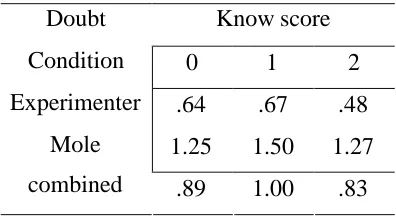
results appear in Table 2. We subjected children’s responses to the doubt question to
a 3 x 2 x 2 between-group ANOVA, with the variables source scores on tell trials
(0,1,2), age group (nursery, 3 - 4 yearsvs. reception, 4 - 5 years) and condition (Mole
vsExperimenter’s doubt). There was a between-child main effect for condition only:
F(1, N = 59) = 8.88, p= .005. Children responded with “No” (it couldn’t be the
other toy) significantly more often in the Mole doubt condition (mean 1.27) than in
an interaction between condition and scores on the source question. Children who
failed the source question showed no less discrimination between Mole and the
Experimenter’s expression of doubt than did children who explicitly understood that
the Experimenter was their source of knowledge.
Our interpretation of these results relies on the previous finding (Robinson,
Haigh & Nurmsoo, 2006), explained above, that children treated the Experimenter
and a puppet no differently when either was the speaker who expressed doubt about
his access. Given this finding, we can argue that children’s differential responses in
the Experimenter and Mole doubt conditions in Experiment 3 reflect their sensitivity
to the specific implications of the speaker’s doubt about his access, for example “I’m
not sure I felt properly.” Children weremoreinclined to accept that it could be the
other toy in the Experimenter doubt condition despite the fact that the Experimenter
expressed no doubt about the toy’s identity, whereas Mole did express such doubt in
the Mole doubt condition, saying for example “I’m not sure it’s the [soft cat].”
Children who did not report explicitly “I know because you told me” nevertheless
behaved as if they reasoned along the lines of : “I believed what you told me because
I thought you were well-informed. If after all you were not well-informed then my
belief could be false.” That is, they exhibited working understanding of the source of
their knowledge.
General Discussion and Conclusions
In the research presented here we aimed to clarify what underlies children’s
errors in answer to the classic question “How do you know….?” Errors cannot be
dismissed as simply due to failure to understand the question. As mentioned in the
introduction, children find it difficult not only to report how they got to know
need in order to find out something. In addition, in Experiments 1 and 3 children who
answered correctly when seeing or feeling was their source, found the question more
difficult when they knew because the Experimenter had told them. In the discussion
of Experiment 1 we speculated on reasons for this difference in difficulty, but the
important point here is that children could understand the know question, without
knowing the answer when it was “I know because you told me.”
Yet children did not appear to suffer from a deep-seated source amnesia or
failure to encode source information: In Experiment 1, children who performed poorly
in answering “How do you know…?” reported more accurately which player felt and
which saw the hidden toy. In Experiment 2, they reported more accurately which
player said the right thing and what the well-informed player had said. Children
could, therefore, report the source of their knowledge, yet fail to report itasthe
source. The conceptual distinction between reporting (what to an adult is) the source
of knowledge, and reporting itasthe source, has been largely ignored, yet the
empirical finding of a difference in difficulty has potentially important implications
for our understanding of children’s developing conceptions of the process of
knowledge acquisition. We consider two such implications:
First, the difference in difficulty between reporting accurately, for example
“You felt the toy” and “You said it was the soft cat” on the one hand, and reporting
accurately “I know it’s the soft cat because you told me,” is easier to accommodate
within source monitoring theory (Johnson, Hashtroudi & Lindsay, 1993), than within
fuzzy trace theory (e.g. Brainerd & Reyna, 2004). Source monitoring theory treats
source judgments as inferences on the basis of recollected experiences. Hence the
correct reports of who saw, who felt, what the well-informed person said, could for an
such an inference might not be made for various reasons. In particular, it might not be
made by a child who simply did not understand the causal connection between the
experiences and the knowledge state. Fuzzy trace theory, in contrast, treats source
information as encoded directly and makes no distinction between recollecting “I saw
it” and reporting “I know because I saw it”. For young children the two clearly are
not equivalent.
Second, the difference in difficulty between reporting experiences and
answering the know question also has implications for research on eye witness
testimony and suggestibility. As mentioned in the introduction, researchers in those
areas often conflate recollection of source with understanding itasa source: They
treat answers to questions such as “Did you see it?” as equivalent to “How do you
know…?” It has been argued that children gain some protection against misleading
or suggestive questioning such as “He was wearing a red cap wasn’t he?” once they
understand more about the knowing process and come to treat beliefs as
representations which can be in mismatch with reality (Welch-Ross, 2000). To test for
such effects it is important to measure children’s causal understanding of the knowing
process, as Welch-Ross (2000) did, rather than just recall of experiences. One
interesting further question to arise from this line of research is whether any such
protective effect is afforded by working understanding about sources, rather than or in
addition to verbally explicit understanding. On the other hand, in much of the research
on suggestibility children are unaware of the experience history of the person who
offers the misleading suggestion, and so knowledge of the knowing process, whether
implicit or explicit, might not be particularly helpful.
In Experiment 3, we found that children who failed to report explicitly “I
correctly, at seeing the implications of the speaker’s doubt about the adequacy of his
information access. Whether or not they could say how they got to know which toy
was in the tunnel, children realised that if the speaker had not felt the toy properly,
and they had relied on his suggestion, then their belief could be false. These children
behaved as if they understood the causal connection between their own knowledge
and the Experimenter’s suggestion about the toy’s identity.
Children spontaneously drew implications from the speaker’s doubt about his
access without being explicitly prompted to reflect on how they knew the hidden toy’s
identity, as they were with the question “How do you know…?” We know little about
how often pre-school children spontaneously engage in reflection on how they know,
or how often they are prompted to engage in such reflection when challenged by
peers’ or adults’ questions. Bartsch, Horvath and Estes (2003) examined the
CHILDES data-base for examples of talk about learning or teaching in the everyday
speech of 5 children. They found that comments on the source of factual knowledge
were rare both in the children’s talk and in adults’ talk to the children. If explicit
reflection on sources of knowledge occurs rather rarely in these early years, children’s
working understanding about the knowing process may be more important than their
relative weakness at reflecting on how they know. Future research may tell us. From
the present research we know that for recently acquired knowledge, children’s
inaccurate explicit reports of how they know do not necessarily indicate deep-seated
source amnesia, failure to encode or recall the events surrounding knowledge
acquisition, or even failure to understand the causal connection between such events
References
Bartsch, K., Horvath, K,. & Estes, D. (2003). Young children’s talk about learning
events.Cognitive Development, 18,177-193.
Brainerd, C.J. & Reyna, V.F. (2004). Fuzzy-trace theory and memory development.
Developmental Review, 24, 396-439.
Drummey, A. B. & Newcombe, N. S. (2002). Developmental changes in source
memory. Developmental Science, 5: 4, 502-513.
Gopnik, A. & Graf, P. (1988). Knowing how you know: young children’s ability to
identify and remember the sources of their beliefs. Child Development, 59,
1366-1371.
Johnson, M. K., Hashtroudi, S. & Lindsay, S. D. (1993). Source monitoring.
Psychological Bulletin, 114, 3-28.
Keenan, T., Ruffman, T., & Olson, D. R. (1994). When do children begin to
understand logical inference as a source of knowledge?Cognitive
Development,9, 331-353.
Naito, M. (2003). The relationship between theory of mind and episodic memory:
evidence for the development of autonoetic consciousness. Journal of
Experimental Child Psychology, 85, 312-336.
O’Neill, D. K. & Gopnik, A. (1991). Young children’s ability to identify the sources
of their beliefs. Developmental Psychology, 27, 390-397.
O’Neill, D. K., Astington, J. W. & Flavell, J. H. (1992). Young children’s
understanding of the role that sensory experience plays in knowledge
O’Neill, D K. & Chong, C. F. (2001). Pre-school children’s difficulty understanding
the types of information obtained through the five senses. Child Development,
72, 3, 803-815.
Perner, J. & Ruffman, T. (1995). Episodic memory and autonoetic consciousness:
Developmental evidence and a theory of childhood amnesia. Journal of
Experimental Child Psychology, 59, 616-548.
Pillow, B.H. (1993) pre-school children’s understanding of the relationship between
modality of perceptual access and knowledge of perceptual properties.British
Journal of Developmental Psychology, 11, 371-389.
Principe, G.F. & Ceci, S. (2002) "I saw it with my own ears" The effects of peer
conversations on pre-schoolers' reports of nonexperienced events.Journal of
Experimental Child Psychology, 83,1-25.
Principe, G.F. & Kanaya, T. (2003, April).Did you hear what I heard? How rumours
can elicit false reports in pre-schoolers. Paper presentation at Meetings of
Society for Research in Child Development, Tampa, Florida.
Principe, G.F., Kanaya, T., Ceci, S,J, & Singh, M. (2006). How rumors can engender
false memories in preschoolers.Psychological Science, 17, 243-248.
Roberts, K.P. & Blades, M. (2000).Children’s Source Monitoring. Mahwah, New
Jersey: Erlbaum.
Robinson, E.J., Haigh, S.J. & Nurmsoo, E. (2006). Children’s working understanding
of knowledge sources: Confidence in knowledge gained from testimony. Paper
under submission.
Robinson, E. J. & Whitcombe, E. L. (2003). Children’s suggestibility in relation to
their understanding about sources of knowledge. Child Development, 74,
Sodian, B. & Wimmer, H. (1987). Children’s understanding of inference as a source
of knowledge.Child Development, 58, 424-433.
Taylor, M., Esbensen, B. M. & Bennett, R. T. (1994). Children’s understanding of
knowledge acquisition: the tendency for children to report they have always
known what they have just learned. Child Development, 65, 1581-1604.
Welch-Ross, M. (2000). A mental-state reasoning model of suggestibility and
memory source monitoring. (pp 227 – 255). In K. P. Roberts and M. Blades
(Eds.)Children’s Source Monitoring.Mahwah, New Jersey: Erlbaum.
Whitcombe, E. L. & Robinson, E. J. (2000). Children’s decisions about what to
believe and the ability to report the source of their beliefs. Cognitive
Development, 15, 329-346.
Wimmer, H., Hogrefe, G. J. & Perner, J. (1988). Children’s understanding of
information access as a source of knowledge. Child Development, 59,
Table1.Experiment 1: Mean (sd) number of correct responses to experience and
know questions (Max. = 2).
.
Question
Know
(direct)
Know
(tell)
Experience
(direct)
Experience
(tell)
0.61 (.85)
1.53 (.70)
0.17 (.51)
0.84 (.96)
1.11 (.83)
1.68 (.48)
0.61 (.70)
1.37 (.76) Age
Younger
Older
Combined 1.08 (.89) 0.51 (.84)
Combined
0.83 (1.04)
2.37 (1.34)
1.62 (1.42) 1.41 (.72) 1.00 (.82)
Combined
1.72 (1.23)
3.05 (1.18)
Table 2. Experiment 3:mean number of times (maximum score = 2) that children
responded “No” to either protagonist’s doubt, denying that it could be the other toy,
in relation to scores for know question.
Know score
0 1 2
.64
1.25
.67
1.50
.48
1.27 Doubt
Condition
Experimenter
Mole