http://wrap.warwick.ac.uk
Original citation:
Yu, A.C., Martin, Graham R. and Park, H. (2005) Improved schemes for inter-frame coding in the H.264/AVC standard. In: Proceedings of the 2005 International Conference on Image Processing (ICIP 2005), Genoa, Italy, 11-14 Sep 2005. Published in: IEEE International Conference on Image Processing, 2005. ICIP 2005. pp. 902-905.
Permanent WRAP url:
http://wrap.warwick.ac.uk/61485
Copyright and reuse:
The Warwick Research Archive Portal (WRAP) makes this work by researchers of the University of Warwick available open access under the following conditions. Copyright © and all moral rights to the version of the paper presented here belong to the individual author(s) and/or other copyright owners. To the extent reasonable and practicable the material made available in WRAP has been checked for eligibility before being made available.
Copies of full items can be used for personal research or study, educational, or not-for profit purposes without prior permission or charge. Provided that the authors, title and full bibliographic details are credited, a hyperlink and/or URL is given for the original metadata page and the content is not changed in any way.
Publisher’s statement:
“© 2005 IEEE. Personal use of this material is permitted. Permission from IEEE must be obtained for all other uses, in any current or future media, including reprinting
/republishing this material for advertising or promotional purposes, creating new collective works, for resale or redistribution to servers or lists, or reuse of any copyrighted component of this work in other works.”
A note on versions:
The version presented here may differ from the published version or, version of record, if you wish to cite this item you are advised to consult the publisher’s version. Please see the ‘permanent WRAP url’ above for details on accessing the published version and note that access may require a subscription.
IMPROVED SCHEMES FOR INTER-FRAME CODING IN THE H.264/AVC STANDARD
Andy C. Yu, Graham R. Martin and Heechan Park
Department of Computer Science, University of Warwick, Coventry, CV4 7AL, United Kingdom Email: {andycyu, grm, heechan}@dcs.warwick.ac.uk
ABSTRACT
An efficient algorithm for inter-frame coding in the H.264/AVC standard is extended to provide more significant speedup in computational performance for sequences containing high spatial correlation and motion. The proposed scheme features a more sophisticated search process and robust predictions to achieve better PSNR-rate performance for a large range of compression levels. Extensive simulation results demonstrate speedups of between 41% and 68%, with no noticeable deterioration in picture quality or compression ratio, even for the coding of complex video sequences.
1. INTRODUCTION
Block-matching motion compensation is a core part of inter-frame coding in the H.264/AVC standard. It aims to reduce the coding of redundant information by identifying the best matching pixel data in adjacent frames. The difference with other standards, however, is that the block size is no longer fixed, but ranges from 4×4 to 16×16 pixels. In order to choose the best block size for a macroblock, the H.264 standard makes use of computationally intensive Lagrangian rate-distortion (RD) optimization [4], the general equation of which is:
) Qp ( . ) Qp ( ) Qp
( D modeR
LC = +λ (1)
where LC(Qp) is the rate-distortion (RD) cost. The Lagrangian multiplier, λmode, is associated with the quantisation factor, Qp, and has the relationship:
3 / ) 12 Qp ( e
mod =0.85×2 −
λ (2)
D(Qp) is a measure of the distortion between the original macroblock and the reconstructed macroblock located in the previous coded frame, and R(Qp) reflects the number of bits, including the macroblock header, motion vectors and all the DCT residue blocks. Both D(Qp) and R(Qp) are associated with the chosen mode and the quantisation factor, Qp.
In inter-frame coding, possible inter-modes are:
} 8 P8 16, 8 , 8 16,16 16 INTRA, SKIP,
{ × × × ×
where SKIP is a direct copy from the previous frame; INTRA represents intra-modes predicted from encoded adjacent pixels, and P8x8 accounts for the inter modes with small partition size (8x8, 4x8, 8x4, and 4x4 pixels).
The optimal mode for a macroblock is selected as that which produces the least RD cost. Since the exhaustive search method is employed in all the inter-modes to acquire a final mode decision, the computational burden of the search process is far more significant than any existing video coding algorithm.
In previous work, a fast algorithm, MFinterms, [1] has been proposed to alleviate inter-frame encoder complexity, while still maintaining picture quality and coding efficiency at certain compression levels. Success of the MFinterms algorithm is achieved by discriminating two kinds of encoded macroblocks: (a) macroblocks encoded with SKIP mode; (b) macroblocks encoded by inter-modes with the larger decomposed partition sizes (greater than 8x8 pixels). The MFInterms algorithm
assigns different categories of inter-modes to each macroblock with a complexity measurement defined as follows:
⎩ ⎨ ⎧
< > =
c AC
c AC
Th 25 . 15 / ) ln(E low,
Th 25 . 15 / ) ln(E high,
Complexity (3)
where Thc is a spatial complexity threshold and EAC is the total energy of the high-frequency component (AC component) in the current macroblock. If the result in (3) is low, the algorithm checks those inter modes with partition sizes of larger than 8x8. Otherwise, the
macroblock is decomposed into four 8-by-8 blocks and a measurement of block-based motion consistency is made to determine whether inter-modes with a smaller partition size are required.
propose improved schemes for the MFinterms algorithm which achieve a better PSNR-rate performance and a reduced computational requirement for any coding condition. The remainder of this paper is organized as follows. In Section 2, the improved schemes for the MFinterms algorithm are presented. Extensive simulation results in terms of PSNR-rate performance and algorithm efficiency are presented in Section 3 and conclusions are drawn in the Section 4.
start
Deactivate all modes
Any neighbour encoded with SKIP
Encode with SKIP mode
end
Temporal similarity Check
Second Level NO
Decision = 0
YES Decision = 1
2. THE PROPOSED SCHEMES FOR THE
MFINTERMS ALGORITHM Fig. 1 Flowchart of 1
stlevel of improved scheme.
The proposed scheme contains a more sophisticated search process and robust predictions in selecting an optimal inter-mode for each macroblock. The scheme is described as comprising three levels. Each level targets a different category of inter-modes according to the complexity of the search processes. The following subsections introduce these three levels.
3.1. The first level of the proposed algorithm
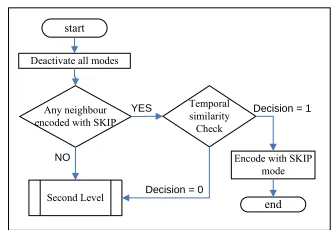
The first level of the proposed algorithm distinguishes the macroblocks encoded with SKIP (denoted as skipped macroblocks). Fig. 1 illustrates the detailed flowchart for this level. The skipped macroblocks can be found in P-frames where the pixel information is almost identical to that in the corresponding same position in the previous frame. Thus, they can be detected by means of the temporal similarity between the two macroblocks. As skipped macroblocks tend to occur in clusters, such as in a patch of static background, we suggest that the current macroblock undergoes temporal similarity detection if at least one of two possible valid skipped macroblocks is found above or to the left of the current macroblock. The decision for the temporal similarity detection is defined as
⎥ ⎦ ⎥ ⎢
⎣ ⎢
+ −
= ε
) 1 ; ( SAD
x Decision
current SAD
t
t (4)
where SADcurrent(t;t−1) is the sum absolute difference (SAD) of the macroblocks in frames t and t−1; ε
represents a tolerance constant; xSAD is the SAD of the available skipped neighbour. An average of the SAD values is computed if both skipped neighbours are valid. A non-zero outcome in (4) indicates that the current macroblock is encoded with SKIP only. Otherwise, further examinations in the second level are required. The algorithm for this level is summarised as follows:
1.1.Deactivate all inter-modes.
1.2.Determine whether one of the encoded neighbours located above or to the left is a skipped macroblock. Execute 1.3 if the situation is true. Otherwise, proceed to next level.
1.3.Perform the temporal similarity test described in (4). If a non-zero decision is obtained, encode the current macroblock with SKIP mode and record its SAD value. Otherwise, further examinations in the next level are required.
3.2. The second level of the proposed scheme
Fig. 2 illustrates the flowchart of the second level. This level targets those macroblocks encoded with inter modes with a large partition size (8×16, 16×8, and 16×16 pixels). The general tendency that inter modes with large partition sizes are more suitable for the encoding of homogeneous content has been verified by a number of authors [1,2]. The reasons given are that: (a) homogeneous macroblocks tend to contain fewer moving features requiring multiple motion descriptors, and (b) owing to the homogeneous content, the distortion costs arising from incorrect predictions are often insignificant.
The spatial complexity measurement in (3) is employed to determine if the current macroblock requires further examination by inter-modes with smaller partition size. However, (3) excludes the case of macroblocks with spatial content in between the two-tiered classifications. Furthermore, it is observed that the mode decision for the aforementioned macroblocks varies according to what level of compression is applied. Since the mode decision for a macroblock is determined by the lowest RD cost, we suggest computing the RD cost of a few inter-modes before the entire search process is performed. If the best mode for a high-detailed macroblock in this level is in favour of using inter-modes with partition size of 16x8
and 8x16, a more thorough search in the next level is
required. Otherwise, the mode decision for the current macroblock is made. The detailed algorithm at this level is described as follows:
[image:3.612.351.518.69.184.2]Start (From 1st Level)
Spatial Complexity
Check Check SKIP, 16x16 modes
Compute RD cost of SKIP, 16x16, 16x8,
and 8x16 modes
Best mode is 16x16 or SKIP?
end Third Level Test HIGH
LOW
YES
NO
2.2. Activate the inter-modes with partition size of 8×16, 16×8, and 16×16 and SKIP. Check the current macroblock with the activated inter-modes.
2.3. Compute the RD cost of the four modes and obtain a mode decision for this level. If the optimal mode is not SKIP or 16×16, proceed to the third level. Otherwise, the mode decision for the current macroblock is decided.
3.2. The third level of the improved scheme
The third level computes searches within the P8x8 mode
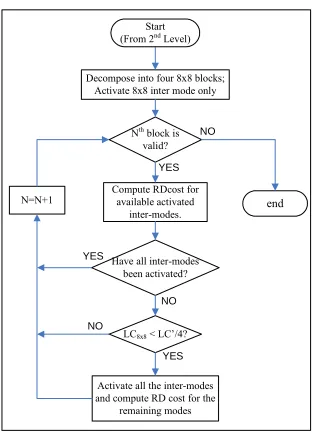
(including the inter-modes with smaller partition sizes of 8×8, 8×4, 4×8, and 4×4 pixels). Since each decomposed 8-by-8 block has to undergo search operations, a very large computational overhead is expected. Fig. 3 illustrates the proposed scheme for this level. The current macroblock is decomposed into four non-overlapping 8×8 blocks. Each block is then checked by the inter mode with partition size of 8×8. The other inter-modes with smaller partition sizes are activated if the following condition is true
4 / ' ) ( th 8
8 N LC
LC× < (5)
where LC8x8(Nth)is the RD cost of the Nth current 8×8 block and LC’ represents the RD cost of the best mode obtained from the last level. Note that (5) does not need to be revised if all inter-modes are activated. Thus, a computational saving is achieved for the first few blocks which do not satisfy the condition in (5). The detailed algorithm of this level is described as follows:
3.1. Decompose the current macroblock into four non-overlapping 8×8 blocks.
3.2. Activate on the inter mode with partition size of 8×8 only.
3.3. Check and compute RD cost for the activated inter-modes for the current 8×8 block until all the blocks have been examined.
3.4. Detect if the other available inter-modes have been activated. If the situation is true, proceed to 3.3. Otherwise, examine the condition (5) and implement 3.5.
3.5. If the condition in (5) is satisfied, activate all the available inter-modes in this level. Otherwise, return to 3.3.
4. SIMULATION RESULTS
This section compares the results of the proposed algorithm incorporating the improved schemes with the previously reported MFInterms algorithm [1]. Results are presented as improvements over the standard H.264 benchmark, software version JM6.1e[3]. Except were stated, the selected sequences are of QCIF resolution (176×144 pixels). The other settings are as follows: in total 100 frames of each sequence were processed. The frame rate and GOP are 30 frames/sec and 10 frames, respectively. The precision and search range of the motion estimation is set to ¼ pixel and ±8 pixels, and finally, CABAC coding is utilised.
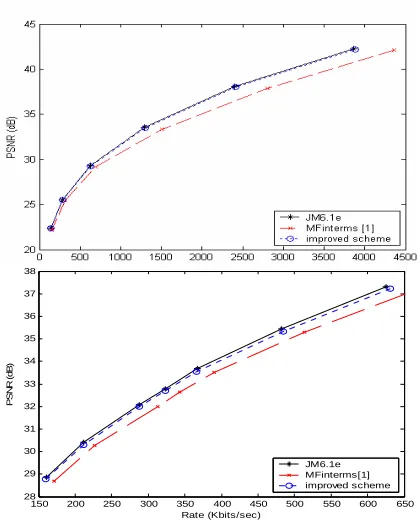
[image:4.612.346.502.68.284.2]Fig. 4 exhibits two PSNR-rate relationship diagrams for the Flower sequence in CIF resolution (top diagram) and the Stefan sequence in QCIF resolution (bottom). Both sequences are classified as Class C sequences. It is clear that the PSNR-rate performance of the new algorithm is virtually identical to that provided by the JM6.1e software, at all bit rates. However the previously reported MFinterms algorithm shows a decreased PSNR, particularly at the higher bit rates. Consequently we conclude that the new algorithm provides better performance than the MFinterms algorithm at all bit rates. Fig. 2 Flowchart of 2nd level of improved scheme.
Fig. 3 Flowchart of the 3rdlevel of improved scheme.
Nth block is
valid? Decompose into four 8x8 blocks;
Activate 8x8 inter mode only
Compute RDcost for available activated
inter-modes. end N=N+1
Start (From 2nd Level)
NO
YES
YES
LC8x8 < LC’/4?
Activate all the inter-modes and compute RD cost for the
remaining modes Have all inter-modes
been activated?
YES NO
[image:4.612.90.267.69.219.2]Table 1 summarises the speed up over the JM6.1e benchmark for the two algorithms. Qp was fixed at 32. Generally, both algorithms provide different degrees of speed up depending on the class of the selected test sequences. Both algorithms reduce the computation time for Class A and Class B sequences by in excess of 57%. For Class C sequences (that generally are more difficult to encode), the new scheme performs almost twice as well as the previously reported MFinterms algorithm, providing speedups of 41%-55% compared with 23%-30%.
Fig. 5 illustrates the speed up achieved by both algorithms for different Qp settings, for the Stefan sequence. Significantly, the proposed algorithm maintains the same speed up of around 42% for low Qp values (high bit rates) and then increases to over 60%; while a slow increase of between 17% and 34% is shown for the MFinterms algorithm. Fig. 5 illustrates that the proposed algorithm is superior to MFinterms at all bit rates.
Class / Sequence MFinterms [1] Proposed scheme A Container Ship 72.94% 68.10% B Silent Voice 60.22% 57.61% Car Phone 30.97% 51.60%
City 22.85% 54.74%
Crew 24.39% 51.76%
Flower (CIF) 27.54% 48.40%
Ice 29.91% 44.10%
Stefan 28.72% 41.45%
C
Tempete (CIF) 20.87% 44.37%
150 200 250 300 350 400 450 500 550 600 650
28 29 30 31 32 33 34 35 36 37 38
Rate (Kbits/sec)
PS
N
R
(
d
B)
[image:5.612.58.286.293.430.2]JM6.1e MFinterms[1] improved scheme
Fig. 4 PSNR-rate relationship diagrams for Flower in CIF (top) and Stefan in QCIF (bottom) resolutions.
Fig. 5 Speedup for Stefan (QCIF) sequence for different Qp values.
Table 1 Computational Speedup compared to JM6.1e
5. CONCLUSIONS
Improved schemes for block size selection in inter-frame coding in the H.264/AVC standard have been proposed. The new algorithm significantly improves the PSNR-rate performance of the previously reported MFinterms algorithm at all bit rates, while almost halving the computational requirement for Class C sequences. The simulation results further show that the proposed algorithm achieves the same coding performance in terms of picture quality and compression ratio as that of the H.264/AVC standard, yet reduces the computational requirement by up to 68%.
[2] I. Richardson, “H.264/MPEG-4 video compression: video coding for next-generation multimedia,” Wiley, London, 2003.
[3] JVT reference software for the H.264/AVC standard, JM 6.1e, downloaded from http://bs.hhi.de/~suehring/tml. [4] ISO/IEC 14496-10:2003, “Information technology – coding of audio visual objects – Part 10: advanced video coding,” Dec. 2003.
6. REFERENCES
[image:5.612.339.541.378.525.2]