The Construction of New Scales: a
Framework and Case Study of the
EUREGIO Cross-Border Region
Markus Perkmann
CSGR Working Paper No. 165/05
Markus Perkmann
The construction of new scales: a framework
and case study of the EUREGIO cross-border
region
Working paper series No 165 May 2005
Abstract:
The article proposes a framework for analysing re-scaling processes and applies it
to a case study of the Dutch-German EUREGIO cross-border region. While much
of the scale debate focuses on the causes and consequences of re-scaling, the
article addresses the conditions and circumstances in which new territorial scales
emerge and suggests a framework of necessary components of re-scaling
processes. Informed by neo-Gramscian thinking, the scales debate as well recent
analyses of regionalisation, these are formulated as: political mobilisation,
governance building and strategic unification. The case study locates the
EUREGIO case with respect to these dimensions. The article concludes that this
framework can be used for studying and comparing other re -scaling cases and
presents an initial typology for classifying cross-border regions.
Key words: scale, re-scaling, cross-border region, cross-border co-operation Europe, territory.
Dr. Markus Perkmann
1
Introduction
Recent transformations of the geographic scale and associated governance modes of public agency have recently attracted much interest by observers (Brenner, 2003; Gualini, 2004; Jessop, 2002; Peck, 2002; Swyngedouw, 2004; Ward & Jonas, 2004). The ‘re-scaling’ debate has highlighted the implications of shifting scales for social forces and populations, and investigated the impact of scales on the role of localities, regions and other socio- geographic formations involved the wider processes of global production and consumption.
The emergence of cross-border regions (CBRs) provides a paradigmatic case for re-scaling processes. A CBR is a territorial unit that comprises contiguous sub-national units from two or more nation states (Perkmann & Sum 2002a). Since borders were hermetic barriers only on rare occasions in the history of nation states, the existence of integrated cross-border spaces is no novelty as such. What is new is that the construction of CBRs has become a more or less explicit strategic objective pursued by social forces within and beyond border regions. Jessop (2002) has commented on the significance of CBRs within the broader context of state restructuring and has identified a variety of different processes and/or strategies underlying and informing their emergence and consolidation. Empirically speaking, CBRs are very different in terms of their set- up, roles and social bases, depending on the institutional context they are embedded in. In Europe, CBRs tend to be groupings of local or regional authorities integrated into or attached to the multi-level policy implementation networks constituted by EU regional policy (Perkmann 2003, Anderson, O’Dowd and Wilson 2003). In North America, the building of CBR tends to be more closely associated with particularist and issue-driven interests and they appear more loosely organised with a variety of involved private and public actors (Blatter 2004, Sparke 2002). In East-Asia, some CBRs are constituent part of the so-called growth triangles that, often in association with Special Economic Zones, exploit locational complementarities between territories with different factor prices and competency levels (Sum 2002, Sparke 2004).
So far, the empirical study of cross-border regions and the theoretical debate on re-scaling have not been explicitly linked up; this is where this paper aims to make a contribution. Specifically, it addresses an aspect of re-scaling processes that has failed to gain much attention in the debate. Most contributions to the scale debate focus on two aspects: the
consequences, authors have pointed to the role of re-scaled arrangements within strategies of neo-liberal restructuring and deregulation, sometimes at the expense of incumbent local communities (e.g. Swyngedouw 1996).
However, less attention has been paid to how re-scaling actually occurs. What are the general circumstances in which new scales are constructed or transformed? What are the necessary ingredients of successful scale construction? This article proposes a framework for studying processes of re-scaling that can serve to answer these questions and analyse as well as compare concrete cases. While the framework categories are informed by the wider debate on state-theory and regionalisation, they are tested with a case study on the EUREGIO, a Dutch-German cross-border region. The choice of the EUREGIO as a case is pertinent insofar as it is a relatively advanced case of cross-border co-operation (CBC) and, at the same time, there is evidence that its model is followed widely by other similar initiatives across Europe (Perkmann 2003).
The purpose of the exercise is to create an analytical template that can inform further case studies and comparative work aimed to identify different types of re-scaling strategies and scenarios. By demonstrating and uncovering empirical variation across various cases, this might help address the implicitly functionalist bias in much of the current debate on scales and re-scaling, suggesting that the emergence of new scales is invariably driven by the pressures of the global capitalist system. Not dissimilarly, neo- liberal approaches view the emergence of new scales, such as ‘natural economic zones’ and cross-border regions, as the de-facto manifestation of the economic imperatives of a globalised economy (Ohmae 1995).
To achieve this objective, the article proceeds as follows. After a brief summary of the scale debate, an argument is made in favour of a territorial concept of scale in order to clarify the ambiguities associated with the concept. Inspired by Neo-Gramscian state theory as well as recent work on concrete re-scaling processes, such as ‘regionalisation’, a framework is then presented that encapsulates the main dimensions of re-scaling processes: political mobilisation, governance building and strategic unification. The framework is subsequently applied to an in-depth study of the emergence of the EUREGIO, whereby the presentation of the data is integrated with the discussion and analysis. Concluding, a few remarks are made as to how this framework can be used for studying further cases of re-scaling and an tentative typology of re-scaling processes is proposed.
(Bezirksregierungen DE and regios NL) on both sides of the border as well as the Dutch central government and the German Land governments of North Rhine-Westphalia (NRW) and Lower Saxony. Interviews were ‘face to face’, lasted 1.5 hours on average and were semi-structured; they were all taped and transcribed. References to interview evidence are coded according to the format ‘i1’, ‘i2’, etc; a list is provided at the end of article. An equally important body of evidence was provided by printed and electronic documentation, in particular policy strategy and planning documents, policy evaluations and public communication materials produced by the EUREGIO, its member authorities, the European Commission, the AEBR, the ‘Institut für Landes - und Stadtentwicklungsforschung’ in North Rhine Westphalia and other organisations such as consultancies commissioned to evaluate policy measures.
2
Scales and the politics of scale
Commonly, ‘geographic scale’ can be referred to as a ‘graduated series, usually a nested hierarchy of bounded spaces of differing size, such as the local, regional, national and supranational’, ‘each with a distinct geographic scope, that is, territorial extent’ (Delaney and Leitner 1997). In the recent literature, there has been a lively debate about the ‘politics of scale’, a notion originally coined by Smith (1992), reflecting the assumption that gegraphical scales are socially constituted in historically specific ways and can hence become a stake in political struggles. This can be read against the background of the 1970s 'locality debate' when a substantivist view of scale postulated intrinsic characteristics of the 'local' (Cooke 1989, Cox and Mair 1989, Duncan and Savage 1989). More recently, authors moved towards a relational conception of scale, emphasising the fact that geographic scales are socially constructed and that their precise manifestation can not be derived a priori (cf. Howitt, 1993).
Williams 1999). At the same time, he argues that ‘scale’ is underpinned by a temporary social compromise’ (Swyndegow 1996: 146). Scale henc e solidifies existing power relationships, regulates forms of cooperation, and defines power strategies. On the regional level, this process has been described by Lipietz as the creation of ‘regional armatures’, involving the establishment of a ‘space-for- itself’ endowed with the capacity to intervene on the part of a particular hegemonic bloc (Lipietz 1994). From such a social- integrative perspective, scale becomes relevant both as a site for control and domination as well as arena for conflicts and co-operation: The 'continuous reshuffling and re-organisation of spatial scales is an integral part of social strategies and struggles for control and empowerment' (ibid: 141).
While these authors emphasise the socially constructed nature of scales qua institut ions, other authors have pointed out that scale also play an important role as (constructed) discursive referents in political life. Scale discourses, as ‘representational tropes' (Jones 1998) can be deployed in political action to provide rationales for specific political projects (Kelly 1997) As Smith argues, ‘by setting boundaries, scale can be constructed as a means of constraint and exclusion, a means of imposing identity, but a politics of scale can also become a weapon of expansion and inclusion, a means of enlarging identities. Scale offers guideposts in the recovery of space from annihilation’ (Smith 1993: 14).
This short overview has highlighted the regulatory, social- integrative and discursive dimensions of scale. The next section explores the relationship between re-scaling and
territorial restructuring.
Re -scaling as reconfiguration of territorial governance
The re-scaling debate has highlighted the role of scales – and implicitly their governance effects – as stakes in political struggles. Brenner’s critique of the overextensive use of the scale concept – and his plea to focus on its ‘plural meaning’ - have done much provide better analytical focus. There is still considerable ambiguity left, however, as to what the concept of scale effectively refers to. On the one hand, ‘scale’ often appears to refer to the
bounded spaces constituted by the territorial set-up of states, regions or localities that are arenas and objects of public governance. On the other, however, scale also appears to refer to the extension of processes, such as commodity chains, firm collaboration or capitalist accumulation in general. While the latter is an important aspect of tendencies such as globalisation, as pointed out by Jessop (1999) and implicit in Castells’ (1996) ‘spaces of flows’, it is distinct from the creation and modification of scales understood as arenas and objects of public governance.
across increasingly extensive geographical scales and ‘[c]utting across these vertical structures are the territorially defined political- economic systems which (…) are manifested at different geographical scales’. In other words, vertical processessuch as the manufacturing of industrial products, or the provision of financial services increasingly criss-cross horizontally constituted local, regional, national or supranational territories. A similar difference underlies Cox and Mair’s (1991) distinction between ‘spaces of dependence’ and ‘spaces of engagement’; here, ‘spaces of dependence’ refer to the exposure of local communities to processes of various spatial extension while ‘spaces of engagement’ emerge when localities constitute themselves as an ‘agent’, i.e. engage in territorial action.
There is a strong argument for limiting the meaning of ‘scale’ to one of these dimensions in the interest of analytical clarity and I therefore limit my discussion of scales to their ‘horizontal’ meaning, i.e. understood as spatially bounded units and objects of public governance. These units exist as socially constructed but nevertheless real social entities that are organised according to a specific social relation: territoriality (Sack 1986, Badie 1995). It is due to collective governance institutions, e.g. governments, that these scales are de facto constituted as objects of governance and targeted by specific policies. Territorial re-scaling then involves the establishment of governance functions at a scale that is different from they were previously situated. In turn, these governance functions are performed by institutions associated each scale, i.e. relatively stabilised and legitimate patterns of social regulation. Therefore, each re-scaling process can be said to involve the institutionalisation of governance institutions at a new scalar level. A new scale can only be efficacious if it gains a sufficient degree of institutional thickness (Jessop 2002: 29), and can hence become an object for manipulation and contestation.
A precondition for this is that social support is mobilised to provide resources and legitimacy for such territorial strategies; such support might be indirect as in the case of formal ju risdictions where it is provided via institutions of representative democracy. The mobilisation of social support is likely to go hand in had with the construction of narratives and discourses interwoven with the material (inter)dependencies involved in re-arranging and constructing scales (MacLeod 1998). In particular, for being a 'space of engagement', i.e. a territory with a capacity to act, it always must be discursively constituted as such. In this way, the locality (or a region) can develop a ‘politic al capacity’ (Ritaine 1998) to engage, for instance, in a territorial project of competitiveness. These ensuing agents are territorial actors who act, as it were, ‘on behalf’ of a territory and whose constitutive legitimacy lies in their capacity to exert relative control over a spatially bounded area.
by an individual or group to affect, influence, or control people phenomena, and relationships, by delimiting and asserting control over a geographic area’ or Cox’s (1991) understanding that territories are ‘bounded areas or arenas in which conflict occurs’ cover only spec ific aspects of territory.
More comprehensively, territoriality is a social relation that puts social subjects in relation to each other in the basis of a set of rules linked to a bounded geographical space. As Collinge (1999) notes, territoriality refers to the ‘socially mediated spatiality of political relations, producing formations which are interpellated as units such as „nations“, „regions“ and „localities“’.
As any social relation, ‘territoriality’ is an abstract principle for creating and reproducing social order but, at the same time, it has to be regarded as historically constructed and historically evolving. Badie (1995) shows how ‘modern territoriality’ emerged as a counter-movement to other modes of socio-spatial organisation, such as the empire, the feudal system or the city-state at the end of the middle ages. He observes that, at the transition from feudal territory to modern territoriality, ‘bounding’ became the instrument of choice for these new strategies of domination [via modern territoriality, my translation] (Badie 1995: 33). The bounding of spaces went hand in hand with the establishment of (the idea of) a single sovereign authority equipped with exclusive power over a homogenous territory, as opposed to the entangled and multiple patchwork instituted by feudal domination over land and populations.
contestation as they can be expected to significantly affect the power, resource appropriation and life chances of a multiplicity of social groups organised at different levels. Narratives and discourses constructing a scale as spatial communities as well as, more instrumentally, as object of intervention, will play an important role in these processes of social contestation and governance re-alignment.
Concluding, a territorial notion of scale sheds light on three interconnected aspects of scale: their nature as social formations, their function as sites of governance and their construction via narratives and discourses. These aspects will be addressed more comprehensively below.
Analysing rescaling processes
As mentioned before, most contributions to the scale debate focus on two aspects: the forces that drive processes of re-scaling, and the consequences of re-scaling. However, less attention has been paid to how re-scaling actually occurs. What are the circumstances in which new scales are constructed or transformed? What are the necessary ingredients of successful scale construction? In the following, a framework is proposed that will serve to analyse concrete cases of re-scaling. The framework lays out the key dimensions of re-scaling processes which are illustrated with the example of a specific case study. While beyond the scope of this paper, future comparat ive case study work might explore degrees of empirical variation across each of the dimensions of the framework and establish different types of newly emerging scales and the circumstances in which they emerge.
The dimensions presented below are derived from several theoretical sources. First, the scaling debate has pointed to several core aspects relevant within re-scaling processes, largely informed by thinking based on the strategic -relational approach and regulation theory (Jessop 2001). Generally speaking, such approaches postulate the existence of historically specific social formations, representing solidified yet unstable compromises among social forces, and institutionally constituted via modes of calculation and regulatory institutional forms producing specific effects for wider economic and social processes (e.g. MacLeod 1998). In line with such thinking, for instance, is Swyngedow’s distinction between scales as regulatory forms and arenas for social formations and struggles.
A further conceptual impetus comes from existing accounts of re-scaling processes, notably ‘regionalization’ (Balme 1996). Keating (1997) has provided a useful template for analysing a specific type of re-scaling process, regionalisation, by distinguishing between the aspects of political mobilization for processes of region-building,
institutional restructuring resulting in new governance structures and functional needs
Gualini (2004) distinguishes between changes in substantive rationales, procedural rationales and interactional-relational rationales affecting the creation of new territorial scales in a scenario of ‘experimental regionalism’.
In light of the scale debate as well as the regionalisation literature, the following dimensions appear to be at the core of re-scaling processes; they can be characterised as social, procedural and substantial respectively:
(a) political mobilisation, i.e. the formation of a social basis underpinning the creation or transformation of a scale. If scales, as noted by Swyngedow, solidify existing power relationships within a temporary hegemonic space, than scales are underpinned and reproduced by specific coalitions of social forces. Political mobilisation then refers to the process through which these coalitions are built and maintained over time.
(b) governance building, referring to emerging arrangements for channelling political and other interests and co-ordinating decision-making. Governance is used here in its broad sense, including exchange, hierarchy and heterarchy (Jessop 1998) but empirically it is most likely that new scales will rely more narrowly on complex configurations of heterarchic arrangements such as networks (e.g. Balme and Jouve 1996).
(c) strategic unification, referring to the construction of a new scale as a unit and object for politico-territorial intervention, constituting a link between strategic intervention and the (intended) effects to be achieved on economic and social processes affecting the territorial scale. Effectively, this aspect refers to the substantive, ‘project’ dimension infusing social formations with shared visions and cognitive guidelines for action and intervention (Colomy 1998).
Having defined these core dimensions of scale building, they are now applied to the case study of the EUREGIO.
3
Case study: the EUREGIO cross-border region
The general context
The EUREGIO is a Dutch-German cross-border region in the area of Enschede (NL) and Münster (DE), involving approx. 140 local authorities with a total population of 3.2m.1
policy areas ranging from spatial planning and economic policy to social and cultural matters.
It has a diversified stream of income of approx. €5.7m (as of 2005), partly from a voluntary membership fee drawn from member authorities. Most of its income, however, is derived from its role as a programme manager for the local implementation of Interreg, the EU’s support programme for CBC (Perkmann 1999). Interreg is part of EU regional policy and provides financial support for local public -sector collaboration across member state borders resulting in structural economic benefits to border areas. Total Interreg funding amounts to approx. 2.3 per cent of the EU’s Cohesion policy budget.3
The alloc ation of Interreg funds is governed by Steering Committees responsible for small-scale border areas, composed by local actors and central or Land authorities from the participating countries. The EUREGIO is an active member of the Steering Committee responsible for the Dutch-German border area but, across Europe, local CBR organisations are not always involved in the formal decision-making process. This means, the EUREGIO is effectively also a policy implementation partner of the EU commission for these reg ional policy measures in the Dutch-German border areas.
In the following, the three core dimensions of the EUREGIO as a newly emerging scale are reported and discussed in detail.
Political mobilisation
The origins of the EUREGIO date back to the 1950s when municipal associations on both sides of the border organised the first cross-border conference. The EUREGIO was established as a joint body of three inter-municipal associations which, on their part, had been founded with the objective of pursuing regional collaboration to solve the structural problems of the border areas.4 The initial period was characterised by a process of
coalition- building across a number of municipalities on both sides of the border that were initially organised within groupings separately for each side of the border.
Their primary interest was to create a platform for the improvement of the local and regional infrastructures which, in the eyes of the local elites, were neglected on the part of the Land (North Rhine Westphalia) and central governments. The situation was critical on the German side where high unemployment and structural problems persisted (CoE, 1972). The area was among the poorest in Germany, and suffered from restructuring processes in the textiles sector which accounted for more than 50% of the industrial labour force in the 60s with local rates of up to 80% (Goinga, 1995: 20). In addition, 20% of the labour force still worked in agriculture.
pre-nation-state past – and the local actors realised that their constituencies suffered from various border effects due to the marginalisation within their respective national economies. Co-operation also appeared promising in addressing the day-to-day border problems, related to commuter flows, business relationships and social contacts.
Even though European integration was at an embryonic level, the existence of a genuine cross-border platform enabled the EUREGIO actors to attach a higher level of legitimacy to their claims vis-à-vis their higher level authorities. Very early, the EUREGIO actors attempted to lobby supra- local actors, such as their national central or Land authorities as well as later the Council of Europe and the European Commission, in relation to regional policy measures. The cross-border coalition was successful, for instance, in influencing transport infrastructure decisions, such as the building of motorways connecting the area to the main German networks or the preservation of railway lines (cf. Raich, 1995:: 155; i5, i6).
This political mobilisation was clearly driven by bureaucratic interests and remained restricted to the realm of public administration without involving a broader popular mobilisation. However, from early on, the municipal groupings involved, and in turn their member municipalities, sought a degree of broader-based legitimacy for their cross-border strategies as the attention shifted towards building governance structures for the newly-emerging cross-border space. CBC was positioned both as a way of seeking reconciliation after the brutalities of WWII as well as a contribution to the ongoing process of European integration (Schack, 1998). In fact, the initial concrete activities of the EUREGIO focused on cultural matters and ‘know your neighbour’ initiatives which were benevolently regarded by the central governments. This meant that both national and supranational authorities could be successfully approached. An illustrative example is the establishment of the ‘Mozer Commission’ in 1971, a strongly ceremonial body which still exists today and involves a large number of members, involving higher- level authorities, sponsors, guests and advisors. Also, as CBC became part of standard activity repertoire of the local authorities’, they sought to emulate a regional democracy by establishing the ‘EUREGIO Council’ in 1978. The Council is a para-parliamentary body constituted by 64 elected politicians appointed by the member authorities; however, it has no formal legislative competencies although, formally speaking, it is the most authoritative among the EUREGIO bodies.
as a whole. In part, however, this was still informed by the interest of gaining access to resources made available particularly by the European Commission. As will become clear from the account given below, the building of cross-border policy co-ordination structures was particularly relevant for being able to draw upon funding provided by Interreg, the European Commission’s programme to support cross-border integration. Both initial political mobilisation and ongoing support for EUREGIO CBC can therefore still be regarded as primarily driven by administrative rationales.
Governance building
CBRs represent a specific challenge within public governance due their atypical, non-nested territorial set-up: As their constituent parts – municipalities, districts and other subnational jurisdictions – belong to different nation states, they do not operate in a conventional context of public administration defined by legal competencies and decision-making mechanisms rooted in public law. CBRs do not have ‘governments’ but rely on voluntary co-operation within a context of pragmatically defined and mutually recognised set of rules. For a long time, they even operated outside public law and resorted to civil law arrangements (Beyerlin 1998). They can therefore be seen as exemplary for a type of public agency that has been described as ‘governance’ by authors from a variety of backgrounds in regional and urban studies, political science and organisational studies (Jessop 1998, Le Galès 1998, Amin/Hausner 1997, Kooiman 1993). In various forms, the principle of governance – often contrasted to government – has widely been connected to the operation of networks among parties willing to co-operate in the absence of a hierarchical instance (Messner 1997, Hanf/O’Toole 1992, Marin/Mayntz 1991).
In light of these challenges, the main question is how a system of networked relationships can be effective in producing a ‘scale’. The considerations below provide an example for such a working arrangement for the specific case of the EUREGIO. Empirically speaking, in the EUREGIO, networked governance is instituted on three levels: (a) the EUREGIO secretariat, acting as skilful and knowledgeable network broker; (b) a horizontal border-crossing network of local authorities; (c) a vertical, ‘multi- level’ network of authorities including local, regional, Land, central state and EU actors.
The EUREGIO as organisation
has the backing of the member authorities. This relative discretion in defining and expanding its tasks has been widely used by the EUREGIO secretariat.
T his is reflected in its ability to generate a stable resource flow to maintain its operations. The EUREGIO disposes over a considerable income from sources not related to Interreg, notably from a membership fee charged to the member authorities, approx. EUR .30 per inhabitant in 2005.
The proceeds from the membership fee enable the EUREGIO to pay the overheads out of its own budget. The secretariat proved successful in raising project-related funding long before Interreg was launched. In most cases, local funds were complemented by contributions from NRW and the European Commission. More recently, the secretariat successfully bid for pilot-projects from various other DGs of the European Commission. As a result, today the secretariat operates a range of activities that strengthen its profile as cross-border regional advice and citizen’s service centre.
Unlike other Euroregions, the secretariat always sought to avoid overdependence on the mostly temporary resources provided by non-local authorities. Although Interreg constituted a major boost in terms of financial revenues and organisational growth, the secretariat has managed to diversify its revenues and secure stable funding from local sources.
The EUREGIO organisation has established itself as a highly regarded regional development agency in the Dutch-German border area. Based on its expertise and local connectedness, the secretariat exerts considerable informal influence upon EU programme implementation, for several reasons: First, by acting as a project animator, it ensures that all available funds are effectively allocated (i2, i5, i18). Secondly, it has made itself indispensable as a network broker. For genuine cross-border projects, project applicants need partners on the other side of the border; the relevant contacts are usually established by the secretariat (i7). Thirdly, the secretariat uses its administrative expertise to turn initial ideas into project applications ready for submission to the Interreg Steering Committee.
The development of a strong organisational basis – enabled by a steadily increasing resource flow – was crucial for providing the local actors with access to Interreg implementation. In the 1980s, the member municipalities agreed to increase their financial contribution in the expectation that this would help to secure a substantial local impact on the allocation of future European funding. The EUREGIO grasped a strategic opportunity when it was still undecided whether a large-scale CBC support programme would be launched.
positioned itself as the strategy unit responsible for a range of tasks no other organisation could deal with, becoming the undisputed agency for ‘mobilising the region’ (i5). Concluding, the role of the secretariat doubles as both a network broker, securing ongoing co-operation among the members of the network, and a policy entrepreneur, continuously seeking to introduce policy innovations to widen the role and impact of the EUREGIO (Mintrom 1997, Roberts and King 1996, Christopoulous 2001). It developed the EUREGIO from a loose network with strong ceremonial elements into a regional policy agency that has assumed the self-defined mandate of transforming the cross-border region into a ‘central location in North-western Europe’ with 20m consumers within 150km (Gabbe, 1985: 95). The secretariat has assumed the role of a ‘functional government’ (Beck 1997) not on the basis of a strong formal mandate but through a skilful moderation and solidification of the horizontal and vertical policy network structures the EUREGIO is embedded in. They are discussed below.
The local network
As a non-mandatory body, the EUREGIO depends on voluntary co-operation among local authorities although common rules and obligations have been defined via formalised agreements. The member authorities are linked via a set of networks that tend to have visible, formalised front-ends as formal bodies. The most important among these is the so-called ‘Working Group’ that acts as a supervisory board and involves senior civil servants and political office-bearers from the most powerful and active member authorities on both sides of the border. In addition, there are a number of ‘Working Circles’, specialising in single policy areas and involving expert civil servants from local and supralocal authorities and interest groups. They deal with project-oriented work in various policy fields, such as economic policy, social matters, or ‘daily border problems’. The most important feature of these relationships is their technocratic nature as the main work load is carried by the expert civil servants. Such technocratic networks are usually more stable than purely ‘topocratic’ networks composed of politicians and tend to be committed to problem-solving as opposed to pure bargaining (Rhodes, 1990, Benz 1995). This is despite the fact that strategic EUREGIO matters are usually dealt with personally by the top officials who act more like political generalists and, hence, ‘topocrats’ representing their constituency.
Decision-making and co-ordination even in technocratic networks can be notoriously difficult, especially when it comes to issues of distribution or even re-distribution (Beck 1997). Conflicts, for instance, arise over the geographical distribution of project funding or decisions favouring larger authorities over smaller ones, or urban municipalities over rural ones.
secretariat playing an active part as a network broker, the EUREGIO developed a set of norms that maintain a usually productive problem-solving climate, for instance a commitment to the ‘long-term’ and a sense of distributional fairness. A balanced distribution of project funding over time (to mitigate limited resources) and across space (to secure commitment) is seen as crucial for unifying particularist interests behind a common objective (i5). There is no explicit or implicit formula for distributing Interreg-support between the two countries or between different constituencies (i1, i7, i11). The secretariat enjoys an uncontested reputation for allocating funds even- handedly. This is why decision-making on projects is usually non-conflictual and smaller municipalities are discouraged from defecting. A further factor in reducing the complexity of decision-making in networks is a relatively small number of participants (Messner 1997). In this respect, the municipal associations in the EUREGIO network play a key role by restricting the number of (relevant) participants, while representing the smaller members. At the same time, they are important in securing the commitment of the participating municipalities, even by sometimes paying for their membership (i2).
The vertical network
Apart from the local network, the EUREGIO is also part of a vertical, multi-level network involving regional, national and European policy agencies, essentially constituting a EU cohesion policy policy implementation network (Heinelt and Smith 1996). These supralocal network linkages provide access to a significant amount of resources, complementing the local resources which can be seen as complementary at best. These relationships were established long before the EUREGIO was given its mandate in Interreg implementation. Its early successes all crucially depended on the support of non-local authorities, in particular the Land NRW, the Dutch government and the European Commission.
The Dutch central government and North Rhine-Westphalia have traditionally adopted a ‘CBC-friendly’ attitude towards their border municipalities. On the German side, special measures for border areas in spatial planning and economic policy have been deployed since the sixties. North Rhine-Westphalia has also experimented with a variety of innovative regional policy schemes. Initiatives such as ‘regional conferences’ sought to delegate regional policy to municipalities and districts by involving them into the design and implementation of structural measures in problem areas (Voelzkow 1995). Evidently, the regional mobilisation in border areas, brokered by Euroregions, is similar to these regional conferences.
similar solution was found for the 1987 action programme before the EUREGIO succeeded in attracting a substantial amount of European funding under art. 10 ERDF for a series of ‘innovative’ pilot projects.
In the 1990s, the loose network relationships were sedimented into a more formal arrangement, the Interreg Steering Committee, involving the economics ministries of the Netherlands, NRW and Lower Saxony, the Dutch provinces and the German district authorities.
De facto, within the confines of its area, the EUREGIO has become an important implementation partner for the European Commission. Due to its expertise and authority in the local context, it enjoys a status that goes far beyond it relatively weak formal position in the vertical network. The EUREGIO is a full member of the Steering Committee and is entitled to propose its chairman.
Formally, the Steering Committee is the ultimate instance in the decision-making process on the allocation of Interreg funds. Practically speaking, however, decisions are rarely imposed on the EUREGIO actors, effectively valuing the professionalism of the secretariat. The interview evidence points to high-trust relationships across the vertical networks (i10, i11, i14), often constituted by long-term working relationships among individuals and high ideological commitment to the CBC cause.
used to discipline the members of the local network. Hence, the EUREGIO secretariat performs an interface function by mediating between th e network of EUREGIO members and the supranational network crystallised in the Steering Committee. On the one hand, the supranational authorities trust in the secretariat’s administrative expertise and its ability to prioritise the ‘objective’ quality of projects over the particularist interests of project applicants. On the other, the local authorities perceive the secretariat as their agent and representative vis-à-vis the higher - level authorities. It can be followed from the high level of interdependence between the local network and the vertical network relationships that, as a newly emerging scale, the EUREGIO is highly dependent on its integration into the supranational policy framework provided by the EU.
Strategic unification
This aspect of emergin g new scales refers to their construction of the region as an object intervention. Early in its history, the EUREGIO actors began to underpin their institution-building strategies by referring to the cross-border space as a unified object to be shaped and constructed (CoE 1972: 111). The ambition of turning the EUREGIO into a ‘functional unit in all spheres of life’, ‘by superseding intra-regional locational competition via developing a specialisation for the unit as a whole’ originated in the late sixties, if not earlier (ibid). The EUREGIO was to be transformed from a separated set of marginalised border economies into an integrated economic space. This strategy was formalised as the ‘region principle’ (Gabbe 1985: 94) and aims to create a ‘centrally located area in North-western Europe’ able to cater for 20m consumers within a radius of 150km (Gabbe 1985: 95). The creation of cross-border development concepts played a major role in this construction of the EUREGIO as a cross-border territorial object of intervention. Such conceptual guidelines defining the intervention space, the objectives to be pursued and the measures to be taken were the precondition for attracting resources from higher level authorities and to develop the EUREGIO from a loose network with strong ceremonial elements into a regional policy agency.
The development programmes were relevant both as planning mechanisms and as social-integrative devic es. As a multi-annual bundle of project fields and project ideas, distributed evenly both geographically as well as in terms of policy areas, they offered the EUREGIO members an expected probability for gaining access to funding opportunities in the future. By opening up a time horizon associated with a stream of resources to be distributed among a relatively large number of actors, they created incentives to co-operate and to expend resources for a secretariat.
The idea of designing locally managed, integrated, multi-sectoral programmes for border areas was conceptually aligned with the emerging regional policy of the European Community from the mid-seventies onwards. The ‘programme approach’ to regional policy propagated by the European Commission (Tömmel 1994) was rapidly translated into a major catalyst for the mobilisation of border areas by providing a cognitive reference for a new object of governance: a ‘cross-border region’.
The rather technical construction of the CBR as an integrated region was complemented by a set of more ceremonial discourses that in turn helped mobilise political support both on the local and supralocal levels. The central discourse is constituted around the concept of the European border. In the context of an integrating Europe, the ‘border’ assumes the quality of a special symbolic marker that was mobilised very effectively by the EUREGIO. By transcending national borders, the EUREGIO claimed to be contributing to European integration ‘on the small scale’. Thus, the EUREGIO is perceived as the realisation of an integrated Europe that is close to the citizens, unbureaucratic and local. Similar views are shared by the European Commission and some academic observers. For the European Commission, and EU-friendly national governments, cross-border regions functions as ‘test beds for the construction of Europe’ (Schulz 1998: 15, cf. also Tränhardt 1993). The background to this discourse is that, if communities on both sides of the borders were to co-operate in the hope of gaining from commonly produced public goods, then commonalties had to be emphasised at the expense of national differences. ‘Europe’ offered itself as the most obvious referent to be invoked as a common identity; it was also an effective symbolic resource vis-à-vis the higher - level actors, i.e. the Land and province authorities, the central governments and the European Commission.
4
Conclusions and implications
This article proposed a framework for analysing processes of rescaling and illustrated the framework with a case study of the EUREGIO. Applied to this specific case, the analysis showed:
border authorities vis-à-vis higher level authorities in the attempt to attract attention and resources to the area. With the advent of new regional policy models that assigned local actors a stronger role in policy design and implementation – particularly promoted by the European Commission (Tömmel 1994) – political support was mobilised for creating and maintaining cross-border governance structures addressing the cross-border space as a new unit of intervention. For both aspects, administrative considerations were primary, and in fact the actors supporting the CBR were almost exclusively local authorities while there was little involvement or interest on the part of other type of collective actors in the EUREGIO.
(b) Governance building in the EUREGIO focused on the intersection of a local policy network involving local authorities and a vertical policy network involving higher - level authorities, i.e. central governments and the European Commission. An entrepreneurially acting agency, the secretariat, plays an active role as network broker, project animator and carrier of expertise. Both networks are highly interdependent. On the one hand, membership of local border-crossing network would lose much of its attraction without a constant resource flow being secured through funding provided by higher-level authorities. On the other, the vertical network relies on the motivational role and decentralised intelligence of the local network for the inception and orderly execution of funded cross-border projects. The governance aspect of the EUREGIO highlights the ‘inter -scalar’ dimension of re-scaling strategies. The newly emerging territorial unit was constituted in high interdependence with higher-level scales, in particular the EU as a supra-regional policy maker. This process did hence not only involve ‘scaling down’ the level at which cross-border development measures are co-ordinated but it also involved a change in the logic of co-ordination, or mode of governance, as observed in other cases of shifting scales. In this specific case, instead of highly bureaucratic decision-making within so-called ‘inter-state commissions’ (Aykaç 1994) operating on a national level, the EUREGIO instituted a ‘grass-roots’ agency operating in a constitutional grey space to achieve a far higher degree of mobilisation and policy commitment to cross-border regional measures on the part of local actors.
concertation of the involved networks around a constant and stable ‘theme of interaction’ that has been recognised as an important factor for the stability of networks (Héritier 1995). Simultaneously, this bureaucratic vision was underpinned by a more ceremonial discourse centred around the ‘European’ dimension of the cross-border region.
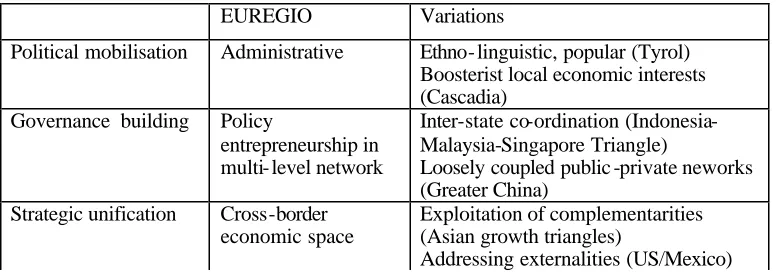
Table 1: Logics of scale construction within cross-border regions EUREGIO Variations
Political mobilisation Administrative Ethno- linguistic, popular (Tyrol) Boosterist local economic interests (Cascadia)
Governance building Policy
entrepreneurship in multi- level network
Inter-state co-ordination (Indonesia-Malaysia-Singapore Triangle)
Loosely coupled public -private neworks (Greater China)
Strategic unification Cross-border economic space
Exploitation of complementarities (Asian growth triangles)
Addressing externalities (US/Mexico)
Strategic unification, finally, was provided by an image of a homogenous cross-border economic space overcoming the disadvantages associated with marginal border location. In cases such as regional co-operation arrangements on the US -Mexican, border is it rather the attempt to mitigate negative social and environmental externalities that come to be the unifying discourse and strategic impetus for CBC (Scott 1999). The exploitation of complementarities, expected to induce major boosts of investment and growth, are at the centre of unification discourses in the South-East Asian growth triangles (Sparke et al 2004).
Having proposed a framework for analysing re-scaling processes and sketched a tentative typology, a few concluding comments are in order in view of further research. It is beyond the scope of this article to present a comprehensive typology of scale construction that not only includes CBRs but potentially other processes involving the creation of new or modified scales as different as macro-regional collaboration or special economic zones. However, it has been shown that re-scaling processes vary widely in terms of political mobilisation, governance building and strategic unification. This indicates that it is not appropriate to hold single causal factors responsible for re-scaling processes tout-court, and that there is indeed a variety of logics at work, possibly in dependence of the wider institutional contexts in which they occur. This is in fact an important theme for future research. A related open question is whether the features of re-scaling processes ‘cluster’ into specific configurations in the sense that particular modes of political mobilisation tend to go hand in hand with specific modes of governance and specific discourses of unification.
References
AEBR (1997). The EU Initiative INTERREG and future developments. Gronau, unpublished manuscript.
Amin, A. & Hausner, J. 1997. Interactive governance and social complexity. In A. Amin & J. Hausner (Eds.), Beyond market and hierarchy: Interactive governance and social complexity. Cheltenham: Edward Elgar.
Anderson, J., O'Dowd, L. and Wilson, T. M. (2003) New borders for a changing Europe: cross-border cooperation and governance. London: Frank Cass.
Aykaç, A. 1994. Transborder regionalisation: an analysis of transborder cooperation structures in Western Europe within the context of European integration and decentralisation towards regional and local governments. Sindelfingen: Libertas. Badie, B. 1995. La fin des territoires: essai sur les désordre international et sur l'utilité
sociale du respect. Paris: Fayard.
Balme, R. & Jouve, B. 1996. Building the regional state: Europe and territorial organization in France. In L. Hooghe (Ed.), Cohesion policy and European integration: building multi- level governance: 219-255. Oxford: Oxford University Press.
Beck, J. (1997). Netzwerke in der transnationalen Regionalpolitik: Rahmenbedingungen, Funktionsweise, Folgen. Baden-Baden, Nomos.
Benz, A. (1995). Politiknetzwerke in der horizontalen Politikverflechtung. In: D. Jansen and K. Schubert (eds): Netzwerke und Politikproduktion: Konzepte, Methoden, Perspektiven. Marburg, Schüren: 185-204.
Benz, A. and B. Eberlein (1999). “The Europeanization of regional policies: patterns of multi- level governance.” Journal of European Public Policy 6(2): 329-48.
Beyerlin, U. 1998. Neue rechtliche Entwicklungen der regionalen und lokalen grenzüberschreitenden Zusammenarbeit. In G. Brunn & P. Schmitt-Egner (Eds.), Grenzüberschreitende Zusammenarbeit in Europa: Theorie - Empirie - Praxis: 118-134. Baden-Baden: Nomos.
Blatter, J. 2004. 'From spaces of place' to 'spaces of flows'? Territorial and functional governance in cross-border regions in Europe and North America. International Journal of Urban and Regional Research, 28(3): 530-+.
Brenner, N. 1998. Between fixity and motion: accumulation, territorial organization and the historical geography of spatial scales. Environment and Planning D-Society & Space, 16(4): 459-481.
Brenner, N. 2001. The limits to scale? Methodological reflections on scalar structuration. Progress in Human Geography, 25(4): 591-614.
Brenner, N. 2003. The formation of the global city and the re-scaling of the State's space in post-fordist Western Europe. Eure-Revista Latinoamericana De Estudios Urbano Regionales, 29(86): 5- 35.
Castells, M. 1996. The rise of the network society. Cambridge MA, Oxford: Blackwell. CoE (1972). 1. Europäisches Symposium der Grenzr egionen. Die Zusammenarbeit
europäischer Grenzgebiete. Basisbericht, ausgearbeitet von V. Frhr. von Malchus. Strasbourg, Council of Europe.
Collinge, C. 1999. Self-organisation of society by scale: a spatial reworking of regulation theory. Environment and Planning D-Society & Space, 17(5): 557-574.
Colomy, P. 1998. Neofunctionalism and neoinstitutionalism: human agency and interest in institutional change. Sociological Forum, 13(2): 265-300.
Cooke, P. 1989. Localities: the changing face of urban Britain. London: Unwin Hyman. Cox, K. R. & Mair, A. 1989. Levels of abstraction in locality studies. Antipode, 21(2):
Cox, K. R. & Mair, A. 1991. From localised social structures to localities as agents. Environment and Planning A, 23: 197- 213.
Cox, K.R (1991) ‘Comment - Redefining 'Territory"’, Political Geography Quarterly 10, 57- 62.
Delaney, D., and H. Leitner. 1997. "The political construction of scale." Political Geography 16:93-7.
Denters, B., Schobben, R., & van der Veen, A. 1998. Governance of European border regions. In G. Brunn & P. Smitt-Egner (Eds.), Grenzüberschreitende Zusammenarbeit in Europa. Theorie - Empirie - Praxis : 135-161. Baden-Baden: Nomos.
Dicken, P. 1998. Global shift (3. edition ed.). London: Paul Chapman.
Duncan, S. & Savage, M. 1989. Space, scale and locality. Antipode, 21(3): 179- 206. Gabbe, J. (1985). EUREGIO: regionale grenzüberschreitende Zusammenarbeit auf
kommunaler Ebene. In: ILS (ed): Staatsgrenzen überschreitende Zusammenarbeit des Landes Nordrhein-Westfalen. Dortmund, ILS: 90-98.
Goinga, K. 1995. Das alltägliche Leben in der Praxis. Gronau: EUREGIO.
Grundy-Warr, C., Peachey, K. and Perry, M. 1999: ‘Fragmented Integration in the Singapore-Indonesian Border Zone: Southeast Asia's 'Growth Triangle'’ against the global economy’. In: International Journal of Urban and Regional Research
23(2): 304.
Gualini, E. 2004. Regionalization as 'experimental regionalism': The rescaling of territorial policy-making in Germany. International Journal of Urban and Regional Research, 28(2): 329-+.
Hanf, K. & O'Toole, L. 1992. Revisiting old friends: networks, implementation structures and the management of inter-organizational relations. European Journal of Political Research, 21: 163-180.
Harvey, D. 1982. The limits to capital. Oxford: Basil Blackwell.
Heinelt, H. and Smith, R. (eds) 1996. Policy networks and European Structural Funds. Aldershot: Avebury.
Héritier, A., Ed. (1993). Policy- Analyse. Opladen.
Hooghe, L. (Ed.). 1996. Cohesion policy and European integration: building multi- level governance. Oxford: Oxford University Press.
Howitt, R. 1993. A world in a grain of sand: toward a reconceptualisation of geographical scale. Australian Geographer, 24(1): 33-44.
Jessop, B. 1998. The rise of governance and the risks of failure: the case of economic development. International Social Science Journal, 50(155): 29-44.
Jessop, B. 2001. Institutional (Re)Turns and the strategic-relational approach. Environment and Planning A, 33: 1213-1235.
Jessop, B. 2002. The political economy of scale. In M. Perkmann & N.-L. Sum (Eds.), Globalization, regionalization and cross-border regions : 25- 49. Houndsmills: Palgrave.
Jones, K. T. 1998. Scale as epistemology. Political Geography, 17(1): 25-28.
Keating, M. 1997. The invention of regions: political restructuring and territorial government in Western Europe. Environment and Planning C, 15(4): 383 - 398. Kelly, P. F. 1997. Globalization, power and the politics of scale in the
Philippines Geoforum, 28(2): 151-171.
Kingdon, J. W. (1984). Agendas, alternatives, and public policies. Boston, Little Brown. Kooiman, J. (Ed.). 1993. Modern governance. New Government-Society Interactions.
London: Sage.
Le Galès, P. 1998. Regulation and governance of European cities. International Journal of Urban and Regional Research, 22(3).
Lipietz, A. 1994. ‘The national and the regional: their autonomy vis-à-vis the capitalist world crisis’. In Palan, R and B Gills (eds) Transcending the State-Global Divide: a Neo-Structuralist Agenda in International Relations, pp.23-43. London: Lynne Reimer.
Luverà, B. 1996. Oltre il confine. Regionalismo europeo e nuovi nazionalismi in Trentino-Alto Adige. Bologna: il mulino.
MacLeod, G. 1998. Relativizing the scales of governance: 'spaces of dependence', territorial blocs, and the political structuration of 'Euro-regionalism', Culture, place and space in contemparary Europe, EURS Conference, September 1998. Malchus, V. F. v. (1986). Bilanz und Perspektiven der institutionellen Entwicklung
grenzüberschreitender Zusammenarbeit in Europa. In: Institut für Landes- und Stadtentwicklungsforschung des Landes Nordrhein-Westfalen (ed) 3. Europäische Konferenz der Grenzregionen. Dortmund, ILS: 23-68.
Marin, B. & Mayntz, R. (Eds.). 1991. Policy networks. Empircal evidence and theoretical considerations . Frankfurt am Main, Boulder: Campus/Westview.
Marsden, S. 2000. The social construction of scale. Progress in Human Geography, , 24: 219-242.
Messner, D. 1997. The network society: economic development and international competitiveness as problems of social governance. London: F.Cass, German Development Institute Berlin.
Murphy, A. 1993. Emerging regional linkages within the European Community: challenging the dominance of the state. Tijdschrift voor Econ. en Soc. Geografie, 84(2): 103-118.
Ohmae, K. 1995. The End of the Nation State: The Rise of Regional Economies. New York: The Free Press.
Peck, J. 2002. Political economics of scale: Fast policy, interscalar relations, and neoliberal workfare. Economic Geography, 78(3): 331-360.
Perkmann, M. (1999) ‘Building governance institutions across European borders’. Regional Studies 33(7): 657-667.
Perkmann, M. (2002): ‘Euroregions. Institutional entrepreneurship in the European Union.’ In: Perkmann, M. and Sum, N.-L. (eds): Globalization, regionalization and cross-border regions. Houndsmills, New York: Palgrave.
Perkmann, M. (2003) 'Cross-border regions in Europe. Significance and drivers of cross-border co-operation.' European Urban and Regional Studies 10 (2): 153-71. Perkmann, M. and Sum, N.-L. (eds) 2002: Globalization, regionalization and cross-border
regions. Houndsmills, New York: Palgrave.
Perkmann, M. and Sum, N.-L. (eds) 2002a: Globalization, regionalization and cross-border regions: Scales, discourses and governace’. In: Perkmann, M. and Sum, N.-L. (eds): Globalization, regionalization and cross-border regions. Houndsmills, New York: Palgrave.
Raich, S. 1995. Grenzüberschreitende und interregionale Zusammenarbeit in einem "Europa der Regionen". Dargestellt anhand der Fallbeispiele Großregion Saar-Lor-Lux, EUREGIO und "Vier Motoren für Europa". Baden-Baden: Nomos. Rhodes, R. A. W. (1990). “Policy networks: a British perspective.” Journal of Theoretical
Politics 2: 293-317.
Ritaine, E. 1998. The political capacity of southern European regions. In P. Le Galès & C. Lequesne (Eds.), Regions in Europe : 67-88. London: Routledge.
Roberts, N. C., and. King, P. J. 1996. Transforming public policy: dynamics of policy entrepreneurship and innovation. San Francisco, Calif.: Jossey-Bass Publishers. Sack, R. D. 1986. Human territoriality. Its theory and history. Cambridge: Cambridge
University Press.
Schack, M. 1998. Grenzüberschreitende Zusammenarbeit an der deutsch-niederländischen Grenze. Aabenraa: Institut for Grænseregionsforskning.
Schulz, C. (1998). Interkommunale Zusammenarbeit im Saar-Lor-Lux-Raum. Staatsübergreifende lokale Integrationsprozesse. Saarbrücken, Selbstverlag Geographie, Universität des Saarlandes.
Scott, J. W. 1999. European and North American contexts for cross-border regionalism. Regional Studies , 33(7): 605-618.
Smith, N. 1992. "Geography, difference and the politics of scale." Pp. 57-79 in
Postmodernism and the Social Sciences, edited by J. Doherty, E. Graham, and M. Malek. New York: St. Martin's Press.
Sparke, M (2002) Not a state, but a state of mind: Cascading cascadias and the geo-economics of cross -border regionalism. In: Perkmann, M. and Sum, N.-L. (eds): Globalization, regionalization and cross-border regions . Houndsmills, New York: Palgrave.
Sparke, M., Sidaway, J. D., Bunnell, T., & Grundy-Warr, C. 2004. Triangulating the borderless world: geographies of power in the Indonesia -Malaysia-Singapore Growth Triangle. Trans Inst Br Geog, 29(4): 485- 498.
Steinberg, 1994: ‘Territory, territoriality and the new industrial geography’. Political Geography 13(1): 3-5.
Sum, N-L. 2002, Globalization, Regionalization and Cross-Border Modes of Growth in East Asia: the (re-)constitution of 'Time-Space Governance'. In: Perkmann, M. and Sum, N.-L. (eds): Globalization, regionalization and cross-border regions. Houndsmills, New York: Palgrave.
Swyngedouw, E. 1996. Reconstructing citizenship, the re-scaling of the state and the new authoritarianism: Closing the Belgian mines. Urban Studies, 33(8): 1499-1521. Swyngedouw, E. 2004. Globalisation or 'glocalisation'? Networks, territories and
rescaling. Cambridge Review of International Affairs, 17(1): 25- 48.
Taylor, P. J. 1995. Beyond containers: internationality, interstateness, interterritoriality. Progress in Human Geography, 19(1): 1-15.
Tömmel, I. (1994). Staatliche Regulierung und europäische Integration: Die Regionalpolitik der EG und ihre Implementation in Italien. Baden- Baden, Nomos.
Tränhardt, D. (1993). Die Kommunen und die Europäische Gemeinschaft. R. Roth and B. Wollmann (eds) Kommunalpolitik. Politisches Handeln in den Gemeinden. Bonn, Bundeszentrale für Politische Bildung: 66-80.
Voelzkow, H. (1995). Die Regionalisierung der Strukturpolitik und neue Formen einer intermediären Interessensvermittlung. H. Kilper (ed) Steuerungseffekte und Legitimation regionaler Netzwerke. Gelsenkirchen, Institut Arbeit und Technik:
Ward, K. & Jonas, A. E. G. 2004. Competitive city-regionalism as a politics of space: a critical reinterpretation of the new regionalism. Environment and Planning A, 36(12): 2119-2139.
Williams, R. W. 1999. Environmental justice in America and its politics of scale. Political Geography, 18(1): 49-73.
Annex: Interview codes
i1 Provincie Overijssel, Zwolle (N L)
i2 Landkreis Grafschaft Bentheim, Nordhorn (DE)
i3 Ministerie van Economische Zaken, Regio Oost, Arnhem (NL) i4 Bezirkregierung Weser -Ems, Oldenburg (DE)
i5 EUREGIO, Gronau (DE) (group interview).
i6 Bezirkregierung, Abteilung Regionalplanung und Wirtschaft, Münster (DE) i7 Beleidsmedewerker Economische Zaken en Grensoverschrijdende Samenwerking,
Regio Acherhoek (NL) i8 EUREGIO, Gronau (DE)
i9 Landkreis Steinfurt, Steinfurt (DE)
i10 Investitionsbank Nordrhein-Westfalen, Düsseldorf (DE)
i11 Ministerium für Wirtschaft und Mittelstand, Technologie and Verkehr des Landes Nordrhein-Westfalen, Düsseldorf (DE)
i12 Kreis Borken, Stabstelle, Bocholt (DE)
i13 European Commission, DG16, INTERREG II/c (spatial planning), Brussels (BE) i14 European Commission, DG16, INTERREG II, Brussels
i15 European Commission, DG12, Brussels
i16 European Commission, DG16, Internal inter-regional co-operation (art. 10), Brussels i17 European Commission, DG16, art. 10 innovative actions for telematics and the
information society, Brussels i18 LACE-TAP office, Brussels
i19 European Commission, DG1, Brussels
i20 European Commission, DG16, Brussels
1
2 For additional details on the EUREGIO, cf. Schack’s (1998), Aykaç (1994); Denters, Schobben
and van der Veen (1998); Murphy (1993); Goinga (1995); IRS (1994).
3 http://europa.eu.int.
4
The informal Interessensgemeinschaft (‘community of interest’) Rhein-Ems (1954), replaced by
the more formal Kommunalgemeinschaft Weser-Ems’ (1962), on the German side; the
Belangengemeemschap Twente-Gelderland and the Samenwerkningsverband Oost-Gelderland
(today Regio Achterhoek), on the Dutch side.
5
‘… the EUREGIO was already there, it was obvious that they were going to do the programme
management.’ (i1).
6
CSGR Working Paper Series
140/04, September S Hiss
Corporate Social Responsibility: A Myth? The Example of the “Round Table Codes of Conduct” in Germany
141/04, September S Hiss
Does Corporate Social Responsibility need Social Capital? The Example of the „Sector Model Social Responsibility” of the “Foreign Trade Association of the German Retail Trade (AVE)”, a Public Private Partnership Project
142/04, October G F Thompson
The Fate of Territorial Engineering: Mechanisms of Territorial Power and Post-Liberal Forms of International Governance
143/04, October P Conconi & C Perroni
The Economics of Special and Differential Trade Regimes
144/04, October G Grimalda & M Vivarelli
One or Many Kuznets Curves? Short and Long Run Effects of the Impact of Skill-Biased Technological Change on Income Inequality
145//04, October J Whalley
Rationality, Irrationality and Economic Cognition
146/04, October M Redoano
Does Centralization Affect the Number and Size of Lobbies?
147/04, October M P Devereaux, B Lockwood and M Redoano
Horizontal and Vertical Indirect Tax Competition: Theory and Some Evidence from the USA
148/04, October M Besfamille & B Lockwood
Are Hard Budget Constraints for Sub-National Governments Always Efficient?
149/04, October P S Martins
Do Foreign Firms Really Pay Higher Wages? Evidence from Different Estimators
150/04, October R Icaza
Civil Society in Mexico and RegionalisationA Framework for Analysis on Transborder Civic Activism
151/04, November G Grimalda
A Game-Theoretic Framework to Study the Influence of Globalisation on Social Norms of Co-operation
152/04, October M Caselli
Some Reflections on Globalization, Development and the Less Developed Countries
153/04, November D Leech & R Leech
Voting Power and Voting Blocs
154/04, November D Leech & R Leech
155/05 B Lockwood & M Redoano
156/05, January D Leech & R Leech
Voting Power implications of a Unified European Representation at the IMF
157/05, February H Nesadurai
Conceptualising Economic Security in an Era of Globalisation: What Does the East Asian Experience Reveal?
158/05, February S Sullivan
‘Viva Nihilism!’ On militancy and machismo in (anti-)globalisation protest
159/05, March S Ghosal and K Thampanishvong
Sovereign Debt Crisis: Coordination, Bargaining and Moral Haz ard
160/05, May R Cohen
The free movement of money and people: debates before and after ‘9/11’
161/05, May E Tsingou
Global governance and transnational financial crime: opportunities and tensions in the global anti-money laundering regime
162/05, May S. Zahed
'Iranian National Identity in the Context of Globalization: dialogue or resistance?'
163/05, May E. Bielsa
‘Globalisation as Translation: An Approximation to the Key but Invisible Role of Translation in Globalisation’
164/05, May J. Faundez
‘The rule of law enterprise – towards a dialogue between practitioners and academics’
165/05, May M. Perkmann
‘The construction of new scales: a framework and case study of the EUREGIO cross -border region’
Centre for the Study of Globalisation and Regionalisation University of Warwick
Coventry CV4 7AL, UK
Tel: +44 (0)24 7657 2533 Fax: +44 (0)24 7657 2548 Email: [email protected]