A Thesis Submitted for the Degree of PhD at the University of Warwick
http://go.warwick.ac.uk/wrap/45919
This thesis is made available online and is protected by original copyright. Please scroll down to view the document itself.
L2 creative writers: Identities and
writing processes
by
Yan Zhao
A thesis submitted in partial fulfilment of the requirements
for the degree of
Doctor of Philosophy in
English Language Teaching and Applied Linguistics
University of Warwick, Centre for Applied Linguistics
TABLE OF CONTENTS
TABLE OF CONTENTS I
LIST OF FIGURES X
LIST OF TABLES XI
ACKNOWLEDGEMENTS XII
DECLARATION XIII
ABSTRACT XIV
ABBREVIATIONS XV
CHAPTER ONE: INTRODUCTION 1
1.1 Three distinctive angles from which this L2 creative writing
research was conducted 2
1.2 Two personal experiences and the research questions 5
1.3 Overview of the thesis structure 9
CHAPTER TWO: LITERATURE REVIEW 12
2.1 L2 Creative writing research 12 2.2 The three-phase movement in L2 writing research—product-
oriented, process-oriented, and the social turn 15
2.2.1 The relevance of process-oriented L2 writing research to L2
creative writing 18
2.3 The three-phase movement in L2 motivation and identity
research—the social-psychological framework, the cognitive and
dynamic view, the sociocultural and poststructuralist approach 21 2.3.1 The social-psychological framework 22
2.3.2 The cognitive and dynamic view of motivation 24
2.3.3 The sociocultural and poststructuralist approach 25
2.3.3.1 Lave and Wenger’s situated learning theory 27
2.3.3.2 Discursive construction of motivation and identity 31
2.3.3.3 Poststructuralist theory—accentuating the agentive stance and the role of power relations 38
2.4 Writer and writing—A combination of L2 motivation, identity
2.5 Two aspects of writer identity—the macro autobiographical self
and the micro task-situated emergent self 46 2.5.1 The sociocultural autobiographical self 47
2.5.2 The connection between the autobiographical self and the task- situated emergent self 54 2.5.3 The task-situated emergent self—writer’s voice 58
2.5.3.1 Romantic, individualist voice versus social discursive voice 59
2.5.3.2 Voice ‘permanently marked’ by features of written texts versus voice ‘dynamically displayed’ in writers’ thoughts
throughout writing processes 67 2.5.3.2.1 Voice marked discursively and/or ideologically in
written texts 69 2.5.3.2.2 Voice as dynamically negotiated in writing processes 76
2.5.3.3 The ‘scientific-objective’ and ‘hermeneutic-explanatory’
models of voice–Positivism and Relativism 83 2.6 Positivism versus Relativism 86
2.7 The overall theoretical framework governing the present research—the sociocognitive perspective on writer identity
research 92
CHAPTER THREE: METHODOLOGY 96
3.1 Introduction 96
3.1.1 Research objectives and research questions 96
3.1.2 Two fundamental theoretical approaches: sociocultural theory
and the sociolinguistics approach 98 3.1.3 Hermeneutic and explanatory model of analysing identities 100
3.2 Method 104
3.2.1 Participants 104
3.2.2 Task and procedures 107
3.2.2.1 In-depth interview on the L2 creative writers’ sociocultural life histories 108 3.2.2.2 Two think-aloud story writing sessions 110
3.2.2.2.1 Autobiographical short story writing task 111
3.2.3 Data collection methods 112
3.2.3.1 Major data collection channels 112
3.2.3.2 Pre-writing interview 113
3.2.3.3 Post-writing interview 115
3.2.3.4 Think-aloud writing 115
3.2.3.4.1 Think-aloud training 115
3.2.3.4.2 Potential limitation posed by the English-only think-
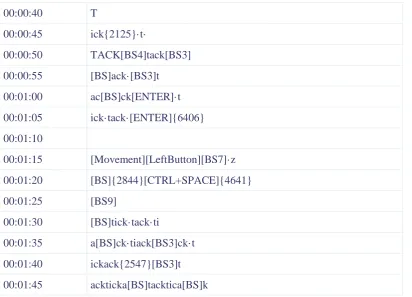
aloud writing sessions 116 3.2.3.4.3 Transcribing the think-aloud audio-recordings with the help of a keystroke logging tool—Inputlog 118 3.2.3.5 Summary of the data collection methods 120
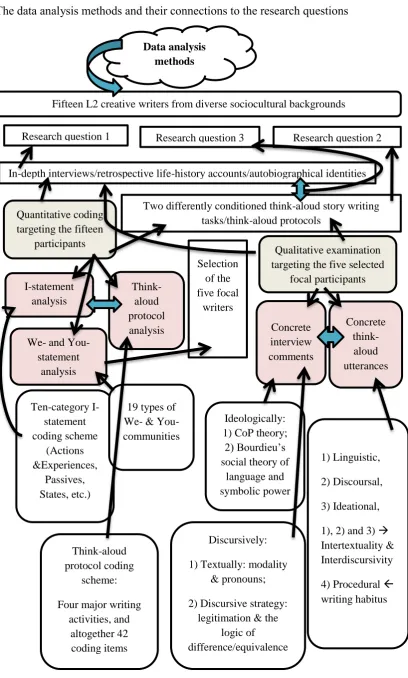
3.2.4 Data analysis methods—quantitative backdrop and qualitative
examination 122
3.2.4.1 Quantitative analysis of all the fifteen participants’ data 123
3.2.4.1.1 Coding of the in-depth interviews—I-statements
analysis, We- and You-statement analysis 123 3.2.4.1.1.1 I-statement analysis 124
3.2.4.1.1.2 We- and You-statement analysis 131
3.2.4.1.2 Coding of the think-aloud protocols 135
3.2.4.1.3 Establishment of the connections between the I-
statement analysis results and the think-aloud protocol analysis results 147 3.2.4.2 Qualitative analysis of the focal participants’ data 150
3.2.4.2.1 Selection of the five focal participants 150
3.2.4.2.2 The in-depth interviews—L2 creative writers’ ideological and discursive constructions of their
autobiographical identities 151 3.2.4.2.3 Think-aloud protocols—L2 creative writers’
enactments of their writers’ voices (i.e. writers’ emergent identities)
3.2.4.2.4 Summary of the data analysis methods
156
158
3.3. Conclusion of Methodology 158
Quantitative analysis results of the fifteen participants’ I-statements and
think-aloud protocols 161
4.1 Quantitative analysis of the fifteen participants’ I-statements made
in the in-depth interviews 161 4.1.1 Three global trends shown in the fifteen participants’
I-statement coding results 168 4.1.1.1 Global Trend One: ‘Actions & Experiences’ and
‘Cognition’ taking leading shares 168 4.1.1.2 Global Trend Two: ‘Actions & Experiences’ taking an
evidently larger proportion than ‘Cognition’ 171 4.1.1.3 Global Trend Three: Discernible differences among the
fifteen participants’ I-statement approaches 174
4.1.1.3.1 Fai 175
4.1.1.3.2 Angeles 180
4.1.1.3.3 Comparisons between Fai and Angeles’s I-statement
identity constructions 186 4.1.1.4 Summary of the three global trends shown in the
I-statement coding results 187 4.2. The coding results of the fifteen participants’ think-aloud protocols 188
4.2.1 Two global trends shown in the fifteen participants’ think-
aloud coding results 195 4.2.1.1 Global Trend One: ‘Composing’ taking the largest share 195
4.2.1.2 Global Trend Two: Evident differences revealed in the
roles played by ‘Planning’, ‘Monitoring’, and ‘Revising’ 197 4.2.2 The establishment of the ‘Four Camps of Writers’ 200
4.2.2.1 Horizontal comparisons of each writing activity across the
fifteen participants 200
4.2.2.2 The Planning Camp writers 203
4.2.2.3 The Revising Camp writers 203
4.2.2.4 The Composing Camp writers 204
4.2.2.5 The Middle Camp writers 205
4.2.2.6 Summary of the four Camps of writers 205
their autobiographical identities and habitual instantiations of their
emergent identities 206
4.3.1 Category-by-category comparisons of the Four Camps’
I-statement coding results 208 4.3.2 Planning Camp vs. Revising Camp: Different I-statement
approaches for identity constructions 214 4.3.2.1 The Planning Camp’s and the Revising Camp’s respective
employment of the different types of I-statements 214 4.3.2.2 Conclusions on the I-statement tendencies respectively
demonstrated by the Planning Camp and the Revising
Camp 219
4.3.2.3 The Planning Camp writers’ constructions of their autobiographical identities—assertive, self-assured, and
socially textured 221 4.3.2.3.1 The Planning Camp: A more socially textured
I-statement approach 221 4.3.2.3.2 The Planning Camp: A more direct and self-assured
I-statement approach 228 4.3.2.4 The Revising Camp writers’ constructions of their
autobiographical identities—implicit, expressive, and self-
critical 232
4.3.2.4.1 The Revising Camp: A more self-critical I-statement
approach 232 4.3.2.4.2 The Revising Camp: A more implicit and personal
I-statement approach 234 4.3.2.4.2.1 The Revising Camp’s more subtle I-statement approach through ‘Cognition’ 235 4.3.2.4.2.2 The Revising Camp’s more personal and
expressive I-statement approach through ‘Emotion’ 238 4.3.2.5 Conclusions on the connection between autobiographical
identities and the habitual aspect of emergent identities 242 4.4 Task influence revealed in the Four Camps of writers’ two
connection to their I-statement coding results 243
4.4.1 The changing aspect of the Four Camps’ emergent identities
revealed in the changing of task conditions 243 4.4.2 My five observations of the major patterns revealed in
Figure 4.2 250
4.4.2.1 Observation One: Two manifestations of universal task influences across the Four Camps’ differently-conditioned
cognitive writing processes 250 4.4.2.1.1 Universal task influences on the Four Camps’
composing activities 260 4.4.2.1.2 Universal task influences on the Four Camps’
Monitoring activities 262 4.4.2.2 Observation Two: Similar task influences exhibited in the
writers’ cognitive writing processes—between the Planning Camp and the Composing Camp, and between the Revising Camp and the Middle Camp 266
4.4.2.3 Observation Three: Three types of adjustments made by the Four Camps to their cognitive writing processes under the change of task contexts 268 4.4.2.4 Observation Four: The symmetry between the Planning
activity and the Revising activity and the symmetry between the Composing activity and the Monitoring activity in the instantiations of the writers’ emergent
identities 271 4.4.2.5 Observation Five: the Four Camps’ instantiations of stable and wavering emergent identities: Revising + Middle
Camps, and Planning + Composing Camps 275 4.4.3 The connection between the pattern of task influences revealed in the Planning Camp and the Revising Camp’s two
differently-conditioned cognitive writing processes and the
pattern shown in these two Camps’ I-statement coding results 279
4.5 Summary of this chapter’s quantitative analysis 281
Qualitative analysis results of the five focal participants’ concrete utterances made in the in-depth interviews and in their think-aloud
writing processes. 285
5.1 Selection of the focal participants for the qualitative data analysis,
and the coding results of the We- and You-statement analysis 285 5.2 The five focal participants—Derek, Maggie, Fai, Teng, Teri—and
their life histories 289
5.2.1 Five successful L2 (or L3) advanced speakers 290
5.2.1.1 Derek and Maggie 290
5.2.1.2 Teng and Fai 292
5.2.1.2.1 Teng 293
5.2.1.2.2 Fai 295
5.2.1.3 Teri 296
5.2.1.4 Conclusions 297
5.2.2 Five motivated and experienced creative writers 298
5.2.2.1 Derek 298
5.2.2.2 Maggie 301
5.2.2.3 Fai and Teng 303
5.2.2.3.1 Fai 304
5.2.2.3.2 Teng 305
5.2.2.4 Teri 308
5.2.2.5 From the sociocultural background to the tangible
foreground 310 5.3 The five focal participants’ self-positioning in specific communities
and their instantiations of emergent identities in their tangible
think-aloud utterances generated in the cognitive writing processes 312
5.3.1 Derek and Maggie 312
5.3.1.1 Derek’s positioning in the professional CoP: an
experienced secondary-school EFL teacher 312 5.3.1.2 Maggie’s self-positioning in her local creative writing
interest group 316
Camp writer 320
5.3.1.3.1 Derek’s Planning activities 321
5.3.1.3.2 Maggie’s Revising activities 325
5.3.2 Fai and Teng 331
5.3.2.1 Fai’s self-identity as a compliant L2 student story writer 332
5.3.2.2 Teng’s self-positioning in the CoP of proficient L2 (or L3)
speakers 334
5.3.2.3 Fai, a strategic and duteous Revising Camp writer; Teng, a spontaneous and expressive Composing Camp writer 338 5.3.2.3.1 Fai’s Planning and Revising activities 338
5.3.2.3.2 Teng’s Composing and Revising activities 343
5.3.3 Teri 347
5.3.3.1 Teri’s self-positioning in various social circles which are
indispensable to her story writing practices 347 5.3.3.2 Teri, an ideationally attentive Planning Camp writer 353
5.3.3.2.1 Teri’s Planning and Monitoring activities 354
5.4 Summary 358
CHAPTER SIX: CONCLUSIONS AND IMPLICATIONS 361
6.1 Introduction 361
6.2 The findings 361
6.3 Implications for L2 creative writing research and L2 writer identity
research 364
6.3.1 Implications for L2 creative writing research 364
6.3.2 Implications for L2 writer identity research 368
6.4 Reflection on methodology 371
6.4.1 Data-collection methods 371
6.4.1.1 In-depth interview and think-aloud writing sessions 371
6.4.1.2 Limitations 372
6.5. Data-analysis methods: hermeneutic analysis of L2 creative
writers’ identities 374
6.5.1 Reflections on I-statement analysis and think-aloud protocol
analysis 374
6.6 Future directions suggested by the findings of the present research 376
6.7 Final remark 377
REFERENCES 379
Appendix A: Question list for the in-depth interview 407
Appendix B: The prompt provided as the story’s beginning in the prompted story-continuation task—an extract drawn
from William Boyd’s Love Hurts (2008, p.157-168) 413 Appendix C: The task for the participants’ think-aloud training 415
Appendix D: Sample of coded I-statement data—portions of coded
I-statements uttered by Teri 416 Appendix E: An illustration of the 19 communities established through
coding the participants’ We- and You-statements 426 Appendix F: Sample of coded think-aloud protocol—portions of coded
think-aloud verbalizations of Maggie’s generated in the
prompted writing task 431
LIST OF FIGURES
Figure 3.1 Overview of the present research 103
Figure 3.2: The example of an extract from an Inputlog keystroke logging file 119
Figure 3.3: Summary of the data collection methods targeting the entire fifteen L2 creative writers 121
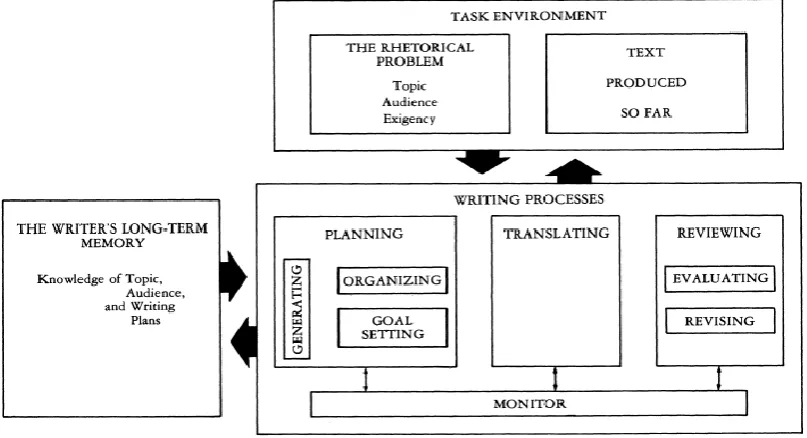
Figure 3.4: The Flower-Hayes cognitive process model of the composing processes (Flower and Hayes, 1981, p. 370) 136
Figure 3.5: The data analysis methods and their connections to the research questions 160
Figure 4.1: The category-by-category comparisons of the Four Camps of writers’ I-statement coding results 209
Figure 4.1a: Actions & Experiences 209
Figure 4.1b: Passive 210
Figure 4.1c: States 210
Figure 4.1d: Affordances & Relations 210
Figure 4.1e: Abilities, Successes & Achievements 211
Figure 4.1f: Constraints, Limitations and Problems 211
Figure 4.1g: Obligations, Self-regulations, & Requisite 211
Figure 4.1h: Desire & Intentions 212
Figure 4.1i: Cognition 212
Figure 4.1j: Feelings and Affect 212
Figure 4.2: Task influence on the Four Camps of writers’ Planning, Composing, Monitoring, and Revising activities 245
Figure 4.2a: Task influence on the Four Camps’ Planning activities 245
Figure 4.2b: Task influence on the Four Camps’ Composing activities 246
Figure 4.2c: Task influence on the Four Camps’ Monitoring activities 246
LIST OF TABLES
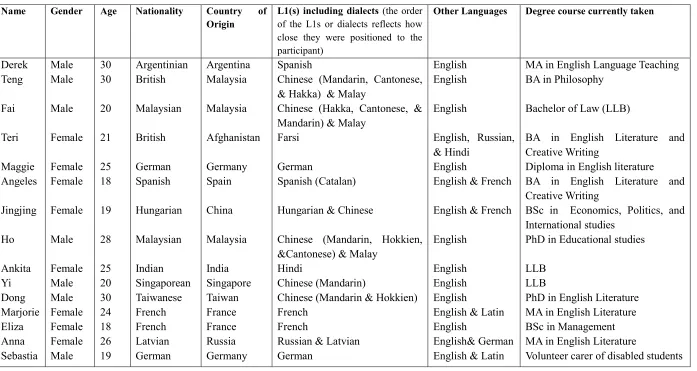
Table 3.1: Basic background information of the fifteen participants 106
Table 3.2: The 19 communities identified in the entire We- and You-statement
coding 134
Table 4.1: The coding results of the fifteen participants’ I-statements uttered in
the in-depth interviews 163
Table 4.2: The coding results of the fifteen participants’ think-aloud protocols
generated in the autobiographical writing task and the prompted
writing task 189
Table 4.3: The respective rankings of the fifteen participants’ Planning,
Composing, Monitoring, and Revising writing activities 201
Table 4.4: The Four Camps of writers 206
Table 4.5: The sequence of the representations of writers in each Camp in
Figure 4.2 245
Table 4.6: The Four Camps’ think-aloud coding results for the
autobiographical writing task and the prompted writing task 252
Table 5.1: The Planning Camp, Composing Camp, and Revising Camp’s
ACKNOWLEDGEMENTS
I would like to express my sincere gratitude to my supervisors Drs. Ema Ushioda
and Richard Smith, both of whom gave me invaluable advice and support throughout
the writing of this thesis. My gratitude is also due to Peter Brown, who has given me
great encouragement always.
I would also like to thank Professor David Morley, Director of the Warwick Writing
Programme, who kindly put me in touch with his Creative Writing students and
helped me to find several of my participants in the study. I am indebted to all of the
15 Creative Writer participants who shared their writing and narratives with me.
Their engagement and enthusiasm went far beyond my expectations.
Of course, I should like to acknowledge the constant encouragement of my parents,
DECLARATION
This thesis is my own work, except where explicitly stated in the text, and has not been submitted for a degree at another university.
My MA research has arisen from the content of this thesis:
Zhao, Y. (2006). Total freedom or a certain control? The effect of different stimuli on the processes and products of three advanced L2 learners’ short story writing experience, unpublished MA dissertation at CAL (the formerly CELTE), the University of Warwick.
ABSTRACT
L2 creative writing research is a relatively unchartered area. Pedagogical discussions on L2 creative writing activities often focus on manifestations of L2 learners’ language learning, writing improvement, or expressions of emotion. There is a lack of research investigating the underlying identities of L2 creative writers as social agents. The present research targets the L2 creative writers who are interested and experienced in certain forms of creative writing. It investigates if and how L2 creative writers’ emergent identities enacted in their online cognitive writing activities under particular tasks are mediated by the writers’ ‘autobiographical identities’ (Clark and Ivanič, 1997) rooted in their life histories.
Fifteen L2 creative writers from diverse sociocultural and academic backgrounds participated in the research. Firstly, the participants’ ‘autobiographical identities’ were explored through eliciting their retrospective life-history accounts in in-depth interviews. Secondly, the research implemented two think-aloud story-writing sessions (Autobiographical writing & Prompted story-continuation writing) to capture the writers’ emergent identities instantiated in their cognitive writing processes. Subsequently, the interconnectedness between these two types of identities was sought.
Two parallel data analyses were conducted: 1) quantitative data coding targeting all fifteen L2 creative writers and 2) qualitative discussions concentrating on five selected focal participants. These two levels of analyses together show that the participants’ cognitive writing processes as evinced through their engagement in these creative writing activities (i.e. their task-situated emergent identities) are mediated by the writers’ previous participation in multiple discourses and social worlds up to the moment of writing (i.e. their autobiographical identities formed throughout their life histories).
ABBREVIATIONS
BA Bachelor of Arts
BSc Bachelor of Science
BBC British Broadcasting Corporation
Bilingual SW Bilingual Student Writer
CoP Community of Practice
EFL English as a Foreign Language
ELT English Language Teaching
ESL English as a Second Language
IELTS International English Language Testing System
L1 First Language or Mother Tongue
L2 Second Language
L3 Third language
L1 SW L1 Student Writer
L2 SW L2 Student Writer
LLB Bachelor of Law
MA Master of Arts
SE Socio-Educational Model of Motivation
SLA Second Language Acquisition
SW Particular Student Writer in Particular Context
CHAPTER ONE: INTRODUCTION
Non-native English speaking creative writers who choose to practice or even
publish in English constitute a salient and legitimate social group. Most prominently,
canonical writers such as Conrad and Rushdie and many modern novelists have
constructed creative identities and discovered stylistic liberation through writing
outside their mother tongue (Pousada, 1994). Also, L2 creative writers who ‘invest’
(Norton, 1995, 2000) in creative writing in English for particular purposes (e.g.
linguistic, educational, commercial, or self-empowerment) are making their voices
heard in various social settings, such as language classrooms, creative writing
courses and interest groups, publishing, media and virtual worlds such as social
networks.
Thus, L2 creative writers have attracted attention among a variety of academic
and professional fields. L2 creative writing has triggered political and
socio-stylistic debate, for example surrounding such novelists such as Conrad and Ha Jin,
who have rejected their L1s as media of artistic expression in favour of English, the
former during the heyday of the British Empire (Sherry, 1972), the latter,
post-Tiananmen Square (Moore, 2002). In the field of identity studies, Omoniyi (In press)
has studied postcolonial writers’ ‘code choices’ (including his own) and their relation
to writers’ negotiations of cultural and linguistic identities. Poststructuralist L2
scholars such as Pavlenko (2005) have examined the discursive construction of
emotions among bilingual writers and questioned whether the L1 always remains
‘the voice of the heart’. In pedagogic fields, too, L2 teachers keenly exchange ideas
on the language learning possibilities offered by L2 creative writing activities and
2009).
Despite the legitimatised social presence L2 creative writers have established,
research has not sufficiently investigated issues of: a) the nature of L2 creative
writers’ cognitive writing processes; and b) how L2 creative writing practices
intersect with the L2 individuals’ identity negotiations in various contexts and how
such literacy practices mediate the writers’ social relationships with the world; and
consequently c) how important L2 creative writing practices are to the writers’ sense
of possibilities for self-hood. In its attempt to address these gaps, my doctoral
research differs from previous L2 creative writing research in three main areas.
1.1 Three distinctive angles from which this L2 creative writing research was
conducted
Firstly, unlike most pedagogical discussions on L2 creative writing activities,
which often focus on L2 learners’ linguistic, literacy and emotion manifestations
(discussed in more detail on p. 12), this research extends its exploration into
underlying identity issues. It explores how L2 creative writers’ online cognitive
writing processes, e.g. their engagements in specific language play, adoptions of
particular discourses, ideologies, or writing procedures in their story creation
processes, are simultaneously the writers’ emerging self-representational acts (also
referred to as writers’ ‘emergent identities’ or ‘voices’ in this thesis). In addition, this
research also investigates 1) how such ‘voices’ instantiated in L2 creative writers’
cognitive story-writing process are the improvisational enactments of the writers’
‘autobiographical identities’ rooted in their previous sociocultural experiences; and
self-positioning in particular contexts. Thus, this research hopes to show that L2
creative writing pedagogy might be enhanced if it were predicated not only on the
conviction that L2 creative writing activities stimulate L2 learners/writers to make
authentic meanings or claim an authorship of the language (see Creative Writing, no
date given), but also on considerations of how L2 learners/writers’ linguistic,
discoursal, and ideological choices and expressions of emotions signal the
development of their identity negotiations. By doing so, L2 teacher researchers could
better hear and appreciate their students’ ‘voices’ expressed in a creative writing
activity so as to create and support the writing contexts which are likely to foster the
students’ meaningful L2 practices.
Secondly, this research differs from previous L2 creative writing research in
terms of the target participants. The participants of this research are fifteen adult L2
creative writers who have previously invested in forms of creative literacy practices
in particular contexts. To begin with, in contrast to the majority of the pedagogically
contextualised discussions on L2 creative writing activities, this research does not
situate its participants as L2 learners/writers who have been initiated into classroom
L2 creative writing activities for language or literacy acquisition purposes, but rather
as social agents who have agentively and purposefully engaged in creative writing to
negotiate particular identities and achieve certain social positioning. Next, as for the
existing body of L2 creative writing studies which indeed approach creative writing
practices as meaningful social actions (discussed later on p. 13), they often target
distinctive social groups such as published immigrant L2 writers from particular
sociohistorical periods or immigrant children living and studying in an
English-speaking context. Compared to the above socioculturalist strand, the present research
simultaneously are ESL speakers, to be more specific, non-native-English-speaking
students studying in universities in the UK.
Finally, as previously mentioned, other than examining L2 creative writers’
autobiographical identities rooted in the L2 individuals’ life histories, this research
takes up a micro and dynamic view of writer identity which resides in the movements
of the writers’ emerging thoughts situated in an immediate creative writing context
and mediated by the writers’ past sociocultural experiences. Previous L2 creative
writer identity studies have managed to tease out ‘writer identities’ from the writers’
1) sociocultural, sociohistorical, or socio-political practices and interactions in
particular social groups, or from 2) the texts that have been produced, or both. So far,
I have not found any writer identity study (on any type of L2 writing) which looks at
manifestations of writer identities in the writers’ task-situated cognitive writing
processes. The Cognitivist process-oriented L2 writing studies (later discussed in
section 2.2) tend to normalize patterns of writing strategies with the ultimate aim of
promoting teachers’ understanding and consequent modelling of the expert writing
strategies in L2 writing classrooms. In contrast, the present study aims to show that
L2 creative writers’ cognitive writing activities are idiosyncratic performances of the
writers’ emergent identities rather than normative indications of the writers’ language
proficiency or writing expertise. Consequently, this research hopes to demonstrate
that examining the L2 writers’ cognitive writing activities does not automatically
turn L2 writing research into a mentalistic study which perceives writing as cognitive
routines, oblivious to the notion of writing as a social act.
Being a motivated L2 creative writer myself and an L2 writer identity researcher,
the above observation of the current gaps in L2 creative writing research has
embodied by my doctoral research was conditioned by two personal experiences:
firstly my Master’s dissertation research conducted on three L2 creative writers, and
secondly my personal experience of attending an English creative writing course, not
only as a motivated L2 creative writer but also as an ESL speaker.
1.2 Two personal experiences and the research questions
Firstly, my Master’s research (Zhao, 2006) investigated three L2 creative writers’
cognitive writing processes. I came to appreciate that general and academic L2
writing has been well-served by Cognitivist process-oriented studies (see the Journal
of Second Language Writing passim), but I wanted to find out what the cognitive
writing processes of L2 creative writers would be like and if my research findings
would corroborate the typically romantic notion of the creative writing process, with
its emphasis on inspiration, ‘creative flow’ and emotional catharsis. I was also keen
to discover if there would be any indications of innovative and meaningful
operations with language and discourse within the writers’ cognitive writing
processes which might support the pedagogical advocacy of L2 creative writing for
language learning.
Thus, in my MA research, the three participants were asked to write two short
stories in English (i.e. a free-writing task, and a story-continuation task) on the spot
while thinking aloud. Across the two tasks as well as in response to the change of
task conditions, I found these three L2 creative writers displayed idiosyncratic
configurations of problem-solving and decision-making activities (such as
goal-setting, questioning, verbal rehearsing, evaluating, revising, or rereading, etc.). They
ideational, and discoursal aspects of writing. I began to ask myself if I could attribute
such different demonstrations of cognitive writing behaviours mainly to factors
associated with levels of language proficiency or writing expertise, as is often done
in the traditional Cognitivist process-oriented L2 writing research (e.g. see
Cumming, 1989; Rijlaarsdam and van den Bergh, 2006). However, in the light of
interviews conducted with these three L2 creative writers on their previous writing
experiences, I drew the tentative conclusion that their distinctive cognitive writing
processes might be importantly connected to their motivation in creative writing and
their motivation in using English for meaning-making.
Secondly, I have been a motivated L2 creative writer myself since I started my
BA course in English language and English literature in Beijing ten years ago.
During my BA study, I wrote semi-autobiographical and horror stories in English for
my coursework and for my own pleasure respectively. In addition, I wrote and
performed several short plays in Englishwith some classmates in our participation in
the English department’s drama competitions. As an L2 creative writer, the second
noteworthy formative personal experience informing the research happened at the
beginning of my doctoral study when, out of interest and with the intention of
associating with a creative writing community, I attended an English creative writing
course at Warwick University. This creative writing course was held every Tuesday
night, and among the 16 students altogether, I was the only non-native speaker of
English. In nearly every session, a few students would be asked to read out their
short stories to the whole class, which would then be followed by peers’ and
teachers’ comments.
From the first class, I always felt a great sense of anxiety because I could not
did (or appeared to do). In addition, I was anxious because some day it would be my
turn to read. How would the others consider me as a writer, or evaluate me as a
person from another culture? To be specific, how would they speculate upon the
content and language of my story, e.g. the previous knowledge and ideology that I
had brought to writing it, and the sophistication or rather naivety of my English
language? I persevered through the whole course. However, throughout this time the
above questions regarding how my work and I were perceived in this community
exerted a constant influence on my story creation processes; namely what should I
write and how could I conform to this community’s endorsed voices and practices.
Although I could not express this affective state in technical terms at that time, as an
ESL speaker and also as a motivated L2 creative writer myself, what I experienced
raised my awareness about issues of multiple identities and self-positioning in a
particular context, i.e. an outsider in a creative writer community which, apart from
me, comprised entirely native English speakers.
These two diverse personal experiences drove me to think that ‘writer voice’
might not simply be a product, a static mark left in written texts for linguists,
literature scholars or historians to scrutinize; rather, ‘writer voice’ could permeate
through everything involved in creating a piece of work, an important part of which
are the movements of the writers’ thoughts, their discursive knowledge and strategies
(Matsuda, 2001). In addition, such writers’ ‘voices’ reflected in the L2 creative
writers’ cognitive writing processes (often documented by think-aloud protocols)
might be mediated by the writers’ autobiographical identities rooted in their life
histories.
The above conceptualization informed my plans for doctoral research. My
L2 creative writers who speak English as their second language. Previously, I have
briefly discussed the three angles from which this research was launched to address
the gaps present in L2 creative writing research. Furthermore, extending to the field
of L2 writing-related research overall, so far I have not found any study which
integrates the often socioculturalist L2 identity studies with the often cognitivist
process-oriented L2 writing research. The integration of these two fields of L2
studies is one key contribution of this research, which embraces a sociocognitive
perspective as its overall theoretical framework (elaborated upon in section 2.7).
This research aims to demonstrate that an examination of L2 writers’ instantaneous
psychological behaviours while performing a writing activity could be organically
related to an investigation of the writers’ sociocultural experiences. In other words,
this research takes up the epistemological stance that L2 creative writing is
simultaneously a cognitive construct and a social phenomenon and these two are
mutually inclusive. Predicated upon the above overall theoretical framework, my
research questions can be briefly stated as:
1. How do L2 creative writers construct their autobiographical identities in their retrospective accounts of their literacy, linguistic, educational, and
professional experiences?
2. In the two differently-conditioned story writing tasks set up by the present research, what is the nature of L2 creative writers’ on-line writing processes
in terms of their attention allocated to different writing behaviours? More
importantly, how are such cognitive writing behaviours the instantiations of
3. What are the connections between the L2 creative writers’ constructions of their autobiographical identities revealed in their retrospective life-history
accounts and their emergent identities enacted in their on-line writing
processes in the two differently-conditioned story writing tasks?
1.3 Overview of the thesis structure
Following this introduction, Chapter Two is the Literature Review which falls
into four parts. In the first part I will review the research that has been done on L2
creative writing and locate the gaps in this field. In the second part, I will look at the
major ideological movements and theoretical shifts in L2 writing research and L2
motivation and identity studies respectively. The third part concentrates fully on the
fundamental issue which the present research has set out to investigate, i.e. the
‘writer identity’ of L2 creative writers. I will examine the theoretical constructs
behind the two types of identities explored by the present research (i.e.
autobiographical identities, and task-situated emergent identities) and their
interrelationship. Then, I will move on to the frequently debated tension between two
opposing research paradigms, i.e. Positivism and Relativism, tracing this divide
through the theory constructions in the fields of L2 motivation and identity studies
and L2 writing studies. In the final part of this literature review, I will briefly discuss
the overall theoretical framework underpinning the present research, i.e. a
sociocognitive perspective.
Chapter Three discusses the methodology employed by the present research.
who come from a diversity of cultures and academic disciplines. Secondly, I will
describe the ‘tasks and procedures’ the present research has adopted to investigate
the fifteen L2 creative writers’ autobiographical identities and their task-situated
emergent identities. I will discuss the procedures under which I conducted in-depth
interviews individually with each of the fifteen participants to learn about their
sociocultural life histories (hence their autobiographical identities). Then I will
describe the two think-aloud story-writing sessions (i.e. autobiographical writing,
and prompted story-continuation writing) that I have designed to capture the writers’
online cognitive writing processes. Thirdly, I will move on to explaining the data
collection method corresponding to each component of the tasks and procedures
previously described. Fourthly, I will discuss data analysis methods: to put it broadly,
a combination of quantitative analysis of the entire fifteen participants and a
qualitative examination of five selected focal participants. First of all, under the
quantitative analysis, I will discuss how I have employed I-statement analysis and
We- & You-statement analysis as the discursive tools to code the interview
transcripts and how I have employed think-aloud protocol analysis to analyse the
participants’ cognitive writing processes. Next, under the qualitative analysis, I will
explain how I, in view of the previous quantitative coding results, concentrated on
some concrete interview comments and think-aloud utterances of five focal
participants to ascertain indications respectively of their autobiographical identities
and of their emergent identities.
Chapter Four and Five respectively deal with the quantitative data analysis
results and discussions and the qualitative data analysis results and discussions. In
Chapter Four, targeting the entire fifteen participants, I will present the I-statement
connections between these two sources of data. In Chapter Five, I will tell the stories
regarding the focal participants’ autobiographical identities in various communities
and then I will portray the focal participants’ task-situated emergent identities
through elaborating on particular think-aloud utterances. With each focal participant,
I also identify a certain connection between their autobiographical identities and
their task-situated emergent identities.
Chapter Six is the Conclusion of this thesis. In light of the findings, I will discuss
how the present research might offer some contribution to two fields of L2 studies,
i.e. L2 creative writing research and L2 writer identity research. Secondly, I will
reflect on the data-collection and data-analysis methods employed by the present
research and then give my thoughts on both the strengths and limitations regarding
these two facets of methodology. Finally, I will discuss the future directions
CHAPTER TWO: LITERATURE REVIEW
2.1 L2 Creative writing research
Despite the recent emergence and advancement of writing research which explores practices in ‘new literacies’ (i.e. forms of literacy involving digital
technology such as multimodal or multimedia story writing, e.g. Skinner and
Hagood, 2008) and out-of-school literacy practices (e.g. Yi, 2007, 2010), creative
writing is still somewhat neglected by research in our field. A small body of
literature on L2 creative writing is available. The work that I was able to find
generally falls into the following three categories.
Firstly, there are pedagogically oriented descriptions and discussions of L2
creative writing tasks for stimulating students’ interests and motivation in writing for
language learning or writing development purposes. Such studies focus on task
design, procedures of implementation in language/writing classroom, and students’
interactions and performances. For example, Grabe and Kaplan (1996) suggested
types of personal narrative and fictional writing tasks to realize students’ ‘creative
power’ (p. 333). Along this line, some research has included persuasive rationales for
the connection of journal writing to the development of academic work, e.g.
encouraging personal voice and self-reflection (e.g. Burton and Carroll, 2001;
Gardner and Fulwiler, 1999; Vanett and Jurich, 1990; Peyton and Reed, 1990).
Tickoo (2001) demonstrated that the ‘attention-getting power’ of his ESL students’
expository writing could be noticeably reinforced by equipping them with the
‘narrative art’ of developing the crisis of a story. In drama writing, Elgar (2002) and
development. In a similar vein, Ensslin (2006) and Tsou, Wang, and Tzeng (2006)
integrated computer-based creative writing activities into their EFL classrooms. In
both cases, they observed an increase in students’ motivation in English writing and
an improvement in certain aspects of their language competence.
The second area of creative writing studies adopts a social constructivist view
and sociocultural frameworks. It approaches creative writing practices as meaningful
social actions and situated activities. These studies set out to explore creative writers’
construction of various identities. This is achieved by examining the surrounding
communities in which the writers’ creative literacy practices are embedded, and the
writers’ social actions, engagement with social relations and resources throughout
the writing process (e.g. Vasudevan, Schultz and Bateman, 2010; Skinner and
Hagood, 2008; Burkhalter and Pisciotta, 1999; Yi, 2007, 2010; Hull and Katz, 2006;
Maguire and Graves, 2001). In addition, the interactions between writer identity and
certain aspects of the creative literacy products (discoursal, semantic, syntactic, or
thematic, etc.) are often investigated. Along this line, there are the exclusively
text-focused L2 identity studies which scrutinized the discoursal or/and ideological
representations of writer ‘voice (elaborated upon later in section 2.5.3.2.1) in
immigrant writers’ autobiographies produced in particular eras and contexts (e.g.
Pavlenko and Lantolf’s, 2000; Pavlenko, 2004; Ros i Sole´, 2004). However,
creative writing studies falling under this second area, influenced by a sociohistorical
perspective, often focus on socially marginalized English-speaking writers (e.g. Hull
and Katz, 2006), or immigrants living in an English-speaking context (e.g. Maguire
and Graves, 2001; Skinner and Hagood, 2008; Yi, 2007, 2010), or both (e.g.
Vasudevan, Schultz and Bateman, 2010). Research of this type investigates creative
and perform their social or ethnic identities, negotiate authorial stance, improve
cultural understandings, and develop their social participation and presence.
The third category of studies utilizes creative writing as a convenient research
instrument, particularly for eliciting narrative writing extracted from L2 children or
relatively low-proficiency L2 learners (e.g. Ellis and Yuan, 2004; Hanaoka, 2007). In
addition, given creative writing’s capacity to capture affective dimensions, poetry
and diary writing have been utilized to gain an insight into L2 individuals’ personal
and emotional responses to dramatic incidents (e.g. Hanauer, 2010) or to their lived
experiences (e.g. Kinginger, 2004).
The above review shows that the motivational and mediational values of creative
writing for language learning, for identity construction, or for emotion-expressing
have been empirically investigated, and that L2 writers’ creative literacy products
and their sociocultural writing processes have been examined. However, little
attention has been paid to contemporary adult L2 creative writers’ self-identities
embedded in their sociocultural life histories, or L2 creative writers’ on-line
cognitive writing processes, or the manner in which the former influences the latter
in a current creative writing task. The present research attempts to integrate the
issues of ‘writer’ and ‘writing’ into one, thus embodying a combination of the
sociocultural writer identity studies and cognitivist process-oriented L2 writing
research.
In what follows, I will first look at the development of major trends in L2 writing
research with a focus on the cognitive and process-oriented approaches. Secondly, I
shall examine L2 motivation and identity research, from the earliest extensive,
survey-based, social-psychological studies applying Gardner’s (1985) seminal
motivation, and finally to the recent sociocultural, poststructuralist perspectives in
identity research.
2.2 The three-phase movement in L2 writing research—product-oriented,
process-oriented, and the social turn
L2 writing research has mainly gone through three stages of ideology and focus.
A brief discussion on each is needed when positioning the present research—a focus
on the cognitive writing process—against the extensive history and background of
those studies already done.
Matsuda (2003) has provided a detailed discussion of the movement in L2
writing studies from the initial product-oriented research approach, also known as
the ‘current-traditional rhetoric’ to the later widely prevalent process-oriented
approach, and finally to a new focus on the post-process pedagogy (also see
Matsuda, Canagarajah, Harklau, Hyland, and Warschauer, 2003; Hyland, 2003;
Atkinson, 2003; Harklau, 2002) which advocates the ‘multiplicity of perspectives’
(Matsuda, 2003, p. 67) and the ‘multifocal nature’ (Atkinson, 2003, p. 12) of L2
writing which is socially and culturally contextualized and concerned with issues
such as power relations and politics as well as the complexities of individuality.
Hyland (Matsuda, Canagarajah, Harklau, Hyland, and Warschauer, 2003) describes
this movement in terms of the social and agentive roles of the writers:
Current conceptions of discourse shift attention from correctness to the resourcefulness
of writers as social actors who bring personal and cultural histories to their writing
The theories underlying this three-phase movement in L2 writing studies are said to
result from the popular pedagogical trends that have reflected the theoretical and
professional development of L2 teaching overall (Matsuda, 2003).
First, product-oriented L2 writing research was originally brought forth by the
‘teacher-centred’ ‘audiolingual approach’ with ‘a focus on form’—prescriptive
grammar, syntax, spelling, textual devices, etc.—thus being criticized as
‘methodologically monolithic’ (Matsuda, 2003, p. 67-75). Recent product-oriented
writing research generally accepts that written texts are influenced by discoursal and
generic conventions of specific discourse communities in which the texts are
embedded. Discoursal features, such as lexical richness, error analysis, textual
structure, thematic/rhetorical move, frequency and distribution of metadiscourse
features (Hyland, 2005b) are often statistically analysed and then correlated with
factors such as disciplinary/cultural context, writing scores, writers’ criteria, writing
processes, or teacher intervention. However, the product-oriented approach has been
critiqued as primarily treating writing as a physical object waiting to be scored or
analysed (Johns, 1990) and as privileging the indisputable authority and power of
teachers who judge and grade students’ texts.
Next, the L2 writing-as-a-process movement partly developed as a reaction
against its predecessor in that it is student-centred, ‘humane and intimate’ (Matsuda,
2003, p, 68). Strategies such as giving students the freedom to choose their own
topic were embraced with the aim of encouraging rather nebulous concepts such as
authentic voice and the development of inner self. Process writing also emphasizes
individual thinking, the writer’s individual mental processing in L2 writing. The
process-oriented trend reflects both the Cognitivist and the Expressivist view of
writers’ cognitive activities and writing strategies; it is Expressivist in that writing
teachers embracing a process-oriented approach tend to downplay the role of social
construction in writing practices to heighten an individualist realization of ‘authentic’
thoughts and emotions through recursive writing processes. The present research
engages only with the Cognitivist dimension of the process-oriented L2 writing
studies as my research embraces a sociocognitive perspective as its overall
theoretical framework. Process-oriented L2 writing research sets out to explore the
types, proportions and/or distributions of various writing strategies or cognitive
activities, e.g. planning, revising, idea-generating, rereading etc., of particular L2
learner/writer groups. Therefore, process-oriented writing researchers believe that
the insights gained from unravelling and comparing expert and novice writers’
writing processes could promote teachers’ understanding and consequent modelling
of the expert writing strategies in L2 writing classrooms.
Both the product and the process approach have been criticized for exerting a
normative influence in investigating writing issues, i.e. prescribing what the written
product or the writing process should be like, without seeing writing as a social act, a
site of conflicting ideologies and social/power relations. Clark and Ivanič (1997)
argued that ‘context of situation’, i.e. ‘the immediate environment in which a text is
actually functioning’ (Halliday and Hasan, 1985, p. 46, cited in Clark and Ivanič,
1997, p. 60), and ‘context of culture’, i.e. ‘the whole historical and socio-political
context in which language is used’ (Clark and Ivanič, 1997, p. 67), ‘must be
incorporated into any theoretical account of the writing process and of written
language’ (p. 58).
At this point we may identify the emergence of post-process writing research
‘sociocultural theories represent the dominant paradigm for writing research today’
(p. 54). Such approaches have been informed by the notion of ‘social turn’ (Matsuda,
2003, p. 73) and ‘sociocognitive situatedness’ (Atkinson, 2003, p. 10) in SLA
research overall. The post-process approach liberates L2 writing from the asocial
‘cognitive routines’ (Faigley. 1986, p. 537, cited in Matsuda, 2003); and as noted by
Hyland (Matsuda, Canagarajah, Harklau, Hyland, and Warschauer, 2003), it sees
‘literacy as social interaction’ which further raises issues like ‘writer purpose,
identity, audience expectations, cultural schemata’ (p. 166). This view is also
reflected in Light’s (2002) understanding of students’ conceptions of creative writing
in that they are not ‘independent cognitive entities’ but ‘socially constituted’ (p. 263).
Again, the arrival of post-process writing research was accompanied by vehement
criticism of its predecessor. However, as Matsuda (2003) warns, despite the
shortcomings of the process-oriented approach, e.g. excessive concern with
individuality and psychological and cognitive matters, we should not abandon it
completely given its continuing popularity evidenced by the quantity of L2 writing
studies examining cognitive writing processes in various contexts (see the Journal of
Second Language Writing passim). Thus, the cognitive view of writing might be
integrated with, instead of replaced by, the ‘social turn’ advocated by the
post-process approach. In the following, I will discuss in more detail the application of
process-oriented writing theories in the examination of cognitive activities enacted in
L2 creative writing processes.
2.2.1 The relevance of process-oriented L2 writing research to L2 creative writing
commonly regarded as an embodiment of the Cognitivist view of writing. Therefore,
in the majority of process-oriented L2 writing studies, there is relatively scarce
exploration of aspects of L2 writers’ feelings, motivation, and, in particular,
self-identities, lying underneath the tip of the iceberg of the demonstrated cognitive
writing behaviours and strategies. One exception is Clachar’s study (1999). Clachar
asked Puerto Rican undergraduate students to write on an emotional and a
non-emotional topic respectively. Analysis of the think-aloud protocols and sample texts
seemed to show that an emotional topic can lead to more focus on ‘lexical
appropriateness and morphosyntactic correctness in L2 written discourse during
planning and composing’ (p. 56). As creative writing is generally perceived as free,
personal, emotional, and original (see Light, 2002), I see it as a particularly
appropriate site to integrate motivational and identity issues into the examination of
L2 writers’ cognitive activities in a writing process.
General and academic L2 writing has been well-served by process-oriented
studies. Such writing studies have stressed the characterization of writing as a
self-regulated information-processing, problem-solving, and decision-making process
where L2 writers constantly juggle with competing linguistic, pragmatic, discoursal,
or ideational constraints (Flower and Hayes, 1980; Swain and Lapkin, 1995;
Cumming 1989, 1990). On the surface, this characterization of writing as a
systematic process seems to clash with the typically romantic notion of the creative
writing process. Studies tend to regard the creative writing process as a capricious,
idiosyncratic, emotional, talent-driven and less cognitively demanding rhapsody of
inspiration compared with the ratiocination of argumentative or persuasive writing
composition (e.g. see Wang and Wen, 2002; Grabe and Kaplan, 1996; Dipardo, 1990;
exception: Manchón, Roca de Larios, and Murphy (2000) used think-aloud protocols
to investigate the backtracking behaviours of intermediate L2 learners and found that
compared with argumentative writing, an imaginative narrative writing task seemed
to impose a bigger cognitive burden on the participants, manifested by a higher
occurrence of backtracking behaviours. The researchers’ suspicion was that the
staple genre of the participants’ L2 writing practice was academic and argumentative
and thus they were less familiar with the imaginative narrative topic ‘in terms of
topic construction, emotions to sift and information to be conveyed’ (p. 33). All of
these are embodiments of problem-solving and decision-making behaviours which
were deemed as crucial by these researchers even for a L2 creative writing task. In
another study, Light (2002) used interviews to investigate creative writing
conceptions and practices of students who took creative writing courses at three UK
universities. He discovered that students’ understanding and practices of creative
writing ‘closely resemble students’ conceptions of writing practices in other
disciplines’ (p. 257). Although he found that all of his interviewees perceived
creative writing as more personal, private, emotional, original and free in comparison
to ‘discursive writing’, he asserted that his ‘[research] results do not support the view
that creative writing is a fundamentally different form of writing vis-à-vis the writing
self’ (p. 273).
Thus I would argue that investigating the cognitive processes of L2 creative
writing will also shed light on the characteristics of L2 writers’ mental exertion and
orchestration of cognitive activities. Insights may be gained into the nature and
distribution of specific types of writing behaviours that occur in the L2 short story
writing process; for example: goal-setting, evaluation, and monitoring. Research may
different L2 creative writers: how and why do they vary among the predominantly
linguistic, ideational, or discoursal aspects? Intriguingly, can differences in writing
behaviours be linked to the ESL writers’ differently constructed identities as creative
writers?
A majority of L2 motivation and identity research focuses on second language
acquisition, rather than L2 writing or L2 creative writing. Therefore, before
positioning my own work in investigating L2 creative writers’ identities, in the
following I will look back on the development, expansion, and shift of focus in the
field of L2 motivation and identity studies in general (not limited to L2 writing).
This development is also presented in a form of three-stage development, i.e. from
the social-psychological framework, to the cognitive and dynamic view of
motivation, and finally to the sociocultural and poststructuralist approach to issues of
L2 identity and agency.
2.3 The three-phase movement in L2 motivation and identity research—the
social-psychological framework, the cognitive and dynamic view, the sociocultural
and poststructuralist approach
The three-phase movement in L2 motivation research was propelled by three
different ideological stances in conceptualizing L2 motivation in terms of
characterizing what constitutes the L2 learners who hold such motivation and what
constitutes the surrounding context where such motivation happens and what the
relationship is between these two. Consequently, the three stages are different in their
interpretations of the connection between L2 motivation and L2 learning. In the very
L2 learner groups who live in the prevailing macro sociopolitical milieu. Later, L2
motivation was regarded as reflected in the dynamic cognitive properties of L2
individuals who regulate their own actions in a task-situated micro context. Most
recently, L2 motivation is seen as part of L2 self-identities which are constructed and
reconstructed through the dialectical relationship between L2 learners and their
multiple macro and micro sociocultural contexts.
2.3.1 The social-psychological framework
Firstly, the traditional social-psychological approach to L2 motivation suggests
that language learning outcomes are not only related to L2 learners’ language
aptitude, but more importantly, affected by the sociopolitical influences in
inter-group settings mediated through L2 learners’ affective traits, such as attitudes,
motives, self-confidence, and anxiety. Based on their survey research on Anglophone
high school students studying French as a second language, Gardner and Lambert
(1959, 1972) introduced the concept of L2 motivation orientations, i.e. the
dichotomy between integrative and instrumental orientations. Defined by Gardner
and Lambert (1972), integrative orientation ‘reflect[s] a sincere and personal interest
in the people and culture represented by the other group’ (p.132); whereas
instrumental orientation means studying a language for vocational, monetary or
academic reasons, or for self-actualization and self-enhancement (Gardner and
MacIntyre, 1991; Grosse, Tuman, and Critz, 1998). With regard to this dichotomy,
desire to become like a native speaker of the target language, instead of seeking to
learn the target language for ‘pragmatic reasons’ (Gardner, Tremblay, and Masgoret,