http://wrap.warwick.ac.uk/
Original citation:
Jarvis, Stephen A., 1970-, Spooner, D. P., Dyson, J. R. D., Zhao, L. and Nudd, G. R.
(2003) Performance-responsive middleware for grid computing. In: All Hands Meeting
2003: Delivering e-Science, Nottingham, UK, 2-4 Sep 2003
Permanent WRAP url:
http://wrap.warwick.ac.uk/61286
Copyright and reuse:
The Warwick Research Archive Portal (WRAP) makes this work by researchers of the
University of Warwick available open access under the following conditions. Copyright ©
and all moral rights to the version of the paper presented here belong to the individual
author(s) and/or other copyright owners. To the extent reasonable and practicable the
material made available in WRAP has been checked for eligibility before being made
available.
Copies of full items can be used for personal research or study, educational, or
not-for-profit purposes without prior permission or charge. Provided that the authors, title and
full bibliographic details are credited, a hyperlink and/or URL is given for the original
metadata page and the content is not changed in any way.
A note on versions:
The version presented in WRAP is the published version or, version of record, and may
be cited as it appears here.For more information, please contact the WRAP Team at:
Performance-responsive Middleware for Grid Computing
Stephen A. Jarvis, Daniel P. Spooner, Justin R.D. Dyson, Lei Zhao, Graham R. Nudd
High Performance Systems Group, University of Warwick, Coventry, UK
[email protected]
Abstract
The development of supportive middleware to manage resources and distributed workload across multiple administrative boundaries is of central importance to Grid computing. Active middleware services that perform look-up, match-making, scheduling and staging are being developed that allow users to identify and utilise appropriate resources that provide sustainable system- and user-level qualities of service.
This paper documents two performance-responsive middleware services that address the implications of executing a particular workload on a given set of resources. These services are based on an estab-lished performance prediction system that is employed at both the local (intra-domain) and global (multi-domain) levels to provide dynamic workload steering. These additional facilities bring about significant performance improvements, the details of which are presented with regard to the user-perceived quality of service and to resource utilisation.
1
Introduction
Grid computing [13, 18] promotes user collaboration through the flexible and co-ordinated sharing of dis-tributed resources. This includes access to facilities that traditionally reside outside the administrative domain of a typical user, such as a super-computing resource or specialist instrumentation. In order to support this approach it is necessary to provide mid-dleware that can manage large, highly dynamic, het-erogeneous multi-domain environments. This mid-dleware is likely to be composed of supportive ser-vices such as resource management – a task which is complicated by the need to provide sustainable, reliable and predictable computing services, despite variations in the available resources and the demands of the users.
Such middleware must adapt to varying architec-tures, system characteristics and user requirements in real time, and implement match-making capabil-ities that link appropriate resources to the varying workload. While these services may operate on tem properties such as architectural, operating sys-tem and memory compatibilities, they can also be driven by soft-matching requirements such as task deadlines and user priority.
This paper documents two
performance-responsive middleware services, which provide ad-ditional match-making capabilities based on the an-ticipated run-time characteristics of an application. These services operate at two levels: at the intra-domain level where predictive information is used
to tune task execution, rearrange the task queue and maximise the utilisation of the servicing architec-tures; and at the multi-domain level where a peer-to-peer agent system is used to steer tasks to under-utilised resources, thereby balancing workload and improving resource usage.
A key feature of this research is that these per-formance services are integrated with standard Grid middleware. Intra-domain resource management is implemented as an additional service that directs the Condor scheduler [19], which provides a mechanism for the deployment of the workload to the physical resources. This extra layer of management uses an iterative scheduling algorithm to select task sched-ules that satisfy service demands, minimise resource idle time and balance the workload over the available intra-domain resources. A peer-to-peer agent system is used to assist in multi-domain workload manage-ment. At this level, the middleware uses the Globus information services [12, 14] to support resource ad-vertisement and discovery. This allows direct inter-domain task migration and results in tangible perfor-mance benefits. Compelling evidence of the benefits of these services is documented for a 256-node Grid. Detail of the supporting performance prediction
system are documented in section 2. The
intra-domain resource management service is described in section 3; this is extended to multi-domain task management in section 4. Experimental results in section 5 provide evidence of substantial improve-ments to user-perceived quality of service and Grid resource utilisation.
2
The PACE Toolkit
The middleware is based on an established Per-formance Analysis and Characterisation Environ-ment (PACE) [20] developed by the High Perfor-mance Systems Group at the University of
War-wick. PACE provides quantitative data
concern-ing the performance of applications runnconcern-ing on high performance parallel and distributed computing
sys-tems. Tools are used to characterise an
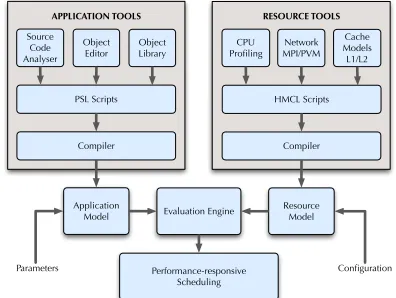
applica-tion using a performance modelling language that captures the key communication/computation steps. Resource capabilities are identified using hardware micro-benchmarks and the resulting hardware and application models are combined in real time to de-rive predictive execution data – Figure 1.
The separation of hardware and software com-ponents allows PACE to evaluate performance
sce-narios, such as the scaling effect of increasing the
number of processors or the impact of modifying a processor mapping strategy. This feature is par-ticularly useful in the context of heterogeneous en-vironments where the same application model can be applied to numerous hardware models to obtain different runtime predictions or scaling behaviours. A choice can then be made as to where and how an application should be run, so as to make best use of available resources and meet any deadline that might have been imposed.
APPLICATION TOOLS
Source Code Analyser
Object Editor
Object Library
RESOURCE TOOLS
CPU Profiling
Network MPI/PVM
Cache Models L1/L2
PSL Scripts
Compiler Compiler
Application Model
Resource Model Evaluation Engine
Performance-responsive Scheduling
Parameters Configuration
[image:3.612.89.287.389.538.2]HMCL Scripts
Fig. 1: An outline of the PACE system.
The PACE performance evaluation and pre-diction capabilities have been validated using ASCI (Accelerated Strategic Computing Initiative)
demonstrator applications [17]. The toolkit
pro-vides a good level of predictive accuracy and the evaluation process typically completes in seconds. PACE has been used in a number of other high-performance settings, including the high-performance op-timisation of financial applications [21], real-time performance analysis and application steering [1] and the predictive performance and scalability mod-elling of the application Sweep3D [8].
3
Intra-domain Management
The management of resources at the intra-domain level is provided by the combination of a scheduler co-ordinator Titan [23] and a standard commodity scheduler (in this case Condor [19], operated in ded-icated mode rather than cycle-stealing mode). Titan employs the PACE predictions to manage the incom-ing tasks and improve resource utilisation by cou-pling application performance data with a genetic algorithm (GA). The objective of the GA is to min-imize the run-time of applications, reduce the re-source idle time and maintain the service contracts (deadline) of each task. This is achieved by target-ing suitable resources and scaltarget-ing the applications using the evaluated performance models.
Titan utilises a cluster-connector that instructs the underlying cluster management software to ex-ecute tasks in a particular order with predetermined resource mappings. This approach allows the pre-dictive information obtained from PACE to drive the task execution provided by established workload management systems. In the case of Condor, this is achieved by generating specific resource advertise-ments (ClassAds [22]) that instruct Condor to run a particular task on a designated resource (or set of re-sources) and generating a custom submit file that de-tails the various input, output and argument param-eters as required. Execution commands are issued to the cluster manager just-in-time, ensuring that the task queue is not reordered by Condor before the tasks are deployed to the underlying resources. Fig-ure 2 provides an overview of the intra-domain level middleware components.
User request / Request from foreign domain scheduler
TITAN Domain
Portal Pre-execution
Engine
PACE
GA
Match Maker Schedule Queue
Cluster Connector
Condor Scheduler
Intra-domain Resources
[image:3.612.324.488.448.644.2]Cluster Domain
Fig. 2: Intra-domain level middleware components.
does not therefore dictate a sea change in the choice of platform that is required in order to benefit from these techniques.
The cluster connector monitors the resources us-ing Condor’s status tools and can respond to re-source variations such as machines going off-line or being re-introduced into the local domain. In each case, the genetic algorithm is able to respond to the changes in state and compensate accordingly. This prevents the schedule queue becoming blocked by a task that specifies more resources than are avail-able and allows the system to utilise new resources as they come on-line.
Tasks enter the system by means of a portal from which the user specifies an application name,
deadline and PACE performance model. A
pre-execution script can also be specified, which allows application-specific initialisation such as modifying input control files based on the processor mapping recommended by Titan, or down-loading appropri-ate binaries for the resource type.
Titan combines the PACE application model with the hardware model for a particular resource. The combined model is evaluated for different pro-cessor configurations to obtain a scaling graph for the application on the given resource. By comparing the application’s minimum time with the run-time of the existing queued tasks, Titan is able to predict when the application will complete and can compare this with the user-specified deadline. If the deadline of the task can be met, the task is submit-ted to the local queue for processing. If the deadline cannot be met then Titan will negotiate with other co-schedulers to determine whether the task request can be satisfied by neighbouring resource domains. If it is not possible to meet the deadline, the task is submitted to the resource that minimises the dead-line failure.
When a task is accepted for processing it is placed in Titan’s scheduling queue with the other
accepted tasks. The genetic algorithm works on
this queue while the jobs are waiting, exploring task mappings that reduce the makespan (end-to-end run-time), idle time (locked between processes) and av-erage delay (the amount of time tasks complete be-fore or after their deadline). The GA creates multiple scheduling solution sets, evaluating these and then rejecting unsuccessful schedules while maintaining the good schedules for the next generation. As bet-ter schedules are discovered, they replace the cur-rent best schedule and the task queue is reordered appropriately. When the resources are free to ac-cept the tasks at the front of the queue, the tasks are despatched by the cluster connector.
On task completion, Titan compares the actual run-time of the task against the predicted run-time
generated by PACE, feeding back refinements where possible.
[image:4.612.303.501.155.445.2]Here, the capabilities of the predictive co-scheduler are demonstrated. This is performed by selecting 30 random tasks from a set of 5 parallel kernels and queuing the tasks onto 16 homogeneous hosts. Each of the parallel kernels has a correspond-ing PACE application model and the task set is cho-sen so that each of the tasks exhibit different parallel scaling behaviours.
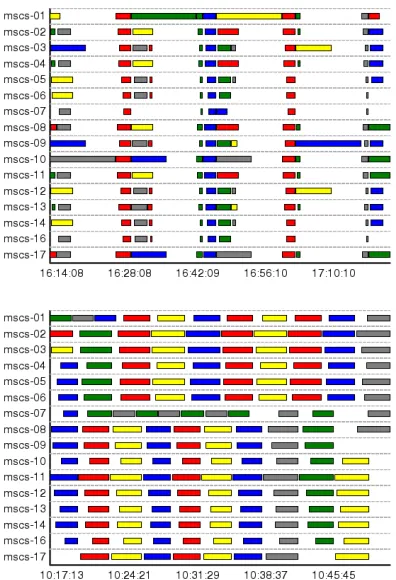
Fig. 3: Top – run-time schedule using Condor (70.08 min); Bottom – run-time schedule using Condor and the predictive co-scheduler Titan (35.19 min).
The results in Figure 3 are based on run-time measurements obtained from a cluster of 16 1.4Ghz Pentium 4s with communication across a Fast Ether-net Ether-network. Using a population size of 40, the Titan co-scheduler (running on an 800Mhz Pentium III) is capable of performing approximately 100 GA itera-tions per second. Each task is assigned an arbitrary deadline, all the tasks run to completion and pre-empting (the ability to multi-task or micro-schedule) is not permitted.
larger tasks block smaller tasks (see Figure 3 – top) and this results in a large idle-time and makespan.
The second experiment illustrates a common scenario where users specify the maximum number of machines in the cluster on which to run their tasks. While in most cases this reduces the single-task exe-cution time, the improvement over fewer hosts may in fact be marginal and blocking is still common (the run-time view is omitted for brevity).
In the third experiment the tasks are submitted with a pre-calculated number of hosts. As one would expect, this significantly reduces the make-span al-though it is a scheme that requires a good deal of pre-execution analysis and user cooperation.
In the final experiment, the Titan co-scheduler is used to dynamically map tasks to resources before the tasks are deployed to the physical resources by Condor (see Figure 3 – bottom). Significant im-provements are made by searching for a schedule that minimises the makespan, reduces the idle time and minimises the average delay.
Experiment Time (m) Idle (%)
Condor
arbitrary hosts per task 70.08 61
maximum hosts per task 69.10 28
calculated hosts per task 38.05 14
Condor & co-sched. Titan 35.19 21
Tab. 1: Experimental results using Condor and us-ing Condor with the Titan co-scheduler.
The results in Table 1 demonstrate the im-provements obtained using this predictive
co-scheduling technique. Over the first two
experi-ments the Condor-Titan system effectively halves
the makespan (from 70 to 35 minutes). Even
when the best resource mapping and schedule is pre-calculated by the users (the third experiment), Condor-Titan still improves the makespan by 8%. These results are significant, but of additional inter-est is the ability of the predictive co-scheduling to self-manage and adapt according to additional qual-ity of service features (see section 5).
4
Multi-domain Management
To schedule across multiple Grid resources with an agreed quality of service, the Titan architecture em-ploys agent brokers that store and disseminate re-source and application data. Where the rere-sources reside outside the administrative domain, the agents communicate through existing Grid information and task management services.
Each Titan scheduler is represented by an agent that promotes the capabilities of the available re-source. The agent receives additional service in-formation from other local agents that is then
or-ganised in Agent Capability Tables (ACTs). The ACTs form the basis of a performance
informa-tion service, which is implemented as a series of
Titan-specific information providers to the Moni-toring and Discovery Service (MDS) [11] from the Globus Toolkit [12].
The MDS consists of Grid Resource Informa-tion Services (GRIS) and Grid Index InformaInforma-tion Services (GIIS) that can be configured to propa-gate service information across Grid domains. The GRIS uses an OpenLDAP server back-end which is customisable using extensible modules (information providers) as shown in Figure 4. Data that is ex-posed to these servers is subsequently cached and propagated to parent GIIS systems using predeter-mined configuration rules.
GIIS Portal
Front End Containing Schema
TITAN Information Provider TITAN Information
Provider TITAN Information
Provider
Agent Broker
Sched.
GRIS
OpenLDAP Server
GRIS Backend
Fig. 4: The interconnection of Titan and the MDS-based performance information service.
The resource schedulers and agents each bind to a GRIS. This allows the inspection of current re-source capabilities by the local scheduler and also by other local agents. Higher-level (multi-domain) access to this information is provided through the GIIS. The advantage of this is that it provides a unified solution to the distribution of data, it is de-centralised (and therefore robust) and information providers are located logically close to the entities which they describe.
Agents use the information from neighbouring agents (through advertisement) or from the informa-tion service (through discovery) to deliver improved
scalability and adaptability. Each domain in the
current implementation is represented by a single agent and agent-level communication is used to
co-ordinate inter-domain resource sharing. When a
so as new resources become available (or current resources go down) the middleware is able to recon-figure accordingly. The implementation of the agent system is documented in [7].
/s
(s) (s) (%)
200 1 OFF 839 -1 24
200 1 ON 302 78 51
200 2 OFF 812 -36 25
200 2 ON 245 72 50
200 5 OFF 814 -64 24
200 5 ON 218 62 49
500 1 OFF 1784 -112 28
500 1 ON 633 78 57
500 2 OFF 1752 -205 29
500 2 ON 461 66 57
500 5 OFF 1877 -276 27
500 5 ON 305 32 68
1000 1 OFF 2752 -314 36
1000 1 ON 1160 79 61
1000 2 OFF 2606 -493 39
1000 2 ON 669 65 74
1000 5 OFF 2756 -681 36
1000 5 ON 467 -6 77
Tab. 2: Experimental results: is the number of re-quests (load); /s is the request submission rate per second;
represents whether the predictive mid-dleware is active;
is the makespan; is the average delay and is the resource utilisation.
An additional feature of this system is the in-tegration of a performance monitor and adviser (PMA). The PMA is capable of modelling and sim-ulating the performance of the agent network while the system is active. Unlike facilitators or brokers in classical agent-based systems, the PMA is not cen-tral to the rest of the agent system; it neither controls the agent hierarchy or serves as a communication centre in either the physical or symbolic sense. The PMA monitors statistical data from the agent system and simulates optimisation strategies in real time. If a better solution (to resource discovery, advertise-ment, agent communication, data management etc) is discovered, then it can be deployed into the live agent system (see [6] for details).
5
Case Study
The impact of employing this middleware is simu-lated on a 256-node grid consisting of 16 separate resource domains. At the intra-domain level, the grid is homogeneous (containing 16 node multipro-cessors or clusters of workstations); at the multi-domain level, the grid is heterogeneous (consist-ing of 6 different architecture types). Agents are mapped to each domain and therefore represent
sub-components of the grid with varying computational capabilities.
A number of experiments are run in which 200, 500 and 1000 requests ( ) are sent to randomly se-lected agents at intervals of 1, 2 and 5 requests per second ( /s); representing a broad spread of work-loads and bursts of activity. During each experiment three system criteria are monitored:
Throughput – the makespan or time to com-pletion (
) for all of the submitted tasks to ex-ecute – this is calculated as the maximum end time (of a task) minus the minimum start time;
Quality of service – represented through the average delay ( ), the amount of time tasks
complete before or after their deadline. The deadlines are randomly assigned from the range of predicted values for each of the do-main architectures, with suitable time allowed for staging and network latency;
Resource utilisation – calculated as the time over which tasks are mapped to hosts. System-wide utilisation ( ) represents the
av-erage over each of the resource domains.
The experimental results in Table 2 represent two scenarios, when the predictive middleware (
) is ON and when the predictive middleware is OFF. In the case when the middleware is off and the sys-tem load and submission rate are low (200 requests submitted at 1 per second), the makespan is 839
seconds. As the workload increases to 500 and
1000 tasks, so the makespan increases accordingly (to 1784 and 2752 seconds respectively). There are small variations in the makespan as the submission rate ( /s) increases, these are not considered signifi-cant and will depend in part on the random selection of tasks for each experiment.
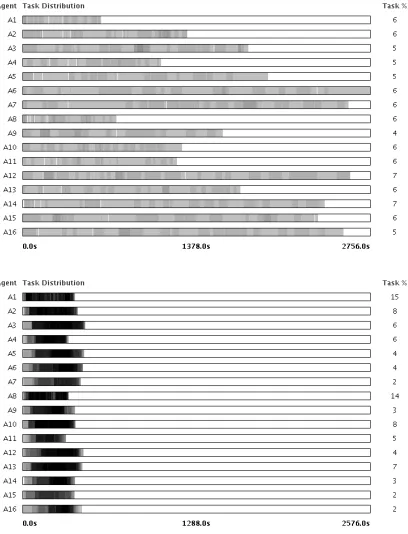
Fig. 5: Results of 1000 tasks submitted 5 per sec-ond. Top – predictive middleware is inactive; bottom – predictive middleware is active. Darker shading indicates greater utilisation.
This feature is emphasised most clearly at the highest workload. When the system is subject to 1000 tasks submitted 1 per second, the middleware reduces the makespan by 58% (from 2752 to 1160 seconds). As the submission rate increases, so in-creased improvements can be observed – a reduction in makespan of 74% at a submission rate of 2 tasks per second, and a reduction in makespan of 83% at a submission rate of 5 tasks per second. Run-time views supporting these results can be found in Fig-ure 5. The redirection of tasks by the agent system can be seen under the % column to the right of the figure. When the middleware is off, each resource domain is assigned roughly the same percentage of tasks. When the middleware is on, tasks are di-rected to the resources that have spare capacity (do-mains D-00 and D-07, for example) and moved off domains whose resources are already over-stretched (domains D-06 and D-15, for example).
Quality of Service
There are a number of definitions of quality of
ser-vice for distributed Grid systems consisting of
non-dedicated resources. Many of these focus on the resource, for example the network (including band-width and latency), processor availability (including FLOPS and CPU utilisation), or additional hardware facilities such as disks etc [15]. Quality of service in
this research symbolises a user-side service that is based on the deadline assigned to each task. This has different characteristics from advance or right-now reservation where the emphasis is on the user choos-ing a set of resources that have been pre-selected as being able to meet their needs. The approach used here is also compatible with the new GRAM-2 [10] terminology; it deals with task SLAs rather than resource SLAs or reservation, and the mapping of tasks to resources – the binding SLA – is performed through the Titan genetic algorithm.
In this work we draw on web services research where users, or groups of users, are assigned service classes under which contractual service agreements are guaranteed for an associated cost [2]. The QoS emphasis here is on the service, rather than the tools or resources needed to deliver that service; the de-livery itself is transparent and is handled by the sup-porting active middleware.
The Titan task mapping process differs from other QoS-based scheduling strategies. In [16] the QoS-guided MinMin mapping process first assigns tasks with high QoS requirements to resources be-fore dealing with those task requests that have a lower priority. While this might seem like a good strategy, it is possible to use lower priority jobs to pack the tasks (see Figure 3), using spare resources for low priority tasks as soon as the tasks and re-sources become available.
The case study in section 5 provides two dif-ferent aspects of deadline-based quality of service: these are the time in which tasks complete before or after their deadline, the average delay , and the
number of tasks that complete before their deadline,
termed and measured as a percentage of the total.
Workload /s
( )
Low 200 1 OFF 57
200 1 ON 89
improvement
Medium 500 2 OFF 27
500 2 ON 83
improvement
High 1000 5 OFF 9
1000 5 ON 50
improvement
Tab. 3: Percentage of tasks meeting their deadlines under low, medium and high workloads.
assigned deadline. This decreases to 27% of tasks under a medium workload (500 requests submitted 2 per second), and to only 9% under a high work-load (1000 requests submitted 5 per second).
The middleware improves by between 32 and
56%, ensuring that 89% of the tasks meet their dead-lines when the workload is low. This figure drops as the workload increases, to 83% at a medium work-load and to 50% at a high workwork-load; this decrease is not unexpected.
provides detail on the percentage of tasks which meet their deadline, but it does not give any indication as to the degree by which this takes place. We therefore use the average delay ( ) as an
addi-tional measure of quality of service, and in so doing gain a greater insight in to the extra schedule capac-ity which the activation of the predictive middleware services can provide.
In the case when the middleware is off and the system load and submission rate are low, the
aver-age delay is -1 second (see Table 2). As the
sub-mission rate increases, so increases to -36 seconds
at a submission rate of 2 requests per second and to -64 seconds at 5 requests per second; this trend is also demonstrated at the higher workloads.
Activating the predictive middleware has a posi-tive effect on ; when 200 requests are sent at 1 per
second, is 78 seconds, indicating spare schedule
capacity. When the workload and submission rate are high (1000 requests at 5 per second) the impact is marked; rather than running 11 minutes over sched-ule (-681 seconds), the prediction-based middleware is able to reduce this to -6 seconds.
It can be seen that without the additional ac-tive middleware services, the quality of the system rapidly deteriorates, both from the point of view of the number of tasks that meet their deadlines and also the extra capacity which is available. With the middleware enabled, the user-side quality of service is maintained up to the point at which the system be-comes fully loaded.
Resource Usage
The high-level task migration provided by the agent system delivers basic load balancing across the re-sources in the underlying grid. This redirection of tasks is different from that provided by GrADS [4], which allows the migration of running tasks in re-sponse to system load in order to improve perfor-mance and prevent system degradation. In the Ti-tan system, once tasks have been staged, they run to completion. This method essentially moves all the decision making forward (to pre-staging) and as a result has negligible run-time overheads as no addi-tional checkpointing is needed; all run-time
report-ing at the co-scheduler level is done usreport-ing Condor’s status tools and as such no additional functionality is therefore required. Although this system shares many of the fundamental properties of the NetSolve Environment [3, 9], its resource management also differs in a number of ways; in particular, PACE is non-intrusive and the predictive data which it sup-plies does not require any link between a client li-brary and the application itself.
Table 2 also shows the resource utilisation ( )
for the system under low, medium and high work-loads. As can be expected, the resource utilisation increases as the system load increases (both when the middleware is active and inactive). What is sig-nificant is how the middleware improves the utili-sation, by 28% for the low workload, 31% for the medium workload and 40% for the high workload. Also of note is the fact that these improvements in-crease as the workload inin-creases.
If we analyse the resource usage at the intra-domain level, we find that the difference in resource utilisation (between the middleware being active and inactive) is larger in the domains with the highest computational capabilities (for example a 40% dif-ference for D-00 and D-07, and a 4% difdif-ference for domains D-06 and D-15). These results are caused by the predictive middleware being able to identify and make use of the larger proportion of idle time on the higher capacity resources. This trend is found to be uniform across the different workloads.
Of additional interest is the relationship between the quality of service measures and resource utilisa-tion. The results in Tables 2 and 3 allow the point at which the middleware begins to fail the majority of users to be identified. This can be seen in Table 2 when switches from being positive to negative, and
in Table 3 when drops to 50%. This system state
corresponds to the case when the resource utilisation measures 75%.
6
Conclusions
Performance-responsive middleware services are set to play an increasingly important role in the man-agement of resources and distributed workloads in emerging wide-area, heterogeneous distributed
com-puting environments. This paper documents two
supporting performance services for these architec-tures, which are based on existing Condor- and Globus-enabled Grid infrastructures.
This paper details a local (intra-domain) level predictive co-scheduler, that uses performance pre-diction data generated by the PACE toolkit to sup-port intra-domain task management. This service is extended to the global (multi-domain) level through an information service based on the Globus MDS. The middleware uses a peer-to-peer agent system and high-level workload steering strategies to bal-ance system load and improve system-wide resource utilisation.
The improvements brought about by these performance-responsive middleware services are
demonstrated on a 256-node Grid. This
multi-tiered approach to Grid performance-service provi-sion is likely to prove successful, where improve-ments brought about at a local level can be exploited by cooperative wide-area management tools.
References
[1] A. Alkindi, D. Kerbyson, and G. Nudd. Optimisa-tion of applicaOptimisa-tion execuOptimisa-tion on dynamic systems.
Future Generation Computer Systems, 17(8):941–
949, 2001.
[2] J. Aman, C. Eilert, D. Emmes, P. Yacom, and D. Dil-lenberger. Adaptive algorithms for managing a dis-tributed data processing workload. IBM Systems Journal, 36(2):242-283, 1997.
[3] D. Arnold, and J. Dongarra. The NetSolve Envi-ronment: Processing Towards the Seamless Grid.
29th Int. Conference on Parallel Processing (ICPP-2000), Toronto Canada, Aug. 21-24, 2000.
[4] F. Berman, et al. The GrADS Project: Software Support for High-Level Grid Application Develop-ment. Int. Journal of High Performance Computing
Applications, 15(4):327-344, 2001.
[5] R. Buyya, D. Abramson, J. Giddy, and
H. Stockinger. Economic models for resource
management and scheduling in Grid computing.
Concurrency and Computation: Practice and Experience, 14:1507-1542, 2002.
[6] J. Cao, S. Jarvis, S. Saini, D. Kerbyson, and
G. Nudd. ARMS: an agent-based resource
man-agement system for grid computing. Scientific
Pro-gramming, 10(2):135–148, 2002.
[7] J. Cao, D. Kerbyson, and G. Nudd. High
per-formance service discovery in large-scale multi-agent and mobile-multi-agent systems. Int. Journal of Software Engineering and Knowledge Engineering,
11(5):621–641, 2001.
[8] J. Cao, et al. Performance modelling of parallel and distributed computing using PACE. 19th IEEE Int.
Performance, Computing and Communication Con-ference (IPCCC’00), pp. 485–492, 2000.
[9] H. Casanova, and J. Dongarra. NetSolve: A Net-work Server for Solving Computational Science Problems. Int. Journal of Supercomputer
Applica-tions and High Performance Computing, 11(3):212–
223, 1997.
[10] K. Czajkowski. GT Resource Management and
Scheduling: The Globus Perspective GlobusWorld
2003, January 13-17 2003, San Diego, CA, USA.
[11] S. Fitzgerald, I. Foster, and C. Kesselman. Grid information services for distributed resource shar-ing. 10th Int. Symposium on High Performance
Dis-tributed Computing (HPDC-10 ’01), 2001.
[12] I. Foster and C. Kesselman. Globus: A metacom-puting infrastructure toolkit. Int. Journal of
Super-computer Applications, 11(2):115–128, 1997.
[13] I. Foster and C. Kesselman. The GRID: Blueprint
for a New Computing Infrastructure. Morgan-Kaufmann, 1998.
[14] I. Foster, C. Kesselman, J. Nick, and S. Tuecke. Grid services for distributed system integration. IEEE Computer, 35(6):37–46, 2002.
[15] I. Foster, A. Roy, and V. Sander. A Quality of Ser-vice Architecture that Combines Resource Reserva-tion and ApplicaReserva-tion AdapReserva-tion. Proceedings of 8th
Int. Workshop on Quality of Service, pp. 181-188,
June 5-7 2000, Pittsburgh, PA, USA
[16] X. He, X. Sun, and G. Laszewski. A QoS Guided Scheduling Algorithm for Grid Computing. Int. Workshop on Grid and Cooperative Computing (GCC02), Hainan, China, 2002
[17] D. Kerbyson, et al. Predictive preformance and scal-ability modelling of a large-scale application.
Super-computing ’01, 2001.
[18] W. Leinberger and V. Kumar. Information power grid : The new frontier in parallel computing? IEEE
Concurrency, 7(4), 1999.
[19] M. Litzkow, M. Livny, and M. Mutka.
Con-dor – a hunter of idle workstations. 8th
Interna-tional Conference on Distributed Computing Sys-tems (ICDCS’88), pp. 104–111, 1988.
[20] G. Nudd, et al. PACE : A toolset for the performance prediction of parallel and distributed systems. Int.
Journal of High Performance Computing Applica-tions, 14(3):228–251, 2000.
[21] S. Perry, R. Grimwood, D. Kerbyson, E. Papaefs-tathiou, and G. Nudd. Performance optimisation of financial option calculations. Parallel Computing, 26(5):623–639, 2000.
[22] R. Raman, M. Livny, and M. Solomon. Matchmak-ing: Distributed Resource Management for High
Throughput Computing. 7th Int. Symposium on
High Performance Distributed Computing (HPDC-7 ’98), 1998