WORKING PAPERS SERIES
WP99-15
The Effects of Systematic Sampling and
Temporal Aggregation on Discrete Time
Long Memory Processes and their Finite
Sample Properties
The Effects of Systematic Sampling and Temporal Aggregation
on Discrete Time Long Memory Processes and Their Finite
Sample Properties
March 1999
Soosung Hwang*
Department of Applied Economics University of Cambridge
Austin Robin Building Sidgwick Avenue Cambridge CB3 9DE
UK
TEL) 44 1223 335282 FAX) 44 1223 335299 E-MAIL) [email protected]
!!!!!!!!!!!!!!!!!!!!!
* I would like to thank Dr. D. Lee for making available his GAUSS programme, and Professor M. J. Chambers,
Abstract
This study investigates the effects of varying sampling intervals on the long memory
characteristics of certain stochastic processes. We find that although different sampling
intervals do not affect the decay rate of discrete time long memory autocorrelation functions
in large lags, the autocorrelation functions in short lags are affected significantly. The level of
the autocorrelation functions moves upward for temporally aggregated processes and
downward for systematically sampled processes, and these effects result in a bias in the long
memory parameter. For the ARFIMA(0,d,0) process, the absolute magnitude of the long
memory parameter, |d|, of the temporally aggregated process is greater than the |d| of the true
process, which is greater than the |d| of the systematically sampled process. We also find that
the true long memory parameter can be obtained if we use a decay rate that is not affected by
1 Introduction
An important class of time series models are the so-called long memory processes which
were introduced by Mandelbrot and Van Ness (1968), Granger and Joyeux (1980), and
Hosking (1981). A simple property of long memory processes is that whilst the
autocorrelations decrease, they decrease very slowly. Therefore, the past influences the future
in a manner reminiscent of chaotic processes.
It is interesting to notice that many of the empirical studies use temporally aggregated
data, such as monthly time series, for the test of long memory process. We now have
available financial data that are sampled on many different frequencies. Consider foreign
exchange data for example. This is now available on a quote-by-quote or trade-by-trade basis.
It is also available on daily, weekly, and even much lower frequencies. This availability
naturally raises questions of temporal aggregation in long memory processes.
Ding, Granger and Engle (1992) conjectured that temporal aggregation does not
change the long memory property of the return series. Recently, Chambers (in press) shows
that at low frequencies, the decay rate of the spectral density functions of long memory
processes is not affected by sampling intervals. Therefore, the true long memory parameter
can be estimated by considering low frequencies regardless of the sampling interval.
A sampling interval which is different from the dynamics of the true process affects
the model specification of long memory processes. However, both the frequencies of the true
process and the effects of the sampling interval on the model specification of long memory
processes are not known. In this situation, an appropriate long memory model which takes
into account the sampling interval is impossible. Most empirical studies which use long
intervals. For this reason, we assume that the sampling interval does not change the model
specification for a long memory process and investigate changes in the long memory
parameter. Thus, our focus is whether or not there is a change in the long memory parameter
when different sampling intervals are used.
In what follows, we extend Chambers (in press) results by using both time and
frequency domain analysis in discrete time long memory processes1. Firstly, the effects of systematic sampling and temporal aggregation on discrete time long memory processes are
presented in an analytical way; autocovariance, autocorrelation, and spectral density functions
are derived for the systematically sampled and temporally aggregated long memory
processes. Then, Monte Carlo simulations using frequency domain maximum likelihood
estimation methods are used for the finite sample properties of systematic sampling and
temporal aggregation effects on discrete time long memory processes.
Our study confirms the results of Chambers (in press), in that the decay rate of
discrete time long memory spectral density functions at low frequencies (or equivalently, the
decay rate of discrete time long memory autocorrelation functions in large lags) is not
affected by systematic sampling or temporal aggregation. However, significant effects of
systematic sampling or temporal aggregation are found in the autocorrelation functions at
short lags, which result in either upward or downward movements in the level of
autocorrelation function. We find that the effects are different for systematically sampled and
temporally aggregated long memory processes. The absolute value of the autocorrelation
coefficient of systematically sampled long memory processes becomes smaller as the
sampling interval increases, while the absolute value of the autocorrelation coefficient of
temporally aggregated long memory processes becomes larger as the sampling interval
sampled long memory processes, the long memory parameter is always biased towards zero
as the sampling interval increases, while in temporally aggregated long memory processes the
absolute value of the long memory parameter, |d|, is larger than its true value. Although it is
not reported in this paper, we find that there is no temporal aggregation effect on continuous
time long memory processes.
We also investigate whether or not the true long memory parameter can be obtained
from the decay rate of long memory spectral density functions at low frequencies in finite
samples. For this purpose, we use the semiparametric regression model suggested by Geweke
and Porter-Hudak (1983). Our simulation results using the semiparametric regression for
discrete time long memory processes show that the estimation biases are much less than the
biases of ML estimates. Therefore, the true long memory parameter can be estimated in
temporally aggregated long memory processes. However, the standard deviation of the
estimates is very large and significant estimation bias still exists in systematically sampled
long memory processes.
2 Discrete Time Long Memory Processes
A model appears to be more attractive when just one parameter is used for long range
dependence. A long memory process is characterized as a process that should explain long
range dependence between observations more effectively than conventional short memory
processes. There are two major models for long memory process, continuous time models
such as the fractional Gaussian noise (FGN) model introduced by Mandelbrot and Van Ness
(1968), and discrete time models such as the autoregressive fractionally integrated moving
Although the FGN model has the benefit that it can be used together with ordinary Brownian
motion, the ARFIMA model is generally preferred to the FGN model. The main reason is that
the former can describe economic and financial time series better than the latter. Moreover,
the ARFIMA model is a generalisation of the more familiar autoregressive integrated moving
average (ARIMA) model; it captures both long and short memory, and it is easier to use than
the FGN model.
Discrete time long memory processes have much more flexibility than ARIMA(p,d,q)
models. The order of integration in the ARIMA process is confined only to integer values
such as 0 or 1. In this process a shock has mean-reversion with an exponential decay rate
when d=0, but has infinite persistence when d=1. This knife-edge distinction between
ARIMA(p,0,q) and ARIMA(p,1,q) may be too narrow. Long memory processes add more
flexibility by allowing for fractional orders of integration such as 0"d"1.
A discrete time long memory process (fractionally integrated process), which was
introduced by Granger and Joyeux (1980) and Hosking (1981), is defined to be a discrete
time stochastic process which is represented as
d t
d
t t
x L x u
# = (1- ) = , (1)
where L is the lag operator, ut is an independent identically distributed random variable, and
-0.5<d<0.53. Using the binomial series expension, the fractional difference operator # d can be represented as
#d d
j
j L
= $
$
+ $
=
%
&
(1 )
) ( 1) ( )
L
j d
j d
= '
' '
(
,
0
(2)
where ( ) is the gamma function.' ( The infinite moving average representation of xt may be
xt L t j t ju j
= = & $
=
%
)( )* +
0
, (3)
where + j + j
d j d j d j d = + + , - % $ ' ' ' ' ( )
( 1) ( ) ( )
1
and as j via Stirling’s approximation.
The autocovariance, autocorrelation and spectral density functions of the fractionally
integrated process for s.0 and 0</"0are5
1 2
2
FI u
d u
s d s d
d d s d
d
d d s
( ) ( ) ( ) ( ) ( ) ( ) ( ) ( ) ( ) , = $ + $ + $ , $ $ - % $ ' ' ' ' ' ' ' ' 1 2 1 1 1 2 1 2
2 1 2
, as s
(4)
3FI
d
s d s d
d s d
d d s ( ) ( ) ( ) ( ) ( ) ( ) ( ) , = $ + + $ , $ $ - % ' ' ' ' ' ' 1 1
1 2 1
, as s
(5)
S =
2 2 2
FI
u d
u d
( ) { sin( )}
,
/ 2
0
/
2
0/ /
2 2 2 2 2 0 $ $ ,
, as
(6)
where s is a lag between observations, / is a frequency, and 2u
2
is a variance of ut. We can
see that the autocorrelations of the fractionally integrated series decline at a slower rate than
that of the autoregressive moving average (ARMA) model. The autocorrelation function (5)
decays at a hyperbolic rate, while that of the ARMA model decays exponentially.
Fractionally integrated processes show different characteristics depending on the
parameter d. A fractionally integrated process is covariance stationary and invertible when
-0.5 <d< 0.5, and it is a long memory process when d lies between 0 and 0.5. The fractional differencing parameter d is defined by the behaviour of the series up to infinite cycles. As d
fractional differencing parameter d decides the decay of the system's response to the
innovation. Sowell (1990) shows that, while the variance of the partial sums of variables
grows linearly with number of observations when d = 0, it grows faster than a linear rate
when 0<d<0.5. On the other hand, when -0.5<d<0, the process has short memory since each
shock is negatively correlated with the others, thus making the variance of the partial sums of
variables less than the variance of the individual shock.
Fractionally integrated processes can easily be generalised to the ARFIMA(p,d,q)
process. More formally,
4(L)(1- L ) x = (L)ud 5
t t (7)
where4(L) = 1 1L 2L ... L 2
p p
$6 $6 $ $6 , 5(L) = 1+71L +72L +...+2 7pLq, -0.5<d<0.5, and
all the roots of 4(L) and 5(L) lie outside of the unit circle. In the ARFIMA model, d may be
chosen to describe the autocorrelation structure of distant observations of a time series, while
the 7 and 6 parameters can be chosen to describe the low lag autocorrelation structure.
Therefore, the ARFIMA model not only overcomes the drawbacks that Mcleod and Hipel
(1978) point out but also generalises the Box-Jenkins ARIMA model where only integral
differencing is allowed.
3 The Effects of Systematic Sampling and Temporal Aggregation on
Discrete Time Long Memory Processes
The sampling interval of observed economic and financial time series (e.g., daily, weekly,
and monthly) does not necessarily correspond to the true unknown interval. We conjecture
that the sampling interval is longer than the true interval, resulting in temporal aggregation in
flow time series and systematic sampling in stock time series. We next investigate the effects
under the assumption that the sampling interval is longer than the true interval.
This section shows the effects of systematic sampling and temporal aggregation on
discrete time long memory processes: a systematically sampled ARFIMA(0,d,0) process and
a temporally aggregated ARFIMA(0,d,0) process. For these two processes, properties such as
autocovariance, autocorrelation, and spectral density functions are derived.
Assumption 1 The dynamics of the true underlying discrete time process xtD take place at
every unknown 1/8 period where 8 is a positive integer, while the observations of the process
take place at every unit time period.
The underlying process is simply thought of as a series of logarithmic changes of the
original positive time series at discrete time intervals. For example, it is a return in financial
markets or a growth rate in economics.
In the assumption above, 8 is a sampling interval. More specifically, 8 is the number
of times the dynamics of the true underlying process take place between observations. When
8=1, the observed time series is equivalent to the true process. When 8 is a positive integer
greater than 1, then the time series is observed less frequently than the frequency of the true
process.
The true underlying process can be partially observed in two ways, systematic
sampling and temporal aggregation. A systematically sampled process is a sequence of the
true process at observation points and, thus, consists of every other 8 of the true process. A
temporally aggregated process is a sequence of the aggregated true process between sampling
the systematically sampled process is like observing a daily process every Monday but not on
other days and the temporally aggregated process is a weekly return process.
Definition 1 A discrete systematically sampled process, whose true process has 1/8
dynamic periods, consists of { xt x DS
t D
= ; t=1,2,3,...}. A discrete aggregated process, whose
true process has 1/8 dynamic periods, consists of { xt x DA
t k D
k 0 1 = &
$
=
$
8 8
; t=1,2,3,...}.
When the true process has 1/8 dynamic periods, the discrete true ARFIMA(0,d,0)
process, xtDF, is defined as
(1- L ) x = d tDF t
1
8
* , = 1, 1+1 / , 1+ 2 / , 1+ 3 / , ...,t 8 8 8 (8)
where *t is a white noise sequence with variance 22. Note that the variance 22 is measured with time interval 1/8. When we assume that the frequency of the process defined in section 2
is 1/8 , the variance of the white noise, 2u
2
, in section 2 is identical to 22 in equation (8). Thus, without loss of generality, we assume 2u 2
2 2
= throughout this section.
We represent a theorem concerning autocovariance, autocorrelation, and spectral
density functions of a systematically sampled ARFIMA(0,d,0) process. This generalises
theorem 1 (a) of Chambers (in press), where he derives the spectral density functions of a
systematically sampled ARFIMA(0,d,0) process.
Theorem 1 Systematically Sampled ARFIMA(0,d,0) Process
Under assumption 1 and definition 1, the discrete systematically sampled ARFIMA(0,d,0)
x k d
d k
t DSF
t k k
= +
+ $
=
%
&
'( ) ('(' )1)0
*
8
t = 1, 2, 3, ... (9)
The autocovariance, 1DSF( , ) , s 8 autocorrelation, 3DSF( , ) , s 8 and spectral density
functions, SDSF( , )/ 8 , of xt
DSF
for s.0, 8.1, and 0</"0 are given by
1 8 8
8 2
DSF s
d s d
d d s d
( , ) ( ) ( )
( ) ( ) ( )
= $ +
$ + $
' '
' ' '
1 2
1 1
2
(10)
, $
$ - %
$ $
'
' '
( )
( ) ( )
1 2 1
2 2 1 2 1
d
d d s as s
d d
2 8 , 8or ,
3 8 8
8 DSF s
d s d
d s d
( , ) ( ) ( )
( ) ( )
= $ +
+ $
' '
' '
1
1 (11)
, ' $ $ $ - % '
( )
( )
1 d 2 1 2 1
d s s
d d
8 , as 8or ,
SDSF
d
( , )/ 8 2 ( sin )
0
/ 8
= $
2
2
2 2 2 (12)
,2 $
-08 / /
2
2 2
2 0
d d
, as ,
where 8 is a sampling interval, s is a lag between observations, / is a frequency, and 22 is a
variance of *t.
Proof : See the Appendix.
The properties of the discrete systematically sampled ARFIMA(0,d,0) process have a
sampling interval 8 that the true discrete ARFIMA(0,d,0) process does not have (see
equations (4), (5), and (6)). The true process is observed differently by the sampling interval.
As pointed out in Chambers (in press), the decay rate in the spectral density function at low
frequencies, -2d, is the same as that of the true ARFIMA(0,d,0) process. The autocorrelation
(compare equation (11) with equation (5)).
However, the absolute value of the autocorrelation function of the systematically
sampled process is always less than that of the true ARFIMA(0,d,0) process, since for any
positive integer 8>1, 82d-1 is less than 1 when -0.5<d<0.5. This decreased autocorrelation
function is expected to make the estimated d biased toward zero. Figures 1 to 4 show the
changes of the autocorrelation functions for systematically sampled and aggregated
ARFIMA(0,d,0) processes when d=0.35(8=5) and d=-0.35(8=5), respectively. In figures 1
and 3, we can see that the absolute values of the autocorrelation functions are decreased by
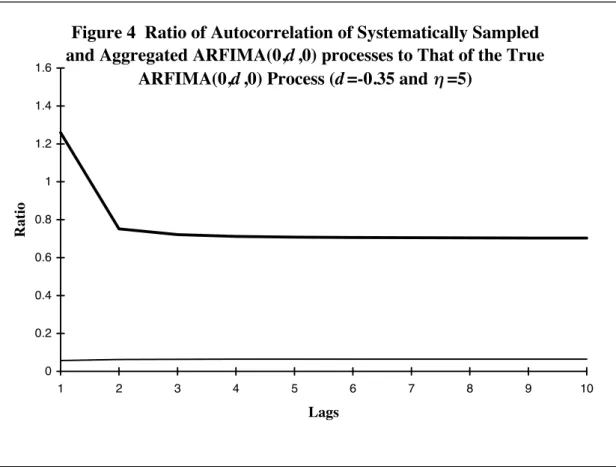
systematic sampling. Figures 2 and 4 show the ratios of the autocorrelations of xtDSF to those
of the true process in various lags, which are always less than 1. Therefore, although we may
estimate the true d by considering low frequencies or equivalently remote autocorrelations, a
systematically sampled ARFIMA(0,d,0) process becomes less persistent than the true
ARFIMA(0,d,0) process.
A discrete aggregated ARFIMA(0,d,0) process, xtDAF, can be obtained by summing a
discrete true ARFIMA(0,d,0) process, xtDF, up to (8$1)/8 lags.
t DAF
j=0-1 t j DF
-d t
-d-1 t
x = x
= (1+ L + L L ) (1- L )
= (1- L) (1- L ) 8
8
8 8
8
8 8
8
*
*
9 $
$
+ /
,...,
1 2 1 1
1 (13)
We present a theorem concerning autocovariance, autocorrelation, and spectral density
functions of a temporally aggregated ARFIMA(0,d,0) process. This generalises theorem 1 (b)
of Chambers (in press), where he only derives spectral density functions of temporally
Theorem 2 Temporally Aggregated ARFIMA(0,d,0) Process
Under assumption 1 and definition 1, the discrete aggregated ARFIMA(0,d,0) process, xtDAF,
is defined as
x k d
k d
t DAF
t k j k j = + + & & $ $ = % = $ ' ' ' ( )
( 1) ( )
0 0 1 * 8 8 8
= 1, 2, 3, ... t (14)
The autocovariance, 1DAF( , ) , s 8 autocorrelation, 3DAF( , ) , s 8 and spectral density functions,
SDAF( , )/ 8 , of xt
DAF
for s.0, 8.1, and 0</"0 are given by
1 8 2 8 8
8 8 8 8 8 8 8 8 DAF s d
d d d
s d s d s d s d s d s d ( , ) ( ) ( ) ( ) ( )[ ( ) ( ) ( ) ( ) ( ) ( ) ], = $ + + $ + + + $ + + + + $ $ $ $ + + $ 2 1 2
2 1 2 1 1
1 1 2 1 ' ' ' ' ' ' ' ' ' (15) 3 8 8 8 8 8 8 8 8 8 8 8 8 8 DAF s s d s d s d s d s d s d d d d d ( , ) ( ) ( ) ( ) ( ) ( ) ( ) ( ) ( ) ( ) ( ) = + + + $ + + + + $ $ $ $ + + $ + + $ + $ + $ ' ' ' ' ' ' ' ' ' ' 1 1 2 1
2 1 2 1
(16) , + + $ $ $ + $ , + $ + $ - % + + + + + + + $ 8 8 8 8 8
1 2 1 2 1 2 1 2
1 2
1 2
1 2
2 1
1 1 2
2 2 1
1 2 1
d d d d
d
d
d
d
s s s
d d d d d d s as [( ) ( ) ] ( ) ( ) ( ) ( ) ( ) , ' ' ' ' , for large s
using Taylor series up to second order,
SDAF
d
( , ) ( sin ) ( )( sin )
/ 8 2
0 / 8 / = $ + 2
2 1 2
2 2 2 2 2 (17)
,2 + $
-08 / /
2
2 2 2
2 0
d d
as
, ,
where 8 is a sampling interval, s is a lag between observations, / is a frequency, and 22 is a
variance of *t.
The limiting spectral density and autocorrelation functions show that the decay rate of
the ARFIMA(0,d,0) process is not changed by temporal aggregation, identical to results in
theorem 1 (b) of Chambers (in press). However, as we can see in figure 1, when d=0.35 and
8=5, the autocorrelation function of the aggregated process is always larger than that of the
true process. For positive d, 8
8
1 2
1 2
1 2 1
+
+
+
$ +
$ d
d
d d
d d
( )
( )
( )
' '
in equation (16) is always larger than its true
value '
'
( )
( )
1$d
d in (5). This is shown in figure 2 by the ratio of the autocorrelation of the
aggregated ARFIMA(0,d,0) process to that of the true ARFIMA(0,d,0) process when d=0.35
and 8=5. Therefore, although the limiting autocorrelation and spectral density functions do
not show any change in the decay rate, the level of the autocorrelation function moves
upward, making the aggregated ARFIMA(0,d,0) process more persistent than the true
ARFIMA(0,d,0) process. On the other hand, when -0.5<d<0, the ratio of the autocorrelation
function of the aggregated ARFIMA(0,d,0) process to that of the true ARFIMA(0,d,0)
process does not show a consistent pattern; see figure 4. However, the pattern of the
autocorrelation function of the aggregated ARFIMA(0,d,0) process in figure 3 is typical for a
larger negative d value. Therefore, for negative d, temporal aggregation makes the true
ARFIMA(0,d,0) process have a higher negative d. As a result, we conclude that, the absolute
value of the discrete time long memory parameter |d| of the aggregated ARFIMA(0,d,0)
process is larger than that of its true process. We present our conclusions in Proposition 1.
Proposition 1
In the discrete systematically sampled ARFIMA(0,d,0) processes, the absolute values of d are
biased toward zero, as the sampling interval 8 increases.
2. Temporal Aggregation Effect
In the discrete aggregated ARFIMA(0,d,0) process, the absolute value of d increases as the
sampling interval 8 increases.
A referee suggests that the ARFIMA(p,d,q) model rather than the ARFIMA(0,d,0)
model would be better to specify the autocorrelation functions of systematically sampled or
temporally aggregated discrete time long memory processes. Figures 2 and 4 support this
suggestion; the ratios of autocorrelation of systematically sampled and temporally aggregated
ARFIMA(0,d,0) processes are not constant over lags. That is, the ratios vary for short lags,
but they approach a constant for larger lags. In addition, the major changes in the levels of the
autocorrelation of systematically sampled and temporally aggregated ARFIMA(0,d,0)
processes occur in the first lag. Therefore, although the autocorrelation functions of
systematically sampled and temporally aggregated ARFIMA(0,d,0) processes are O(s2d-1) as
s-%, autocorrelation levels of systematically sampled and temporally aggregated
ARFIMA(0,d,0) processes are changed in short lags, generating a short memory process. In
these cases, ARFIMA(0,d,0) processes together with appropriate short memory processes
may be better specified than ARFIMA(0,d,0) processes for systematically sampled and
temporally aggregated ARFIMA(0,d,0) processes. However, we do not know what the
exactly specified model is or the dynamic period of the true underlying process. In this study,
we investigate the effects of sampling interval on the long memory parameter when sampling
Whilst the above analysis reflects the impact of temporal aggregation on the true
model, it does not deal with issues of estimation. We consider this problem in the next
section.
4 Finite Sample Properties of the Effects of Systematic Sampling and
Temporal Aggregation on Discrete Time ARFIMA(0,
d
,0) Processes
4.1 Maximum Likelihood Estimation
Many studies of long memory processes have used the frequency domain approach, since the
spectral generating function is generally easy to evaluate. Time domain maximum likelihood
is computationally difficult to use for large sample sizes because of the inversion of the T:T
covariance matrix. The frequency domain approximate log-likelihood is represented as
follows:
lnL( ) = lns( ) 1
2
I( ) s( ) k=
T-1
k
k
k k T
7 / /
/
$ $ &
=
$
1
2 1 1
1
9 , (18)
where I( ) =
e ( X - X )
2 T k
t=1 T
i t
t T
k
/
0
/
9
2
, s(/k) is a spectral density function, and
/k 0 k
T k
= 2 , and =1 2, , ..., -1T .
Fox and Taqqu (1986) prove that the estimates obtained using only the last term of
equation (18) are consistent and asymptotically normal. These results are extended by
Dahlhaus (1989) as in equation (18). Cheung and Diebold (1994) compare the exact time
domain ML estimates of Sowell (1992a) with the approximate frequency domain ML
estimates of Fox and Taqqu (1986). When the mean of a process is known, the time domain
feasible in practice. Time domain ML estimates with a sample mean do not seem to be
preferred to frequency domain ML estimates. In addition, when the sample size is more than
150 and d>0, there is little difference between the two, and the frequency domain ML
estimates are less biased than the time domain ML estimates. Therefore, Cheung and Diebold
(1994) suggest that the frequency domain ML estimation method is an attractive and efficient
alternative when large sample sizes are used. Hauser (1992) and Lee (1994) also find similar
results.
The recursive Levinson (1947)-Durbin (1960) algorithm is used for the generation of
the ARFIMA(0,d,0) process. The Cholesky decomposition is not a suitable method here,
because, as noted in GPH, it needs memory proportional to T2 and computation time
proportional to T3. Therefore, when as in this study T=1000, it becomes impractical to use the
Cholesky decomposition.
The GAUSS computer package is used for all computations. We use the same
GAUSS code as Lee (1994) for the generation of fractionally integrated processes. For the
numerical optimization method, the Broyden, Fletcher, Goldfard and Shanno (BFGS)
algorithm is used. However, when the BFGS algorithm cannot find the optimum, the
Davidon, Fletcher and Powell (DFP) algorithm, or the Newton-Raphson algorithm, or the
steepest descent method are used in that order. Convergence tolerance for the gradient of
estimated coefficients is set to 10-5.
Sampling intervals of 8 = 1, 5, 10, 15, 20 are explored. First, a sample size of
T=1,000 is generated and then, the original time series are transformed into systematically
sampled or temporally aggregated processes. Systematically sampled processes are obtained
xt x S
t
,8 = 8 (19)
where xt s
,8 is a systematically sampled process with a sampling interval 8 and xt is the
originally generated series. When 8=1, the frequencies of the true process are the same as the
observation frequencies. However, when 8>1, the transformed process becomes a
systematically sampled process with sampling interval 8. To explore temporal aggregation
effects, the original process is temporally aggregated as follows6:
t, A
k= t-k x = 8 x
8
8
0 1
$
9 (20)
Since the sample size decreases according to the increase in the sampling interval, the sample
sizes for the sampling intervals 8=1, 5, 10, 15, 20 are 1,000, 200, 100, 66, 50, respectively.
For the ARFIMA(0,d,0) process, equation (18) is used for the likelihood function.
The spectral density functions for the ARFIMA(0,d,0) process are
d k d
k
S 2 1 2
2
)) cos( 1 ( 2 ) (
/ 0
2
/ 8
$
= + (21)
where 282 is the variance of the white noise variables of systematically sampled or
temporally aggregated ARFIMA(0,d,0) processes. Since the exact values of the variance are
not known for systematically sampled and temporally aggregated processes7, we estimate {d,282} for the ARFIMA(0,d,0) model for all 8.
As shown in section 3, the autocorrelations of systematically sampled and aggregated
processes are also a function of the parameters d. Therefore, ten points in both the parameter
d of the ARFIMA process are explored: d=±0.05, ±0.15, ±0.25, ±0.35, ±0.45. For each {d, 8}
set, 1000 Monte Carlo replications are performed. For the starting values of d, the true d
processes are used for the starting values of 282. The bias, standard deviation, and mean
square error (MSE) of the estimated d are computed.
The results of 1000 replications of the ML estimation of the ARFIMA(0,d,0)
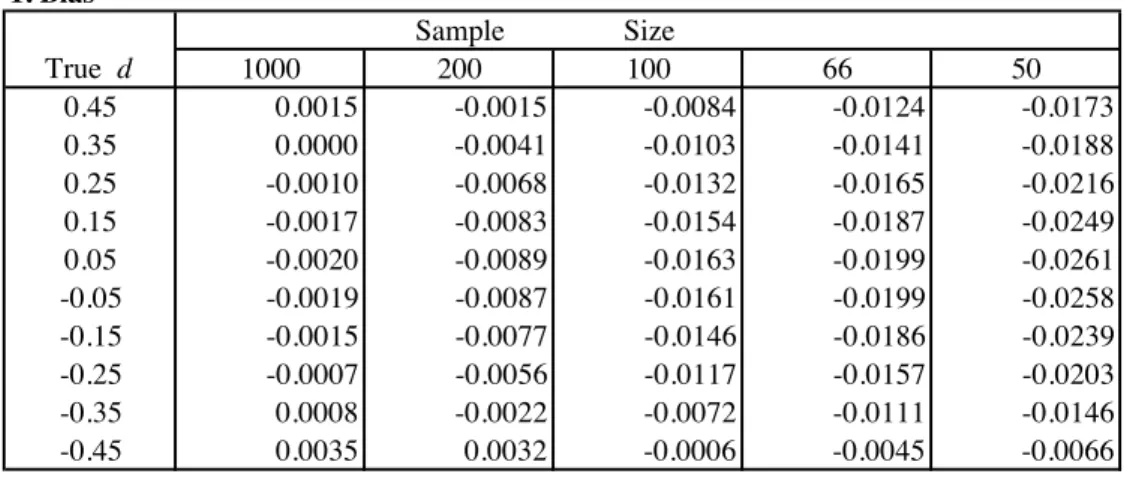
processes are reported in tables 1 to 3. Table 1 shows the finite sample properties of the
frequency domain approximate ML estimation for the original ARFIMA(0,d,0) process at
sample sizes of T=1000, 200, 100, 66, 50, respectively. The results for the ARFIMA(0,d,0)
process are consistent with those of Hauser (1992) and Lee (1994). As expected, the
estimation bias and standard deviation of estimates tend to increase, as the sample size
becomes smaller.
Table 2 shows the simulation results for the finite sample properties of the
systematically sampled process. As explained in the previous section, for the systematically
sampled process, long memory parameters are biased toward zero. The finite sample
properties of the systematic sampling effects can be summarised as follows. Firstly, the
systematic sampling effect appears in the ARFIMA(0,d,0) process. When the dynamics of the
true process are more frequent than the observations of the process, the estimates of the
observed systematically sampled process are always biased toward zero. Table 2 shows that
the bias is larger in -0.5<d<0 than in 0<d<0.5. This is because in -0.5<d<0, long memory
processes have similar properties to those of short memory processes.
Our second investigation looks at the temporal aggregation effects, see table 3. As
expected, in the aggregated ARFIMA(0,d,0) process, the aggregation effect has upward bias.
The simulation results support what we found in the section 3, that is, the absolute magnitude
of the long memory parameter, |d|, of the aggregated ARFIMA(0,d,0) process is greater than
Table 3 show that the magnitude of the bias depends on the sampling interval; the
bias of the aggregated ARFIMA(0,d,0) process increases as 8 increases. However, after some
sampling intervals, it shows little difference. This can be explained by the autocorrelation
function of (16). As 8 becomes infinitely large, the limiting autocorrelation function can be
represented as
3 8 8
8
8 DAF
d d
d
s d d d s
d d
( , , ) ( )
( )
( )
.
, +
$ +
$
, - %
+ $
+
1 2 2 1
1 2 1 2
1
' '
d(1+ 2d)s2d -1, as
(22)
Therefore, for an infinitely large 8 the autocorrelation is not a function of 8. Note that the
above limiting autocorrelation function is the same as that of the discrete time fractional
Gaussian noise process, see Mandelbrot and Van Ness (1969). The dynamics of the true
process which have an infinitestimal interval in continuous time long memory processes
are equivalent to an infinitely large 8 in discrete time long memory processes.
4.2 Further Considerations
Chambers (in press) shows that the true long memory parameter d can be estimated
regardless of sampling interval, since the decay rates of the spectral density function are not
affected by systematic sampling or temporal aggregation. Our results agree with his for both
spectral density and autocorrelation functions; see equations (11), (12), (16), and (17).
To further investigate whether or not estimates obtained using low frequencies reflect
the true long memory parameter d, we use simulations with the semiparametric regression
analysis of Geweke and Porter-Hudak (1983) (GPH). GPH concentrate on low frequencies
represented as8
ln I( j) = c - d (ln sin( )) j
j
/ 2 / *
2 2
+ (23)
where c is a constant. The long memory parameter d can be estimated with j=1,2,...,g(T),
where
Tlim ( )-%g T =%and Tlim ( ) /-%g T T =
0 . That is, g(T) should be sufficiently small compared
with T. Here, g(T)9 is set equal to T0.5. As presented in equation (23), the semiparametric method of GPH uses only the decay rate of fractionally integrated processes. Since systematic
sampling and temporal aggregation do not affect the decay rate of the true long memory
process, the GPH method is a more appropriate method to estimate the true unobserved long
memory parameter than parametric methods such as those used in the previous subsection.
Four points, d=±0.15, ±0.35 at sampling intervals 8=1, 5, 10, 15, 20 are considered in
both the systematically sampled and temporally aggregated ARFIMA(0,d,0) processes. Other
simulation conditions are the same as those of the ML estimation of subsection 4.1.
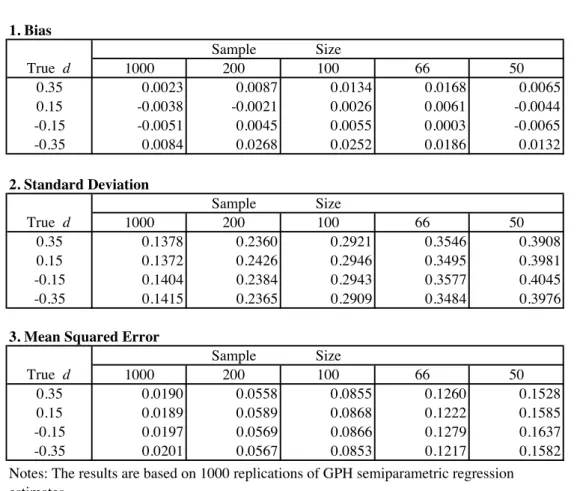
Tables 4 to 6 show the results of 1,000 replications of GPH’s semiparametric
estimation. Table 4 represents finite sample properties of GPH’s estimates. The estimation
bias is small and seems robust to changes in sample size and d10. The standard deviation is also robust to the changes in the value of the true parameter. However, the standard
deviations are larger than those of the ML estimates in table 1 and seem very large for small
samples. This is because the number of periodograms used in GPH estimation is only T0.5. Therefore, the MSEs of the GPH estimates are high compared with those of ML estimates
and the GPH estimates are not efficient for small samples11.
Let us first consider the finite sample properties of systematically sampled processes.
Table 5 shows that the estimation bias is still present. Although the estimation biases are less
values, there is little difference between GPH and ML estimates. This may be because for
negative d, the discrete time long memory process has the properties of a short memory
process rather than those of a long memory process. However, as expected, for a temporally
aggregated long memory process, using low frequencies gives estimates close to the true long
memory parameter. Table 6 shows that the bias of estimates obtained using low frequencies is
small in the aggregated long memory process.
Therefore, for the finite samples considered in this study, the true d may not be
obtained when observed time series are systematically sampled. On the other hand, for the
temporally aggregated time series, we may obtain the true d by considering low frequencies.
However, note that standard deviations are relatively very high in the GPH’s semiparametric
estimates.
Chambers (in press) concentrates only on the decay rate of long memory processes
near the zero frequency and suggests that the true long memory parameter can be estimated
using the decay rate of the spectral density function at low frequencies. Our finite sampling
simulations show that GPH semiparametric estimates using only low frequencies may fail to
obtain the true long memory parameter when the observed time series is systematically
sampled or the number of observations is small. In addition, the true long memory parameter
may not be obtained when -0.5<d<0.
5 Conclusion
This study investigated the effects of systematic sampling and temporal aggregation on long
memory processes under the assumption that there was no change in model specification
section 3 and the simulations conducted in section 4, the following results are obtained: for
the ARFIMA(0,d,0) process, the absolute value of the long memory parameter, |d|, of the
temporally aggregated process is larger than the |d| of the true process which is larger than the
|d| of the systematically sampled process.
Our results are consistent with those of Chambers (in press) and Ding, Granger and
Engle (1992) who conjecture that temporal aggregation does not change the decay rate of
autocorrelations. One of the interesting properties of discrete time long memory processes is
that although the autocorrelation level is affected by systematic sampling or temporal
aggregation, the decay rate of the autocorrelations in remote lags or equivalently, the decay
rate of spectral densities at low frequencies is not affected by the sampling interval. For the
finite samples used in this study, GPH’s semiparametric regression gives a long memory
parameter close to its true value for the temporally aggregated process, while the estimates
are still biased toward zero for the systematically sampled long memory process.
However, it is worth pointing out that the autocorrelation function of discrete time
long memory processes shifts downwards or upwards by systematic sampling or temporal
aggregation. In this respect, although we may estimate the true long memory parameter using
the decay rates, we conclude that the sampling interval does impact on the long memory
parameter if we do not consider the changes in model specification. Empirical studies on the
existence of long memory processes in economic and financial time series may be affected by
the sampling interval. The probability that we find evidence of a long memory process
increases as the sampling interval increases for a temporally aggregated time series, if there
exists long memory. Our results in section 4 do suggest that for a large number of
observations such as in financial time series, the true long memory parameter may be
NOTES
1 The results for continuous time long memory processes can be obtained from the author on request.
2 We use ‘bias’ for the difference between the true long memory parameter values and the long memory
parameter values of the systematically sampled or temporally aggregated long memory processes. ‘Bias’ used in this study means a model misspecification bias. We use ‘estimation bias’ for the difference between the true values and the estimated parameter values to differentiate the ‘bias’ in this study.
3 Although d may be any real number, d is assumed to lie in the interval (-0.5, 0.5) with a finite number of
difference.
4 Moving average (MA) representation will be used for our explanation. The autoregressive (AR) representation
can be inferred from the MA representation. That is, the d of the MA representation is equal to -d of the AR representation.
5 See Granger and Joyeux (1980) and Hosking (1981) for proof.
6 Sample size of both systematically sampled and aggregated processes when 8=15 is 66 and only the first 990
observations from the original sample size of 1000 are used.
7 Only when 8=1, 2 1
2 is known to be 1.
8 This equation is a logarithmic transformation of equation (6).
9 The GPH method has some difficulties in selecting g(T); see Sowell (1992b) and Hurvich and Beltrao (1993).
GPH suggest that g(T)=T0.5 is appropriate and Diebold and Rudebusch (1989) and Cheung (1993) also show that the exponent (0.5) is appropriate.
10 The biases of the GPH estimates are found in the presence of AR or MA processes (Agiakloglou, Newbold
and Wohar, 1993) and in either non-invertible (d=-0.5) or nonstationary (d=0.5) ARFIMA(0,d,0) processes (Hurvich and Ray, 1995).
11 See Sowell (1992a) for the simulation results of the finite sample properties of GHP, time domain ML, and
REFERENCES
Agiakloglou, C., P. Newbold, and M. Wohar (1993) Bias in an Estimator of the Fractional
Difference Parameter. Journal of Time Series Analysis 14, 235-246.
Chambers, M. (in press) Long Memory and Aggregation in Macroeconomic Time Series.
International Economic Review.
Chambers, M. (1996) The Estimation of Continuous Parameter Long-memory Time Series
Models. Econometric Theory 12, 374-390.
Cheung, Y. (1993) Long Memory in Foreign-Exchange Rates. Journal of Business and
Economic statistics 11, 93-101.
Cheung, Y., and F. Diebold (1994) On Maximum Likelihood Estimation of the Differencing
Parameter of Fractionally-Integrated Noise with Unknown Mean. Journal of
Econometrics 62, 301-316.
Dahlhaus, R. (1989) Efficient Parameter Estimation for Self-Similar Processes. The Annals of
Statistics 17, 1749-1766.
Diebold, F. X., and G. D. Rudebusch (1989) Long Memory and Persistence in Aggregate
Output. Journal of Monetary Economics 24, 189-209.
Ding, Z., C. Granger, and R. F. Engle (1992) A Long memory Property of Stock Market
Returns and a New Model. Discussion paper 92-21, Department of Economics,
University of California, San Diego.
Fox, R., and M. S. Taqqu (1986) Large-Sample Properties of Parameter Estimates for
517-532.
Geweke, J., and S. Porter-Hudak (1983) The Estimation and Application of Long Memory
Time Series Models. Journal of Time Series Analysis 4, 221-238
Gradshteyn, I. S., and I. M. Ryzhik (1994) Table of Integrals, Series, and Products. Fifth
Edition, Academic Press.
Granger, C., and R. Joyeux (1980) An Introduction to Long-Memory Time Series Models and
Fractional Differencing. Journal of Time Series Analysis 1, 15-29
Hauser, M. A. (1992) Long Range Dependence in International Output Series: A
Reexamination. Working Paper, Department of Statistics, University of Economics
and Business Administration.
Hidalgo, J., and Y. Yajima (1996) Semiparametric Estimation of the Long-range Parameter.
Unpublished manuscript.
Hosking, J. (1981) Fractional Differencing. Biometrika 68, 165-76
Hurvich, C. M., and K. I. Beltrao (1993) Asymptotics for the Low-Frequency Ordinates of
the Periodogram of Long-Memory Time Series. Journal of Time Series Analysis 14,
455-472.
Hurvich, C. M., and B. K. Ray (1994) Estimation of the Memory Parameter for
Nonstationary or Noninvertible Fractionally Integrated Processes. Journal of Time
Series Analysis 16, 17-41.
Lee, D. (1994) Asymptotic Theory for Long-Memory Time Series. Michigan State University
PhD Dissertation.
Mandelbrot, B., and J. Van Ness (1968) Fractional Brownian Motions, Fractional Noises and
Mcleod, A. I., and K. W. Hipel (1978) Preservation of the Rescaled Adjusted range, 1, A
Reassessment of the Hurst Phenomenon. Water Resource Research 14, 491-508.
Robinson, P. M. (1994) Semiparametric Analysis of Long-memory Time Series. Annals of
Statistics 22, 515-539.
Robinson, P. M. (1995) Log-periodogram Regression of Time Series with Long Range
Dependence. Annals of Statistics 23, 1048-1072.
Sowell, F. (1990) The Fractional Unit Root Distribution. Econometrica 58, 495-505.
Sowell, F. (1992a) Maximum Likelihood Estimation of Stationary Univariate Fractionally
Integrated Time Series Models. Journal of Econometrics 53, 165-188
Sowell, F. (1992b) Modeling Long-Run Behavior with the Fractional ARIMA Model.
APPENDIX
Proof of Theorem 1 Systematically Sampled ARFIMA(0,d,0) Process.
The spectral density function of xDSF in equation (12) is easily obtained from equation (8).
The autocovariance function of xDSF , 1DSF( , ) , has an s8 8s lag between observations in the
true process. That is, a lag of magnitude s between observations in systematically sampled
ARFIMA(0,d,0) is equivalent to a lag of magnitude 8s in the true ARFIMA(0,d,0) process.
Therefore, we can use equation (4) to derive 1DSF( , ) by simply replacing s 8 s with 8s.
Mathematically, 2 2 2 2 2 2 2 2 2 2 1 1 1 1 1 2 1 1 1 2 1 1 1 1 1 1 2 1 2 1 1 1 1 1 1 1 3 3 2 2 2 2 1 1 1 1 3 2 2 1 2 1 1 2 1 2 8 ' ' ' ' 8 ' ' 8 ' ' 8 ' 8 ' ' 8 ' ' 2 8 8 8 ' ' 8 ' ' 2 8 8 8 8 8 8 8 ' ' 8 ' ' 2 ' 8 ' ' 8 ' ' 8 ' ' 8 ' ' 8 ' ' 8 ' ' 2 * ' ' ' * ' ' ' * * 8 ' ' 8 ' * 8 ' ' 8 ' * ' ' ' * 8 1 8 8 8 8 ) d s ( ) d ( ) d ( ) d ( ) d s ( ) d ( ) d s ( ) d ( ) s ( ) s ( ) d ( ) d s ( ) d ( ) ; s ; d s , d ( F ) s ( ) d ( ) d s ( ) d ( ...] ) s )( s ( ) d ( d ) d s )( d s ( ) s ( d ) d s ( [ ) s ( ) d ( ) d s ( ) d ( ...] ) ( ) s ( ) d ( ) d s ( ) ( ) s ( ) d ( ) d s ( ) ( ) s ( ) d ( ) d s ( [ ) d ( ..)] ) ( ) d ( ) d ( ) ( ) d ( ) d ( ( ..) ) s ( ) d ( ) d s ( ) s ( ) d ( ) d s ( .. ) ( ) d ( ) d ( ( E[ = ) x , x ( Cov ) , s ( s t s t s t s t s t t t DSF s t DSF t DSF $ + $ $ + = $ $ + $ + + + = + + + + = + ( + + + + + + + + + + + + = + + + + + + + + + + + + + = + + + + + : + + + + + + + + + + + = $ $ $ $ $ $ $ $ $ $ (A1)
F( , ; ; ) ( ) ( ) ( ) ( )( ) ( )( ) ( )( ) ... ( ) ( ) ( ) ( )
; < 1 ; < 1
; ; < < 1 1
; ; ; < < <
1 1 1
1 1 ; <
1 ; 1 < 1 ; <
1 1 1
1 1
1 1 2
1 2 1 2
1 2 1 2 3
= + ( ( + + + + ( ( + + + + + + + ( ( ( + = $ $ $ $
[ > + ]
(9.122, p1068, Gradshteyn and Ryzhik, 1994).
' '
' ' (A2)
The autocorrelation function in equation (11) follows straightforwardly.!
Proof of Theorem 2 Temporally Aggregated ARFIMA(0,d,0) Process.
Let us define 1DF(s) as the autocovariance function of the true underlying fractionally
integrated process DF t
x , where s is a lag between observations. That is,
. ) d s ( ) d ( ) d ( ) d s ( ) d ( ) x , x ( Cov ) s ( DF / s t DF t DF 2 1 1 2 1 2 ' ' ' ' ' 1 8 $ + $ + $ = = $
This is actually the same as equation (4) as explained after Definition 1 of page 10. Then the
autocovariance function of xtDAF is
], ) d s ( ) d s ( ) d s ( ) d s ( ) d s ( ) d s ( [ ) d ( ) d ( ) d ( ) d ( ] ) i s d ( ) i s d ( ) i s d ( ) i s d ( ) s d ( ) s d ( [ ) d ( ) d ( ) d ( ) i s ( ) i s ( ) s ( ) i s ( ) i ( ) i s ( ) i ( ) s ( ) x , x ( Cov ) , s ( k i k k i i i k DF i i k DF DF i DF i DF DF k DF / k s t k DF / k t DAF $ + + $ $ $ $ + + + + $ + + + $ + + $ = + + $ + + + $ + $ $ + + + $ + $ $ $ = + + $ + $ = + $ + $ $ + $ = =
&
&
&
& &
& &
&
&
&
&
$ = = $ = $ = $ = $ = $ = $ = $ = $ = $$ $ = $ 8 ' 8 ' 8 8 ' 8 8 ' 8 8 ' 8 8 ' ' ' ' 2 8 ' 8 ' 8 ' 8 ' 8 ' 8 ' ' ' ' 2 8 1 8 1 8 81 8 1 8 8 1 8 8 81 8 1 8 8 8 8 8 8 8 8 8 8 8 8 1 2 1 1 1 1 2 1 2 2 1 1 1 1 1 2 1 2 0 1 0 2 1 0 1 1 0 1 1 0 1 0 1 0 1 0 (A3)' ' ' ' ' ' ( ) ( ) [ ( ) ( ) ( ) ( ) ]. a k
b k a b
a N b N a b k N + + = + $ + + + $ + & = 1 1 1 1 1 (A4)
The variance function of xtDAF is
] ) d ( ) d ( ) d ( ) d ( ) d ( ) d ( [ ) d ( ) d ( ) d ( ) d ( ) , ( DAF $ + $ $ $ $ + + + $ + + $ + + $ = ' ' 8 ' 8 ' 8 ' 8 ' ' ' ' 2 8 1 1 2 1 1 1 1 2 1 2 2 1 0 2 (A5)
Using the following equation (see 8.334, p946, Gradshteyn and Ryzhik, 1994)
) x sin( ) x ( ) x ( 0 0 '
' 1$ = (A6)
we have )) d ( sin( ) d ( ) d ( 8 0 0 8 ' 8 ' + $ = + $ $ + 1 (A7) )) d ( sin( ) d ( ) d ( 8 0 0 8 ' 8 ' $ $ = $ $ + + 1 (A8)
Since 8 is a positive integer, equation (A7) is the same as equation (A8). Equating and
rearranging the two equations, we have
) d ( ) d ( ) d ( ) d ( 8 ' 8 ' 8 ' 8 ' + $ + + = $ $ $ + 1 1 (A9)
Therefore, we have
] ) d ( ) d ( ) d ( ) d ( [ ) d ( ) d ( ) d ( ) d ( ) , ( DAF $ + $ + $ + + $ + + $ = ' ' 8 ' 8 ' ' ' ' 2 8
1 2 1 2 1
1 1 2 1 2 2 1 0 2 (A10)
The autocorrelation function of DAF t
x is obtained using autocovariance function (A3) and
variance function (A9) of xtDAF, and the spectral density function of DAF t
x follows from
Table 1 Finite Sample Properties of the Frequency Domain Approximate Maximum Likelihood Estimation of ARFIMA(0,d,0) Processes
1. Bias
Sample Size
True d 1000 200 100 66 50 0.45 0.0015 -0.0015 -0.0084 -0.0124 -0.0173 0.35 0.0000 -0.0041 -0.0103 -0.0141 -0.0188 0.25 -0.0010 -0.0068 -0.0132 -0.0165 -0.0216 0.15 -0.0017 -0.0083 -0.0154 -0.0187 -0.0249 0.05 -0.0020 -0.0089 -0.0163 -0.0199 -0.0261 -0.05 -0.0019 -0.0087 -0.0161 -0.0199 -0.0258 -0.15 -0.0015 -0.0077 -0.0146 -0.0186 -0.0239 -0.25 -0.0007 -0.0056 -0.0117 -0.0157 -0.0203 -0.35 0.0008 -0.0022 -0.0072 -0.0111 -0.0146 -0.45 0.0035 0.0032 -0.0006 -0.0045 -0.0066
2. Standard Deviation
Sample Size
True d 1000 200 100 66 50 0.45 0.0268 0.0671 0.1036 0.1267 0.1544 0.35 0.0264 0.0662 0.0995 0.1259 0.1546 0.25 0.0261 0.0656 0.0993 0.1264 0.1543 0.15 0.0260 0.0655 0.0989 0.1266 0.1529 0.05 0.0259 0.0655 0.0990 0.1267 0.1532 -0.05 0.0258 0.0655 0.0992 0.1268 0.1534 -0.15 0.0258 0.0656 0.0995 0.1270 0.1538 -0.25 0.0258 0.0657 0.1000 0.1274 0.1546 -0.35 0.0260 0.0661 0.1008 0.1282 0.1558 -0.45 0.0265 0.0671 0.1024 0.1296 0.1574
3. Mean-Squared Error
Sample Size
Table 2 Finite Sample Properties of the Frequency Domain Approximate Maximum Likelihood Estimation of Systematically Sampled
ARFIMA(0,d,0) Processes
1. Bias
Sampling Interval (=)
True d 1 5 10 15 20 0.45 0.0015 -0.1188 -0.1638 -0.2001 -0.2200 0.35 0.0000 -0.1320 -0.1798 -0.2159 -0.2335 0.25 -0.0010 -0.1289 -0.1690 -0.1996 -0.2114 0.15 -0.0017 -0.1007 -0.1244 -0.1472 -0.1518 0.05 -0.0020 -0.0441 -0.0512 -0.0679 -0.0684 -0.05 -0.0019 0.0355 0.0390 0.0251 0.0261 -0.15 -0.0015 0.1289 0.1370 0.1238 0.1248 -0.25 -0.0007 0.2289 0.2379 0.2243 0.2249 -0.35 0.0008 0.3315 0.3396 0.3253 0.3255 -0.45 0.0035 0.4348 0.4411 0.4262 0.4262
2. Standard Deviation
Sampling Interval (=)
True d 1 5 10 15 20 0.45 0.0268 0.0623 0.0981 0.1263 0.1523 0.35 0.0264 0.0609 0.0959 0.1258 0.1509 0.25 0.0261 0.0601 0.0951 0.1243 0.1499 0.15 0.0260 0.0606 0.0955 0.1238 0.1490 0.05 0.0259 0.0622 0.0961 0.1226 0.1495 -0.05 0.0258 0.0631 0.0965 0.1217 0.1510 -0.15 0.0258 0.0632 0.0967 0.1212 0.1529 -0.25 0.0258 0.0628 0.0965 0.1209 0.1548 -0.35 0.0260 0.0623 0.0963 0.1208 0.1562 -0.45 0.0265 0.0618 0.0962 0.1209 0.1571
3. Mean-Squared Error
Sampling Interval (=)
Table 3 Finite Sample Properties of the Frequency Domain Approximate Maximum Likelihood Estimation of Temporally Aggregated
ARFIMA(0,d,0) Processes
1. Bias
Sampling Interval (=)
True d 1 5 10 15 20 0.45 0.0015 0.0916 0.1041 0.0977 0.0909 0.35 0.0000 0.0694 0.0802 0.0776 0.0687 0.25 -0.0010 0.0480 0.0562 0.0540 0.0463 0.15 -0.0017 0.0267 0.0307 0.0262 0.0177 0.05 -0.0020 0.0052 0.0046 -0.0030 -0.0119 -0.05 -0.0019 -0.0165 -0.0224 -0.0335 -0.0427 -0.15 -0.0015 -0.0380 -0.0500 -0.0651 -0.0745 -0.25 -0.0007 -0.0587 -0.0774 -0.0968 -0.1068 -0.35 0.0008 -0.0773 -0.1028 -0.1259 -0.1370 -0.45 0.0035 -0.0910 -0.1223 -0.1473 -0.1598
2. Standard Deviation
Sampling Interval (=)
True d 1 5 10 15 20 0.45 0.0268 0.0708 0.1038 0.1348 0.1603 0.35 0.0264 0.0673 0.0995 0.1288 0.1530 0.25 0.0261 0.0655 0.0969 0.1280 0.1530 0.15 0.0260 0.0652 0.0962 0.1272 0.1520 0.05 0.0259 0.0652 0.0963 0.1265 0.1532 -0.05 0.0258 0.0651 0.0962 0.1267 0.1542 -0.15 0.0258 0.0651 0.0961 0.1271 0.1554 -0.25 0.0258 0.0652 0.0965 0.1278 0.1568 -0.35 0.0260 0.0657 0.0976 0.1290 0.1584 -0.45 0.0265 0.0675 0.1004 0.1314 0.1599
3. Mean-Squared Error
Sampling Interval (=)
Table 4 Finite Sample Properties of the Semiparametric Regression Analysis of GPH for ARFIMA(0,d,0) Processes
1. Bias
Sample Size
True d 1000 200 100 66 50 0.35 0.0023 0.0087 0.0134 0.0168 0.0065 0.15 -0.0038 -0.0021 0.0026 0.0061 -0.0044 -0.15 -0.0051 0.0045 0.0055 0.0003 -0.0065 -0.35 0.0084 0.0268 0.0252 0.0186 0.0132
2. Standard Deviation
Sample Size
True d 1000 200 100 66 50 0.35 0.1378 0.2360 0.2921 0.3546 0.3908 0.15 0.1372 0.2426 0.2946 0.3495 0.3981 -0.15 0.1404 0.2384 0.2943 0.3577 0.4045 -0.35 0.1415 0.2365 0.2909 0.3484 0.3976
3. Mean Squared Error
Sample Size
Table 5 Finite Sample Properties of Semiparametric Regression Analysis of GPH for Systematically Sampled ARFIMA(0,d,0) Processes
1. Bias
Sampling Interval (=)
True d 1 5 10 15 20 0.35 0.0023 -0.0567 -0.1212 -0.1533 -0.2013 0.15 -0.0038 -0.0796 -0.1101 -0.1229 -0.1355 -0.15 -0.0051 0.1374 0.1413 0.1539 0.1477 -0.35 0.0084 0.3413 0.3422 0.3489 0.3527
2. Standard Deviation
Sampling Interval (=)
True d 1 5 10 15 20 0.35 0.1378 0.2311 0.3067 0.3508 0.3976 0.15 0.1372 0.2332 0.2842 0.3438 0.3924 -0.15 0.1404 0.2362 0.2871 0.3399 0.3935 -0.35 0.1415 0.2472 0.2852 0.3454 0.3773
3. Mean Squared Error
Sampling Interval (=)
Table 6 Finite Sample Properties of Semiparametric Regression Analysis of GPH for Temporally Aggregated ARFIMA(0,d,0) Processes
1. Bias
Sampling Interval (=)
True d 1 5 10 15 20 0.35 0.0023 0.0033 0.0019 0.0125 0.0105 0.15 -0.0038 -0.0061 -0.0073 -0.0043 -0.0071 -0.15 -0.0051 -0.0145 -0.0238 -0.0276 -0.0377 -0.35 0.0084 -0.0036 -0.0229 -0.0382 -0.0493
2. Standard Deviation
Sampling Interval (=)
True d 1 5 10 15 20 0.35 0.1378 0.2351 0.2918 0.3562 0.4002 0.15 0.1372 0.2342 0.2904 0.3650 0.3973 -0.15 0.1404 0.2377 0.3041 0.3627 0.4132 -0.35 0.1415 0.2423 0.2954 0.3545 0.3970
3. Mean Squared Error
Sampling Interval (=)
Notes : The upper line represents the autocorrelation function of the aggregated ARFIMA (0,d,0) process, the middle line represents the autocorrelation function of the true ARFIMA(0,d,0) process, and the lower line represents the autocorrelation function of the systematically sampled ARFIMA(0,d,0) process. The autocorrelations up to 30 lags are calculated using exact autocorrelation functions and autocorrelations from 31 to 200 lags are calculated using limiting autocorrelation functions (see equations (11) and (16)).
Notes : The upper line represents the ratio of autocorrelations of the aggregated ARFIMA (0,d,0) process to those of its true ARFIMA (0,d,0) process. The lower line represents the ratio of autocorrelations of the systematically sampled ARFIMA(0,d,0) process to those of the true ARFIMA(0,d,0) process.
Figure 1 Autocorrelation Functions of True, Systematically Sampled and Aggregated ARFIMA(0,d,0) Processes
(d=0.35 and 8=5)
0 0.1 0.2 0.3 0.4 0.5 0.6 0.7
1 21 41 61 81 101 121 141 161 181
Lags (1 -200)
Autocorrelation
Figure 2 Ratio of Autocorrelation of Systematically Sampled and Aggregated ARFIMA(0,d,0) Processes to That of the True
ARFIMA(0,d,0) Process (d=0.35 and 8=5)
0 0.2 0.4 0.6 0.8 1 1.2 1.4
Notes : The thick line represents the autocorrelation function of the aggregated ARFIMA (0,d,0) process, the middle line represents the autocorrelation function of the true ARFIMA(0,d,0) process, and the thin (upper) line represents the autocorrelation function of the systematically sampled ARFIMA(0,d,0) process. The autocorrelations are calculated using exact autocorrelation functions.
Notes : The upper line represents the ratio of autocorrelations of the aggregated ARFIMA (0,d,0) process to those of its true ARFIMA (0,d,0) process. The lower line represents the ratio of autocorrelations
Figure 3 Autocorrelation Functions of True, Systematically Sampled and Aggregated ARFIMA(0,d,0) Processes
(d=-0.35 and 8=5)
-0.25 -0.2 -0.15 -0.1 -0.05 0 0.05
Lags (1-20)
Autocorrelation
Figure 4 Ratio of Autocorrelation of Systematically Sampled and Aggregated ARFIMA(0,d,0) processes to That of the True
ARFIMA(0,d,0) Process (d=-0.35 and 8=5)
0 0.2 0.4 0.6 0.8 1 1.2 1.4 1.6
1 2 3 4 5 6 7 8 9 10
Lags