Abstract—Applying multi-applications to Network-on-Chip (NoC) communication structure has been receiving increasing attention recently. In this paper, we present a multi-application mapping algorithm for 3D NoC, which target to balance on-chip latency. Besides, we propose an accurate analytical delay model based on M/G/1 queuing model, which can be used to optimize performance and verify the constraint of delay in terms of flow level. In order to verify the efficiency of our proposed approach, several sets of multi-application benchmarks are evaluated.
Simulation results show that the proposed algorithm reduces the maximum average latency by 18.32% and the standard deviation of latency by 15.57%.
Index Terms—3D Network-on-Chip, M/G/1 queuing model, multi-application mapping
I. INTRODUCTION
ith the advance of semi-conductor technologies, the amount of IP cores integrated on one chip continue to increase, which means that the challenge of communication is serious than ever. Network-on-Chip (NoC) has been introduced as a promising communication mechanism to provide high bandwidth and performance [1]. Meanwhile, the advent and increasing viability of 3D Integrated circuits make it possible to move from 2D NoC to 3D NoC [2]. 3D NoC has been adopted as a communication centric paradigm to address the interconnect issues in a many-core system.
Application mapping is one of the effective ways to optimize on-chip network performance, which is exercised at the early stage of the NoC based many-core system design.
Large numbers of researches [3-5] have been done for mapping applications onto NoC architectures. In [3], Hu et al.
presented a branch and bound algorithm which maps the tasks of an application to NoC nodes such that the total communication energy consumption is minimized under specified performance constraints. A NAMP algorithm is proposed to map IP cores onto the NoC architecture under the Manuscript received July 10, 2015. This work is supported by the Natural Science Foundation of China under Grant 61106018 and 61376025, the Industry-academic Joint Technological Innovations Fund Project of Jiangsu under Grant BY2013003-11.
Gui Feng, the College of Electrical and Information Engineering, Nanjing University of Aeronautics and Astronautics(NUAA), Nanjing 210016, China (email:[email protected])
Fen Ge, the College of Electrical and Information Engineering, NUAA, Nanjing 210016, China (email: [email protected]).
Ning Wu, the College of Electrical and Information Engineering, NUAA, Nanjing 210016, China (e-mail: [email protected]).
bandwidth constraint with the aim of minimizing communication delay [4]. Tang et al. proposed a two-step genetic algorithm and the related software for mapping applications on a fixed NoC architecture [5].
However, all these above typical approaches focus on the mapping of a single application. With the number of on-chip cores increasing, a single application could not make full use of the resources on one chip. To be cost effective, several different applications are often integrated on the same chip and executed in parallel. Several multi-application mapping methods are also proposed. Murali et al. presented a method to map multiple use-cases onto the NoC architecture with the constraints of each use-cases satisfied [6]. However, this method may suffer time overhead incurred by reconfiguring the NoC and loading new applications. Multi-objective adaptive immune algorithm(M2AIA) is proposed to minimize latency and power consumption [7]. In another approach called Incremental approach (INC) [8], it mainly takes two steps: the region selection and the task allocation.
INC deals with multi-applications in sequentially, which may lead to unfairness for resources between applications. Besides, all these approaches do not apply to 3D NoC.
Moreover, there are another two important issues for multi-application mapping, which the above approaches do not consider. One issue is that multi applications running in parallel on the same chip often have different and strict latency requirements. Simply taking the number of hops as the metrics of the packet latency [9] can not satisfy the performance evaluation requirements in the system design, which means an accurate analytical delay model is needed in this case. Another issue is that packet latency deviation is a critical metric for systems to provide quality-of-service guarantees [10]. Hence, not only the overall network latency should be reduced, the multi-application mapping should also balance the average packet latency experienced by different applications.
To address the issues presented above, in this paper, we propose a multi-application mapping framework for 3D NoC utilizing an accurate analytical delay model based on M/G/1 queuing model, which target to balance latency among multi-applications. The rest of the paper is organized as follows: Section II describes the M/G/1 delay model and problem definition. Section III presents our delay-aware mapping framework based on genetic algorithm.
Experimental results are demonstrated in section IV and finally we conclude our work in section V.
Balancing 3D Network-on-Chip Latency in Multi-Application Mapping based on M/G/1
Delay Model
Gui Feng, Fen Ge, and Ning Wu
W
II. PROBLEM FORMULATION AND DEFINITIONS A. 3D NoC architecture model
3D Mesh based NoC architecture is shown in Fig.1(a). In 3D NoC, IP cores are distributed on different 2D layers.
Various layers are stacked on top of each other with direct vertical interconnects. The structure of a single node is depicted in Fig.1(b). Every node contains an intellectual property (IP) core and a router with input channels and output channels. Each IP core performs its own computational, storage or I/O processing functionality, and is equipped with a network interface (NI). NI translates data between IP cores and routers by packeting/unpacketing data packets and also manages the packet injection process.
0 IP0 1
IP1
2 IP2 3 IP3
4 IP4 5 IP5
6 IP6 7 IP7
IP NI
LC
Crossbar Switch
Routing&
Arbitration
LC LC
Router
Input Channels Output Channels
Injection channel
Ejection channel
LC LC LC LC LC
LC LC LC LC LC LC
(a) A 3D Mesh based architecture (b) A node structure of 3D NoC Fig. 1. A 3D Mesh based NoC architecture and a node structure in this
architecture
The router is the key component of NoC, which is responsible for routing data packets on the on-chip network, thus it has a great influence on the network latency. For 3D NoC architecture, the router should have seven input/output ports in seven directions (East(E), South(S), West(W), North(N), Up(U), Down(D), Local(L)). And it comprises the following major modules.
Buffer. This is a finite FIFO buffer for storing packets in transmission. In the model shown in Fig.1(b), a buffer is associated with each input physical channel and each output physical channel. Usually, a buffer takes virtual channels to improve performance. In our work, each port of the router is equipped with six virtual channels, which equals to six possible directions from the adjacent router.
Link controller(LC). The flow of packets across the physical channel between adjacent routers is implemented by the link controller. The link controllers on either side of a channel coordinate to transfer flits.
Crossbar switch. This module is responsible for connecting input channels to output channels.
Routing and arbitration unit. This module implements the routing algorithms, selects the output channel for an incoming packet, and accordingly sets the crossbar switch. In this paper, we take deterministic routing algorithm.
B. M/G/1 delay model
According to the M/G/1 queuing model that is widely used in the network performance analysis, the delay analytical model we proposed for 3D NoC is based on the following assumptions:
(1) Each node in the network sending packets is independent of each other, and the arrival rate of the packets obeys the Poisson distribution.
(2) The network uses wormhole switching technology and XYZ routing algorithm.
(3) The length of the packet is fixed as M, and the width of the input buffer in the router is equal to the width of a flit.
(4) The length of input buffer for each virtual channel in the router is fixed to be F flits (1<<F<M).
(5) The local port of the router has infinite input buffer, which means it can deal with the data packets as fast as possible.
A specific application mapped on the NoC architecture usually consists of multiple data flows which realize the packets transmission from the source node to the destination node through on-chip network. The average network delay can be obtained by calculating the average delay of all the data flows in the application, which can be computed as follows:
, ,
1 1 1
1 1
( j j j j ( 1) )
m m d
N Li b x y z dir b Si
i i j
T T T d B T M W
m m
(1) where m is the number of the data flows. TLi denotes transmission delay of packets in a flow in NoC. Tb represents the time of a flit passing through a router with non-blocking.
, ,
j j j j
x y z dir
B is the block delay of a header flit that is blocked in the input buffer of the router j in the dir direction. The coordinates of the router is given by (x,y,z). dir represents the forward direction in a router, e.g. East(E), South(S), West(W), North(N), Up(U), Down(D) and Local(L). WSi is the waiting time of a head flit that is blocked in the source node.
TABLEI
PARAMETERS AND NOTATIONS IN ANALYTICAL MODEL
Parameters Explanation m Number of the date flows
TLi Transmission delay of packets in a date flow in NoC Tb Time of a flit travel through a router with non-blocking Bxj,yj,zj,dirj Block delay of a header flit that is blocked in the input
buffer of the dir direction at the router j
d Hops of a packet transmitting from the source node to the destination node
x,y,z,dir Block probability of a packet that is blocked in the dir direction of the buffer at (x,y,z).
x,y,z,dir Average waiting time of a packet being blocked in the buffer
Tix,y,z,dir Average service time of a packet
fij Probability of the packets transmitting from the i direction to the j direction the router
ij Arrival rate of packets in the input channel of the dir direction
j,k,l Packet injection rate of the node (j,k,l)
d(j,k,l)(j’,k’,l’) Probability of sending packets from node(j,k,l) to node (j’,k’,l’)
R(j,k,l,j’,k’,l’, x,y,z,dir)
Routing function
Px,y,z,dir’ Probability of buffer being occupied at (x,y,z)
x,y,z,dir->L Congestion probability of the data packet transmitting from the input buffer of dir direction to the local port T0 Service time of the network interface at the destination
node
Ai Number of the following routers that will affect the average service time
Px,y,z,dir Probability of the virtual channel being occupied v Number of virtual channels
dir,x,y,z,dir’ Arrival rate of the data packet from the dir direction of the upstream router to the dir’ direction of the local router TR Delay of the transmit network
x,y,z,L Arrival rate of the packet from the source node to the transmit network
From (1), it is clear to see that the key to calculate the average network delay in the application mapping is to attain the values of , ,
j j j j
x y z dir
B and WSi. All the parameters and their explanation used in our proposed analytical model are summarized in Table I.
(1) Calculate Bx y z dir, , ,
The block delay of a header flit that is blocked in the input buffer of the dir direction at the router (x,y,z) can be calculated as follows:
, , , , , , , , ,
x y z dir x y z dir x y z dir
B (2) where x y z dir, , , denotes the block probability of a packet being blocked in the buffer. x y z dir, , , is the average waiting time of a packet being blocked in the buffer.
In order to calculatex y z dir, , , , we need to calculate the transmit matrix Frepresented by:
0 0
0 0
0 0
0
NE NS NW NU ND NL
EN ES EW EU ED EL
SN SE SW SU SD SL
WN WE WS WU WD WL
UN UE US UW UD UL
DN DE DS DW DU DL
LN LE LS LW LU LD
f f f f f f
f f f f f f
f f f f f f
F f f f f f f
f f f f f f
f f f f f f
f f f f f f
(3)
In (3), fij is the probability of the packets transmitting from the i direction to the j direction of the router, which can be calculated as follows:
ij ij
ij j
f
(4) where ijis the arrival rate of the packets in the dir direction of the input channel., , , , , ( , , )( ', ', ')
, , ', ', '
( , , , ', ', ' , , , )
x y z dir j k l j k l j k l
j k l j k l
d R j k l j k l x y z dir
(5) where R j k l j k l x y z dir( , , , ', ', ' , , , ) is the routing function.
When the source node sends the data packet to the destination node using the input channel of the dir direction in the router (x,y,z), the function is set to be 1, else to be 0. As we take the XYZ routing algorithm, it is easy to get the packet arrival rate of each input channel in a router. Take the dir=E as an example to calculate the blocking probability, that is:
, , , , 1, , , 1, , , , 1,
, , 1, 1, , , , , ,
x y z E EN x y z S ES x y z N EU x y z D
ED x y z U EW x y z W EL x y z E L
f P f P f P
f P f P f
(6)
where Px,y,z,dir’ represents the probability of the buffer being occupied in the dir’ direction at the router(x,y,z), which will be discussed in detail in the following. x y z dir, , , L is the congestion probability of the data packet transmitting from the input buffer of the dir direction to the local port at the router (x,y,z). When the congestion happens, the local port should service for transmission from other directions. Hence, it can be drawn that:
, , , ' '
', ' '
x y z dir L dir L dir L
dir dir dir dir
(7)The average waiting time of a packet being blocked in the buffer x y z dir, , , can be drawn from the M/G/1 queuing model:
2
, , , , , ,
, , , 2
, , , , , , , , ,
( )
2(1 ) 1
x y z dir x y z dir b
x y z dir
x y z dir x y z dir x y z dir
Ti M T
Ti Ti
(8) In this study, we consider the wormhole switching with XYZ routing algorithm. A packet consisted of multiple flits is dispersed on multiple links. The elapsed time of packets in one link, which starts from the header flit entering this link to the last load flit leaving the link.
Fig. 2. Packet transmission with wormhole switching
One example of packet transmission with wormhole switching is shown in Fig.2, which presents the transmission process of a packet from router 6 to router 1. It assumes that the destination node is router 1, and the packet has 6 flits. In Fig.2(a), when the whole packet leaves the router 4, the header flit do not arrive the destination node, thus, only router 5 and router 3 will affect their average service time.
Meanwhile, in Fig.2(b), when the packets have not leave router 2, the header flit has entered into the destination node.
Hence, the following routers will affect its service time. From these, we can get the average service time of the ith router backward from the destination node along the transmission path:
1
1, 2,3,...
{
0i
b j
i j i Ai
b
M T B i
T i
M T
(9)where T0 is the service time of the network interface at the destination node. Ai is the number of the following routers that will affect the average service time, which can be calculated as follows:
[ / ] 1 [ / ]
{
1i
M F d i M F
A d i else
(10)
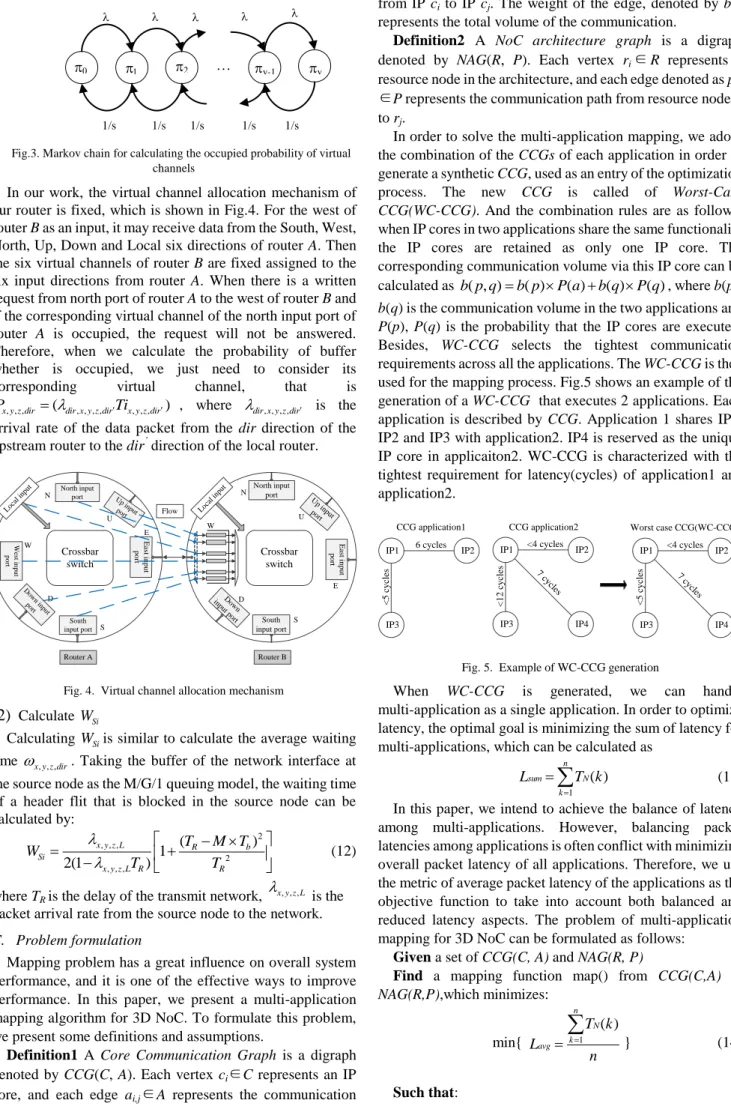
In [11], the author proposes an analytical method based on Markov. The method states that the probability of v virtual channel being occupied can be calculated through the Markov chain shown in Fig.3. In the Figure, the state of v
corresponds to the situation of v virtual channel whether is occupied. The transfer probability from state v to v1 is 1/S, where S is average service time. From the Markov model, the probability of v virtual channel being occupied can be computed as follows:
(1 )( ) 0 ( )
{
vv v
v V
S S
P S v V
(11)
If we take dynamic virtual channel allocation mechanism, Px,y,z,dir is the probability of all virtual channels being occupied.
That is Px y z dir, , , (x y z dir, , , Tix y z dir, , , )V, where v is the number of virtual channels.
header flit load flit (a)
(b) 6
6
5
5
4
4
3
3
2
2
1
1 Ai Ai
Fig.3. Markov chain for calculating the occupied probability of virtual channels
In our work, the virtual channel allocation mechanism of our router is fixed, which is shown in Fig.4. For the west of router B as an input, it may receive data from the South, West, North, Up, Down and Local six directions of router A. Then the six virtual channels of router B are fixed assigned to the six input directions from router A. When there is a written request from north port of router A to the west of router B and if the corresponding virtual channel of the north input port of router A is occupied, the request will not be answered.
Therefore, when we calculate the probability of buffer whether is occupied, we just need to consider its corresponding virtual channel, that is
, , , ( , , , , , , , )
x y z dir dir x y z dir x y z dir
P Ti , where dir x y z dir, , , , is the arrival rate of the data packet from the dir direction of the upstream router to the dir’ direction of the local router.
Crossbar switch
East input port
N Local input
S W
Router A
N Local input
S W
E
Router B
West input
port
E North input
port
South input port Dow
n inp po ut
rt
Upport input U
D
South input port
East input port
North input port
Dow inp n
ut port D
Up input port Flow U
Crossbar switch
Fig. 4. Virtual channel allocation mechanism
(2) Calculate WSi
Calculating WSiis similar to calculate the average waiting time x y z dir, , , . Taking the buffer of the network interface at the source node as the M/G/1 queuing model, the waiting time of a header flit that is blocked in the source node can be calculated by:
2 , , ,
2 , , ,
( )
2(1 ) 1
x y z L R b
Si
x y z L R R
T M T
W T T
(12)
where TR is the delay of the transmit network, x y z L, , , is the packet arrival rate from the source node to the network.
C. Problem formulation
Mapping problem has a great influence on overall system performance, and it is one of the effective ways to improve performance. In this paper, we present a multi-application mapping algorithm for 3D NoC. To formulate this problem, we present some definitions and assumptions.
Definition1 A Core Communication Graph is a digraph denoted by CCG(C, A). Each vertex ci∈C represents an IP core, and each edge ai,j∈A represents the communication
from IP ci to IP cj. The weight of the edge, denoted by bi,j, represents the total volume of the communication.
Definition2 A NoC architecture graph is a digraph denoted by NAG(R, P). Each vertex ri∈ R represents a resource node in the architecture, and each edge denoted as pi,j
∈P represents the communication path from resource node ri to rj.
In order to solve the multi-application mapping, we adopt the combination of the CCGs of each application in order to generate a synthetic CCG, used as an entry of the optimization process. The new CCG is called of Worst-Case CCG(WC-CCG). And the combination rules are as follows:
when IP cores in two applications share the same functionality, the IP cores are retained as only one IP core. The corresponding communication volume via this IP core can be calculated as b p q( , )b p( )P a( )b q( )P q( ), where b(p), b(q) is the communication volume in the two applications and P(p), P(q) is the probability that the IP cores are executed.
Besides, WC-CCG selects the tightest communication requirements across all the applications. The WC-CCG is then used for the mapping process. Fig.5 shows an example of the generation of a WC-CCG that executes 2 applications. Each application is described by CCG. Application 1 shares IP1, IP2 and IP3 with application2. IP4 is reserved as the unique IP core in applicaiton2. WC-CCG is characterized with the tightest requirement for latency(cycles) of application1 and application2.
IP1 IP2
IP3 6 cycles
<5 cycles
CCG application1
IP1 IP2
IP3 IP4
<4 cycles
<12 cycles
CCG application2
IP1 IP2
IP3 IP4
<4 cycles
<5 cycles
Worst case CCG(WC-CCG)
7 cycles 7 cyc
les
Fig. 5. Example of WC-CCG generation
When WC-CCG is generated, we can handle multi-application as a single application. In order to optimize latency, the optimal goal is minimizing the sum of latency for multi-applications, which can be calculated as
1
( )
n
sum N
k
L T k
(13) In this paper, we intend to achieve the balance of latency among multi-applications. However, balancing packet latencies among applications is often conflict with minimizing overall packet latency of all applications. Therefore, we use the metric of average packet latency of the applications as the objective function to take into account both balanced and reduced latency aspects. The problem of multi-application mapping for 3D NoC can be formulated as follows:Given a set of CCG(C, A) and NAG(R, P)
Find a mapping function map() from CCG(C,A) to NAG(R,P),which minimizes:
min{ 1
( )
n N avg k
T k
L n
} (14)
Such that:
… v-1 v
1/s 1/s 1/s 1/s 1/s
i f
T T
(15) where L is the average latency of multi-applications and n is the number of applications. Tf is the delay constraint of flow in an application. Hence, the goal of our proposed algorithm that maps CCG(C, A) to NAG(R, P) is to find a mapping according to equation(14), and satisfy performance constraint as equation (15) .
III. MULTI-APPLICATION MAPPING ALGORITHM In this paper, we propose a multi-application mapping algorithm for 3D NoC based on M/G/1 queuing model, which intend to achieve latency balance among multi-application.
The overview of the proposed approach is shown in Fig.6, which mainly has three phases.
Get delay of a flow
Get average delay of an application
Get average delay of multi-application - core communication
graph
- delay requirement
- topology - buffer size - routing algorithm - switching method WC-CCG generation
M/G/1 analytical model Phase 1
Phase 2
Phase 3 feedback
S1
S2
S3
Application Architecture
Mapping
GA Tool
Fig. 6. Multi-application mapping algorithm flow
In the first phase, we generate the WC-CCG for a set of multi-application, according to the delay requirements. The synthesis in detail is discussed in Part C of section II. In our paper, the delay requirement can be satisfied in flow level.
In the second phase, GA tool is taken to explore solution space. Firstly, we generate an initial population of n chromosome, which consists of many randomly generated IP core placements. Each chromosome is encoded into integer strings, with its length equal to the number of vertices in a CCG. Secondly, the fitness of each chromosome is evaluated and delay constraint is verified. The fitness function and delay constraint are given by (14) and (15) separately, which will be calculated in the following phase. Then, a new population is created by applying three operators similar to the natural selection operators – selection, crossover and mutation.
In the last phase, we calculate average delay utilizing M/G/1 queuing model. Three steps are executed sequentially in this phase:
Step1: The delay of a flow is computed using equation(6), (8), (2) and (12). Then, we verify whether the delay requirement is satisfied and feedback the result to phase2. If the delay requirement is not satisfied, the fitness is set to be zero.
Step2:The average delay of a single application is calculated by iterating Step1.
Step3:In this step, we calculate the average delay of multi-application utilizing the results from Step2.
As a result, the average delay of multi-application is obtained. And GA explores the optimal mapping utilizing the
results of M/G/1 delay model.
IV. EXPERIMENTALRESULTS
In this section, we present the experimental results obtained by executing the proposed approach on various multimedia benchmark applications. We generate three sets of benchmarks by TGFF[12] and each application in the sets is different, where the amount of data transferred from the source node to the destination node is randomly distributed.
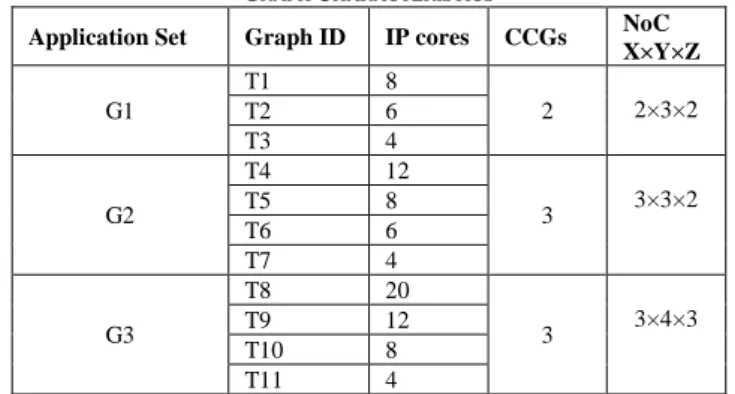
The application set information and the size of 3D Mesh NoC architecture are summarized in Table II. For simplification, the size of each IP core is assumed to be the same.
TABLEII GRAPH CHARACTERISTICS
Application Set Graph ID IP cores CCGs NoC X×Y×Z G1
T1 8
2 2×3×2
T2 6
T3 4
G2
T4 12
3 3×3×2
T5 8
T6 6
T7 4
G3
T8 20
3 3×4×3
T9 12
T10 8
T11 4
To verify the efficiency of the proposed mapping algorithm, we compare the results generated by our proposed method against random mapping. Besides, in order to evaluate the effect of latency balancing of the proposed approach, we compare two conditions one take equation (14) as the optimal goal, while the other take equation (13). Both of them are executed utilizing M/G/1 and GA tool. We denote the former by GA+M/G/1_avg, and the later by GA+M/G/1_sum.
Mapping results are evaluated in NoC simulator Nirgam[13]
and Orion[14].
(a)Power consumption comparison on overall system
(b)Latency comparison on overall system Fig. 7. The performance comparison on overall system
In Fig.7(a), we show a comparison of overall system on power consumption using three sets of benchmarks. From the figure, it can be seen that both cases of optimizing sum latency and average latency show better results than random mapping.
which save power consumption 21.43% and 17.62%
respectively. From Fig.7(b), we can see that taking the sum of latency as objective function saves 22.36% latency on average, while taking the average latency as the objection function saves 17.10% latency on average.
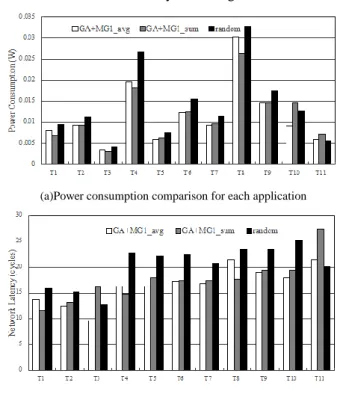
(a)Power consumption comparison for each application
(b)Latency comparison for each application Fig. 8. The performance comparison for each application In Fig.8, we show a comparison of power consumption and latency for each single application in different sets.
GA+M/G/1_avg saves 16.93% and 18.32% than random mapping on power consumption and latency respectively.
While GA+M/G/1_sum saves 12.92% and 12.20% than random mapping on power consumption and latency respectively. From the results, we can see that GA+M/G/1_sum has better performance on overall system.
The application has higher IP cores tend to be optimized greater than other applications in the same set. However, this may lead to unfairness for applications in the same set. Our proposed method is to take the average latency as the target goal, which can alleviate this difference and improves performance for individual application.
TABLEIII DELAY DEVIATION COMPARISON
Approach G1 G2 G3
GA+M/G/1 _avg 4.32 0.17 3.26
GA+M/G/1 _sum 5.48 1.92 18.75
random 2.71 0.77 4.54
Furthermore, we compare the deviation of the latency for multi-applications in different sets. And the results are summarized in Table III. It is obvious that our proposed method save 64.98% and 15.57% than the other two cases on average. For set G1, when the number of IP cores is small, the deviation of latency for three cases is narrowly matched.
When the number of IP cores increase, GA+M/G/1_avg shows better results than GA+M/G/1_sum, which prove our proposed method is an effective to achieve latency balance among multi-applications.
V. CONCLUSION
In this paper, we propose a multi-application mapping framework for 3D NoC utilizing an accurate analytical delay model based on M/G/1 queuing model, which target to balance latency among multi-applications. And GA algorithm is taken to solve the multi-application NoC mapping problem.
We applied our approach on several multi-applications benchmarks. Simulation results show that the proposed algorithm is able to save the maximum average latency by 18.32% and the deviation of latency by 15.57%, which prove our proposed method is an effective to achieve latency balance among multi-applications.
REFERENCES
[1] A. Hemani, A. Jantsch, S. Kumar, et al., “Network on chip: An architecture for billion transistor era,” Proceeding of the IEEE NorChip Conference, 31, 2000.
[2] S. Im and K. Banerjee, “Full chip thermal analysis of planar (2-D) and vertically integrated (3-D) high performance Ics,” Electron Devices Meeting, IEDM'00. Technical Digest. International. IEEE, p.727-730. 2000.
[3] J. Hu and R. Marculescu, “Energy-aware mapping for tile-based NoC architectures under performance constraints,” Proc. of Asia and South Pacific Design Automation Conference, Kitakyushu, Japan, p.233-239. 2003.
[4] S. Murali and G. De Micheli, “Bandwidth-constrained mapping of cores onto NoC architectures,” in Proc. of IEEE/ACM Design, Automation and Test in Europe Conference, Paris, France, pp.
896-901, 2004.
[5] T. Lei and S. Kumar, “A two-step genetic algorithm for mapping task graphs to network on chip architecture,” in Proc. of Euromicro Symposium on Digital System Design, Belek-Antalya, Turkey, 2003, pp. 180-187.
[6] Murali S. “Mapping and configuration methods for multi-use-case networks on chips”. Conference on Design Automation. IEEE, 2006,pp.146--151.
[7] Sepulveda J, Strum M, Chau W J, et al. “A multi-objective approach for multi-application NoC mapping,” IEEE Second Latin American Symposium on Circuits & Systems, 2011,pp.1 - 4.
[8] C.-L. Chou, U. Y. Ogras, and R. Marculescu, “Energy- and Performance-Aware Incremental Mapping for Networks on Chip With Multiple Voltage Levels,” IEEE Transactions on Computer-Aided Design of Integrated Circuits and Systems, vol. 27, no. 10, pp. 1866–1879, Oct. 2008.
[9] Pavlidis, Vasilis F., and E. G. Friedman. "3-D Topologies for Networks-on-Chip," IEEE Transactions on Very Large Scale Integration Systems15.10(2007), pp.1081-1090.
[10] Zhu D, Chen L, Yue S, et al. “Balancing On-Chip Network Latency in Multi-application Mapping for Chip-Multiprocessors,” 2014 IEEE International Parallel & Distributed Processing Symposium (IPDPS).
IEEE Computer Society, 2014, pp.872-881.
[11] W.J. Dally, “Virtual channel flow control,” IEEE Trans. Parallel Distrib. Systems 3(2),1992, pp.194–205.
[12] R.P.Dick, D.L.Rhodes, and W.Wolf, “TGFF:Task Graphs For Free,”
In Proceeding of International Workshop on Hardware/Software Codesign,1988.
[13] Lavina Jain, “NIRGAM Manual. A Simulator for NoC Interconnect Routing and Application Modeling,” 2007.
[14] A.B.Kahng, B.Li, L.S.Peh, and K. Samadi, “ORION2.0: A power area simulator for interconnection networks,” IEEE Trans. Very Large Scale Integr.(VLSI) Syst.,vol.20, pp.191-196,2012.