Abstract—Wireless networks have been widely and intensively used on a global scale. In accordance with such a use, the limitation of the total throughput of an access point (AP) for the network has become a problem. This problem is especially serious when the AP is accessed by a lot of wireless terminals because the total throughput of the AP becomes much smaller than expected due to the collision of accesses by the terminals.
IEEE 802.11 standards are usually adopted for such wireless networks and two basic access control methods are defined in the standards: distributed coordinated function (DCF) and point coordinated function (PCF). In general, DCF is preferable for the case with smaller number of terminals and PCF is preferable with larger number of terminals. However, even if such functions are appropriately selected in accordance with the number of terminals, the total throughput is much lower than its theoretical upper limit that we expect to achieve. Although a lot of researches have been conducted to solve this problem, their results are far from satisfactory since the total throughputs achieved by the researches are rather limited.
Thus, the purpose of this paper is to propose a novel approach to achieve high total throughput, which is close to its theoretical upper limit, regardless of the number of terminals accessing an AP. The principles of the proposed approach are threefold: (1) terminals are grouped in such a manner that there are no hidden terminals in each group, (2) these groups are selected one by one and DCF is applied to the accesses by the terminals of each selected group and (3) the duration of DCF for each group is determined in proportion to the number of the active terminals of the group. Principles (1) and (2) lead to the avoidance of the access collisions by the terminals and also to the reduction in the traffic overhead due to RTS/CTS handshakes and Principle (3) achieves access fairness among the terminals of different groups. Thus, the proposed approach can achieve much higher total throughput than the current IEEE standards and other conventional access control methods. The high throughput achieved by the proposed method is demonstrated to be close to its theoretical upper limit by some computer simulation results.
Index Terms—IEEE 802.11, terminal grouping, throughput, wireless network
Manuscript received March 19, 2014; revised April 6, 2014.
Kengo Michishita is with the Graduate School of Engineering, The University of Tokyo, Tokyo, Japan. (e-mail: [email protected].
ac.jp).
Yasushi Wakahara is with the Graduate School of Engineering and Information Technology Center, The University of Tokyo, Tokyo, Japan.
(e-mail: [email protected])..
I. I
NTRODUCTIONIRELESS networks based on IEEE 802.11 standards [1] have been widely and intensively used on a global scale because of their usefulness and low cost in accordance with the progress of information society in the 21st century.
Wireless networks can be operated in two modes. One is infrastructure mode and the other is ad hoc mode. In infrastructure mode, an access point (AP) is generally connected with a wired network and the AP is to be accessed by one or more wireless terminals. In ad hoc mode, the wireless network generally consists of wireless terminals and the communication between two of the terminals can be made either directly or through one or more other terminals. Some wireless networks in ad hoc mode are called MANET (mobile ad hoc network) where the terminals are assumed to make moves.
Wireless networks in both modes suffer from the deterioration of total throughput depending on various environment conditions, especially when there are a larger number of wireless terminals [2]-[4]. And a lot of researches have been globally performed to solve or mitigate this throughput problem. One of the main differences between the two modes is whether the communication is of single or multi hop. In ad hoc mode, the communication between two terminals are often of multi-hop and the total throughput of such multi-hop communication has been widely and deeply studied [5] and as the result of the related researches a novel control method has recently been proposed to achieve high throughput that is very close to its theoretical upper limit [6],[7]. Thus, the research for achieving high throughput for wireless multi-hop communication is considered to have become mature enough.
Meanwhile, the research for achieving high throughput of a wireless network with an AP accessed by more than one terminals is not considered mature enough, since the total throughput achieved by the conventional access control methods is much lower than its theoretical upper limit.
Considering that many of the currently widely used wireless networks are operated in infrastructure mode and also the level of the research for enhancing the throughput of wireless networks in infrastructure mode is not mature, this paper aims at achieving high throughput of a wireless network in infrastructure mode.
A lot of researches have been conducted in the literature to try to solve this throughput problem and they are presented
High Throughput Access Control based on Groups of Visible Terminals for Wireless
Network
Kengo Michishita, and Yasushi Wakahara
W
and published in various conferences and journals [2]-[16].
Basic technologies for the access control of wireless terminals are distributed coordinated function (DCF) and point coordinated function (PCF), both of which are defined in IEEE 802.11 standard. The throughput by DCF becomes generally higher than that by PCF when the number of terminals is small because of the relatively larger polling overhead by PCF. Meanwhile, the throughput by PCF becomes higher than that by DCF when the number of terminals becomes large due to the increase in the collision probability of accesses by the terminals and also to the overheads of control frames such as RTS (request to send) and CTS (clear to send) in DCF. In the followings, some of the related researches, which are considered most representative, are described and discussed in concrete, and it is concluded that there is a strong need to invent a new access control method for a wireless network in infrastructure mode.
A simple approach to achieve high throughput regardless of the number of terminals is a hybrid combination of DCF and PCF [8]. This method defines a super-frame that consists of contention period for DCF and contention free period for PCF.
The AP always monitors the accesses by terminals and calculates the throughputs that are achieved by DCF and PCF respectively in each super-frame and adjusts the durations of DCF and PCF in accordance with their throughputs in such a manner that the overall total throughput becomes higher in the following super-frame. Basically this method takes DCF when the number of terminals is small and it takes PCF when the number is large. As easily understood, the throughput of this hybrid method is in principle limited by the throughputs of either DCF or PCF, and this method cannot achieve higher throughput than either DCF or PCF. As such, this method cannot overcome the basic problem of low total throughput of wireless networks in nature.
Another approach is to schedule the accesses of the terminals in a distributed manner. High performance DCF (HDCF) [9] is a method taking this approach and when a terminal accesses an AP and transmits a data frame, the frame indicates another terminal that is allowed to access the AP immediately after the end of the frame transmission followed by a predetermined guard time DIFS. HDCF can avoid overheads due to the exchange of RTS/CTS and also the backoff mechanism in DCF and accordingly HDCF can achieve higher throughput than other conventional access control methods. In principle, HDCF can be made use of only if there are no hidden terminals in the coverage of the AP because each terminal needs to know and identify all the other terminals that may access the AP. In practice, however, there are many hidden terminals usually since the coverage areas of terminals are different from each other. In other words HDCF is not considered practical for a general wireless network.
There is an access control method based on the grouping of terminals and only the terminals of one group are allowed to access the AP at a time and the access opportunities for each group are given in turns [10]. This method is effective in mitigating the collision probability of terminals since the number of terminals that can access the AP at the same time becomes smaller in accordance with the number of groups.
However, this method in practice cannot achieve much higher
total throughput than expected because either the collision probability of terminals is not so small or the overhead due to the sequential control related to the turns of groups for the access to the AP is not so small depending on the number of groups and the numbers of the terminals in the individual group.
As described above, although there are lots of researches aiming at higher total throughput for a wireless network, the access control methods obtained as the results of these researches have not succeeded in solving a serious problem of low total throughput. The purpose of this paper is to propose a new method to achieve much higher throughput than DCF, PCF and other conventional access control methods and this proposed method aims at high total throughput that is close to its theoretical upper limit.
The rest of this paper is organized as follows. Section II presents a new access control method for an infrastructure mode wireless network to achieve high total throughput.
Section III evaluates the throughput of the proposed method and demonstrates its superiority to the conventional methods and also its closeness to the theoretical upper limit. Section IV concludes this paper with some suggestion of its future extension.
II. P
ROPOSAL OF A NEWA
CCESSC
ONTROLM
ETHODAs mentioned in Section I, the deterioration of total throughput of a wireless network is due to time delay caused by the collision of frames and their retransmissions by the AP and the wireless terminals, and also by the control frame overheads of RTS and CTS exchanged by the AP and the terminals. These collisions are usually made by hidden terminals and it is important to reduce the probability of collision due to hidden terminals and to avoid the redundant or useless retransmission of frames in order to enhance the total throughput especially when the number of terminals becomes larger. It is also important to make RTS/CTS exchange unnecessary to reduce the related traffic overheads. This paper proposes a novel access control method to achieve such reduction and avoidance of collision and also to make RTS/CTS exchange unnecessary based on the following principles.
(1) grouping of the terminals where there are no hidden terminals in each group
(2) application of DCF without exchange of RTS/CTS to the accesses by the terminals in each group
(3) duration of the access by terminals in each group in proportion to the number of the terminals
Hereinafter, the following assumptions are made.
- The access control is performed by the AP in infrastructure mode based on IEEE 802.11 standards.
- The AP and all the terminals have non-directional antenna and their radio transmission ranges are all circle of the same size.
- The interference and the carrier sensing ranges are the same as the transmission range for the AP and every terminal.
A. Grouping of Terminals
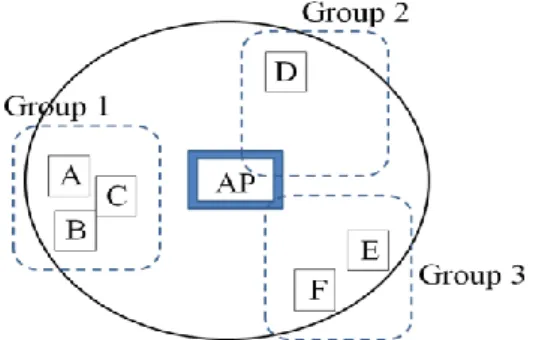
An example of the terminal grouping with no hidden
terminals in every group is shown in Fig. 1. In Fig. 1, there are
three groups of terminals and Group 1, 2 and 3 have 3, 1 and 2
terminals, respectively. In Fig. 1 the range of only the AP is depicted for simplicity. Since the AP and all the terminals have the same size transmission range, it is easily understood that there are no hidden terminals in each group. For example, Group 1 consists of terminals A, B and C, and each of the three terminals are within the transmission ranges of the other two terminals, and these three terminals are visible to each other. In other words, there are no hidden terminals in Group 1.
Fig. 1 An example of grouping of terminals Theoretically, the number of groups can be made at most 6.
Fig. 2 shows the division of the transmission range of an AP into 6 areas of the same size and shape, where the central angle of each area is all 60 degrees. The terminals in the transmission range of the AP are grouped so that every terminal in each of the 6 areas belongs to a same group. In this grouping, the longest distance between any two terminals in an area is equal to or less than the radius of the transmission range. Therefore all the terminals in each area are within the transmission range of each other and visible to each other, and thus there are no hidden terminals in each group.
Fig. 2 Division of transmission range into 6 areas In general, the larger the number of groups, the overhead for switching the turns of access among the groups becomes larger. The larger the number of terminals in each group, the collision probability by the terminals in individual group becomes larger. Thus, there is a tradeoff between the number of groups and the number of terminals in the individual group from the viewpoint of the access collision and the traffic overhead. However, the overhead for the switching is very small since the control frame used for polling the following group is of small size. Furthermore, the collision probability by the terminals in a group is also very small since there are no hidden terminals in each group and collision can be made only by two or more terminals which have the same backoff time
that is the minimum among the terminals in the group because each terminal always performs carrier sensing function. Thus, there is not a strong need to optimize the number of groups and the number of member terminals in individual group.
B. Visible Terminal Table (VTT)
In the proposed access control method, every terminal is equipped with a table named visible terminal table (VTT).
VTT maintains a set of terminals that are within the transmission range of the owner terminal of the VTT and therefore all the terminals in the VTT are visible to its owner terminal. The VTT is constructed and maintained in the following manner.
In IEEE 802.11 standard, when a data frame is received by the AP or a terminal successfully, an ACK frame is always returned by the AP or the terminal. Thus, when a terminal overhears the exchange of a data frame and an ACK frame between the AP and another terminal, then the former terminal recognizes that the latter terminal is within the transmission range of the former terminal and visible to the former terminal.
In this manner, it is possible for a terminal to obtain the list of the terminals that are within its transmission range and visible, and accordingly it is possible for a terminal to construct and maintain the VTT.
The time horizon by the proposed access control method is divided into super-frames and each super-frame consists of access duration for each group terminals. Duration of a super-frame can be decided by considering the delay in the exchange of frames between the AP and the terminals. The delay can be designed depending on the number of terminals and also the trade-off between the processing burden for updating the grouping of terminals and the accuracy of the VTT information used for the update.
The information in the VTT of a terminal is transmitted to the AP via a data frame from the terminal to the AP once per super-frame as far as the VTT is updated in the previous super-frame.
C. Algorithm for Grouping of Terminals
The AP collects and maintains all the latest information in the VTTs of all the terminals in every super-frame. Making use of the information, the AP groups the terminals according to the following algorithm and updates the grouping whenever the information is updated.
<Algorithm for grouping of terminals>
(step1) If there are one or more terminals that have become non-active from active in the previous super-frame, these terminals are all removed from their groups. If the number of the member terminals of each group becomes 0 as the result of this terminal removal, the group itself is also removed.
(step2) A terminal that has not yet been grouped is taken and it is called TT in the following steps.
(step3) If there exists no group, create a new group and make TT as the member of the new group, otherwise go to (step4). If there remains a terminal yet to be grouped, go to (step2), otherwise stop.
(step4) It is tested whether TT is within the transmission range of and visible to every terminal of each existing group.
If the test results in the affirmative with regard to a
group, then TT becomes a member of the group. If the test results in the negative for every group, create a new group and make TT as the member of the new group. If there remains a terminal yet to be grouped, go to (step2), otherwise stop.
Note: It is possible to modify (step1) so that the judgment on the state change of a terminal from active to non-active is made only after the terminal has not exchanged any data frames during more than one previous super-frames in order to avoid misjudgment: e.g. the disability of frame transmission by a terminal due to congestion of frame traffic instead of the real non-activeness of the terminal.
< Proof of the correctness of the algorithm>
The number of terminals in a group can increase only in (step4) and according to the process in (step4), all the terminals of a group are always visible to each other and thus there are no hidden terminals in each group. Furthermore, it is obvious that the algorithm stops after all the terminals yet to be grouped are processed by either (step3) or (step4). Thus, the above algorithm groups all the terminals with no hidden terminals in each group in a finite time, which leads to the proof of the correctness of the algorithm.
D. Access Control by the Proposed Method
The AP of a wireless network performs grouping of terminals according to the algorithm described above by the proposed access control method. As its result, the AP determines the time duration of access by the terminals of each group. The time duration should be determined in such a manner to achieve the fairness among the terminals. The fairness can be defined in different ways depending on the policy of the management of the wireless network. Since the management policy is not a subject of this paper, the fairness is simply defined in this paper in accordance with the number of active terminals in the groups as formulated below, where the active terminals are defined as the terminals that have data to transmit.
Ti
= T×A
i/A, where
- Ti
and T denote the access time duration assigned to group i and the time duration of a super-frame which is equal to a period of grouping cycle, respectively and - A
iand A denote the number of active terminals in group i
and their total sum, respectively.
At the start of access duration of each group, the AP broadcasts a control message, similar to a poll in PCF, indicating the group and its member terminals. On receiving the control message, all the active terminals in the designated group will start contending for the transmission of frames based on DCF. Since there are no hidden terminals in the group, the possibility of collision by the terminals is very low because of carrier sensing function of every terminal, and thus RTS/CTS exchange becomes unnecessary in the proposed method, which leads to the efficient use of the time and accordingly to high total throughput.
After the access duration ends of a group, the AP broadcasts another control message designating another group. By sequentially designating different groups by the control messages of the AP, it becomes possible that every
group will be given an opportunity to transmit data frames alternatively and sequentially.
It should be noted that the number of active terminals of each group is defined as the number in the previous period. By such definition, there can be some error in the number of active terminals of a group in practice and in order to avoid wasting of time due to the error, the AP changes the turns of group access by broadcasting a new control message automatically if there is no access by the terminals in the group for a predefined interval time.
III. E
VALUATION OFP
ROPOSEDA
CCESSC
ONTROLM
ETHODA. Evaluation Method and Simulation Scenario
The total throughput of the proposed access control method for a wireless network in infrastructure mode is simulated by making use of a network simulator NS-2 [17].
For the comparison, DCF with RTS/CTS, DCF without RTS/CTS, PCF and Hybrid access control method [8] are also simulated. The simulation is repeated for 20 times with randomly selected different locations of terminals to show the average value of total throughputs with their 95% confident intervals. It should be noted that the terminals do not make any moves in the simulation for simplicity reason. The total throughput is defined as the total number of user data bits in the data frames exchanged per second between every one of the terminals and the AP.
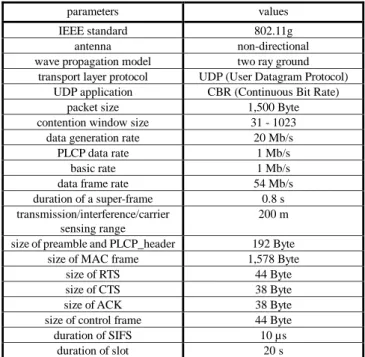
The main parameters and their values in the simulation scenario are summarized in Table I. In the simulation, data frames are generated by every active terminal at the rate sufficiently high so that there is no waiting time for the generation before the start of transmitting the frames by the terminal. Data frame transmissions are initiated by only the terminals and the simulation of the case where the AP initiates the transmission of data frames has not been performed in the following evaluation since the simulation results of the total throughput are considered basically the same regardless of whether the data frame transmission is initiated by the terminals or the AP.
TABLEI SIMULATION SCENARIO
parameters values
IEEE standard 802.11g
antenna non-directional
wave propagation model two ray ground transport layer protocol UDP (User Datagram Protocol)
UDP application CBR (Continuous Bit Rate)
packet size 1,500 Byte
contention window size 31 - 1023
data generation rate 20 Mb/s
PLCP data rate 1 Mb/s
basic rate 1 Mb/s
data frame rate 54 Mb/s
duration of a super-frame 0.8 s transmission/interference/carrier
sensing range
200 m
size of preamble and PLCP_header 192 Byte
size of MAC frame 1,578 Byte
size of RTS 44 Byte
size of CTS 38 Byte
size of ACK 38 Byte
size of control frame 44 Byte
duration of SIFS 10 µs
duration of slot 20 s
B. Evaluation Results and their Discussions
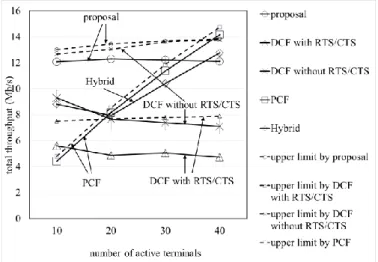
Figs. 3 and 4 show the total throughput versus the number of active terminals when there are 40 and 4 terminals in the transmission range of an AP, respectively. The solid lines and the dotted lines denote the total throughputs obtained as the results of the simulation and their theoretical upper limits, respectively.
Fig. 3 Total throughput of various access control methods versus the number of active terminals out of 40 terminals
Fig. 4 Total throughput of various access control methods versus the number of active terminals out of 4 terminals The theoretical upper limits of the total throughputs are derived assuming no collision of accesses by the terminals. As an example, the theoretical upper limit by the proposed method Th
pis calculated by the following formula:
Thp
=p_size/(T
DIFS+T
backoff+T
data+T
SIFS+T
ACK), where
p_size = size of data in bits,
T
DIFS= time duration of DIFS T
backoff= time duration of backoff T
data= time duration of data frame, T
SIFS= time duration of SIFS, and T
ACK= time duration of ACK frame.
According to Fig. 3, the total throughput of PCF is highest only when the number of active terminals is very close to the total number of terminals and the total throughput of the proposed method is highest in all the other cases. Especially
when the number of active terminals becomes smaller, the total throughput of the proposed method is much higher than all the other methods. In general, the number of active terminals is far smaller than the total number of terminals, since each terminal will not continue to be active to transmit or receive data frames for a long time and it usually transmits or receives data frames intermittently in practice. Thus, the proposed method is considered by far the best among the simulated access control methods in terms of the total throughput. It should be noted that the proposed method is characterized by its stable high total throughput regardless of the number of active terminals.
The difference between the total throughput of PCF and its theoretical upper limit is very small because there is no collision of frames in PCF and the difference comes from only the overheads of polling messages. The difference between the total throughput of the proposed method and its theoretical upper limit is small because the collision probability is very small due to the principle that each group consists of only visible terminals. On the other hand, the total throughput of DCF without RTS/CTS is much higher than that of DCF with RTS/CTS because of no traffic overheads due to RTS/CTS.
The difference between the total throughput of DCF without RTS/CTS and its theoretical upper limit is very large because of large collision possibility and the resultant retransmission of frames with longer backoff. Furthermore, the difference between the total throughput of DCF with RTS/CTS and its theoretical upper limit is rather large because of some possibility of collision and the resultant retransmission of frames with longer backoff. The total throughput of Hybrid method is limited by either that of PCF or DCF as expected.
According to Fig. 4 with 4 terminals in total, when the number of active terminals is small, the collision probability becomes small even for DCF and therefore DCF without RTS/CTS and the proposed method outperform other methods if the number of active terminals becomes small.
However, the feature of stable highest total throughput is maintained by the proposed method with the exception of the case where the number of active terminals is very close to the total number of terminals. Since the probability of such exception is very low in practice as mentioned above, the proposed access control method is concluded as the best in terms of the total throughput of a wireless network in infrastructure mode based on IEEE 802.11 standards.
In the simulation of the proposed method, the number of groups was usually 4 or 5 and the maximum number of groups was 7, which means there is some room to improve the grouping algorithm by making the number of groups at most 6 to minimize the overhead for switching the groups accessing the AP. The throughputs of different terminals were almost the same for all the cases by the proposed method. In other words, the fairness among the terminals can be maintained regardless of the groups by the proposed grouping algorithm.
In the above simulation, it is assumed that only the terminals have data to transmit. In practice, however, the AP is very likely to have data transmit. If the AP is taken as a terminal in the above simulation, the evaluation results become applicable for such a practical case.
IV. C
ONCLUSIONThis paper has addressed a problem of low total throughput
for a wireless network with a lot of terminals accessing an AP
in infrastructure mode based on IEEE 802.11 standards. The main contribution of this paper is a proposal of a novel access control method by terminals based on groups of only visible terminals and with no hidden terminals, which makes the collision probability by the terminals in each group very small and as such the dominant reason for the low total throughput problem is mostly solved. Some computer simulations were conducted to demonstrate the effectiveness of the proposed method and the total throughput achieved by the proposed method is close to its theoretical upper limit. It is thus concluded that the proposed access control method for a wireless network is basically a best solution to the throughput deterioration problem. The proposed access control method is characterized by its stable high total throughput regardless of the number of active terminals. This characteristic is practically very useful, since it is not easy to control the number of active terminals and the number can change randomly and arbitrary in actual wireless networks.
Some further study on or extensions to the proposed access control method are as follows to make its applications wider and to achieve even higher total throughput.
- Improvement of the grouping algorithm to optimize the numbers of groups and the terminals of the individual groups.
- Evaluation and extension to the grouping algorithm to cope with moves of the terminals.
- Extension to the grouping algorithm to cover latest IEEE 802.11 standards such as 802.11ac and 802.11ad [18].
- Evaluation and extension to the access control to cope with the case with more than one AP, where the assignment of different channels should be taken into account.
- Evaluation and extension to the access control to cope with the case where the interference/carrier sensing rage is much larger than the transmission range.
- Evaluation and extension to the access control to cover QoS (quality of service) other than the total throughput such as time delay with its variation and loss probability of frames.
R
EFERENCES[1] IEEE Standard for Information technology--Telecommunications and information exchange between systems Local and metropolitan area networks--Specific requirements Part 11: Wireless LAN Medium Access Control (MAC) and Physical Layer (PHY) Specifications. IEEE Std 802.11™-2012
[2] Hongqiang Zhai1, Younggoo Kwon, and Yuguang Fang, “Performance analysis of IEEE 802.11 MAC protocos lin wireless LANs,” Wirel.
Commun. Mob. Comput., No. 4, pp. 917–931, 2004
[3] Samarth H. Shah, Kai Chen, and Klara Nahrstedt, “Available Bandwidth Estimation in IEEE 802.11-based Wireless Networks,”
IEEE trans. on mobile comput., Vol.7, No.10, pp.1228-1241, October 2008
[4] Salwa Serag Eldin, Mohamed Nasr, Salah Khamees, Essam Sourour, and Mohamed Elbanna, “Performance enhancement of IEEE 802.11n wireless LAN using irregular LDPCC,” Proceedings of the Sixth international conference on Wireless and Optical Communications Networks, WOCN’09, pp.312-316, 2009
[5] R. Vaze, and R. W. Heath, “Transmission capacity of ad-hoc networks with multiple antennas using transmit stream adaptation and interference cancellation,” IEEE Transactions on Information Theory, vol. 58, pp. 780-792, 2012
[6] XinruYao, Yasushi Wakahara, "Synchronized Multi-Hop Protocol with High Throughput for an IEEE 802.11 Multi-Hop Wireless Network,”
Proc. of IEEE Smart Communications in Network Technologies, Paris, France, June 2013.
[7] XinruYao, and Yasushi Wakahara, “Application of Synchronized Multi-Hop Protocol to Time-Variable Multi-Rate and Multi-Hop Wireless Network,” Proc. of APNOMS Conference, Hiroshima, Japan,
September 2013.
[8] Dong, X. James, M. Ergen, P. Varaiya, A. Puri. "Improving the aggregate throughput of access points in IEEE 802.11 wireless LANs,”
Proceedings of 28th Annual IEEE International Conference on Local Computer Networks. LCN'03, 2003
[9] Alonso Luis, Ramon Ferrus, and Ramon Agusti, “WLAN throughput improvement via distributed queuing MAC,” Communications Letters, IEEE 9.4: pp.310-312, 2005.
[10] Yasuda, Ken'ichi, Shigeaki Tagashira, and Satoshi Fujita, “Adaptive MAC Scheme for Wireless LAN Based on Dynamic Group Constructions,” Seventh International Conference on Parallel and Distributed Computing, Applications and Technologies, PDCAT'06., 2006
[11] H. Al-Mefleh, and J.M. Chang, “High Performance Distributed Coordination Function for Wireless LANs,” Networking, vol.4982, pp.812-823, Springer May 2008.
[12] S. Mare, D. Kotz, and A. Kumar, “Experimental validation of analytical performance models for IEEE 802.11 networks,” Second International Conference on Communication Systems and Networks (COMSNETS), pp.1-8, 2010
[13] Bin Yang, “Comparison of IEEE802.11 Standards,” Directed Research Project Report, University Of Alberta, 2012
[14] Janis Jansons, Arturs Barancevs, Ernests Petersons, and Nikolajs Bogdanovs, “IEEE802.11a standard performance in mobile environment,” International Journal on new computer architecture and their applications (IJNCAA) 2(3): pp.496-499, 2012
[15] Qi Wang, Katia Jaffrès-Runser, Jean-Luc Scharbarg, Christian Fraboul, and Yi Sun, Jun Li, “Delay distribution of IEEE802.11 DCF: a comparative study under saturated conditions,” Proceedings of the 10th ACM symposium on Performance evaluation of wireless ad hoc, sensor, & ubiquitous networks, PE-WASUN, pp.41-48, 2013 [16] Femi-Jemilohun Oladunni Juliet, and Walker Stuart, “Empirical
peformance evaluation of enhanced throughput schemes of IEEE802.11 technology in wireless area networks,” International Journal of Wireless & Mobile Networks (IJWMN) Vol. 5, No. 4, pp.171-185, August 2013
[17] The Network Simulator - ns-2
http://nsnam.isi.edu/nsnam/index.php/User_Information
[18] E. Perahia, and M. X. Gong
, “
Gigabit wireless LANs: an overview of IEEE 802.11ac and 802.11ad,”
ACM SIGMOBILE Mobile Computing and Communications Review, vol. 15, pp. 23-33, 2011