Power indices taking into account agents' preferences
Fuad Aleskerov
No 898
WARWICK ECONOMIC RESEARCH PAPERS
Power indices taking into account agents' preferences
Fuad Aleskerov
State University 'Higher School of Economics' and
Institute of Control Sciences Russian Academy of Sciences
Moscow 101000 Russia
[email protected], [email protected]
A set of new power indices is introduced extending Banzhaf power index and allowing to take into account agents’ preferences to coalesce. An axiomatic characterization of intensity functions representing a desire of agents to coalesce is given. A set of axioms for new power indices is presented and discussed. An example of use of these indices for Russian parliament is given.
1. Introduction
Power indices have become a very powerful instrument for study of electoral bodies and an institutional balance of power in these bodies [5-8, 11].
One of the main shortcomings mentioned almost in all publications on power indices is the fact that known indices do not take into account the preferences of agents [6,10]. Indeed, in construction of those indices, e.g., Shapley-Shubik or Banzhaf power indices [4,12], all agents are assumed to be able to coalesce. Moreover, none of those indices evaluates to which extent the agents are free in their wishes to create coalition, how intensive are the connections inside one or another coalition.
Consider an example. Let three parties A, B and C with 50, 49 and 1 sets, respectively, are presented in a parliament, and the voting rule is simple majority, i.e., 51 votes for.
Then winning coalitions are A+B, A+C, A+B+C and A is pivotal in all coalitions, B is pivotal in the first coalition and C is pivotal in the second one. Banzhaf power index β for these parties is equal to1
1 Banzhaf power index is evaluated as
,
= bi
5 / 1 ) ( ) ( , 5 / 3 )
(A = β B =β C =
β .
Assume now that parties A and B never coalesce in pairwise coalition, i.e., coalition
A+B is impossible. Let us, however, assume that the coalition A+B+C can be implemented, i.e. in the presence of `moderator' C parties A and B can coalesce. Then the winning coalitions are A+C and A+B+C, and A is pivotal in both coalitions while C is in one; B is pivotal in none of the winning coalitions. In this case β(A)=2/3, β(B)=0 and β(C)=1/3, i.e.,
although B has almost half of the seats in the parliament, its power is equal to 0.
If A and B never coalesce even in the presence of a moderator C, then the only winning coalition is A+C, in which both parties are pivotal. Then
β
(
A
)
=
β
(
C
)
=
1
/
2
.Such situations are met in real political systems. For instance, Russian Communist Party in the second parliament (1997-2000) had had about 35% of seats, however, its power during that period was always almost equal to 0 [1].
We introduce here two new types of indices based on the idea similar to Banzhaf power index, however, taking into account agents' preferences to coalesce.
In the first type the information is used about agents' preferences over other agents. These preferences are assumed to be linear orders. Since these preferences may not be symmetric, the desire of agent 1 to coalesce with agent 2 can be different than the desire of agent 2 to coalesce with agent 1. These indices take into account in a different way such asymmetry of preferences.
In the second type of power index the information about the intensity of preferences is taken into account as well, i.e., we extend the former type of power index to cardinal information about agents' preferences.
The structure of the paper is as follows. Section 2 gives main notions. In Section 3 we define and discuss `ordinal’ power indices. In Section 4 cardinal indices are introduced. In Section 5 we evaluate power distribution of groups and factions in the Russian Parlament in 2000-2003 using some of new indices. Section 6 and 7 provides some axioms for the indices introduced.
Acknowledgments. I am very thankful to the participants of the Workshop on Constitutional and Scientific Quandaries (International Center on Economic Research, Turin,
i
Italy, June 20-23, 2005) and Workshop on Voting Power and Procedures (Warwick University, UK, July 20-23, 2005), and particularly to Professors Dennis Leach, Norman Schofield, Kenneth Shepsle, John Ferejohn, Moshe Machover and Federico Valenciano for helpful comments.
Mrs. Natalya Andryshina and Ms. Anna Sokolova helped me a lot to prepare the text. Mr. Vyacheslav Yakuba prepared software to evaluate the indices.
This work was supported by the grant of the State University `Higher School of Economics’ (grant #285/10-04). Professors Vladimir Avtonomov, Yaroslav Kuz’minov, Andrey Yakovlev and Evgeniy Yasin had supported the project from its very beginning.
Finally, this work is partially supported by the grant #05-01-00188 of Russian Foundation of Basic Research.
All these help and support are gratefully acknowledged.
2. Main notions
The set of agents is denoted as N, N ={1,K,n}, n>1. A coalition ω is the subset of
N,
ω
⊆
N
.We consider the situation when the decision of a body is made by voting procedure; agents who do not vote `yes’ vote against it, i.e., the abstention is not allowed.
Each agent has a predefined number of votes, vi >0, i=1,K,n. It is assumed that a
quota q is predetermined and as a decision making rule the voting with quota is used, i.e., the decision is made if the number of votes for it is not less than q,
q v
i i ≥
∑
.The model describes a voting by simple and qualified majority, voting with veto (as in the Security Council of UNO), etc.
A coalition ω is called winning if the sum of votes in the coalition is not less than q. An agent i is called pivotal in the coalition ω if the coalition ω \{i} is a loosing one.
For such voting rule the set of all winning coalitions
Ω
possesses the following properties:
φ
∉
Ω
,Ω
Sometime, one additional condition is applied as well
,
\
N
ω
Ω
Ω
ω
∈
⇒
∉
which implies that
q
≥
⎡
n
/
2
⎤
, where⎡ ⎤
x is the smallest integer greater or equal to x.To solve the problem stated above, two types of indices, ordinal and cardinal, are introduced. Both types are constructed on the following basis: the intensity of connection
)
,
i
(
f
ω
of the agent with other members of ω is defined. Then for such agent i the valuei
χ
is evaluated as( )
∑
=
ω
ω
χ
if
i
,
,
i.e. the sum of intensities of connections of i over those coalitions ω in which i is pivotal. Naturally, other functions instead of summation can be considered.
Then the power indices are constructed as
( )
∑
=
j j
i
i
χ
χ
α
.The very idea of
α
( )
i
is the same as for Banzhaf index, with the difference that inBanzhaf index we evaluate the number of coalitions in which i is pivotal.
The main question now is how to construct the intensity functions
f
(
i
,
ω
)
. Below wegive two ways how to construct those functions.
Each agent i is assumed to have a linear order2 Pi revealing her preferences over other
agents in the sense that i prefers to coalesce with agent j than with agent k if Pi contains the
pair (j, k). Obviously, Pi is defined on the cartesian product (N \{i})×(N \{i}).
Since
P
i is a linear order, the rankp
ij of the agent j inP
i can be defined. Weassume that
p
ij=
N
-1 for the most preferable agent j inP
i.The value
p
ij shows how many agents less preferable than j are inP
i. For instance, ifN={A,B,C,D} and PA :BfC fD, then
P
AB=
3,P
AC=
2 andP
AD=
1.Using these ranks, one can constract different intensity functions.
A second way of construction of
f
(
i
,
ω
)
is based on the idea that the valuesp
ij ofconnection of i with j are predetermined somehow. In general, it is not assumed
p
ij=
p
ji.Then the intensity function can be constructed as above.
Below we give four different ways how to construct
f
(
i
,
ω
)
in ordinal case andsixteen ways of construction of cardinal function
f
(
i
,
ω
)
.3.Ordinal indices
For each coalition ω and each agent i construct now an intensity
f
(
i
,
ω
)
ofconnections in this coalition. In other words, f is a function which maps
Ω
×
N
(=2
N\{Ø}) into R1,f
:
N
×
Ω
→
R
1. This very valuef
(
i
,
ω
)
is evaluated using the ranks of members of coalition. Several different ways to evaluate f using different information about agents’ preferences are provided:a) Intensity of i’s preferences. In this form only preferences of i’s agent over other agents are evaluated, i.e.,
∑
∈
+ =
ω ω ω
j ij
p i
f ( , )
b) Intensity of preferences for i. In this case consider the sum of ranks of i given by other members of coalition ω
∑
∈
− =
ω ω ω
j ji
p i
f ( , )
c) Average intensity with respect to i’s agent
2
) , ( ) , ( ) ,
(i ω f i ω f i ω
f
−
+ +
=
d) Total positive average intensity. Consider any coalition ω of size k≤n. Without
loss of generality we can put ω ={1,K,k}. Then consider for each i f+(i,ω) and constract
ω ω ω
∑
∈ω+
+ = i
i f f
) , ( )
( ,
ω ω ω
∑
∈ω−
− = i
i f f
) , ( )
(
f) Total average intensity is defined as
ω ω ω =
∑
i∈ωi f f
) , ( )
(
It is worth emphasizing here that the intensities d) - f) do not depend on agent i, i.e., for any agent i in the following calculation of power indices we will assume that for any i in the coalition ω the corresponding intensity is the same.
Consider now several examples.
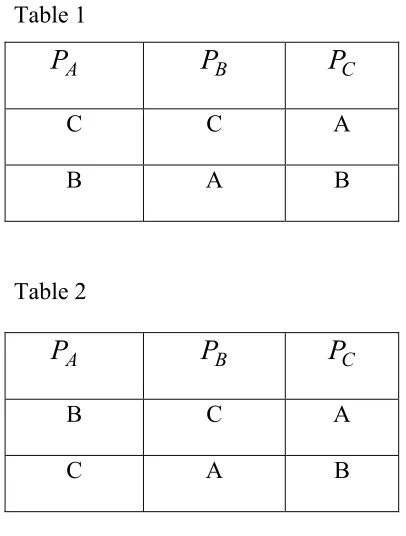
Example 1. Let n=3, N={A, B, C}, ν(A)=33, ν(B)=ν(C)=33, q=50. Consider two
[image:7.595.172.375.345.613.2]preference profiles given in Tables 1 and 2.
Table 1
A
P
P
BP
CC C A
B A B
Table 2
A
P
P
BP
CB C A
C A B
For both preference profiles there are three winning coalitions in which agents are pivotal. These coalitions are A+B, A+C and B+C.
⎟
⎟
⎠
⎞
⎜
⎜
⎝
⎛
=
0
1
2
2
0
1
2
1
0
C
p
ijB
A
C
B
A
⎟⎟
⎠
⎞
⎜⎜
⎝
⎛
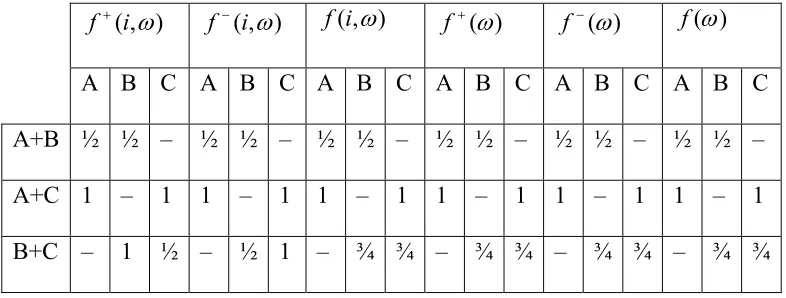
= 0 1 2 2 0 1 1 2 0 B A C B A ' C pijNow, for the profile given in Table 1 one can calculate the values of intensities a)-f) obtained by each agent i in each winning coalition ω. These values for the first preference profile is given in Table 3 and for the second one – in Table 4.
[image:8.595.102.495.348.497.2][image:8.595.85.512.541.689.2]
Table 3. Intensity values for the first preference profile
Table 4. Intensity values for the second preference profile )
, (i ω
f+ f −(i,ω) f(i,ω) f+(ω) f−(ω) f(ω)
A B C A B C A B C A B C A B C A B C
A+B ½ ½ – ½ ½ – ½ ½ – ½ ½ – ½ ½ – ½ ½ –
A+C 1 – 1 1 – 1 1 – 1 1 – 1 1 – 1 1 – 1
B+C – 1 ½ – ½ 1 – ¾ ¾ – ¾ ¾ – ¾ ¾ – ¾ ¾
) , (i ω
f+ f−(i,ω) f(i,ω) f+(ω) f−(ω) f(ω)
A B C A B C A B C A B C A B C A B C
A+B 1 ½ – ½ 1 – ¾ ¾ – ¾ ¾ – ¾ ¾ – ¾ ¾ –
A+C ½ – 1 1 – ½ ¾ – ¾ ¾ – ¾ ¾ – ¾ ¾ – ¾
Using these intensity functions one can define now the corresponding power indices
)
i
(
α
. Let i be a pivotal agent in a winning coalition ω. Denote as χi the number equal to the value of the intensity function for a given coalition ω and agent i. Then the power index is defined as follows∑ ∑
∑
∈ = N j j j i i i ω ω ω ω χ χ α in pivotal is , in pivotal is , ) (As we already mentioned this index is similar to the Banzhaf index. The difference is
that χi in the Banzhaf index is equal to 1, in the case under study χi represents some
intensity value.
The indices α(i) will be denoted as α1(i),K,α6(i).
Let us evaluate now the values
α
1(
⋅
)
−
α
6(
⋅
)
for all agents for the preference profile from Table 1.The agent A (as well as agents B and C) is pivotal in two coalitions; the sum of the
values )f +(i,ω for each i is equal to 3/2. Then
.) ( ) ( 3 1 2 / 3 2 / 3 2 / 3 2 / 3 )
( 1 1
1 A α B α C
α = = =
+ + =
The value α2(⋅) is evaluated differently. The sum of values f−(i,ω) from Table 3 for
all i and ω is equal to 9/2. However, for A
∑
= ωω) 3/2 ,
(A
f ,
∑
=ω
ω) 1 , (B
f and
∑
=ω
ω) 2 , (C
f . Then
3 1 9 3 ) (
2 A = =
α ;
9 2 ) (
2 B =
α and
9 4 ) (
2 C =
α .
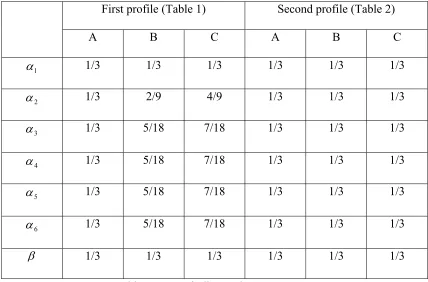
The values of the indices α1–α6 for both preference profiles are given in Table 5 as
well as the values of Banzhaf index β
Consider now another example.
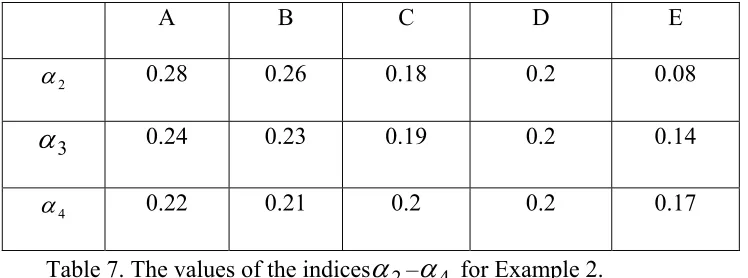
Example 2. Let N={A, B, C, D, E}, each agent has one vote, q=3 and the preferences of agents are given in Table 6.
The values of indices α2 –α4 are given in Table 7.
Note that α1 is equal to the Banzahalf index, which for this case gives
5 / 1 ) ( = ∈
First profile (Table 1) Second profile (Table 2)
A B C A B C
1
α 1/3 1/3 1/3 1/3 1/3 1/3
2
α 1/3 2/9 4/9 1/3 1/3 1/3
3
α 1/3 5/18 7/18 1/3 1/3 1/3
4
α 1/3 5/18 7/18 1/3 1/3 1/3
5
α 1/3 5/18 7/18 1/3 1/3 1/3
6
α 1/3 5/18 7/18 1/3 1/3 1/3
[image:10.595.64.492.126.408.2]β 1/3 1/3 1/3 1/3 1/3 1/3
Table 5. Power indices values
A
P PB PC PD
P
E rankB A D A B 4
C C A B A 3
D D B C D 2
E E E E C 1
[image:10.595.70.493.452.597.2]A B C D E
2
α 0.28 0.26 0.18 0.2 0.08
3
α
0.24 0.23 0.19 0.2 0.144
[image:11.595.84.458.71.210.2]α 0.22 0.21 0.2 0.2 0.17
Table 7. The values of the indices
α
2–α
4 for Example 2.Example 3. Consider the case when 3 parties A, B and C have 50, 49 and 1 seats,
respectively. Assume that decision making rule is simple majority, i.e. 51 votes. Then the winning coalitions are A+B, A+C and A+B+C. Note that A is pivotal in all three coalitions, B and C are pivotal in one coalition each. Then β(A)=3/5, 5β(B)=β(C)=1/ .
Consider now the case with the preferences of agents given below:
P
A:
C
f
B
;B
C
:
P
Af
andP
C:
A
f
B
.Then the values of α1 and α2 (constructed by f +(i,ω) and f−(i,ω) are as follows
8 / 1 ) ( , 5 / 1 ) ( , 8 / 5 )
( 1 1
1 A = α B = α C =
α ,
and the values of α2 are equal to α1.
Consider another preference profile:
P
A:
C
f
B
,P
A:
C
f
B
;P
C:
A
f
B
, i.e.,only agent C changes her preferences. Then one can easily evaluate that 7
/ 1 ) ( ) ( , 7 / 5 )
( 1 1
1 A = α B =α C =
α ; α2(A)=10/19, α2(B)=3/19, α2(C)=6/19.
4.Cardinal indices
Assume now that the desire of party i to coalesce with party j is given as real number
ij
p , p i j n
j
ij =1, , =1,K,
∑
. In general, it is not assumed that pij = pji.One can call the value pij as an intensity of connection of i with j. It may be
interpreted as, for instance, a probability for i to form a coalition with j. We define now several intensity functions
; )
, (
ω ω
∑
∈ω+ = j
ij
p i
f
b) average intensity of connection of other members of coalition ω with i
;
p
)
,
i
(
f
j jiω
ω
ω∑
∈ −=
c) average intensity for i
)); , ( ) , ( ( 2 1 ) ,
(i ω f i ω f iω
f = + + −
d) average positive intensity in ω
, ) , ( ) ( ω ω ω
∑
∈ω+
+ = i
i f f
e) average negative intensity in ω
, ) , ( ) ( ω ω ω
∑
∈ω−
− = i
i f f
f) average intensity in ω
, ) , ( ) ( ω ω ω =
∑
i∈ωi f f
In contrast to ordinal case now we can introduce several new intensity functions:
g) minimal intensity of i'sconnections
ij j p
i
fmin+ (,ω)=min ;
h) maximal intensity of i's connections
ij j p
i
fmax+ ( ,ω)=max ;
i) maximal fluctuation of i's connections
) max min ( 2 1 ) , ( ij j ij j
mf i p p
f ω = +
k) maximal intensity of connections of other agents in ω with i
ji j p
i
fmax− (,ω)=max
l) s-mean intensity of i'sconnectionswith other agents in ω
s j
s ij
sm i p
f+ =
∑
ω ω) 1 ,
( ;
m) s-mean intensity of connections of other agents in ω with i
s j
s ji
sm i p
f+ =
∑
ω ω) 1 ,
( ;
n) max min intensity
ij j
i p
fmaxmin(ω)=maxmin ;
o) min max intensity
ji j
i p
fminmax(ω)=minmax ;
p) maximal fluctuation
)) ( ) ( ( 2 1 )
(ω fmaxmin ω fminmax ω
fmf = +
Note that the intensity functions in the cases d)–f), n)–p) do not depend on agent herself but only on coalition ω.
Now the corresponding power indices can be define as above, i.e.,
∑
∑
∑
∈ = N j j i i i i ω ω ω ω ω χ χ α in pivotal isis winning,
in pivotal is is winning, card ) ( ) ( ,
where χ is one of the above intensity functions.
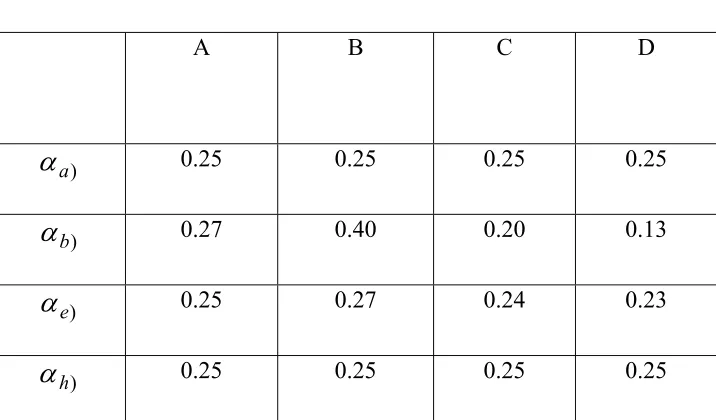
Example 4. Let N={A,B,C,D}, each voter has only one vote, the quota is equal to q=3,
and the matrix
p
ij is given in Table 8. In Table 9 the power indices are given for the casesA B C D
A 0.7 0.2 0.1
B 0.3 0.5 0.2
C 0.1 0.7 0.2
[image:14.595.108.428.73.231.2]D 0.7 0.2 0.1
Table 8. Matrix
p
ij for Example 3A B C D
)
a
α
0.25 0.25 0.25 0.25)
b
α
0.27 0.40 0.20 0.13)
e
α
0.25 0.27 0.24 0.23)
h
α
0.25 0.25 0.25 0.25Table 9. Some cardinal indices for Example 3
5. Evaluation for Russian Parliament
We will study now a distribution of power among factions in the third Russian Parliament (1999-2003) using these new indices.
The matrix
p
ij is constructed using the consistency index; the latter (the index ofconsistency of positions of two groups) is constructed as
(
)
(
)
2 2 1 1
2 1 2
1
1 , , 1 , max 1 ,
q q q q
q q q
q c
− −
− −
[image:14.595.88.446.291.501.2]where q1 and q2 be the share of “ay” votes in two groups of MPs [1].
We consider the value of consistency index as the value of intensity of connections between agents i and j. Then we are in cardinal framework, and one can use one of the indices introduced in the previous section.
On Fig. 1 the values of
α
a) index are given for the Russian Parliament from 2000 to2003 on the monthly basis. It can be readily seen that index α gives lower values for Communist Party (sometimes up to 3%) and higher values for Edinstvo (up to 1%). It is interesting to note that Liberal-Democrats (Jirinovski’s Party) had had almost equal values by both indices, which corresponds to the well-known flexibility of that party position.
Let us note that different ways to use the index α are possible. For instance, following the approach from [1], we may assume that if the consistency value for two factions
is less than some threshold value
δ
, then parties do not coalesce, i.e.,p
ij=
0
.5. Axiomatic construction of a cardinal intensity function
Now we will try to axiomatize a construction of cardinal intensity function.
First, we define an intensity function depending on intensities pij of connections of i
with other members of coalition ω, i.e., if ω ={1,K,m}, m≤n,
) , , , , , , , , , , , ( ) ,
(i fi p11 p1m p21 p2m pi1 pim pmm
f ω = K K K K K
As it is seen, the intensity function for i depends not only of i’s connections with other members of coalition, but depends also of connections of other members among themselves.
However, we will restrict this function in a way which is similar to independence of irrelevant alternatives [3]: f(i,ω) will depend on connections of agent i with other members
of coalition ω only, i.e.,
). , , ( ) ,
(i fi pi1 pim
f ω = K
For the sake of simplicity we put
p
ijω≥
0
for alli
,
j
and∑
∈
∀
ω ω
j ij
p
i
=1.
I would like to emphasize that in this formulation the sum of
p
ijω is equal to 1 in eachω
, i.e., now connections are defined by2
N−
1
matricesp
ijω for each coalition ω.Axiom 1. For any m – tuple of values (pi1,K,pim) there exist a function f(i,ω) such that 10≤ f(i,ω)≤ , f is continious differentiable function of each of its arguments.
Axiom 2. If pij =0 for any j, then f(i,ω)=0.
Axiom 3. (Monotonicity). A value of f(i,ω) increases if any value pij increases, and a value of f(i,ω) decreases if pij decreases. Moreover, equal changes in intensities pij lead
to equal changes of f(i,ω). This means that
i ij i
p
f μ
= ∂
∂
for any j
and
0
=
∂
∂
lj i
p
f
for any
l
≠
i
.Then the following theorem holds
Theorem. An intensity function
f
(
i
,
ω
)
satisfies Axioms 1–3 iff it is represented in the formω
ω
∑
=
jij
p
)
,
i
(
f
.Proof is similar to the proof of the theorem from [9] given in the framework of probabilistic social choice and hence is omitted.
An axiomatic characterization of other types of intensity functions is still an open problem.
7. Axioms for power indices
We introduce several axioms, which any reasonable power index should satisfy to.
First, we call a voting situation a four-tuple
{
N
,
q
,
v
,
P
r
}
, where N is a set of agents,1 , >
=n n
N , q is a quota, v=(v1,K,vn) is a set of votes which agents possess, Pr is a
preference profile, where each agent i∈N has a preference (linear order) Pi over N \{i} or
preference matrix pij .
In words, for no agent it is known in advance, independently of agents’ preferences, that her power is equal to 0.
Axiom 2. Consider two voting situations
{
N
,
q
,
v
,
P
r
}
and{
N
,
q
,
v
'
,
P
r
}
. Let NA∈
∃ s.t. v'(A)≥v(A), and ∀B∈N , B≠ A, v'(B)=v(B). Then α'(A)≥α(A).
Assume that for a given distribution of votes and a given preference profile we evaluate power distribution among agents. Then we increase the number of votes for a given agent A, keeping the votes of other agents as before. Then Axiom 2 states that voting power of A in new situation should be not less than before.
Axiom 3. (Symmetry) Let η be a one-to-one correspondence of N to N. Then )
, , ( ) , ,
(α1 αn αη(1) αη(n)
η K = K .
Axiom 3 states that power of agents does not depend of their names, i.e., the procedure of evaluation of power distribution must treat agents in a similar way.
Axiom 4. Let i∈N be pivotal in no winning coalition ω. Then α(i)=0.
It is usual axiom in voting power models (in fact, in game – theoretic models – see [12]): a dummy player has power equal 1 to 0.
Axiom 5’. First Monotonicity Axiom (FMA). Consider two voting situations ]
, , ,
[N q v P and [N,q,v,P']. Let for some i and any k ≠i '
k k P
P = holds. Let additionally for
some j
p
'ij>
p
ijholds. Then α'(j)≥α(j).This axiom can be explained in a simple way: all preferences except i’s are the same in two profiles; in i'th preference the evaluation of j is higher in new profile than in the old
one. Then the power of j should not be less in new voting situation (with P').
Axiom 5”. Second Monotonicity Axiom (SMA). Consider two voting situations ]
, , ,
[N q v P and [N,q,v,P']. Let for two agents i and j α(i)≥α(j) holds, where α(i) is the
voting power of i in the first voting situation. Let P' is such that for any k ≠l '
k k P
P = holds,
and in the preferences of l’s agent
lj li lj
li p p p
p' − ' > −
holds.
Then α'(i)≥α'(j) (weak version of SMA) or α'(i)>α(j) (strong version of SMA),
In words, let power of i is not less than the power of j with respect to first voting
situation. Let P' is such that for any agent but
l
new preferences of agents coincide with oldpreferences, and in l’s preference the relative position of i with respect to j is higher in '
l
p
than in pl. Then the voting power of i should be not less than that of j in new voting situation
(weak version) or even must be greater than that of j (strong version).
Axiom 6. Let 'P be an intensity matrix such that pij' =kpij for every i,j=1,K,n. Then α'(i)=α(i), where α' is the power vector obtained from 'P .
Axiom 6 deals with cardinal power indices. It says that voting power of agents does not change under the transformation of scale of intensities in the form
, '
ij ij kp
p =
i.e., when intensities multiply to the same constant k.
References
1. Aleskerov F., Blagoveschenskiy N., Satarov G., Sokolova A., Yakuba V. "Evaluation of power of groups and factions in the Russian parliament (1994-2003)", WP7/2003/01, Moscow: State University "High School of Economics", 2003 (in Russian)
2. Aleskerov F., Blagoveschensky N., Konstantinov M., Satarov G., Yakuba V. “A balancedness of the 3d State Duma of Russian Federation evaluated by the use of claster-analysis”, WP7/2005/04, Moscow: State University "High School of Economics", 2005 (in Russian)
3. Arrow K.J. “Social Choice and Individual Values, – 2nd ed., New Haven: Yale University Press, 1963.
4. Banzhaf, J. F., “Weighted Voting Doesn't Work: А Mathematical Analysis”, Rutgers Law Review, 1965, v.19, 317-343.
5. Brams S. “Game Theory and Politics”, The Free Press, New York, 1975
6. Felsenthal D., Machover М "The Measurment of Voting Power: Theory and Practices, Problems and Paradoxes", Edgar Elgar Publishing House, 1998
7. Grofman, В. and Н. Scarrow “Ianucci and Its Aftermath: The Application of Banzhaf index to Weighted Voting in the State of New York”, Brams, S., Schotter
А. апd G Schwodiatuer (eds.) Applied Game Theory, 1979
8. Heme, К. and Н Nurmi “А Priori Distribution of Power in the EU Council of Ministers and the European Parliament”, Scandinavian Journal оf Ро1ilitical Studies, 1993, v.16, 269-284
9. Intriligator M.D. “A Probabilistic Model of Social Choice”, The Review of Economic Studies, v.XL(4), 1973, 553-560.
10.Laruelle A., Valenciano F. “Shapley-Shubik and Banzhaf indices revisited”, Mathematics of Operations Research, v.26, 2001, 89-104.
11.Leech, D. “Voting power in the governance of the International Monetary Fund”, Annals of Ореrations Research, 2002, v.109, 375-397.
Distribution of power of groups and faction in Russian parliament (index alpha)
0 0.05 0.1 0.15 0.2 0.25
jan.-fe b.00
mar.00apr.00may.00jun .00
jul.00sep.0 0
oct.00nov.0 0
dec.0 0
jan.-fe b.01
mar.-ap r.01
may.01jun .01
jul.01sep.0 1
oct.01nov.0 1
dec.0 1
jan.02feb.0 2
mar.02apr.02may.02jun .02
sep .02
oct.02nov.0 2
dec.0 2
jan.03feb.0 3
mar.03apr.03may.03jun .03
sep .03
oct.03nov.0 3
ndex alfa