1
How Do Technical Companies Use Microblogging?
Author:
Zhang Shu
Programme:
MSc Communication Studies
Institute:
Faculty of Behavioral, Management, and Social Sciences
University of Twente, The Netherlands
Graduation committee:
Prof.dr. M.D.T. de Jong
S.J. Pothof, MSc.
2
Abstract
3
Table of contents
1 INTRODUCTION ... 4
2 LITERATURE REVIEW ... 5
2.1 Social media... 5
2.2 Microblogging(Twitter/Sina Weibo) ... 6
2.3 Organizational use of microblogging ... 7
2.3.1 Marketing communication ... 8
2.3.2 Emergency communication ... 9
2.3.3 Pedagogical communication ... 9
2.3.4 Technical communication ... 10
3 METHOD ... 11
3.1 Sample ... 11
3.2 Data-gathering and sample characteristics ... 11
3.3 Code development ... 11
3.4 Coding procedures ... 12
3.5 Intercoder reliability ... 12
4 RESULTS ... 12
4.1 Corporate communication ... 12
4.2 Marketing ... 17
4.3 Emergency communication ... 18
4.4 Pedagogical communication ... 19
4.5 Technical communication ... 19
4.6 Comparison of Twitter and Sina Weibo ... 21
5 DISCUSSION ... 24
5.1. Main finding ... 24
5.2. Theoretical implications ... 24
5.3. Limitations and recommendations for future research ... 26
5.4. Conclusion ... 26
4
1
INTRODUCTION
Web 2.0 brought dynamic websites into our world: instead of just reading web pages, users can also interact with each other and participate in the virtual world. The transformation to Web 2.0 greatly boosted the development of social media. As of 2014, more than 1.8 billion internet users have accessed social networks (Statista, 2014). The popular social media platforms, including Wikipedia, YouTube, Twitter, and Facebook. are all built upon the technology of Web 2.0.
Microblogging is one of the most popular social media forms; it is casual, rapid and synchronous (Vieweg, Hughes, Starbird, & Palen, 2010), which lets users write brief posts (fewer than 140 characters) and share them with others via instant message, mobile phone, e-mail, or the Web. In the Western world, the most prevalent microblogging platform is Twitter; in China, Sina Weibo (新浪微博) is the top microblogging service.
Unlike other social media such as Facebook, microblogging services are more of an open community, where users can reach not only their friends‘ content but also that of strangers‘ and of companies‘ official accounts. Users can find what they want by searching with key words or user names, or by tracking recommended information. The openness and public nature of microblogging helps companies to get closer to users and understand their needs better, which made it welcomed by the business world.
According to Case and King (2006), 79% of the Fortune 200 firms utilizing Twitter use the technology for news distribution. Researchers also found that microblogging is a form of electronic word-of-mouth to spread consumer opinions concerning brands, and suggest that microblogging should be considered in companies‘ overall marketing strategies (Jansen, Zhang, Sobel, & Chowdury, 2009). Krüger and Potthoff (2012) conducted a case study on Adidas, which proved that Twitter is of high importance for the company and was used strategically to increase product awareness.
Case and King (2006) examined the microblogging usage and implications of Fortune 200 firms, and found that computer/IT (95%) and telecommunications (88%) companies had a high participation in microblogging. This could be attributed to the computer firms‘ professional expertise in technology, which determined that they could implement, monitor and understand microblogging better. However, little is known about how technical companies use microblogging.
5 & Bulearca, 2010; Gu & Wang, 2012).There are also studies about the use of Twitter in educational activities (Grosseck & Holotescu, n.d.) and as a pedagogical tool (Rinaldo, Tapp, & Laverie, 2011).What is more, microblogging can also contribute in natural hazard events (Chew & Eysenbach, 2010) to convey emergency messages (Bowdon, 2014). Relatively, little is known about microblogging in the domain of technical communication. Do technical companies also use microblogging for technical communication?
Twitter and Sina Weibo are popular for companies, but widely used in different regions. Sina Weibo is the primary microblogging platform in China, and Twitter is the top one in the Western world. Little is known about the similarities and differences between Sina Weibo and Twitter usage.
This study focuses on how Chinese technical companies use Sina Weibo and how Western companies use Twitter, by analyzing the communication types in their posts. The main research questions are:
(1) How do Technical companies use microblogging?
(2) What are differences and similarities between Chinese companies‘ use of Sina Weibo and Western companies‘ use of Twitter?
2
LITERATURE REVIEW
2.1
Social media
Developed on the conceptual and technological foundation of Web 2.0, social media are a group of Internet-based applications that allow the formation and exchange of user- generated content (Kaplan & Haenlein, 2010). Social media are highly accessible (easy to get to) and scalable (can be used to reach large numbers) (Pitt, Parent, Steyn, Berthon, & Money, 2011). They transform broadcasting media monologues (one to many) into social media dialogues (many to many), encourage the democratization of knowledge and information, and change individuals from mere content consumers into content producers.
As of January 2014, 74% of the online adults use social networking sites (PewResearch Center, 2014), and 71% of the online adults were Facebook users in 2013. Facebook and Instagram show high levels of user engagement: 63% of the Facebook users visit the site at least once a day, with 40% doing so multiple times throughout the day, and 57% of the Instagram users visit the site at least once a day (PewResearch Ccenter, 2013).
6 proportion that will likely increase to 47% within the next four years. A survey of over 400 companies showed that the top companies‘ goals in social media were to generate more word of mouth, increase customer loyalty, enhance product or brand awareness, bring new ideas into the company, and improve the quality of customer support (Soat, 2010). Companies faced several obstacles when building online communities, including getting people to engage and participate, attracting people to the community, appealing people to keep coming back, and finding enough time to manage the community (Case & King, 2006).
Social media comprise several communication functions, which can be divided into seven blocks: identity, conversation, sharing, presence, relationships, reputation, and groups. (Kietzmann, Hermkens, McCarthy, & Silvestre, 2011). Kietzmann et al. suggest there are four Cs guiding firms to employ social media: cognize (i.e., understanding social media functionality, recognizing main influencers and knowing about their rivals), congruity (i.e., developing congruent and suitable strategies with different social media), curate (i.e., deciding how often and when to use social media platform, and who will in charge the platform online), and chase (i.e., keeping pace with social media development and responding to customer feedback in time).
2.2
Microblogging(Twitter/Sina Weibo)
Microblogging‘s benefits include simplicity, more frequent postings, and linking to more detailed information on other sites. The relationship of following and being followed by other users is not necessarily reciprocal on microblogging services: following certain accounts does not mean that they will follow you back, but is rather like subscriptions, with users receiving the Tweets/Weibos from accounts they are following. The Tweets/Weibos are accessible by the public, which means that the essence of events can be transmitted instantaneously on a large scale across the network (Jansen, Zhang, Sobel, & Chowdury, 2009).
Microbloggers post frequent brief updates about their personal lives, allowing them to keep in touch with friends and colleagues, including those outside their immediate environment (Zhao & Rosson, 2009). According to Finin and Tseng (2007), the most common use of Twitter is for daily chatter, with most posts talking about daily routine or current activities. Users also have conversations with friends, via direct replies using the @ symbol followed by a username.
7 follow the stream of tagged messages in real time (Bruns & Stieglitz, 2012).
Twitter and Sina Weibo are dominated in different regions. Twitter is popular in the Western world. It was launched in 2006, and gained most of its popularity in 2009, when it reached 58.5 million users, a 949% increase from September 2008 (Schonfeld, 2009). According to the information search website Statistics Brain (2014), Twitter has 645,750,000 users, who post 58 million tweets per day, and 135,000 new users signing up each day. After Twitter had become a huge success, a Twitter-like Chinese microblogging system called Sina Weibo was launched in 2009 and reached 61,400,000 users in December 2013. In March 2014, Sina Corporation filed an IPO under the symbol WB. It began trading publicly on April 17, 2014 (AFP; Sheridan, 2014).
Both Twitter and Sina Weibo allow users to post short 140-character messages, but since Chinese characters are based on a logogram instead of the alphabet system it is possible to include comparatively more information under the 140-character limit (Chan, Wu, Hao, Xi, & Jin, 2012). Unlike Twitter, Weibo users can also upload videos and communicate through short instant messages called private messages (私信). The comments (评论) in Weibo are threaded listed under the original message, instead of independently appearing in the feed of the user who made the comment and being broadcast to the user‘s followers (Qu, Huang, Zhang, & Zhang, 2011; Zhang & Pentina, 2012). What is more, Sina Weibo has a function named ―blog‖ (长微博), by which users can break the 140 words limitation. They can write long articles with the blog function and the system will generate the link and preview of the blog into a post. Users can also set privacy levels for their Weibo by using the ―Friends Circle‖ (朋友圈) function to decide who they want to share each post with.
2.3
Organizational use of microblogging
The rise of microblogging led to its adoption by various organizations and individuals. Microblogging is widely used for propagating company- related information, promoting sales, broadcasting real-time emergency information, distributing knowledge, and disseminating technical communication. Corporate communication
8 negative remarks about brands and products. (C2C).
Zhao & Rosson (2004) conclude that microblogging has both relational and personal impacts on informal communication at work. The relational aspect builds personal perception of colleagues, generates common ground for future conversation and generates a sense of connectedness by proximity, similarity and exposure to personal events. The personal aspect encourages work-relevant information sharing and expertise seeking. Some use microblogging to share information and URLs. And in some cases as a RSS feed for gathering valuable resources on people‘s work and other interests (Zhao & Rosson, 2004).
Senadheera and Warren (2011) studied how Australian banks use different social media sites by analyzing the functionality of selected social media services and strategies about how to use them. To explore communication patterns in a team using Twitter as an internal microblogging tool, Riemer and Richter (2010) conducted a genre analysis to study communication patterns for internal communication, found out using Twitter in corporate context is quite different from in the public open network. To find out brand communication in Twitter, Krüger and Potthoff (2012) conducted a case study on the company Adidas, the research was focused on awareness aspect, showed each official twitter account follows its own distinct strategy and focus on specific target group, concluded social media communication is of prime importance for Adidas.
Companies focused on different aspects of corporate communication. Wal-Mart uses Twitter to provide news about their corporate culture. The Bank of America uses it to respond service issues as well as reassuring privacy. State Farm promotes their community service and Dell is building a community and selling products.(Case & King, 2006)
2.3.1 Marketing communication
Bernoff and Li (2008) think that marketing is more than promotion of products and services, and also includes the state that marketing is not limited to the promotion of products and services themselves but it also includes the supporting of brands and sentiments about products and services. Microblogging offers immediate access to sentiment indicators, and provides insight into affective reactions toward products at critical junctions of the decision-making and purchasing process rendering it an online projection of traditional word-of-mouth (WOM). (Jansen et al., 2009)
9 concluded that the studied branding and product tweets posted by costumers could be categorized into four different purposes: sentiment i.e. expression of either positive or negative opinion about a brand, information seeking i.e. asking in order to fill a gap in the information concerning a brand, information providing i.e. offering information about a brand, and comment i.e. the use of a brand in a tweet where the brand was not the primary focus. Companies not only watch tweets about their own products and brand, and but also use Twitter to monitor perceptions of their competitors to gain market share.
2.3.2 Emergency communication
Many users report real-time information, a potentially interesting source of latest news, or comment about current events on Twitter. This characteristic means Twitter has been used effectively to inform people about emergency situations and to mobilize support efforts and relief for people in acutely desperate circumstances (Bowdon, 2014). In recent years, an ever-increasing body of literature has emerged on the field of microblogging and emergency communication.
Starbird and Palen (2010) focus on the Red River Flood and the Oklahoma Fires in 2009, finding that Twitter patterns are dependent on user‘s geographic relation; the broader Twitter audience focuses more on major headlines and ‗‗abstract‘‘ aspects of the event, while local populations propagate ‗‗more locally-relevant and helpful information‘‘. Qu et al.(2011) analyze how people responded to the 2010 Yushu Earthquake on Sina-Weibo, reporting that the microblogging system was used for four major purposes during the disaster and its aftermath. Cheong and Cheong (2011) analyzed Twitter responses to the 2011 Australian floods, finding that several different groups of actors, including local authorities, political personalities, social media volunteers, traditional media reporters and people from non-profit, humanitarian and community associations, played an important role in disseminating information about the disaster. Chew and Eysenbach‘s (2010) collation of tweets related to the 2009 H1N1 pandemic suggest that the use of ‗‗infodemiology‘‘ can help health authorities to identify and respond to public health concerns.
2.3.3 Pedagogical communication
10 increase links between educators and learners in formal and informal way; to help the transformation of explicit knowledge to public available shared knowledge and its dissemination.
2.3.4 Technical communication
Technical companies are quite active in using microblogging; Australian software developer Atlassian used Twitter to engage its customers in the development of understandable user information. They integrated ‗checkpoints‘ where users could tweet about their progress, and comment on how the instructions helped them ―win‖ the game (Blount, 2013). Nokia has several Twitter accounts; their tweets cover changes in the company‘s executive board, the company‘s quarter and annual results, and the launch of new products (Katajisto, 2010). The Microsoft Xbox team uses Twitter to ―talk with customers, find answers, and take care of issues. The Xbox Support Twitter account is staffed by a team of employees who include their initials with each tweet.‖(Rauch, Morrison, & Goetz, 2010). Twitter ―hashtags‖ grouping certain topics could assist technical writers understand customer needs in the information development process. Instant messaging is used for customer support; Best Buy, for instance, now offers ―Real Time Twelp,‖ where customers can send tweets to the Geek Squad for instant technical support (Milstein, 2012).
An article in the Society for Technical Communication‘s Intercom magazine cites a report by eMarketing, stating that 21% of Twitter users (and most users in the 35–55 age group) now employ this messaging tool for work-related activities. The same article suggests that that Twitter can be used to distribute PDFs of instruction manual updates, remind users to make program updates, and follow up on consumer inquiries. Tweets have potential as an innovative method for delivering tips and tricks and links to online help (Gentle, 2009) The number of searches per month on Twitter is 19 billion, more than Yahoo and Bing combined, and second only to Google(Rauch et al., 2010), indicating that many visitors access Twitter in order to search the datastream.
11
3
METHOD
The goal of this study is to present a thorough understanding of the status of microblogging usage of the technical companies. It‘s to compare the Chinese and the Western technical companies‘ activities in Twitter and Sina Weibo. Hence, a qualitative content analysis was considered most suitable to address the analysis.
3.1
Sample
Each year Fortune ranks the 500 largest U.S. corporations according to revenue. According to statistics of Fortune 2013, there are 25 technical companies among these 500 corporations (Whiting, 2013) and nine of them produce actual entity products. I randomly selected two of these companies as samples; Dell and Hewlett-Packard selected as the sample. As for the native Chinese technical companies, I chose the top 50 companies from the 2013 ranking of China‘s most valuable brands and selected two random technical companies : 华为(Huawei) and 联想(Lenovo). Hence, the research samples comprised of two western companies: Dell and Hewlett-Packard, and two Chinese companies: Huawei and Lenovo, which amounts to a total of four companies.
3.2
Data-gathering and sample characteristics
To find out the different use of Twitter and Sina Weibo, we collected tweets from these technical companies‘ verified official Twitter and Weibo accounts. When I began to collect data, the research showed each company has at least 20 official Twitter/Sina Weibo accounts. For example, Dell has Direct2Dell, Life at Dell, Dell Cares PRO, DellCares and more. Each account has its own agenda and targeted followers. The dataset comprises of content of each official account that‘s been captured over a two week period: 07-11-2014 to 20-11-2014.
3.3
Code development
There are two main tasks to be accomplished in this research: Firstly, analyze the content of the companies‘ tweets/weibo and determine what communicative functions they serve to find how the technical companies use microblogging. Secondly, compare the similarities and differences between the Chinese and Western companies‘ usage of microblogging. For this analysis, the coding process was a combination of deductive and grounded theory.
12 of microblogging.
3.4
Coding procedures
The database contains of tweets/weibos sent within a two week period: November 7th - November 20th, 2014: Tweets from Dell and HP, and weibos from Huawei and Lenovo, all within the same time period. I read the content of each coded tweet/weibo from their respective companies and followed the links they provided. This helped to conclude the companies‘ internal links in one type and external sources from other media in another. Next, categorize the types of communication of each tweet/weibo.Then conduct an open coding to create subcategories for each communication type. I read the microblogging samples to determining different subcategories that they are in, then coded the subcategory by creating a subcategory name that fits. During the coding process, I constantly compare microblogging to the previously determined subcategories to make sure the code is consistent. If a sample doesn‘t fit the previous subcategories create a new category for it. Each subcategory was only recorded once, the repeated subcategories are omitted to avoid overlap.
3.5
Intercoder reliability
Ten microbloggings were selected randomly from each company‘s code results. A total of 40 microbloggings, twenty in English and twenty in Chinese were coded. Before coding, the definition of each subcategory was provided to the coder and after reading the definition; she began coding communication types and subcategories into the microbloggings. The Cohen‘s kappa score of communication type was .85 and of subcategories was.78, indicating an acceptable intercoder reliability.
4
RESULTS
In line with our research questions, the results contain two main parts. First, we reviewed all the tweets/weibo of the four companies‘ official accounts within the two week timeline; examined the content of these tweets/weibo and then categorized them into the five communication types: corporate, marketing, emergency, pedagogical and technical communication. Then classified and analyzed them into specific subcategories based on the tweets/weibo‘s purpose and main point.
4.1
Corporate communication
13 categorized in this communication.
As shown in Table 1 and discussed in detail below, 31 types of corporate communication in microblogging emerged from the coding process. Based on the grounded theory analysis of the data, I then grouped these categories into 7 major aspects: achievements, company in the media, human resource, company news, corporate social responsibility, relationship building
and sustaining company image.
Achievements
The achievements microblogging could be further divided into three categories: company award focuses on the companies‘ received award for the contributions and achievements they made. It shows the honor and recognition the companies achieved in the industry and society.
Company rank gives a clear impression about the companies‘ position in the industry. A high rank for a company shows it gained support from customers and professional analysts.
Employee award reports companies‘ staff winning prizes which implies that companies have good and qualified employees to provide service. Companies share their achievements and successful stories by microblogging, building a good image among followers and strengthening their recognition among customers.
Company in the media
Sometimes company generated tweets/weibo may seem too objective, because, to some extent, self-promoting also needs the support and evidence from others. Hence, technical companies also include external sources mentioning their companies in their tweets/weibo.
These external sources express companies‘ image in a more reliable and objective aspects, in which six categories emerged: an article mentioning the company by giving references to the organization in a more general contribution; analysis of a company’s success explains the reason why a company is successful; a company adapting change provides news of of it‘s improved strategies for better development; a company’s technical innovation gives a glimpse of it‘s new technology which will be launched to market in the future; a company analyzes industry trends to make informed predictions of the developing trend of the industry and
company event report introduces the content of it‘s events in detail. Technical companies post other media‘s reports about their behavior to present a positive image to the public.
Human resource
Companies also use microblogging to introduce their internal situation concerning human resource. There are eight types of human resource microblogging: employee life sharing
introduces employees‘ life at companies and also their extracurricular activities. Company working benefits shows the growth and opportunities companies can provide for their staff.
14 management. Employee working experience is the content of staff sharing their working feeling and working content. Company closes gender gap addresses that the companies diminished gender gap in their human resource distribution. Company recruitment posts job position and job application information. Company working environment introduces companies‘ office and working atmosphere. Company history talks about past historical moments of companies.
Company news
Microblogging is also used to convey real-time information of companies. The news
contains various aspects: collaboration reports about companies‘ cooperation with other
organizations. Company event recommendation suggests or invites people to participate in
their event. Company event report serves as subsequent report of companies
recommended events to give detailed introductions about the contents or themes of the
events. Company project launch introduces the foundation of companies‘ projects.
Technical companies are always dedicated to innovating new products; company’s
technical innovation serves to present these newly developed products.
Corporate social responsibility
Corporate social responsibility is described as ―a balanced approach for organizations to address economic, social and environmental issues in a way that aims to benefit people, communities and society‖. There are two forms of corporate social responsibility that emerged in Technical companies‘ microblogging: 1.company commitmen‘ i.e. a company‘s sense of
responsibility towards the community and environment. For example, Dell committed to support and strengthen cybersecruity through the use and application of Dell security solutions.2. Public welfare program i.e. a company‘s contribution to public welfare like providing scholarship for college students, establishing environment protection foundation.
Relationship building
Technical companies interact with users on microblogging, aiming to build a good
customer relationship and give a good impression to followers. They organize customer
activity (i.e., launch face-to-face activities for consumers); raise hot topic discussion by
initiating heated discussion with users; express appreciation to their users for their
support; share funny information like hilarious news and interesting pictures; post daily
greeting i.e. companies post friendly greetings such as good morning, good night; share
inspiring quote by posting encouraging proverb.
Sustaining company image
15 like making the users feel that they are always will to help. Chinese technical company
Lenove retweet notice for missing people to assist parents to find their missing child,
trying to create a good company image.
Table 1 Corporate Communication
Category Example
1 Achievements: accomplishment of the company and its employees, awards and ranking.
1.1 Company award HP receives Points of Light Tribute Award for extraordinary
contribution to volunteering and service http://hp.nu/E56mq
1.2 Company rank DID YOU KNOW: HP is ranked among the top 100 Military Friendly
Employers for 2015. http://militaryfriendly.com/employer-list
1.3 Employee award Congrats to Carol Fawcett for being recognized as a 2015
@Computerworld #Premier100 IT leader! http://del.ly/6017s1nB
2 Company in the media: external sources mentioning the organization.
2.1 Article mentioning
company
Lync is being renamed "Skype for Business" in a bold step
http://del.ly/6016srGp
2.2 Analysis of company
success
via @CRN: 10 Signs Dell Pulled Off A Successful Reboot
http://del.ly/6010sY9j by @zpring
2.3 Company adapting
change
Changes in the tech landscape and how HP is adapting, with our CEO
@MegWhitmanhttp://hp.nu/E8Mj4
2.4 Company‘s technical
innovation
@Dell debuts plastic made from air, a new #carbon-neutral production!
Share via @PackWorld
2.5 Company analyzes
industry trend
Our GM of Server Solutions, Ashley Gorakhpurwalla, Talks System
Trends with @enterprisetek: http://del.ly/6012SQ3m
2.6 Company event report Excellent summary of #DellWorld by @englishmdp Includes Video
http://www.esg-global.com/blogs/dell-world-2014-includes-video/ …
#ESGGlobal #Blog
3 Human resources: introducing what life at companies is like.
3.1 Employee life sharing HP PHL employees jumping for joy for a fruitful FY14 at the
Thanksgiving Year-ender at Enchanted Kingdom. #LifeatHP
3.2 Company working
benefits
Read about how innovation at HP creates ground breaking products -
http://hp.nu/EmRD2 #LifeatHP
3.3 Company culture With Dell your future is open and the possibilities are endless. Check
out our culture at Dell. http://del.ly/6017SIJP
16
experience #ExploreHP and apply today! http://hp.nu/EBlnq
3.5 Company closes gender
gap
How tech can close the gender gap w/ @aongusatdell @girlstart
@TelleWhitney @CatalystInc @statestreet [VIDEO]
http://del.ly/6012SUhq
3.6 Company recruitment Want to work for a world class IT security services org? Come join us
@DellSecureWorks ! http://jobs.dell.com/secureworks
3.7 Company working
environment
When a start-up meets a multinational: What's it like being a start-up in
residence at Dell? http://del.ly/6011SCof via @startupstowers
3.8 Company history It‘s been an innovative 75 years. Here‘s to the next #HP75
http://hp.nu/Ee2SO #TBT
4 Company news: reporting companies’ latest information.
4.1 Collaboration Head of Innovation at @DELL, @Chorhummel, shares his interest in
partnering with #startups at #DEMO2014.
4.2 Company event
recommendation
Join me on 11/18 with @Dell as we discuss the benefits IT
organizations are seeing from capacity planning modules
http://buff.ly/1rgC3zr
4.3 Company event Report Combine textual and sensor data to amp up IoT Impact says Ron
Mecum at dell IoT lab opening
4.4 Company project launch The new @Dell Internet of Things (#IoT) Lab at the Silicon Valley
Solutions Center. Learn more: http://del.ly/6010sgji @JoyceatDell
4.5 Company‘s technical
innovation
Strength in innovation - In just 30 mins, #3DbyHP created a chain link
strong enough to lift a car. http://hp.nu/EhgnO
5 Corporate social responsibility: companies’ sense of responsibility towards the community and
environment.
5.1 Company commitment Paul Christman blogs about #NISTframework and shared priorities
from @USChamber's 3rd #Cybersecurity Summit:
http://del.ly/6010s5mr #NSCAM
5.2 Public welfare program RT @ConservationOrg: Every time you use (or RT)
#NatureIsSpeaking, HP donates $1 to nature! http://hp.nu/EtaOq
6 Relationship building: companies interacting with users to build a good customer relationship.
6.1 Organize customer
activity
Come and join our party to find your beloved one, let‘s celebrate!
6.2 Raise hot topic discussion Today‘s topic: which express company is the most efficient? Tell us
your answer to win a gift.
6.3 Express appreciation Many thanks to the now over 3 million customer members of our Dell
17
6.4 Sharing funny
information
Learn this skill to test if the other person likes you.
6.5 Daily greeting Good morning! Another cold morning here in Florida. Hows your
weather? We are logging in for the day so let us know if you have
questions.
6.6 Sharing inspiring quote #Quote "Risks must be taken, because the greatest hazard in life is to
risk nothing." - Leo Buscaglia
7 Sustaining company image.: companies offer non-profit assistance to keep good impression on
their potential customers.
7.1 Retweet notice for
missing people
@People‘s Daily:Four year old boy is missing, retweet this picture to
help parents find their child.
4.2
Marketing
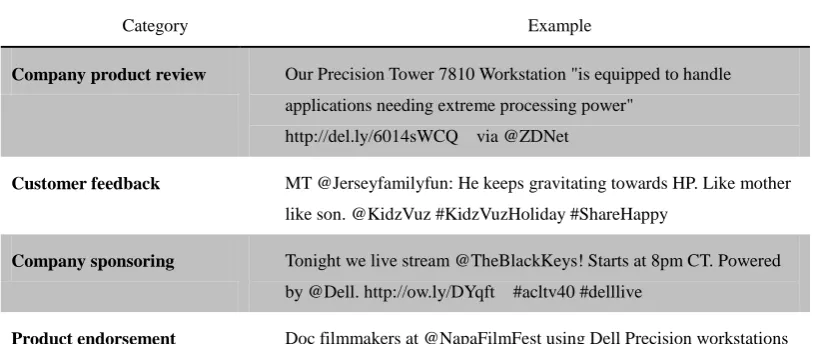
Microblogging as a free and effective form of marketing is widely welcomed by firms. Table 2 shows how technical companies use microblogging for marketing. Company product review
refers to customer‘s, website‘s or expert‘s comment on a company‘s products. Customer feedback includes information from customers about how they feel about a product or a service. Company sponsoring is a company‘s financial or in-kind support of an activity.
[image:17.595.111.518.577.749.2]Product endorsement invites famous people to appear in product advertisements or showing support for company products. Product advertising aims to build and maintain product awareness with potential buyers. Participate to win lottery encourages users to participate in activities launched by a company, which may lead to winning a lottery. Self-test posts online self- test with concealed advertising. Sale promotion offers company activities that encourage the purchase or sale of a product or service. Design philosophy explains what companies are trying to accomplish with their product design.
Table 2 Marketing Communication
Category Example
Company product review Our Precision Tower 7810 Workstation "is equipped to handle
applications needing extreme processing power"
http://del.ly/6014sWCQ via @ZDNet
Customer feedback MT @Jerseyfamilyfun: He keeps gravitating towards HP. Like mother
like son. @KidzVuz #KidzVuzHoliday #ShareHappy
Company sponsoring Tonight we live stream @TheBlackKeys! Starts at 8pm CT. Powered
by @Dell. http://ow.ly/DYqft #acltv40 #delllive
18
to tell the story of the Napa earthquake #nvff
Product advertising Capture moments of inspiration whenever and wherever they occur
with the @Dell Venue 8 Pro 3000 http://spr.ly/6013sGtv
Participate to win lottery Gemini guys are funny and supporting friends! Gemini people, @
Lenevo with your selfie to win a gift.
Self-test Has overpriced, inefficient storage killed your free time? Find out your
official Life Quality rating: http://techpageone.dell.com/lifequality
@Dell_Storage
Sale promotion Don't wait for Black Friday,save up to 30% on select Dell appliances
today during the Black Friday Presale! Shop now!
http://del.ly/6013sstN
Design philosophy From the 1st commercial LED to the 1st memristor, reducing power
consumption has always been our mission. #HP75
4.3
Emergency communication
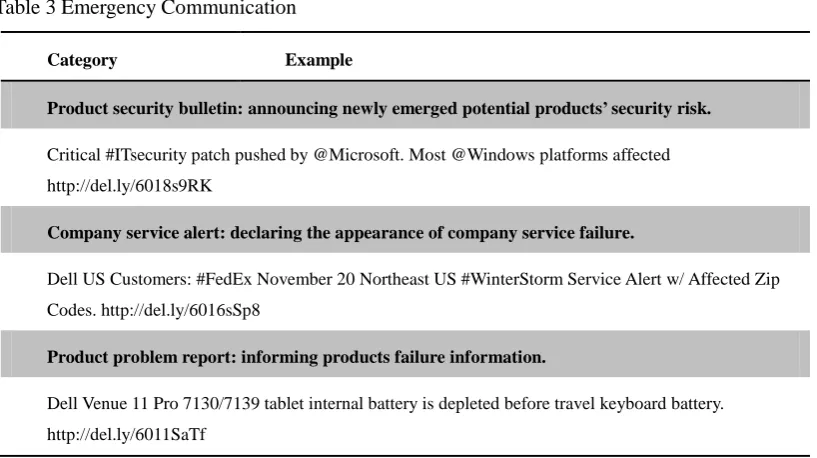
Technical companies use microblogging to report potential emergency problems, keeping followers informed of the latest emergency news, reminding them to avoid unnecessary risk. There are three types of emergency communication that emerged during our analysis. First,
[image:18.595.111.520.490.719.2]product security bulletin: announcing newly emerged potential products‘ security risk. Second, company service alert: declaring the existence of company service failure to reassure users. Third, product problem report: informing products failure information.
Table 3 Emergency Communication
Category Example
Product security bulletin: announcing newly emerged potential products’ security risk.
Critical #ITsecurity patch pushed by @Microsoft. Most @Windows platforms affected
http://del.ly/6018s9RK
Company service alert: declaring the appearance of company service failure.
Dell US Customers: #FedEx November 20 Northeast US #WinterStorm Service Alert w/ Affected Zip
Codes. http://del.ly/6016sSp8
Product problem report: informing products failure information.
Dell Venue 11 Pro 7130/7139 tablet internal battery is depleted before travel keyboard battery.
19
4.4
Pedagogical communication
Microblogging was proved an effective way of learning; technical companies also conduct pedagogical communication in the microblogging world. The pedagogical information contains: knowledge sharing concerning management skills, self-improvement suggestions,
job applying tips and technical information. Great accounts recommendation refers to the company recommending other useful information sharing microblogging accounts. Sharing role model story to describe the successful experience of other individuals. Industry trend sharing informs the predication to the developing trend of industry.
Table 4 Pedagogical Communication
Category Example
Knowledge sharing: companies share information, skills, or expertise to the followers.
Management skills 3 Habits Of Highly Successful CEOs http://del.ly/6013sJil
Self-improvement
suggestion
"7 Ways To Make Meetings Functional" on @LinkedIn
http://del.ly/6015sg3x
Job applying tips 3 Magic Phrases Every Interviewer Wants to Hear
http://del.ly/6016sdDq via @dailymuse @lzhng #InterviewTips
Technical information #HP #GovSec: @DHSgov eyes next-generation #biometric matching
technologies via @GCNTech http://ow.ly/Eowsq
Great accounts recommendation: recommend other useful information sharing account.
Great Instagram accounts to follow for Science. Thanks @plugusin
http://blog.williamferriter.com/2014/11/14/five-instagram-accounts-for-scichat-nation/ …
Sharing role model story: sharing successful individual’s experience.
A role model for entrepreneurs everywhere…and at only thirteen! http://del.ly/6010sZ1a #DWEN
@Forbes @Ventureneer @IsabellaRTaylor
Industry trend sharing: sharing informed prediction to the developing trend of industry.
#Telemedicine, digital health vital to med industry's transition into the future via @FierceHealthIT
http://del.ly/6015sWk7
4.5
Technical communication
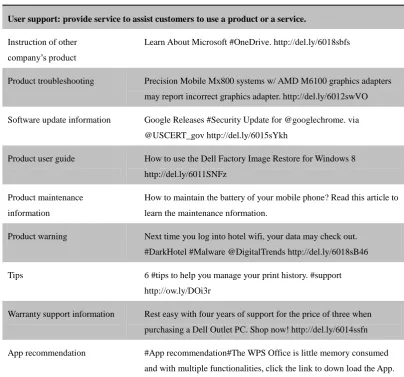
20 helping users to solve a problem by assisting them with repairing failed products or processes.
Software update information i.e. providing the company‘s newly released software version or patch information. Product user guide i.e. a step-by-step guide for users to learn how to use the products. Product maintenance information i.e. information about how to preserve products in daily usage. Product warning: introducing the product‘s potential risk, reminding
the user how to avoid the risk. Tips i.e. helpful hints and tricks about how to use products.
Warranty support information i.e. the product‘s after-sale service information. App recommendation i.e. introducing App briefly and recommending users to download.
[image:20.595.109.514.379.756.2]Besides, another form of technical communication is linking users with Q&A which means helping users by linking them with people who can help. For example, the tweet‖ NYC tweeps > RT @greggweiss Hey #NYC: I need to borrow a @Dell laptop charger for 15-20 minutes. Broadway & Spring. Who can help me out?‖ asking for the charger of a Dell laptop, the company didn‘t provide direct help, it retweeted the tweet, asking their followers to assist this user..
Table 5Technical Communication
Category Example
User support: provide service to assist customers to use a product or a service.
Instruction of other company‘s product
Learn About Microsoft #OneDrive. http://del.ly/6018sbfs
Product troubleshooting Precision Mobile Mx800 systems w/ AMD M6100 graphics adapters
may report incorrect graphics adapter. http://del.ly/6012swVO
Software update information Google Releases #Security Update for @googlechrome. via
@USCERT_gov http://del.ly/6015sYkh
Product user guide How to use the Dell Factory Image Restore for Windows 8
http://del.ly/6011SNFz
Product maintenance
information
How to maintain the battery of your mobile phone? Read this article to
learn the maintenance nformation.
Product warning Next time you log into hotel wifi, your data may check out.
#DarkHotel #Malware @DigitalTrends http://del.ly/6018sB46
Tips 6 #tips to help you manage your print history. #support
http://ow.ly/DOi3r
Warranty support information Rest easy with four years of support for the price of three when
purchasing a Dell Outlet PC. Shop now! http://del.ly/6014ssfn
App recommendation #App recommendation#The WPS Office is little memory consumed
21 Linking users with Q&A: helping users by linking them with people who can help.
NYC tweeps > RT @greggweiss Hey #NYC: I need to borrow a @Dell laptop charger for 15-20
minutes. Broadway & Spring. Who can help me out?
[image:21.595.83.536.252.769.2]4.6
Comparison of Twitter and Sina Weibo
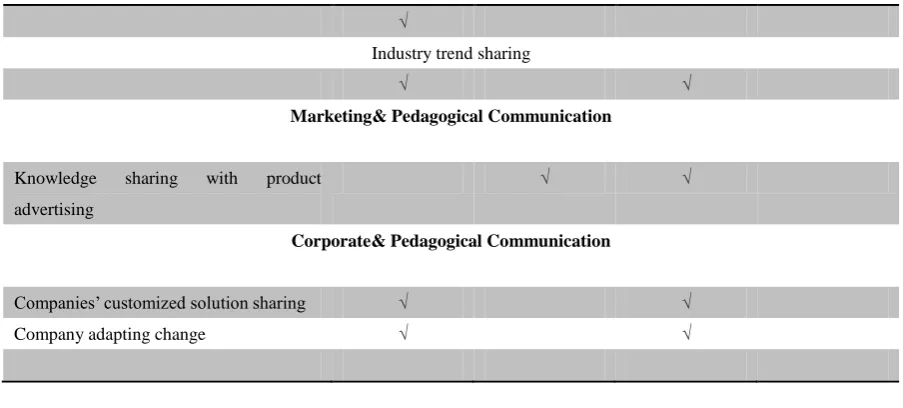
Table 6 Comparison of microblogging use in Chinese and western technical companies Corporate Communication
Achievement
Dell HP Huawei Lenovo
Company Award √ √ √
Company Rank √ √ √
Employee award √
Company in the media
Article mentioning company √ √
Analysis of company success √
Company adapting change √ √ √
Company‘s technical innovation √
Company analyzes industry trend √
Company event report √
Human resource
Employee life sharing √ √
Company working benefits √ √
Company culture √ √ √
Employee working experience √ √ √ √
Company closes gender gap √
Company recruitment √ √ √
Company working environment √
Company history √ √
Company news
Collaboration √ √ √
Company event recommendation √ √
Company event Report √ √ √
Company project launch √ √
Company‘s technical innovation √ √
Corporate social responsibility
Company commitment √
Public welfare program √ √
Relationship building
22
Raise hot topic discussion √ √
Express appreciation √
Sharing funny information √ √
Daily greeting √ √
Sharing inspiring quote √ √ √
Sustaining company image.
Retweet Notice for missing people √
Technical communication
User support
Instruction of other company‘s product √ √ √ √
Product troubleshooting √ √ √
Software update information √ √ √ √
Product user guide √ √ √
Product maintain information √ √
Product warning √
Tips √ √ √
Warranty support information √ √ √
App recommendation √ √
Respond to customer complain √
Linking users with Q&A √
Emergency Communication
Product security bulletin √ √
Company service alert √ √
Product problem report √ √
Marketing
Company product review √ √ √ √
Customer feedback √ √ √ √
Company sponsoring √ √ √ √
Product endorsement √ √
Product advertising √ √ √ √
Participate to win lottery √ √ √
Self-test √
Sale promotion √ √ √
Design philosophy √ √
Pedagogical Communication
Knowledge sharing
Management skills √
Self-improvement suggestion √ √
Job applying tips √
Technical information √ √
Great accounts recommendation
√ √
23
√
Industry trend sharing
√ √
Marketing& Pedagogical Communication
Knowledge sharing with product
advertising
√ √
Corporate& Pedagogical Communication
Companies‘ customized solution sharing √ √
Company adapting change √ √
During the coding process, it shows the four companies are all active in using microblogging. They have different official accounts specialize in different fields and focus on different target groups. For example, the account ‗DELLCares‘ aims to provide customer support, dedicating to listen, help and provide proactive information to the customers; ‗Dell Outlet‘ is the account that provides sale related information of Dell products, like offers, coupon code and posts links to the online shopping website; ‗Life At Dell‘ offers information about the company‘s career opportunities, gives insider tips about recruitment and shows what life at Dell is like around the world. The diverse Twitter/Weibo accounts of the four companies proved they paid attention to the microblogging implementation.
After the coding, we compared the Twitter use of Dell and HP with Weibo use of Huawei and Lenovo. The result shows they all use microblogging for corporate, marketing, pedagogical and technical communication. For corporate communication, they report company news and achievements for external communication and introduce company human resource for internal communication. They post a wealth of information about their products to stimulate users‘ buying intention for marketing communication. Sharing knowledge with followers for pedagogical communication and providing user support for technical communication.
[image:23.595.83.535.70.274.2]24 customer activity, raise hot top discussions, and share funny stories to increase mutual communication with costumers. They also use Sina weibo to share inspiring quotes, express appreciation and post daily greetings to followers.
5
DISCUSSION
5.1.
Main finding
The research found that both Chinese and western technical companies value the use of microblogging. They use it for five types of communication: corporate, marketing, emergency, pedagogical and technical communication. From the previous literature, there is no presence of companies use of microblogging for pedagogical communication, but the results shows that both Chinese and Western technical companies are conducting pedagogical communication in their microblogging use. Especially western companies Dell and HP, they post frequent tweets about knowledge sharing on a daily basis. From these tweets, followers can have a broad understanding about their technical field and learn more about the whole technical industry.
The difference in use of microblogging is that Chinese companies pay great attention to relationship building with followers while western companies seldom do; they organize costumer activities to communicate with followers face to face; raise hotspot topic to discuss and interact with followers. This could be explained by the first dimension of Hofstede‘s(1980) five cultural dimensions: individualism-collectivism. Chinese culture is the typical collectivistic culture; one tends to define self with others instead of distinct from others (Triandis, 1995), hence, these Chinese companies are dedicated in relationship building to establish a good customer relationship, binding customers as part of their companies. Moreover, Guanxi, the concept of keeping a web of connections to keep favorable interpersonal and organizational relationship, is of great importance within the Chinese society. Xin and Pearce (1996) conclude Guanxi as the lifeblood of personal relationships and business conducts in China. This may also explain why Chinese companies focus more on the relationship building aspect with their followers.
5.2.
Theoretical implications
25
company in the media and company news are all trying to inform customers about the companies‘ new products or events. Jansen et al (2009) concluded that microblogging realizes the essence of electronic word-of-mouth (eWOM) communication; it is true when technical companies employ microblogging they retweet customer feedback and product review, allowing followers to view the genuine sentiment of their products in order to advertise and disseminate their products information to stimulate users‘ buying intention. The interest based and RSS function of microblogging made it an ideal platform for pedagogical information (Dunlap & Lowenthal, 2009). Obviously, technical companies also realized that using Twitter and Sina Weibo for pedagogical communication is a good way to attract and keep the followers‘ attention. Hence, they use microblogging for knowledge sharing in diverse aspects like management skills, self-improvement suggestion, job applying tips, technical information
and etc. According to Markel (1996), technical communication is the process of creating, designing, and transmitting technical information so that people can understand the information easily, safely, effectively, and efficiently. Pringle and Williams (2005) conclude that a majority of technical communicators perceive technical communication as based on skills that involve designing information by conducting audience analysis, communicating, writing, designing, or editing. Today, the definition of technical communication is not limited to the narrow field of providing instructional and informational communication about technical products, but is extended to a broader area: it bridges the gap between technology and users by expressing users‘ opinion in the design processes of technical products. It involves content and information management and it even provides promotion strategies, Technical companies keep pace with the times when they using microblogging. They not only provide traditional user support but also provide customers with real time help like linking users with Q&A to offer them the most timely assistance.
Second, the comparison of microblogging use in Chinese and Western companies shows they use microblogging mostly for the same purpose, but a stark difference exists: Chinese companies pay attention to relationship building with followers which western companies do not; Chinese companies pay attention to organize customer activity, raise hot topic discussion, express appreciation, share funny information and inspiring quote, aimed at creating a good relationship with followers. Western companies, on the other hand, employ twitter to share knowledge which Chinese companies seldom do.
Practical implications
26 Besides, companies should manage their microblogging accounts in a more consistent manner. Clearly specify the function and field of each account, manage the content of each tweet/weibo carefully to avoid redundancy and overlap.
5.3.
Limitations and recommendations for future research
This paper is about how technical companies use microblogging. Due to the large amount of companies‘ official microblogging accounts and external link of each microblogging, the sample of my research is not enough; only four companies are analyzed This means future research is needed for a larger sample of companies. Also the timeline of the sample is only two weeks, for future research, the timeline should be longer.
This paper concludes that, given the limitations of the research method, it is difficult to say if the companies‘ use of microblogging is successful. Are costumers satisfied with the content of their tweets/weibos? Which aspects of microblogging help the companies and customers? Therefore, it is recommended to do user research.
For future research, it is also advised that researchers should focus on one of the five communication types, and use a larger sample and longer timeline analysis of how technical companies use microblogging. For instance, in the case of technical communication, how do technical companies use microblogging for technical communication? What is the distinction between traditional technical communication and microblogging technical communication? And in which situation and aspects is microblogging better for users to use?
5.4.
Conclusion
In can be concluded that both Chinese and Western technical companies are active in using microblogging. Their use of microblogging is of great diversity and different purposes: They use it for corporate, marketing, emergency, pedagogical can technical communication. Each company has several official microblogging accounts serving different functions and target groups.
27
REFERENCES
AFP (2014).Sina Weibo, 'China's Twitter,' files for IPO.Hindustan Times.
Bernoff, J. and Li, C. (2008). Harnessing the power of the Oh-So-Social Web. MIT Sloan
Management Review (49301).
Blanton, A (2010). Content for tomorrow: social media and the dilemmas for technical publications teams, The Center for Information-Development Management, Volume 12, Issue 1, February 2010.
Blount, P. (2013). Usable user content – how social networks are transforming technical communication
Bowdon, M. a. (2014). Tweeting an ethos: Emergency messaging, social media, and teaching technical communication. Technical Communication Quarterly, 23(1), 35–54. doi:10.1080/10572252.2014.850853
Bulearca, M., & Bulearca, S. (2010). Twitter: A viable marketing tool for SMEs? Global Business & Management Research, 2, 296–309.
Carim, L., & Warwick, C. (2013). Use of social media for corporate communications by research-funding organisations in the UK. Public Relations Review, 39(5), 521–525. doi:10.1016/j.pubrev.2013.08.006
Case, C. J., & King, D. L. (2006). Cutting edge communication:Microblogging at the Fortune 200, Twitter implementaion and usage.
Chan, M., Wu, X., Hao, Y., Xi, R., & Jin, T. (2012). Microblogging, online expression, and political efficacy among young chinese citizens: the moderating role of information and entertainment needs in the use of weibo. Cyberpsychology, Behavior and Social Networking, 15(7), 345–9. doi:10.1089/cyber.2012.0109
Chew, C., & Eysenbach, G. (2010). Pandemics in the age of Twitter: content analysis of Tweets during the 2009 H1N1 outbreak. PloS One, 5(11), e14118. doi:10.1371/journal.pone.0014118
Davidson, D., 2009. How to put a price on your social media strategy, Revolution Magazine – The Insider‘s Guide to Digital Marketing 2009, November, pp.29-33;
Dunlap, J. C., & Lowenthal, P. R. (2009a). Horton hears a tweet. EDUCAUSE Quarterly, 32(4), 1-11.
Finin, T., & Tseng, B. (2007). Why We Twitter : Understanding Microblogging, 56–65.
28
Glaser, B., & Strauss, A. (1967). The discovery of grounded theory. Chicago: Aldane.
Grosseck, G., & Holotescu, C. (n.d.). Can we use Twitter for educational activities?
Gu, C., & Wang, S. (2012). Empirical study on social media marketing based on Sina Microblog.
2012 Second International Conference on Business Computing and Global Informatization, 537– 540. doi:10.1109/BCGIN.2012.146
International Organization for Standardization strategic advisory group on corporate social responsibility, preliminary working definition of organizational social responsibility, ISO/TMB AGCSR N4, 2002.
Ivanova, M. (1825). Understanding microblogging hashtags for learning enhancement, 11, 17–23.
Jansen, B. J., Zhang, M., Sobel, K., & Chowdury, A. (2009). Twitter power: Tweets as electronic word of mouth. Journal of the American Society for Information Science and Technology, 60, 2169–2188. doi:10.1002/asi.21149
Kaplan, A. M., Haenlein, M. 2010. Users of the world, unite! The challenges and opportunities of social media. Business Horizons, 53(1), 59–68.
Katajisto, L. (2010). Implementing social media in technical communication. Professional Communication Conference (IPCC), 2010 IEEE International. doi:10.1109/IPCC.2010.5530019
Kietzmann, J. H., Hermkens, K., McCarthy, I. P., & Silvestre, B. S. (2011). Social media? Get serious! Understanding the functional building blocks of social media. Business Horizons, 54, 241–251. doi:10.1016/j.bushor.2011.01.005
Krüger, N., & Potthoff, T. (2012). Brand Communication In Twitter – A Case Study On Adidas.
Larson, K. and Watson, R. T. (2011). The Value of Social Media: Toward Measuring Social Media Strategies. In Proceedings of the International Conference on Information Systems (ICIS) 2011, pp. 1-18.
Palen, L., Starbird, K., Vieweg, S., & Hughes, A. (2010). Twitter-based information distribution during the 2009 Red River Valley flood threat. Bulletin of the American Society for Information Science and Technology, 36(5), 13–17.
Patrick M. Sheridan (2014). Weibo IPO leads Chinese stock invasion".CNN Money.
PewResearch. (2014), Social networking fact sheet. Retrieved from: http://www.pewinternet.org/fact-sheets/social-networking-fact-sheet/
PewResearch(2013) Social media update 2013. Retrieved from: http://www.pewinternet.org/2013/12/30/social-media-update-2013/
29
Pringle, K., & Williams, S. (2005). The future is the past: has technical communication arrived as a profession? Technical Communication, 52(3), 361–370.
Rauch, M., Morrison, C., & Goetz, A. (2010). Are we there yet? An examination of where we‘ve been and where we're headed as technical communicators. 2010 IEEE International Professional Comunication Conference, 297–309. doi:10.1109/IPCC.2010.5530027
Van Riel, C. B. M. 1995, Corporate Communication(Prentice Hall, New York).
Riemer, K. and Richter, A. (2010). Tweet Inside: Microblogging in a Corporate Context. In Proceedings of BLED. Paper 41.
Rinaldo, S. B., Tapp, S., & Laverie, D. a. (2011). Learning by tweeting: using Twitter as a pedagogical tool. Journal of Marketing Education, 33(2), 193–203. doi:10.1177/0273475311410852
Romero, D. M., Galuba, W., Asur, S., & Huberman, B. A. (2011). Influence and passivity in social media. In Lecture Notes in Computer Science (including subseries Lecture Notes in Artificial Intelligence and Lecture Notes in Bioinformatics) (Vol. 6913 LNAI, pp. 18–33). doi:10.1007/978-3-642-23808-6_2
Rybalko, S., & Seltzer, T. (2010). Dialogic communication in 140 characters or less: How Fortune 500 companies engage stakeholders using Twitter. Public Relations Review, 36(4), 336–341. doi:10.1016/j.pubrev.2010.08.004
Saravanakumar, M., & SuganthaLakshmi, T. (2012). Social media marketing. Life Science Journal,
9, 4444–4451.
Schonfeld, E., 2009. Twitter finds growth abroad with 58.4 million global visitors in September,
TechCrunch, 26 October. Available from:
http://techcrunch.com/2009/10/26/twitter-finds-growth-abroad-with-58-4-million-global-visitors-in -september/
Senadheera, V., & Warren, M. (2011). A Study Into How Australian Banks Use Social Media.
Soat, J. (2010). 7 Questions Key to Social Networking Success. Informationweek.com, 1254, 18-24.30.
Statista. (2014), Statistics and facts about Social Networks Retrieved from:http://www.statista.com/topics/1164/social-networks/
Stieglitz, S., & Krüger, N. (2011). Analysis of Sentiments in Corporate Twitter Communication – A Case Study on an Issue of Toyota.
Strauss, A., & Corbin, J. (1990). Basics of qualitative research: Grounded theory procedures and
techniques. Newbury Park, CA: Sage.
30
Hazards Events : What Twitter May Contribute to Situational Awareness, 1079–1088.
Xin KR, Pearce JL. 1996. Guanxi: connections as substitutes for formal institutional support. Academy of Management Journal 39: 1641–1658
Zhang, L., & Pentina, I. (2012). Motivations and usage patterns of Weibo. Cyberpsychology, Behavior and Social Networking, 15(6), 312–7. doi:10.1089/cyber.2011.0615
Zhao, D., & Rosson, M. B. (2004). How and Why People Twitter : The Role that Micro- blogging Plays in Informal Communication at Work.
中国最具价值品牌排行榜
Retrieved from http://www.worldbrandlab.com/brandmeeting/2013china500/brand1.htm