2019
Consumer Perceived
Value & Location-Based
Service Mobile
Application
ANALYZING THE EFFECT OF PERCEIVED VALUE DIMENSIONS
ON COMMITMENT AND BEHAVIORAL INTENTION AND
PRIVACY CONCERNS ON BEHAVIORAL INTENTION
ANISA LEVINA WIDHYANA - S1942611
Faculty of Behavioral, Management and Social Science (BMS) Chair
Abstract
Purpose: The popularization of smartphones has brought about fundamental changes in Location-Based Services (LBS). In this article, the direct effects of various value dimensions are analyzed: monetary, convenience, emotional, social, conditional and epistemic value. The importance of perceived value in customers on customer decision making is well known. Yet, few studied assess the direct effect of perceived value dimension on commitment and behavioral intention, specifically in using mobile LBS application.
Fundamentally, in this digital era, the spreading of LBS has raised privacy concerns due to the potential misuse of user’s information. Thus, privacy concern was added to the model.
Method: A quantitative method using survey targeted to the end users of GO-JEK were conducted to examine whether perceived value dimensions and privacy concern have effect on commitment and behavioral intention.
Main findings: Conditional value and convenience value mostly influenced behavioral intention, followed by epistemic value. The effect of monetary value and privacy concern were not significant. Emotional value had the highest influence on commitment, followed by conditional value, while social value was found no significant.
Implications: The primary implication in this study is the value-based approach gives a good foundation for segmenting and planning marketing strategies as effective marketing
strategies requires good knowledge about the needs and value perceptions of each customer segment. Adding privacy concern to the model gave insights on whether customers consider privacy when using LBS application.
Table of Contents
Abstract
1. Introduction………4
Case of GO-JEK……….…….6
2. Theoretical Framework………..8
2.1 Customer Perceived Value……….…..…...8
2.1.1 Value Dimensions……….…….…………..10
2.2 The Impact of Perceived Value on Commitment and Behavioral Intention…….…..13
2.3. Privacy Concern………15
3. Methodology………...17
3.1 Pre-test………...17
3.2 Quantitative Method………..………..17
3.2.1 Procedure………..………..18
3.2.2 Participants………..………..………...18
3.2.3 Measures………..19
3.2.4 Reliability Analysis………..22
3.2.5 Factor Analysis……….………....22
4. Results 4.1 Descriptive Analysis……….………..23
4.2 Correlation Analysis……….………..23
4.3 Regression Analysis……….……….…………..24
4.4 Hypotheses Overview………25
4.5 Additional Analysis………..………...26
5. Discussion………...30
6. Theoretical and Practical Implications………..33
7. Limitations……….………...34
References………35
Appendix A………..44
Appendix B………..51
1 Introduction
Location-based services (LBS) have gained attention as companies are facing new opportunities in offering more customized services. The ability to identify customer’s location at a certain time is one of the most promising applications of LBS. Positioning techniques assist the service providers offer entirely new services or add value to the current ones by taking the context usage into account (Barnes, 2003; Harter, 2000).
According to Duri et al., 2001, Location-based Services or LBS are, “Services in which the location of a person or an object is used to shape or focus the application or service. The other applications for location-based information are related to advertising, roadside assistance, fleet management, people tracking, road pricing and location-based products (Barnes, 2003). Junglas and Watson (2008) defined LBS as any service that takes into account the geographic location of an entity. The term of entity can be either humans or other objects. Location-based services (LBS) can also be described as services that depend on and are enhanced by the positional information of the mobile device (Hirsch, Kemp & Ilka, 2006; Dhar & Varshney, 2011). Sadoun and Al-Bayari (2007) explained that LBS consist of three components: (1) the mobile positioning system, (2) the mobile telephony network to deliver services to the users, and (3) the LBS application.
With the growing popularity of smartphones, more attention is being paid to the LBS industry. LBS can also be defined as network-based services that integrate a mobile device’s location or position with other information in order to provide added value to the user (Barnes 2003; Xu & Gupta 2009). Smartphones with built-in GPS are able to provide users with novel experiences through a variety of LBS applications. There are many benefits of installing LBS applications on smartphones, both for customers and companies. For instance, LBS-based target advertising can be performed by connecting to ‘searching’ or ‘call connecting’ functions, and commercial functions such as automatic payments are also enabled (Ryu, 2010).
general functional purposes, for instance emailing, calendars and weather information. Due to public demands and the development of mobile technologies, more functions were created such as, mobile games, banking, order-tracking, GPS and location-based services. One of the reason people choose what they are using is perceived value. Fundamentally, the popularity and massive growth of smartphone usage has generated studies on the comprehensive adoption of new mobile applications.
Customers need to understand how the service brings value to their everyday life. Perceived value plays an integral role in persuading customers to use the services. This theory is relevant as examining customer perceived value is essential in assessing current services and for the development of further ones, since customer segments may have different motives to use services and thus perceive different value in them. The purpose of the study is to analyze the effect of perceived value dimensions (monetary, convenience, emotional, conditional and epistemic value) and privacy concern on attitudinal and behavioral components of loyalty: commitment and behavioral intentions to use LBS application. Privacy concern is added to the model as nowadays many customers are becoming aware of the extent to which they are sacrificing their privacy when engaging online. Privacy is a fast-growing concern, and customers are sensitive to companies that fail to protect and respect it.
commitment, though the research did not suggested mediations happened to other perceived value dimensions.
By mean of a survey, the model is tested, with the results giving both theoretical implications and practical implications on the usefulness in using the theory of consumption values under today’s rapid technological development. It is essential to know whether this theory is still relevant or not nowadays as the applications of LBS have grown fast. Moreover, practical implications were obtained on how to increase awareness of using LBS in a way that gives a realistic picture of how LBS applications create value for customers. Adding privacy concern provides an understanding on how to address customers’ uneasiness to share their data. Thus, the main research question is: How do perceived value dimensions and privacy concern influence commitment and behavioral intentions to use LBS application?
This study examines the LBS offered by Go-Jek, an application that provides various kinds of services to customers, from ordering motorcycle taxis to arranging a masseur for a house-massage. However, this paper will only focus on the taxi services provided by the applications.
Case of Go-Jek
In earlier mobile phones with fewer functions, also known as feature phones, LBS were confined to simple location-tracking services. Smartphones, however, have completely changed LBS with their powerful operating systems and various applications. LBS applications with a wide variety of business models have emerged, and LBS and ridesharing application have been combined. For instance, Go-Jek, a motorcycle taxi phone service in Indonesia, is an application to order a ride that allow users to select and store pre-defined locations such as home and work. In addition to regular rides, Go-Jek offers various on-demand services under the brand. Go- Food (food orders and deliveries), Go-Send (logistics), Go-Pay (mobile payments) and Go-Life (lifestyle services, such as massage and hair styling) are a few product lines under Go-Jek company. As a market leader in Indonesia, Go-Jek processes more than 100 million transactions for its 20-25 million monthly users (Potkin, 2018).
2 Theoretical Framework
There is a lack of knowledge on the factors that predict whether people will use an application with LBS. This study aims to explain the role of the LBS, theory of consumption values, and privacy concern respectively and develop the hypotheses.
2.1 Customer Perceived Value
Technology is only an enabler of new and innovative LBS. Customers’ evaluation of the usage experience is not based on the technology but mainly on how valuable they perceive the location-based information to be in certain context (Lehrer, Constantiou & Hess, 2011). This is relevant especially in the location-based application, where the personal, social, psychological and physical context should be taken into account while the service is being used (Carroll, Howard, Peck & Murphy, 2002a; Tamminen, Oulasvirta, Toiskallio & Kankainen, 2004).
Customer value is acquired from a person’s experience and interaction with a product or service. It becomes a fundamental issue in marketing research since it is linked to overall business performance. Customer value perception provides a relevant background for assessing mobile services and the value of the contents from a customer’s point of view, since customers may perceive the value of an offering differently based on needs, preferences, personal value and financial resources (Ravald & Grönroos, 1996). Value perception may also vary based on the usage situation (Anckar & D’Incau, 2002).
antecedent of the purchasing intention or the use of a service (Parasuraman & Grewal, 2000; Sheth et al., 1991; Sweeney & Soutar, 2001; Zeithaml, 1988). Other findings propose that mobile service use is not technology driven, but value-driven instead (Constantious, 2009; Pura, 2005). This is especially relevant in the mobile services, where the personal, social, psychological and physical context that the service is being used in should be taken into account (Carroll et al., 2002a; Tamminen et al., 2004).
The importance of the theory of consumption values lies in postulating that customers balance value assessments for making informed, intrinsically and extrinsically motivated consumption decisions (Kim et al., 2007). Many scholars agree that there are two motives for acquiring products and services: functional needs, and non- functional needs, associated with social, emotional, and epistemic values; these concepts may also be applied in the domain of IT (Turel et al., 2010).
Previous researchers (Kim et al., 2007; Turel et al., 2007) mentioned that the users of information and communication technology (ICT) are not only using the technology, but also using it to use the service . In order to understand the behaviors of ICT users, studies can not only consider the technology utilities, but also take other factors into account, such as emotional, psychological, or social factors (Wang, et al., 2013). Moreover, both the marketing and the Information Systems (IS) disciplines have empirically shown that perceived value is multi-dimensional and can be measured by a variety of instruments (Pura, 2005; Sweeney & Soutar, 2001). Several empirical studies have applied the perceived value concept to investigate the adoption and usage of mobile technologies, such as mobile internet (Kim et al., 2007), location-based services (Pura, 2005), or mobile data services (Kim & Han, 2009; Yang & Jolly, 2009), Those studies discovered the significant influences of perceived value on customers' adoption or usage behaviors. Therefore, this study utilized the multi-dimensional value approach to analyze the effects on commitment and behavioral intention.
Conditional value had the strongest influence on behavioral intentions, followed closely by commitment. Then, convenience value and monetary value had a minor effect on behavioral intentions, compared to other constructs. Furthermore, the other value dimensions had an indirect effect via commitment. Thus, commitment was influenced strongly by conditional value and almost as strongly by emotional value. On the contrary, the positive effects of social value on commitment and the negative effect of epistemic value on behavioral intentions were not significant. However, Pura had not included privacy concern as one of the predictor for behavioral intention. Thus, the current study add privacy concern to examine whether it has impact on behavioral intention.
These findings are explained further in the next section and used as references for hypotheses for this study .
2.1.1 Value Dimensions
Sheth et al. (1991) identified five value dimensions, which are functional, social, emotional, epistemic and conditional value. Since no measurement items were reported to validate this perceived value model in the mobile applications context, other researchers’ work has been used as support to define these dimensions in detail, primarily adapted from Pura (2005) who used the same dimensions for electronic self-service context.
“Gojekin aja”, which means “Just order ‘gojek’ to do it”. For example, in a meeting when an individual wants to send a small package in a short period of time, his/her colleague recommends using GO-JEK to deliver it. Therefore, it is expected that a significant relationship will happen between social value and commitment towards LBS mobile applications.
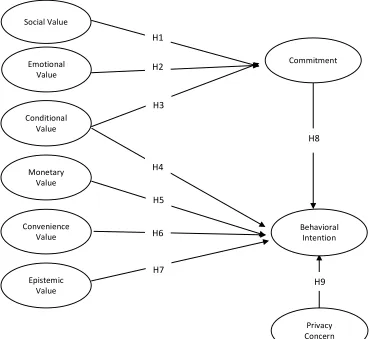
H1. Social value has a positive impact on commitment to GO-JEK
Emotional value is attained when a product or service aroused feelings or affective states (Sheth et al., 1991; Sweeney & Soutar, 2001). A fun or enjoyable experience when using the service for instance has a relationship to emotional value (Holbrook, 1994). Entertainment and fun seeking have been reported as customers’ motives to use mobile services (Leung & Wei, 2000). Pura (2005) revealed that emotional value has the strongest influence on commitment and has an indirect effect on behavioral intentions through commitment as well. Furthermore, emotional value helps to strengthen the emotional connection with target customers, which is important to gain loyal customers (Butz & Goodstein, 1996). Hence, the author expected a positive relationship between emotional value and commitment towards using LBS mobile applications.
H2. Emotional value has a positive effect on commitment to GO-JEK
• H3. Conditional value has a positive effect on commitment to GO-JEK
• H4. Conditional value has a positive effect on behavioral intentions to use GO-JEK Functional value is obtained from effective task accomplishment. It often relates to monetary value or supremacy compared with the alternatives (Sheth et al., 1991). Wang et al. (2004) defined functional value as “utility derived from the perceived quality and expected performance of the product or service”. In a literature about consumer behavior, efficient task fulfillment is also referred to as the output/input ratio, convenience, availability or ease of use (Holbrook, 1994). Moreover, convenience is an important factor in using mobile technology in addition to task fulfillment (Anckar & D’Incau, 2002; Carol et al., 2002a, b). For those reasons, in this study functional value aspects are portrayed by two value dimensions, monetary value and convenience value. According to research done by Wang et al., (2004), functional value has a direct effect on behavior. Pura (2005) found that monetary and convenience value have a positive influence on behavioral intention when using mobile LBS. Therefore, it is expected that monetary value and convenience value affect behavioral intentions positively.
• H5. Monetary value has a positive effect on behavioral intentions to use GO-JEK
general since the novelty value disappears. Thus, epistemic value is expected to have a negative influence on behavioral intentions in LBS application use.
H7. Epistemic value has a negative effect on behavioral intentions to use LBS application
2. 2 The Impact of Perceived Value on Commitment and Behavioral Intention
Yang and Peterson (2004) argued that perceived value not only affects consumption choice decision as its original view, but may also influence many other behavioral outcomes such as customer satisfaction, behavioral usage intentions, and loyalty. Customers’ value perceptions have been found to increase individuals’ readiness to buy and decrease their search intentions for alternatives (De Ruyter & Bloemer, 1999; Grewal et al., 2003; Hellier et al., 2003). In earlier research, behavioral intentions have been used by several researchers to predict loyal behavior (Ajzen & Fishbein, 1980; Duman & Mattila, 2005; Gremler & Gwinner, 2000; Mathwick et al., 2001; Odin et al., 2001; Sweeney et al., 1999; Van Riel et al., 2004).
Behavioral intention is influenced by repeated episodes of positive affect toward the brand, and by definition suggests a brand-specific commitment to re-purchase (Oliver, 1999). It is a loyalty state that contains what appears to be the deeply held commitment to buy. Therefore, commitment and behavioral intentions should be measured as individual constructs. Previous research supports the importance of commitment in relationship marketing and how it is necessary to understand the reasons behind the behavior (Dwyer et al., 1987; Gundlach et al., 1995; Morgan & Hunt, 1994; Roos et al., 2005).
Behavioral intentions, as an affirmed likelihood to engage in a certain behavior, are important indicators of customers’ future behaviors. According to the Theory of Planned Behavior (TPB), behavioral intentions trigger future behaviors (Ajzen & Fishbein, 1980). Favorable behavioral intentions lead to customer loyalty, which is defined as ‘‘a deeply held commitment to repurchase or patronize a preferred product or service in the future’’ (Oliver, 1997). Behavioral intentions can be viewed as signals that show whether a customer will continue to utilize a company’s services or switch to a different provider (Zeithaml et al., 1996).
In service marketing, commitment has been found to be the most important factor of loyal customer behavior (Gundlach et al., 1995; Harrison-Walker, 2001; Johnson et al., 2001; Wetzels et al., 1998). Moreover, committed customers tend to be more tolerant to service failures (Mattila, 2004). It is important to measure commitment to the LBS application in order to estimate if a customer is completely loyal or only use the same mobile LBS application out of habit, convenience or constraints. Commitment is especially important in the LBS application context, where usage decisions are made in a certain situational context and people may not use the application frequently, but can still be regarded as loyal to one application if they are committed to use the same application next time the need appears.
intention to use mobile LBS application.
H8. Commitment has a positive effect on behavioral intentions to use LBS application
2.3 Privacy Concern
Privacy becomes consumers’ concern as the consequence of using the LBS technology. This phenomenon is the so-called ‘location-aware future’ (Wilson, 2012). Consumers acknowledge that their location can be observed through cameras, mobile phones and other electronic devices. As stated by Kinsley (2010) and supported by Anderson (2010), LBS are classified as anticipatory technology. LBS, specifically mobile LBS application need users’ consensus to allow the application to see their locations and utilize the information to provide services to consumers. Hence, without the agreement from the consumers, LBS will not work (Theodorakopoulos et al., 2014). Furthermore, to use the full potential of LBS, customers have to comply with the use of marketing and are willing, as well as comfortable, to provide their personal information such as customers’ location through their smartphones.
It is well known that privacy concerns make people to be more cautious about disclosing their information (Culnan, 1993; Culnan & Bies, 2003; Dinev & Hart, 2006; Li et al., 2011; Metzger, 2004). For instance, a study by Malhotra, Kim & Argawal (2004) found that the internet users concern about the collection of their personal information and for what purposes this information will be used. Researchers found that customers who care greatly about their privacy are less likely to response positively compared to consumers with less privacy concerns. Consumers who have higher level of privacy concern are more hesitant towards LBS and are less open-minded to the potential advantage of this service (Han & Maclaurin, 2002; Ward, Bridges, & Chitty, 2005; Xu, et al., 2011). In conclusion, the hypothesis is:
H9. Privacy concern has insignificant effect on behavioral intention to use GO-JEK
Figure 1. Theoretical Framework
Emotional Value
Conditional Value
Monetary Value
Convenience Value
Epistemic Value
Commitment
Behavioral Intention H1
H2
H4
H5
H6
H7
Privacy Concern
H8 Social Value
H3
3 Methodology
3.1 Pre-test
A pre-test was conducted to examine whether the constructs of consumer perceived value are relevant for the context of location-based service application, which in this case is GO-JEK. Interviews were held with 7 participants whose age ranged from 18 to 26-year-old who have experience in using the LBS applications. There were 4 females and 3 males who took part in the test. A question list was used to initiate and guide the interview using an open-ended questioning technique (see Appendix C). The topics in the interview consisted of participants’ understanding regarding the LBS application, the five value dimensions used by previous literature: social, emotional, functional, conditional and epistemic value and the role of privacy concern. Moreover, non-directive prompts and probing questions were used to assist in initiating and focusing interview. The instrument thus was refined with regard to content, wording accuracy, and relevance. This procedure helped to make the final survey instrument more valid and clearer.
From the results, it can be concluded that respondents were aware of GO-JEK existence and most of the individuals’ reasons to choose GO-JEK when ordering a motorcycle taxi. Participants were also aware that they shared personal information with GO-JEK.
3.2 Quantitative Method
Milberg & Burke, 1996; Dinev & Hart, 2006). See Table 1 for the complete measurement items.
3.2.1 Procedure
The data were collected with online survey targeted the end users of mobile LBS application. The survey consisted of 40 questions regarding topics related to consumer perceived value and loyalty in LBS application context. These topics are created to test the hypotheses stated in the theoretical framework and were measured on a five-point Likert scale to see how people rate certain topics. Score 1 is for ‘totally disagree’ and 5 is for ‘totally agree’. Demographic questions and background questions were also included to filter who has filled the survey to prevent the lack of controllability over who filled in the survey (Granello & Wheaton, 2004; Lefever, Dal, & Matthiasdottir, 2007). The topics were picked based on their relation to the research topic, their theoretical background and the tested/proved usability and reliability.
As can be seen in Appendix A (in English) and Appendix B (in Indonesian), the survey started by explaining the reason for conducting this research and presented some basic information such as duration, the company case, and privacy assurance. Then, on the first question there was an informed consent stating that the participant was voluntarily taking part in this research. Followed by the demographic questions: gender, age, domicile and completed education level. After this introductory part, the real survey began by introducing Go-Jek as the case study. Questions about the frequency of end-users using Go-Ride service in a week was included. Then, the survey was divided to 9 parts, based on each construct as explained in the theoretical frameworks. Lastly, at the end of the survey, the participant was thanked for his/her time. The results were analyzed by the researcher and stated in the result section of this thesis.
3.2.2 Participants
Go-Jek is originally from Indonesia and the vast majority of Indonesians are familiar with it, the survey was in Bahasa Indonesia.
There were 517 responses collected, with 407 of them were selected to continue after data cleaning procedure (145 males and 262 females). The majority of the participants were from Jakarta (39,8%) and West Java (32,7%). Moreover, 53,8 percent of participants had obtained a Bachelor degree and 24,1 percent had got a Master degree or PhD.
Lastly, the frequency of respondents using Go-Jek per week was considered. The frequency analysis was conducted to analyze participants’ responses on the question “How often do you use GO-JEK in a week?”. Accordingly, 34.2 percent of the respondent specified using JEK for less than two days, 24.6 percent used it 2 to 3 days, 22.9 percent used GO-JEK 4 to 5 days and 18.4 percent used it every day.
3.2.3 Measures
The data were collected with an online questionnaire targeted to Indonesian end users of the mobile LBS application. 250 respondents were targeted to fill in the survey. Earlier research advised targeting surveys only to those respondents who have experience of using the application (Pura, 2005). This was considered especially important in service areas like LBS application where non-users usually have no practical perception of the application. Hence, the precondition for participating in the survey was that the respondent has had experience of using the mobile LBS application. Background questions were asked to ensure that the customers actually had used at least one search word listed in the survey.
The dependent variables were measure on five-point Likert scale. Accordingly, participants were given choices to answer ranging from strongly disagree to strongly agree (1. Strongly disagree; 2. Disagree; 3. Neutral; 4. Agree; 5. Strongly agree).
Table 1. Measurement Items
Constructs Items and their sources Label Cronbach’s
Alpha
Factor Loading Monetary Value (Adapted and modified from Chen & Dubinsky
2003; Dodds & Monroe 1991; Sweeney & Soutar 2001)
.78
1. The price that GO-JEK offers is
acceptable MV1 .78
2. GO-JEK’s services are good value for
money MV2 .71
3. The services by GO-JEK are better value for money than I would pay for the same service via other applications
MV3 .68
4. The affordable price is what attracted
me to use GO-JEK regularly MV4 .67
Convenience Value
(Adapted and modified from Anderson & Srinivasan, 2003; Mathwick et al. 2001)
.84
5. I save time and money when I order via
Go-Jek CNV1 .64
6. I value the ease of using Go-Jek
application CNV2 .47
7. I value the option of using Go-Jek
application instantly via mobile device CNV3 .53
8. I value the convenience of using Go-Jek CNV4 .53
9. Using Go-Jek application makes my life
easier CNV5 .63
10. Using Go-Jek application is an efficient
way to manage my time CNV6 .70
Social Value (Adapted and modified from Soutar & Sweeney
2003; Sweeney & Soutar 2001)
.81
11. I feel social pressure from my family to
use Go-Jek SV1 .86
12. I feel social pressure from my friends to
use Go-Jek SV2 .83
13. I look for social approval when I use
Go-Jek SV3 .80
14. A good impression from my social environment is what I am aiming for when using Go-Jek
SV4 .55
Emotional Value (Adapted and modified from Soutar & Sweeney 2003; Sweeney & Soutar 2001)
.86
15. Using Go-Jek gives me pleasure EMV1 .55
16. Using Go-Jek makes me feel good EMV2 .76
17. Using Go-Jek makes me feel relaxed EMV3 .81
18. I do not feel anxious when using Go-Jek EMV4 .73
Conditional Value (Created for this study) .83
20. I value the help from Go-Jek to get what
I need in a certain situation CND2 .80
21. I value the independence of place and
time offered by using Go-Jek CND3 .72
22. Go-Jek eases my daily activity CND4 .55
Epistemic Value (Adapted from Donthu & Garcia, 1999) .83
23. I use Go-Jek to experiment with new
ways of doing things EPV1 .68
24. I use Go-Jek to test out the new
application EPV2 .76
25. I use Go-Jek out of curiosity EPV3 .86
26. I use Go-Jek to satisfies my
inquisitiveness EPV4 .87
Commitment (Adapted and modified from Fullerton (2003),
Garbarino & Johnson (1999) and Zeithaml et al. (1996))
.90
27. I feel loyal to use Go-Jek CM1 .81
28. Go-Jek has a great deal of personal
meaning for me CM2 .72
29. I am a loyal user of Go-Jek CM3 .82
30. I consider Go-Jek as my first choice to
order this type of service CM4 .81
Behavioral Intention
(Adapted from Gremler & Gwinner (2000), Taylor & Baker (1994) and Zeithaml et al. (1996))
.70
31. I intend to continue using Go-Jek’s
services in the future BI1 .67
32. I will use similar applications like Go-Jek
more frequently in the future BI2 .77
33. There is a probability that I will order other services or product by Go-Jek in the future
BI3 .76
34. I can recommend Go-Jek to others BI4 .48
Privacy Concern (Adapted and modified from Smith et al., (1996); DInev & Hart (2006))
.86
35. It bothers me to disclose my personal
information to Go-Jek PC1 .65
36. I am concerned that other people may monitor my current location
continuously
PC2 .79
37. Go-Jek is collecting too much
information about me PC3 .77
38. I am concerned that the information I
submit to GO-JEK could be misused PC4 .81
39. Go-Jek may divulge my personal information to unauthorized parties without my consent
PC5 .75
40. My personal information could be
3.2.4 Reliability Analysis
Cronbach’s Alpha score was used to check the reliability of the constructs. As shown in Table 2, all constructs (Monetary Value, Convenience Value, Social Value, Emotional Value, Conditional Value, Epistemic Value, Commitment, Behavioral Intention and Privacy Concern) were reliable since the Cronbach’s Alpha scores were at least .70.
3.2.5 Factor Analysis
To know whether all items created measured the right construct, factor analysis was conducted (Table 2). In order to see the correlation among the factors and the relationship among the items in the constructs, orthogonal rotation (Varimax) method was used to rotate the factors one another. It was proposed that a construct should have at least three items with > 0,4 factor loading score (Field, 2013).
4 Results
4.1 Descriptive Statistics
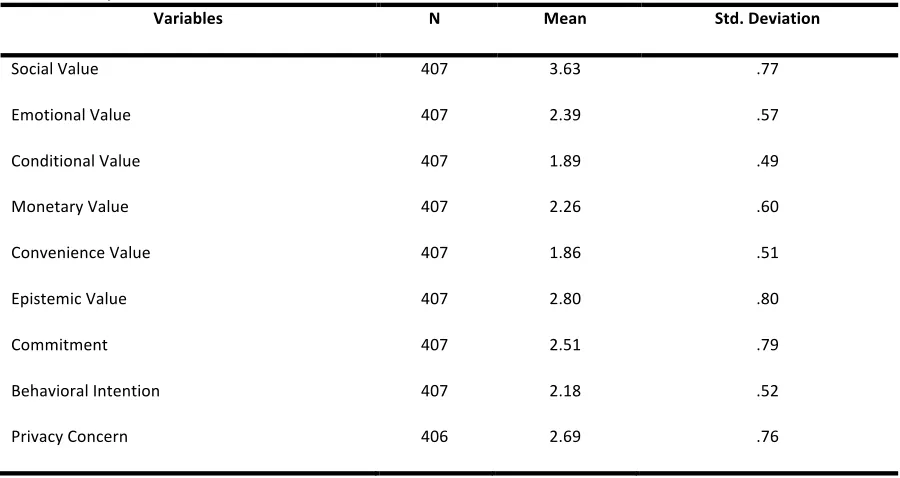
[image:23.595.72.522.237.476.2]Mean and standard deviation for each variable were measured for this study. According to the collected data, social value had the highest score with M=3.63, SD=.77, while conditional value had the lowest score with M=1.89, SD=.49. The analysis results can be found in table 2.
Table 2. Descriptive Statistics
Variables N Mean Std. Deviation
Social Value 407 3.63 .77
Emotional Value 407 2.39 .57
Conditional Value 407 1.89 .49
Monetary Value 407 2.26 .60
Convenience Value 407 1.86 .51
Epistemic Value 407 2.80 .80
Commitment 407 2.51 .79
Behavioral Intention 407 2.18 .52
Privacy Concern 406 2.69 .76
4.2 Correlations Analysis
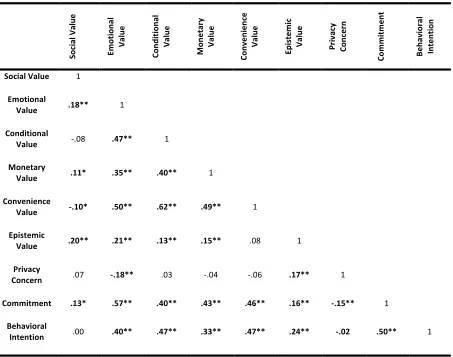
In this section, linear relationships between different variables are revealed. Furthermore, the score of the correlation coefficients gave the insights about the strength and direction of these relationships. Table 4 displays the whole result.
Table 4. Correlation Analysis Soc ia l V al ue Em ot io nal Val ue Condi tiona l Va lu e M onet ar y Val ue Conveni enc e Val ue Ep is te m ic Val ue Pr iv ac y Conc er n Co m m itm en t Beha vi or al Int ent ion
Social Value 1
Emotional
Value .18** 1
Conditional
Value -.08 .47** 1
Monetary
Value .11* .35** .40** 1
Convenience
Value -.10* .50** .62** .49** 1
Epistemic
Value .20** .21** .13** .15** .08 1
Privacy
Concern .07 -.18** .03 -.04 -.06 .17** 1
Commitment .13* .57** .40** .43** .46** .16** -.15** 1
Behavioral
Intention .00 .40** .47** .33** .47** .24** -.02 .50** 1
**. Correlation is significant at the .01 level (2-tailed) *. Correlation is significant at the .05 level (2-tailed)
4.3 Regression Analysis
This section discusses the result of regression analysis that was conducted in this study. Hierarchical analysis was done to examine the influence of perceived value dimensions and privacy concern on commitment and behavioral intention. In this study, two models were analyzed. The first model tested the influence of perceived value dimensions and privacy concern on commitment. On the second model, the study added commitment as predictor and tested for their influence towards behavioral intention.
F(4,405)=38.991, p<.001). In this model, it could be inferred that commitment was strongly influenced by the emotional value (ß=.366, p<.001), whereas epistemic value had insignificant effect on commitment with beta score of=.044, p=.281 (see Table 5).
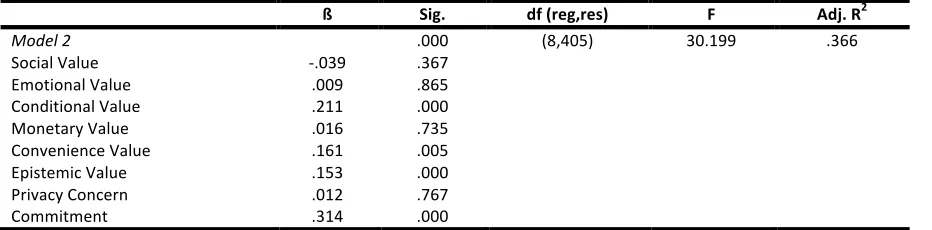
[image:25.595.72.533.319.423.2]Furthermore, perceived value dimensions and privacy concern, with the addition of commitment as predictor, were tested towards behavioral intention and could described 37 percent of behavioral intention. The regression analysis of the modified model revealed that commitment (ß=.314, p<.001) had significant influence on behavioral intention. Amongst all predictors, emotional value had the most insignificant effect on behavioral intention with beta coefficient score .009, p=.865, in which the detail can be found in Table 6.
Table 5. Regression Analysis on Commitment
ß Sig. df (reg,res) F Adj. R2
Model 1 .000 (7,405) 38.991 .396
Social Value .057 .174
Emotional Value .366 .000
Conditional Value .059 .259
Monetary Value .189 .000
Convenience Value .147 .008
Epistemic Value .044 .281
Privacy Concern -.081 .046
Table 6. Regression analysis on Behavioral Intention
ß Sig. df (reg,res) F Adj. R2
Model 2 .000 (8,405) 30.199 .366
Social Value -.039 .367
Emotional Value .009 .865
Conditional Value .211 .000
Monetary Value .016 .735
Convenience Value .161 .005
Epistemic Value .153 .000
Privacy Concern .012 .767
Commitment .314 .000
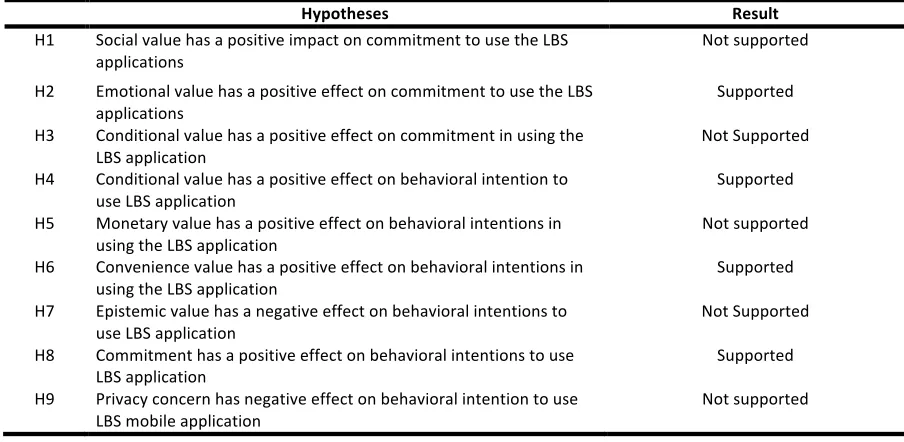
4.4 Hypotheses Overview
[image:25.595.72.538.468.583.2]Table 8. Hypotheses Overview
Hypotheses Result
H1 Social value has a positive impact on commitment to use the LBS
applications Not supported
H2 Emotional value has a positive effect on commitment to use the LBS applications
Supported
H3 Conditional value has a positive effect on commitment in using the
LBS application Not Supported
H4 Conditional value has a positive effect on behavioral intention to use LBS application
Supported
H5 Monetary value has a positive effect on behavioral intentions in using the LBS application
Not supported
H6 Convenience value has a positive effect on behavioral intentions in using the LBS application
Supported
H7 Epistemic value has a negative effect on behavioral intentions to use LBS application
Not Supported
H8 Commitment has a positive effect on behavioral intentions to use LBS application
Supported
H9 Privacy concern has negative effect on behavioral intention to use LBS mobile application
Not supported
4.5 Additional Analysis
Additional analysis was conducted to know whether the current model can be modified and/or changed. In order to discover whether there are indirect effects of perceived value on behavioral intention through commitment, this study performed the PROCESS tool by Hayes as the mediation analysis. This SPSS add-on analyzed the data to find if a mediating effect is present, and if it is significant. A mediation is significant when the following criteria is met: the relationship between independent and mediating variable is significant, the relationship between the mediating variable and dependent variable is significant, the relationship between the independent variable through the mediating variable to the dependent variable is both significant and stronger than the relationship between the independent and dependent variable if the mediating variable would not be present (Hayes, 2013).
According to the results, the effects of social value on commitment (b=.06, p=.17) was found as insignificant. Since the criteria is the relationship between independent and mediating variable has to be significant, mediation is not met.
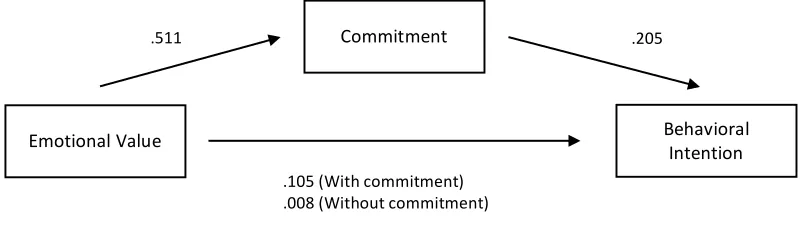
Figure 2 shows the results of mediation analysis of commitment on behavioral intention. Emotional value was found to have a significant influence on commitment (b=.511, p<.001) and commitment has a significant effect on behavioral intention (b=.205, p <.001). With a confidence interval of 95% (.07, .16) of indirect effect which do not cross zero, it can be assumed that emotional value has an indirect effect on behavioral intention through social value.
Conditional value was found to not have significant effect on commitment (b=1, p=.26). Since the criteria of “the relationship between independent and mediating variable is
significant” is not met, meaning no mediation was found. In this case, commitment did not
act as mediator between conditional value and behavioral intention.
Moreover, Figure 3 shows that monetary value has a significant influence on commitment (b=.251, p<.001) and commitment showed significant effect on behavioral intention (b=.205, p<.001). Furthermore, with a confidence interval of 95% (.023, .087) of the indirect effect which did not cross zero, mediation is indicated. Therefore, mediation was occurred between monetary value and behavioral intention through commitment.
Emotional Value
Commitment
Behavioral Intention
.511 .205
.105 (With commitment) .008 (Without commitment)
[image:27.595.95.497.359.472.2].023 CI [.065, .165]
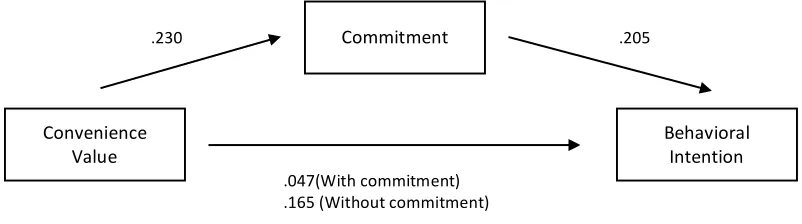
Convenience value has an influence on commitment with b=.230 and p<.05, as well as commitment has significant effect on behavioral intention (b=.205, p<.001). Despite that both results indicated that there is a mediation, the relationship between convenience value to behavioral intention through commitment was weaker than the relationship between convenience value and behavioral intention without commitment as mediator. Hence, it can be assumed that mediation is not met. A more detailed insight into the mediation effect and can be seen in Figure 4.
Epistemic value showed insignificant effect on commitment (b=.04, p=.28). Thus, it can be assumed that mediation through commitment is not occurring between epistemic value and behavioral intention as one of the criteria is not met.
Privacy concern had significant negative influence on commitment (b=-.09, p<.05) and
Monetary Value Behavioral Intention
Commitment
.251 .205
[image:28.595.96.493.112.223.2].052 (With commitment) .014 (Without commitment)
Figure 3. PROCESS Analysis for Mediation of Commitment between Monetary Value and Behavioral Intention
.016 CI [.023, .087]
Convenience Value
Commitment
Behavioral Intention
.230 .205
.047(With commitment) .165 (Without commitment)
Figure 4. PROCESS Analysis for Mediation of Commitment between Convenience Value and Behavioral Intention
[image:28.595.95.496.498.610.2]5 Discussion
This study focused on discovering the influence of perceived value dimensions on commitment and behavioral intention among Indonesian who use GO-JEK application. Moreover, the effect of privacy concern towards behavioral intention was explored as the GO-JEK application is based on sharing data. It is important to underline that the scientific literature on perceived value dimensions which the hypotheses were built on, had mainly focused on mobile service context in comparison with location-based mobile application (Pura, 2005). In the context of current study, privacy concern was added as another predictor of behavioral intention as customers shared their personal information to GO-JEK and it is essential to know customers’ perception on this matter.
An online questionnaire was distributed to users of GO-JEK. The next paragraph will present the discussion of this study’s findings more comprehensively and also compare the results to existing literature. Furthermore, limitations regarding this study will be discussed as well as the recommendations for future related research. The chapter will be ended with an overall conclusion of the whole study.
Commitment was strongly influenced by emotional value, which confirmed the previous study that suggested emotional value had the strongest influence on commitment (Pura, 2005). Emotional value relates to positive feelings and fun. However, in location-based service application, context emotion can also mean feeling safe when using the application and avoiding negative feeling. Thus, building commitment with communication that emphasizes the pleasant, safety, emotional aspects of using the application in a certain situation which could help customers to differentiates and remember GO-JEK next time when the need arises and stay loyal to use GO-JEK in the future.
Different results were obtained for conditional value, which surprisingly had no significant influence towards commitment but had significant impact towards behavioral intention. It was implied that individuals are not committed to use application for ordering services from GO-JEK in certain situations. Pura (2005) found that conditional value had significant influence for both commitment and behavioral intention. Contrasting results between this study and Pura’s might be because of the different case study. While Pura (2005) took mobile service, this research chose ride-sharing application where customers do not commit to one application.
Monetary value refers to good value for money and an acceptable price. This stidy revealed that monetary value had significant impact on commitment. In general, GO-JEK application users were price sensitive, but price may not be one of the most relevant factors when customers assessed the value of application. It is a matter of price perception compared to other alternatives and customers who see the service provided by GO-JEK to be affordable and good value for money when they need the service may be willing to pay for the service in the right context. This reason is probably customers who use the location-based application evaluate the service by its usefulness and whether it is helpful in specific situation. For example, when a manager is in hurry to catch a meeting but got stuck in a traffic jam, ordering a motorcycle taxi through GO-JEK is the solution to reach the destination on time, even though it is far since the motorcycle-taxi rate is quite affordable.
supported in this research. The time saved and convenience gained by ordering for a service with a mobile device could be essential and valuable to customers. The convenience lies in the ability to order the ride based on customers’ chosen location. A means of transport can be ordered easily and instantly, and it may even be more efficient than using a public transport. As a result, the customers can order the ride without having to hail on the road.
Epistemic value had significant effect on behavioral intention. This might be because GO-JEK always updating their application and in general offers various services. Culture may also play role since Indonesian is continuously curious about technology. In addition, GO-JEK regularly releases innovations which may excite the curiosity of customers.
Privacy concern refers to users’ worries in sharing personal information to location-based application. The results in this study indicates that there was strongly no significant influence of privacy concern on behavioral intention. This finding is contradicted with previous studies which suggested that consumers who have higher level of privacy concern are more hesitant towards LBS and are less open-minded to the potential advantage of this service (Culnan, 1993; Culnan & Bies, 2003; Dinev & Hart, 2006; Li et al., 2011; Metzger, 2004). This finding can be due to norms and behaviors regarding private and public matters are different across culture (Moore Jr., 1984). There is a probability that Indonesian differ substantially in how much they care about privacy. Culture and norms might affect how individuals see
6 Theoretical and Practical Implications
The results of this study which was conducted in order to contribute to the scientific knowledge regarding consumers’ choice behavior, can work as a guidance for future research. Based on the research findings, it is indicated that theory of consumption values by Sheth et al. (1990) are still relevant in the location-based application context. Privacy concern was added to the model as online privacy is directly related to one’s own physical security in today’s digital world. Since no significant effects of monetary value and privacy concern on behavioral intention were found, it can be beneficial to continue the investigation of the role of privacy concern and monetary value among Indonesians in this fast-changing digital world.
The primary practical implication in this study is the value-based approach gives a good foundation for segmenting and planning marketing strategies as effective marketing strategies requires good knowledge about the needs and value perceptions of each customer segment. Moreover, communicating the benefits to potential customers helps to attract new customers who share similar value perceptions with the customers the company wishes to keep.
7 Limitations
Location-based service application with different aims, e.g. dating and location based gaming may produce different results, possibly increasing the influence of emotional and social value. Individuals who have experience in using other types of location-based application beside GO-JEK may have different perspectives on perceived values. Therefore, it is necessary to mention the limitation regarding the number of constructs. The component of perceived value included only a limited number of construct. There are several others constructs that may be applied in the future research. Therefore, researchers should also consider that the constructs can change depends on the context of the study. Second, this research was conducted only for Indonesian. Customers’ value perceptions and their influence on commitment and behavior may differ in different cultures, and results indicated the weight of influence of different value dimensions should be interpreted carefully, at least with regard to Western or European markets where the culture is considered to be more individualistic. Thus, the results can be different for other nationalities or in other countries since the culture and norms are unalike.
References
Acquisti, A., Brandimarte, L., & Loewenstein, G. (2015). Privacy and human behavior in the age of information. Science, 347(6221), 509-514.
Ajzen, I. & Fishbein, M. (1980). Understanding Attitudes and Predicting Social Behavior. Prentice-Hall, Englewood Cliffs, NJ.
Anckar, B., & D'incau, D. (2002). Value creation in mobile commerce: Findings from a consumer survey. Journal of Information Technology Theory and Application (JITTA), 4(1), 8.
Anderson, B. (2010). Preemption, precaution, preparedness: Anticipatory action and future geographies. Progress in Human Geography, 34(6), 777-798. doi:
10.1177/0309132510362600
Anderson, R. E., & Srinivasan, S. S. (2003). E-satisfaction and e-loyalty: A contingency framework. Psychology & marketing, 20(2), 123-138. doi: 10.1002/mar.10063 Barnes, S. J. (2003). Location-based services: the state of the art. E-Service, 2(3), 59-70. doi:
10.2979/esj.2003.2.3.59
Bauer, C., & Strauss, C. (2016). Location-based advertising on mobile devices. Management
Review Quarterly, 66(3), 159-194. doi: 10.1007/s11301-015-0118-z
Beatty, S. E., Homer, P., & Kahle, L. R. (1988). The involvement—commitment model: Theory and implications. Journal of business research, 16(2), 149-167.
Brief, A. P., & Aldag, R. J. (1977). The intrinsic-extrinsic dichotomy: Toward conceptual clarity. Academy of Management review, 2(3), 496-500. doi:
10.5465/amr.1977.4281861
Butz Jr, H. E., & Goodstein, L. D. (1996). Measuring customer value: gaining the strategic advantage. Organizational dynamics, 24(3), 63-77. doi:
10.1016/S0090-2616(96)90006-6
Carroll, J., Howard, S., Peck, J., & Murphy, J. (2002a). A field study of perceptions and use of mobile telephones by 16 to 22 year olds. Journal of Information Technology Theory
Carroll, J., Howard, S., Vetere, F., Peck, J., & Murphy, J. (2002b). Just what do the youth of today want? Technology appropriation by young people. In System Sciences, 2002.
HICSS. Proceedings of the 35th Annual Hawaii International Conference on (pp.
1777-1785). IEEE. doi: 10.1109/HICSS.2002.994089
Chen, S. C. (2012). The customer satisfaction–loyalty relation in an interactive e-service setting: The mediators. Journal of Retailing and Consumer Services, 19(2), 202-210. Chen, Z., & Dubinsky, A. J. (2003). A conceptual model of perceived customer value in
e-commerce: A preliminary investigation. Psychology & Marketing, 20(4), 323-347. doi: 10.1002/mar.10076
Constantiou, I. D. (2009). Consumer behaviour in the mobile telecommunications’ market: The individual’s adoption decision of innovative services. Telematics and
Informatics, 26(3), 270-281. doi: 10.1016/j.tele.2008.11.005
Culnan, M. J. (1993). " How Did They Get My Name?": An Exploratory Investigation of Consumer Attitudes toward Secondary Information Use. MIS quarterly, 341-363.
Culnan, M. J., & Bies, R. J. (2003). Consumer privacy: Balancing economic and justice considerations. Journal of social issues, 59(2), 323-342.
Dabholkar, P. A., & Bagozzi, R. P. (2002). An attitudinal model of technology-based self service: moderating effects of consumer traits and situational factors. Journal of the
academy of marketing science, 30(3), 184-201. doi: 10.1177/0092070302303001
Day, G. S. 1969. A Two-Dimensional Concept of Brand Loyalty. Journal of Advertising
Research, 9, 29-35.
De Ruyter, K., & Bloemer, J. (1999). Customer loyalty in extended service settings: The interaction between satisfaction, value attainment and positive mood. International
Journal of Service Industry Management, 10(3), 320-336. doi:
10.1108/09564239910276917
Dhar, S., & Varshney, U. (2011). Challenges and business models for mobile location-based services and advertising. Communications of the ACM, 54(5), 121-128. doi:
10.1145/1941487.1941515
Dodds, W. B., Monroe, K. B., & Grewal, D. (1991). Effects of price, brand, and store information on buyers' product evaluations. Journal of marketing research, 307-319. doi: 10.2307/3172866
Donthu, N., & Garcia, A. (1999). The internet shopper. Journal of advertising research, 39(3), 52-52.
Duman, T., & Mattila, A. S. (2005). The role of affective factors on perceived cruise vacation value. Tourism Management, 26(3), 311-323. doi: 10.1016/j.tourman.2003.11.014 Duri, S., Cole, A., Munson, J., & Christensen, J. (2001, July). An approach to providing a
seamless end-user experience for location-aware applications. In Proceedings of the 1st
international workshop on Mobile commerce (pp. 20-25). ACM. doi:
10.1145/381461.381465
Dwyer, F. R., Schurr, P. H., & Oh, S. (1987). Developing buyer-seller relationships. The
Journal of marketing, 11-27. doi: 10.2307/1251126
Field, A. (2013). Discovering statistics using IBM SPSS statistics. sage.
Fullerton, G. (2003). When does commitment lead to loyalty?. Journal of service
research, 5(4), 333-344. doi: 10.1177/1094670503005004005
Garbarino, E., & Johnson, M. S. (1999). The different roles of satisfaction, trust, and commitment in customer relationships. the Journal of Marketing, 70-87. doi: 10.2307/1251946
Granello, D. H., & Wheaton, J. E. (2004). Online Data Collection: Strategies for Research.
Journal of Counseling & Development, 82(4), 387-393. doi:
10.1002/j.1556-6678.2004.tb00325.x
Gremler, D. D., & Gwinner, K. P. (2000). Customer-employee rapport in service
relationships. Journal of Service Research, 3(1), 82-104. doi: 10.1177/109467050031006 Grewal, D., Iyer, G. R., Krishnan, R., & Sharma, A. (2003). The Internet and the price–value–
loyalty chain. Journal of Business Research, 56(5), 391-398. doi: 10.1016/S0148-2963(01)00227-2
Harrison-Walker, L. J. (2001). The measurement of word-of-mouth communication and an investigation of service quality and customer commitment as potential
antecedents. Journal of service research, 4(1), 60-75. doi: 10.1177/109467050141006 Han, P., & Maclaurin, A. (2002). Do Consumers Really Care About Online Privacy? Marketing
Management, 11(1), 35.
Harter, B. (2000). Location, location, location. Global Telephony, Vol. 8 No. 9, p. 42. Hayes, A. F. (2019). PROCESS macro for SPSS and SAS. Retrieved August 8, 2019, from
http://processmacro.org/index.html
Hennig-Thurau, T., Gwinner, K. P., & Gremler, D. D. (2002). Understanding relationship marketing outcomes: an integration of relational benefits and relationship
quality. Journal of service research, 4(3), 230-247. doi: 10.1177/1094670502004003006 Hellier, P. K., Geursen, G. M., Carr, R. A., & Rickard, J. A. (2003). Customer repurchase
intention: A general structural equation model. European journal of
marketing, 37(11/12), 1762-1800. doi: 10.1108/03090560310495456
Hirsch, F., Kemp, J., & Ilkka, J. (2007). Mobile web services: architecture and implementation. John Wiley & Sons.
Hirschman, E. C. (1980). Innovativeness, novelty seeking, and consumer creativity. Journal of
consumer research, 7(3), 283-295. doi: 10.1086/208816
Holbrook, M. B. (1994). The nature of customer value: an axiology of services in the
consumption experience. Service quality: New directions in theory and practice, 21, 21-71.
Johnson, M. D., Gustafsson, A., Andreassen, T. W., Lervik, L., & Cha, J. (2001). The evolution and future of national customer satisfaction index models. Journal of economic
Psychology, 22(2), 217-245.
Junglas, I. A., & Watson, R. T. (2008). Location-based services. Communications of the ACM, 51(3), 65-69. doi: 10.1145/1325555.1325568
Kim, B., & Han, I. (2009). What drives the adoption of mobile data services? An approach from a value perspective. Journal of Information Technology, 24(1), 35-45. http://dx.doi.org/10.1057/jit.2008.28
Kim, H. W., Chan, H. C., & Gupta, S. (2007). Value-based adoption of mobile internet: an empirical investigation. Decision support systems, 43(1), 111-126.
Kinsley, S. (2010). Representing ‘things to come’: feeling the visions of future
technologies. Environment and Planning A, 42(11), 2771-2790. doi: 10.1068/a42371 Lefever, S., Dal, M., & Matthiasdottir, A. (2007). Online Data Collection in Academic
Research: Advantages and Limitations. British Journal of Educational Technology, 38(4), 574-582. doi: 10.1111/j.1467-8535.2006.00638.x
Lehrer, C., Constantiou, I., & Hess, T. (2011). A COGNITIVE PROCESSES ANALYSIS OF INDIVIDUALS’USE OF LOCATION-BASED SERVICES.
Leung, L., & Wei, R. (2000). More than just talk on the move: Uses and gratifications of the cellular phone. Journalism & Mass Communication Quarterly, 77(2), 308-320. Doi: 10.1177/107769900007700206
Li, H., Sarathy, R., & Xu, H. (2011). The role of affect and cognition on online consumers' decision to disclose personal information to unfamiliar online vendors. Decision Support
Systems, 51(3), 434-445.
Liljander, V. and Strandvik, T. (1997). Emotions in service satisfaction. International Journal
of Service Industry Management. 8 (2). 148-69.
Lyong Ha, C. (1998). The theory of reasoned action applied to brand loyalty. Journal of
product & brand management, 7(1), 51-61. doi: 10.1108/10610429810209737
Malhotra, N. K., Kim, S. S., & Agarwal, J. (2004). Internet Users' Information Privacy Concerns (Iuipc): The Construct, the Scale, and a Causal Model. Information systems
research, 15(4), 336-355. doi: 10.1287/isre.1040.0032
Mathwick, C., Malhotra, N., & Rigdon, E. (2001). Experiential value: conceptualization, measurement and application in the catalog and Internet shopping environment☆
1. Journal of retailing, 77(1), 39-56. doi: 10.1016/S0022-4359(00)00045-2
Metzger, M. J. (2004). Privacy, trust, and disclosure: Exploring barriers to electronic commerce. Journal of computer-mediated communication, 9(4), JCMC942.
Meuter, M. L., Ostrom, A. L., Roundtree, R. I., & Bitner, M. J. (2000). Self-service technologies: understanding customer satisfaction with technology-based service encounters. Journal of marketing, 64(3), 50-64. doi: 10.1509/jmkg.64.3.50.18024 Moore Jr, B. (1984). Privacy: Studies in social and cultural history, armonk, ny: Me sharpe. Morgan, R. M., & Hunt, S. D. (1994). The commitment-trust theory of relationship
marketing. The journal of marketing, 20-38. doi: 10.2307/1252308
Nysveen, H., Pedersen, P. E., & Thorbjørnsen, H. (2005). Intentions to use mobile services: Antecedents and cross-service comparisons. Journal of the academy of marketing
science, 33(3), 330-346. doi: 10.1177/0092070305276149
Oliver, R. L. (1999). Whence consumer loyalty?. Journal of marketing, 63(4_suppl1), 33-44. Odekerken-Schroder, GJ (1999). The role of the buyer in affecting buyer-seller relationships:
empirical studies in a retail context. Maastricht University. Diss.
Odin, Y., Odin, N., & Valette-Florence, P. (2001). Conceptual and operational aspects of brand loyalty: An empirical investigation. Journal of business research, 53(2), 75-84. doi: 10.1016/S0148-2963(99)00076-4
Pagani, M. (2004). Determinants of adoption of third generation mobile multimedia services. Journal of interactive marketing, 18(3), 46-59. doi: 10.1002/dir.20011
Parasuraman, A., & Grewal, D. (2000). The impact of technology on the quality-value-loyalty chain: a research agenda. Journal of the academy of marketing science, 28(1), 168-174. Doi: 10.1177/0092070300281015
Pihlström, M., & Brush, G. J. (2008). Comparing the perceived value of information and entertainment mobile services. Psychology & Marketing, 25(8), 732-755. doi: 10.1002/mar.20236
Potkin, F. (2018, August 18). Indonesia's Go-Jek close to profits in all segments, except...
Retrieved March 30, 2019, from
https://www.reuters.com/article/us-indonesia-gojek- interview/indonesias-go-jek-close-to-profits-in-all-segments-except-transport-ceo-idUSKBN1L20SI
Pritchard, M. P., Havitz, M. E., & Howard, D. R. (1999). Analyzing the commitment-loyalty link in service contexts. Journal of the academy of marketing science, 27(3), 333.
Pura, M. (2005). Linking perceived value and loyalty in location-based mobile
services. Managing Service Quality: An International Journal, 15(6), 509-538. doi: 10.1108/09604520510634005
Ravald, A., & Grönroos, C. (1996). The value concept and relationship marketing. European
journal of marketing, 30(2), 19-30.
Roos, I., Gustafsson, A., & Edvardsson, B. (2005). The role of customer clubs in recent telecom relationships. International journal of service industry management, 16(5), 436-454. doi: 10.1108/09564230510625750
Russell, J. (2016, August 04). Indonesia's Go-Jek raises $550 million to battle Uber and Grab. Retrieved January 22, 2019, from https://techcrunch.com/2016/08/04/indonesias-go-jek-raises-550-million-to-battle-uber-and-grab/
Ryu, H. S. (2010). Status and Prospects of Smartphone Applications. KT Business & Economy
Research Center, Seoul.
Sadoun, B., & Al-Bayari, O. (2007). Location based services using geographical information systems. Computer Communications, 30(16), 3154-3160. doi:
10.1016/j.comcom.2007.05.059
Semeijn, J., van Riel, A. C., van Birgelen, M. J., & Streukens, S. (2005). E-services and offline fulfilment: how e-loyalty is created. Managing Service Quality: An International
Journal, 15(2), 182-194. doi: 10.1108/09604520510585361
Sheth, J. N., Newman, B. I., & Gross, B. L. (1991). Consumption values and market choices:
Theory and applications.
Smith, H. J., Milberg, S. J., & Burke, S. J. (1996). Information privacy: measuring individuals' concerns about organizational practices. MIS quarterly, 167-196. doi: 10.2307/249477 Soutar, G. N., & Sweeney, J. C. (2003). Are there cognitive dissonance segments?. Australian
Journal of Management, 28(3), 227-249. doi: 10.1177/031289620302800301
Sweeney, J. C., & Soutar, G. N. (2001). Consumer perceived value: The development of a multiple item scale. Journal of retailing, 77(2), 203-220. doi:
Sweeney, J.C., Soutar, G.N. and Johnson, L.W. (1999). The Role of Perceived Risk in the Quality-Value Relationship: A Study in a Retail Environment. Journal of retailing, 75(1). 77-105.
Tamminen, S., Oulasvirta, A., Toiskallio, K., & Kankainen, A. (2004). Understanding mobile contexts. Personal and ubiquitous computing, 8(2), 135-143. doi: 10.1007/s00779-004-0263-1
Taylor, S. A., & Baker, T. L. (1994). An assessment of the relationship between service quality and customer satisfaction. Journal of retailing, 70(2), 163-178.
Theodorakopoulos, G., Shokri, R., Troncoso, C., Hubaux, J.-P., & Le Boudec, J.-Y. (2014). Prolonging the Hide-and-Seek Game: Optimal Trajectory Privacy for Location-Based
Services. Paper presented at the Proceedings of the 13th Workshop on Privacy in the
Electronic Society. doi: 10.1145/2665943.2665946
Turel, O., Serenko, A., & Bontis, N. (2007). User acceptance of wireless short messaging services: Deconstructing perceived value. Information & Management, 44(1), 63-73. http://dx.doi.org/10.1016/j.im.2006.10.005
Turel, O., Serenko, A., & Bontis, N. (2010). User acceptance of hedonic digital artifacts: A theory of consumption values perspective. Information & Management, 47(1), 53-59. Van Riel, A. C., Lemmink, J., Streukens, S., & Liljander, V. (2004). Boost customer loyalty with
online support: the case of mobile telecoms providers. International Journal of Internet
Marketing and Advertising, 1(1), 4-23.
Wang, H. Y., Liao, C., & Yang, L. H. (2013). What affects mobile application use? The roles of consumption values. International Journal of Marketing Studies, 5(2), 11.
Wang, Y., Po Lo, H., Chi, R., & Yang, Y. (2004). An integrated framework for customer value and customer-relationship-management performance: a customer-based perspective from China. Managing Service Quality: An International Journal, 14(2/3), 169-182. doi: 10.1108/09604520410528590
Ward, S., Bridges, K., & Chitty, B. (2005). Do Incentives Matter? An Examination of on-Line Privacy Concerns and Willingness to Provide Personal and Financial Information. Journal
Wetzels, M., De Ruyter, K., & Van Birgelen, M. (1998). Marketing service relationships: the role of commitment. Journal of business & industrial marketing, 13(4/5), 406-423. doi: 10.1108/08858629810226708
Wilson, M. W. (2012). Location-Based Services, Conspicuous Mobility, and the Location- Aware Future. Geoforum, 43(6), 1266-1275. doi: 10.1016/j.geoforum.2012.03.014 Xu, H., & Gupta, S. (2009). The effects of privacy concerns and personal innovativeness on
potential and experienced customers’ adoption of location-based services. Electronic
Markets, 19(2-3), 137-149. doi: 10.1007/s12525-009-0012-4
Xu, H., Luo, X. R., Carroll, J. M., & Rosson, M. B. (2011). The Personalization Privacy Paradox: An Exploratory Study of Decision Making Process for Location-Aware Marketing.
Decision Support Systems, 51(1), 42-52. doi: 10.1016/j.dss.2010.11.017
Yang, K., & Jolly, L. D. (2009). The effects of consumer perceived value and subjective norm on mobile data service adoption between American and Korean consumers. Journal of Retailing and Consumer services, 16(6), 502-508.
http://dx.doi.org/10.1016/j.jretconser.2009.08.005
Yang, Z., & Peterson, R. T. (2004). Customer perceived value, satisfaction, and loyalty: The role of switching costs. Psychology & Marketing, 21(10), 799-822.
Yun, H., Han, D., & Lee, C. C. (2013). Understanding the use of location-based service applications: Do privacy concerns matter?. Journal of Electronic Commerce
Research, 14(3), 215.
Zeithaml, V. A. (1988). Consumer perceptions of price, quality, and value: a means-end model and synthesis of evidence. The Journal of marketing, 2-22. doi: 10.2307/1251446 Zeithaml, V. A., Berry, L. L., & Parasuraman, A. (1996). The behavioral consequences of
service quality. the Journal of Marketing, 31-46. doi: 10.2307/1251929
Zhao, L., Lu, Y., & Gupta, S. (2012). Disclosure intention of location-related information in location-based social network services. International Journal of Electronic