NUS at the HOO 2012 Shared Task
Daniel Dahlmeier1, Hwee Tou Ng1,2, and Eric Jun Feng Ng2 1NUS Graduate School for Integrative Sciences and Engineering
2Department of Computer Science, National University of Singapore
{danielhe,nght,eng}@comp.nus.edu.sg
Abstract
This paper describes the submission of the Na-tional University of Singapore (NUS) to the HOO 2012 shared task. Our system uses a pipeline of confidence-weighted linear classi-fiers to correct determiner and preposition er-rors. Our system achieves the highest correc-tion F1score on the official test set among all
14 participating teams, based on gold-standard edits both before and after revision.
1 Introduction
Grammatical error correction is the task of automati-cally detecting and correcting erroneous word usage and ill-formed grammatical constructions in text. Determiner and preposition errors are the two most prominent types of errors made by non-native speak-ers of English. Although there has been much work on automatic correction of determiner and preposi-tion errors over the last few years, it has so far been impossible to directly compare results because dif-ferent teams have evaluated on difdif-ferent data sets.
The HOO 2012 shared task evaluates grammatical error correction systems for determiner and prepo-sition errors. Participants are provided with a set of documents written by non-native speakers of En-glish. The task is to automatically detect and cor-rect determiner and preposition errors and produce a set of corrections (callededits). Evaluation is done by computing precision, recall, and F1 score be-tween the system edits and a manually created set of gold-standard edits. The details of the HOO 2012 shared task are described in the official overview pa-per (Dale et al., 2012).
In this paper, we describe the system submission from the National University of Singapore (NUS). Our system treats determiner and preposition correc-tion as classificacorrec-tion problems. We use confidence-weighted linear classifiers to predict the correct word from a confusion set of possible correction op-tions. Separate classifiers are built for determiner errors, preposition replacement errors, and preposi-tion inserpreposi-tion and delepreposi-tion errors. The classifiers are combined into a pipeline of correction steps to form an end-to-end error correction system. Our system achieves the highest correction F1 score on the offi-cial test set among all 14 participating teams, based on gold-standard edits both before and after revision. The remainder of this paper is organized as fol-lows. The next section presents our error correction system. Section 3 describes the features. Section 4 presents experimental results. Section 5 contains further discussion. Section 6 concludes the paper.
2 System Architecture
Our system consists of a pipeline of sequential steps where the output of one step serves as the input to the next step. The steps in sequence are:
1. Pre-processing
2. Determiner correction (Det)
3. Replacement preposition correction (RT)
4. Missing and unwanted preposition correction (MT, UT)
The final output after the last step forms our submis-sion to the shared task. Each correction step (i.e., steps 2, 3, 4) involves three internal steps:
1. Feature extraction
2. Classification
3. Language model filter
Feature extraction first analyzes the syntactic struc-ture of the input sentences (part-of-speech (POS) tagging, chunking, and parsing) and identifies relevant instances for correction (e.g., all noun phrases (NP) for determiner correction). Each in-stance is mapped to a real-valued feature vector. Next, a classifier predicts the most likely correction for each feature vector. Finally, the proposed correc-tions are filtered using a language model and only corrections that strictly increase the language model score are kept.
2.1 Confidence-Weighted Learning
As the learning algorithm for all classifiers, we choose confidence-weighted (CW) learning (Dredze et al., 2008; Crammer et al., 2009), which has been shown to perform well for natural language pro-cessing (NLP) problems with high dimensional and sparse feature spaces. Instead of keeping a single weight vector, CW learning maintains a distribu-tion over weight vectors, parametrized by a multi-variate normal distribution N(µ,Σ) with mean µ
and covariance matrix Σ. In practice, Σ is of-ten approximated by a diagonal matrix (Dredze et al., 2008). CW is an online learning algorithm that proceeds in rounds over a labeled training set
((y1,x1),(y2,x2), . . . ,(yn,xn)), one example at a time. After thei-th round, CW learning updates the distribution over weight vectors such that thei-th ex-ample is predicted correctly with probability at least
0< η <1while choosing the update step that min-imizes the Kullback-Leibler (KL) distance from the current distribution. The CW update rule is:
(µi+1,Σi+1) = (1)
arg min µ,Σ
DKL (N(µ,Σ)||N(µi,Σi))
s.t. P r[yi|xi,µ,Σ]≥η.
Dredzeet al.(2008) show that in the binary case, the CW update rule has a closed-form solution. In the multi-class case, there exists no closed-form solu-tion but the solusolu-tion can be efficiently approximated.
2.2 Pre-processing
Pre-processing involves sentence splitting, tokeniza-tion, re-casing, and spelling correction. We noticed
that the HOO 2012 training data contained a large number of spelling mistakes and that some docu-ments are written in all upper case. Both have a neg-ative effect on tagging and classification accuracy. We automatically identify and re-case upper-case documents using a standard re-casing model from statistical machine translation (SMT). Re-casing is modeled as monotone decoding (without reorder-ing) involving translation of an un-cased sentence to a mixed-case sentence. Next, we automatically correct spelling mistakes using an open-source spell checker. Words are excluded from spelling correc-tion if they are shorter than a threshold (set to 4 char-acters in our work), or if they include hyphens or up-per case characters inside the word. We apply a lan-guage model filter (described in the next subsection) to filter the proposed spelling corrections. Note that spelling correction is only performed to improve the accuracy of subsequent correction steps. Spelling corrections themselves arenotpart of the edits sub-mitted for evaluation.
2.3 Determiner Correction
Determiner errors include three error types: replace-ment determiner (RD), missing determiner (MD), and unwanted determiner (UD). Although determin-ers are not limited to articles (a, an, the, empty arti-cle), article errors account for the majority of de-terminer errors. We therefore focus our efforts on errors involving only articles.
2.3.1 Correction as Classification
We treat determiner error correction as a multi-class multi-classification problem. A multi-classifier is trained to predict the correct article from aconfusion setof possible article choices {a, the, }, given the sen-tence context. The articleanis normalized asaand restored later using a rule-based heuristic. During training, every NP in the training data generates one training example. The class y ∈{a, the, } is the correct article as annotated by the gold standard or the observed article used by the writer if the arti-cle is not annotated (i.e., the artiarti-cle is correct). The surrounding context is represented as a real-valued feature vectorx∈ X. The features of our classifiers are described in Section 3.
Training examples without any error (i.e., the ob-served article equals the correct article) greatly out-number those examples with an error (i.e., the ob-served article is different from the correct article). As the observed article is highly correlated with the correct article, the observed article is a valuable fea-ture (Rozovskaya and Roth, 2010; Dahlmeier and Ng, 2011). However, the high correlation can have the undesirable effect that the classifieralways pre-dicts the observed article and never proposes any corrections. To mitigate this problem, we re-sample the training data, either by oversampling examples with an error or undersampling examples without an error. The sampling parameter is chosen through a grid search so as to maximize the F1score on the de-velopment data. After training, the classifier can be used to predict the correct article for NPs from new unseen sentences.
During testing, every NP in the test data generates one test example. If the article predicted by the clas-sifier differs from the observed article and the differ-ence between the classifier’s confiddiffer-ence score for its first choice and the classifier’s confidence score for the observed article is higher than some threshold parameter t, the observed article is replaced by the proposed correction. The threshold parameter t is tuned through a grid search so as to maximize the F1 score on the development data. We found that using a separate threshold parameter value for each class worked better than using a single threshold value.
2.3.2 Language Model Filter
All corrections are filtered using a large language model. Only corrections that strictly increase the normalized language model score of a sentence are kept. The normalized language model score is de-fined as
scorelm =
1
|s|logP r(s), (2)
wheresis the corrected sentence and|s|is the sen-tence length in tokens. The final set of article correc-tions is applied to an input sentence (i.e., replacing the observed article with the predicted article).
2.4 Replacement Preposition Correction
Replacement preposition correction follows the same strategy as determiner correction, but with a different confusion set and different features. The
confusion set consists of 36 frequent prepositions which we adopt from our previous work (Dahlmeier and Ng, 2011).1 These prepositions account for
the majority of preposition replacement errors in the HOO 2012 training data. During training, every prepositional phrase (PP) in the training data which is headed by a preposition from the confusion set generates one training example. The classy is the correct preposition. During testing, every PP in the test data which is headed by a preposition from the confusion set generates one test example.
2.5 Missing Preposition Correction
Our system corrects missing and unwanted prepo-sition errors for the seven most frequently missed or wrongly inserted prepositions in the HOO 2012 training data. These preposition are about, at, for, in, of, on, andto. While developing our system, we found that adding more prepositions did not increase performance in our experiments.
We treat missing preposition (MT) correction as a binary classification problem.2 For each preposition
p, we train a binary classifier that predicts the pres-ence or abspres-ence of that preposition. Thus, the con-fusion set consists only of the prepositionpand the “empty preposition”. During training, we require examples of contexts where p should be used and where it should be omitted. As prepositions typi-cally appear before NPs, we take every NP in the training data as one training example. If the prepo-sition p appears right in front of the NP (i.e., the prepositionp and the NP form a PP), the example is a positive example, otherwise (i.e., another prepo-sition or no prepoprepo-sition appears before the NP) it is a negative example. During testing, every NP which does not directly follow a preposition gener-ates one test example. If the classifier predicts that the prepositionpshould have been used in this con-text with sufficiently high confidence and inserting
pincreases the normalized language model score,p
is inserted before the NP.
1
about, along, among, around, as, at, beside, besides, be-tween, by, down, during, except, for, from, in, inside, into, of, off, on, onto, outside, over, through, to, toward, towards, under, underneath, until, up, upon, with, within, without
2.6 Unwanted Preposition Correction
Unwanted preposition correction is treated as a bi-nary classification problem similar to missing prepo-sition correction but with different training and test examples. When training the classifier for preposi-tion p, every PP where the writer used the preposi-tionpis one training example. If the gold-standard annotation labels p as unwanted, the example is a positive example for deleting p, otherwise it is a negative example. During testing, every PP with the prepositionpgenerates one test example. If the classifier predicts thatpshould be deleted with suffi-ciently high confidence and deletingpincreases the normalized language model score,pis deleted.
We found that separate classifiers for missing and unwanted preposition correction gave slightly bet-ter results compared to using a single classifier for both tasks. As the test examples for missing and unwanted preposition correction of a preposition p
are disjoint, both steps can be performed in paral-lel. This also prevents the case of the system “con-tradicting” itself by first inserting a preposition and later deleting it. We perform missing preposition correction and unwanted preposition correction for each preposition in turn, before moving to the next preposition.
3 Features
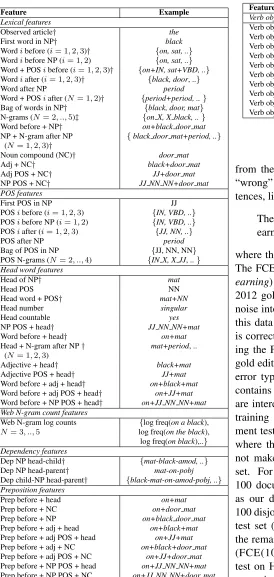
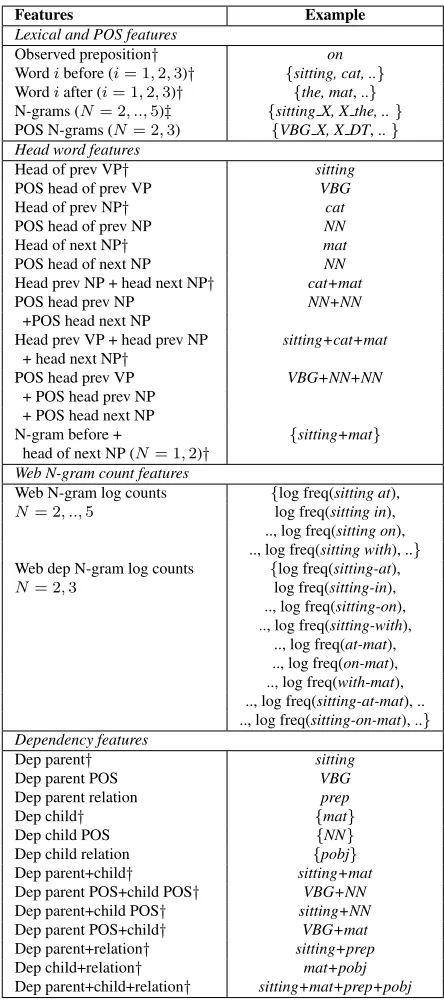
In this section, we describe the features used in our system. The choice of features can have an impor-tant effect on classification performance. The exact features used for determiner, replacement preposi-tion, and missing and unwanted preposition correc-tion are listed in Tables 1, 2, 3, and 4, respectively. The features were chosen empirically through exper-iments on the development data.
The most commonly used features for grammat-ical error correction are lexgrammat-ical and POS N-grams, and chunk features. We adopt the features from previous work by Han et al. (2006), Tetreault and Chodorow (2008), and Rozovskayaet al.(2011) for our system. Tetreaultet al. (2010) show that parse features can further increase performance, and we use the dependency parse features based on their work. For all the above features, the observed ar-ticle or preposition used by the writer is “blanked out” when computing the features. However, we add
the observed article or preposition as an additional feature for determiner and replacement preposition correction.
The features described so far are all binary-valued, i.e., they indicate whether some feature is present in the input or not. Additionally, we can construct real-valued features by counting the log frequency of surface N-grams on the web or in a web-scale corpus (Bergsma et al., 2009). Web-scale N-gram count features can harness the power of the web in connection with supervised classification and have successfully been used for a number of NLP generation and disambiguation problems (Bergsma et al., 2009; Bergsma et al., 2010), although we are not aware of any previous application in gram-matical error correction. Web-scale N-gram count features usually use N-grams of consecutive tokens. The release of web-scale parsed corpora like the WaCky project (Baroni et al., 2009) makes it pos-sible to extend the idea to dependency N-grams of child-parent tuples over the dependency arcs in the dependency parse tree, e.g., {(child, node), (node, parent)} for bigrams, {(child’s child, child, node), (child, node, parent), (node, parent, parent’s par-ent)}for trigrams. We collect log frequency counts for dependency N-grams from a large dependency-parsed web corpus and use the log frequency count as a feature. We normalize all real-valued feature values to a unit interval[0,1]to avoid features with larger values dominating features with smaller val-ues.
4 Experiments
In this section, we report experimental results of our system on two different data sets: a held-out test split of the HOO 2012 training data, and the official HOO 2012 test set.
4.1 Data Sets
Feature Example
Lexical features
Observed article† the
First word in NP† black
Wordibefore (i= 1,2,3)† {on, sat, ..}
Wordibefore NP (i= 1,2) {on, sat, ..}
Word + POSibefore (i= 1,2,3)† {on+IN, sat+VBD, ..}
Wordiafter (i= 1,2,3)† {black, door, ..}
Word after NP period
Word + POSiafter (N= 1,2)† {period+period, ..}
Bag of words in NP† {black, door, mat}
N-grams (N= 2, ..,5)‡ {on X, X black, ..}
Word before + NP† on+black door mat
NP + N-gram after NP {black door mat+period, ..}
(N= 1,2,3)†
Noun compound (NC)† door mat
Adj + NC† black+door mat
Adj POS + NC† JJ+door mat
NP POS + NC† JJ NN NN+door mat
POS features
First POS in NP JJ
POSibefore (i= 1,2,3) {IN, VBD, ..}
POSibefore NP (i= 1,2) {IN, VBD, ..}
POSiafter (i= 1,2,3) {JJ, NN, ..}
POS after NP period
Bag of POS in NP {JJ, NN, NN}
POS N-grams (N= 2, ..,4) {IN X, X JJ, ..}
Head word features
Head of NP† mat
Head POS NN
Head word + POS† mat+NN
Head number singular
Head countable yes
NP POS + head† JJ NN NN+mat
Word before + head† on+mat
Head + N-gram after NP† mat+period, .. (N= 1,2,3)
Adjective + head† black+mat
Adjective POS + head† JJ+mat
Word before + adj + head† on+black+mat Word before + adj POS + head† on+JJ+mat Word before + NP POS + head† on+JJ NN NN+mat Web N-gram count features
Web N-gram log counts {log freq(on a black),
N= 3, ..,5 log freq(on the black), log freq(on black),..}
Dependency features
Dep NP head-child† {mat-black-amod, ..}
Dep NP head-parent† mat-on-pobj
Dep child-NP head-parent† {black-mat-on-amod-pobj, ..}
Preposition features
Prep before + head on+mat
Prep before + NC on+door mat
Prep before + NP on+black door mat
Prep before + adj + head on+black+mat
Prep before + adj POS + head on+JJ+mat
Prep before + adj + NC on+black+door mat
[image:5.612.78.352.52.629.2]Prep before + adj POS + NC on+JJ+door mat Prep before + NP POS + head on+JJ NN NN+mat Prep before + NP POS + NC on+JJ NN NN+door mat
Table 1: Features for determiner correction. Exam-ple: “The cat sat onthe black door mat.” †: lexical tokens in lower case,‡: lexical tokens in both origi-nal and lower case
Feature Example
Verb object features
Verb obj† sat on
Verb obj + head† sat on+mat
Verb obj + NC† sat on+door mat
Verb obj + NP† sat on+black door mat Verb obj + adj + head† sat on+black+mat Verb obj + adj POS + head† sat on+JJ+mat Verb obj + adj + NC† sat on+black+door mat Verb obj + adj POS + NC† sat on+JJ+door mat Verb obj + NP POS + head† sat on+JJ NN NN+mat Verb obj + NP POS + NC† sat on+JJ NN NN+door mat
Table 1: (continued)
from the original FCE data set. This can lead to “wrong” gold edits that produce ungrammatical sen-tences, like the following sentence
There are a lot of possibilities (→of) to earn some money ...
where the prepositionof is inserted beforeto earn. The FCE data set contains another edit (to earn→
earning) but this edit is not included in the HOO 2012 gold annotation. This necessarily introduces noise into the training data as a classifier trained on this data will learn that inserting of before to earn
Features Example
Lexical and POS features
Observed preposition† on
Wordibefore (i= 1,2,3)† {sitting, cat, ..}
Wordiafter (i= 1,2,3)† {the, mat, ..}
N-grams (N= 2, ..,5)‡ {sitting X, X the, ..}
POS N-grams (N= 2,3) {VBG X, X DT, ..}
Head word features
Head of prev VP† sitting
POS head of prev VP VBG
Head of prev NP† cat
POS head of prev NP NN
Head of next NP† mat
POS head of next NP NN
Head prev NP + head next NP† cat+mat
POS head prev NP NN+NN
+POS head next NP
Head prev VP + head prev NP sitting+cat+mat + head next NP†
POS head prev VP VBG+NN+NN
+ POS head prev NP + POS head next NP
N-gram before + {sitting+mat}
head of next NP (N= 1,2)†
Web N-gram count features
Web N-gram log counts {log freq(sitting at),
N= 2, ..,5 log freq(sitting in), .., log freq(sitting on), .., log freq(sitting with), ..}
Web dep N-gram log counts {log freq(sitting-at),
N= 2,3 log freq(sitting-in),
.., log freq(sitting-on), .., log freq(sitting-with),
.., log freq(at-mat), .., log freq(on-mat), .., log freq(with-mat), .., log freq(sitting-at-mat), .. .., log freq(sitting-on-mat), ..}
Dependency features
Dep parent† sitting
Dep parent POS VBG
Dep parent relation prep
Dep child† {mat}
Dep child POS {NN}
Dep child relation {pobj}
Dep parent+child† sitting+mat
Dep parent POS+child POS† VBG+NN
Dep parent+child POS† sitting+NN
Dep parent POS+child† VBG+mat
Dep parent+relation† sitting+prep
Dep child+relation† mat+pobj
[image:6.612.311.541.71.345.2]Dep parent+child+relation† sitting+mat+prep+pobj
Table 2: Features for replacement preposition cor-rection. Example: “He saw a cat sittingon the mat.” †: lexical tokens in lower case,‡: lexical tokens in both original and lower case
Features Example
Lexical and POS features
Wordibefore (i= 1,2,3)† {sitting, cat, ..}
Wordiafter (i= 1,2,3)† {the, mat, ..}
N-grams (N= 2, ..,5)‡ {sitting X, X the, ..}
POS N-grams (N= 2,3) {VBG X, X DT, ..}
Head word features
Head of prev VP† sitting
POS head of prev VP VBG
Head of prev NP† cat
POS head of prev NP NN
Head of next NP† mat
POS head of next NP NN
Head prev NP + head next NP† cat+mat
POS head prev NP NN+NN
+ POS head next NP
Head prev VP + head prev NP sitting+cat+mat + head next NP†
POS head prev VP VBG+NN+NN
+ POS head prev NP + POS head next NP
N-gram before + {sitting+mat, ..}
head of next NP (N= 1,2)†
Web N-gram count features
Web N-gram log counts {log freq(sitting on the),
N= 3, ..,5 log freq(sitting the), .. ,log freq(sitting on the mat), .., log freq(sitting the mat), ..}
Table 3: Features for missing preposition correction. Example: “He saw a cat sitting the mat.”†: lexical tokens in lower case,‡: lexical tokens in both origi-nal and lower case
Features Example
Web N-gram count features
Web N-gram log counts {log freq(went to home),
[image:6.612.73.295.96.598.2]N= 3, ..,5 log freq(went home), .. ,log freq(cat went to home), .., log freq(cat went home), ..}
Table 4: Features for unwanted preposition correc-tion. Example: “The cat wentto home.”
Data set # Documents # Sentences # Tokens
FCE(1044) 1,044 22,434 339,902
FCE(1244) 1,244 28,033 423,850
HOO-DEV 100 2,798 42,347
HOO-DEVTEST 100 2,674 41,518
HOO-TEST 100 1,393 20,563
[image:6.612.327.528.456.517.2]official HOO 2012 test data (HOO-TEST), which is not part of the FCE corpus, is completely unob-served during system development. Table 5 gives an overview of the data. Besides the FCE and HOO 2012 data sets, we use the following corpora. The Google Web 1T 5-gram corpus (Brants and Franz, 2006) is used for language modeling and collect-ing N-gram counts, the PukWaC corpus from the WaCky project (Baroni et al., 2009) is used for col-lecting web-scale dependency N-gram counts, and the New York Times section of the Gigaword cor-pus3 is used for training the re-casing model. All data sets used in our system are publicly available.
4.2 Resources
We use the following NLP resources in our sys-tem. Sentence splitting is performed with the NLTK toolkit.4 For spelling correction, we use the free software Aspell.5 All words that appear at least ten times in the HOO 2012 training data are added to the spelling dictionary. We use the OpenNLP tools (ver-sion 1.5.2)6 for POS tagging, YamCha (version 0.33) (Kudo and Matsumoto, 2003) for chunk-ing, and the MaltParser (version 1.6.1) (Nivre et al., 2007) for dependency parsing. We use Ran-dLM (Talbot and Osborne, 2007) for language mod-eling. The re-casing model is built with the Moses SMT system (Koehn et al., 2007) from the Gigaword New York Times section and all normal-cased docu-ments in the HOO 2012 training data. The CuVPlus English dictionary (Mitton, 1992) is used to deter-mine the countability of nouns. The CW learning algorithm is implemented by our group. The source code is available from our website.7 All resources
used in our system are publicly available.
4.3 Evaluation
Evaluation is performed by computing detection, recognition, and correction F1score between the set of system edits and the set of gold-standard edits as defined in the HOO 2012 overview paper (Dale et al., 2012). Detection scores are very similar to recognition scores (about 1–2% higher). We omit
3LDC2009T13
4http://www.nltk.org
5
http://aspell.net
6http://opennlp.apache.org
7http://nlp.comp.nus.edu.sg/software
Step Recognition Correction
P R F1 P R F1
Det 62.26 12.68 21.06 54.09 11.01 18.30
+ RT 64.34 22.41 33.24 57.35 19.97 29.63
+ MT/UT 60.75 28.94 39.20 54.84 26.12 35.39
Table 6: Overall precision, recall, and F1 score on the HOO-DEVTEST data after determiner correc-tion (Det), replacement preposicorrec-tion correccorrec-tion (RT), and missing and unwanted preposition correction (MT/UT).
detection scores due to space limitations. Evaluation on the official test set is performed with respect to two different gold standards: the original gold stan-dard from Cambridge University Press and a revised version which was created in the HOO 2012 shared task in response to change requests from participat-ing teams. All scores are computed with the official scorer. The official gold-standard edits are given in character offsets, while our system internally works with token offsets. Therefore, all token offsets are automatically mapped back to character offsets be-fore we submit our system edits. We only submitted one run of our system.
Type Recognition Correction
P R F1 P R F1
RD 30.00 5.66 9.52 30.00 5.66 9.52
MD 69.67 41.67 52.15 59.02 35.29 44.17
UD 40.74 11.00 17.32 40.74 11.00 17.32
Det 62.26 27.73 38.37 54.09 24.09 33.33
RT 69.09 33.63 45.24 63.64 30.97 41.67
MT 53.25 35.34 42.49 49.35 32.76 39.38
UT 38.46 12.20 18.52 38.46 12.20 18.52
[image:7.612.319.536.390.493.2]Prep 59.62 29.95 39.87 55.40 27.83 37.05
Table 7: Individual scores for each error type on the HOO-DEVTESTdata.
4.4 Results
Step Recognition Correction
P R F1 P R F1
Det 57.76 14.79 23.55 48.28 12.36 19.68
+ RT 58.93 21.85 31.88 47.02 17.44 25.44
+ MT/UT 55.98 25.83 35.35 45.45 20.97 28.70
(a) Before revisions
Step Recognition Correction
P R F1 P R F1
Det 68.10 16.70 26.83 62.93 15.43 24.79
+ RT 71.43 25.37 37.44 63.10 22.41 33.07
+ MT/UT 69.38 30.66 42.52 61.72 27.27 37.83
[image:8.612.88.536.58.126.2](b) After revisions
Table 8: Overall precision, recall, and F1 score on the HOO-TESTdata after determiner correction (Det), replacement preposition correction (RT), and missing and unwanted preposition correction (MT/UT).
Type Recognition Correction
P R F1 P R F1
RD 33.33 2.56 4.76 33.33 2.56 4.76
MD 62.24 48.80 54.71 51.02 40.00 44.84
UD 33.33 9.43 14.71 33.33 9.43 14.71
Det 57.76 30.88 40.24 48.28 25.81 33.63
RT 61.54 23.53 34.04 44.23 16.91 24.47
MT 46.15 21.05 28.92 38.46 17.54 24.10
UT 40.00 13.95 20.69 40.00 13.95 20.69
Prep 53.76 21.19 30.40 41.94 16.53 23.71
(a) Before revisions
Type Recognition Correction
P R F1 P R F1
RD 100.00 8.33 15.38 66.67 5.56 10.26
MD 70.41 52.67 60.26 65.31 48.85 55.90
UD 46.67 11.29 18.18 46.67 11.29 18.18
Det 68.10 34.50 45.80 62.93 31.88 42.32
RT 78.85 27.52 40.80 63.46 22.15 32.84
MT 61.54 28.57 39.02 53.85 25.00 34.15
UT 60.00 23.08 33.33 60.00 23.08 33.33
Prep 70.97 27.05 39.17 60.22 22.95 33.23
(b) After revisions
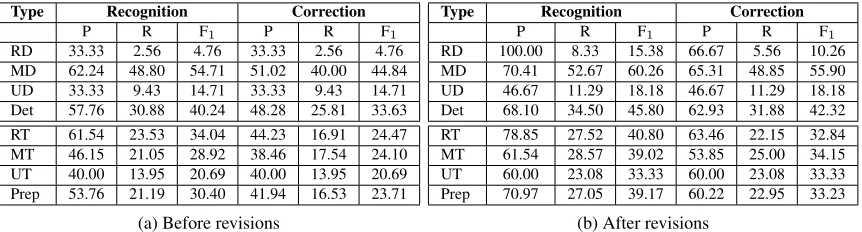
Table 9: Individual scores for each error type on the HOO-TESTdata.
for each of the six error types, and for determiners (Det: aggregate of RD, MD, UD) and prepositions (Prep: aggregate of RT, MT, UT) on the held-out HOO-DEVTEST set and the official test set HOO-TEST, respectively.
5 Discussion
The main differences between our submission to the HOO 2011 shared task (Dahlmeier et al., 2011) and to this year’s shared task are the use of the CW learn-ing algorithm, the use of web-scale N-gram count features, and the use of the observed article or prepo-sition as a feature. The CW learning algorithm per-formed slightly better than the empirical risk mini-mization batch learning algorithm that we have used previously while being significantly faster during training. Adding the web-scale N-gram count fea-tures showed significant improvements in initial ex-periments. Using the observed article or preposition feature allows the classifier to learn a bias against unnecessary corrections. We believe that our good precision scores are a result of using this feature.
In our experiments, we tried adding additional training data from other text corpora: the NUS Cor-pus of Learner English (NUCLE) (Dahlmeier and Ng, 2011) and the Gigaword corpus. Unfortunately, we did not see any consistent improvements over
simply using the FCE corpus. The general rule of thumb that “more data is better data” did not seem to hold true in this case. After the evaluation had com-pleted, we also tried training on additional training data and tested the resulting system on the official test set but did not see improvements either. We be-lieve that no improvements were obtained due to the similarity between the training and test data, since all of them are student essays written in response to question prompts from the Cambridge FCE exam.
6 Conclusion
We have presented the system from the National University of Singapore that participated in the HOO 2012 shared task. Our system achieves the highest correction F1score on the official test set among all 14 participating teams, based on gold-standard edits both before and after revision.
Acknowledgments
[image:8.612.92.523.176.292.2]References
M. Baroni, S. Bernardini, A. Ferraresi, and E. Zanchetta. 2009. The WaCky wide web: A collection of very large linguistically processed web-crawled corpora.
Language Resources and Evaluation, 43(3):209–226. S. Bergsma, D. Lin, and R. Goebel. 2009. Web-scale
N-gram models for lexical disambiguation. In Pro-ceedings of the Twenty-First International Joint Con-ference on Artificial Intelligence, pages 1507–1512, Pasadena, California, USA.
S. Bergsma, E. Pitler, and D. Lin. 2010. Creating robust supervised classifiers via web-scale N-gram data. In
Proceedings of the 48th Annual Meeting of the Associ-ation for ComputAssoci-ational Linguistics, pages 865–874, Uppsala, Sweden.
T. Brants and A. Franz. 2006. Web 1T 5-gram corpus version 1.1. Technical report, Google Research. K. Crammer, M. Dredze, and A. Kulesza. 2009.
Multi-class confidence weighted algorithms. InProceedings of the 2009 Conference on Empirical Methods in Nat-ural Language Processing, pages 496–504, Singapore. D. Dahlmeier and H.T. Ng. 2011. Grammatical error cor-rection with alternating structure optimization. In Pro-ceedings of the 49th Annual Meeting of the Associa-tion for ComputaAssocia-tional Linguistics: Human Language Technologies, pages 915–923, Portland, Oregon, USA. D. Dahlmeier, H.T. Ng, and T.P. Tran. 2011. NUS at the HOO 2011 pilot shared task. In Proceedings of the Generation Challenges Session at the 13th Eu-ropean Workshop on Natural Language Generation, pages 257–259, Nancy, France.
R. Dale, I. Anisimoff, and G. Narroway. 2012. HOO 2012: A report on the preposition and determiner error correction shared task. InProceedings of the Seventh Workshop on Innovative Use of NLP for Building Ed-ucational Applications, Montr´eal, Qu´ebec, Canada. M. Dredze, K. Crammer, and F. Pereira. 2008.
Confidence-weighted linear classification. In Pro-ceedings of the 25th International Conference on Ma-chine Learning, pages 184–191, Helsinki, Finland. N.-R. Han, M. Chodorow, and C. Leacock. 2006.
De-tecting errors in English article usage by non-native speakers. Natural Language Engineering, 12(2):115– 129.
P. Koehn, H. Hoang, A. Birch, C. Callison-Burch, M. Federico, N. Bertoldi, B. Cowan, W. Shen, C. Moran, R. Zens, C. Dyer, O. Bojar, A. Constantin, and E. Herbst. 2007. Moses: Open source toolkit for statistical machine translation. InProceedings of the ACL 2007 Demo and Poster Sessions, pages 177–180, Prague, Czech Republic.
T. Kudo and Y. Matsumoto. 2003. Fast methods for kernel-based text analysis. InProceedings of the 41st
Annual Meeting of the Association for Computational Linguistics, pages 24–31, Sapporo, Japan.
R. Mitton. 1992. A description of a computer-usable dic-tionary file based on the Oxford Advanced Learner’s Dictionary of Current English.
J. Nivre, J. Hall, J. Nilsson, A. Chanev, G. Eryigit, S. K¨ubler, S. Marinov, and M. Marsi. 2007. Malt-Parser: A language-independent system for data-driven dependency parsing. Natural Language Engi-neering, 13(2):95–135.
A. Rozovskaya and D. Roth. 2010. Training paradigms for correcting errors in grammar and usage. In Pro-ceedings of Human Language Technologies: The 2010 Annual Conference of the North American Chapter of the ACL, pages 154–162, Los Angeles, California. A. Rozovskaya, M. Sammons, J. Gioja, and D. Roth.
2011. University of Illinois system in HOO text cor-rection shared task. InProceedings of the Generation Challenges Session at the 13th European Workshop on Natural Language Generation, pages 263–266, Nancy, France.
D. Talbot and M. Osborne. 2007. Randomised language modelling for statistical machine translation. In Pro-ceedings of the 45th Annual Meeting of the Association of Computational Linguistics, pages 512–519, Prague, Czech Republic.
J. Tetreault and M. Chodorow. 2008. The ups and downs of preposition error detection in ESL writing. In
Proceedings of the 22nd International Conference on Computational Linguistics, pages 865–872, Manch-ester, UK.
J. Tetreault, J. Foster, and M. Chodorow. 2010. Using parse features for preposition selection and error de-tection. InProceedings of the ACL 2010 Conference Short Papers, pages 353–358, Uppsala, Sweden. H. Yannakoudakis, T. Briscoe, and B. Medlock. 2011.