Sequential vs. Hierarchical Syntactic Models of Human Incremental
Sentence Processing
Victoria Fossum and Roger Levy Department of Linguistics University of California, San Diego
9500 Gilman Dr. La Jolla, CA 92093
{vfossum,rlevy}@ucsd.edu
Abstract
Experimental evidence demonstrates that syn-tactic structure influences human online sen-tence processing behavior. Despite this ev-idence, open questions remain: which type of syntactic structure best explains observed behavior–hierarchical or sequential, and lexi-calized or unlexilexi-calized? Recently, Frank and Bod (2011) find that unlexicalized sequen-tial models predict reading times better than unlexicalized hierarchical models, relative to a baseline prediction model that takes word-level factors into account. They conclude that the human parser is insensitive to hierarchi-cal syntactic structure. We investigate these claims and find a picture more complicated than the one they present. First, we show that incorporating additional lexical n-gram prob-abilities estimated from several different cor-pora into the baseline model of Frank and Bod (2011) eliminates all differences in accuracy between those unlexicalized sequential and hi-erarchical models. Second, we show that lexi-calizing the hierarchical models used in Frank and Bod (2011) significantly improves pre-diction accuracy relative to the unlexicalized versions. Third, we show that using state-of-the-art lexicalized hierarchical models fur-ther improves prediction accuracy. Our results demonstrate that the claim of Frank and Bod (2011) that sequential models predict reading times better than hierarchical models is pre-mature, and also that lexicalization matters for prediction accuracy.
1 Introduction
Various factors influence human reading times dur-ing online sentence processdur-ing, includdur-ing word-level factors such as word length, unigram and bigram probabilities, and position in the sentence. Yet word-level factors cannot explain many observed process-ing phenomena; ample experimental evidence ex-ists for the influence of syntax on human behav-ior during online sentence processing, beyond what can be predicted using word-level factors alone. Examples include the English subject/object rela-tive clause asymmetry (Gibson et al., 2005; King and Just, 1991) and anti-locality effects in German (Konieczny, 2000; Konieczny and D¨oring, 2003), Hindi (Vasishth and Lewis, 2006), and Japanese (Nakatani and Gibson, 2008). Levy (2008) shows that these processing phenomena can be explained by surprisal theory under a hierarchical probabilis-tic context-free grammar (PCFG). Other evidence of syntactic expectation in sentence processing in-cludes the facilitation of processing at “or” follow-ing “either” (Staub and Clifton, 2006); expectations of heavy noun phrase shifts (Staub et al., 2006); el-lipsis processing (Lau et al., 2006); and syntactic priming (Sturt et al., 2010).
Experimental evidence for the influence of syn-tax on human behavior is not limited to experiments carefully designed to isolate a particular processing phenomenon. Several broad-coverage experimental studies have shown that surprisal under hierarchi-cal syntactic models predicts human processing dif-ficulty on large corpora of naturally occurring text, even after word-level factors have been taken into
account (Boston et al., 2008; Demberg and Keller, 2008; Roark et al., 2009).
Despite this evidence, in recent work Frank and Bod (2011) challenge the notion that hierarchical syntactic structure is strictly necessary to predict reading times. They compare per-word surprisal predictions from unlexicalized hierarchical and se-quential models of syntactic structure along two axes: linguistic accuracy (how well the model pre-dicts the test corpus) and psychological accuracy (how well the model predicts observed reading times on the test corpus). They find that, while hierar-chical phrase-structure grammars (PSG’s) achieve better linguistic accuracy, sequential echo state net-works (ESN’s) achieve better psychological accu-racy on the English Dundee corpus (Kennedy and Pynte, 2005). Frank and Bod (2011) do not in-clude lexicalized syntactic models in the compar-ison on the grounds that, once word-level factors have been included as control predictors in the read-ing times model, lexicalized syntactic models do not predict reading times better than unlexicalized syn-tactic models (Demberg and Keller, 2008). Based on the results of their comparisons between unlexical-ized models, they conclude that the human parser is insensitive to hierarchical syntactic structure.
In light of the existing evidence that hierarchical syntax influences human sentence processing, the claim of Frank and Bod (2011) is surprising. In this work, we investigate this claim, and find a picture more complicated than the one they present. We first replicate the results of Frank and Bod (2011) using the dataset provided by the authors, verifying that we obtain the same linguistic and psychologi-cal accuracies reported by the authors. We then ex-tend their work in several ways. First, we repeat their comparisons using additional, more robustly estimated lexical n-gram probabilities as control pre-dictors in the baseline model.1 We show that when these additional lexical n-gram probabilities are used as control predictors, any differences in psycholog-ical accuracy between the hierarchpsycholog-ical and sequen-tial models used in Frank and Bod (2011) vanish. Second, while they restrict their comparisons to
un-1
By robustly estimated, we mean that these probabilities are estimated from larger corpora and use a better smoothing method (Kneser-Ney) than the lexical n-grams of Frank and Bod (2011).
lexicalized models over part-of-speech (POS) tags, we investigate the lexicalized versions of each hi-erarchical model, and show that lexicalization sig-nificantly improves psychological accuracy. Third, while they explore only a subset of the PSG’s im-plemented under the incremental parser of Roark (2001), we explore a state-of-the-art lexicalized hi-erarchical model that conditions on richer contexts, and show that this model performs still better. Our findings demonstrate that Frank and Bod (2011)’s strong claim that sequential models predict reading times better than hierarchical models is premature, and also that lexicalization improves the psycholog-ical accuracy of hierarchpsycholog-ical models.
2 Related Work
Several broad-coverage experimental studies
demonstrate that surprisal under a hierarchical syn-tactic model predicts human processing difficulty on a corpus of naturally occurring text, even after word-level factors have been taken into account. Under surprisal theory (Hale, 2001; Levy, 2008), processing difficulty at word wi is proportional to
reading time atwi, which in turn is proportional to
the surprisal ofwi in the context in which it is
ob-served: surprisal(wi) = −log(pr(wi|context)).
Typically, context ≈ w1...wi−1. Comput-ing surprisal(wi) thus reduces to computing −log(pr(wi|w1...wi−1)). Henceforth, we refer
to this original formulation of surprisal as total
surprisal.
Boston et al. (2008) show that surprisal estimates from a lexicalized dependency parser (Nivre, 2006) and an unlexicalized PCFG are significant predic-tors of reading times on the German Potsdam Cor-pus. Demberg and Keller (2008) propose to isolate syntactic surprisal from total surprisal by replacing each word with its POS tag, then calculating sur-prisal as usual under the incremental probabilistic phrase-structure parser of Roark (2001). (Following Roark et al. (2009), we hereafter refer to this type of surprisal as POS surprisal.) They find that only POS surprisal, not total surprisal, is a significant predictor of reading time predictions on the English Dundee corpus.
omit-ting lexical information from the conditioning con-text, they ignore differences among words within a syntactic category that can influence syntactic ex-pectations about upcoming material. Second, by re-placing words with their most likely POS tags, they treat POS tags as veridical, observed input rather than marginalizing over all possible latent POS tag sequences consistent with the observed words.
Roark et al. (2009) propose a more principled way of decomposing total surprisal into its syntactic and lexical components, defining the syntactic surprisal ofwias:
−log
P
D:yield(D)=w1...wipr(D minus last step) P
D:yield(D)=w1...wi −1
pr(D)
and the lexical surprisal ofwias:
−log
P
D:yield(D)=w1...wipr(D) P
D:yield(D)=w1...wipr(D minus last step)
where D is the set of derivations in the parser’s beam at any given point; D : yield(D) = w1...wi
is the set of all derivations in D consistent with w1...wi; andD minus last step includes all steps
in the derivation except for the last step, in whichwi
is generated by conditioning upon all previous steps ofD(includingti).
Roark et al. (2009) show that syntactic surprisal produces more accurate reading time predictions on an English corpus than POS surprisal, and that de-composing total surprisal into its syntactic and lex-ical components produces more accurate reading time predictions than total surprisal taken as a single quantity. In this work, we compare not only differ-ent types of syntactic models, but also differdiffer-ent mea-sures of surprisal under each of those models (total, POS, syntactic-only, and lexical-only).
3 Models
Estimating surprisal(wi) amounts to calculating −log(pr(wi|w1...wi−1)). Language models differ in the way they estimate the conditional proba-bility of the event wi given the observed context
w1...wi−1. In the traditional formulation of surprisal under a hierarchical model, the event wi is
condi-tioned not only on the observed contextw1...wi−1 but also on the latent context consisting of the syn-tactic treesT whose yield isw1...wi−1; computing
pr(wi|w1...wi−1) therefore requires marginalizing over all possible latent contexts T. In this formu-lation of surprisal, the context includes lexical infor-mation (w1...wi−1) as well as syntactic information (T :yield(T) =w1...wi−1), and the predicted event itself (wi) contains lexical information.
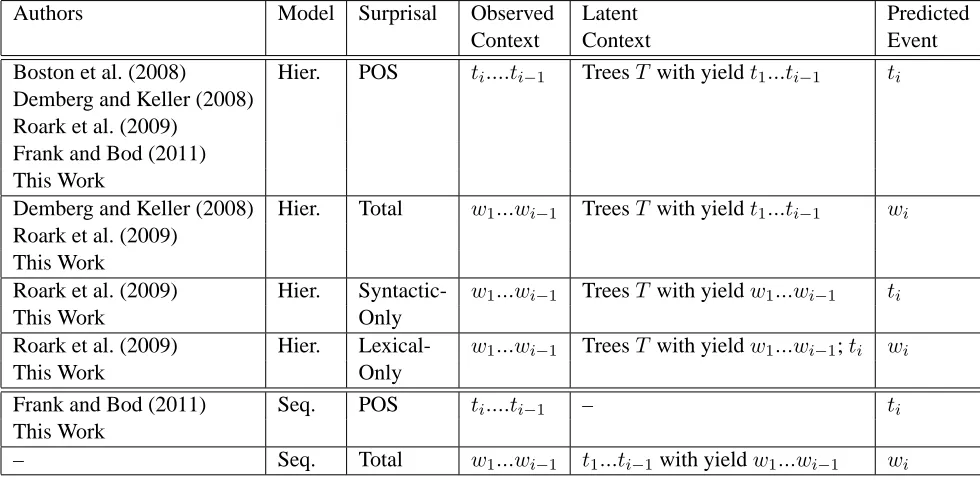
Other formulations of surprisal are also possible, in which the event, observed context, and latent con-text are otherwise defined. In this work, we classify syntactic models as follows: lexicalized models in-clude lexical information in the context, in the pre-dicted event, or both; unlexicalized models include lexical information neither in the context nor in the predicted event; hierarchical models induce a latent context of trees compatible with the input;
sequen-tial models either induce no latent context at all,
or induce a latent sequence of POS tags compati-ble with the input. Tacompati-ble 1 summarizes the syntactic models and various formulations of surprisal used in this work.
Following Frank and Bod (2011), we consider one type of hierarchical model (PSG’s) and two types of sequential models (Markov models and ESN’s).
3.1 Phrase-Structure Grammars
PSG’s consists of rules expanding a parent node into children nodes in the syntactic tree, with associ-ated probabilities. Frank and Bod (2011) use PSG’s that generate POS tag sequences, not words. Under such grammars, the prefix probability of a tag se-quencetis the sum of the probabilities of all trees T : yield(T) = t1...ti, where the probability of
each treeT is the product of the probabilities of the rules used in the derivation ofT.
con-Authors Model Surprisal Observed Latent Predicted
Context Context Event
Boston et al. (2008) Hier. POS ti....ti−1 TreesT with yieldt1...ti−1 ti
Demberg and Keller (2008) Roark et al. (2009)
Frank and Bod (2011) This Work
Demberg and Keller (2008) Hier. Total w1...wi−1 TreesT with yieldt1...ti−1 wi Roark et al. (2009)
This Work
Roark et al. (2009) Hier. Syntactic- w1...wi−1 TreesT with yieldw1...wi−1 ti
This Work Only
Roark et al. (2009) Hier. Lexical- w1...wi−1 TreesT with yieldw1...wi−1;ti wi
This Work Only
Frank and Bod (2011) Seq. POS ti....ti−1 – ti
This Work
[image:4.612.80.570.47.287.2]– Seq. Total w1...wi−1 t1...ti−1 with yieldw1...wi−1 wi
Table 1: Contexts and events used to produce surprisal measures under various probabilistic syntactic models.Trefers to trees;trefers to POS tags; andwrefers to words.
dition rule expansions on the current head node2.
In addition to the grammars over POS tag se-quences used by Frank and Bod (2011), we evalu-ate PSG’s over word sequences. We also include the state-of-the-art Berkeley grammar (Petrov and Klein, 2007) in our comparison. Syntactic cate-gories in the Berkeley grammar are automatically split into fine-grained subcategories to improve the likelihood of the training corpus under the model. This increased expressivity allows the parser to achieve state-of-the-art automatic parsing accuracy, but increases grammar size considerably.3
3.2 Markov Models
Frank and Bod (2011) use Markov models over POS tag sequences, where the prefix probability of a sequence t is Qipr(ti|ti−n+1, ti−n+2...ti−1). They use three types of smoothing: additive, Good-Turing, and Witten-Bell, and explore values of n from 1 to 3.
2or rightmost child node, if the head node is not yet
avail-able(Roark, 2001).
3
To make parsing with the Berkeley grammar tractable un-der the prefix probability parser, we prune away all rules with probability less than10−4.
3.3 Echo State Networks
Unlike Markov models, ESN’s (J¨ager, 2001) can capture long-distance dependencies. ESN’s are a type of recurrent neural network (Elman, 1991) in which only the weights from the hidden layer to the output layer are trained; the weights from the input layer to the hidden layer and from the hidden layer to itself are set randomly and do not change. In re-current networks, the activation of the hidden layer at tagtidepends not only on the activation of the
in-put layer at tagti, but also on the activation of the
hidden layer at tagti−1, which in turn depends on the activation of the hidden layer at tagti−2, and so forth. The activation of the output layer at tagti is
therefore a function of all previous input symbols t1...ti−1 in the sequence. The prefix probability of a sequencetunder this model isQipr(ti|t1...ti−1), wherepr(ti|t1...ti−1)is the normalized activation of the output layer at tagti. Frank and Bod (2011)
eval-uate ESN’s with 100, 200...600 hidden nodes.
4 Methods
prob-abilities using beam search. For the Berkeley gram-mar, we use a probabilistic Earley parser modified by Levy4 to calculate exact prefix probabilities us-ing the algorithm of Stolcke (1995). We evaluate each hierarchical model under each type of surprisal (POS, total, lexical-only, and syntactic-only), where possible.
4.1 Data Sets
Each syntactic model is trained on sections 2-21 of the Wall Street Journal (WSJ) portion of the Penn Treebank (Marcus et al., 1994), and tested on the Dundee Corpus (Kennedy and Pynte, 2005), which contains reading time measures for 10 subjects over a corpus of 2,391 sentences of naturally occurring text. Gold-standard POS tags for the Dundee cor-pus are obtained automatically using the Brill tagger (Brill, 1995).
Frank and Bod (2011) exclude subject/word pairs from evaluation if any of the following conditions hold true: “the word was not fixated, was presented as the first or last on a line, was attached to punc-tuation, contained more than one capital letter, or contained a non-letter (this included clitics)”. This leaves 191,380 subject/word pairs in the data set published by Frank and Bod (2011). Because we consider lexicalized hierarchical models in addition to unlexicalized ones, we additionally exclude sub-ject/word pairs where the word is “unknown” to the model.5 This leaves us with a total of 148,829 sub-ject/word pairs; all of our reported results refer to this data set.
4.2 Evaluation
Following Frank and Bod (2011), we compare the per-word surprisal predictions from hierarchical and sequential models of syntactic structure along two axes: linguistic accuracy (how well the model ex-plains the test corpus) and psychological accuracy (how well the model explains observed reading times on the test corpus).
4
The prefix parser is available at: www.http://idiom.ucsd.edu/ rlevy/prefixprobabilityparser.html
5
We consider words appearing fewer than 5 times in the training data to be unknown.
4.2.1 Linguistic Accuracy
Each model provides surprisal estimates
surprisal(wi). The linguistic accuracy over
the test corpus is n1 Pni=1surprisal(wi), where n
is the number of words in the test corpus.
4.2.2 Psychological Accuracy
We add each model’s per-word surprisal predic-tions to a linear mixed-effects model of first-pass reading times, then measure the improvement in reading time predictions (according to the de-viance information criterion) relative to a baseline model; the resulting decrease in deviance is the psychological accuracy of the language model. Using the lmer package for linear mixed-effects models in R (Baayen et al., 2008), we first fit a baseline model to first-pass readings times over the test corpus. Each baseline model contains the following control predictors for each sub-ject/word pair: sentpos(position of the word in the sentence), nrchar (number of characters in
the word), prevnonfix (whether the previous
word was fixated by the subject), nextnonfix (whether the next word was fixated by the subject), logwordprob (log(pr(wi))), logforwprob
(log(pr(wi|wi−1))), and logbackprob (log(pr(wi|wi+1))). When fitting each
base-line model, we include all control predictors; all significant two-way interactions between them (|t| ≥ 1.96); by-subject and by-word intercepts; and a by-subject random slope for the predictor that shows the most significant effect (nrchar).6
We evaluate the statistical significance of the dif-ference in psychological accuracy between two pre-dictors using a nested model comparison. If the model containing both predictors performs signifi-cantly better than the model containing only the first predictor under aχ2 test (p ≤ 0.05), then the sec-ond predictor accounts for variance in reading times above and beyond the first predictor, and vice versa.
6
5 Results
We first replicate the results of Frank and Bod (2011) by obtaining POS surprisal values directly from the authors’ published dataset for each syntac-tic model, then evaluating the psychological accu-racy of each of those models relative to the baseline model defined above.7
Baseline Model with Additional Lexical N-grams
Next, we explore the impact of the lexical n-gram probabilities used as control predictors upon psy-chological accuracy. Frank and Bod (2011) state that they compute lexical unigram and bigram prob-abilities via linear interpolation between estimates from the British National Corpus and the Dundee corpus itself (p.c.); upon inspection, we find that the bigram probabilities released in their published data set (which are consistent with their published exper-imental results) more closely resemble probabilities estimated from the Dundee corpus alone. Because of the small size of the Dundee corpus, lexical bigrams from this corpus alone are unlikely to be representa-tive of a human’s language experience.
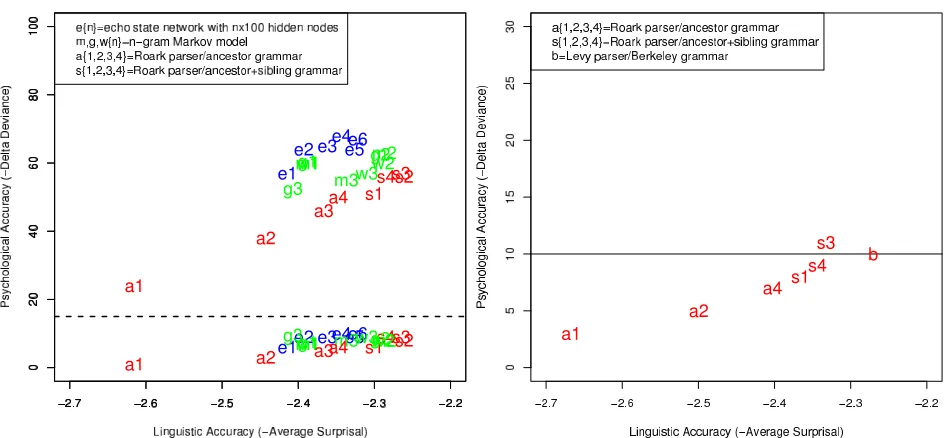
We augment the lexical bigram probabilities used in the baseline model of Frank and Bod (2011) with additional lexical unigram and bigrams esti-mated using the SRILM toolkit (Stolcke, 2002) with Kneser-Ney smoothing from three corpora: sec-tions 2-21 of the WSJ portion of the Penn Tree-bank, the Brown corpus, and the British National corpus. We include these additional predictors and all two-way interactions between them in the base-line model. Figure 1 shows that the relative differ-ences in psychological accuracy between unlexical-ized hierarchical and sequential models vanish under this stronger baseline condition.8
Unlexicalized Hierarchical Models We then
cal-culate POS surprisal values under each of the ances-tor (a1-a4) and the ancesances-tor+sibling (s1-s4) hierar-chical models ourselves, using the parser of Roark
7
The only difference between our results and the original results in Figure 2 of Frank and Bod (2011) is that we evaluate accuracy over a subset of the subject/items pairs used in Frank and Bod (2011) (see Section 4.1 for details).
8
The psychological accuracies of the best sequential model (e4) and the best hierarchical model (s3) used in Frank and Bod (2011) relative to the stronger baseline with additional lexical n-grams are not significantly different, according to aχ2test.
et al. (2009). We also calculate POS surprisal un-der the Berkeley grammar (b) using the Levy prefix probability parser. Figure 2 shows the accuracies of these models.9
Lexicalized Hierarchical Models Next, we
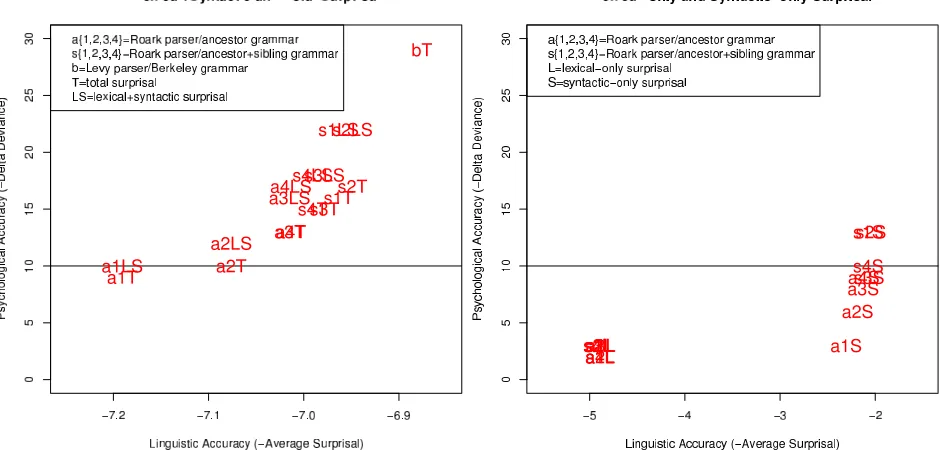
lex-icalize the hierarchical models. Figure 3 shows the results of computing total surprisal under each lexicalized hierarchical model (a1-a4T, s1-s4T, and bT). The lexicalized models improve signifi-cantly upon their unlexicalized counterparts (χ2 = 7.52to12.47, p ≤ 0.01) in all cases; by con-trast, the unlexicalized models improve signifi-cantly upon their lexicalized counterparts (χ2 = 4.05to5.92, p ≤ 0.05) only in some cases (s1-s4). Each lexicalized model improves significantly upon e4, the best unlexicalized model of Frank and Bod (2011) (χ2 = 6.96to23.45, p ≤ 0.01), though e4 also achieves a smaller but still signifi-cant improvement upon each of the lexicalized mod-els (χ2 = 4.49to7.58, p ≤ 0.05). The lexical-ized Berkeley grammar (bT) achieves the highest linguistic and psychological accuracy; the improve-ment of bT upon e4 is substantial and significant (χ2(1) = 23.45, p ≤ 0.001), while the improve-ment of e4 upon bT is small but still significant (χ2(1) = 4.50, p ≤ 0.1). Estimated coefficients for surprisal estimates under each lexicalized hierar-chical model are shown in Table 2.10
Decomposing Total Surprisal Figure 3 shows the
results of decomposing total surprisal (a1-a4T, s1-s4T) into its lexical and syntactic components, then entering both components as predictors into the mixed-effects model (a1-a4LS, s1-s4LS).11For each grammar, the psychological accuracy of the surprisal estimates is slightly higher when both lexical and syntactic surprisal are entered as predictors, though the differences are not statistically significant.
9Our POS surprisal estimates have slightly worse linguistic
accuracy but slightly better psychological accuracy than Frank and Bod (2011); these differences are likely due to differences in beam settings and in the subset of the WSJ used as training data.
10
Each surprisal estimate predicts reading times in the ex-pected (positive) direction.
11
Figure 1: Psychological vs. linguistic accuracy of POS sur-prisal estimates from unlexicalized sequential and hierar-chical models of Frank and Bod (2011) relative to baseline system of Frank and Bod (2011) (shown above dotted line), and relative to a baseline system including additional lex-ical unigrams and bigrams (shown below dotted line). In-corporating additional lexical n-grams into baseline system virtually eliminates all differences in psychological accu-racy among models.
Figure 2: Psychological vs. linguistic accuracy of POS surprisal estimates from unlexicalized hierarchical models used in this work, relative to a baseline system with ad-ditional lexical unigrams and bigrams. Horizontal line in-dicates most psychologically accurate model of Frank and Bod (2011) for ease of comparison.
POS vs. Syntactic-only Surprisal Figures 2 and
4 show the results of computing POS surprisal (a1-a4, s4) and syntactic-only surprisal (a1-a4S, s1-s4S), respectively, under each of the Roark gram-mars. While syntactic surprisal achieves slightly higher psychological accuracy than POS surprisal for each model, the difference is statistically signifi-cant in only one case (s1).
6 Discussion
In the presence of additional lexical n-gram control predictors, all gaps in performance between the un-lexicalized sequential and hierarchical models used in Frank and Bod (2011) vanish (Figure 1). Frank and Bod (2011) do not include lexicalized hierarchi-cal models in their study; our results indicate that lexicalizing hierarchical models improves their psy-chological accuracy significantly compared to the unlexicalized versions. Overall, the lexicalized hier-archical model with the highest linguistic accuracy
(Berkeley) also achieves the highest psychological accuracy.
Decomposing total surprisal into its lexical- and syntactic-only components improves psychological accuracy, but this improvement is not statistically significant. Computing syntactic-only surprisal in-stead of POS surprisal improves psychological accu-racy, but this improvement is statistically significant in only one case (s1).
7 Conclusion and Future Work
Figure 3: Psychological vs. linguistic accuracy of lexi-cal+syntactic (LS) and total (T) surprisal estimates from lexicalized hierarchical models used in this work, relative to baseline system with additional lexical unigrams and bi-grams as control predictors. Decomposing total surprisal into lexical-only and syntactic-components improves chological accuracy. Horizontal line indicates most psy-chologically accurate model of (Frank and Bod, 2011).
Figure 4: Psychological vs. linguistic accuracy of lexical-only (L) and syntactic-lexical-only (S) surprisal estimates from lexicalized hierarchical models used in this work, relative to baseline system with additional lexical unigrams and bi-grams as control predictors. On its own, syntactic-only prisal predicts reading times better than lexical-only sur-prisal. Horizontal line indicates most psychologically ac-curate model of (Frank and Bod, 2011).
Surprisal Coef. |t| Surprisal Coef. |t|
a1LS 0.82 2.61 a1T 1.30 2.98
a2LS 1.01 3.24 a2T 1.38 3.19
a3LS 1.14 3.65 a3T 1.56 3.60
a4LS 1.17 3.76 a4T 1.56 3.64
s1LS 1.38 4.43 s1T 1.71 4.00
s2LS 1.37 4.44 s2T 1.75 4.16
s3LS 1.20 3.90 s3T 1.64 3.91
s4LS 1.21 3.97 s4T 1.62 3.89
bT 3.15 5.34
Table 2: Estimated coefficients and |t|-values for sur-prisal estimates shown in Figure 3. Coefficients are es-timated by adding each surprisal estimate, one at a time, to the baseline model of reading times used in Figure 3.
robustly estimated lexical n-gram probabilities are incorporated as control predictors into the baseline model of reading times. Next, we show that lexical-izing hierarchical grammars improves psychological accuracy significantly. Finally, we show that using better lexicalized hierarchical models improves
psy-chological accuracy still further. Our results demon-strate that the claim of Frank and Bod (2011) that sequential models predict reading times better than hierarchical models is premature, and that further in-vestigation is required.
In future work, we plan to incorporate lexical in-formation into the sequential syntactic models used in Frank and Bod (2011) so that we can compare the hierarchical lexicalized models described here against sequential lexicalized models.
Acknowledgments
[image:8.612.80.306.405.532.2]References
R. H. Baayen, D. J. Davidson, and D. M. Bates. 2008. Mixed-effects modeling with crossed random effects for subjects and items. In Journal of Memory and Lan-guage, 59, pp. 390-412.
Marisa Ferrara Boston, John Hale, Reinhold Kliegl, Umesh Patil, and Shravan Vasishth. 2008. Parsing costs as predictors of reading difficulty: An evaluation using the potsdam sentence corpus. In Journal of Eye Movement Research, 2(1):1, pages 1-12.
Eric Brill. 1995. Transformation-based error-driven learning and natural language processing: A case study in part-of-speech tagging. Computational lin-guistics, 21(4).
Eugene Charniak. 1996. Tree-bank grammars. In AAAI. Vera Demberg and Frank Keller. 2008. Data from
eye-tracking corpora as evidence for theories of syntactic processing complexity. In Cognition, Volume 109, Is-sue 2, pages 193-210.
J.L. Elman. 1991. Distributed representations, simple re-current networks, and grammatical structure. Machine Learning, 7(2).
Stefan Frank and Rens Bod. 2011. Insensitivity of the human sentence-processing system to hierarchical structure. In Psychological Science.
Edward Gibson, Timothy Desmet, Daniel Grodner, Du-ane Watson, and Kara Ko. 2005. Reading relative clauses in english. Cognitive Linguistics, 16(2). John Hale. 2001. A probabilistic earley parser as a
psy-cholinguistic model. In Proceedings of NAACL. Herbert J¨ager. 2001. The” echo state” approach to
analysing and training recurrent neural networks. In Technical Report GMD 148, German National Re-search Center for Information Technology.
Mark Johnson. 1998. Pcfg models of linguistic tree rep-resentations. Computational Linguistics, 24.
A. Kennedy and J. Pynte. 2005. Parafoveal-on-foveal effects in normal reading. Vision research, 45(2). Jonathan King and Marcel Just. 1991. Individual
dif-ferences in syntactic processing: The role of working memory. Journal of memory and language, 30(5). Dan Klein and Chris Manning. 2003. Accurate
unlexi-calized parsing. In Proceedings of ACL.
Lars Konieczny and Philipp D¨oring. 2003. Anticipation of clause-final heads: Evidence from eye-tracking and srns. In Proceedings of ICCS/ASCS.
Lars Konieczny. 2000. Locality and parsing complexity. Journal of Psycholinguistic Research, 29(6).
E. Lau, C. Stroud, S. Plesch, and C. Phillips. 2006. The role of structural prediction in rapid syntactic analysis. Brain and Language, 98(1).
Roger Levy. 2008. Expectation-based syntactic compre-hension. Cognition.
Mitchell Marcus, Grace Kim, Mary Ann Marcinkiewicz, Robert Macintyre, Ann Bies, Mark Ferguson, Karen Katz, and Britta Schasberger. 1994. The penn tree-bank: Annotating predicate argument structure,. In Proceedings of ARPA Human Language Technology Workshop.
Kentaro Nakatani and Edward Gibson. 2008. Distin-guishing theories of syntactic expectation cost in sen-tence comprehension: Evidence from japanese. Lin-guistics, 46(1).
Joakim Nivre. 2006. Inductive dependency parsing, vol-ume 34. Springer Verlag.
Slav Petrov and Dan Klein. 2007. Improved inference for unlexicalized parsing. In Proceedinngs of HLT-NAACL.
Brian Roark, Asaf Bachrach, Carlos Cardenas, and Christophe Pallier. 2009. Deriving lexical and syn-tactic expectation-based measures for psycholinguistic modeling via incremental top-down parsing. In Pro-ceedings of EMNLP.
Brian Roark. 2001. Probabilistic top-down parsing and language modeling. Computational linguistics, 27(2). A. Staub and C. Clifton. 2006. Syntactic prediction in language comprehension: Evidence from either... or. Journal of Experimental Psychology: Learning, Mem-ory, and Cognition, 32(2).
A. Staub, C. Clifton, and L. Frazier. 2006. Heavy np shift is the parsers last resort: Evidence from eye move-ments. Journal of memory and language, 54(3). Andreas Stolcke. 1995. An efficient probabilistic
context-free parsing algorithm that computes prefix probabilities. Computational Linguistics, 21(2). A. Stolcke. 2002. Srilm-an extensible language
mod-eling toolkit. In Seventh International Conference on Spoken Language Processing.
P. Sturt, F. Keller, and A. Dubey. 2010. Syntactic prim-ing in comprehension: Parallelism effects with and without coordination. Journal of Memory and Lan-guage, 62(4).