Proceedings of the NAACL HLT 2010 Workshop on Computational Approaches to Analysis and Generation of Emotion in Text, pages 17–25,
Toward Plot Units: Automatic Affect State Analysis
Amit Goyal and Ellen Riloff and Hal Daume III and Nathan Gilbert
School of Computing University of Utah Salt Lake City, UT 84112
{amitg,riloff,hal,ngilbert}@cs.utah.edu
Abstract
We present a system called AESOP that au-tomatically produces affect states associated with characters in a story. This research repre-sents a first step toward the automatic genera-tion of plot unit structures from text. AESOP incorporates several existing sentiment analy-sis tools and lexicons to evaluate the effective-ness of current sentiment technology on this task. AESOP also includes two novel compo-nents: a method for acquiringpatient polar-ity verbs, which impart negative affect on their patients, andaffect projection rulesto propa-gate affect tags from surrounding words onto the characters in the story. We evaluate AE-SOP on a small collection of fables.
1 Introduction
In the 1980s, plot units (Lehnert, 1981) were pro-posed as a knowledge structure for representing nar-rative stories and generating summaries. Plot units are fundamentally different from the story represen-tations that preceded them because they focus on the emotional states and tensions between characters as the driving force behind interesting plots and cohe-sive stories. Plot units were used in narrative sum-marization studies, both in computer science and psychology (Lehnert et al., 1981), but the compu-tational models of plot units relied on tremendous amounts of manual knowledge engineering.
Given the recent swell of activity in automated methods for sentiment analysis, we embarked on a project to see whether current techniques could auto-matically detect the affect states needed for plot unit
analysis. Plot units are complex structures that in-clude affect states, causal links, and cross-character links, and generating complete plot unit structures is beyond the scope of this work. As an initial step to-ward the long-term goal of automatically generating plot units, we began by creating a system to automat-ically identify the affect states associated with char-acters. Anaffect staterepresents the emotional state of a character, based on their perspective of events in the story. Plots units include three types of af-fect states: positive (+) states, negative (-) states, and mental (M) states that have neutral emotion (these are often associated with plans and goals).
Our system, called AESOP, pulls together a va-riety of existing technologies in sentiment analy-sis to automatically identify words and phrases that have positive/negative polarity or that correspond to speech acts (for mental states). However, we needed to develop a method to automatically map these affect tags onto characters in the story.1 To address this issue, we createdaffect projection rules
that propagate affect tags from words and phrases to characters in the story via syntactic relations.
During the course of our research, we came to ap-preciate that affect states, of the type required for plot units, can represent much more than just di-rect expressions of emotion. A common phenom-ena are affect states that result from a character be-ing acted upon in a positive or negative way. For example, “the cat ate the mouse” produces a pos-itive affect state for the cat and a negative affect
1
This is somewhat analogous to, but not exactly the same as, associating opinion words with their targets or topics (Kim and Hovy, 2006; Stoyanov and Cardie, 2008).
The Father and His Sons
(s1) A father had a family of sons who were perpetually quarreling among themselves. (s2) When he failed to heal their disputes by his exhortations, he determined to give them a practical illustration of the evils of disunion; and for this purpose he one day told them to bring him a bundle of sticks. (s3) When they had done so, he placed the faggot into the hands of each of them in succession, and ordered them to break it in pieces. (s4) They tried with all their strength, and were not able to do it. (s5) He next opened the faggot, took the sticks separately, one by one, and again put them into his sons’ hands, upon which they broke them easily. (s6) He then addressed them in these words: “My sons, if you are of one mind, and unite to assist each other, you will be as this faggot, uninjured by all the attempts of your enemies; but if you are divided among yourselves, you will be broken as easily as these sticks.”
(a) “Father and Sons” Fable
Father Sons
(quarreling)a1
(stop quarreling)a3
(annoyed)a2
(exhortations)a4
(exhortations fail)a5
m
m
a
(teach lesson)a6
m
(get sticks & break)a7
m
(get sticks & break)a8
(cannot break sticks)a9
a
(cannot break sticks)a10
a
(bundle & break)a11
(bundle & break)a12
(break sticks)a13
a
(break sticks)a14 a m a shared request request shared shared s2 s2 s2 s2 s2 s2 s4 s5 s5 s1 s2 s4 s5 s5
(lesson succeeds)a15 s5
(b) Plot Unit Analysis for “Father and Sons” Fable
state for the mouse because obtaining food is good but being eaten is bad. This type of world knowl-edge is difficult to obtain, yet essential for plot unit analysis. In AESOP, we use corpus statistics to au-tomatically learn a set of negative patient polarity verbs which impart a negative polarity on their pa-tient (e.g., eaten, killed, injured, fired). To acquire these verbs, we queried a large corpus with patterns to identify verbs that frequently occur with agents who stereotypically have evil intent.
We evaulate our complete system on a set of AE-SOP’s fables. In this paper, we also explain and cat-egorize different types of situations that can produce affect states, several of which cannot be automati-cally recognized by existing sentiment analysis tech-nology. We hope that one contribution of our work will be to create a better awareness of, and apprecia-tion for, the different types of language understand-ing mechanisms that will ultimately be necessary for comprehensive affect state analysis.
2 Overview of Plot Units
Narratives can often be understood in terms of the emotional reactions and affect states of the char-acters therein. The plot unit formalism (Lehnert, 1981) provides a representational mechanism for af-fect states and the relationships between them. Plot unit structures can be used for tasks such as narrative summarization and question answering.
Plot unit structures consist ofaffect statesfor each character in a narrative, and links explaining the re-lationships between these affect states. The affect
states themselves each have a type: (+) for positive states, (-) for negative states, and (M) for mental states (with neutral affect). Although affect states are not events per se, events often trigger affect states. If an event affects multiple characters, it can trigger multiple affect states, one for each character.
Affect states are further connected by causal links, which explain how the narrative hangs together. These include motivations (m), actualizations (a),
terminations (t) and equivalences (e). Causal links
exist between affect states for the same character. Cross-character links explain how single events af-fect two characters. For instance, if one character
requestssomething of the other, this is an M-to-M link, since it spans a shared mental affect for both characters. Other speech acts can be represented as
Mto+(promise) orMto-(threat).
To get a better feeling of the plot unit represen-tation, a short fable, “The Father and His Sons,” is shown in Figure 1(a) and our annotation of its plot unit structure is shown in Figure 1(b). In this fa-ble, there are two characters (the “Father” and the “Sons”) who go through a series of affect states, de-picted chronologically in the two columns.
In this example, the first affect state is a negative state for the sons, who are quarreling (a1). This state is shared by the father (via a cross-character link) who has a negative annoyance state (a2). The fa-ther then decides that he wants to stop the sons from quarreling, which is a mental event (a3). The causal link froma2toa3with anmlabel indicates a
This produces an M (a3) linked to an M (a4) with am(motivation) link, which represents subgoaling.
The father’s overall goal is to stop the quarreling (a3) and in order to do so, he creates a subgoal of exhorting the sons to stop (a4). The exhortations fail, which produces a negative state (a5) for the fa-ther. Theacausal link indicates an “actualization”,
representing the failure of the plan (a4).
The failure of the father’s exhortations leads to a new subgoal: to teach the sons a lesson (a6). Them
link froma5toa6 is an example of “enablement.” At a high level, this subgoal has two parts, indicated by the two gray regions (a7−a10anda11−a14). The first gray region begins with a cross-character link (M to M), which indicates a request (in this case, to break a bundle of sticks). The sons fail at this, which upsets them (a9) but pleases the father (a10). The second gray region depicts the second part of the father’s subgoal; he makes a second request (a11 toa12) to separate the bundle and break the sticks, which the sons successfully do, making them happy (a13) and the father happy (a14). This latter struc-ture (the second gray region) is an HONORED RE
-QUEST plot unit. At the end, the father’s plan
suc-ceeds (a15) which is an actualization (alink) of his
goal to teach the sons a lesson (a6).
In this example, as well as the others that we an-notated in our gold standard, (see Section 5.1), we annotated conservatively. In particular, in reading the story, we may assume that the father’s origi-nal plan of stopping the son’s quarrelling also suc-ceeded. However, this is not mentioned in the story and therefore we chose not to represent it. It is also important to note that plot unit representations can have t (termination) and e (equivalence) links that
point backwards in time, but they do not occur in the Father and Sons fable.
3 Where Do Affect States Come From?
We began this research with the hope that recent re-search in sentiment analysis would supply us with effective tools to recognize affect states. However, we soon realized that affect states, as required for plot unit analysis, go well beyond the notions of pos-itive/negative polarity and private states that have been studied in recent sentiment analysis work. In this section, we explain the wide variety of
situa-tions that can produce an affect state, based on our observations in working with fables. Most likely, an even wider variety of situations could produce affect states in other text genres.
3.1 Direct Expressions of Emotion
Plot units can include affect states that correspond to explicit expressions of positive/negative emotional states, as has been studied in the realm of sentiment analysis. For example, “Max was disappointed”
produces a negative affect state for Max, and“Max was pleased” produces a positive affect state for Max. However, the affect must relate to an event that occurs in the story’s plot. For example, a hypotheti-cal expression of emotion would not yield an affect state (e.g.,“if the rain stops, she will be pleased”).
3.2 Situational Affect States
Positive and negative affect states also frequently represent good and bad situational states that char-acters find themselves in. These states do not rep-resent emotion, but indicate whether a situation is good or bad for a character based on world knowl-edge. For example, “Wolf, who had a bone stuck in his throat, ...” produces a negative affect state for the wolf. Similarly,“The Old Woman recovered her sight...” produces a positive affect state. Senti-ment analysis is not sufficient to generate these af-fect states. Sometimes, however, a direct expression of emotion will also be present (e.g.,“Wolf was un-happy because he had a bone stuck...”), providing redundancy and multiple opportunities to recognize the correct affect state for a character.
Situational affect states are common and often motivate plans and goals that are central to the plot.
3.3 Plans and Goals
Plans and goals are another common reason for affect states. The existence of a plan or goal is usually represented as a mental state (M). Plans and goals can be difficult to detect automatically. A story may reveal that a character has a plan or goal in a variety of ways, such as:
be generated.
Speech acts: a plan or goal may be revealed
through a speech act between characters. For example, “the wolf asked an eagle to extract the bone” is a directive speech act that indicates the wolf’s plan to resolve its negative state (having a bone stuck). This example illustrates how a negative state (bone stuck) can motivate a mental state (plan). When a speech act involves multiple characters, it produces multiple mental states. For example, a mental state should also be produced for the eagle, because it now has a plan to help the wolf (by virtue of being asked).
Inferred plans/goals:plans and goals sometimes must be inferred from actions. For example, “the lion hunted deer” reveals the lion’s plan to obtain food. Similarly, the serpent spat poison into the man’s water”implies that the serpent had a plan to kill the man.
Plans and goals also produce positive/negative af-fect states when they succeed/fail. For example, if the eagle successfully extracts the bone from the wolf’s throat, then both the wolf and the eagle will have positive affect states, because both were suc-cessful in their respective goals. A directive speech act between two characters coupled with positive af-fect states for both characters is a common plot unit structure called an HONORED REQUEST, depicted by the second gray block shown in Fig.1(b).
The affect state for a character is always with respect to its view of the situation. For example, consider: “The owl besought a grasshopper to stop chirping. The grasshopper refused to desist, and chirped louder and louder.” Both the owl and the grasshopper have M affect states representing the request from the owl to the grasshopper (i.e., the owl’s plan to stop the chirping is to ask the grasshopper to knock it off). The grasshopper refuses the request, so a negative affect state is produced for the owl, indicating that its plan failed. However, a positive affect state is produced for the grasshopper, because its goal was to continue chirping which was accomplished by refusing the request. This scenario is also a common plot unit structure called aDENIED REQUEST.
3.4 Patient Role Affect States
Many affect states come directly from events. In particular, when a character is acted upon (thetheme
orpatient of an event), a positive or negative affect state often results for the character. These affect states reflect world knowledge about what situations are good and bad. For example:
Negative patient roles: killed X, ate X, chased X,
captured X,fired X,tortured X
Positive patient roles:rescued X,fed X,adopted X,
housed X,protected X,rewarded X
For example,“a man captured a bear” indicates a negative state for the bear. Overall, this sentence would generate a SUCCESS plot unit consisting of an M state and a + state for the man (with an actual-izationacausal link between them representing the
plan’s success) and a - state for the bear (as a cross-character link indicating that what was good for the man was bad for the bear). A tremendous amount of world knowledge is needed to generate these states from such a seemingly simple sentence. Similarly, if a character is rescued, fed, or adopted, then a + af-fect state should be produced for the character based on knowledge that these events are desirable. We are not aware of existing resources that can automat-ically identify affect polarity with respect to event roles. In Section 4.1.2, we explain how we automat-ically acquirePatient Polarity Verbsfrom a corpus to identify some of these affect states.
4 AESOP: Automatic Affect State Analysis
We created a system, called AESOP, to try to auto-matically identify the types of affect states that are required for plot unit analysis. AESOP incorporates existing resources for sentiment analysis and speech act recognition, and includes two novel components:
patient polarity verbs, which we automatically gen-erate using corpus statistics, and affect projection rules, which automatically project and infer affect labels via syntactic relations.
story. Third, AESOP applies affect projection rules to propagate affect states onto the characters, and in some cases, to infer new affect states.
4.1 Step 1: Assigning Affect Tags to Words
4.1.1 Sentiment Analysis Resources
AESOP incorporates several existing sentiment analysis resources to recognize affect states associ-ated with emotions and speech acts.
• OpinionFinder2 (Wilson et al., 2005) (Version 1.4) is used to identify all three types of states. We use the +/- labels assigned by its contextual polar-ity classifier (Wilson, 2005) to create +/- affect tags. TheMPQASDtags produced by its Direct Subjective and Speech Event Identifier (Choi et al., 2006) are used as M affect tags.
•Subjectivity Lexicon3(Wilson, 2005): The pos-itive/negative words in this list are assigned +/- af-fect tags, when they occur with the designated part-of-speech (POS).
• Semantic Orientation Lexicon4 (Takamura et al., 2005): The positive/negative words in this list are assigned +/- affect tags, when they occur with the designated part-of-speech.
• A list of 228 speech act verbs compiled from (Wierzbicka, 1987)5, which are used for M states.
4.1.2 Patient Polarity Verbs
As we discussed in Section 3.4, existing resources are not sufficient to identify affect states that arise from a character being acted upon. Sentiment lexi-cons, for example, assign polarity to verbs irrespec-tive of their agents or patients. To fill this gap, we tried to automatically acquire verbs that have a strong patient polarity (i.e., the patient will be in a good or bad state by virtue of being acted upon).
We used corpus statistics to identify verbs that frequently occur with agents who typically have evil (negative) or charitable (positive) intent. First, we identified 40 words that are stereotypically evil agents, such asmonster,villain,terrorist, and mur-derer, and40words that are stereotypically charita-ble agents, such ashero,angel,benefactor, and res-cuer. Next, we searched the google Web1T 5-gram
2http://www.cs.pitt.edu/mpqa/opinionfinderrelease/
3http://www.cs.pitt.edu/mpqa/lexiconrelease/collectinfo1.html 4
http://www.lr.pi.titech.ac.jp/∼takamura/pndic en.html
5
http://openlibrary.org/b/OL2413134M/English speech act verbs
corpus6 using patterns designed to identify verbs that co-occur with these words as agents. For each agent term, we applied the pattern “*ed by [a,an,the] AGENT” and extracted the list of matching verbs.7
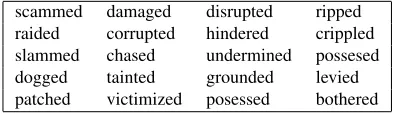
Next, we rank the extracted verbs by computing the ratio between the frequency of the verb with a negative agent versus a positive agent. If this ratio is>1, then we save the verb as anegative patient polarity verb(i.e., it imparts negative polarity to its patient). This process produced408negative patient polarity verbs, most of which seemed clearly neg-ative for the patient. Table 1 shows the top 20 ex-tracted verbs. We also tried to identify positive pa-tient polarity verbs using a positive-to-negative ra-tio, but the extracted verbs were often neutral for the patient, so we did not use them.
[image:5.612.328.525.302.359.2]scammed damaged disrupted ripped raided corrupted hindered crippled slammed chased undermined possesed dogged tainted grounded levied patched victimized posessed bothered
Table 1: Top 20 negative patient polarity verbs
4.2 Step 2: Identifying the Characters
The problem of coreference resolution in fables is somewhat different than for other genres, pri-marily because characters are often animals (e.g.,
“he”=“owl”). So we hand-crafted a simple rule-based coreference system. For the sake of this task, we made two assumptions: (1) There are only two characters per fable, and (2) Both characters are mentioned in the fable’s title.
We then apply heuristics to determine number and gender for the characters based on word lists, Word-Net (Miller, 1990) and POS tags. If no determina-tion of a character’s gender or number can be made from these resources, a process of elimination is em-ployed. Given the two character assumption, if one character is known to be male, but there are female pronouns in the fable, then the other character is as-sumed to be female. The same is done for number agreement. Finally, if there is only one character be-tween a pronoun and the beginning of a document,
6
http://www.ldc.upenn.edu/Catalog/CatalogEntry.jsp?catalogId=LDC2006T13 7The corpus is not POS tagged so there is no guarantee these
the pronoun is assumed to corefer with that char-acter. The character then assumes the gender and number of that pronoun. Lastly, WordNet is used to obtain a small set of non-pronominal, non-string-match resolutions by exploiting hypernym relations, for instance, linkingPeasantwiththe man.
4.3 Step 3: Affect Projection
Our goal is to produce affect states for each char-acter in the story. Therefore every affect tag needs to be attributed to a character, or discarded. Since plots typically revolve around actions, we used the verbs as the basis for projecting affect tags onto the characters. In some cases, we also spawn new affect tags associated with mental states to indicate that an action is likely the manifestation of a plan.
We developed 6 types of affect projection rules
that orchestrate how affect tags are assigned to the characters based on verb argument structure. We use the Sundance shallow parsing toolkit (Riloff and Phillips, 2004) to generate a syntactic analysis of each sentence, including syntactic chunking, clause segmentation, and active/passive voice recognition. We normalize the verb phrases (VPs) with respect to voice (i.e., we transform the passive voice construc-tions into an active voice equivalent) to simplify our rules. We then make the assumption that the Subject of the VP is its AGENT and the Direct Object of the VP is its PATIENT.8The affect projection rules only project affect states onto AGENTS and PATIENTS that correspond to a character in the story. The five types of rules are described below.
1. AGENTVP: This case applies when the VP has no PATIENT, or a PATIENT that is not a char-acter in the story, or the PATIENT corefers with the AGENT. All affect tags associated with the VP are projected onto the AGENT. For example,“Mary laughed (+)” projects a positive affect state onto Mary.
2. VPPATIENT9: All affect tags associated with the VP are projected onto the PATIENT, unless both M and +/- tags exist, in which case only the +/- tags are projected. For example, “loved (+) the cat”, projects a positive affect state onto the cat.
8
We are not actually doing thematic role recognition, so this will not always be correct, but it is a reasonable approximation.
9
Agent is missing or not a character.
3. AGENTVPPATIENT: This case applies when the AGENT and PATIENT refer to different char-acters. All affect tags associated with the VP are projected onto the PATIENT, unless both M and +/-tags exist, in which case only the +/- +/-tags are pro-jected (as in Rule #2). If the VP has an M tag, then we also project an M tag onto the AGENT (repre-senting a shared, cross-character mental state). If the VP has a +/- tag, then we project a + tag onto the agent (as an inference that the AGENT accom-plished some action).
4. AGENTVERB1toVERB2PATIENT. We di-vide this into two cases: (a) If the agent and patient refer to the same character, then Rule #1 is applied (e.g., “Bo decided to teach himself...”). (b) If the agent and patient are different, we apply Rule #1 to
VERB1to agent and Rule #2 to VERB2. If no
af-fect tags are assigned to either verb, then we create an M affect state for the agent (assuming that the VP represents some sort of plan).
5. If a noun phrase refers to a character and in-cludes a modifying adjective with an affect tag, then the affect is mapped onto the character. For exam-ple,“thehappy(+) fox”.
Finally, if an adverb or adjectival phrase (e.g., predicate adjective) has an affect tag, then that affect tag is mapped onto the preceding VP and the projec-tion rules above are applied. For all of the rules, if a clause contains a negation word, then we flip the polarity of all words in that clause. Our negation list contains:no, not, never, fail, failed, fails, don’t, and didn’t.
5 Evaluation
5.1 Data Set
State M(66) +(52) -(39) All(157)
System R P F R P F R P F R P F
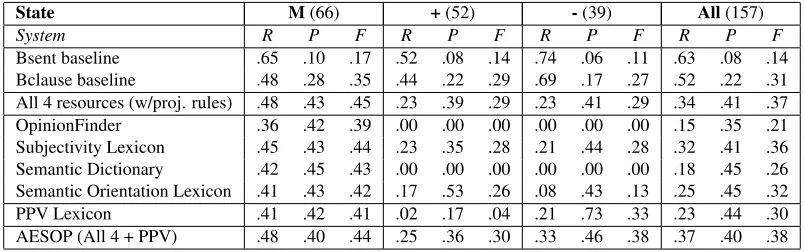
Bsent baseline .65 .10 .17 .52 .08 .14 .74 .06 .11 .63 .08 .14 Bclause baseline .48 .28 .35 .44 .22 .29 .69 .17 .27 .52 .22 .31 All 4 resources (w/proj. rules) .48 .43 .45 .23 .39 .29 .23 .41 .29 .34 .41 .37 OpinionFinder .36 .42 .39 .00 .00 .00 .00 .00 .00 .15 .35 .21 Subjectivity Lexicon .45 .43 .44 .23 .35 .28 .21 .44 .28 .32 .41 .36 Semantic Dictionary .42 .45 .43 .00 .00 .00 .00 .00 .00 .18 .45 .26 Semantic Orientation Lexicon .41 .43 .42 .17 .53 .26 .08 .43 .13 .25 .45 .32
PPV Lexicon .41 .42 .41 .02 .17 .04 .21 .73 .33 .23 .44 .30
[image:7.612.105.507.71.197.2]AESOP (All 4 + PPV) .48 .40 .44 .25 .36 .30 .33 .46 .38 .37 .40 .38
Table 2: Evaluation results for 2 baselines, 4 sentiment analysis resources with projection rules, and our PPV lexicon with projection rules. (The # in parentheses is the number of occurrences of that state in the gold standard).
We collected 34 fables from an Aesop’s Fables web site10, choosing fables that have a true plot (some only contain quotes) and exactly two charac-ters. We divided them into a development set of 11 stories, a tuning set of 8 stories, and a test set of 15 stories. The Father and Sons story from Figure 1(a) is an example from our set.
Creating a gold standard was itself a substantial undertaking. Plot units are complex structures, and training non-experts to produce them did not seem feasible in the short term. So three of the authors discussed and iteratively refined manual annotations for the development and tuning set stories until we became comfortable that we had a common under-standing for the annotation task. Then to create our gold standard test set, two authors independently created annotations for the test set, and a third au-thor adjudicated the differences. The gold standard contains complete plot unit annotations, including affect states, causal links, and cross-character links. For the experiments in this paper, however, only the affect state annotations were used.
5.2 Baselines
We created two baselines to measure what would happen if we use all 4 sentiment analysis resources
without any projection rules. The first one (Bsent) operates at the sentence level. It naively projects ev-ery affect tag that occurs in a sentence onto evev-ery character in the same sentence. The second base-line (Bclause) operates identically, but at the clause level.
10
http://www.pacificnet.net/∼johnr/aesop/
5.3 Evaluation
As our evaluation metrics we used recall (R), preci-sion (P), and F-measure (F). We evaluate each sys-tem on individual affect states (+, - and M) as well as across all affect states. The evaluation is done at the sentence level. Meaning, if a system produces the same affect state as present in the gold standard for a sentence, we count it as a correct affect state. Our main evaluation also requires each affect state to be associated with the correct character.
Table 2 shows the coverage of our two baseline systems as well as the four Sentiment Analysis Resources used with our projection rules. We can make several observations:
•As expected, the baselines achieve relatively high recall, but low precision.
• Each of the sentiment analysis resources alone is useful, and using them with the projection rules leads to improved performance over the baselines (10 points in F score for M and 6 points overall). This shows that the projection rules are helpful in identifying the characters associated with each affect state.
• The PPV Lexicon, alone, is quite good at cap-turing negative affect states. Together with the projection rules, this leads to good performance on identifying mental states as well.
State M(66) +(52) -(39) All(157)
System R P F R P F R P F R P F
[image:8.612.128.484.71.140.2]Bclause w/o char .65 .37 .47 .50 .25 .33 .77 .19 .30 .63 .26 .37 AESOP w/o char .55 .44 .49 .33 .47 .39 .36 .50 .42 .43 .46 .44 Bclause w/ char .48 .28 .35 .44 .22 .29 .69 .17 .27 .52 .22 .31 AESOP w/ char .48 .40 .44 .25 .36 .30 .33 .46 .38 .37 .40 .38
Table 3: Evaluating affect states with and without respect to character.
State M(66) +(52) -(39) All(157)
System R P F R P F R P F R P F
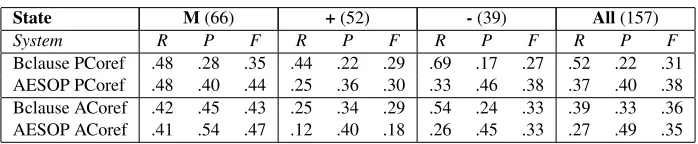
Bclause PCoref .48 .28 .35 .44 .22 .29 .69 .17 .27 .52 .22 .31 AESOP PCoref .48 .40 .44 .25 .36 .30 .33 .46 .38 .37 .40 .38 Bclause ACoref .42 .45 .43 .25 .34 .29 .54 .24 .33 .39 .33 .36 AESOP ACoref .41 .54 .47 .12 .40 .18 .26 .45 .33 .27 .49 .35
Table 4: Final results of Bclause and AESOP systems with perfect and automated coreference
evaluated with respect to the correct character. (2) For AESOP: there is a smaller drop in both preci-sion and recall for M and -, suggesting that our pro-jection rules are doing well for these affect states. (3) For AESOP: there is a large drop in both preci-sion and recall for +, suggesting that there is room for improvement of our projection rules for positive affect.
Finally, we wish to understand the role that coref-erence plays. Table 4 summarizes the results with perfect coreference and with automated coreference. AESOP is better than both baselines when we use perfect coreference (PCoref), which indicates that the affect projection rules are useful. However, when we use automated coreference (ACoref), re-call goes down and precision goes up. Rere-call goes down because our automated coreference system is precision oriented: it only says “coreferent” if it is sure.
The increase in precision when moving to auto-mated coreference is bizarre. We suspect it is pri-marily due to the handling of quotations. Our perfect coreference system resolves first and second person pronouns in quotations, but the automated system does not. Thus, with automated coreference, we al-most never produce affect states from quotations. This is a double-edged sword: sometimes quotes contain important affect states, sometimes they do not. For example, from the Father and Sons fable, “if you are dividedamong yourselves, you will be
brokenas easily as these sticks.” Automated coref-erence does not produce any character resolutions
and therefore AESOP produces no affect states. In this case this is the right thing to do. However, in another well-known fable, a tortoise says to a hare: “although you be asswiftas the wind, I havebeaten
you in the race.” Here, perfect coreference produces multiple affect states, whicharerelated to the plot: the hare recieves a negative affect state for having been beaten in the race.
6 Conclusions
AESOP demonstrates that sentiment analysis tools can successfully recognize many affect states when coupled with syntax-based projection rules to map the affect states onto characters. We also showed thatnegative patient polarity verbscan be harvested from a corpus to identify characters that are in a neg-ative state due to an action. However, performance is still modest, revealing that much work remains to be done. In future work, new methods will be needed to represent affect states associated with plans/goals, events, and inferences.
7 Acknowledgments
[image:8.612.132.481.168.240.2]References
Yejin Choi, Eric Breck, and Claire Cardie. 2006. Joint extraction of entities and relations for opinion recogni-tion. InEMNLP ’06: Proceedings of the 2006 Confer-ence on Empirical Methods in Natural Language Pro-cessing, pages 431–439, Morristown, NJ, USA. Asso-ciation for Computational Linguistics.
S. Kim and E. Hovy. 2006. Extracting Opinions, Opin-ion Holders, and Topics Expressed in Online News Media Text. InProceedings of ACL/COLING Work-shop on Sentiment and Subjectivity in Text.
W. Lehnert, J. Black, and B. Reiser. 1981. Summariz-ing Narratives. InProceedings of the Seventh Interna-tional Joint Conference on Artificial Intelligence. W. G. Lehnert. 1981. Plot Units and Narrative
Summa-rization. Cognitive Science, 5(4):293–331.
G. Miller. 1990. Wordnet: An On-line Lexical Database.
International Journal of Lexicography, 3(4).
E. Riloff and W. Phillips. 2004. An Introduction to the Sundance and AutoSlog Systems. Technical Report UUCS-04-015, School of Computing, University of Utah.
V. Stoyanov and C. Cardie. 2008. Topic Identification for Fine-Grained Opinion Analysis. InConference on Computational Linguistics (COLING 2008).
Hiroya Takamura, Takashi Inui, and Manabu Okumura. 2005. Extracting semantic orientations of words using spin model. InACL ’05: Proceedings of the 43rd An-nual Meeting on Association for Computational Lin-guistics.
A. Wierzbicka. 1987. English speech act verbs: a se-mantic dictionary. Academic Press, Sydney, Orlando. T. Wilson, P. Hoffmann, S. Somasundaran, J. Kessler, J. Wiebe, Y. Choi, C. Cardie, E. Riloff, and S. Pat-wardhan. 2005. OpinionFinder: A system for subjec-tivity analysis. InProceedings of HLT/EMNLP 2005 Interactive Demonstrations.