The Potsdam NLG systems at the GIVE-2.5 Challenge
Konstantina Garoufi and Alexander Koller Area of Excellence “Cognitive Sciences”
University of Potsdam, Germany
{garoufi, akoller}@uni-potsdam.de
Abstract
We present the Potsdam natural language gen-eration systems P1 and P2 of the GIVE-2.5 Challenge. The systems implement two dif-ferent referring expression generation models from Garoufi and Koller (2011) while behav-ing identically in all other respects. In partic-ular, P1 combines symbolic and corpus-based methods for the generation of successful refer-ring expressions, while P2 is based on a purely symbolic model which serves as a qualified baseline for comparison. We describe how the systems operated in the challenge and discuss the results, which indicate that P1 outperforms P2 in terms of several measures of referring expression success.
1 Introduction
The Challenge on Generating Instructions in Vir-tual Environments (GIVE; Koller et al. (2010)) is an evaluation effort for natural language generation (NLG) systems, which focuses on real-time genera-tion of situated language. In this shared task, the role of the NLG system is to guide a human instruction follower (IF) through a 3D virtual world with the goal of completing a treasure-hunting task. As an internet-based evaluation, GIVE has been success-ful in attracting both a large number of volunteers for the IF role and a high level of interest from the research community.
In this paper, we report on our participation in the third installment of GIVE (GIVE-2.5; Strieg-nitz et al. (2011)). Although most of the work on the generation of referring expressions (REs) to
date has focused either on logical properties of REs, such as uniqueness and minimality, or on their de-gree of similarity to human-produced expressions (see Krahmer and van Deemter (To appear) for a comprehensive survey), we believe that it would be desirable to optimize a system directly for useful-ness. We therefore approach the RE generation task with a model that aims at computing the unique RE which is fastest for the hearer to resolve (Garoufi and Koller, 2011). The purpose of the Potsdam NLG systems P1 and P2 at the challenge was to as-sess with a task-based evaluation to what extent the model actually manages to do so.
While we cannot present the RE generation mod-ules in detail here (see Garoufi and Koller (2011) for that), note that P1 implements the hybrid model mSCRISP of Garoufi and Koller, which extends the planning-based approach to sentence generation (Koller and Stone, 2007) with a statistical model of RE success. This model was learnt from a corpus of human instruction giving sessions in the GIVE do-main (Gargett et al., 2010), in which every RE was annotated with a measure of how easy it has been for the hearer to resolve. System P1 is therefore de-signed to optimize the REs it generates for under-standability. On the other hand, system P2 is an im-plementation of the baseline model EqualCosts of Garoufi and Koller. This is a purely symbolic model that always computes a correct and unique RE, but does so without any empirical guidance about ex-pected understandability. System P2 behaves in the exact same way as P1 in all respects, with the ex-ception of the RE generation module. It therefore serves as a qualified baseline against which we can
compare the performance of the mSCRISP model.
Plan of the paper. We describe the two systems P1 and P2 in Section 2. As the RE generation mod-ules have been presented in full detail in Garoufi and Koller (2011), we mostly focus on the other aspects of the systems’ behavior here. We then comment on the evaluation results in Section 3 and conclude in Section 4.
2 The systems P1 and P2
The two systems operate on the same codebase, dif-fering only in their RE generation modules. In par-ticular, they follow identical strategies for determin-ing their communicative goals, switchdetermin-ing between navigation and reference, as well as issuing warn-ings and other feedback.
2.1 Determining the communicative goals
The GIVE framework provides an NLG system with a plan of what the IF must do in order to com-plete the task by picking up a trophy. This plan is a symbolic sequence of mixed moves and ob-ject manipulation actions such asmove(reg1, reg2), manipulate(b1,off, on, reg2), take–t1(reg3). Our
systems parse the plan in order to identify objects of interest and determine the nature of the communica-tive goals related to these: If amove action which
involves going through a doorway from one room to another is encountered in the plan, then that door-way is registered as a target with the corresponding communicative goal that the IF should go through it. If, on the other hand, a manipulate ortake ac-tion is encountered, then the patient of this acac-tion is registered as a target (be it a button to push or a trophy to take), while, accordingly, the manipulation of that target becomes a communicative goal for the systems to pursue.
2.2 Navigation and reference
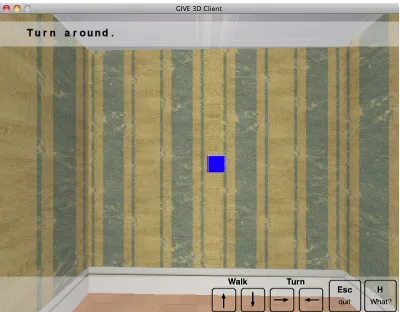
[image:2.612.327.527.59.215.2]Once the next target and the communicative goal have been determined, the systems go on to check whether a certain condition for reference is met; in particular, whether the target is currently in the IF’s field of view. This precondition reflects empirical observations that human instruction givers typically manipulate the non-linguistic context of scenes in convenient ways (e.g. by making the referent vi-sually salient) before referring to objects in these
Figure 1: Example of a navigation instruction aiming at making the next target visible.
Figure 2: Example of a navigation instruction urging the IF to go through a doorway that they already see.
[image:2.612.325.526.266.421.2]scenes (Stoia et al., 2006; Sch¨utte et al., 2010). If the precondition is not fulfilled, then the systems resort to low-level navigation instructions such as “Turn left” or “Go straight” in order to change the IF’s location to one that allows them to see the target (Figure 1). Because doorways are also perceived as targets, it is guaranteed that the next target is always located in the same room as the IF. As a result, this process usually involves no more than a few turns.
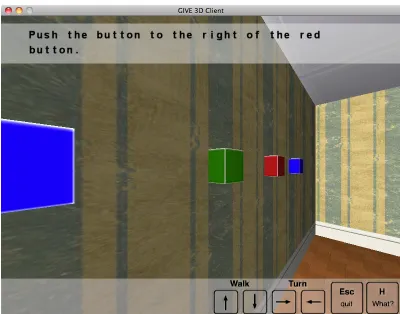
nav-igation instruction that urges the IF to go through a visible doorway, while Figure 3 presents an exam-ple of an RE for a button target issued by system P1. In this scene, system P2 would generate the differ-ent RE “the right one to the right of the green but-ton”. The systems issue all these kinds of instruc-tions at regular intervals repeatedly, until they detect that the IF has reacted. This is to make sure that the IF knows at all times what they are expected to do.
2.3 Execution monitoring
In real-time instruction giving it is crucial for a sys-tem to be able to monitor whether the IF actually ex-ecutes the given instructions, assess how well they progress on the task, and finally react to such ob-servations with appropriate feedback. Our systems issue three main types of such feedback:
• Positive feedback.The IF receives an affirma-tion (e.g. “Good job!”, “Excellent!”) as soon as they accommodate the given communica-tive goal by executing the associated action. These situations are important because apart from moving the task forward they establish that a system’s RE has been resolved by the IF correctly.
• Negative feedback. Conversely, if the IF per-forms a different action than the one expected, e.g. by pushing the wrong button or going into the wrong room, they are immediately told so (Figure 4). This serves not only as feedback for the IF but also as an opportunity for the sys-tems to reevaluate the situation and make the necessary computations for figuring out which communicative goal should come next.
• Warnings.Finally, certain regions in the GIVE
[image:3.612.326.526.58.215.2]worlds are equipped with alarms so that step-ping on them would cause the IF to lose the game. If the systems detect that the IF has approached an activated alarm closely enough that this outcome becomes likely, they inter-rupt all their other functions and issue a brief warning about the danger (e.g., “Beware of the alarm on the floor!”).
Figure 3: Example of an expression referring to a button target, as generated by P1.
2.4 Example instruction-giving session
Example (1) below presents a simplified excerpt from an interaction between system P1 and an IF, in which several of the instruction types listed above can be found.
(1) P1:Turn left.
IF: (turns left until the target becomes visible) P1:Push the yellow button.
IF: (starts moving towards the button) P1:Push the button.
IF: (pushes the button) P1:Good!
P1:Now turn right.
IF: (turns right until the target becomes visible) P1:Go through the doorway.
IF: (goes through the doorway) P1:Excellent!
P1:Turn right.
IF: (starts turning right) P1:Go straight.
IF: (starts moving straight ahead) P1:Don’t step on the alarm!
P1:Go straight.
IF: (continues moving ahead)
P1:Push the green one in front of you.
Figure 4: Example of execution monitoring and negative feedback.
attributes to include in it and which not. Since the at-tribute selection process of P1 relies on the context features of the scene in a much more substantial way than that of P2, which simply uses the visual con-text in order to ensure that the RE is distinguishing in the domain, this phenomenon is observed in P1 more frequently than in P2. Indeed, P1 may change its decision of which attributes to include in an RE not because, say, a potential distractor has come into sight, but just because e.g. the IF has moved closer to the target, or even because the system has already attempted to refer to it in a particular way several times before without success.
3 Results
Although none of the objective and subjective evalu-ation measures of the challenge establish any signif-icant differences between the two systems based on the current snapshot of the results, P1 does achieve better scores than P2 on most measures of RE suc-cess.
3.1 RE success
Areas in which P1 outperforms P2 include the ob-jective measures of task success, number of actions executed by the IF (indicating incorrect resolution of REs), and game duration. But also in terms of sub-jective measures, as extracted by the IFs’ responses to a post-task questionnaire, P1 scores higher than P2 for the most part: It is perceived as generat-ing better instructions overall (“Overall, the system gave me good instructions”), better REs to buttons
(“I could easily identify the buttons the system de-scribed to me”), and clearer, more trustworthy in-structions (“I had to re-read inin-structions to under-stand what I had to do”, “I felt I could trust the sys-tem’s instructions”; see Striegnitz et al. (2011) for details).
More importantly, we compared the systems with respect to RE resolution success and successfulness, which is the exact measure of RE understandability that P1 was optimized for. This comparison does establish a significant difference between the two, indicating that P1 generates REs that are faster re-solvable by the IFs after effects of RE rephrasing as described in Subsection 2.4 have been factored out (see Garoufi and Koller (2011) for details).
3.2 Error analysis
Finally, looking into possible causes of failure for the systems’ REs, we find that the most appar-ent problem involves generating expressions which, though not semantically invalid, are of disputable linguistic acceptability. Typical instances of such REs are “the button to the left of the right button”, “the button below the upper button” and variants of these. These cases arise due to the fact that we did not constraint the systems’ grammar so as to dis-allow such constructions, while the systems often chose attributes for which this particular type of re-alization was possible.
It turns out that P2 was more prone to this type of REs than P1, which at first glance seems like a probable reason for the lower RE success rates of the system. However, examining the portion of REs of each system that did not fall into this category, we found that P1 still generated significantly more suc-cessful REs after factoring out the effects of rephras-ing. It would be interesting for future work to com-pare the systems’ REs in a more controlled way, so that their attribute selection and realization aspects can be evaluated in separation.
4 Conclusion
collect data for both objective and subjective mea-sures, and compare it against the baseline. The re-sults indicate that the model outperforms the base-line with respect to the measure of RE understand-ability that it was optimized for.
Acknowledgments
Thanks to Kristina Striegnitz for clarifying impor-tant aspects of the evaluation methodology, and to all 148 internet users who went on a virtual treasure hunt to make this evaluation possible.
References
Andrew Gargett, Konstantina Garoufi, Alexander Koller, and Kristina Striegnitz. 2010. The GIVE-2 Corpus of Giving Instructions in Virtual Environments. In Pro-ceedings of the 7th Conference on International Lan-guage Resources and Evaluation, Valletta, Malta. Konstantina Garoufi and Alexander Koller. 2011.
Com-bining symbolic and corpus-based approaches for the generation of successful referring expressions. In Pro-ceedings of the 13th European Workshop on Natural Language Generation, Nancy, France.
Alexander Koller and Matthew Stone. 2007. Sentence generation as planning. In Proceedings of the 45th Annual Meeting of the Association of Computational Linguistics, Prague, Czech Republic.
Alexander Koller, Kristina Striegnitz, Donna Byron, Jus-tine Cassell, Robert Dale, Johanna Moore, and Jon Oberlander. 2010. The First Challenge on Generat-ing Instructions in Virtual Environments. In M. The-une and E. Krahmer, editors, Empirical Methods in Natural Language Generation, volume 5790 ofLNCS, pages 337–361.
Emiel Krahmer and Kees van Deemter. To appear. Com-putational generation of referring expressions: A sur-vey. Computational Liguistics.
Niels Sch¨utte, John Kelleher, and Brian Mac Namee. 2010. Visual salience and reference resolution in sit-uated dialogues: A corpus-based evaluation. In Pro-ceedings of the AAAI 2010 Fall Symposium on Dialog with Robots, Arlington, VA.
Laura Stoia, Donna K. Byron, Darla M. Shockley, and Eric Fosler-Lussier. 2006. Sentence planning for re-altime navigational instructions. In Proceedings of the Human Language Technology Conference of the NAACL, New York City, NY.
Kristina Striegnitz, Alexandre Denis, Andrew Gargett, Konstantina Garoufi, Alexander Koller, and Mariet Theune. 2011. Report on the Second Second NLG