How we BLESSed distributional semantic evaluation
Marco Baroni
University of Trento Trento, Italy
Alessandro Lenci
University of Pisa Pisa, Italy
Abstract
We introduce BLESS, a data set specifically designed for the evaluation of distributional semantic models. BLESS contains a set of tu-ples instantiating different, explicitly typed se-mantic relations, plus a number of controlled random tuples. It is thus possible to assess the ability of a model to detect truly related word pairs, as well as to perform in-depth analy-ses of the types of semantic relations that a model favors. We discuss the motivations for BLESS, describe its construction and struc-ture, and present examples of its usage in the evaluation of distributional semantic models.
1 Introduction
In NLP, it is customary to distinguish between in-trinsic evaluations, testing a system in itself, and
extrinsic evaluations, measuring its performance in some task or application (Sparck Jones and Galliers, 1996). For instance, the intrinsic evaluation of a de-pendency parser will measure its accuracy in identi-fying specific syntactic relations, while its extrinsic evaluation will focus on the impact of the parser on tasks such as question answering or machine trans-lation. Current approaches to the evaluation of Dis-tributional Semantic Models(DSMs, also known as semantic spaces, vector-space models, etc.; see Turney and Pantel (2010) for a survey) are task-oriented. Model performance is evaluated in “se-mantic tasks”, such as detecting synonyms, recog-nizing analogies, modeling verb selectional prefer-ences, ranking paraphrases, etc. Measuring the per-formance of DSMs on such tasks represents an
in-direct test of their ability to capture lexical mean-ing. The task-oriented benchmarks adopted in dis-tributional semantics have not specifically been de-signed to evaluate DSMs. For instance, the widely used TOEFL synonym detection task was designed to test the learners’ proficiency in English as a sec-ond language, and not to investigate the structure of their semantic representations (cf. Section 2).
To gain a real insight into the abilities of DSMs to address lexical semantics, existing benchmarks must be complemented with a more intrinsically oriented approach, to performdirect testson the specific as-pects of lexical knowledge captured by the models. In order to achieve this goal, three conditions must be met: (i) to single out the particular aspects of meaning that we want to focus on in the evaluation of DSMs; (ii) to design a data set that is able to ex-plicitly and reliably encode the target semantic infor-mation; (iii) to specify the evaluation criteria of the system performance on the data set, in order to get an estimate of the intrinsic ability of DSMs to cope with the selected semantic aspects. In this paper, we address these three conditions by presentingBLESS
(Baroni andLenciEvaluation ofSemanticSpaces), a new data set specifically geared towards the in-trinsic evaluation of DSMs, downloadable from: http://clic.cimec.unitn.it/distsem.
2 Distributional semantics benchmarks There are several benchmarks that have been widely adopted for the evaluation of DSMs, all of them cap-turing interesting challenges a DSM should meet. We briefly review here some commonly used and representative benchmarks, and discuss why we felt
the need to add BLESS to the set. We notice at the outset of this discussion that we want to carve out a space for BLESS, and not to detract from the impor-tance and usefulness of other data sets. We further remark that we focus on data sets that, like BLESS, are monolingual English and, while task-oriented, not aimed at a specific application setting (such as machine translation or ontology population).
Probably the most commonly used benchmark in distributional semantics is the TOEFLsynonym de-tection task introduced to computational linguis-tics by Landauer and Dumais (1997). It consists of 80 multiple-choice questions, each made of a target word (a noun, verb, adjective or adverb) and 4 re-sponse words, 1 of them a synonym of the target. For example, given the target levied, the matched words areimposed,believed,requested, correlated, the first one being the correct choice. The task for a system is then to pick the true synonym among the responses. The TOEFL task focuses on a single semantic relation, namely synonymy. Synonymy is actually not a common semantic relation and one of the hardest to define, to the point that many lexi-cal semanticists have concluded that true synonymy does not exist (Cruse, 1986). Just looking at a few examples of synonym pairs from the TOEFL set will illustrate the problem: discrepancy/difference, pro-lific/productive,percentage/proportion,to market/to sell, color/hue. Moreover, the criteria adopted to choose the distractors (probably motivated by the language proficiency testing purposes of TOEFL) are not known. By looking at the set, it is hard to discern a coherent pattern. In certain cases, the distractors are semantically close to the target word (volume,sampleandprofitforpercentage), whereas in other cases they are not (home,trail, andsongfor
annals). It it thus not clear whether we are asking the models to distinguish a semantically related word (the synonym) from random elements, or a more tightly related word (the synonym, again) from other related words. The TOEFL task, finally, is based on a discrete choice (either you get the right word, or you don’t), with the result that evaluation is “quan-tized”, leading to large accuracy gains for small ac-tual differences (one model that guesses one more synonym right than another gets 1.25% more points in percentage accuracy).
The WordSim 353 data set (Finkelstein et al.,
2002) is a widely used example ofsemantic simi-larity rating set (see also Rubenstein and Goode-nough (1965) and Miller and Charles (1991)). Sub-jects were asked to rate a set of 353 word pairs on a “similarity” scale and average ratings for each pair were computed. Models are then evaluated in terms of correlation of their similarity scores with aver-age ratings across pairs. From the point of view of assessing the performance of a DSM, the Word-Sim (and related) similarity ratings are a mixed bag, in two senses. First, the data set contains a vari-ety of different semantic relations. In a recent se-mantic annotation of the WordSim performed by Agirre et al. (2009) we find that, among the 174 pairs with above-median score (and thus presum-ably related), there is 1 identical pair, 17 synonym pairs, 28 hyper-/hyponym pairs, 30 coordinate pairs, 6 holo-/meronym pairs and 92 (more than half) pairs that are “topically related, but none of the above”. Second, the scores are a mixture of intuitions about which of these relations are more semantically tight and intuitions about more or less connected pairs
within each of the relations. For example, among the top-rated scores we find synonyms such as jour-ney/voyage and coordinate concepts (king/queen). If we look at the relations characterizing pairs around the median rating, we find both less “per-fect” synonyms (monk/brother, that are synonymous only under an unusual sense of brother) and less close coordinates (skin/eye), as well as pairs in-stantiating other, less taxonomically tight relations, such as many syntagmatically connected items ( fam-ily/planning, disaster/area, bread/butter). Appar-ently, a single scale is merging intuitions about se-mantic similarity of specific pairs and sese-mantic sim-ilarity of different relations.
ve-hicle class (helicopter, motorcycle. . . ), the motiva-tion class (ethics, incitement, . . . ), and the social unit class (platoon, branch). The concepts are bal-anced in terms of frequency and ambiguity, so that, e.g., thetreeclass contains a common concept such as pine but also the casuarina tree, as well as the
sambatree, that is not only an ambiguous term, but one where the non-arboreal sense dominates.
Concept categorization data sets, while interest-ing to simulate one of the basic aspects of human cognition, are limited to one kind of semantic re-lation (discovering coordinates). More importantly, the quality of the results will depend not only on the underlying DSMs, but also on the clustering algo-rithm being used (and on how this interacts with the overall structure of the DSM), thus making it hard to interpret the performance of DSMs. The forced “hard” category choice is also problematic, and ex-aggerates performance differences between models especially in the presence of ambiguous terms (a model that puts samba in the occasion class with
dance and ball might be penalized as much as a model that puts it in themonetary currencyclass).
A more general issue with all benchmarks is that tasks are based on comparing a single quality score for each considered model (accuracy for TOEFL, correlation for WordSim, a clustering quality mea-sure for AP, etc.). This gives little insight intohow
and why the models differ. Moreover, there is no well-established statistical procedure to assess sig-nificance of differences for most commonly used measures. Finally, either because the data sets were not originally intended as standard benchmarks, or even on purpose, they all are likely to cause coverage problems even for DSMs trained on very large cor-pora. Think of the presence of extremely rare nouns likecasuarinain AP, of proper nouns in WordSim (it is not clear to us that DSMs are adequate semantic models for referring expressions – at the very least they should not be mixed up lightly with common nouns), or multi-word expressions in other data sets.
3 How we intend to BLESS distributional semantic evaluation
DSMs measure the distributional similarity between words, under the assumption that proximity in distri-butional space models semantic relatedness,
includ-ing, as a special case, semantic similarity (Budanit-sky and Hirst, 2006). However, semantically related words in turn differ for the type of relation hold-ing between them: e.g., dog is strongly related to bothanimalandtail, but with different types of re-lations. Therefore, evaluating the intrinsic ability of DSMs to represent the semantic space of a word en-tails both (i) determining to what extent words close in semantic space are actually semantically related, and (ii) analyzing, among related words, which type of semantic relation they tend to instantiate. Two models can be equally very good in identifying se-mantically related words, while greatly differing for the type of related pairs they favor.
The BLESS data set complies with both these constraints. The set is populated with tuples ex-pressing arelationbetween a target concept (hence-forth referred to asconcept) and a relatum concept (henceforth referred to asrelatum). For instance, in the BLESS tuplecoyote-hyper-animal, the concept
coyote is linked to the relatum animal via the hy-pernymy relation (the relatum is a hypernym of the concept). BLESS focuses on a coherent set of basic-level nominal concrete concepts and a small but ex-plicit set of semantic relations, each instantiated by multiple relata. Depending on the type of relation, relata can be nouns, verbs or adjectives. Moreover, BLESS also contains, for each concept, a number of
random “relatum” words that are not semantically related to the concept. Thus, it also allows to evalu-ate a model in terms of its ability to harvest relevalu-ated words given a concept (by comparing true and ran-dom relata), and to identify specific types of relata, both in terms of semantic relation and part of speech. A data set intending to represent a gold standard for evaluation should include tests items that are as little controversial as possible. The choice of re-stricting BLESS to concrete concepts is motivated by the fact that they are by far the most studied ones, and there is better agreement about the relations that characterize them (Murphy, 2002; Rogers and Mc-Clelland, 2004).
rela-tions are also highly controversial, and may easily lead to questionable classifications. For instance, concepts are related to events, but often it is not clear how to distinguish the events expressing a typical function of nominal concepts (e.g., car and trans-port), from those events that are also strongly re-lated to them but without representing their typical functionsensu stricto(e.g.,carandfix). As will be shown in Section 4, the BLESS data set tries to over-come this dilemma by attempting a difficult com-promise: Semantic relations are not limited to tax-onomic types and also include attributes and events strongly related to a concept, but in these cases we have resorted to underspecification, rather than com-mitting ourselves to questionable granular relations. BLESS strives to capture those differences and similarities among DSMs that do not depend on coverage, processing choices or lexical preferences. BLESS has been constructed using a publicly avail-able collection of corpora for reference (see Section 4.4 below), which means that anybody can train a DSM on the same data and be sure to have perfect coverage (but this is not strictly necessary). For each concept and relation, we pick a variety of relata (see next section) in order to abstract away from inciden-tal gaps of models or different lexical/topical prefer-ences. For example, the conceptrobinhas 7 hyper-nyms including the very general and non-technical
animal and bird and the more specific and techni-calpasserine. A model more geared toward techni-cal terminology might assign a high similarity score to the latter, whereas a commonsense-knowledge-oriented DSM might pickbird. Both models have captured similarity with a hypernym, and we have no reason, in general semantic terms, to penalize one or the other. To maximize coverage, we also make sure that, for each concept and relation, a reason-able number of relata are frequently attested in our reference corpora (see statistics below), we only in-clude single-word relata and, where appropriate, we include multiple forms for the same relatum (both
sockandsocksas coordinates ofscarf– as discussed in Section 4.1, we avoided similar ambiguous items as target concepts).
Currently, distributional models for attributional similarity and relational similarity (Turney, 2006) are tested on different data sets, e.g., TOEFL and SAT respectively (briefly, attributional similarity
pertains to similarity between a pair of concepts in terms of shared properties, whereas relational sim-ilarity measures the simsim-ilarity of the relations in-stantiated by couples of conceptpairs). Conversely, BLESS is not biased towards any particular type of semantic similarity and thus allows both families of models to be evaluated on the same data set. Given a concept, we can analyze the types of relata that are selected by a model as more attributionally similar to the target. Alternatively, given a concept-relatum pair instantiating a specific semantic relation (e.g., hypernymy) we can evaluate a model ability to iden-tify analogically similar pairs, i.e., others concept-relatum pairs instantiating the same relation (we do not illustrate this possibility here).
Finally, by collecting distributions of 200 similar-ity values for each relation, BLESS allows reliable statistical testing of the significance of differences in similarity within a DSM (for example, using the procedure we present in Section 5 below), as well as across DSMs (for example, via a linear/ANOVA model with relations and DSMs as factors – not il-lustrated here).
4 Construction
4.1 Concepts
BLESS includes 200 distinct English concrete nouns as target concepts, equally divided be-tween living and non-living entities. Concepts have been grouped into 17 broader classes: AM -PHIBIAN REPTILE (including amphibians and
rep-tiles: alligator), APPLIANCE (toaster), BIRD
(crow), BUILDING(cottage),CLOTHING (sweater), CONTAINER (bottle), FRUIT (banana), FURNI -TURE (chair), GROUND MAMMAL (beaver), IN -SECT (cockroach), MUSICAL INSTRUMENT ( vio-lin),TOOL(i.e., manipulable tools or devices: ham-mer),TREE (birch),VEGETABLE (cabbage), VEHI -CLE (bus),WATER ANIMAL(including fish and sea
mammals:herring),WEAPON(dagger).
All 200 BLESS concepts are single-word nouns in the singular form (we avoided concepts such as
sub-jects with semantic features, each tagged with its property type. As further constraints guiding our selection, we wanted concepts with a reasonably high frequency (cf. Section 4.4), we avoided am-biguous or highly polysemous concepts and we bal-anced inter- and intra-class composition. Classes in-clude both prototypical and atypical instances (e.g.,
robinandpenguinforBIRD), and have a wide
spec-trum of internal variation (e.g., the class VEHICLE
contains wheeled, air and sea vehicles). 175 BLESS concepts are attested in the McRae Norms, while the remnants were selected by the authors according to the above constraints. The average number of con-cepts per class is 11.76 (median 11; min. 5AMPHIB -IAN REPTILE; max. 21GROUND MAMMAL). 4.2 Relations
For each concept noun, BLESS includes several relatum words, linked to the concept by one of the following 5 relations. COORD: the relatum
is a noun that is a co-hyponym (coordinate) of the concept, i.e., they belong to the same (nar-rowly or broadly defined) semantic class: alligator-coord-lizard; HYPER: the relatum is a noun that
is a hypernym of the concept: alligator-hyper-animal; MERO: the relatum is a noun referring
to a part/component/organ/member of the concept, or something that the concept contains or is made of: alligator-mero-mouth; ATTRI: the relatum is
an adjective expressing an attribute of the concept:
alligator-attri-aquatic; EVENT: the relatum is a
verb referring to an action/activity/happening/event the concept is involved in or is performed by/with the concept: alligator-event-swim. BLESS also includes the relations RAN.N, RAN.J and RAN.V,
which relate the target concepts to control tuples with random noun, adjective and verb relata, respec-tively.
The BLESS relations cover a wide spectrum of information useful to describe a target concept and to qualify the notion of semantic relatedness: taxo-nomically related entities (hyperandcoord), typical attributes (attri), components (mero), and associated events (event). However, except forhyper and co-ord(corresponding to the standard relations of class inclusion and co-hyponymy respectively), the other BLESS relations are highly underspecified. For in-stance,mero corresponds to a very broad notion of
meronymy, including not only parts (dog-tail), but also the material (table-wood) as well as the mem-bers (hospital-patient) of the entity the target con-cept refers to (Winston et al., 1987);eventis used to represent the behaviors of animals (dog-bark), typi-cal functions of instruments (violin-play), and events that are simply associated with the target concept (car-park);attricaptures a large range of attributes, from physical (elephant-big) to evaluative ones ( car-expensive). As we said in section 3, we did not at-tempt to further specify these relations to avoid any commitment to controversial ontologies of property types. Note that we exclude synonymy both because of the inherent problems in this very notion (Cruse, 1986), and because it is impossible to find convinc-ing synonyms for 200 concrete concepts.
In BLESS, we have adopted the simplifying as-sumption that each relation type has relata belonging to the same part of speech: nouns forhyper,coord
andmero, verbs for event, and adjectives for attri. Therefore, we abstract away from the fact that the same semantic relation can be realized with different parts of speech, e.g., a related event can be expressed by a verb (transport) or by a noun (transportation).
4.3 Relata
The relata of the non-random relations are English nouns, verbs and adjectives selected and validated by both authors using two types of sources: se-mantic sources (the McRae Norms (McRae et al., 2005), WordNet (Fellbaum, 1998) and ConceptNet (Liu and Singh, 2004)) andtext sources(Wikipedia and the Web-derived ukWaC corpus, see Section 4.4 below). These resources greatly differ in dimension, origin and content and therefore provide comple-mentary views on relata. Their relative contribution to BLESS also depends on the type of relation and the target concept. For instance, the rich taxonomic structure of WordNet has been the main source of in-formation for many technical hypernyms (e.g. gym-nosperm, oscine), which instead are missing from more commonsense-oriented resources such as the McRae Norms and ConceptNet. Meronyms are rarer in WordNet, and were collected mainly from the latter two resources, with many technical terms (e.g., parts of ships, weapons) harvested from the Wikipedia entries for the target concepts.
Norms, ConceptNet and ukWaC. In the McRae Norms, the number of features per concept is fairly limited, but they correspond to highly distinctive, prototypical and cognitively salient properties. Con-ceptNet instead provides a much wider array of as-sociated events and attributes that are part of our commonsense knowledge about the target concepts (e.g., the eventspark,stealandbreak, etc. forcar). ConceptNet relations such asCreated by,Used for,
Capable of etc. have been analyzed to identify po-tential event relata, while theHas propertyrelation has been inspected to look for attributes. The most salient adjectival and verbal collocates of the tar-get nouns in the ukWaC corpus were also used to identify associated attributes and events. For in-stance, the target conceptelephantis not attested in the McRae Norms and has few properties in Con-ceptNet. Thus, many of its related events have been harvested from ukWaC. They include verbs such as
hunt, kill, etc. which are quite salient and frequent with respect to elephants, although they can hardly be defined as prototypical properties of this animal. As a result of the combined use of such different types of sources, the BLESS relata are representative of a wide spectrum of semantic information about the target concepts: they include domain-specific terms side by side to commonsense ones, very dis-tinctive features of a concept (e.g., hoot for owl) together with attributes and events that are instead shared by a whole class of concepts (e.g., all animals have relata such aseat,feed, andlive), prototypical features as well as events and attributes that are sta-tistically salient for the target, etc.
In many cases, the concept properties contained in semantic sources are expressed with phrases, e.g.,
lay eggs,eat grass,live in Africa, etc. We decided, however, to keep only single-word relata in BLESS, because DSMs are typically populated with single words, and, when they are not, they differ in the kinds of multi-word elements they store. There-fore, phrasal relata have always been reduced to their head: a verb for properties expressed by a verb phrase, and a noun for properties expressed by a noun phrase. For instance, from the property lay eggs, we derived the event relatumlay.
To extract the random relata, we adopted the fol-lowing procedure. For each relatum that instantiates a true relation with the concept, we also randomly
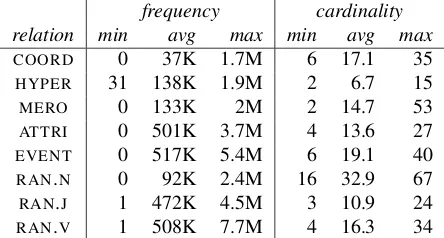
picked from our combined corpus (cf. Section 4.4) another lemma with the same part of speech, and frequency within 1 absolute logarithmic unit from the frequency of the corresponding true relatum. Since picking a random term does not guarantee that it will not be related to the concept, we filtered the extracted list by crowdsourcing, using the Ama-zon Mechanical Turk via the CrowdFlower interface (CF).1 We presented CF workers with the list of about 15K concept+random-term pairs selected with the procedure we just described, plus a manually checked validation set (a “gold set” in CF terminol-ogy) comprised of 500 concept+true-relatum pairs and 500 concept+random-term pairs (these elements are used by CF to determine the reliability of work-ers, and discard the ratings of unreliable ones), plus a further set of 1.5K manually checked concept+true-relatum pairs to make the random-true distribution less skewed. The workers’ task was, for each pair, to check a YES radio button if they thought there is a relation between the words, NO otherwise. The words were annotated with their part of speech, and workers were instructed to pay attention to this in-formation when making their choices. Extensive commented examples of both related pairs and un-related ones were also provided in the instruction page. A minimum of 2 CF workers rated each pair, and, conservatively, we preserved only those items (about 12K) that were unanimously rated as unre-lated to their concept by the judges. See Table 1 for summary statistics about the preserved random sets (nouns:RAND.N, adjectives:RAN.J, verbs:RAN.V).
4.4 BLESS statistics
For frequency information, we rely on the combi-nation of the freely available ukWaC and Wackype-dia corpora (size: 1.915B and 820M tokens, respec-tively).2 The data set contains 200 concepts that have a mean corpus frequency of 53K occurrences (min. 1416 chisel, max. 793Kcar). The relata of these concepts (26,554 in total) are distributed as re-ported in Table 1.
Note that the distributions reflect certain “natural” differences between relations (hypernyms tend to be more frequent words than coordinates, but there are
frequency cardinality relation min avg max min avg max COORD 0 37K 1.7M 6 17.1 35
HYPER 31 138K 1.9M 2 6.7 15
MERO 0 133K 2M 2 14.7 53
ATTRI 0 501K 3.7M 4 13.6 27 EVENT 0 517K 5.4M 6 19.1 40
RAN.N 0 92K 2.4M 16 32.9 67
RAN.J 1 472K 4.5M 3 10.9 24
[image:7.612.73.295.55.174.2]RAN.V 1 508K 7.7M 4 16.3 34
Table 1: Distribution (minimum, mean and maximum) of
the relata of all BLESS concepts: thefrequencycolumns
report summary statistics for corpus counts across relata
instantiating a relation; the cardinality columns report
summary statistics for number of relata instantiating a relation across the 200 concepts, only considering relata
with corpus frequency≥100.
more coordinates than hypernyms, etc.). Instead of trying to artificially control for these differences, we assess their impact in Section 5 by looking at the behavior of baselines that exploit the frequency and cardinality of relations as proxies to semantic simi-larity (such factors could also be entered as regres-sors in a linear model).
5 Evaluation
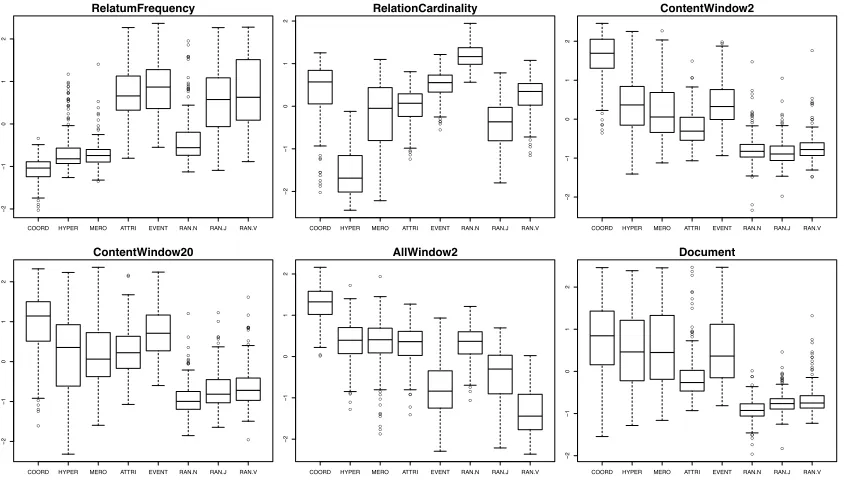
This section illustrates one possible way to use BLESS to explore and evaluate DSMs. Given the similarity scores provided by a model for a concept with all its relata across all relations, we pick the re-latum with the highest score (nearest neighbour) for each relation (see discussion in Section 3 above on why we allow models to pick their favorite from a set of relata instantiating the same relation). In this way, for each of the 200 BLESS concepts, we obtain 8 similarity scores, one per relation. In order to fac-tor out concept-specific effects that might add to the overall score variance (for example, a frequent con-cept might have a denser neighborhood than a rarer one, and consequently the nearest relatum scores of the former are trivially higher than those of the lat-ter), we transform the 8 similarity scores of each concept onto standardizedzscores (mean: 0; s.d: 1)
by subtracting from each their mean, and dividing by their standard deviation. After this transformation, we produce aboxplotsummarizing the distribution of scores per relation across the 200 concepts (i.e.,
each box of the plot summarizes the distribution of the 200 standardized scores picked for each rela-tion). Our boxplots (see examples in Fig. 1 below) display the median of a distribution as a thick hori-zontal line within a box extending from the first to the third quartile, with whiskers covering 1.5 of the interquartile range in each direction from the box, and values outside this extended range – extreme outliers – plotted as circles (these are the default boxplotting option of the R statistical package).3 While the boxplots are extremely informative about the relation types that are best captured by models, we expect some degree of overlap among the distri-butions of different relations, and in such cases we might want to ask whether a certain model assigns significantly higher scores to one relation rather than another (for example, tocoordinatesrather than ran-dom nouns). It is difficult to decidea prioriwhich pairwise statistical comparisons will be interesting. We thus take a conservative approach in which we performall pairwise comparisons using the Tukey Honestly Significant Difference test, that is simi-lar to the standardttest, but accounts for the greater likelihood of Type I errors when multiple compar-isons are performed (Abdi and Williams, 2010). We only report the Tukey test results for those com-parisons that are of interest in the analysis of the boxplots, using the standardα = 0.05 significance threshold.
5.1 Models
Occurrence and co-occurrence statistics for all mod-els are extracted from the combined ukWaC and Wackypedia corpora (see Section 4.4 above). We ex-ploit the automated morphosyntactic annotation of the corpora by building our DSMs out of lemmas (instead of inflected words), and relying on part of speech information.
Baselines. TheRelatumFrequencybaseline uses the frequency of occurrence of a relatum as a sur-rogate of its cosine with the concept. With this ap-proach, we want to verify that the unequal frequency distribution across relations (see Table 1 above) is not trivially sufficient to differentiate relation classes in a semantically interesting way. For our second baseline, we assign a random number as cosine
rogate to each relatum (to smooth these random val-ues, we generate them by first sampling, for each relatum, 10K random variates from a uniform distri-bution, and then averaging them). If the set of relata instantiating a certain relation is larger, it is more likely that it will contain the highest random value. Thus, thisRelationCardinality baseline will favor relations that tend to have large relata set across con-cepts, controlling for effects due to different cardi-nalities across semantic relations (again, see Table 1 above).
DSMs. We choose a few ways to construct DSMs for illustrative purposes only. All the models contain vector representations for the same words, namely, approximately, the top 20K most frequent nouns, 5K most frequent adjectives and 5K most frequent verbs in the combined corpora. All the models use Local Mutual Information (Evert, 2005; Baroni and Lenci, 2010) to weight raw co-occurrence counts (this asso-ciation measure is obtained by multiplying the raw count by Pointwise Mutual Information, and it is a close approximation to the Log-Likelihood Ratio). Three DSMs are based on counting co-occurrences with collocates within a window of fixed width, in the tradition of HAL (Lund and Burgess, 1996) and many later models. The ContentWindow2
model records sentence-internal co-occurrence with the nearest 2 content words to the left and right of each target concept (the same 30K target nouns, verbs and adjectives are also employed as context content words). ContentWindow20 is like Con-tentWindow2, but considers a larger window of 20 words to the left and right of the target. AllWin-dow2adopts the same window of ContentWindow2, but considers all co-occurrences, not only those with content words. The Document model, finally, is based on a (Local-Mutual-Information transformed) word-by-document matrix, recording the distribu-tion of the 30K target words across the documents in the concatenated corpus. This DSM is thus akin to traditional Latent Semantic Analysis (Landauer and Dumais, 1997), without dimensionality reduction. The content-window-based models have, by con-struction, about 30K dimensions. The other models are much larger, and for practical reasons we only keep 1 million dimensions (those that account, cu-mulatively, for the largest proportion of the overall
Local Mutual Information mass).
5.2 Results
The concept-by-concept z-normalized distributions of cosines of relata instantiating each of our rela-tions are presented, for each of the example mod-els, in Fig. 1. The RelatumFrequency baseline shows a preference for adjectives and verbs in gen-eral, independently of whether they are meaningful (attributes, events) or not (random adjectives and verbs), reflecting the higher frequencies of adjec-tives and verbs in BLESS (Table 1). The Relation-Cardinality baseline produces even less interesting results, with a strong preference for random nouns, followed by coordinates, events and random verbs (as predicted by the distribution in Table 1). We can conclude that the semantically meaningful patterns produced by the other models cannot be explained by trivial differences in relatum frequency or rela-tion cardinality in the BLESS data set.
● ● ● ● ● ● ● ● ● ● ● ● ● ● ● ● ● ● ● ● ● ● ● ● ● ● ● ● ● ● ● ● ● ● ● ● ● ● ● ● ● ● ● ● ● ● ● ● ● ● ● ● ● ●
COORD HYPER MERO ATTRI EVENT RAN.N RAN.J RAN.V
− 2 − 1 0 1 2 RelatumFrequency ● ● ● ● ● ● ● ● ● ● ● ● ● ● ● ● ● ● ● ● ● ● ● ●
COORD HYPER MERO ATTRI EVENT RAN.N RAN.J RAN.V
− 2 − 1 0 1 2 RelationCardinality ● ● ● ● ● ● ● ● ● ● ● ● ● ● ● ● ● ● ● ● ● ● ● ● ● ● ● ● ● ● ● ● ● ● ● ● ● ● ● ● ● ● ● ● ● ● ●
COORD HYPER MERO ATTRI EVENT RAN.N RAN.J RAN.V
− 2 − 1 0 1 2 ContentWindow2 ● ● ● ● ● ● ● ● ● ● ● ● ● ● ● ● ● ● ● ● ● ● ● ● ● ● ● ● ● ● ● ● ●
COORD HYPER MERO ATTRI EVENT RAN.N RAN.J RAN.V
− 2 − 1 0 1 2 ContentWindow20 ● ● ● ● ● ● ● ● ● ● ● ● ● ● ● ● ● ● ● ● ● ● ● ● ●
COORD HYPER MERO ATTRI EVENT RAN.N RAN.J RAN.V
− 2 − 1 0 1 2 AllWindow2 ● ● ● ● ● ● ● ● ● ● ● ● ● ● ● ● ● ● ● ● ● ● ● ● ● ● ● ● ● ● ● ● ● ● ● ● ● ● ● ● ● ● ● ● ● ● ● ● ●
COORD HYPER MERO ATTRI EVENT RAN.N RAN.J RAN.V
[image:9.612.96.518.55.295.2]− 2 − 1 0 1 2 Document
Figure 1: Distribution of relata cosines across concepts (values on ordinate are cosines after concept-by-concept z-normalization).
words, and thus they capture syntactic, rather than semantic distributional properties. As a result, ran-dom nouns are as high (statistically indistinguish-able from) hypernyms and meronyms. Interestingly, attributes also belong to this subset of relations – probably due to the effect of determiners, quantifiers and other DP-initial function words, that will often occur both before nouns and before adjectives. In-deed, even random adjectives, although significantly below the other relations we discussed, are signif-icantly above both random and meaningful verbs (i.e., events). For the Document model, all mean-ingful relations are significantly above the random ones. However, coordinates, while still the nearest neighbours (significantly closer than all other rela-tions) are much less distinct than in the window-based models. Note that we cannot saya priorithat ContentWindow2 is better than Document because it favors coordinates. However, while they are both able to sort out true and random relata, the latter shows a weaker ability to discriminate among differ-ent types of semantic relations (co-occurring within a document is indeed a much looser cue to similarity than specifically co-occurring within a narrow win-dow). Traditional DSM tests, based on a single
qual-ity measure, would not have given us this broad view of how models are behaving.
6 Conclusion
References
Herv Abdi and Lynne Williams. 2010. Newman-Keuls and Tukey test. In N.J. Salkind, D.M. Dougherty, and
B. Frey, editors, Encyclopedia of Research Design.
Sage, Thousand Oaks, CA.
Eneko Agirre, Enrique Alfonseca, Keith Hall, Jana Kravalova, Marius Pasc¸a, and Aitor Soroa. 2009. A study on similarity and relatedness using distributional
and WordNet-based approaches. In Proceedings of
HLT-NAACL, pages 19–27, Boulder, CO.
Abdulrahman Almuhareb. 2006. Attributes in Lexical
Acquisition. Phd thesis, University of Essex.
Marco Baroni and Alessandro Lenci. 2010.
Dis-tributional Memory: A general framework for
corpus-based semantics. Computational Linguistics,
36(4):673–721.
Marco Baroni, Stefan Evert, and Alessandro Lenci,
edi-tors. 2008. Bridging the Gap between Semantic
The-ory and Computational Simulations: Proceedings of the ESSLLI Workshop on Distributional Lexical Se-mantic. FOLLI, Hamburg.
Marco Baroni, Eduard Barbu, Brian Murphy, and Mas-simo Poesio. 2010. Strudel: A distributional semantic
model based on properties and types. Cognitive
Sci-ence, 34(2):222–254.
Alexander Budanitsky and Graeme Hirst. 2006. Evalu-ating wordnet-based measures of lexical semantic
re-latedness.Computational Linguistics, 32:13–47.
D. A. Cruse. 1986. Lexical Semantics. Cambridge
Uni-versity Press, Cambridge.
Stefan Evert. 2005. The Statistics of Word
Cooccur-rences. Dissertation, Stuttgart University.
Christiane Fellbaum, editor. 1998. WordNet: An
Elec-tronic Lexical Database. MIT Press, Cambridge, MA. Lev Finkelstein, Evgeniy Gabrilovich, Yossi Matias, Ehud Rivlin, Zach Solan, Gadi Wolfman, and Eytan Ruppin. 2002. Placing search in context: The concept
revisited. ACM Transactions on Information Systems,
20(1):116–131.
Thomas Landauer and Susan Dumais. 1997. A solu-tion to Plato’s problem: The latent semantic analysis theory of acquisition, induction, and representation of
knowledge. Psychological Review, 104(2):211–240.
Hugo Liu and Push Singh. 2004. ConceptNet: A
prac-tical commonsense reasoning toolkit. BT Technology
Journal, pages 211–226.
Kevin Lund and Curt Burgess. 1996. Producing
high-dimensional semantic spaces from lexical
co-occurrence. Behavior Research Methods, 28:203–208.
Ken McRae, George Cree, Mark Seidenberg, and Chris McNorgan. 2005. Semantic feature production norms
for a large set of living and nonliving things.Behavior
Research Methods, 37(4):547–559.
George Miller and Walter Charles. 1991. Contextual
cor-relates of semantic similarity. Language and
Cogni-tive Processes, 6(1):1–28.
Gregory Murphy. 2002.The Big Book of Concepts. MIT
Press, Cambridge, MA.
Timothy Rogers and James McClelland. 2004.
Seman-tic Cognition: A Parallel Distributed Processing Ap-proach. MIT Press, Cambridge, MA.
Herbert Rubenstein and John Goodenough. 1965.
Con-textual correlates of synonymy. Communications of
the ACM, 8(10):627–633.
Karen Sparck Jones and Julia R. Galliers. 1996.
Evaluat-ing Natural Language ProcessEvaluat-ing Systems: An Analy-sis and Review. Springer Verlag, Berlin.
Peter Turney and Patrick Pantel. 2010. From frequency
to meaning: Vector space models of semantics.
Jour-nal of Artificial Intelligence Research, 37:141–188. Peter Turney. 2006. Similarity of semantic relations.
Computational Linguistics, 32(3):379–416.
Morton E. Winston, Roger Chaffin, and Douglas Her-rmann. 1987. A taxonomy of part-whole relations.