Leveraging Transliterations from Multiple Languages
Aditya Bhargava, Bradley Hauer, and Grzegorz Kondrak
Department of Computing Science University of Alberta
Edmonton, Alberta, Canada, T6G 2E8
{ab31,bmhauer,gkondrak}@ualberta.ca
Abstract
While past research on machine transliter-ation has focused on a single translitera-tion task, there exist a variety of supple-mental transliterations available in other languages. Given an input for English-to-Hindi transliteration, for example, translit-erations from other languages such as Japanese or Hebrew may be helpful in the transliteration process. In this paper, we propose the application of such supplemen-tal transliterations to English-to-Hindi ma-chine transliteration via an SVM re-ranking method with features based on n-gram
alignments as well as system and align-ment scores. This method achieves a rel-ative improvement of over 10% over the base system used on its own. We further apply this method to system combination, demonstrating just under 5% relative im-provement.
1 Introduction
The focus of significant previous work in machine transliteration, including that presented at past NEWS Shared Tasks (Li et al., 2009; Kumaran et al., 2010b), has been on single transliteration tasks in isolation of other other languages. This is despite the fact that the various languages provided repre-sent a significant quantity of potentially useful data that is being ignored. In this NEWS 2011 Shared Task submission, we present a method which bene-ficially applies supplemental transliterations from other languages to English-to-Hindi transliteration.
In practice, this is a realistic situation in which transliterations from other languages can help. For example, Wikipedia contains articles on guitarist John Petrucci in English and Japanese, but not in Hindi. If we wanted to automatically generate a stub (skeleton) article in Hindi, we would need to
transliterate his name into Hindi. Since a Japanese version already exists, we could extract from it additional information to help with the translitera-tion process. Importantly, since our article is about an American guitarist, we would explicitly want to start with the English (original) version of the name, and treat other languages as extra data, rather than vice versa.
In order to effectively incorporate the other-language data, we apply SVM re-ranking in a man-ner that has previously been shown to provide sig-nificant improvement for grapheme-to-phoneme conversion (Bhargava and Kondrak, 2011). This method is flexible enough to incorporate multiple languages; it employs features based on character alignments between potential outputs and existing transliterations from other languages, as well as scores of these alignments, which serve as a mea-sure of similarity. We apply this approach on top of the same DIRECTL+ system as submitted last year
(Jiampojamarn et al., 2010b) for English-to-Hindi machine transliteration. Compared to the base DI -RECTL+ performance, we are able to achieve
sig-nificantly better results, with a relative performance increase of over 10%. We also achieve improve-ments without supplemental transliterations by sim-ply apsim-ply the same approach with another sys-tem’s output as extra data. We furthermore experi-ment with romanization for Hindi data as well as different alignment length settings for English-to-Chinese transliteration. This paper presents meth-ods, methodology, and results for the above experi-ments.
2 Leveraging multiple transliterations
Bhargava and Kondrak (2011) present a method for applying transliterations to grapheme-to-phoneme conversion. Here, we apply this method verbatim to machine transliteration. The method is based on SVM re-ranking applied overn-best output lists
generated by a base system. Intuitively, we have
an existing base transliteration system that, for a given input, provides a set ofnscored outputs, with
the correct output not always appearing in the top position. In order to help bring the correct output to the top, we turn to existing transliterations of the input from other languages. In order to leverage a variety of features and transliterations from all available languages, SVM re-ranking is applied to this task.
For each output, a feature vector is constructed. Given alignments between the input and output, for example, binary indicator features based on grouping input and outputn-grams in the style of
DIRECTL+ (Jiampojamarn et al., 2010a) are
con-structed. The base system’s score for the output would be included as well, along with differences between the given output’s score and the scores for the other outputs in the list. This feature construc-tion process is then repeated, replacing the input with an available transliteration, for each available transliteration language. The score in this latter case is used as a measure of how “similar” a candi-date output is to a “reference” transliteration from another language. We refer to these other transliter-ations assupplementaltransliterations. While the score features provide a global measure of similar-ity, then-gram features allow weights to be learned
for character combinations between the candidate output and supplemental transliterations; this pro-vides very fine-grained features that can explicitly use certain characters in supplemental translitera-tions to help determine the quality of a candidate output.
There are, however, some practicalities that must be considered. Bhargava and Kondrak (2011) note the importance of applying multiple languages; they found it difficult to achieve significant im-provements using transliterations from one lan-guage only. This is due in part to noise in the data (which has been observed in some of the NEWS Shared Task data (Jiampojamarn et al., 2009)) as well as differing conventions for various translitera-tion “schemes”. These issues are handled implicitly in two ways: (1) the granularity of then-gram
fea-tures allows certain character combinations in the transliteration to be learned as being positive or neg-ative indicators of a candidate output’s quality, or that they should be ignored altogether; and (2) the use of multiple transliterations helps smooth out some of the noise. While we do not examine these methods here for brevity’s sake, Bhargava and
Kon-drak (2011) show the effectiveness of the granular
n-gram features vs. the score features as well as
the importance of applying multiple transliteration languages.
3 Alignment of training data
Practically, we must consider how to generate the alignments between the candidate output transliter-ations and the supplemental translitertransliter-ations for the
n-gram features, as well as how to generate the
sim-ilarity scores. M2M-ALIGNER(Jiampojamarn et
al., 2007) addresses both of these. M2M-ALIGNER
is an unsupervised character alignment system, meaning that it can learn to align data given suf-ficient training data consisting of unaligned input-output pairs. Once trained, M2M-ALIGNERwill
then produce an alignment for a new pair as well as an alignment score. Because the algorithm is a many-to-many extension of the unsupervised edit distance algorithm, we can see that the align-ment score should represent some notion of script-agnostic similarity.
Since we will be applying M2M-ALIGNER
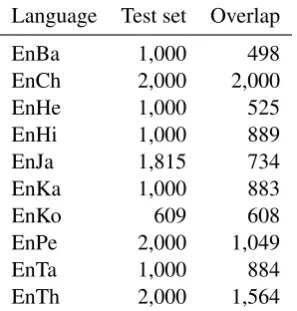
be-tween candidate output transliterations and supple-mental transliterations for a variety of supplesupple-mental languages, we will need to build several alignment models, each being built from separate training data. The majority of the task data are English-source, so for any entry in one language corpus we can easily find corresponding transliterations in other language corpora. In other words, to gener-ate training data for M2M-ALIGNERbetween the
target transliteration language and a supplemental language, we need only intersect the two corpora on the basis of the common English input.
Language Test set Overlap EnBa 1,000 498 EnCh 2,000 2,000 EnHe 1,000 525 EnHi 1,000 889 EnJa 1,815 734 EnKa 1,000 883
EnKo 609 608
[image:3.595.108.257.61.217.2]EnPe 2,000 1,049 EnTa 1,000 884 EnTh 2,000 1,564
Table 1: The number of entries in the test data (per language) that have at least one supplemen-tal transliteration available from another language corpus.
4 Base systems
Our principal base system that generates then-best
output lists is DIRECTL+, which has produced
ex-cellent results in the NEWS 2010 Shared Task on Transliteration (Jiampojamarn et al., 2010b). For re-ranking, note that training a re-ranker requires training data where the base system scores are rep-resentative of unseen data so that the re-ranker does not simply learn to follow the base system; we therefore split the training data into ten folds and perform a sort-of cross validation with DIRECTL+.
This provides us with usable training data for re-ranking. We tune the SVM’s hyperparameter based on performance on the provided development data, and use the best DIRECTL+ settings established
in the NEWS 2010 Shared Task (Jiampojamarn et al., 2010b). Armed with optimal parameter settings, we combine the training and development data into a single set used to train our final DIRECTL+
sys-tem. We also repeat the cross-validation process for training the re-ranker.
We also apply the SVM re-ranking approach to system combination. In this case, we addi-tionally train another system—here we use SE -QUITUR (Bisani and Ney, 2008)—for
English-to-Hindi transliteration. During test time, we feed the input into bothDIRECTL+ and SEQUITUR, and
use the top SEQUITURoutput as supplemental data.
We expect that sometimes SEQUITURwill provide
a correct answer where DIRECTL+ does not; the
hope is that the SVM re-ranking approach will be able to learn when this is the case based on the
n-gram and score features.
Language Type System Acc. EnHi Standard DTL 47.1 EnHi Standard DTL+Rom. 45.7 EnHi Standard DTL+SEQ 49.3
[image:3.595.311.522.62.188.2]EnHi Non-Std. DTL+Supp. 52.1 EnCh Standard DTL 3-1 34.1 Standard DTL 7-1 28.7 EnJa Standard DTL 43.5
Table 2: Word accuracy (%) for the various submitted runs. DTL is generic DIRECTL+;
DTL+Rom. is DIRECTL+ trained on romanized
data; DTL+SEQis DIRECTL+ re-ranked with SE -QUITUR outputs; and DTL+Supp. is DIRECTL+
re-ranked with supplemental transliteration data from other languages.
5 Hindi romanization
In addition to the above re-ranking approach, we experimented with a romanization method for the Hindi data. Since consonant characters in the De-vanagari alphabet have vowels included by default, we romanize the text in order to provide DIRECTL+
with direct individual control over the consonant and vowel components of the Hindi characters. The default vowel is changed by means of diacritic-like characters, which in turn deletes the default vowel; this requires a context-sensitive (but still rule-based) romanization method, which we con-struct manually. We then train DIRECTL+ on the
romanized data; during testing, we take the ro-manized output and convert it back into Devana-gari Unicode characters, again using a manually-constructed context-sensitive rule-based converter.
[image:3.595.109.254.66.218.2]6 Results
Table 2 shows that SVM re-ranking significantly improves the English-to-Hindi transliteration accu-racy in comparison with the base system. Leverag-ing all of the English-source transliteration corpora as supplemental data yields an increase of over 10%. When applied using SEQUITUR’s output as
“supplemental” data, we see almost a 5% (relative) increase in word accuracy.
from one language to another.
The English-to-Chinese results, which use only the base DIRECTL+ system, demonstrate the
im-portance of the alignment length parameter setting. DIRECTL+ requires aligned data for input, and the
maximum length of the alignments will have an effect on what DIRECTL+ learns to produce. We
submitted both 3-to-1 and 7-to-1 alignments be-cause they gave similar results during development, and both were better than other tested possibilities. In the final results, we see a substantial difference between the two alignment settings. We hypoth-esize that the complexity of English-to-Chinese mappings is better captured by the alignments that map longer sequences of English letters to single Chinese characters. making it difficult to generalize to new data.
Finally, we observe very good overall accuracy in the English-to-Japanese results (which also only use base DIRECTL+), which further confirm the
effectiveness of DIRECTL+ when applied to
ma-chine transliteration.
7 Previous work
There are three lines of research that are relevant to the work we have presented in this paper: (1) DI -RECTL+ and SEQUITUR for machine
translitera-tion; (2) applying multiple languages; and (3) sys-tem combination.
For the NEWS 2009 and 2010 Shared Tasks, the discriminative DIRECTL+ system that
incor-porates many-to-many alignments, online max-margin training and a phrasal decoder was shown to function well as a general string transduction tool; while originally designed for grapheme-to-phoneme conversion, it produced excellent results for machine transliteration (Jiampojamarn et al., 2009; Jiampojamarn et al., 2010b), leading us to re-use it here. Finch and Sumita (2010) also sub-mitted a top-performing system that was based in part on SEQUITUR, which is a generative system
based on jointn-gram modelling (Bisani and Ney,
2008).
In this paper, we applied multiple transliteration languages to a single transliteration task. While our method is based on SVM re-ranking with similar features as to those used in the base sys-tem (Bhargava and Kondrak, 2011), there have been other explorations into incorporating other language data, particularly when data are scarce. Zhang et al. (2010), for example, apply a
pivot-ing approach to machine transliteration, and simi-larly Khapra et al. (2010) propose to transliterate through “bridge” languages. Along similar lines, Kumaran et al. (2010a) find increases in accuracy using a linear-combination-of-scores system that combined the outputs of a direct transliteration sys-tem with a syssys-tem that transliterated through a third language. For statistical machine translation, Cohn and Lapata (2007) also explore the use of a third language.
Finally, we also touched briefly on system com-bination: we applied the SVM re-ranking method to combining the outputs of both DIRECTL+ and
SEQUITUR, in particular treating DIRECTL+ as
the base system and using SEQUITUR’s best
out-puts to re-rank DIRECTL+’s output lists. Finch and
Sumita (2010), in contrast, combine SEQUITUR’s
output with that of a phrase-based statistical ma-chine translation system, achieving excellent sults. Where our approach is based on SVM re-ranking, theirs merged the outputs of the two sys-tems together and then used a linear combination of the system scores to re-rank the combined list.
8 Conclusion
In this paper, we described our submission to the NEWS 2011 Shared Task on machine translitera-tion. Our focus was on incorporating supplemental data, using a method based on SVM re-ranking, with features derived fromn-gram alignments and
alignment scores. We demonstrated improvements of over 10% when applying other transliteration data to English-to-Hindi machine transliteration, and just under 5% when applying another system’s outputs in a similar manner. We also found that the romanization of Hindi characters brings about a decrease in performance, and that the alignment length parameter in the DIRECTL+ system has a
critical effects on the results.
Acknowledgements
We are grateful to Ying Xu for examining our initial Chinese results. This research was supported by the Natural Sciences and Engineering Research Council of Canada.
References
Meeting of the Association for Computational
Lin-guistics: Human Language Technologies, Portland,
Oregon, USA, June. Association for Computational Linguistics.
Maximilian Bisani and Hermann Ney. 2008. Joint-sequence models for grapheme-to-phoneme conver-sion.Speech Communication, 50(5):434–451, May. Trevor Cohn and Mirella Lapata. 2007. Machine translation by triangulation: Making effective use of multi-parallel corpora. In Proceedings of the 45th
Annual Meeting of the Association of Computational
Linguistics, pages 728–735, Prague, Czech
Repub-lic, June. Association for Computational Linguistics. Andrew Finch and Eiichiro Sumita. 2010. Translitera-tion using a phrase-based statistical machine transla-tion system to re-score the output of a joint multi-gram model. In Proceedings of the 2010 Named
Entities Workshop, pages 48–52, Uppsala, Sweden,
July. Association for Computational Linguistics. Sittichai Jiampojamarn, Grzegorz Kondrak, and Tarek
Sherif. 2007. Applying many-to-many alignments and hidden Markov models to letter-to-phoneme conversion. In Human Language Technologies 2007: The Conference of the North American Chap-ter of the Association for Computational Linguistics;
Proceedings of the Main Conference, pages 372–
379, Rochester, New York, USA, April. Association for Computational Linguistics.
Sittichai Jiampojamarn, Aditya Bhargava, Qing Dou, Kenneth Dwyer, and Grzegorz Kondrak. 2009. Di-recTL: a language independent approach to translit-eration. InProceedings of the 2009 Named Entities Workshop: Shared Task on Transliteration (NEWS 2009), pages 28–31, Suntec, Singapore, August. As-sociation for Computational Linguistics.
Sittichai Jiampojamarn, Colin Cherry, and Grzegorz Kondrak. 2010a. Integrating joint n-gram features into a discriminative training framework. InHuman Language Technologies: The 2010 Annual Confer-ence of the North American Chapter of the Associa-tion for ComputaAssocia-tional Linguistics, pages 697–700, Los Angeles, California, USA, June. Association for Computational Linguistics.
Sittichai Jiampojamarn, Kenneth Dwyer, Shane Bergsma, Aditya Bhargava, Qing Dou, Mi-Young Kim, and Grzegorz Kondrak. 2010b. Translitera-tion generaTranslitera-tion and mining with limited training resources. In Proceedings of the 2010 Named
Entities Workshop, pages 39–47, Uppsala, Sweden,
July. Association for Computational Linguistics. Mitesh M. Khapra, A Kumaran, and Pushpak
Bhat-tacharyya. 2010. Everybody loves a rich cousin: An empirical study of transliteration through bridge languages. InHuman Language Technologies: The 2010 Annual Conference of the North American Chapter of the Association for Computational
Lin-guistics, pages 420–428, Los Angeles, California,
June. Association for Computational Linguistics.
A. Kumaran, Mitesh M. Khapra, and Pushpak Bhat-tacharyya. 2010a. Compositional machine translit-eration. ACM Transactions on Asian Language
Information Processing (TALIP), 9(4):13:1–29,
De-cember.
A. Kumaran, Mitesh M. Khapra, and Haizhou Li. 2010b. Report of NEWS 2010 Transliteration Min-ing Shared Task. InProceedings of the 2010 Named
Entities Workshop, pages 21–28, Uppsala, Sweden,
July. Association for Computational Linguistics.
Haizhou Li, A. Kumaran, Vladimir Pervouchine, and Min Zhang. 2009. Report of NEWS 2009 Ma-chine Transliteration Shared Task. InProceedings of the 2009 Named Entities Workshop: Shared Task on
Transliteration (NEWS 2009), pages 1–18, Suntec,
Singapore, August. Association for Computational Linguistics.