1
A short sequence within subdomain N1 of region A of the Staphylococcus aureus 1
MSCRAMM clumping factor A is required for export and surface display. 2
Niamh McCormack, Timothy J. Foster# and Joan A. Geoghegan#* 3
Department of Microbiology, Moyne Institute of Preventive Medicine, School of Genetics
4
and Microbiology, Trinity College Dublin, Dublin 2, Ireland.
5
6
Running Title: Export and surface displayof ClfA. 7
8
Contents category: Cell and Molecular Biology of Microbes
9
10
Key words: Staphylococcus aureus, clumping factor A, MSCRAMM, protein secretion,
11
fibronectin binding protein B.
12
13
Word counts: Summary 248, main text 5108.
14
15
16
#
These authors contributed equally
17
*Corresponding author: E-mail: [email protected]. Telephone: +35318961188.
18
Fax: +35316799294
2 Summary
20
Clumping factor A (ClfA) is the archetypal fibrinogen-binding surface protein of
21
Staphylococcus aureus and a member of the Microbial Surface Component Recognising 22
Adhesive Matrix Molecules (MSCRAMM) family. An N-terminal signal sequence directs
23
export of the MSCRAMM by the Sec pathway and the C-terminal cell wall-anchoring
24
domain allows covalent attachment of ClfA to peptidoglycan by sortase. Region A of ClfA
25
comprises three independently folded subdomains N1, N2 and N3. Subdomains N2N3
26
comprise IgG-like folds and promote fibrinogen binding. Nothing is known about the
27
structure or function of subdomain N1. Here we demonstrate an unexpected role for N1 in
28
the export and surface localization of ClfA. Attempted expression of a ClfA variant lacking
29
subdomain N1 resulted in impaired growth of S. aureus and accumulation of ClfA protein in
30
the cytoplasm and cytoplasmic membrane. The presence of residues 211-228 of N1 was
31
required to allow display of ClfA on the bacterial surface. The importance of this region was
32
confirmed when a ClfA variant lacking residues 211-220 was also mislocalized to the
33
cytoplasm and cytoplasmic membrane. However these residues were not required for export
34
of ClfA lacking the Ser-Asp repeats that links region A to the wall-anchoring domain.
35
Similarly, subdomain N1 of a related MSCRAMM fibronectin binding protein B was
36
required for export and surface display of the full length protein but not a derivative lacking
37
fibronectin binding repeats. In summary we demonstrate that residues in the N1 subdomain
38
are required for export and cell wall localization of S. aureus MSCRAMMs.
39
40
41
3 Introduction
43
Staphylococcus aureus is a commensal bacterium that colonises the anterior nares of 44
about 20% of the population (van Belkum et al., 2009). The organism is an important
45
opportunistic pathogen that can cause both superficial skin lesions and more serious invasive
46
infections such as endocarditis and sepsis (Lowy, 1998).
47
The ability of S. aureus to colonise the host and cause infection is due in part to the
48
expression of secreted virulence factors and cell wall-anchored surface proteins. The
49
microbial surface component recognizing adhesive matrix molecules (MSCRAMM) family
50
comprises proteins with related N-terminal ligand-binding A domains (Foster et al., 2013).
51
These contain two tandemly arrayed subdomains, N2 and N3, that are composed of IgG-like
52
folds (Deivanayagam et al., 2002) and the N-terminal N1 subdomain which, in the case of the
53
related protein ClfB, is elongated and is not compact (Perkins et al., 2001). The A domains
54
are linked to the cell wall by an extended flexible region comprising repeats of the dipeptide
55
Ser-Asp (ClfA, ClfB, SdrC, SdrD, SdrE, Bbp) or 10/11 fibronectin binding domains
56
(FnBPA, FnBPB) (Hartford et al., 1997; Schwarz-Linek et al., 2003). MSCRAMMs are also
57
found in coagulase-negative staphylococci and S. pseudintermedius (Bannoehr et al., 2011;
58
Foster et al., 2013).
59
MSCRAMMs play a pivotal role during colonization and establishment of S. aureus
60
infection yet very little is known about how these proteins are directed to the secretion
61
apparatus (Schneewind & Missiakas, 2012; Sibbald et al., 2006). Members of the
62
MSCRAMM family possess an N-terminal signal sequence that is predicted to mediate their
63
translocation across the cytoplasmic membrane by the general secretory (Sec) pathway
64
(DeDent et al., 2008; Sibbald et al., 2006). The Sec system in S. aureus consists of
65
homologues of the canonical SecYEG translocation channel and the SecA ATPase (Sibbald
66
4
pre-proteins to sites of peptidoglycan biosynthesis at the region of septum formation (DeDent
68
et al., 2008). However, the mechanisms involved in trafficking MSCRAMMs to this cellular 69
compartment are yet to be elucidated (DeDent et al., 2008; Schneewind & Missiakas, 2012).
70
Surface display of S. aureus YSIRK/GS-motif containing surface proteins is reduced in
71
mutants lacking the spdA, spdB or spdC genes but the molecular basis of this is not
72
understood (Frankel et al., 2010).
73
A sorting signal is located at the C-terminus of the protein. It comprises an LPXTG
74
motif, a hydrophobic membrane-spanning domain and at the extreme C-terminus, a stretch of
75
positively charged residues. The last two elements delay secretion across the membrane and
76
facilitate recognition and cleavage of the LPXTG sequence by sortase A, a protein anchored
77
to the cytoplasmic membrane (Schneewind et al., 1993). Sortase cleaves between threonine
78
and glycine forming an acyl-enzyme intermediate which allows transfer of the MSCRAMM
79
to the pentaglycine crossbridge of lipid II. Following transglycosylation the MSCRAMM
80
becomes covalently anchored to peptidoglycan (Ton-That et al., 2000).
81
Clumping factor A is an important MSCRAMM that promotes virulence during
82
invasive infection (Josefsson et al., 2001; McAdow et al., 2011; Moreillon et al., 1995) .
83
This involves both coating the bacterium with plasma fibrinogen and capturing and activating
84
the complement regulator factor I which in turn results in cleavage of the complement
85
opsonin C3b (Hair et al., 2010; Higgins et al., 2006). ClfA is also an adhesin which
86
promotes bacterial attachment to immobilized fibrinogen and to platelet-fibrin thrombi on
87
heart valves during the initiation of endocarditis (Moreillon et al., 1995; Que et al., 2001).
88
The A domain of ClfA binds to a peptide sequence comprising the extreme
C-89
terminal residues of the γ-chain of fibrinogen (McDevitt et al., 1997). The X-ray crystal
90
structure of ClfA N2N3 has been solved both as an apo-protein and with the fibrinogen
5
peptide ligand bound (Ganesh et al., 2008). The fibrinogen γ-chain peptide binds in a
92
hydrophobic trench formed between the separately folded N2 and N3 subdomains by the
93
‘dock, lock, and latch’ mechanism (Ponnuraj et al., 2003). Docking of the peptide in the
94
binding trench induces a conformational change in the flexible extension of the C-terminus of
95
the N3 subdomain which is reoriented to cover the ligand peptide and “locks” it in place.
96
Latching is completed by formation of an extra β-strand which is complementary to a β-sheet
97
of the N2 domain. The MSCRAMMs ClfB, Bbp, FnBPA and FnBPB bind to fibrinogen by a
98
similar mechanism (Burke et al., 2011; Ganesh et al., 2011; Keane et al., 2007; Vazquez et
99
al., 2011). In all cases the ligand binding site appears to be confined to subdomains N2N3 100
(Burke et al., 2011; Ganesh et al., 2011; Keane et al., 2007; Vazquez et al., 2011).
101
The boundaries of the N1, N2 and N3 subdomains were originally defined for ClfB
102
before structures of any of the proteins were solved. The S. aureus zinc-metalloprotease
103
aureolysin was found to cleave ClfB at a ‘SLAVA’ motif and the cleavage site was
104
designated as the boundary between N1 and N2 (McAleese et al., 2001). Virtually nothing is
105
known about the structure or function of subdomain N1 of the MSCRAMM family of surface
106
proteins. The objective of this study was to determine if subdomain N1 of ClfA plays a role
107
in export of the protein and its subsequent elaboration on the cell surface.
108
109
6 Methods
116
Bacterial culture conditions and reagents 117
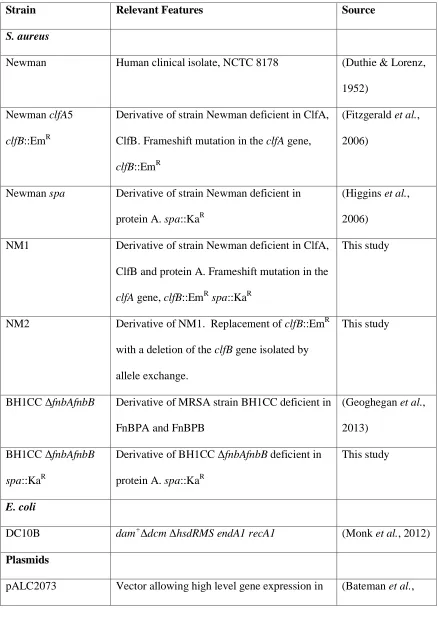
Strains are listed in Table 1. S. aureus was grown on trypticase soy agar or broth (TSA, TSB,
118
Oxoid) with shaking (200 rpm) at 37 °C. For expression studies stationary phase cultures
119
were diluted 1:100 in brain heart infusion broth (BHI, Difco), grown to an OD600 of 0.5 and
120
induced with anhydrotetracycline (ATc) for 2 h at 37 °C. E. coli strains were cultured on
121
Luria agar or broth (Difco) at 37°C. Antibiotics were incorporated into media where
122
appropriate at the following concentrations: 100 µg ampicillin (Ap) ml-1, 10 µg
123
chloramphenicol (Cm) ml-1, 10 µg erythromycin (Em) ml-1, 50 µgkanamycin (Ka) ml-1, 100
124
– 1200 nganhydrotetracycline (ATc) ml-1. Unless otherwise stated all reagents were obtained
125
from Sigma.
126 127
Plasmid and strain construction 128
Bacterial strains and plasmids used in this study are listed in Table 1. Strain NM1 was
129
constructed by transduction of spa::KaR into strain Newman clfA5 clfB::EmR. Deletion of
130
clfB::EmR from strain NM1 to yield NM2 was achieved by allelic replacement using
131
pIMAYΔclfB (Table 1) as previously described (Monk et al., 2012). Strain BH1CC 132
ΔfnbAfnbB spa::KaR was constructed by transduction of spa::KaR into strain BH1CC
133
ΔfnbAfnbB. The complete clfA gene from strain Newman was amplified from genomic DNA 134
by PCR (primers study are listed in Table S1) and cloned between EcoRI and BglII sites of
135
pRMC2 or between the EcoRI and KpnI sites of pALC2073 to generate pRMC2clfA and
136
pALC2073clfA, respectively. The fnbB gene from strain 8325 was amplified from genomic
137
DNA by PCR and cloned between the EcoRI and BglII sites of pRMC2 to generate
138
pRMC2fnbB. Inverse PCR was used to generate derivatives of pRMC2clfA, pALC2073clfA
139
and pRMC2fnbB. Alanine substitutions and FLAG epitopes were incorporated by primer
7
extension during inverse PCR. PCR products were treated with DpnI to eliminate parental
141
template DNA and following blunt-end ligation plasmids were transformed into E. coli
142
DC10B. Plasmids were purified from DC10B and transformed into S. aureus made
143
electrocompetent as previously described (Lofblom et al., 2007; Monk et al., 2012). Plasmid
144
DNA (5 µg) was introduced into S. aureus by electroporation and transformants were
145
recovered by plating on TSA containing Cm.
146 147
Fractionation of S. aureus and Western immunoblotting. 148
S. aureus cultures were grown as described above, washed in phosphate buffered saline 149
(PBS) and adjusted to an OD600 of 10. Cell wall-associated proteins were solubilised by
150
resuspending bacteria in 250 μl digestion buffer (50 mM Tris-HCl, 20 mM MgCl2, 30 %
151
(w/v) raffinose, pH 7.5) containing protease inhibitors (Roche) and lysostaphin (AMBI
152
Products LLC, 200 μgml-1) at 37 °C for 10 min. Protoplasts were removed by centrifugation
153
at 12,000 x g for 10 min and the supernatant containing solubilised cell wall proteins was
154
transferred to a clean tube and boiled for 5 min in Laemmli sample buffer. Protoplast pellets
155
were washed with digestion buffer and resuspended in ice-cold Tris-HCl (50 mM, pH 7.5)
156
containing protease inhibitors (Roche) and DNase (80 µgml-1). Protoplasts were lysed on ice
157
by vortexing. Complete lysis was confirmed by phase contrast microscopy. Lysed cell
158
fractions were separated by centrifugation at 44,500 x g for 1 h at 4 °C. The supernatant was
159
retained as the cytoplasmic fraction. The pellet was washed with ice-cold Tris-HCl (50 mM,
160
pH 7.5) and resuspended in Tris-HCl (50 mM, pH 7.5). Fractions were separated by 7.5 %
161
sodium dodecyl sulfate (SDS) polyacrylamide gel electrophoresis, transferred onto PVDF
162
and blocked in 10 % (w/v) skimmed milk proteins. Blots were probed with ClfA mAb, a
163
murine monoclonal antibody raised against ClfA subdomains N2N3 (a kind gift from
164
Inhibitex Inc, 1:2000) and bound antibody was detected using horseradish peroxidise
8
conjugated rabbit anti-mouse IgG (1:3000, Dako). FnBPB blots were probed with
166
biotinylated fibronectin and bound biotin was detected using horseradish peroxidise
(HRP)-167
conjugated streptavadin. FLAG-tagged constructs were probed with murine monoclonal
anti-168
FLAG IgG (1:2000, Pierce) and detected with horseradish peroxidise (HRP)-conjugated
169
rabbit anti-mouse IgG (1:2000, Dako) Reactive bands were visualised using the LumiGLO
170
reagent and peroxide detection system (Cell Signalling Technology). Antibodies were
171
removed from blots by incubation at 70°C for 30 min in stripping buffer (2 % SDS, 100 mM
172
β-mercaptoethanol and 50 mM Tris). Stripped blots were washed twice in PBS, blocked in 10
173
% (w/v) skimmed milk proteins and then probed with polyclonal rabbit anti-SdrE IgG
174
(1:2000, O'Brien et al., 2002) or rabbit anti-Micrococcus luteus F1/F0 ATPase serum (Downer
175
et al., 2002). Bound antibody was detected using HRP-conjugated goat anti-rabbit IgG 176
(1:10,000, Dako) or protein A peroxidase (1:500).
177 178
Dot immunoblotting 179
Bacteria were washed twice in PBS and adjusted to an OD600 of 1.0. Doubling dilutions were
180
spotted onto a nitrocellulose membrane (Protran) membrane and allowed to dry. For whole
181
cell lysates bacteria were incubated in PBS containing protease inhibitors (Roche) and
182
lysostaphin (AMBI Products LLC, 200 μgml-1) at 37°C for 15 mins. Lysates were
183
incubated with DNase (80 µg/ml) for 10 min at room temperature and heated to 85°C for 5
184
min. Cellular debris was sedimented by centrifugation at 12,000 x g. Lysates were spotted
185
onto a nitrocellulose membrane (Protran) membrane and allowed to dry. Membranes were
186
blocked for 1 h in 10% (w/v) skimmed milk proteins and immunoblotting was performed as
187
above.
9 Competitive growth assay
191
For competitive growth experiments stationary phase cultures were adjusted to an OD600 of
192
0.025 in BHI. Equal volumes of two S. aureus strains were mixed and grown in BHI
193
incorporating Cm to an OD600 of 0.5. Where appropriate ATc (1200 ng ml-1) was added and
194
cultures were incubated at 37 °C for a further 2 h before being plated on TSA incorporating
195
Cm. Colonies which were resistant to Cm were replica plated onto TSA containing Em and
196
the percentage of Em resistant bacteria was calculated.
197
198
Statistical analysis 199
Statistical analysis was performed using Prism Graphpad 5 software. P values were
200
calculated using Students t-test.
201
202
203
204
205
206
207
208
209
10 Results
211
Expression of ClfA variants lacking subdomain N1. 212
The subdomain boundaries of the A region of ClfA were originally defined based on
213
amino-acid sequence similarity with ClfB where the position of a cleavage site (SLAVA) for
214
the S. aureus metalloprotease aureolysin defined the junction between subdomains N1 and
215
N2 (Perkins et al., 2001). ClfA contains a similar sequence (SLAAVA). Based on this motif
216
the amino-acid coordinates of the N2N3 subdomains of ClfA were originally defined as
217
residues 221-559 (McDevitt et al., 1995; O'Connell et al., 1998). More recently the N2N3
218
subdomains of ClfA have been crystallized (Deivanayagam et al., 2002; Ganesh et al., 2008)
219
allowing the precise definition of boundaries of the N2N3 subdomains as comprising residues
220
229-545 (Fig. 1).
221
This study set out to determine if subdomain N1 of ClfA plays a role in protein
222
secretion and elaboration on the cell surface. To facilitate this, the clfA gene of strain
223
Newman was cloned into and expressed from the anhydrotetracycline (ATc)-inducible vector
224
pRMC2 (Corrigan & Foster, 2009) to yield pRMC2clfA. Plasmid pRMC2clfA was
225
manipulated to create derivatives lacking DNA encoding the N1 subdomain of ClfA (residues
226
40-220 or residues 40-228) yielding plasmids pRMC2clfA ΔN140-220 and pRMC2clfAΔN1
40-227
228, respectively (Fig. 1). Two pRMC2clfAΔN1 constructs were generated to reflect the
228
different definitions of the boundary of subdomain N1. ClfAΔN140-220 represents a deletion
229
up to the SLAAVA motif while ClfAΔN140-228 removes the entire N1 sequence defined by the
230
X-ray crystal structure of N2N3 (Fig. 1). Plasmids were transformed into strain NM1, a
231
ClfA-, ClfB-, Spa-deficient derivative of S. aureus Newman (Table 1).
232
Whole cell dot immunoblotting was performed to measure the amount of ClfA on the
233
bacterial surface. Serial dilutions of bacteria were applied to a nitrocellulose membrane and a
11
monoclonal antibody that recognizes an epitope in subdomains N2N3 of ClfA (ClfA mAb)
235
was used to detect the protein. Expression of ClfA by NM1 (pRMC2clfA) could not be
236
detected in the absence of inducer (Fig. 2a) in agreement with previous studies showing that
237
gene expression from pRMC2 is tightly repressed (Corrigan & Foster, 2009). Strain NM1
238
carrying the pRMC2 empty vector was used as a negative control. Addition of increasing
239
concentrations of ATc resulted in increasing amounts of ClfA on the surface of S. aureus
240
(Fig. 2a). A high level of surface expression similar to that achieved by the single
241
chromosomal gene in strain Newman was achieved at inducer concentrations of 800 ng ml-1
242
and 1.2 µgml-1. In contrast neither ClfA ΔN140-220 nor ClfAΔN140-228 could be detected on the
243
surface of S. aureus even at the highest concentration of inducer tested (Fig. 2a). All proteins
244
could be detected when whole cell lysates were probed with ClfA mAb (Fig. 2b). Thus the
245
failure to detect ClfA ΔN140-220 and ClfAΔN140-228 on the surface of S. aureus suggested that
246
N1 might have a role in protein export. As a control, the same bacteria were spotted onto a
247
nitrocellulose membrane and probed for expression of SdrE, a member of the MSCRAMM
248
family which is exposed on the surface of S. aureus. All bacteria were recognized equally by
249
antibodies directed against SdrE (Fig. S1). This demonstrates that similar amounts of
250
bacteria were immobilised on the nitrocellulose membrane.
251
Variants of pRMC2 clfA were constructed which retained differing amounts of N1 in
252
an attempt to determine the minimum sequence that supported surface display. A mutant
253
lacking residues 40-210 but retaining C-terminal residues of N1 (ClfAΔN140-210) was
254
displayed on the surface of S. aureus, albeit at a slightly lower level than full-length ClfA
255
expressed from pRMC2clfA (Fig. 2a). However when cultures of NM1 (pRMC2clfA) and
256
NM1 (pRMC2clfAΔN140-210) were induced with 800 ng and 1.2 µgATc ml-1, respectively,
257
the amount of ClfA and ClfAΔN140-210 on the surface of S. aureus was found to be the same.
258
These inducer concentrations were used for all further experiments.
12
Subdomain N1 is required for ClfA to be localized to the S. aureus cell wall. 260
Whole cell immunoblotting indicated that ClfAΔN140-220 was not elaborated on the
261
surface of S. aureus following induction with ATc (Fig. 2a) but ClfAΔN140-220 could be
262
detected in whole cell lysates (Fig. 2b). Therefore the subcellular location of ClfAΔN140-220
263
following induction was investigated. Fractions corresponding to the cytoplasm, the
264
cytoplasmic membrane and proteins solubilised from the cell wall by lysostaphin treatment
265
during protoplast formation (cell wall fraction) were analyzed by Western immunoblotting
266
probing with the ClfA mAb. In the wild type ClfA sample a band of 150 kDa was detected
267
only in the cell wall fraction. This is consistent with normal sorting. In contrast, ClfAΔN1
40-268
220 was not detected in the cell wall fraction but was instead located in the membrane and
269
cytoplasmic fractions (Fig. 3a). This protein migrated more slowly than expected and may
270
represent translation products that had not been cleaved by signal peptidase and sortase A.
271
Similar results were obtained for ClfAΔN140-228 (Fig. S2). The failure to localize to the cell
272
wall explains why ClfAΔN140-220 and ClfAΔN140-228 were not detected on the surface of
273
intact bacterial cells. In contrast ClfAΔN140-210 was only detected in the cell wall fraction in a
274
similar fashion to full-length ClfA indicating that this truncate had been correctly secreted
275
and sorted. As a control for secretion and sorting activity in cells attempting to express the
276
ΔN1 constructs, samples were also probed for the expression of SdrE, a member of the
277
MSCRAMM family which is known to be sorted to the cell wall (O'Brien et al., 2002). This
278
protein was detected only in the cell wall fraction indicating that it had been exported and
279
sorted correctly in all strains (Fig. 3b). Fractions were also probed with antibodies
280
recognizing the integral membrane protein F1/F0 ATPase as a control for purity of
281
cytoplasmic membrane preparations. This protein was detected only in the membrane
282
fraction of all strains (Fig. 3c). Cytoplasmic fractions were stained with Coomassie to show
283
equal loading of protein (Fig. 3d). In summary, these data indicate that ClfAΔN140-220 is
13
mislocalised to the membrane and cytoplasmic fractions while ClfAΔN140-210 is only found in
285
the cell wall fraction in a similar fashion to full-length ClfA.
286
287
Identification of residues in subdomain N1 required for ClfA to be localized to the cell 288
wall. 289
The N1 truncate ClfAΔN140-210 was sorted efficiently to the cell wall of S. aureus while
290
ClfAΔN140-220 and ClfAΔN140-228 were found in the cytoplasm and membrane (Fig. 3a, Fig
291
S3) suggesting that residues 211 - 220 may be required for efficient translocation and cell
292
wall localization. In order to investigate this further, plasmid pRMC2clfA was manipulated
293
to create a derivative lacking DNA encoding amino-acids 211–220 of ClfA (plasmid
294
pRMC2clfAΔ211-220). ClfAΔ211-220 was not detected in the cell wall but was present in the
295
membrane and cytoplasm fractions (Fig. 4a) indicating that residues 211-220 are necessary
296
for cell wall localization.
297
While ClfAΔN140-210 was detected in the cell wall fraction only (Fig. 3), a variant
298
where residues 211-220 were substituted with ten alanines (ClfAΔN140-220+10Ala) was not (Fig
299
5a). These data show that residues 211-220 are necessary for cell wall localization of ClfA.
300
SdrE was detected only in the cell wall fraction indicating that it had been exported and
301
sorted correctly in all strains (Fig. 4b).
302
303
Expression of a ClfA variant lacking subdomain N1 inhibits growth of S. aureus. 304
Expression of ClfAΔN140-220 or ClfAΔN140-228 could not be detected on the surface of
305
S. aureus when NM1 (pRMC2clfAΔN140-220) and NM1 (pRMC2clfAΔN140-228) were grown in
306
the presence of a high concentration of inducer (Fig. 2a). To determine if expression of ClfA
14
ΔN140-220 is deleterious, the clfA gene was cloned into pALC2073, the precursor of pRMC2
308
which allows constitutive expression in S. aureus due to weak TetR repression (Bateman et
309
al., 2001; Corrigan & Foster, 2009). Plasmid pALC2073clfAΔN140-220 was constructed in
310
and isolated fromE. coli DC10B. Equal amounts of the parental plasmid pALC2073clfA and 311
pALC2073clfAΔN140-220 DNA were used to transform S. aureus NM1. Transformation with
312
pALC2073clfA yielded ~2 x 10³ Cm resistant colonies. However, pALC2073clfAΔN140-220
313
yielded fewer than 20 transformants. Both plasmids could be introduced into E. coli with
314
equal efficiency (~ 3 x 10⁴ CFU per transformation, Fig. S3) confirming the integrity of the
315
DNA. The failure to establish transformants with pALC2073clfAΔN140-220 in S. aureus
316
suggested that this plasmid may be unstable or that constitutive expression of a variant of
317
ClfA lacking subdomain N1 inhibits growth.
318
This prompted us to investigate if inducing expression of ClfAΔN140-220 in S. aureus
319
would inhibit bacterial growth. Gene expression from pRMC2 is tightly repressed in the
320
absence of inducer. Plasmids pRMC2clfA and pRMC2clfA∆N140-220 transformed into S.
321
aureus with equal efficiency (data not shown). Competitive growth experiments were 322
performed with bacteria harbouring pRMC2clfA or pRMC2clfAΔN140-220. In order to
323
distinguish between cells harbouring the different plasmids, pRMC2clfAΔN140-220 was
324
introduced into strain NM2, a variant of NM1 where the clfB::EmR mutation was replaced by
325
a deletion of the clfB gene (ΔclfB) which is Em sensitive. Equal numbers of NM1 326
(pRMC2clfA) and NM2 (pRMC2clfAΔN140-220) were mixed and co-cultured either in the
327
presence or absence of the inducer ATc until the OD600 of the culture reached 2.0. Total
328
viable counts were obtained by plating on agar containing Cm. Replica plating onto agar
329
incorporating Em allowed the number of Em resistant bacteria NM1 (pRMC2clfA) to be
330
counted.
15
When ClfA expression was induced and the bacteria were allowed to grow for two
332
generations the number of NM2(pRMC2clfAΔN140-220) recovered was 1.5 times lower than
333
for NM1 (pRMC2clfA) (Fig. 5). This indicates that expression of ClfA lacking subdomain
334
N1 confers a growth disadvantage compared to expression of full-length ClfA. In the
335
absence of inducer when ClfA expression was repressed (Fig. 2a), equal numbers of NM1
336
(pRMC2clfA) and NM2(pRMC2clfAΔN140-220) were recovered (Fig. 5). This indicates that
337
the fitness disadvantage is due to the expression of ClfA ∆N140-220. To investigate if
338
expression of wild-type ClfA affected the fitness of S. aureus, control experiments were
339
conducted with NM1 (pRMC2clfA) and NM2 carrying the empty vector pRMC2. The
340
proportion of EmS to EmR bacteria was the same for cultures grown in ATc and the
inducer-341
free control (Fig. S4). These data indicate that expression of ClfAΔN140-220 in S. aureus
342
inhibits bacterial growth.
343
344
Subdomain N1 is not required for cell wall localization of a ClfA variant lacking 345
residues comprising the serine-aspartate repeat region. 346
The A domains of MSCRAMMs are linked to the cell wall by an extended flexible
347
region. In the case of ClfA this comprises Ser-Asp dipeptide repeats. We hypothesised that
348
the N1 subdomain might be required for the export of the flexible repeat region. To
349
investigate this, plasmids pRMC2clfA and pRMC2clfAΔN140-220 were manipulated in order to
350
create variants lacking DNA encoding the Ser-Asp dipeptide repeat region (residues 559-875)
351
generating plasmid pRMC2clfAΔSD559-875 and plasmid pRMC2clfAΔN140-220ΔSD559-875,
352
respectively. Both ClfAΔSD559-875 and ClfAΔN140-220ΔSD559-875 were detected only in the cell
353
wall (Fig. 6). This demonstrates that the N1 subdomain is not required for export or cell wall
16
localization of ClfA lacking the flexible Ser-Asp repeat region and is only required for
355
expression of the repeat containing protein.
356
357
Subdomain N1 is required for cell wall localization of another MSCRAMM with a long 358
unstructured repeat region FnBPB. Region A of FnBPB shares ~ 25% amino-acid identity 359
with the corresponding region of ClfA and is organised into N1, N2 and N3 subdomains (3).
360
FnBPB does not have a Ser-Asp repeat region and instead harbours fibronectin binding
361
repeats at the C-terminus of the protein. In order to determine if subdomain N1 was required
362
for localisation of other S. aureus MSCRAMMs, we studied the subcellular localisation of
363
FnBPB variants.
364
The fnbB gene from strain 8325 was cloned into pRMC2 to generate pRMC2fnbB.
365
Plasmid pRMC2fnbB was manipulated to remove the entire N1 subdomain spanning residues
366
38-162 to yield pRMC2fnbBΔN138-162. Plasmids were transformed into a strain of the MRSA
367
isolate BH1CC lacking both FnBPA and FnBPB as well as protein A (BH1CC ∆fnbAfnbB 368
spa::KaR, Table 1). This was chosen as the host strain since FnBPB is not subject to
369
proteolytic processing and remains intact on the surface of BH1CC during all stages of
370
growth (Geoghegan et al., 2013).
371
Cell wall, membrane and cytoplasmic fractions were probed for FnBPB expression in
372
a ligand affinity blot using biotinylated fibronectin. Similarly to ClfA, FnBPB is covalently
373
anchored to the pentaglycine crossbridge of peptidoglycan and is released by lysostaphin
374
treatment of S. aureus. FnBPBΔN138-162 was not detected in the cell wall fraction. Reactive
375
bands with a molecular weight of ~100 kDa were observed in the membrane and cytoplasm
376
fractions (Fig. 7a). This indicates that the N1 subdomain of FnBPB is required for cell wall
377
localization of the protein.
17
To determine if the N1 subdomain is necessary for export of FnBPB in the absence of
379
the fibronectin binding repeat regions, pRMC2fnbBΔN138-162 was manipulated to yield
380
pRMC2fnbBΔN138-162ΔFnBR481-811 FLAG. A FLAG epitope tag was introduced by primer
381
extension during PCR. A reactive band with a molecular weight of ~ 65 kDa was observed in
382
the cell wall fraction (Fig. 7b). This demonstrates that the N1 subdomain is not required for
383
export or cell wall localization of FnBPB lacking the flexible fibronectin binding repeat
384
region.
385
386
387
388
389
390
391
392
393
394
395
396
397
18 Discussion
399
Clumping factor A is the archetypal member of the MSCRAMM family of
wall-400
anchored proteins of S. aureus. The defining features of these proteins are (i) the A region
401
and (ii) the flexible unfolded region linking the A region to the cell wall spanning/anchoring
402
domain. The A domains comprise two separately folded subdomains N2 and N3.
403
MSCRAMMs related to ClfA have an N-terminal subdomain N1 with no known function.
404
This paper reports for the first time a crucial role for subdomain N1 in export and surface
405
expression of MSCRAMMs. We demonstrate that residues 211-220 of N1 of ClfA are
406
required for the protein to be translocated across the membrane so that it can be anchored by
407
sortase to cell wall peptidoglycan. Deletion mutants lacking N1 were not exported and
408
instead accumulated in the cytoplasm and the membrane fractions. This could only be
409
detected in bacteria where ClfA expression was tightly repressed and was only expressed
410
after addition of an inducer. Constitutive expression of an N1 deletion mutant following
411
transformation into S. aureus resulted in a very low yield of transformants. Induction of the
412
truncated clfA mutant in S. aureus caused a significant loss of fitness compared to cells
413
expressing wild-type ClfA which shows that attempting to express the protein lacking N1 is
414
causing damage to the cell. Dissection of the N1 subdomain of ClfA revealed that a stretch
415
of 10 residues close to the boundary between N1 and N2 is necessary for surface expression,
416
and that only this region plus the 8 residues that join it to the beginning of N2 as defined by
417
the X-ray crystal structure is necessary. As yet no function has been identified for residues
418
40 – 210 of ClfA and the role of this region warrants further investigation.
419
We hypothesised that if this is a feature of the MSCRAMM family and not just a
420
property specific to ClfA then the N1 subdomains of other MSCRAMMs would also be
421
required for surface expression. Accordingly deletion of the N1 subdomain of
422
FnBPB prevented surface expression of that protein. Further support comes from an
19
observation that a plasmid constitutively expressing an FnBPA N1 deletion mutant could not
424
be established in S. aureus (Geoghegan et al., 2013). The level of amino acid sequence
425
similarity between the N1 subdomains of the MSCRAMMs is very low so that it is not
426
possible to determine if a similar ‘motif’ is present in this region. All MSCRAMMs with a
427
repeat region contain an N1 subdomain. MSCRAMMs are found in many species of
428
staphylococci including S. epidermidis, S. pseudintermedius and S. lugdunensis (Bannoehr et
429
al., 2011; Heilbronner et al., 2011; Ponnuraj et al., 2003). 430
Previous studies have shown that MSCRAMM proteins are exported by the Sec
431
system with the other major secretory pathways (twin-arginine and accessory Sec system)
432
playing no role (DeDent et al., 2008). However, virtually nothing is known about how
433
proteins of the MSCRAMM family are trafficked to the Sec apparatus (Schneewind &
434
Missiakas, 2012; Sibbald et al., 2006). Previous studies identified a ‘YSIRK-GS’ motif in
435
the signal sequence of MSCRAMMs and certain other surface proteins (DeDent et al., 2008).
436
This feature is required for the proteins to be targeted to the cross-wall of the cell but despite
437
the fact that this phenomenon has been described for streptococci and staphylococci the
438
molecular details of the mechanism are completely lacking (Carlsson et al., 2006; DeDent et
439
al., 2008; Schneewind & Missiakas, 2012). Similarly, we have herein identified a new 440
region of the MSCRAMM required for its export, but the mechanism involved is not yet
441
understood. In the absence of a fundamental understanding of pre-protein trafficking in S.
442
aureus it is difficult to speculate about the functions of N1. It is possible that the N1 443
subdomain acts as a cytoplasmic chaperone by directly binding to another region of the
444
protein. Alternatively, residues 211-220 could engage a molecular chaperone that guides the
445
long protein from the ribosome to the Sec translocation apparatus. Since truncates lacking
446
the repeat region are exported and cell wall anchored in the absence of N1 it is likely that this
20
region is required to stabilise the long flexible repetitive repeat regions and to assist with
448
transport. 449
In conclusion this paper provides new insights into the requirements for ClfA export.
450
Our findings suggest that secretion of large MSCRAMM proteins by Gram-positive bacteria
451
involves mechanisms more complex than previously appreciated.
452
453
Acknowledgements 454
This work was funded by a Science Foundation Ireland Programme Investigator grant
455
08/IN/B1845 and a Health Research Board grant RP/2009/19.
456
21 References
471
Bannoehr, J., Ben Zakour, N. L., Reglinski, M., Inglis, N. F., Prabhakaran, S., Fossum, 472
E., Smith, D. G., Wilson, G. J., Cartwright, R. A. & other authors (2011). Genomic and 473
surface proteomic analysis of the canine pathogen Staphylococcus pseudintermedius reveals
474
proteins that mediate adherence to the extracellular matrix. Infect Immun 79, 3074-3086.
475
476
Bateman, B. T., Donegan, N. P., Jarry, T. M., Palma, M. & Cheung, A. L. (2001). 477
Evaluation of a tetracycline-inducible promoter in Staphylococcus aureus in vitro and in vivo
478
and its application in demonstrating the role of sigB in microcolony formation. Infect Immun
479
69, 7851-7857. 480
481
Burke, F. M., Di Poto, A., Speziale, P. & Foster, T. J. (2011). The A domain of 482
fibronectin-binding protein B of Staphylococcus aureus contains a novel fibronectin binding
483
site. FEBS J 278, 2359-2371.
484
485
Carlsson, F., Stalhammar-Carlemalm, M., Flardh, K., Sandin, C., Carlemalm, E. & 486
Lindahl, G. (2006). Signal sequence directs localized secretion of bacterial surface proteins. 487
Nature 442, 943-946. 488
489
Corrigan, R. M. & Foster, T. J. (2009). An improved tetracycline-inducible expression 490
vector for Staphylococcus aureus. Plasmid 61, 126-129.
491
22
DeDent, A., Bae, T., Missiakas, D. M. & Schneewind, O. (2008). Signal peptides direct 493
surface proteins to two distinct envelope locations of Staphylococcus aureus. The EMBO
494
journal 27, 2656-2668. 495
496
Deivanayagam, C. C., Wann, E. R., Chen, W., Carson, M., Rajashankar, K. R., Hook, 497
M. & Narayana, S. V. (2002). A novel variant of the immunoglobulin fold in surface 498
adhesins of Staphylococcus aureus: crystal structure of the fibrinogen-binding MSCRAMM,
499
clumping factor A. The EMBO journal 21, 6660-6672.
500
501
Downer, R., Roche, F., Park, P. W., Mecham, R. P. & Foster, T. J. (2002). The elastin-502
binding protein of Staphylococcus aureus (EbpS) is expressed at the cell surface as an
503
integral membrane protein and not as a cell wall-associated protein. J Biol Chem 277,
243-504
250.
505
506
Duthie, E. S. & Lorenz, L. L. (1952). Staphylococcal coagulase; mode of action and 507
antigenicity. J Gen Microbiol 6, 95-107.
508
509
Fitzgerald, J. R., Loughman, A., Keane, F., Brennan, M., Knobel, M., Higgins, J., Visai, 510
L., Speziale, P., Cox, D. & other authors (2006). Fibronectin-binding proteins of 511
Staphylococcus aureus mediate activation of human platelets via fibrinogen and fibronectin 512
bridges to integrin GPIIb/IIIa and IgG binding to the FcgammaRIIa receptor. Mol Microbiol
513
59, 212-230. 514
23
Foster, T. J., Geoghegan, J. A., Ganesh, V. K. & Hook, M. (2013). Adhesion, invasion and 516
evasion: the many functions of the surface proteins of Staphylococcus aureus. Nat Rev
517
Microbiol 12, 49-62. 518
519
Frankel, M. B., Wojcik, B. M., DeDent, A. C., Missiakas, D. M. & Schneewind, O. 520
(2010). ABI domain-containing proteins contribute to surface protein display and cell 521
division in Staphylococcus aureus. Mol Microbiol 78, 238-252.
522
523
Ganesh, V. K., Rivera, J. J., Smeds, E., Ko, Y. P., Bowden, M. G., Wann, E. R., 524
Gurusiddappa, S., Fitzgerald, J. R. & Hook, M. (2008). A structural model of the 525
Staphylococcus aureus ClfA-fibrinogen interaction opens new avenues for the design of anti-526
staphylococcal therapeutics. PLoS Pathog 4, e1000226.
527
528
Ganesh, V. K., Barbu, E. M., Deivanayagam, C. C., Le, B., Anderson, A. S., Matsuka, Y. 529
V., Lin, S. L., Foster, T. J., Narayana, S. V. & other authors (2011). Structural and 530
biochemical characterization of Staphylococcus aureus clumping factor B/ligand interactions.
531
J Biol Chem 286, 25963-25972. 532
533
Geoghegan, J. A., Monk, I. R., O'Gara, J. P. & Foster, T. J. (2013). Subdomains N2N3 of 534
fibronectin binding protein A mediate Staphylococcus aureus biofilm formation and
535
adherence to fibrinogen using distinct mechanisms. J Bacteriol 195, 2675-2683.
536
24
Hair, P. S., Echague, C. G., Sholl, A. M., Watkins, J. A., Geoghegan, J. A., Foster, T. J. 538
& Cunnion, K. M. (2010). Clumping factor A interaction with complement factor I increases 539
C3b cleavage on the bacterial surface of Staphylococcus aureus and decreases
complement-540
mediated phagocytosis. Infect Immun 78, 1717-1727.
541
542
Hartford, O., Francois, P., Vaudaux, P. & Foster, T. J. (1997). The dipeptide repeat 543
region of the fibrinogen-binding protein (clumping factor) is required for functional
544
expression of the fibrinogen-binding domain on the Staphylococcus aureus cell surface. Mol
545
Microbiol 25, 1065-1076. 546
547
Heilbronner, S., Holden, M. T., van Tonder, A., Geoghegan, J. A., Foster, T. J., 548
Parkhill, J. & Bentley, S. D. (2011). Genome sequence of Staphylococcus lugdunensis 549
N920143 allows identification of putative colonization and virulence factors. FEMS
550
Microbiol Lett 322, 60-67. 551
552
Higgins, J., Loughman, A., van Kessel, K. P., van Strijp, J. A. & Foster, T. J. (2006). 553
Clumping factor A of Staphylococcus aureus inhibits phagocytosis by human
554
polymorphonuclear leucocytes. Fems Microbiol Lett 258, 290-296.
555
556
Josefsson, E., Hartford, O., O'Brien, L., Patti, J. M. & Foster, T. (2001). Protection 557
against experimental Staphylococcus aureus arthritis by vaccination with clumping factor A,
558
a novel virulence determinant. J Infect Dis 184, 1572-1580.
559
25
Keane, F. M., Loughman, A., Valtulina, V., Brennan, M., Speziale, P. & Foster, T. J. 561
(2007). Fibrinogen and elastin bind to the same region within the A domain of fibronectin 562
binding protein A, an MSCRAMM of Staphylococcus aureus. Mol Microbiol 63, 711-723.
563
564
Lofblom, J., Kronqvist, N., Uhlen, M., Stahl, S. & Wernerus, H. (2007). Optimization of 565
electroporation-mediated transformation: Staphylococcus carnosus as model organism. J
566
Appl Microbiol 102, 736-747. 567
568
Lowy, F. D. (1998). Staphylococcus aureus infections. N Engl J Med 339, 520-532. 569
570
McAdow, M., Kim, H. K., Dedent, A. C., Hendrickx, A. P., Schneewind, O. & 571
Missiakas, D. M. (2011). Preventing Staphylococcus aureus sepsis through the inhibition of 572
its agglutination in blood. PLoS Pathog 7, e1002307.
573
574
McAleese, F. M., Walsh, E. J., Sieprawska, M., Potempa, J. & Foster, T. J. (2001). Loss 575
of clumping factor B fibrinogen binding activity by Staphylococcus aureus involves cessation
576
of transcription, shedding and cleavage by metalloprotease. J Biol Chem 276, 29969-29978.
577
578
McDevitt, D., Francois, P., Vaudaux, P. & Foster, T. J. (1995). Identification of the 579
ligand-binding domain of the surface-located fibrinogen receptor (clumping factor) of
580
Staphylococcus aureus. Mol Microbiol 16, 895-907. 581
26
McDevitt, D., Nanavaty, T., House-Pompeo, K., Bell, E., Turner, N., McIntire, L., 583
Foster, T. & Hook, M. (1997). Characterization of the interaction between the 584
Staphylococcus aureus clumping factor (ClfA) and fibrinogen. Eur J Biochem 247, 416-424. 585
586
Monk, I. R., Shah, I. M., Xu, M., Tan, M. W. & Foster, T. J. (2012). Transforming the 587
untransformable: application of direct transformation to manipulate genetically
588
Staphylococcus aureus and Staphylococcus epidermidis. mBio 3.e00277-11. 589
590
Moreillon, P., Entenza, J. M., Francioli, P., McDevitt, D., Foster, T. J., Francois, P. & 591
Vaudaux, P. (1995). Role of Staphylococcus aureus coagulase and clumping factor in 592
pathogenesis of experimental endocarditis. Infect Immun 63, 4738-4743.
593
594
Mulcahy, M. E., Geoghegan, J. A., Monk, I. R., O'Keeffe, K. M., Walsh, E. J., Foster, T. 595
J. & McLoughlin, R. M. (2012). Nasal Colonisation by Staphylococcus aureus Depends 596
upon Clumping Factor B Binding to the Squamous Epithelial Cell Envelope Protein Loricrin.
597
PLoS Pathog 8, e1003092. 598
599
O'Brien, L., Kerrigan, S. W., Kaw, G., Hogan, M., Penades, J., Litt, D., Fitzgerald, D. 600
J., Foster, T. J. & Cox, D. (2002). Multiple mechanisms for the activation of human platelet 601
aggregation by Staphylococcus aureus: roles for the clumping factors ClfA and ClfB, the
602
serine-aspartate repeat protein SdrE and protein A. Mol Microbiol 44, 1033-1044.
603
27
O'Connell, D. P., Nanavaty, T., McDevitt, D., Gurusiddappa, S., Hook, M. & Foster, T. 605
J. (1998). The fibrinogen-binding MSCRAMM (clumping factor) of Staphylococcus aureus 606
has a Ca2+-dependent inhibitory site. J Biol Chem 273, 6821-6829.
607
608
Perkins, S., Walsh, E. J., Deivanayagam, C. C., Narayana, S. V., Foster, T. J. & Hook, 609
M. (2001). Structural organization of the fibrinogen-binding region of the clumping factor B 610
MSCRAMM of Staphylococcus aureus. J Biol Chem 276, 44721-44728.
611
612
Ponnuraj, K., Bowden, M. G., Davis, S., Gurusiddappa, S., Moore, D., Choe, D., Xu, Y., 613
Hook, M. & Narayana, S. V. (2003). A "dock, lock, and latch" structural model for a 614
staphylococcal adhesin binding to fibrinogen. Cell 115, 217-228.
615
616
Que, Y. A., Francois, P., Haefliger, J. A., Entenza, J. M., Vaudaux, P. & Moreillon, P. 617
(2001). Reassessing the role of Staphylococcus aureus clumping factor and fibronectin-618
binding protein by expression in Lactococcus lactis. Infect Immun 69, 6296-6302.
619
620
Schneewind, O., Mihaylova-Petkov, D. & Model, P. (1993). Cell wall sorting signals in 621
surface proteins of gram-positive bacteria. The EMBO journal 12, 4803-4811.
622
623
Schneewind, O. & Missiakas, D. M. (2012). Protein secretion and surface display in Gram-624
positive bacteria. Philosophical transactions of the Royal Society of London Series B,
625
Biological sciences 367, 1123-1139. 626
28
Schwarz-Linek, U., Werner, J. M., Pickford, A. R., Gurusiddappa, S., Kim, J. H., Pilka, 628
E. S., Briggs, J. A., Gough, T. S., Hook, M. & other authors (2003). Pathogenic bacteria 629
attach to human fibronectin through a tandem beta-zipper. Nature 423, 177-181.
630
631
Sibbald, M. J., Ziebandt, A. K., Engelmann, S., Hecker, M., de Jong, A., Harmsen, H. 632
J., Raangs, G. C., Stokroos, I., Arends, J. P. & other authors (2006). Mapping the 633
pathways to staphylococcal pathogenesis by comparative secretomics. Microbiol Mol Biol
634
Rev 70, 755-788. 635
636
Ton-That, H., Mazmanian, S. K., Faull, K. F. & Schneewind, O. (2000). Anchoring of 637
surface proteins to the cell wall of Staphylococcus aureus. Sortase catalyzed in vitro
638
transpeptidation reaction using LPXTG peptide and NH(2)-Gly(3) substrates. J Biol Chem
639
275, 9876-9881. 640
641
van Belkum, A., Verkaik, N. J., de Vogel, C. P., Boelens, H. A., Verveer, J., Nouwen, J. 642
L., Verbrugh, H. A. & Wertheim, H. F. (2009). Reclassification of Staphylococcus aureus 643
nasal carriage types. J Infect Dis 199, 1820-1826.
644
645
Vazquez, V., Liang, X., Horndahl, J. K., Ganesh, V. K., Smeds, E., Foster, T. J. & Hook, 646
M. (2011). Fibrinogen is a ligand for the Staphylococcus aureus microbial surface 647
components recognizing adhesive matrix molecules (MSCRAMM) bone sialoprotein-binding
648
protein (Bbp). J Biol Chem 286, 29797-29805.
649
29 Table 1
651
Strain Relevant Features Source
S. aureus
Newman Human clinical isolate, NCTC 8178 (Duthie & Lorenz,
1952)
Newman clfA5
clfB::EmR
Derivative of strain Newman deficient in ClfA,
ClfB. Frameshift mutation in the clfA gene,
clfB::EmR
(Fitzgerald et al.,
2006)
Newman spa Derivative of strain Newman deficient in
protein A. spa::KaR
(Higgins et al.,
2006)
NM1 Derivative of strain Newman deficient in ClfA,
ClfB and protein A. Frameshift mutation in the
clfA gene, clfB::EmR spa::KaR
This study
NM2 Derivative of NM1. Replacement of clfB::EmR
with a deletion of the clfB gene isolated by
allele exchange.
This study
BH1CC ΔfnbAfnbB Derivative of MRSA strain BH1CC deficient in FnBPA and FnBPB
(Geoghegan et al.,
2013)
BH1CC ΔfnbAfnbB spa::KaR
Derivative of BH1CC ΔfnbAfnbB deficient in
protein A. spa::KaR
This study
E. coli
DC10B dam+Δdcm ΔhsdRMS endA1 recA1 (Monk et al., 2012) Plasmids
30
the absence of inducer. ApR CmR 2001)
pALC2073clfA pALC2073 containing full-length clfA gene. A. Loughman,
Trinity College
Dublin. This study
pALC2073clfAΔN1
40-220
pALC2073 clfA lacking region encoding
residues 40-220 of ClfA
This study
pRMC2 Anhydrotetracycline-inducible expression
vector with tight repression in the absence of
inducer. ApR CmR
(Corrigan & Foster,
2009)
pRMC2clfA pRMC2 containing full-length clfA gene from
strain Newman
This study
pRMC2clfAΔN140-220 pRMC2clfA lacking DNA encoding residues 40-220 of ClfA
This study
pRMC2clfAΔN140-228 pRMC2clfA lacking DNA encoding residues 40-228 of ClfA
This study
pRMC2clfAΔN140-210 pRMC2clfA lacking DNA encoding residues 40-210 of ClfA
This study
pRMC2clfAΔ211-220 pRMC2clfA lacking region encoding residues 211-220 of ClfA
This study
pRMC2clfAΔN1 40-220
+10Ala
pRMC2clfA lacking DNA encoding residues
40-220 and inserting DNA encoding 10 alanine
codons.
This study
pRMC2clfAΔSD
559-875
pRMC2clfA lacking DNA encoding residues
559-875
This study
31
ΔSD559-875 clfA lacking DNA encoding residues 40-220
and 559-875
pRMC2fnbB pRMC2 containing full-length fnbB gene from
strain 8325-4
This study
pRMC2fnbBΔN138-162 pRMC2fnbB lacking DNA encoding residues 38-167
This study
pRMC2fnbBΔN1
38-162ΔFnBR481-811
pRMC2fnbB lacking DNA encoding residues
38-167 and 481-811
This study
pIMAYΔclfB Plasmid for creating clfB deletion of Newman by allelic exchange. Carries 500 bp fragment
of DNA from upstream of and 500 bp
downstream from clfB. CmR
(Mulcahy et al.,
2012)
652
32 Figure Legends.
654
Fig. 1. Schematic representation of ClfA derivatives. The N terminal signal sequence (SS) is 655
followed by three independently folded subdomains, N1, N2 and N3 comprising the A
656
domain. A flexible repeat region (R) links the A domain to the C-terminal Wall (W) and
657
Membrane (M) spanning region which contain the LPXTG motif that allows anchoring of the
658
protein to cell wall peptidoglycan by sortase A. The amino-acid coordinates of the signal
659
sequence (SS), N1, N2 and N3 subdomains, SD repeat region (R) and cell wall (W) and
660
membrane spanning (M) regions are indicated. The crystal structure of residues 229-545 of
661
subdomains N2N3 is shown (Protein Data Bank code 2VR3). Residues 211-229 comprising
662
the C- terminal region of subdomain N1 and the first residue of N2 as defined by the crystal
663
structure are highlighted. Amino acid coordinates of the predicted cleavage site of the
664
metalloprotease aureolysin are indicated.
665
666
Fig. 2. Expression of ClfA and ClfA derivatives. Dot immunoblot of intact bacteria (a) or 667
whole cell lysates (b) of S. aureus NM1 expressing ClfA, ClfA ΔN1 40-220, ClfA ΔN1 40-228 or
668
ClfA ΔN1 40-210 from pRMC2. Newman Δspa has been included as a positive control for
669
ClfA expression and NM1 carrying pRMC2 empty vector serves as a negative control. The
670
concentrations of inducer and the OD600 of the cells are indicated. Filters were probed with
671
ClfA mAb.
672
673
Fig. 3. Subcellular localization of ClfA, ClfAΔN140-220 and ClfAΔN140-210. Cellular fractions
674
from S. aureus expressing ClfA, ClfA ΔN1 40-220 or ClfA ΔN1 40-210 were probed with a) ClfA
675
mAb, b) anti-SdrE IgG or c) anti-ATPase IgG in a Western immunoblot. Fractions are
33
labelled cell wall (CW), membrane (CM) and cytoplasm (CP). Cytoplasm fractions were
677
stained with Coomassie brilliant blue (d).
678
679
Fig. 4. Subcellular location of ClfA, ClfAΔN140-220 +10Ala and ClfAΔ211-220. Cellular fractions
680
from S. aureus expressing ClfA induced with 800 ng ml-1 ATc, ClfAΔN140-220 +10Ala and
681
ClfAΔ211-220 induced with ATc (1200 ng ml-1) were probed with a) ClfA mAb or b) anti-SdrE
682
IgG in a Western immunoblot. Fractions are labelled cell wall (CW), membrane (CM) and
683
cytoplasm (CP).
684
685
Fig. 5. Growth inhibitory effects of expression of ClfA∆N140-220.
686
S. aureus NM1 (pRMC2clfA) and NM2 (pRMC2clfAΔN140-220) cells were induced with ATc
687
(1200 ng ml-1) and plated on agar incorporating Cm. Colonies resistant to Cm were replica
688
plated onto agar containing Em. Bars represent the mean percentage CFU based on the total
689
Cm resistant CFU. Error bars represent the standard deviation on the mean of three
690
independent experiments. Statistical analysis was performed using Students t test.
691
692
Fig. 6. Subcellular location of ClfA, ClfAΔSD559-875 and ClfAΔN140-220ΔSD559-875
693
Cellular fractions from S. aureus expressing ClfA, ClfAΔSD559-875 or ClfAΔN140-220ΔSD
559-694
875 probed with ClfA mAb. Fractions are labelled cell wall (CW), cytoplasmic membrane
695
(CM) and cytoplasm (CP).
696
34
Fig. 7. Subcellular location of FnBPB, FnBPBΔN138-162 and FnBPBΔN138-162 ΔFnBR481-811.
698
a) Cellular fractions from S. aureus expressing FnBPB or FnBPBΔN138-162 probed with
699
biotinylated fibronectin and detected with HRP conjugated streptavadin. Fractions are
700
labelled cell wall (CW), membrane (CM) and cytoplasm (CP).
701
b) Cellular fractions from S. aureus expressing FnBPBΔN138-162 ΔFnBR481-811 probed with
702
monoclonal rabbit anti-FLAG IgG. Fractions are labelled cell wall (CW), membrane (CM)
703
and cytoplasm (CP).
704
705
ClfA ΔN1
40-210ClfA
ClfA ΔN1
40-220CW
CM
CP
CW
CM
CP
CW
CM
CP
130 kDa
100 kDa 170 kDa
170 kDa
ClfA mAb
Anti-SdrE IgG
(a)
(b)
(c)
55 kDa40 kDa
Anti-ATPase IgG
(d)
(a)
170kDa
130kDa
100kDa
70kDa
55kDa
40kDa
CW
CM
CP
CW
CM
CP
CW
CM
CP
ClfA
ClfA ΔSD
559-875ClfA ΔN1
40-220ΔSD
559-875CW CM CP
170 kDa
130 kDa
100 kDa
70 kDa
50 kDa
FnBPB ΔN1
38-162ΔFnBR
(b)
Anti-FLAG
IgG
FnBPB
FnBPB ΔN1
38-162CW
CM
CP
CW
CM
CP
130 kDa 170 kDa