Utilizing Citations of Foreign Words in
Corpus-Based Dictionary Generation
Reinhard Rapp University of Tarragona
GRLMC
Michael Zock
Laboratoire d’Informatique Fondamentale CNRS Marseille
Abstract
Previous work concerned with the identi-fication of word translations from text collections has been either based on par-allel or on comparable corpora of the re-spective languages. In the case of compa-rable corpora basic dictionaries have been necessary to form a bridge between the languages under consideration. We present here a novel approach to identify word translations from a single mono-lingual corpus without necessarily requir-ing dictionaries, although, as will be shown, a dictionary can still be useful for improving the results. Our approach is based on the observation that for various reasons monolingual corpora typically contain many foreign words (for example citations). Relying on standard news-ticker texts, we will show that their co-occurrence-based associations can be successfully used to identify word trans-lations.
1 Introduction
The web has popularized information access. As a consequence, the information put on the web evolved, expanding from mainly technical documents in one language (English) to topics concerning nearly any aspect of life in many lan-guages. For this reason it cannot be expected anymore that all web users speak English. Yet users speaking only one of the minority lan-guages will be penalized, finding only a small fraction of web content accessible. Hence they can make only very limited use of what is avail-able. In order to increase information access
in-dependently of the users’ mother tongue, auto-matic translation is desirable.
Recognizing this need, Google, among others, is providing free machine translation services for any pair of currently 50 languages.1
However, with 6800 living languages, of which 600 also use a written form, offering comprehensive trans-lation services remains a challenge.
The statistical approach to machine trans-lation (SMT), as adopted by Google, relies on parallel corpora, i.e. large collections of existing translations. But it is a daunting task trying to acquire parallel corpora for all possible language pairs. Therefore, it appears that for some lan-guages Google has combined SMT with an inter-lingua approach. This allows optimal exploita-tion of languages for which parallel corpora are easily obtained. These languages are then used as pivots. Note that in phrase-based SMT an inter-lingua approach may operate at the level of the phrase table, which facilitates matters while speeding up the process. At the downside it must be noted that a phrase table derived via a pivot language is generally of lower quality than a phrase table directly compiled from parallel texts (provided the corpus size is similar). Hence, just as for other interlingua approaches, translation quality is severely compromised.
An alternative approach that has been sug-gested is to try to generate the required dictionar-ies from other sources than parallel corpora. Bear in mind that statistical machine translation re-quires a language model and a translation model. To generate the language model only monolin-gual corpora of the target language are required which, for example, can be acquired from the web. If only few such documents exist, one may well conclude that there is probably no real need
1
for translation involving this particular language. So the main bottleneck are the parallel corpora required to generate a translation model. But the purpose of the translation model is in essence the creation of a bilingual dictionary, be it a diction-ary of individual words or a dictiondiction-ary of phra-ses. For this reason, if we can find other ways to generate dictionaries for lesser used languages, this will be beneficial not only for the users of these languages but also for the solution of the overall problem of machine translation.
In other words, an important challenge is the generation of dictionaries. Since comparable cor-pora are a far more common resource than paral-lel corpora, attempts to exploit them for diction-ary construction have received considerable at-tention recently.2
One approach is to mine parallel sentences from comparable corpora. Roughly speaking, this can be done by automatically translating a corpus from one language (source language) to another (target language), and then searching in a large corpus of the target language for sentences simi-lar to the translations. The advantage of this pro-cedure is that the sentences retrieved this way are correct sentences as they were produced by hu-mans, whereas the sentences translated by a ma-chine tend to be garbled and of lower quality. However, the big problem with this approach is to ensure that the retrieved sentence pairs are indeed translations of each other. While there is no perfect solution to this problem, several stud-ies have shown that such data can be useful for building or supplementing translation models in SMT (see e. g. Munteanu & Marcu, 2005; Wu & Fung, 2005).
Another approach for exploiting comparable corpora in dictionary generation is based on the observation that word co-occurrence patterns between languages tend to be similar (Fung & McKeown, 1997; Rapp, 1995; Chiao et al., 2004). If, for example, two words X and Y co-occur more often than expected by chance in a corpus of language A, then their translated
2
There is also the approach of identifying orthograph-ically similar words (Koehn & Knight, 2002) which does not even require a corpus as simple word lists will suffice. However, this approach is promising only for closely related languages but appears to have lim-ited scope otherwise. For this reason we will not fur-ther discuss it here.
valents should also co-occur more frequently than expected in a corpus of language B. A great number of variants of this approach has been proposed, e.g. emphasizing aspects of corpus selection or expanding it to collocations or short phrases (Babych et al., 2007).
What is common to these studies is that they consider the source and the target language as two distinct semantic spaces, without any links at the beginning. Therefore, in order to connect the two, a base dictionary is required, and the pur-pose of the system is to expand this base diction-ary. Building a dictionary from scratch is not possible this way or at least computationally un-feasible (see Rapp, 1995).
Whether the assumption of two completely distinct semantic spaces is realistic remains an open issue. Are separate lexical networks really a reasonable model for the processing of different languages by people?
One could say this is a plausible model, as-suming a person lived for some years in one country, and then for some more years in another country, assuming further that this person never looked at a dictionary or another multilingual document and never communicated with a per-son mixing both languages.
It is known that this can work. The reason is probably the following: Many words of the basic dictionary assumed above correspond to items of the physical world. These items generally have names in natural languages which can serve as mediators. That the extrapolation to more ab-stract notions is possible has been claimed by Rapp (1999).
Still, although persons proceeding this way can easily understand and, after some years, even think in each of the two languages, experience shows that they tend to have some difficulties when making translations, especially literal translations.
com-munity of foreigners coming from the same country, teachers in language classes, etc. In many cases there will also be multilingual docu-ments around: leaflets, explanations in a mu-seum, or signs in a public area (e.g. airport).
Hence the spoken and written “corpus” (in-put) on which such a person’s language acquisi-tion process is based is not solely monolingual. While the corpus may be mainly monolingual, it surely will contain some multilingual elements.
If we agree on this, our next step could be to acquire transcripts of language teaching classes with bilingual teachers and try to exploit these for dictionary generation. Since obtaining such transcripts in large enough quantities should be much more difficult than obtaining parallel cor-pora, this approach will probably not solve the data acquisition bottleneck which is the practical problem we were about to solve in the first place. The current study is therefore based on news-ticker texts which is a text type very similar to standard newspaper texts. At least for some lan-guages it is available in large quantities. How-ever, this type of text is probably not ideally suited for our purpose. Surprisingly, the reason is that newsticker and newspaper texts tend to be very well edited. This means that the author will typically avoid foreign words, and if ever some remain the respective passages are likely be re-phrased in order to make sure that the text uses familiar vocabulary, easily understandable by the readers. However, this is problematic for our ap-proach which is based on the occurrences of for-eign words in a monolingual text. So this is one of the rare cases where noisy corpora should yield better results than perfectly clean data.
On the other hand, as this study suggests a (to our knowledge) novel approach, we consider it important to use a corpus that is generally known and available, and which has not been compiled with this particular purpose in mind. Only this way our results can convincingly give an idea concerning the baseline performance of the sug-gested algorithm. At this stage we consider this more important than optimizing results by com-piling corpora specifically suited for the purpose, even though this will be a logical next step.
2 Approach and Language Resources
Starting from the observation that monolingual dictionaries typically include a large number of
foreign words, we consider the most significant co-occurrences of them as potential translation candidates. This implies that the underlying cor-pus corresponds to the target language, and that it can be utilized for any source language for which it contains a sufficient number of word citations. As this paper is written in English, we chose an English corpus as this should make judging our results convenient for most readers. However, being the world’s most widely spoken language, English tends to be rather self-contained in com-parison to other languages, which may use for-eign words more frequently. In particular, as a side effect of globalization, the use of English terminology is popular in many other languages. Therefore, in order to identify, for example, German–English word translations, it is better to look at occurrences of English words in a Ger-man corpus rather than at occurrences of GerGer-man words in an English corpus.3
Nevertheless, the corpus we use here is the latest release of the English Gigaword Corpus (Fourth Edition) provided by the Linguistic Data Consortium (Parker et al., 2009). It consists of newswire texts of the time between 1995 and 2008 from the following news agencies:
• Agence France-Presse, English Service • Associated Press Worldstream, English
Ser-vice
• Central News Agency of Taiwan, English Service
• Los Angeles Times/Washington Post News-wire Service
• New York Times Newswire Service • Xinhua News Agency, English Service Altogether, the corpus comprises about 3 billion words. Since we are not interested in the transla-tion of functransla-tion words, and in order to reduce the computational load, we removed all function words that were included in a stop word list for English comprising about 200 items. The stop words had been manually selected from a corpus-derived list of high frequency words.
In the resulting corpus associations between words need to be identified, something that is usually done on the basis of co-occurrences. In
3
order to count the co-occurrences between pairs of words, a text window comprising the ten words preceding and following a given foreign word is considered. On the resulting co-occur-rence counts a standard association metric like the log-likelihood ratio (Dunning, 1993) is ap-plied.
Note that the above mentioned window size of ±10 words from the given word relates to the preprocessed corpus from which function words have already been removed. Since in English roughly every second word tends to be a function word, the effective window size is about ±20 words. This window size is somewhat larger than what we typically find in other studies. However, the reason for this is quite obvious: As citations of foreign words are rare, we have a severe prob-lem of data sparseness, and by looking at a rela-tively large window we try to somewhat com-pensate for this.4
Despite its simplicity, this procedure of com-puting associations to foreign words already works well for identifying word translations. We simply assume that the strongest association is the best translation. We used this approach for words from three languages: French, German, and Spanish. The results are presented in the next section. In order to measure the quality of our results, for all source words of a language we counted the number of times where the expected English target word obtained the highest associa-tion score.
As our gold standard for evaluation we used an existing list of translations as described in Rapp & Zock (2010), i.e. a resource that had not been compiled with the current application in mind. The data consists of 1079 word equations in three languages: English, French, and German. It has been extracted from the respective editions of the Collins GEM dictionaries, whereby when looking up a word only the first entry in the list of possible translations was taken into account. As in the current study we are also interested in Spanish, we manually looked up the main
4
In preliminary experiments we also experimented with other window sizes. However, as we noticed that changes within a reasonable range of e.g. 5 to 20 words have only little effect, we do not consider them here.
lations at the leo.dict.org website5
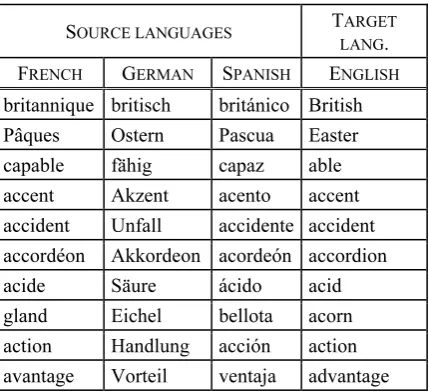
and added an-other column to this resource. Table 1 shows a few sample entries of the resulting list of word equations which were used for evaluating our approach.
We should mention that the term word equa-tion is a bit problematic, as most words tend to be ambiguous, and ambiguities tend to vary with language. For this reason, we should, at least in principle, disambiguate all words in our corpus and map them to unambiguous concepts. Next we should use a gold standard using such con-cepts rather than words. Unfortunately, the cur-rent state of the art does not allow doing this with sufficient accuracy. Anyhow, addressing this problem is well beyond the scope of this paper.
SOURCE LANGUAGES TARGET
LANG.
FRENCH GERMAN SPANISH ENGLISH
britannique britisch británico British Pâques Ostern Pascua Easter
capable fähig capaz able
accent Akzent acento accent accident Unfall accidente accident accordéon Akkordeon acordeón accordion
acide Säure ácido acid
[image:4.595.307.522.289.485.2]gland Eichel bellota acorn action Handlung acción action avantage Vorteil ventaja advantage Table 1. Some sample entries from the gold standard of word equations.
So far, for identifying the translations of the 1079 French words, we assumed the following ap-proach: We first computed their associations and then conducted an evaluation by checking for how many words the top association was identi-cal to the English translation found in the gold standard. The same approach was also used for the other languages, namely German and French. Hence, the three source languages were treated completely independently of each other.
5
However, there are several problems with this approach, in particular:
a) Several correct translations b) Data sparseness
c) Homograph trap
Let us discuss these issues point by point.
a) Several correct translations
Suppose we tried to identify the translation of the German word Straße and our gold standard listed
street as the correct translation. If, however, our system produced road this would be considered just as much of an error as if it had produced a very remote word such as volcano. Hence, con-sidering only a single word as being correct, which is the consequence of using as gold stan-dard the resource exemplified in Table 1, implies that performance figures are artificially low, giv-ing us only the lower bound of the true perform-ance.
Despite this shortcoming, we will neverthe-less do so for the following reasons: 1) This is a pilot study presenting a new approach. For this reason, clarity has priority over performance. 2) The number of translations listed in a dictionary typically depends on the size of the resource. Hence, there is no absolute difference between correct and incorrect translations. Rather, we need to set a threshold somewhere, and truncat-ing after the first word listed is arguably the clearest and simplest way of doing so. 3) This is the main reason. We want to extend our approach to the multilingual case by (simultaneously) looking at several source languages. Given the fact that each language tends to have its own (i.e. idiosyncratic) ambiguities, we are already satis-fied if words from the various source languages have the same main translation. That all possible translations are identical is very unlikely.
b) Data sparseness
What will happen if a source word does not oc-cur at all in the corpus, or only once or twice? We mentioned already that an appropriate choice of text genre, corpus size, and window size can somewhat reduce the problem of data sparseness. We also mentioned that by reversing source and target languages we can look at the problem from
two perspectives, which may yield further im-provement. Nevertheless, these suggestions are limited in scope. Hence, given the nature of our approach, data sparseness will remain the core problem.
Fortunately, there is another possibility which is more promising than the ones mentioned above, provided that we manage to solve the am-biguity problem. The solution consists in consid-ering several source languages concurrently. Suppose that rather than starting from scratch we use existing dictionaries for various languages.6 In this case we can easily generate word equa-tions such as the ones shown in Table 1. We do this by considering as a single item all words appearing in a given row (excluding the target language word), and by computing the associa-tions to this aggregated artificial unit. (This is a simplified proposal. We shall see later how to improve it.) If, for example, we have 10 source languages, then it does not matter that 8 source words do not occur in the corpus, as long as the other two are well represented.
c) The homograph trap
By this we mean that a word form from the source language also exists in the target lan-guage, but with a different meaning. For exam-ple, let us assume that we wanted to translate the word can (house) from Catalan to English. Sup-pose further that we are lucky and have ten Cata-lan citations with this word in our English cor-pus. But this will not help us because the word
can happens to also belong to English, meaning something completely different. Moreover, can is a high frequency word, occurring millions of times in a large corpus. Of course, if we had a perfect word sense disambiguator, we could separate the Catalan and the English occurrences of can, thereby solving the problem.7
Unfortu-nately, existing tools are not powerful enough to do the job. What is worse, such collisions are not
6
Which, for example, by using open source tools such as Moses and Giza++ (see www.statmt.org) can be easily generated from parallel corpora, e.g. from the Europarl corpus (Koehn, 2005) or the JRC Acquis corpus (Steinberger et al., 2006).
7
uncommon between languages using the same script. So what can we do? Our suggestion is ex-actly the same as above for the problem of data sparseness, i.e. to look at several source lan-guages in parallel.
But it is clear that collapsing all source words into a single item does not work. If only one of them happens to be also a common word in the target language, it is very likely that its co-occur-rences will override the co-occurco-occur-rences of the foreign words we are interested in. So there is little chance to come up with a correct result.
We propose a relatively simple solution to this problem, which possibly may well be novel in this context. Let us develop the idea.
In preliminary experiments we have tried sev-eral possibilities. Collapsing the source words would be equivalent to adding the respective co-occurrence vectors. This is apparently not ade-quate because, as mentioned above, the vector of a very frequent word would dominate all others. An alternative would be to sum up the associa-tion vectors. By the term associaassocia-tion vector we mean the co-occurrence vectors after application of an association measure (in our case the log-likelihood ratio). It turns out that this somewhat reduces the problem without solving it entirely. Another possibility would be vector multiplica-tion. Multiplication is considerably better than addition as a property of multiplication is that moderate but coinciding support for a particular target word from several source words leads to a higher product than strong support by only a few. This is a highly desirable property as it helps us avoiding the homograph trap, and because all values are subject to considerable sampling er-rors.
Unfortunately, there is yet another problem. Our association measure of choice, namely the log-likelihood ratio, as typical for ratios, has a skewed value characteristic. Since otherwise our previous experiences with the log-likelihood ra-tio are very good,8
and since it seems reasonably well suited for sparse data (Dunning, 1993), we suggest to multiply log-likelihood ranks rather than log-likelihood scores. This proposal is based on the observation (Dunning, 1993) that rankings of association strengths as produced by the
8
To the best of our knowledge no other measure could consistently beat it over a wide range of NLP applications.
likelihood ratio tend to be highly accurate even at higher ranks. Let us call this procedure the prod-uct-of-rank algorithm
This algorithm works as follows: Starting from a vocabulary of target language words (which are the translation candidates), for each of these words an association vector is computed. Next, for each association vector the ranks of all words in the source language word tuple under consideration are determined. Hence, if we have three languages (e.g. English, French and Ger-man) we would get three values. These values are multiplied with each other, and finally all target language words are sorted according to the resulting products. As small ranks stand for strong associations, the word obtaining the smal-lest value is considered to be the translation of the source language tuple. This algorithm turned out to lead to highly plausible rankings and to be robust with regard to sampling errors.9
It is also quite effective in eliminating the homograph problem.
3 Experimental Results and Evaluation
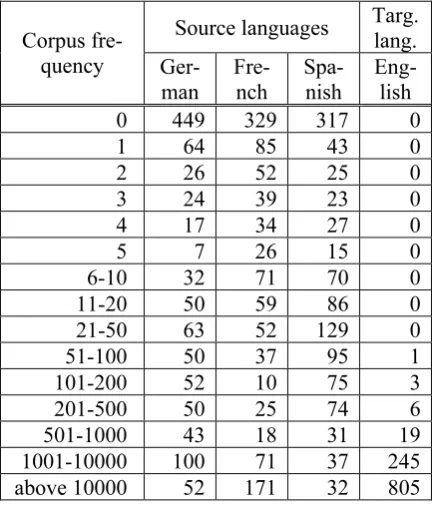
Let us first try to see whether the basic assump-tion underlying our approach is sound, namely that we will find a sufficient number of foreign words in our corpus. To check this claim, we have listed in Table 2 for each of the four lan-guages the number of words from the gold stan-dard falling into particular frequency categories. For example, the value of 70 in the field belong-ing to the row 6-10 and the column Spanish
means that out of the 1079 Spanish words in our gold standard 70 have a corpus frequency be-tween 6 and 10 in the 4th edition of the English Gigaword Corpus. Apparently, words with zero occurrences or with a very low corpus frequency are problematic because of data sparseness. Yet words with very high frequencies are not less problematic, as they may turn out to have homo-graphs in the target language. As there is no gen-erally accepted definition of what the vocabulary of a given language is, we cannot give precise figures concerning the number of homographs in our gold standard for each language pair.
9
theless, we believe that Table 2 gives a fair im-pression. By taking a look at the high frequency source language words one can see that the pair French–English has the greatest number of homographs, followed by German–English, and finally Spanish–English.
Source languages Targ. lang. Corpus
fre-quency
Ger-man Fre-nch Spa-nish Eng-lish
0 449 329 317 0
1 64 85 43 0
2 26 52 25 0
3 24 39 23 0
4 17 34 27 0
5 7 26 15 0
6-10 32 71 70 0
11-20 50 59 86 0
21-50 63 52 129 0
51-100 50 37 95 1
101-200 52 10 75 3
201-500 50 25 74 6
501-1000 43 18 31 19
1001-10000 100 71 37 245
[image:7.595.72.290.160.413.2]above 10000 52 171 32 805
Table 2: Corpus frequencies of the words occurring in the gold standard.
As to be expected, the corpus frequencies of the language of the corpus, namely English, are or-ders of magnitude higher than those of the other languages. But the table also gives a good idea concerning the presence of French, German, and Spanish word citations in written English. How-ever, we should not be misled by the overwhelm-ing presence of French words in the high fre-quency ranges, as this mainly reflects the amount of homography. Although pronunciation rules are very different between English and French, spelling tends to be similar, which is why there are lots of homographs. In contrast, Spanish and German usually use different spelling even for words having the same historical roots, which is why homography is far less common.10
10
As an example for such spelling conversions, let’s mention that the grapheme c in English is almost con-sistently replaced by k in German, e.g. class → Klasse
and clear → klar.
From the figures of Table 2 one may conclude that identifying word translations from a mono-lingual corpus is not easy because of data sparse-ness. Nevertheless it seems possible, at least to some extent. Let us therefore take a look at some results.
In our experimental work we first identified word translations for stimulus words from a sin-gle source language, then for stimulus words from two source languages, and finally for stimu-lus words from three source languages.
a) One source language
We started by conducting separate runs for each of the three source languages (French, German, Spanish) and determined the number of times the algorithm was able to come up with the expected English translation as the top ranked association for the 3 * 1079 source words. Note, however, that hereby we did not consider the full range of possible target words present in the English Gi-gaword corpus as this would include many for-eign words. Instead, we restricted the number of target words to the 1079 English words present in the gold standard.
The respective figures are 163 (15.1%) for French, 85 (7.9%) for German, and 97 (9.0%) for Spanish. As can be seen, French clearly per-formed best, which confirms previous studies that the lexical agreement between French and English is surprisingly high. Nevertheless, on average, only 10.7% of the translations were identified correctly, which does not look very good. However, remember that these figures can be considered as a lower bound as we do not take alternative translations into account and as the underlying corpus has not been prepared specifi-cally for this purpose. Note also that the product-of-ranks algorithm has no effect in the case when only a single source language is considered. (If there is only one value, no multiplication takes place.)
b) Two source languages
re-sults yields an average of 18.4%, which is a nice improvement over the initial 10.7% which we had for single source languages. This lends sup-port to our hypothesis that the product-of-ranks algorithm works effectively in this context.
c) Three source languages
Finally, all three source languages were com-bined, resulting in the correct translation of 248 of the altogether 1079 test items, which corre-sponds to a performance of 23.0%. This further improvement is consistent with our hypothesis that performance should increase when more source languages are considered.
Let us take a closer look at these performance gains. At the beginning we increased the number of source languages by 100% (from 1 to 2), yielding a relative performance increase of 72% (the absolute performance improved from 10.7% to 18.4%). Next we increased the number of source languages by 50% (from 2 to 3) which yielded a relative performance increase of 25% (absolute performance had improved from 18.4% to 23%). This means that the behavior is worse than linear, as in the linear case we should have obtained a further improvement of 72%/2 = 36%. But of course when combining statistics in NLP, hardly ever a linear behavior can be observed, and the above findings seem satisfactory. Never-theless they should be supported by looking at further languages, see Section 4.11
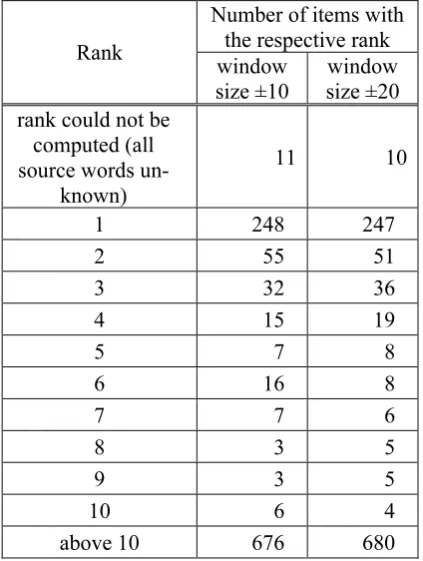
For the case of looking at three source lan-guages in parallel, let us provide data concerning the rank distribution of the expected translations (see the middle column of Table 3). Overall, in 357 of the 1079 cases (33.9%) the expected translation ranks among the top five, and in 392 cases (36.3%) it is among the top ten associa-tions. These results are based on a window size of ±10 words when counting the co-occurrence frequencies. To give an idea that the procedure is robust in this respect, we provide analogous
11
Another important question, which we have not dealt with yet, is to what extend the observed gain in performance when increasing the number of source languages is a side effect of a higher likelihood that at least one of the source words happens to be identical to the target word (with the same or a similar mean-ing). In such cases (which might be common when considering related languages), predicting the correct translation is rather easy.
ues for a window size of ±20 words in the third column of Table 3. As can be seen, apart from the usual statistical fluctuations the difference is hardly noticeable.
Number of items with the respective rank
Rank window
size ±10 size ±20 window rank could not be
computed (all source words
un-known)
11 10
1 248 247
2 55 51
3 32 36
4 15 19
5 7 8
6 16 8
7 7 6
8 3 5
9 3 5
10 6 4
[image:8.595.304.516.143.424.2]above 10 676 680
Table 3: Ranks of the expected translations when all three source languages are combined.
EXAMPLE 1
Given word French: tablier [7] Given word German: Schürze [0] Given word Spanish: delantal [4] Expected translation into English
according to the gold standard: apron [3059] Top 5 translations as computed:
1 apron [3059] 2 sausage [9954] 3 sauce [49139] 4 appetite [24682] 5 mustard [13477]
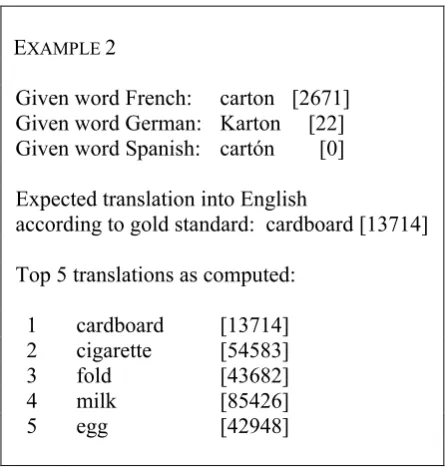
EXAMPLE 2
Given word French: carton [2671] Given word German: Karton [22] Given word Spanish: cartón [0] Expected translation into English
according to gold standard: cardboard [13714] Top 5 translations as computed:
[image:9.595.70.293.73.309.2]1 cardboard [13714] 2 cigarette [54583] 3 fold [43682] 4 milk [85426] 5 egg [42948]
Table 5: Sample results.
Having looked at the quantitative results, some sample output may also be of interest. For this purpose, Tables 4 and 5 show sample results for triplets of source language words. Hereby, the numbers in square brackets refer to the corpus frequencies of the respective words in the Eng-lish Gigaword Corpus.
4 Summary and Future Work
In this paper we made an attempt to solve the problem of identifying word translations on the basis of a single monolingual corpus where the same corpus is supposed to be used for several language pairs. The basic idea underlying our work is to look at citations of foreign words, to compute their co-occurrence-based associations, and to consider these as translations of the re-spective words.
We pointed out some difficulties with this ap-proach, namely the problem of data sparseness and the homograph trap, but were able to suggest and implement at least partial solutions. Using the product-of-ranks algorithm, our main sugges-tion was to look at several source languages in parallel, which at least in theory has the potential to solve the experienced problems.
We did not have very high expectations when starting this work and were positively surprised by the resulting performance of up to 25% crectly predicted test items. As pointed out, in
or-der to avoid raising unjustified expectations, we presented somewhat conservative figures which should leave room for improvements.
Obvious extensions of the current work are to increase the number of considered languages and to also use other large monolingual corpora. For example, we could use the web corpora provided by the web-as-a-corpus (WaCky) initiative (Ba-roni et al., 2009). A few such corpora have al-ready been made available recently, and as they are based on a largely automatic acquisition pro-cedure there are probably more to come. This reflects a tendency towards extremely large cor-pora. Processing in the current framework turns out to be unproblematic if sparse matrices are used, as foreign word occurrences are implicitly of low frequency.
Although web corpora should be very noisy in comparison to the carefully edited newsticker texts used here, the interesting thing is that ac-cording to the hypothesis formulated in the intro-duction the current approach seems to provide one of the rare occasions where noisy data is bet-ter than perfectly clean data, and we hope that future work will prove this prediction correct.
Another possibility for future work is to look at second rather than first order associations, i.e. to consider those words as potential translations of a given foreign word which show similar con-text words. This might be promising in so far as the sparse data problem is less salient in this case.
tell us is that there can be a multitude of statisti-cally significant co-occurrences even at non-obvious places. So what we possibly should rule out is that, even across languages, there are sepa-rate clusters without any interconnections.
Acknowledgments
Part of this research was supported by a Marie Curie Intra European Fellowship within the 7th European Community Framework Programme. We thank the Linguistic Data Consortium for making available the English Gigaword Corpus, and Lourdes Callau, Maria Dolores Jimenez Lo-pez, and Lilica Voicu for their support in acquir-ing it.
References
Babych, Bogdan; Sharoff, Serge; Hartley, Anthony; Mudraya, Olga (2007). Assisting Translators in In-direct Lexical Transfer. Proceedings of the 45th In-ternational Conference of the Association for Com-putational Linguistics ACL 2007, Prague, 136–143. Baroni, Marco; Bernardini, Silvia; Ferraresi, Adriano, Zanchetta, Eros (2009). The WaCky Wide Web: A collection of very large linguistically processed Web-crawled corpora. Journal of Language Re-sources and Evaluation 43 (3): 209–226.
Chiao, Yun-Chuang; Sta, Jean-David; Zweigenbaum, Pierre (2004). A novel approach to improve word translations extraction from non-parallel, compara-ble corpora. In: Proceedings of the International Joint Conference on Natural Language Processing, Hainan, China. AFNLP.
Dunning, Ted (1993). Accurate methods for the sta-tistics of surprise and coincidence. Computational Linguistics, 19(1), 61–74.
Fung, P.; McKeown, K. (1997). Finding terminology translations from non-parallel corpora. Proceedings of the 5th Annual Workshop on Very Large Cor-pora, Hong Kong, 192–202.
Fung, P.; Yee, L. Y. (1998). An IR approach for trans-lating new words from nonparallel, comparable texts. In: Proceedings of COLING-ACL 1998,
Montreal, Vol. 1, 414–420.
Koehn, Philipp; Knight, Kevin (2002). Learning a translation lexicon from monolingual corpora. In: Unsupervised Lexical Acquisition. Proceeding of the ACL SIGLEX Workshop, 9–16.
Koehn, Philipp (2005). Europarl: A parallel corpus for statistical machine translation. Proceedings of MT Summit, Phuket, Thailand, 79–86.
Munteanu, Dragos Stefan; Marcu, Daniel (2005). Im-proving machine translation performance by ex-ploiting non-parallel corpora. Computational Lin-guistics 31(4), 477–504.
Rapp, Reinhard (1995). Identifying word translations in non-parallel texts. In: Proceedings of the 33rd Meeting of the Association for Computational Lin-guistics. Cambridge, Massachusetts, 320–322. Rapp, Reinhard. (1999). Automatic identification of
word translations from unrelated English and Ger-man corpora. In: Proceedings of the 37th Annual Meeting of the Association for Computational Lin-guistics 1999, College Park, Maryland. 519–526. Rapp, Reinhard; Zock, Michael (2010). Automatic
dictionary expansion using non-parallel corpora. In: Andreas Fink, Berthold Lausen, Wilfried Seidel Al-fred Ultsch (Eds.) Advances in Data Analysis, Data Handling and Business Intelligence. Proceedings of the 32nd Annual Meeting of the GfKl, 2008. Hei-delberg: Springer.
Steinberger, Ralf; Pouliquen, Bruno; Widiger, Anna; Ignat, Camelia; Erjavec, Tomaž; Tufiş, Dan; VARGA, Dániel (2006). The JRC-Acquis: A
multi-lingual aligned parallel corpus with 20+ languages.
Proceedings of the 5thLREC, Genoa, Italy. Wu, Dekai; Fung, Pascale (2005). Inversion
transduc-tion grammar constraints for mining parallel sen-tences from quasi-comparable corpora. Proceedings of the Second International Joint Conference on Natural Language Processing (IJCNLP-2005). Jeju, Korea.