Probabilistic Human-Computer Trust Handling
Florian Nothdurft?, Felix Richter†and Wolfgang Minker??Institute of Communications Engineering
†Institute of Artificial Intelligence Ulm University
Ulm, Germany
florian.nothdurft, felix.richter, [email protected]
Abstract
Human-computer trust has shown to be a critical factor in influencing the complex-ity and frequency of interaction in techni-cal systems. Particularly incomprehensi-ble situations in human-computer interac-tion may lead to a reduced users trust in the system and by that influence the style of interaction. Analogous to human-human interaction, explaining these situations can help to remedy negative effects. In this pa-per we present our approach of augment-ing task-oriented dialogs with selected ex-planation dialogs to foster the human-computer trust relationship in those kinds of situations. We have conducted a web-based study testing the effects of different goals of explanations on the components of human-computer trust. Subsequently, we show how these results can be used in our probabilistic trust handling architec-ture to augment pre-defined task-oriented dialogs.
1 Introduction
Human-computer interaction (HCI) has evolved in the past decades from classic stationary interaction paradigms featuring only human and computer to-wards intelligent agent-based paradigms featuring multiple devices and sensors in intelligent envi-ronments. For example, ubiquitous computing no longer seems to be a vision of future HCI, but has become reality, at least in research labs and pro-totypical environments. Additionally, the tasks a technical system has to solve cooperatively with the user have become increasingly complex. How-ever, this change from simple task solver to intel-ligent assistant requires the acceptance of and the trust in the technical system as dialogue partner and not only as ordinary service device.
Especially trust has shown to be a crucial part in the interaction between human and technical sys-tem. If the user does not trust the system and its actions, advices or instructions the way of interac-tion may change up to complete aborinterac-tion of future interaction (Parasuraman and Riley, 1997). Espe-cially those situations in which the user does not understand the system or does not expect the way how the system acts are critical to have a negative impact on the human-computer trust (HCT) rela-tionship (Muir, 1992). Those situations do occur usually due to incongruent models of the system: During interaction the user builds a mental model of the system and its underlying processes deter-mining system actions and output. However, if this perceived mental model and the actual system model do not match the HCT relationship may be influenced negatively (Muir, 1992). This may, for example, be due to a mismatch in the expected and the actual system action and output.
For example, if a technical system would assist the user in having his day scheduled in a time ef-fective manner, the user would be in a vulnerable situation of relying on the reasoning capabilities of the system. However, when the user-expected time schedule does not match the system-generated, the question arises if the user will trust the system, de-spite lacking the knowledge if the schedule is cor-rect. If the user trusts the automated day schedul-ing capability of the system, he will probably at-tend the appointments exactly as scheduled. How-ever, if he does not trust this automated outcome he won’t rely on it and will question the plan.
Therefore, the goal should be to detect those critical situations in HCI and to react appropri-ately. If we take a look at how humans detect and handle critical situations, we can conclude that they use contextual information combined with in-terpreted multimodal body analysis (e.g., facial expression, body posture, speech prosody) for de-tection and usually some sort of explanation to
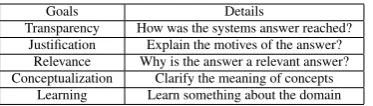
Goals Details
Transparency How was the systems answer reached? Justification Explain the motives of the answer?
Relevance Why is the answer a relevant answer? Conceptualization Clarify the meaning of concepts
[image:2.595.90.277.61.114.2]Learning Learn something about the domain
Table 1: Goals of explanation after (Sørmo and Cassens, 2004). These goals subsume different kinds of explanation as e.g., why, why-not, what-if, how-to explanations
clarify the process of reasoning (i.e. increasing transparency and understandability). As even hu-mans are sometimes insecure about judging the di-alog partner and to decide whether and which type of reaction would be appropriate, it seems valid that a technical system will not overcome this is-sue of uncertainty. Therefore, we assume that the transfer of this problem to a technical system can only be handled effectively by incorporating un-certainty and thus using a probabilistic model. In the remainder of this paper, we will first elaborate how to react to not understandable situations and secondly present how to incorporate these findings into a multimodal dialogue system using a proba-bilistic model.
2 Coping with Incomprehensible Situations
Analogous to human-human interaction provid-ing explanations in not understandable situations in HCI can reduce the loss of trust (Glass et al., 2008). However, HCT is not a one-dimensional simple concept. It may be devided into several components, which all have to be well-functioning to have the user trust a technical system. Exis-tent studies concentrated on showing that explana-tions or different kinds of explanaexplana-tions can influ-ence HCT in general (Lim et al., 2009). So, what is lacking currently is which explanations do influ-ence which bases of human-computer trust.
2.1 Explanations
In general, explanations are given to clarify, change or impart knowledge. Usually the implicit idea consists of aligning the mental models of the participating parties. The mental model is the per-ceived representation of the real world, or in our case of the technical system and its underlying processes. In this context explanations try to es-tablish a common ground between the parties in the sense that the technical system tries to clar-ify its actual model to the user. This is the
at-tempt of aligning the user’s mental model to the actual system. However, explanations do not al-ways have the goal of aligning mental models, but can be used for other purposes as well. Analogous to human-human interaction, in human-computer interaction the sender of the explanation pursues a certain goal, with respect to the addressee, which should be achieved. The question remains, how these different goals of explanation (see table 1) map to HCT, meaning, how they influence HCT or components of it.
2.2 Human-Computer Trust
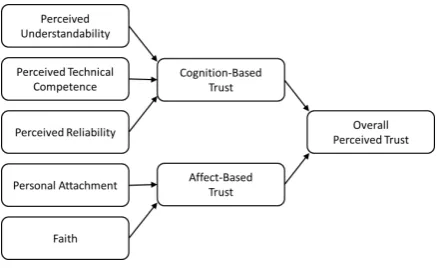
Figure 1: Human-computer trust model: Personal attachment and faith build the bases for affect-based trust. Rerceived understandability, techni-cal competence and reliability for cognition-based trust.
deemed trustworthy. If any of the bases does not fulfill this requirement, the overall trustworthiness can suffer (Madsen and Gregor, 2000).
3 Related Work
Previous work on handling trust in technical sys-tems was done for example by Glass et al. (2008). They investigated factors that may change the level of trust users are willing to place in adaptive agents. Among these verified findings were state-ments like “provide the user with the information provenance for sources used by the system”, “in-telligently modulating the granularity of feedback based on context- and user-modeling” or “supply the user with access to information about the in-ternal workings of the system”. However, what is missing in Glass et al.’s work is the idea of rat-ing the different methods to uphold HCT in gen-eral and the use of a complex HCT model. Other related work was for example done by Lim et al. (2009) on how different kinds of explanations can improve the intelligibility of context-aware intel-ligent systems. They concentrate on the effect of Why, Why-not, How-to and What-if explanations on trust and understanding system’s actions or re-actions. The results showed that Why and Why-not explanations were the best kind of explanation to increase the user’s understanding of the sys-tem, though trust was only increase by providing Why explanations. Drawbacks of this study were that they did only concentrate on understanding the system and trusting the system in general and did not consider that HCT is on the one hand not only influenced by the user’s understanding of the system and on the other hand that if one base of
trust is flawed, the HCT in general will be dam-aged (Mayer et al., 1995).
Regarding the issue of trusting a technical sys-tem or its actions and reactions related work ex-ists for example on “credibility” (Fogg and Tseng, 1999). However, this term developed in the web community focusing on the believability of exter-nal sources. The term trust is used in the web research community as well as in work on “trust in automation”. However, as Fogg stated himself later (Tseng and Fogg, 1999) credibility should be called believability and trust-in-automation should be called dependability to reduce the missunder-standings. In this work we use the term human-computer trust and its model by Madsen and Gre-gor (2000) subsuming both terms.
4 Experiment on Explanation Effectiveness
The insight that human-computer trust is not a simple but complex construct and the lack of di-rected methods to influence components of HCT motivated us to conduct an experiment which tried to overcome some of these issues. The use of ex-planations to influence HCT bases in a directed and not arbitrary way, depends on whether an effective mapping of explanation goals to HCT bases can be found. This means, that we have to identify which goal of explanation influences which base of trust in the most effective way. Therefore, the goal was to change undirected strategies to handle HCT issues into directed and well-founded ones, substantiating the choice and goal of explanation.
For that we conducted a web-based study in-ducing events to create not understandable or not expected situations and then compared the effects of the different goals of explanations on the HCT-bases. For our experiment we concentrated on jus-tification and transparency explanations. Justifica-tions are the most obvious goal an explanation can pursue. The main idea of this goal is to provide support for and increase confidence in given sys-tem advices or actions. The goal of transparency is to increase the users understanding in how the system works and reasons. This can help the user to change his perception of the system from a black-box to a system the user can comprehend. Thereby, the user can build a mental model of the system and its underlying reasoning processes.
ac-quired by using flyers in the university as well as through facebook. The age of the participants was in a range from 14 to 61, with the mean being 24,1. Gender wise, the distribution was 59% (male) to 41% (female), with most of the participants be-ing students. For the participation the students did receive a five euro voucher for a famous online store. However, this was only granted when fin-ishing the complete experiment. Therefore, partic-ipants dropping out of the experiment would waive the right on the voucher.
4.1 Set-Up
[image:4.595.306.527.60.268.2]The main objective of the participants to organize four parties for friends or relatives in a web-based environment. This means that they had to use the browser at home or the university to organize for example, the music, select the type and amount of food or order drinks. Each party was described by an initial screen depicting the key data for the party. This included which tasks had to be accom-plished and how many people were expected to join (see figure 2). Each task was implemented as a single web-page, with the goal to organize one part of the party (i.e., dinner, drinks, or cham-pagne reception). The user had to choose from several drop-down menus which item should be ordered for the party and in what number. For ex-ample, the user had to order the components of the dinner (see figure 3). When an entry inside a drop-down menu was chosen, the system gave an advice on how much of this would be needed to satisfy the needs of one guest. Additionally, be-fore the participant could move on to the next task, the orders were checked by the system. The sys-tem would output whether the user had selected too much, too little or the right amount and only if everything was alright could proceed to the next task. The experiment consisted in total of four rounds. The first two rounds were meant to go smoothly and were supposed to get the subject used to the system and by that building a men-tal model of it. After the first two rounds a HCT questionnaire was presented to the user. As ex-pected the user has built a relationship with the system by gaining an understanding of the systems processes. The next two rounds were meant to influence the HCT-relationship negative with un-expected external events. These unun-expected, and incongruent to the user’s mental model, system events were influencing pro-actively the decisions
Figure 2: General information on the party. How many people plan to attend the event and what type of tasks have to be accomplished.
and solutions the user made to solve the task. This means, without warning, the user was overruled by the system and either simply informed by this change, or was presented an additional justifica-tion or transparency explanajustifica-tion as seen in figure 3. In this figure we can see that the user’s order (’Bestellungsliste’) was changed pro-actively be-cause of an external event. Here the attendance of some participants was cancelled in the reservation system, thus the system did intervene. This pro-active change was explained at the bottom of the web-page by, in this case, providing a justification (’The order was changed by the system, because the number of attending persons decreased’). The matching transparency explanation would not only provide a reason, but explain how the system an-swer was reached (’Due to recent events the or-der was changed by the system. The oror-der vol-ume has been reduced, because several persons canceled their attendance in the registration sys-tem.’). Events like this occurred several times in the rounds 3 and 4 of the party planning.
4.2 Results
Figure 3: This screenshot shows one of the tasks the user has to accomplish. In this case dinner (’Haupt-gerichte’) including entree (’Vorspeisen’) and desserts has to be ordered.
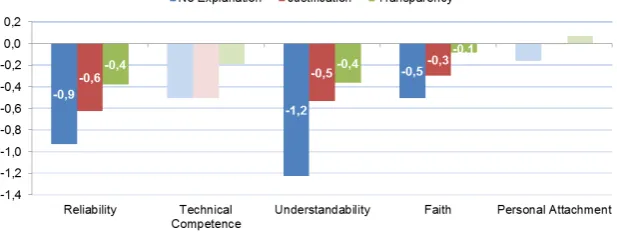
the critical rounds 3 and 4. However, if expla-nations were presented only 33% (justifications) and 35% (transparency) did quit. This means that eventhough the participants would encounter neg-ative consequences of losing the reward money, they did drop out of the experiment. Therefore, we can state that the use of explanations in incom-prehensible and not expected situations can help to keep the human-computer interaction running. The main results from the HCT-questionnaires can be seen in figure 4. The data states that providing no explanations in rounds three and four resulted in a decrease in several bases of trust. Therefore, we can conclude that the external events did in-deed result in our planned negative change in trust.
Perceived understandability diminished on aver-age over the people questioned by 1.2 on a Lik-ert scale with a range from 1 to 5 when providing no explanation at all compared to only 0.4 when providingtransparencyexplanations (no explana-tion vs. transparency t(34)=-3.557 p<0.001), and on average by 0.5 with justifications (no expla-nation vs. justifications t(36)=-2.023 p<0.045). Omitting explanations resulted in an average de-crease of 0.9 for the perceived reliability, with transparency explanations in a decrease of 0.4 and forjustificationsin a decrease of 0.6 (no explana-tion vs. transparency t(34)=-2.55 p<0.015).
These results support our hypotheses that trans-parency explanations can help to reduce the neg-ative effects of trust loss regarding the user’s per-ceived understandability and reliability of the
sys-tem in incomprehensible and unexpected situa-tions. Especially for the base of understandability, meaning the prediction of future outcomes, trans-parency explanations fulfill their purpose in a good way. Additionally, they seem to help with the per-ception of a reliable, consistent system. The re-sults show that it is worthwhile to augment ongo-ing dialogs with explanations to maintain HCT.
aug-Figure 4: This figure shows the changes of HCT bases from round 2 to round 4. The scale was a 5 point likert scale with e. g., 1 the system being not understandable at all and 5 the opposite.
mentation architecture (see figure 5).
5 Implementation
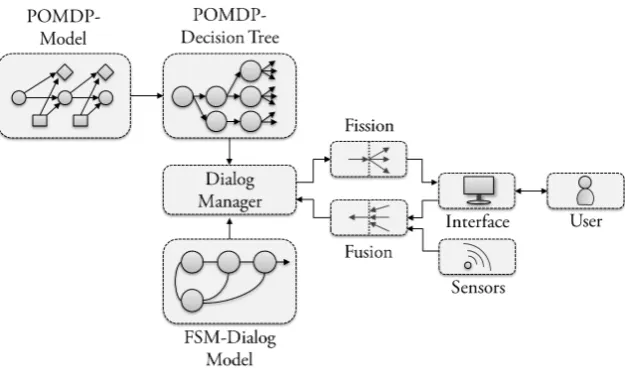
The augmentation of the dialog is done using two different kinds of dialog models. On the one hand we are using a classic dialog model based on a finite-state machine approach for the task-oriented part of the dialog. On the other hand a planner (M¨uller et al., 2012) is used to generate from a POMDP a decision tree. This POMDP is used only for the augmentation of the task-oriented part of the dialog with explanations. The communi-cation between each module of the architecture is controlled by a XML-based message-oriented middleware (Schr¨oder, 2010), using a publish-subscribe system to distribute the XML-messages. In order to decide when to induce additional ex-planations, on one hand critical situations in HCI have to be recognized and on the other hand, if necessary the appropriate type of explanation has to be given. Obviously, recognizing those situa-tions cannot be done solely by using information coming from interaction and its history. Multi-modal input as speech recognition accuracy, fa-cial expressions or any other sensor information can help to improve the accuracy of recognizing critical moments in HCI. However, mapping sen-sor input to semantic information is usually done by classifiers and those classifiers convey a certain amount of probabilistic inaccuracy which has to be handled. Therefore, a decision model has to be able to handle probabilistic information in a suit-able manner.
5.1 Probabilistic Decision Model
For the problem representation when and how to react, a so-called partially observable Markov
de-cision process (POMDP) was chosen and formal-ized in the Relational Dynamic Influence Dia-gram Language (RDDL) (Sanner, 2010). RDDL is a uniform language which allows an efficient description of POMDPs by representing its con-stituents (actions, observations, belief state) with variables. Formally, a POMDP consists of a set
S of world states, a setA of system actions, and a set O of possible observations the system can make. Further, transition probabilities P(s0|s, a) describe the dynamics of the environment, i.e., the probability of the successor world state being s0 when action ais executed in states. The obser-vation probabilities P(o|s0, a) represent the sen-sors of the system in terms of the probability of making observation o when executing a resulted in successor world states0. Each time the system executes an actiona, it receives a rewardR(s, a) which depends on the world statesthe action was executed in. The overall goal of the system is to maximize the accumulated reward it receives over a fixed number of time steps. (For more informa-tion on POMDPs, see Kaelbling et al. (1998).)
A POMDP is then used by a planner (Silver and Veness, 2010; M¨uller et al., 2012) to search for a policy that determines the system’s behavior. This policy is, e.g., represented as a decision tree that recommends the most suitable action based on the system’s previous actions and observations. For example, a policy for a POMDP that models HCI with respect to HCT, can thus represent a decision tree which represents a guideline for a dialog flow which ensures an intact HCT-relationship.
[image:6.595.144.453.73.190.2]du-Figure 5: The architecture consists of two dialog models, a fission and fusion engine, sensors as well as the multimodal interface representation to interact with the user. The dialog models can be seperated in a task-oriented FSM-dialog model and into a POMDP-based decision tree for explanation augmentation. This decision tree is generated from a POMDP-model by a planner.
ration of interaction for each dialog step as well as the semantic information of the input (i.e., which action in the interface was triggered by speech, touch or point-and-click interaction). Those types of interaction can bring along uncertainty (e.g., speech recognition rate). The states in terms of HCT is modeled by its respective bases, namely understandability, technical-competence, reliabil-ity, faith and personal attachment. The system actions A are the dialogs presented to the user. These are the different goals of explanations (jus-tification, transparency, conceptualization, rele-vance and learning) as well as the task-oriented part of the dialog represented by a so-called com-municative function(c) with c from set C (e.g., question, inform, answer, offer, request, instruct). This means, that in the POMDP only the com-municative function of the task-oriented dialogs is represented without the specific content.
The transition probabilities are defined as con-ditional probability functions (CPFs) and model user behavior dependent on the system’s actions and the user’s current HCT values. Basically, con-ditional functions are defined usingif else for all wanted cases. For example, we defined that the user’s understanding in s0 will probably be high if a transparency explanation was the last system action. When the user’s understanding is indeed high in s0, the observation will probably be that the user clickedokay, and the time he took for the interaction was around his usual amount taken for
explanations. From this observation, a planner can infer that the transparency explanation indeed in-creased the user’s understanding.
Now, the quest is to define the reward func-tion R(s, a) in a way that it leads to an optimal flow of actions. I.e., the system should receive a penalty when the bases of trust do not remain in-tact, and actions should incur a cost so that the sys-tem only executes them when trust is endangered. However, because POMDPs tend to be become very quick very complex, we chose to seperate the task-oriented dialog from the additional dialog augmentation with explanations when needed.
5.2 Dialog Augmentation Process
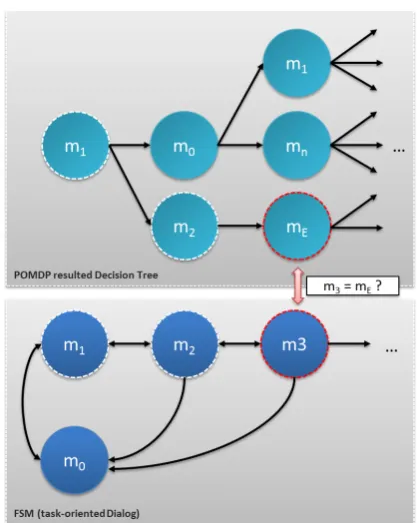
[image:7.595.143.456.64.253.2]dia-Figure 6: This figure shows the comparison of FSM to Decision Tree. The next action m3 in the FSM does not correspond to the one endorsed by the POMDP Decision Tree. Therefore, the dialog will be augmented by explanation action mE.
log flow is interrupted, and the ongoing dialog is augmented by the proposed explanation. For ex-ample, if the user is presented currently a commu-nicative function of typeinformand the decision tree recommends to provide a transparency expla-nation, because the understanding and reliability are probably false, the originally next step in the FSM is postponed and first the explanation is pre-sented. The other way around, if the next action in the FSM is subsumed by the one scheduled by the POMDP, the system does not need to intervene. For example, if the next FSM-action is to instruct the user about how to connect amplifier and re-ceiverand the POMDP would recommend an ac-tion of type communicative funcac-tion instruct, no dialog augmentation is needed.
6 Dialog Interface
Each dialog action in the FSM as well as the ex-planation dialogs are represented by a so-called di-alog goal, which is allocated on the one hand a type of communicative function c. On the other hand the dialog content is composed of multiple information objects referencing so-called
informa-Figure 7: A typical output presentation of the fis-sion component of a dialog goal. Here the user gets instruction on how to connect the BluRay-Playerwith anHDMIcable.
tion IDsin the information model. Each informa-tion object can consist of different types (e.g., text, audio, and pictures). For interface presentation the dialog goal is passed to the fission which se-lects and combines the information objects at run-time by a fission sub-component to compose the user interface in a user- and situation-adaptive way (Honold et al., 2012). In figure 7 we can see a typi-cal interface for a transmitted dialog goal in which the user can interact via speech, touch or GUI.
7 Conclusion and Future Work
In this paper we showed the necessity to deal with critical situations in HCI in a probabilistic ap-proach. The advantage of our approach is that the designer still can define a FSM-based task-oriented dialog. Usually most commercial sys-tems are still based on such approaches. However, expanding the dialog by a probabilistic decision model seems to be a valuable choice. Our experi-ment on the influence of explanations on HCT has clearly shown, that it is worthwhile to augment the ongoing dialog by transparency or justification ex-planations for an intact HCT relationship. In the future we will run experiments on how effective the hybrid FSM-POMDP approach is compared to classic as well as POMDP dialog systems.
Acknowledgment
[image:8.595.76.285.59.321.2] [image:8.595.314.522.61.187.2]References
B. J. Fogg and Hsiang Tseng. 1999. The elements of computer credibility. InProceedings of the SIGCHI conference on Human Factors in Computing Sys-tems, CHI ’99, pages 80–87, New York, NY, USA. ACM.
Alyssa Glass, Deborah L. McGuinness, and Michael Wolverton. 2008. Toward establishing trust in adap-tive agents. InIUI ’08: Proceedings of the 13th in-ternational conference on Intelligent user interfaces, pages 227–236, NY, USA. ACM.
Frank Honold, Felix Sch¨ussel, and Michael Weber. 2012. Adaptive probabilistic fission for multimodal systems. In Proceedings of the 24th Australian Computer-Human Interaction Conference, OzCHI ’12, pages 222–231.
L. P. Kaelbling, M. L. Littman, and A. R. Cassandra. 1998. Planning and acting in partially observable stochastic domains. Artificial Intelligence, pages 99–134.
John D. Lee and Katrina A. See. 2004. Trust in au-tomation: Designing for appropriate reliance. Hu-man Factors, 46(1):50–80.
Brian Y. Lim, Anind K. Dey, and Daniel Avrahami. 2009. Why and why not explanations improve the intelligibility of context-aware intelligent systems. In Proceedings of the SIGCHI Conference on Hu-man Factors in Computing Systems, CHI ’09, pages 2119–2128, NY, USA. ACM.
Maria Madsen and Shirley Gregor. 2000. Measur-ing human-computer trust. InProceedings of the 11 th Australasian Conference on Information Systems, pages 6–8.
Roger C. Mayer, James H. Davis, and F. David Schoor-man. 1995. An Integrative Model of Organiza-tional Trust. The Academy of Management Review, 20(3):709–734.
B M Muir. 1992. Trust in automation: Part i. theoret-ical issues in the study of trust and human interven-tion in automated systems. In Ergonomics, pages 1905–1922.
Felix M¨uller, Christian Sp¨ath, Thomas Geier, and Su-sanne Biundo. 2012. Exploiting expert knowl-edge in factored POMDPs. In Proceedings of the 20th European Conference on Artificial Intelligence (ECAI 2012), pages 606–611.
Raja Parasuraman and Victor Riley. 1997. Humans and automation: Use, misuse, disuse, abuse.Human Factors: The Journal of the Human Factors and Er-gonomics Society, 39(2):230–253, June.
Scott Sanner. 2010. Relational dynamic in-fluence diagram language (rddl): Language description. http://users.cecs.anu.edu.au/ ssan-ner/IPPC2011/RDDL.pdf.
Marc Schr¨oder. 2010. The semaine api: Towards a standards-based framework for building emotion-oriented systems. Advances in Human-Machine In-teraction, (319406):21.
D. Silver and J. Veness. 2010. Monte-carlo planning in large POMDPs. InNIPS, pages 2164–2172. F. Sørmo and J. Cassens. 2004. Explanation goals
in case-based reasoning. In Proceedings of the 7th European Conference on Case-Based Reason-ing, pages 165–174.