Quality Queue Management for Future Wireless Networks
Gianluigi Pibiri
A Dissertation submitted to the University of Dublin, Trinity College
in fulfillment of the requirements for the degree of
Doctor of Philosophy (Computer Science)
Declaration
I declare that this work has not been submitted as an exercise for a degree at this or any other
University and it is entirely my own work.
Gianluigi Pibiri
Permission to Lend and/or Copy
I agree to deposit this thesis in the University’s open access institutional repository or allow
the librarian to do so on my behalf, subject to Irish Copyright Legislation and Trinity College
Library conditions of use and acknowledgement.
Gianluigi Pibiri
Acknowledgements
I will be forever thankful to my supervisor, Dr. Meriel Huggard, for her support and patience
with me me over the years. Her suggestions and advice have been most helpful; not only
throughout the Ph.D. process, but also in my personal life.
I would like to thank Dr. Ciarán Mc Goldrick for his willingness to provide me with advice
and guidance. I have benefited greatly from his insightful technical observations throughout my
work on this dissertation. He was a second supervisor to me and was always happy to suggest
possible research directions for me to explore when I ran into challenges along the way.
I thank my colleagues Ricardo, Alessandro, Ritesh and Waqas for their support and
friend-ship – I enjoyed drinking copious cups of coffee and tea with you all over the past few years.
I enjoyed drinking copious cups of coffee and tea with you all over the past few years.
I would like to thank my family, and in particular my parents, for their belief in me and their
on-going support. I would not have completed this work without the knowledge that they were
there for me no matter what.
I express my gratitude and thanks to all those who have supported me in my work on this
thesis.
Gianluigi Pibiri
University of Dublin, Trinity College
Abstract
Wireless networking protocols and mobile devices are key contributors to the ever-growing
de-mand for realtime services. These large throughput services are often prioritised and managed
using specialised traffic policies. Today’s wireless networks will be replaced by their newer,
faster, less expensive counterparts in the very near future. These Very High Throughput
net-works will deliver a significant increase in throughput and a reduction in effective cost.
Realtime services are sensitive to packet loss and delay, and their successful delivery
de-mands a high standard of Quality of Service (QoS). The quality perceived by the final user is
measured as the Quality of Experience (QoE). Hence, Telephone Companies (TELCOs) aim to
provide realtime services with the best QoE possible.
This thesis aims to extend the provision of QoE to realtime services on future wireless
net-works.
The first contribution of this work is a novel metric, the expected Quality of Service (eQoS),
that estimates QoE on future wireless networks using combinatorics. eQoS provides an almost
instantaneous estimate of the QoE at the node and is inferred from the traffic flows crossing the
node. It provides a statistical estimate of the end user perception of the network’s quality.
The second contribution is a theoretical model to capture the probability of successful and
unsuccessful channel access on a future wireless network. This theoretical model uses
combi-natorics to calculate the probabilities that (i) a collision occurs, (ii) a packet is transmitted and
(iii) the channel is idle.
Management (QQM) system for future wireless networks. QQM is designed using fuzzy logic
controllers, it manages wireless resources with the goal of providing real time traffic flows with
the best QoE possible in the network. QQM incorporates eQoS and is a robust, efficient, scalable
means of managing realtime services on future wireless networks. The novelty of the QQM
system is to use eQoS to manage network parameters.
The QQM system optimises the throughput between the flows, manages the queues and
Contents
Acknowledgements iv
Abstract v
List of Tables xii
List of Figures xiii
Chapter 1 Introduction 1
1.1 Context . . . 2
1.1.1 Quality of Service . . . 3
1.1.2 Traffic Management . . . 3
1.2 Motivation . . . 4
1.3 Contribution . . . 5
1.4 Outcomes . . . 7
1.5 Structure of the Thesis . . . 7
1.6 Summary . . . 8
1.7 Publications . . . 9
Chapter 2 Wireless Networking and Real Time Services 10 2.1 Wireless Mobile Networks . . . 11
2.1.2 IEEE802.11 Protocols . . . 15
2.1.3 IEEE802.11a, b and g . . . 16
2.1.4 IEEE802.11n . . . 17
2.2 IEEE802.11e . . . 21
2.3 IEEE802.11ac . . . 24
2.3.1 MU-MIMO . . . 26
2.4 Wireless Network Services . . . 26
2.4.1 Streaming . . . 27
2.4.2 Voice over IP . . . 29
2.4.3 Audio encoding . . . 31
2.4.4 Video encoding . . . 32
2.5 Summary . . . 36
Chapter 3 A Review of Network Quality Provision Mechanisms 37 3.1 Quality of Service . . . 39
3.1.1 QoE . . . 40
3.1.2 QoS in Wireless Networks . . . 46
3.2 Wireless Network Architectures and Protocols . . . 47
3.2.1 Mathematical Models of Wireless Networks . . . 51
3.3 Active Queue Management . . . 55
3.3.1 Random Early Detection (RED) and its Derivatives . . . 56
3.3.2 Random Exponential Marking (REM) . . . 60
3.3.3 Adaptive Virtual Queue (AVQ) . . . 61
3.3.4 BLUE . . . 61
3.3.5 AQM using Control Theory . . . 62
3.4 Fuzzy Logic and Fuzzy Control Systems . . . 65
3.4.1 AQM using Fuzzy Logic and Fuzzy Control Systems . . . 68
3.6 Summary . . . 73
Chapter 4 eQoS 74 4.1 The Definition of eQoS . . . 75
4.1.1 Description and Motivation . . . 76
4.1.2 Setting the Parametersαandβ . . . 82
4.2 eQoS for VoIP Services . . . 83
4.2.1 eQoS for Audio Streaming . . . 87
4.2.2 Settingαandβfor Audio Streaming . . . 89
4.2.3 eQoS for Video Streaming . . . 91
4.2.4 Setting the parametersα,βandγfor Video Streaming . . . 95
4.3 Considerations for the Practical Application of eQoS . . . 98
4.4 Summary . . . 102
Chapter 5 Quality Queue Management 104 5.1 Theoretical Analysis of a Multi Queue System . . . 105
5.1.1 Determining the Probability a Packet is Successfully Transmitted . . . 108
5.1.2 Determining the Probability a Collision Occurs . . . 111
5.1.3 Extending the Model toAC2andAC3 . . . 112
5.1.4 Contention Window Sizes and Queueing inAC0andAC1 . . . 114
5.2 An Application of the Theoretical Model . . . 116
5.3 Model Limitations . . . 120
5.4 Estimating the Number ofACs Simultaneously Contending for Channel Access 120 5.5 The Quality Queue Management Algorithm . . . 131
5.5.1 Algorithm Operation . . . 134
5.6 Algorithm Limitations and Applicability . . . 152
Chapter 6 Algorithm Evaluation 155
6.1 Simulation Platform . . . 156
6.1.1 Simulation Environment . . . 160
6.1.2 Traffic Mix . . . 162
6.1.3 QoS Metrics . . . 166
6.2 Evaluation of the eQoS Metric . . . 167
6.2.1 Evaluation of eQoS for VoIP services . . . 168
6.2.2 Evaluation of eQoS for Audio Services . . . 171
6.2.3 Evaluation of eQoS for Video Services . . . 173
6.3 Packet Transmission Times & Throughput Evaluation for 802.11ac . . . 175
6.4 Performance Evaulation of the QQM Subsystems . . . 185
6.4.1 The Contention Window Controller . . . 188
6.4.2 The Active eQoS Controller . . . 192
6.4.3 The Queue Management Controller . . . 193
6.4.4 The QQM Controller . . . 197
6.5 Overhead and Complexity Analysis . . . 227
6.6 Summary . . . 229
Chapter 7 Conclusion 231 7.1 Achievements and Contributions . . . 233
7.2 Applicability and Limitations . . . 234
7.3 Future Work . . . 235
7.4 Final Remarks . . . 235
List of Acronyms 237
List of Tables
2.1 Summary of AC parameters [35] . . . 22
2.2 Summary of AC map between 7 and 4 ACS [35] [39] . . . 23
3.1 Summary of MOS levels [77] [8] . . . 41
3.2 Summary of the Notation used for Permutations and Combinations . . . 54
5.1 Notation for key probabilities associated with events that occur in time slotx . 108 5.2 Video streaming details . . . 131
6.1 Video Stream Formats . . . 166
6.2 Summary of CW Sizes and Traffic Flows for Experiment 1 . . . 177
6.3 Summary of CW Sizes and Traffic Flows for Experiment 2 . . . 180
6.4 Summary of CW Sizes and Traffic Flows for Experiment 3 . . . 181
6.5 Summary of CW Sizes and Traffic Flows for Experiment 4 . . . 183
6.6 Summary of CW Sizes and Traffic Flows for Experiment 5 . . . 185
6.7 Summary of VoIP Flows in Configuration 5 . . . 204
6.8 Summary of VoIP flows in configuration 5 . . . 210
6.9 Summary of VoIP flows in configuration 5 . . . 216
List of Figures
2.1 Infrastructure Wireless Network . . . 14
2.2 VoIP protocol with compression G.729 . . . 29
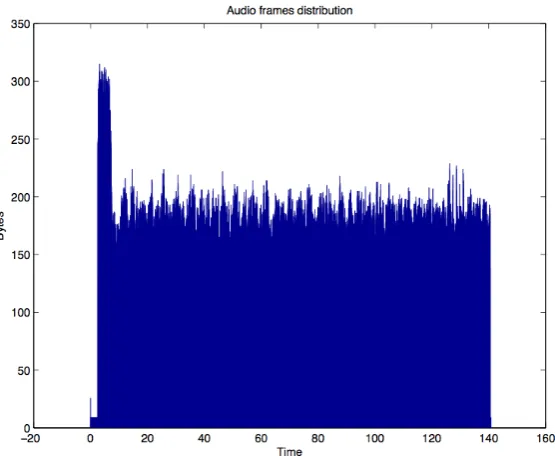
2.3 Audio Frames size showing variations due to the nature of the data. . . 32
2.4 Structure of the MPEG Group Of Pictures [67]. I Frames are in black, B Frames are in light grey and P Frames are in light grey . . . 34
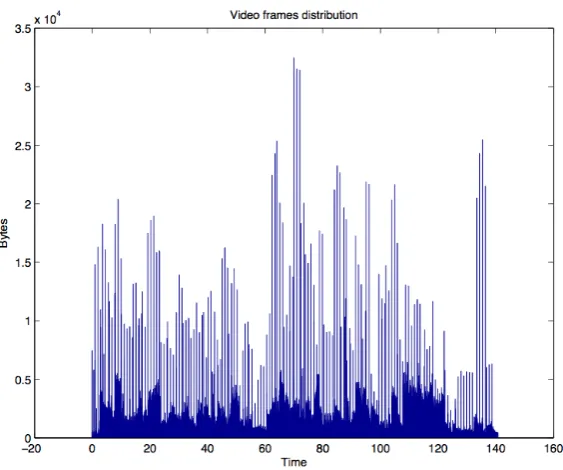
2.5 Example of Video Frames showing variations in Frame Size. . . 35
3.1 Wireless infrastructure architecture . . . 47
3.2 RED probability distribution [121] . . . 57
3.3 Closed loop AQM controller [10] [149] . . . 64
3.4 Example of Fuzzy set [163] . . . 66
3.5 Closed loop Fuzzy Controller [162] [163] [164] . . . 67
4.1 Illustration of packets transmitted and lost. . . 78
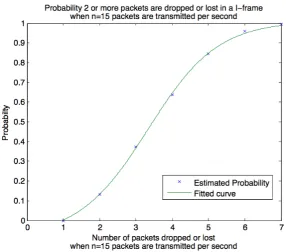
4.2 Estimated probabilities and the fitted sigmodal curve for VoIP traffic. . . 86
4.3 eQoS curves for VoIP traffic with varying values ofαandβ. . . 87
4.4 Estimated probabilites and the fitted sigmodal curve for audio traffic. . . 90
4.5 eQoS curves for audio streaming with varying values ofαandβ . . . 92
4.6 MOS decreases as audio streaming packets are lost. . . 92
4.8 Probability two or more packets are dropped in sequence from P frames as the
number of packets dropped or lost increases. . . 97
4.9 Average number of lost packets for the example whenw(PD+Pd)= 0.01 . . . . 100
4.10 Average number of lost packets for the example whenw(PD+Pd)= 0.05 . . . . 100
4.11 Average number of lost packets for the example whenw(PD+Pd)= 0.05 for the first 100 packets transmitted. . . 101
5.1 EDCA: AIFS and Backoff times withCWmin . . . 107
5.2 Probability a maximum of twoAC0s access the channel at the same time in the same slot for VoIP calls. . . 123
5.3 Probability a maximum of twoAC1s access the channel at the same time in the same slot for video streams. . . 124
5.4 Probability that one AC0 is transmitting at slot 0 for a range of CW sizes for bothAC0andAC1 . . . 125
5.5 Probability one AC1 is transmitting at slot 0 for a range ofCW sizes for both AC0 andAC1 . . . 126
5.6 Probability no transmissions occur at slot 0 for a range of CW sizes for both AC0 andAC1 . . . 127
5.7 Probability a collision occurs at slot 0 for a range ofCW sizes for both AC0 andAC1 . . . 128
5.8 Intersection of surfaces representingPc0andPe0 . . . 130
5.9 QQM algorithm flow chart. . . 134
5.10 eQoS Fuzzy Controller. . . 136
5.11 eQoS Error Input . . . 136
5.12 eQoS Derivative Sign Input . . . 137
5.13 Packet Delay Input . . . 138
5.14 Jitter Input . . . 139
5.16 Contention Window fuzzy controller. . . 142
5.17 Controller input error for CW0 and CW1 . . . 143
5.18 Controller input derivative sign for CW0 and CW1 . . . 144
5.19 Controller output for CW0 and CW1 . . . 145
5.20 The Queue Management System Flowchart . . . 146
6.1 IEEE802.11ac packet structure [6] . . . 157
6.2 Infrastructure wireless network used for the simulations. . . 160
6.3 PESQ MOS vs average eQoS for VoIP: Experiment 1 . . . 170
6.4 PESQ MOS vs average eQoS for VoIP: Experiment 2 . . . 171
6.5 Regression graph of PEAQ vs average eQoS for Audio Streaming . . . 173
6.6 Regression graph of PSNR vs average eQoS for Video Streaming . . . 175
6.7 Simulation results and traffic averages for 5 VoIP, 5 Audio and 5 Video streams, 5 TCP flows and a mix of 3 TCP and 2 UDP flows . . . 177
6.8 Simulation results and traffic averages for 10 VoIP, 5 Audio and 5 Video streams, 10 TCP flows and a mix of 5 TCP and 5 UDP flows . . . 180
6.9 Simulation results and traffic averages for 10 VoIP, 5 Audio and 5 Video streams, 6 TCP flows, 2 UDP flows and a mix of 5 TCP and UDP flows . . . 182
6.10 Simulation results and traffic averages for 10 VoIP, 5 Audio and 5 Video streams, 10 TCP flows, 5 UDP flows and a mix of 5 TCP and 5 UDP flows . . . 184
6.11 Simulation results and traffic averages for 20 VoIP, 10 Audio and 10 Video streams, 10 TCP flows, 5 UDP flows and a mix of 15 TCP and 5 UDP flows . . . 186
6.13 Simulation results for configurations 2 and 3 comparing the number of collisions
per second and the number of packets received per second for two systems: (i)
IEEE802.11ac with EDCA and (ii) the same system with the addition of the
contention window controller . . . 190
6.14 Simulation results for configurations 4 and 5 comparing the number of collisions
per second and the number of packets received per second for two systems: (i)
IEEE802.11ac with EDCA and (ii) the same system with the addition of the
contention window controller . . . 191
6.15 Simulation results for configurations 0 and 1 comparing the number of collisions
per second and the number of packets received per second for two systems: (i)
IEEE802.11ac with EDCA and (ii) the same system with the addition of both
the contention window and active eQoS controllers . . . 194
6.16 Simulation results for configurations 2 and 3 comparing the number of collisions
per second and the number of packets received per second for two systems: (i)
IEEE802.11ac with EDCA and (ii) the same system with the addition of both
the contention window and active eQoS controllers . . . 195
6.17 Simulation results for configurations 4 and 5 comparing the number of collisions
per second and the number of packets received per second for two systems: (i)
IEEE802.11ac with EDCA and (ii) the same system with the addition of both
the contention window and active eQoS controllers . . . 196
6.18 Real and Virtual lengths of Queue 0 and Queue 1 for the Configuration 0
Simu-lation . . . 197
6.19 Real and Virtual lengths of Queue 0 and Queue 1 for the Configuration 1
Simu-lation . . . 198
6.20 Real and Virtual lengths of Queue 0 and Queue 1 for the Configuration 2
Simu-lation . . . 199
6.21 Real and Virtual lengths of Queue 0 and Queue 1 for the Configuration 3
6.22 Real and Virtual lengths of Queue 0 and Queue 1 for the Configuration 4
Simu-lation . . . 201
6.23 Real and Virtual lengths of Queue 0 and Queue 1 for the Configuration 5
Simu-lation . . . 202
6.24 Comparison of the QoE of VoIP Flows at Wireless Nodes 1 and 7 for two
sys-tems: (i) IEEE802.11ac with EDCA and (ii) the same system with the addition
of QQM for the Configuration 5 Simulation . . . 205
6.25 Comparison of the QoE of VoIP Flows at Wireless Nodes 11 and 17 for two
sys-tems: (i) IEEE802.11ac with EDCA and (ii) the same system with the addition
of QQM for the Configuration 5 Simulation . . . 206
6.26 Comparison of the QoE of VoIP Flows at Wireless Nodeses 21 and 27 for two
systems: (i) IEEE802.11ac with EDCA and (ii) the same system with the
addi-tion of QQM for the Configuraaddi-tion 5 Simulaaddi-tion . . . 207
6.27 Comparison of the QoE of VoIP Flows at Wireless Nodes 31 and 37 for two
sys-tems: (i) IEEE802.11ac with EDCA and (ii) the same system with the addition
of QQM for the Configuration 5 Simulation . . . 208
6.28 Comparison of the QoE of VoIP Flows at Wireless Nodes 41 and 47 for two
sys-tems: (i) IEEE802.11ac with EDCA and (ii) the same system with the addition
of QQM for the Configuration 5 Simulation . . . 209
6.29 Comparison of QoE of audio and video unidirectional flows at Wireless Nodes
0 and 8 for two systems: (i) IEEE802.11ac with EDCA and (ii) the same system
with the addition of QQM for the Configuration 5 Simulation . . . 211
6.30 Comparison of QoE of audio and video unidirectional flows at Wireless Nodes10
and 18 for two systems: (i) IEEE802.11ac with EDCA and (ii) the same system
with the addition of QQM for the Configuration 5 Simulation . . . 212
6.31 Comparison of QoE of audio and video unidirectional flows at Wireless Nodes
20 and 28 for two systems: (i) IEEE802.11ac with EDCA and (ii) the same
6.32 Comparison of QoE of audio and video unidirectional flows at Wireless Nodes30
and 38 for two systems: (i) IEEE802.11ac with EDCA and (ii) the same system
with the addition of QQM for the Configuration 5 Simulation . . . 214
6.33 Comparison of QoE of audio and video unidirectional flows at Wireless Nodes
40 and 48 for two systems: (i) IEEE802.11ac with EDCA and (ii) the same
system with the addition of QQM for the Configuration 5 Simulation . . . 215
6.34 QoE of audio and video bidirectional Flows at Wireless Node 6 for two systems:
(i) IEEE802.11ac with EDCA and (ii) the same system with the addition of
QQM for the Configuration 5 Simulation . . . 218
6.35 QoE of audio and video bidirectional Flows at Wireless Node 9 for two systems:
(i) IEEE802.11ac with EDCA and (ii) the same system with the addition of
QQM for the Configuration 5 Simulation . . . 219
6.36 QoE of audio and video bidirectional Flows at Wireless Node 16 for two
sys-tems: (i) IEEE802.11ac with EDCA and (ii) the same system with the addition
of QQM for the Configuration 5 Simulation . . . 220
6.37 QoE of audio and video bidirectional Flows at Wireless Node 19 for two
sys-tems: (i) IEEE802.11ac with EDCA and (ii) the same system with the addition
of QQM for the Configuration 5 Simulation . . . 221
6.38 QoE of audio and video bidirectional Flows at Wireless Node 26 for two
sys-tems: (i) IEEE802.11ac with EDCA and (ii) the same system with the addition
of QQM for the Configuration 5 Simulation . . . 222
6.39 QoE of audio and video bidirectional Flows at Wireless Node 29 for two
sys-tems: (i) IEEE802.11ac with EDCA and (ii) the same system with the addition
of QQM for the Configuration 5 Simulation . . . 224
6.40 QoE of audio and video bidirectional Flows at Wireless Node 36 for two
sys-tems: (i) IEEE802.11ac with EDCA and (ii) the same system with the addition
6.41 QoE of audio and video bidirectional Flows at Wireless Node 39 for two
sys-tems: (i) IEEE802.11ac with EDCA and (ii) the same system with the addition
of QQM for the Configuration 5 Simulation . . . 226
6.42 QoE of audio and video bidirectional Flows at Wireless Node 46 for two
sys-tems: (i) IEEE802.11ac with EDCA and (ii) the same system with the addition
of QQM for the Configuration 5 Simulation . . . 227
6.43 QoE of audio and video bidirectional Flows at Wireless Node 49 for two
sys-tems: (i) IEEE802.11ac with EDCA and (ii) the same system with the addition
Chapter 1
Introduction
Almost all global information exchanges take place across the Internet and it is continuously
growing and evolving to meet the needs of its ever-expanding multitude of users. It allows
for the exchange of information via a wide-range of protocols, from simple file transfers and
more complex database related web services through to the delivery of key realtime services
like phone calls and video streaming.
The demand for continuity of access to information, regardless of the user’s location, has
encouraged the development and refinement of existing wireless technologies and protocols.
The volume of network traffic generated by laptops, tablets and mobile phones is continuously
increasing [1] [2] [3] and these are now key instruments for information exchange.
The information being transmitted is, itself, changing in nature. The focus is now on
re-altime data delivery as these services are one of the major drivers of network traffic growth in
terms of volume and the number of data flows [1] [2] [3]. Consequently, those developing new
wireless network technologies must consider customer satisfaction as a key aspect of their
pro-visioning policy. This is mainly due by economic factors: customers pay for these services and
Telephone Companies (TELCOs) compete for business by offering their users low cost, high
1.1
Context
Mobile communications are a core element of the services provided by modern TELCOs.
Mo-bile devices are a practical, economic mechanism for everyday communications in the home and
office. ISPs are interested in wireless technologies and their evolution, as they are seen as a key
element of their future service offerings. They are constantly seeking to develop and expand the
number and variety of wireless services they offer so as to increase the number of sources of
revenue available to them.
There are two main technologies that mobile, wireless devices use to access internet. The
first of these is cellular networking; for example, Fourth Generation (4G) phone networks [4]
or Worldwide Interoperability for Microwave Access (WiMax) [5] networks that use existing
protocols such as the Internet Protocol (IP) [5]. The second access method that is commonly used
employs wireless networking technologies based on the IEEE802.11 [5] family of protocols.
Wireless networks can form Local Area Networks (LAN) using High Throughput (HT)
wire-less protocols, while some lower throughput wirewire-less protocols form smaller Personal Area
Net-works (PAN). Wireless networking technologies are not limited to these settings and it should be
noted that it is equally possible to use wireless technologies to form the backbone or backhaul
of an access wireless network.
Future wireless networks, as heralded by the standardisation of Very High Throughput
(VHT) [6] in December 2013, are able to provide real time services that rival those on offer
on more expensive cellular networks. The widespread deployment of Quality of Service (QoS)
provision mechanisms and traffic management algorithms within these networks allow them to
provide mobile devices with access to the Internet at an almost negligible cost.
VHT [7] refers to the physical characteristics of the protocol with a larger channel than High
Throughput (HT) and, consequently, the ability to transmit data in the wireless channel at a
1.1.1 Quality of Service
The prevalence of wireless networks, and the mobile devices that use them, have forced TELCOs
to explore ways to provide realtime services to their customers with some form of quality
as-surance. In particular, TELCOs are seeking to improve the quality of the services provided,
the QoS, and the quality as assessed by the end-users of those services, the Quality of
Expe-rience (QoE). Users may make decisions on whether to use a service, or not, based on their
perceived QoE [8].
QoE [8] is a well-established means of determining customer satisfaction. It indicates if the
service is provided with “good” quality from the end-users perspective. Hence, TELCOs are
interested in monitoring QoE and in managing the traffic on their network so as to guarantee
their customers a high level of QoE.
TELCOs can easily measure the QoS through the physical network parameters.
Deteriora-tion of the network parameters indicates that the service is provided with low QoE. The challenge
is to find an easily calculated, instantaneous mechanism that captures the relationship between
QoE and the physical network parameters and a mechanism that uses this to adjust the network
parameters and improve the quality of the service delivered to the end user and, consequently,
the QoE.
1.1.2 Traffic Management
This thesis explores ways to manage the traffic in a wireless network effectively and efficiently.
The first mechanism employed to do this will be the regulation of channel access through traffic
prioritisation, the second will use Active Queue Management (AQM) [9] algorithms.
AQM [9] algorithms were introduced over twenty years ago as a congestion avoidance
mech-anism for use in router buffers. A key objective of most AQM schemes is to avoid the queue
becoming full by dropping selected packets as they arrive at the queue. Traditional buffering
sys-tems simply drop arriving packets when the queue is full as there is no place to store then. These
of the prevailing network conditions.
The key goal of all AQM schemes is to drop packets before the queue overflows [9]. This
signals traffic sources about the existence of network congestion and they respond by reducing
the packet arrival rate at the queue. AQM schemes can handle Transmission Control Protocol
(TCP) traffic, because the traffic throughput is regulated via acknowledgement packets sent to
the traffic source. On the other hand, User Datagram Protocol (UDP) traffic cannot be managed
in this way as, by definition, it does not respond to acknowledgements or packet drops [10].
These schemes have mainly been designed and implemented on wired networks and there
has been only limited exploration of how they may be successfully implemented on wireless
networks. Their use on wireless networks is complicated by the widely varying characteristics
of the traffic mix and the typically low traffic throughput observed on these networks [11] [12].
The benefits of AQM schemes are that they prevent and delay congestion, they can increase
fairness amongst traffic flows and they can control the throughput of traffic. From the point of
view of quality, they can help to manage physical network parameters; for example, they can
maximize throughput and reduce queueing delays. These improvements do not necessarily have
a knock-on effect on the delivery of QoE as network parameter improvements only have an
indirect impact on the QoE.
Traffic management schemes that are designed to provide specific QoE guarantees are
at-tractive for a number of reasons. For example, by improving the QoE it follows that the network
functionality will also improve; moreover, the network is protected from undesirable traffic and
any unfairness between flows is eliminated. In addition, QoE can provide network elements with
a form of feedback for unresponsive flows [13].
1.2
Motivation
This dissertation is motivated by three main technical and economic concerns: the provision of
high quality internet access that truly delivers on the performance promised by future wireless
offers an alternative to cellular systems and the financial desire to offer satisfactory, low cost
services to network users.
The evolution of network access methods, devices used and services required is well
docu-mented [1] [2] [3]. Wireless technologies are the most popular method of internet access, and
almost everyone has one or more mobile devices, such as a cell phone, tablet or laptop. Future
wireless protocols will soon become widely available on network devices for public use in the
home, office and wider environment. As inferred from [1] [2] [3], real-time communications
like phone calls, video calls and conferencing and more general audio and video streaming are
currently, and likely to remain, the dominant methods of communication.
Future wireless networks have the potential to offer the same services as cell phone networks
but on a network where local access points provide high quality internet connectivity. Such
networks could then provide services with a quality that is comparable to that of more expensive,
sophisticated cellular networks in terms of the available throughput, the cost and the geographic
spread of availability. This is most feasible in urban areas where the concentration of future
wireless network access points is likely to be most dense.
End users require the wireless services they are provided with to be of satisfactory quality
and, ideally, at minimal cost. If future wireless networks are to provide these services then it is
necessary to enhance the mechanisms for quality provision associated with them. In particular,
network traffic management systems need to extend beyond the provision of basic QoS to include
enhanced guarantees of end-user QoE.
The discussion above motivates the need to develop a system to optimise future wireless in
order to deliver their services with the highest quality possible and was the inspiration for the
work presented in this thesis.
1.3
Contribution
This thesis addresses the challenge of designing a system that is suitable for use in a typical
of this system relies on two core contributions of this thesis: the first is a metric to provide an
instantaneous estimate of the QoE at a node; the second is a theoretical model to predict some
key behaviours of future wireless networks.
The first contribution is the expected Quality of Service (eQoS) metric. It provides an
instan-taneous estimate of customer satisfaction. It is inferred at the node via per flow sampling. The
novelty is in the capability of eQoS to instantaneously capture the relationship between physical
network parameters and customer satisfaction.
The second contribution is a new practical, scalable theoretical model that captures packet
transmissions and collisions. It is a function of the future wireless network’s environmental
vari-ables. The novelty of the theoretical model is that it uses combinatorics to infer the probability
that, at a given node, the channel is idle, that a collision occurs or that a packet is transmitted.
Finally, the new traffic management algorithm, Quality Queue Management (QQM) exploits
eQoS and the theoretical model to control and maintain the quality of each flow in the system.
QQM has been designed for future wireless networks, but it is equally applicable to other high
throughput wireless networking systems. QQM’s novelty is in the way in which it is designed
to manage and exploit the interactions between the quality management features of the basic
priority queueing system and the channel access mechanisms deployed in multi-queue based
systems.
Four publications support the work developed in this thesis. The first two of these relate
to how existing AQM schemes can be successfully deployed in a wireless environment. In
particular, the first article [12] provides a clear articulation of how traffic prioritisation impacts
on wireless access point performance; while the second article sets out how existing queue
management algorithms need to be re-engineered for use in a wireless environment [11]. The
third publication [14] is of most relevance to this thesis as it is the first articulation of the eQoS
metric that forms one of the pillars on which the QQM algorithm is built. The fourth publication
[15] completes the contribution of this thesis including the theoretical model and the QQM
1.4
Outcomes
This thesis describes the design of an innovative traffic management system that draws on novel
elements presented in this work to provide its key functionalities.
The eQoS metric provides instantaneous estimates of the QoE. It will be shown that these
estimates are comparable to those obtained using popular automated perceived quality metrics.
The theoretical model will be shown to efficiently estimate the probabilities that the channel
is idle, that a packet is transmitted or that a collision occurs when the Enhanced Distributed
Channel Access (EDCA) method is used in the wireless network.
The QQM traffic management system can be implemented in all nodes that have access to
a wireless network. It is designed to be used in a future wireless networks; however, it can
also be applied in all wireless networking environments that use priority systems with multiple
queues and a scheduler to manage access to the channel. The QQM traffic management system
is structured so that it does not interfere with, or alter, the wireless networking protocol used
but rather it works to improve the protocol’s performance and enhance its delivery of a quality
service to the end user.
1.5
Structure of the Thesis
This section provides a detailed description of the structure of this thesis and of the topics
dis-cussed in the remaining chapters.
Chapter two details current wireless network technologies and future wireless networking
protocols [6] [16] [17]. The chapter also introduces channel access methods and real time
ser-vices, such as voice and video, on wireless networks.
The third chapter provides a detailed description of the state of the art, describing the
essen-tial underpinnings of this dissertation. The chapter is divided into three parts. The first provides
the necessary definitions and sets out the state of the art in relation to QoS [8]. Particular
atten-tion is paid to QoE [8] and its evaluaatten-tion in wireless networks. The second part of the chapter
wire-less network traffic and determine channel access contention. The last part of the chapter is a
thorough description of active queue management and its application in wireless networks.
Chapter four sets out the novel quality metric, eQoS. The chapter describes the
combinato-rial methods used to infer the eQoS for standard realtime services: Voice over IP (VoIP) [18],
audio and video traffic [19]. The chapter concludes with a discussion of possible application
scenarios for the formulas derived.
QQM and the theoretical model used to determine channel access priorities are detailed in
chapter five. This model, together with the eQoS metric, lies at the heart of the design of the
QQM algorithm.
Chapter six provides an evaluation of the algorithms and formulas detailed in chapters four
and five. It also includes a detailed description of the traffic mix, metrics and software platform
used for these evaluations. The results of simulations used to evaluate the eQoS metric are
presented and possible application scenarios for the theoretical model are explored. In addition,
the chapter presents an extensive exploration by simulation of a practical implementation of
QQM algorithm and its components. These results are compared with those obtained from a
traditional network that does not make use of QQM.
Chapter seven concludes this thesis, providing a summary of its contributions and
sugges-tions for future work.
1.6
Summary
This chapter provided a brief introduction to the central elements of this thesis. It discussed
the wireless network environments and the basics concepts underpinning Quality of Service and
Active Queue Management. The initial introduction was followed by a detailed description of
1.7
Publications
• PIBIRI, G., MCGOLDRICK, C. ANDHUGGARD, M. Ensuring quality services on WiFi networks for offloaded cellular traffic. InWireless On-demand Network Systems and
Ser-vices (WONS), 2017 13th Annual Conference on. IEEE, pp. 136-143.
• PIBIRI, G., MC GOLDRICK, C., AND HUGGARD, M. Expected Quality of Service (eQoS) a Network Metric for Capturing End-user Experience. InWireless Days (WD),
2012 IFIP (2012), IEEE, pp. 1–6.
• PIBIRI, G., MCGOLDRICK, C., ANDHUGGARD, M. Enhancing AQM performance on Wireless Networks. InWireless Days (WD), 2012 IFIP (2012), IEEE, pp. 1–3.
• PIBIRI, G., MCGOLDRICK, C.,ANDHUGGARD, M. Using Active Queue Management to Enhance Performance in IEEE802.11. In Proceedings of the 4th ACM workshop on
Performance monitoring and measurement of heterogeneous wireless and wired networks
Chapter 2
Wireless Networking and Real Time
Services
The increasing popularity, and growing capabilities, of mobile wireless communications devices
provides a strong motivation for the development of future wireless telecommunication systems.
These devices have rapidly overtaken desktop computers, home telephones and other
communi-cation devices that make use of wired connections [1] [2] [3].
The typical services provided by mobile wireless devices include telephony, video
confer-encing, media streaming and, of course, non real-time data. Telephone calls are usually provided
using VoIP [18] services, while audio and video are used for other services.
Mobile devices typically connect to the internet using Wide Area Network (WAN) and
Wireless Local Area Network (WLAN) technologies. WAN services may be delivered using
Third Generation (3G) [5] and 4G [4] mobile phone networks, or by WiMax [5] which is
in-cluded as one of the 4G standards in release 2 [4]. WLAN services are most often delivered by
the IEEE 802.11 standards that are collectively branded as WIreless FIdelity (WiFi) [5].
The newer WiFi protocols offer comparable performance per user to that of 4G technologies
[20] [21]. They form part of the future businesses model for TELCOs and it is anticipated that
motivates the key contribution of this thesis, namely the enhancement of the quality of service
and experience that will be offered by future WiFi protocols for realtime and critical services
like VoIP and video streaming.
A brief description of wireless internet access methods is provided below. This is followed
by a more detailed description of the IEEE802.11 protocol family and its evolution pathways.
Real time services used for everyday, everywhere communications are then detailed in the
con-cluding section of this chapter.
2.1
Wireless Mobile Networks
Today’s mobile devices typically connect to the internet using cellular and WiFi networks.
Mo-bile phone networks are now in their fourth generation, 4G. These are capable of achieving
download speeds of up to 1 Gbit/s. Current WiFi networks achieve a throughput performance of
up to 600 Mbit/s but in the next few years it is envisioned that they will rival 4G technologies in
terms of throughput and diffusion.
Mobile phone networks are a mix of legacy 2G and 3G technologies alongside the newer 4G
ones. 3G mobile devices mainly use Universal Mobile Telecommunications System (UMTS)
[5]. The other popular 3G standard is CDMA2000 [5] which operates in a similar way to UMTS.
High Speed Packet Access (HSPA) or HSPA+ (HSDPA advanced) are used in conjunction with
multiple access schemes, such as Wideband Code Division Multiple Access (W-CDMA), to
access the network. Communications between the mobile device or User Equipment (UE) and
the Base Station (BS), are generally duplexed using Frequency Division Duplex (FDD) [5].
3G systems typically operate around the 2.0 GHz frequency band, but this varies from country
to country depending on licensing agreements. Four QoS classes are provided: VoIP and audio
streaming are given the highest priority, then video streaming; while services that require a lower
priority, such as non-real time data transfer, are managed by the final two classes [5]. Of the two
lower priority classes, one is used for best effort traffic and the other for background traffic [5].
traffic is IP traffic only [22], thus TELCOs will offer IP services and effectively become Internet
Service Providers (ISPs). 4G networks offer similar service capabilities to those of existing WiFi
networks but they achieve higher performance in terms of quality assurance and the security
provided. Many telecommunications companies are repurposing their existing 3G architecture
to deliver 4G to their customers.
The technologies currently used for 4G are WiMax and Long Term Evolution Advanced
(LTE-A) [4]. WiMax is based upon the IEEE802.16 protocol [5]. IEEE802.16m is known as
WiMax Profile 2.0 and fits the 4G requirements [4]. It works in a frequency range from 450MHz
to 3.6 GHz [23] and communications are duplexed using Frequency Division Duplex (FDD)
and Time Division Duplex (TDD) over the digital encoding Orthogonal Frequency-Division
Multiplexing (OFDM). OFDM is also used for multi-user channel access. WiMax uses a time
slot based scheduler to manage channel access. Time slot allocations are managed by the base
station (BS) and used to control the QoS provided to the clients; hence it is necessary for the
mobile device to maintain an almost constant connection to the BS.
WiMax can be used in rural or low density population zones as a replacement for a wired
backhaul. IEEE802.16 [23] defines five QoS classes: a very high priority QoS class and the
four QoS classes specified for UMTS. WiMax achieves its best transfer rate when using 64
Quadrature Amplitude Modulation (QAM) with a channel width of 20MHz [24].
LTE Advanced [25] [22] is one of the few defined and tested wireless telecommunications
standards that meets 4G requirements. LTE Advanced introduces some new structural features
such as the use of Multiple Input Multiple Output (MIMO) [21] [26]. Section 2.1.4.1 of this
dissertation provides a more detailed description of MIMO. Communications are duplexed using
FDD and a mix of OFDMA and scalable FDMA for the uplink. LTE advanced includes other
features; for example, cognitive radio is used to optimise the radio communication parameters
2.1.1 WiFi Networks
The mobile phone technologies listed above provide network access for mobile devices. An
alternate means of network access is provided by WiFi. This has some advantages over cellular
networks. First of all it is much cheaper to deploy. At a minimum it requires a Digital Subscriber
Line (DSL) and a small router with a wireless interface as an Access Point (AP). It does not
require the installation of any pylons or antennas.
Secondly, WiFi can provided network access for each Small Office/Home Office (SOHO)
and can also be used for local or personal area network communications. Users are managed
locally and do not depend directly on TELCOs. This makes the network much easier to configure
and the associated costs are much lower than for mobile phone networks. This can be considered
a disadvantage for the TELCOs, as they lose direct commercial control over their customers. On
the other hand customers do not have access to direct support from the TELCOs.
WiFi uses the IEEE802.11 [5] family of protocols. They are backward compatible and this
gives the user the opportunity to choose between protocols that are best suited to their needs.
WiFi has many of the same features for quality assurance as a cellular phone network. The work
detailed in this thesis seeks to expand the quality assurance features of future wireless networks.
One architecture used to provide internet access for mobile devices is an infrastructure based
wireless network [5]. This is the most popular architecture and is used for both WiFi and cellular
networks and is illustrated in figure 2.1. In an infrastructure based wireless network mobile
nodes communicate directly with the AP or BS, and the AP acts as gateway between the wired
backhaul network and the wireless network. By contrast, in an ad hoc network architecture all
the mobile devices can communicate with each other without the need for a gateway node. This
is used for many mesh and sensor networks [5]. The nodes on the left hand side of figure 2.1
are wired nodes, and act as both traffic sources and destinations. The nodes on the right hand
side of figure 2.1 are mobile devices and these are also potential traffic destinations or sources.
For example, during a voice or video call a mobile phone will be both a source and a destination
Fig. 2.1: Infrastructure Wireless Network
The typical traffic sources are shown in figure 2.1. These include IP-based phone calls, audio
sources such as Internet radio and video.
The AP in an infrastructure wireless network has the potential to be a network bottleneck.
This occurs when the rate at which traffic arrives at the AP along the wired connection exceeds
the channel throughput available at the AP. This causes the queue length at the AP to grow until
it reaches its maximum value.
The theoretical maximum throughput [27] achieved by future wireless network protocols
will be comparable to the capacity of the wired link connecting the AP to the rest of the
net-work. However, this may not be sufficient to prevent congestion due to buffer overflow. This is
because the wireless channel is shared amongst the mobile stations and the available throughput
is reduced due to the use of collision avoidance mechanisms, see section 2.1.2, the number of
mobile devices connected to the network and the services provided by the network. From this it
can be concluded that the WiFi AP is a key network node where the traffic has to be carefully
managed.
An ad hoc wireless network without any communication link to other networks is an
Independent Basic Service Set (IBSS) [5]. When the wireless network can communicate with
other wireless networks it is known as a Basic Service Set (BSS). The backhaul of a wireless
backhaul the wired traffic is transported to and from the AP [5]. Multiple wireless networks can
be joined together, with the DS, creating an Extended Service Set (ESS) [5].
Wired links are typically full duplex and operate in both directions at the same time using
different physical cables; by contrast, mobile devices on a cellular network communicate in
both directions using FDD channels [5], while WiFi uses TDD for communication between the
mobile stations and the AP. Even when technologies like MIMO or MU-MIMO are used, see
sections 2.1.4.1 and 2.3.1, the communication is not full duplex.
In the following section a more detailed description of the protocols used in WiFi networks
is provided.
2.1.2 IEEE802.11 Protocols
IEEE802.11 [5] was standardised in 1997 and defines OSI layers 1 and 2 for wireless
commu-nication over the 2.4GHz frequency band. Its initial throughput of 1 Mbps was later extended to
2 Mbps and today’s variants achieve almost 7 Gbps.
IEEE 802.11 also specifies the following services: Station Services (SS) associated with a
mobile device and Distribution System Services (DSS) associated with an AP [5]. SS are
ser-vices such as authentication, deauthentication, privacy and MAC Service Data Unit (MSDU)
delivery [5]. DSS are similar to SS as, for example, they allow for association, disassociation,
distribution, integration, and re-association [5]. All these services are either provided with
spe-cial packets called beacons or inferred from normal communications via packet headers.
The most popular channel access method in IEEE802.11 is the Distributed Control
Func-tion (DCF) [5] [28] [29]. DCF uses Carrier Sense Multiple Access / Collision Avoidance
(CSMA/CA) to distribute traffic and avoid collisions between data packets. Before sending a
packet each station, including the AP, has to listen to the channel for a time called a Distributed
Inter Frame Spacing (DIFS). Each station that finds the channel idle after a DIFS has to wait
a random backoff time before starting to transmit. This backoff time depends on the size of
starts transmitting, all the other stations stop decrementing their backoff timers and wait until the
transmission is completed to continue decrementing their backoff timers. The channel is sensed
by each station every DIFS time. A the station can transmit when its backoff timer is zero and
the channel is idle. A collision occurs when two stations transmit simultaneously. In this case
theCWs of the colliding stations are doubled [5] [28] [29].
The alternative access method for IEEE802.11 uses a Point Coordination Function (PCF)
[30]. With PCF the AP is the coordinator and decides the time and the order in which every
station can transmit over the channel. As discussed in [30], PCF is not popular and it is usually
not implemented at the AP. A variety of enhancements to PCF have been developed to provide
quality assurance [31], but these are quite complex in nature and have not led to a rise in its
popularity.
Collision Avoidance [5] can be achieved by sending a Request To Send (RTS) packet and
then waiting for the destination node to respond with a Clear To Send (CTS) packet before the
transmission of a data packet. Each RTS and CTS packet is sent after an interval known as
a Short Inter Frame Spacing (SIFS). After the CTS packet is received, the station sends the
data packet. Data packet reception is confirmed to the source by the destination node using
Acknowledgement (ACK) packets. Once a data packet is received the destination waits a SIFS
interval before sending an ACK packet back to the source.
For backward compatibility control packets like RTS, CTS, ACK or ARP are sent at a lower
speed, usually 1Mbps, but their speed of transmission depends on the IEEE802.11 protocol
extension being used in the network.
In the following subsection the three of the earliest and most popular IEEE802.11 protocol
extensions are considered in more detail.
2.1.3 IEEE802.11a, b and g
The three protocols IEEE802.11a [32], IEEE802.11b [33] and IEEE802.11g [34] are extensions
of IEEE802.11 [5] [26]. Together with IEEE802.11n [21] these are the most widely used WLAN
market and because they are backward compatible with each other.
Other IEEE802.11 [5] extensions exist, but these often have a specific purpose such as the
provision of quality guarantees e.g. IEEE802.11e, or security e.g. IEEE802.11i, or because they
can work with special node architectures e.g. IEEE802.11s.
IEEE802.11a, b and g include CSMA for collision avoidance. This feature is optional, but it
is to be recommended if collisions between data packets are to be avoided.
IEEE802.11a [5] uses OFDM to transmit data on a 20 MHz channel. IEEE802.11a uses 48
subcarriers for data and 4 pilot carriers, giving a total of 52 subcarriers per channel on the 5 GHz
frequency band. On each carrier, it uses Binary Phase Shift Keying (BPSK), Quadrature Phase
Shift Keying (QPSK), 16-QAM or 64-QAM modulation. With 64-QAM it can use a 5/6 rate
encoder and a guard interval of 800 nanoseconds between symbols. IEEE802.11a has a spectral
efficiency of 2.7 bits per second per Hertz at the maximum speed of 54 Mbps on a 20 MHz
channel [26]. IEEE802.11a offers transmission at rates that vary between 6 Mbps and 54 Mbps.
IEEE802.11b [5] uses Complementary Code Keying (CCK) modulation on a 22 MHz
chan-nel at the frequency of 2.4 GHz. Its spectral efficiency is 0.5 bits per second per Hertz at the
maximum speed of 11Mbps [26]. IEEE802.11b achieves data rates from 5.5 Mbps to 11 Mbps.
IEEE802.11g [5] uses a 20MHz channel at the frequency of 2.4 GHz. Its spectral efficiency
is 2.7 bits per second per Hertz at a top speed of 54 Mbps [26]. IEEE 802.11g achieves the same
throughput as IEEE802.11a when OFDM is used. The data rates for IEEE802.11g vary between
1 Mbps to 54 Mbps. Rates of 22 Mbps and 33 Mbps can be achieved using 8 Phase-Shift
Keying (PSK) modulation.
These IEEE802.11 protocols have been superseded by IEEE802.11n and this is considered
in the following subsection.
2.1.4 IEEE802.11n
The final version of IEEE802.11n [21] [26] was released in September 2009. It not only
in-creases the available channel throughput but also includes features that improve efficiency and
MIMO and frame aggregation.
IEEE802.11n includes improvements to the physical layer. Like IEEE802.11a and g, it uses
a 20 MHz channel but it also introduces a 40 MHz channel [26]. A single 40 MHz channel
offers greater potential when compared to the simple aggregation of two 20 MHz channels. By
using a single 40 MHz channel, the stopband between the two aggregated 20 MHz channels can
be used for additional OFDM subcarriers to increase spectral efficiency [26]. 20 MHz channels
are used at 2.4 GHz and 5 GHz, while 40 MHz channels are usually used only at 5 GHz.
The method used to transmit data is OFDM. There are 52 subcarriers in a 20 MHz channel
and 108 subcarriers in a 40 MHz channel [26]. The modulation used to reach the maximum
throughput is 64 QAM with a 5/6 encoder rate. The maximum throughput is 65 Mbps in a 20
MHz channel and 135 Mbps in a 40 MHz channel. The throughput can be multiplied by the
number of transmitters, up to a maximum of four, using space division multiple access. This
gives the maximum throughput on a 20 MHz channel as 260 Mbps and on a 40 MHz channel as
540 Mbps [26]. Another important IEEE802.11n feature to increase the data transmission rate is
the reduction of the guard interval and symbol times to 400 nanoseconds and 3.6 microseconds
respectively.
The second innovative feature of IEEE802.11n is that it optimises the throughput by
aggre-gating frames [26]. MSDU or MAC Sublayer Protocol Data Unit (MPDU) frames can be joined
together and transmitted as a single large frame. A large frame resulting from the aggregation
of MSDUs has a single MAC header and tailer. A large frame resulting from the aggregation
of MPDUs has one MAC header and one trailer for each MPDU. All large frames have a single
Layer 1 header. For both frame aggregation methods a block acknowledgement feature is
avail-able [26]. This returns a single acknowledgement frame for each aggregate frame, avoiding the
need for a single acknowledgement per frame.
There are two disadvantages associated with frame aggregation [26]. First of all, MSDU
frames can only be aggregated if they have the same destination; this is not the case for MPDU
frame aggregation. If the number of mobile stations sharing the network is large then it is
aggre-gation is the large number of frames lost if a single large frame is damaged or not received at the
destination. This disadvantage is more evident when the collision avoidance feature is not used
as a whole frame is lost if a collision occurs.
Both frame aggregation and block acknowledgement are not considered in this thesis for
two reasons. First of all, the system proposed in this work does not include features to improve
the throughput introduced by the protocol. Secondly, the number of mobile stations involved in
the network simulations is large and so it is unlikely that any of the queues contain packets to
be sent to the same destination in sequence. When packets to the same destination are not in
sequence in the queue the frame aggregation and block acknowledgement features are inefficient
and effectively useless.
IEEE802.11n also includes a power saving feature that is useful for constrained mobile
de-vices. The feature switches the radio frequency transmitters on and off, either dynamically or
statically, reducing the power used at the transmitter [26].
Like the other members of this protocol family, IEEE802.11n is backward compatible.
IEEE802.11n permits different modulations for each spatial stream on the 2.4 GHz frequency
band, the legacy preamble and header are managed so as to avoid reception by mobile devices
that use older standards. Backward compatibility is not needed if the frequency band used is 5
GHz, and so IEEE802.11n operates on this band using a 40 MHz channel [26].
The increased throughput of IEEE802.11n does not mean that the bottleneck between wired
and wireless networks at the AP no longer exists. Using wireless standards with high, or very
high throughput, for example IEEE802.11ac [6], the bottleneck is likely to exist because the
wired backhaul capacity is almost always greater than the throughput available on the channel.
The wired throughput, the huge number of mobile devices connected to the access point and
services available on wireless networks all combine to create a bottleneck at the AP.
The other advantage of IEEE802.11n is that it uses MIMO. As this technology is used by
2.1.4.1 MIMO
Multiple Input Multiple Output (MIMO) [21] [26] technology incorporates multiple
transmit-ters and receivers in the same device. The goal of MIMO is to increase the Signal-to-Noise
Ra-tio (SNR), so it is particularly suited for environments where radio communicaRa-tions are difficult;
for example, due to the presence of radio noise. MIMO was designed to overcome problems
as-sociated with multipath propagation and reflections, thereby increasing the available throughput
on the wireless network.
MIMO achieves different objectives depending on the number of transmitters and receivers
used and their configurations. When the number of transmitters is greater than the number of
receivers, MIMO can be configured in four modes. The antenna selection configuration chooses
the best antenna for transmission based on packet error measurements. Transmit beamforming
adjusts the transmitted signals giving rise to improvements in the SNR. Cyclic delay diversity
configures the transmitter to send a copy of the same signal on each antenna using different
subcarrier frequencies, but the SNR improvements achieved are not that significant. Space time
block coding is when blocks of data are sent by different transmitter antennas but in different
orders [26].
Using multiple transmitters and receivers, MIMO can be configured to achieve space
divi-sion multiplexing. This gives rise to a significant increase in the throughput by using a different
spatial stream for each antenna [26].
MIMO can be configured as an equaliser when the number of antennas at the receiver
ex-ceeds the number of transmitters. In this mode the receiver combines multiple signals to improve
the SNR [26].
MIMO provides improvements in throughput, radio signal reception and bit errors. This
dissertation focuses on channel access improvements and the management of packet scheduling
on a theoretical error free channel, therefore MIMO is not considered. On the other hand the
improvements introduced by MIMO are likely to be beneficial to the system proposed in this
In the next section the quality improvements achieved by the IEEE802.11e protocol are
detailed.
2.2
IEEE802.11e
IEEE802.11e [35] [36] is an amendment to the standard that redesigned the OSI Layer 2 of the
IEEE802.11 protocol to enhance QoS.
The IEEE802.11a, b and n protocols considered above, all manage traffic using a single
queue. In particular, they do not split the traffic into separate macro-categories and they do not
use multiple queues or priorities. IEEE802.11e improves upon the two coordination functions
DCF and PCF [5] by using Class of Service (CoS) [37] to manage traffic priorities. CoS is a
tech-nique developed to split the traffic into separate macro-categories, each of which is associated
with a specific queue and a specific priority.
A new coordination function, called the Hybrid Coordination Function (HCF) [35] [38] is
used to define two new channel access schemes: EDCA and HCF Controlled Channel Access
(HCCA). The traffic is split into Traffic Categories (TC) and each TC is managed in a queue
that has an associated priority for access to the channel. EDCA is an improvement of DCF and
it manages four traffic CoS. HCCA [35] [38] evaluates the services and sessions associated with
each mobile device in order to coordinate channel access. It also considers QoS parameters
when managing channel access. HCCA is more complex than EDCA and is a very efficient
algorithm in terms of the QoS achieved.
EDCA utilises four Access Categories [35]:AC0,AC1,AC2andAC3. Each AC is defined
as a collection of parameters that characterise a queue and regulate the channel access priority.
Each AC has an associated queue:Q0,Q1,Q2andQ3. These queues store packets prior to their
transmission on the wireless channel.
The first Access Category (AC) [35],AC0, also calledACV O, has highest priority; it is used
for voice and audio traffic. Q0is the queue associated withAC0. The second AC isAC1, also
Access Category CW min CW max TXOP AIF SN Type of traffic
AC0(AC_VO) 3 7 1.504ms 2 voice and audio
AC1(AC_VI) 7 15 3.008ms 2 video
AC2(AC_BE) 15 1023 0 3 best effort
AC3(AC_BK) 15 1023 0 7 background
Table 2.1: Summary of AC parameters [35]
Q1 is the queue associated withAC1. The third AC isAC2, also calledACBE. It has a lower
priority thanAC1. It is used for traffic that requires best effort; for example, telnet sessions or
database access. Q2 is the queue associated withAC2. The last AC isAC3. AC3 manages the
background traffic and is also known asACBK. It has the lowest priority. It handless traffic such
as that generated by file transfers and web browsers. The queue associated withAC3 isQ3.
For each AC queue EDCA controls access to the channel using a backoff time [35], a CW
that is set to be between a minimum and maximum value and an Arbitration Inter-Frame Space
(AIFS) Number (AIFSN). The backoff time is a randomly chosen number of time slots between
0 and the minimal contention window,CWmin. Every AC has a differentCWminas shown in
table 2.1. TheCW is doubled every time a collision occurs between transmitted packets. The CW can increase up to the value ofCWmax.
EachAC has a specific Arbitration Inter-Frame Space (AIFS) [35]. AIF S(i)is the AIFS associated with access categoryACiwhere, for example,i= 1,2,3,4. The AIFS is the interval
between frame transmissions, it replaces the DIFS used in IEEE802.11 and varies depending on
priority. AIFS is calculated by the formula [35]:
AIF S[AC] =AIF SN[AC]×SlotT ime+SIF S. (2.1)
The AC with highest priority has the lowest CW and AIFS Number, therefore it is more likely
to access the channel before any other AC.
User Priority Access Category Type of traffic
1 AC_BK Background
2 AC_BK Background (Spare)
0 AC_BE Best Effort
3 AC_BE Best Effort (Excellent Effort)
4 AC_VI Video (Controlled Load)
5 AC_VI Video
6 AC_VO Voice
7 AC_VO Voice (Network Control)
Table 2.2: Summary of AC map between 7 and 4 ACS [35] [39]
When an AC has access to the channel, transmission is not limited to a single packet, rather packets are transmitted for an interval of length TXOP, separated by a SIFS. Table 2.1
sum-marises the most commonly defined parameters for eachAC 1. While table 2.2 shows how the
fourACs can be remapped to the seven CoS defined in 802.1d [35] [39] and vice versa. These parameters are re-purposed for the IEEE802.11ac [6] protocol.
IEEE802.11e also allows for Automatic Power Save Delivery (APSD) [40] [35] to reduce
en-ergy consumption. After the end of a service interval a station automatically switches into sleep
mode until the start of the next service period. Service intervals may follow a predetermined
schedule or may be triggered by the AP. The block acknowledgement, defined in IEEE802.11n,
is also defined in IEEE802.11e to turn off acknowledgements. It is also possible to save time
and throughput if the service does not require feedback and packet retransmission.
In the next section the main features of the two IEEE802.11 protocols that are likely to
dominate future wireless networks are detailed.
1http://www.ieee802.org/1/files/public/docs2008/avb-gs-802-11-qos-tutorial-1108.
2.3
IEEE802.11ac
IEEE802.11ac [6] was approved in December 2013. This very powerful standard significantly
increases throughput on WiFi networks and, in conjunction with the existing EDCA standard, is
able to provide high quality performance. The actual IEEE802.11ac release is draft 3.0.
IEEE802.11ac is backward compatible with the existing popular standards IEEE802.11a, b,
g and n. It operates in the 5 GHz frequency band, and will include most of the important features
of its predecessors.
In contrast to IEEE802.11n, IEEE802.11ac increases the available channel sizes to 80MHz
and 160MHz. These 80MHz and 160MHz channels use a single spatial stream, while more
spa-tial streams are optional. The modulation used is 256-QAM, 3/4 and 5/6; whereas IEEE802.11n
uses 64-QAM, 5/6. Binary Convolutional Coding (BCC) is used to correct the errors at the
re-ceiver and Space-Time Block Coding (STBC) is used to improve transmission by sending
mul-tiple copies of the frame for each antenna. The throughput achieved goes from 780 Mbit/s for
a 160 MHz channel and single antenna up to a maximum of around 7 Gbit/s [7] when multiple
antennas are used.
IEEE802.11ac includes MIMO and also introduces the concept of Multi User - Multi Input
Multi Output (MU-MIMO). As MU-MIMO is not specific to IEEE802.11ac it will be considered
separately in section 2.3.1 below.
Most of the Layer 2 features of IEEE802.11n are included in IEEE802.11ac. These include
TXOP, aggregation of MSDUs and MPDUs together with a substantial increase in the maximum
frame size and CSMA/CA to avoid packet collision. The high speed data transmission achieved
by IEEE802.11ac contrasts with the low speed of the PPDU headers, as shown in [6] and [7],
making RTS and CTS control packets extremely onerous and costly in terms of throughput.
This is because RTS and CTS packets are backward compatible and so their transmission time
is comparable to that needed for much larger data packets. For this reason, this thesis does not
use RTS and CTS packets. In addition, the algorithm proposed in this dissertation makes RTS
For this dissertation the 160MHz channel is considered to have a throughput of 780 Mbit/s
for packet transmission using Single Input and Single Output (SISO). As discussed in section
2.1.4, Block Acknowledgment (BA) can be used for a sequence of frames with the same
destina-tion. However, such sequences are unlikely if the number of mobile stations sharing the network
is large and so the BA feature will not be implemented and used in this work. In the wireless
configuration considered in this thesis all mobile nodes and access points use the IEEE802.11ac
standard. The technical specifications of the IEEE802.11ac protocol, including VHT, packet
structure, etc., are given in [7] and [6].
As detailed in section 2.2, QoS enhancements for wireless networks are specified in
IEEE802.11e [35]. However, this discussion would not be complete without mention of two
other amendments that focus on improving quality: IEEE802.11aa [17] and IEEE802.11ae [16].
IEEE802.11aa [41] [42] [17] introduces specific features to improve the delivery of video
and audio streams over a wireless network.
One of these features is Groupcast with Retries (GCR). This feature mainly concerns
broad-cast traffic and makes it possible to deliver one media streaming to multiple recipients [41].
The intra-access category prioritisation feature introduces two more ACs for video and audio:
the Alternate Voice (A_VO) and Alternate Video (A_VI) classes [41]. A Stream Classification
Service (SCS) acts to arbitrarily map the media to these new ACs [41]. While these features
are beyond the scope of this work, they could be used to extend the functionality of the system
proposed in this dissertation.
Overlapping Basic Service Set (OBSS) management [41] is another IEEE 802.11aa feature,
but it is not relevant for this thesis as it is mainly concerned with the physical layer. The other
key feature to mention is the Stream Reservation Protocol (SRP) [41]. This assigns network
resources to deliver the media stream with better quality. This feature requires advance
config-uration and, unlike the system proposed in this thesis, it does not actively follow changes in the
traffic.
IEEE802.11ae [16] [41] uses the QoS Management Frame (QMF) procedure to prioritise
beacon or frame exchanges to prioritise frames. In this thesis control packets will be prioritised
for all mobile stations and the AP. This is in agreement with the IEEE802.11ae protocol and so
this amendment does not affect the results presented in this work.
In order to conclude this overview of the IEEE802.11 family of protocols it is
neces-sary to discuss the functionality and key features of the extended version of MIMO used by
IEEE802.11ac, i.e. MU-MIMO. This is included in the subsection below.
2.3.1 MU-MIMO
IEEE802.11ac makes use of Multi User - MIMO (MU-MIMO) [43] [7]. To be more specific,
IEEE802.11ac implements DownLink MU-MIMO (DL MU-MIMO). DL MU-MIMO uses
dif-ferent spatial streams to transmit to difdif-ferent mobile stations at the same time. By contrast, the
mobile stations cannot communicate simultaneously with the AP, rather they transmit one at a
time.
In Layer 1, MU-MIMO [44] mixes beamforming and energy optimisation, known as Null
Steering, to optimise transmission to a specific mobile station and multiple communications with
a number of mobile stations.
One of the key features of MU-MIMO is at layer 2 where this thesis focusses on. MU-MIMO
applies TXOP at Layer 2. TXOP transmission of multiple frames is permitted only between
mobile devices with the same AC. A mechanism for improving TXOP between different ACs
has been proposed [43]: the AC that has the opportunity to use the TXOP can share the TXOP
simultaneously with other ACs.
Even though MU-MIMO provides significant improvements for multiple transmission, it
was not made available in the early releases of IEEE802.11ac compatible devices [44].
2.4
Wireless Network Services
Everyday communications involving mobile devices typically make use of a wide variety of
![Fig. 2.4: Structure of the MPEG Group Of Pictures [67]. I Frames are in black, B Frames are in](https://thumb-us.123doks.com/thumbv2/123dok_us/1506034.691772/53.595.189.454.234.530/fig-structure-mpeg-group-pictures-frames-black-frames.webp)
![Fig. 3.2: RED probability distribution [121]](https://thumb-us.123doks.com/thumbv2/123dok_us/1506034.691772/76.595.156.474.120.378/fig-red-probability-distribution.webp)