Reducing Sparsity Improves the Recognition of Implicit Discourse
Relations
Junyi Jessy Li
University of Pennsylvania [email protected]
Ani Nenkova
University of Pennsylvania [email protected]
Abstract
The earliest work on automatic detec-tion of implicit discourse reladetec-tions relied on lexical features. More recently, re-searchers have demonstrated that syntactic features are superior to lexical features for the task. In this paper we re-examine the two classes of state of the art representa-tions: syntactic production rules and word pair features. In particular, we focus on the need to reduce sparsity in instance repre-sentation, demonstrating that different rep-resentation choices even for the same class of features may exacerbate sparsity issues and reduce performance. We present re-sults that clearly reveal that lexicalization of the syntactic features is necessary for good performance. We introduce a novel, less sparse, syntactic representation which leads to improvement in discourse rela-tion recognirela-tion. Finally, we demonstrate that classifiers trained on different repre-sentations, especially lexical ones, behave rather differently and thus could likely be combined in future systems.
1 Introduction
Implicit discourse relations hold between adjacent sentences in the same paragraph, and are not sig-naled by any of the common explicit discourse connectives such asbecause,however,meanwhile, etc. Consider the two examples below, drawn from the Penn Discourse Treebank (PDTB) (Prasad et al., 2008), of a causal and a contrast relation, re-spectively. The italic and bold fonts mark the ar-guments of the relation, i.e the portions of the text connected by the discourse relation.
Ex1: Mrs Yeargin is lying. [Implicit = BECAUSE]They found students in an advanced class a year earlier who said she gave them similar help.
Ex2:Back downtown, the execs squeezed in a few meetings at the hotel before boarding the buses again.[Implicit = BUT]
This time, it was for dinner and dancing - a block away. The task is undisputedly hard, partly because it is hard to come up with intuitive feature represen-tations for the problem. Lexical and syntactic fea-tures form the basis of the most successful stud-ies on supervised prediction of implicit discourse relations in the PDTB. Lexical features were the focus of the earliest work in discourse recogni-tion, when cross product of words (word pairs) in the two spans connected via a discourse re-lation was studied. Later, grammatical produc-tions were found to be more effective. Features of other classes such as verbs, inquirer tags, posi-tions were also studied, but they only marginally improve upon syntactic features.
In this study, we compare the most commonly used lexical and syntactic features. We show that representations that minimize sparsity issues are superior to their sparse counterparts, i.e. the bet-ter representations are those for which informative features occur in larger portions of the data. Not surprisingly, lexical features are more sparse (oc-curring in fewer instances in the dataset) than syn-tactic features; the superiority of synsyn-tactic repre-sentations may thus be partially explained by this property.
More surprising findings come from a closer ex-amination of instance representation approaches in prior work. We first discuss how choices in prior work have in fact exacerbated the sparsity problem of lexical features. Then, we introduce a new syntactically informed feature class, which is less sparse than prior lexical and syntactic fea-tures, and improves significantly the classification of implicit discourse relations.
Given these findings, we address the question if any lexical information at all should be pre-served in discourse parsers. We find that purely syntactic representations show lower recognition
for most relations, indicating that lexical features, albeit sparse, are necessary for the task. Lexical features also account for a high percentage of the most predictive features.
We further quantify the agreement of predic-tions produced from classifiers using different in-stance representations. We find that our novel syn-tactic representation is better for implicit discourse relation prediction than prior syntactic feature be-cause it has higher overall accuracy and makes correct predictions for instances for which the al-ternative representations are also correct. Differ-ent represDiffer-entation of lexical features however ap-pear complementary to each other, with markedly higher fraction of instances recognized correctly by only one of the models.
Our work advances the state of the art in implicit discourse recognition by clarifying the extent to which sparsity issues influence predictions, by in-troducing a strong syntactic representation and by documenting the need for further more complex integration of lexical information.
2 The Penn Discourse Treebank
The Penn Discourse Treebank (PDTB) (Prasad et al., 2008) contains annotations for five types of discourse relations over the Penn Treebank corpus (Marcus et al., 1993). Explicitrelations are those signaled by a discourse connective that occurs in the text, such as “because”, “however”, “for ex-ample”. Implicit relations are annotated between adjacent sentences in the same paragraph. There are no discourse connectives between the two sen-tences, and the annotators were asked to insert a connective while marking their senses. Some pairs of sentences do not contain one of the explicit dis-course connectives, but the insertion of a connec-tive provides redundant information into the text. For example, they may contain phrases such as “the consequence of the act”. These are marked
Alternative Lexicalizations(AltLex). Entity rela-tions(EntRel) are adjacent sentences that are only related via the same entity or topic. Finally, sen-tences where no discourse relations were identi-fied were markedNoRel. In this work, we consider
AltLexto be part of theImplicitrelations, and En-tRelto be part ofNoRel.
All connectives, either explicit or implicitly in-serted, are associated with two arguments of the minimal span of text conveying the semantic con-tent between which the relation holds. This is
il-lustrated in the following example where the two arguments are marked in bold and italic:
Ex:They stopped delivering junk mail.[Implicit = SO]Now thousands of mailers go straight into the trash.
Relation senses in the PDTB are drawn from a 3-level hierarchy. The top level relations are
Comparison(arg1 and arg2 holds a contrast rela-tion),Contingency(arg1 and arg2 are causally re-lated),Expansion(arg2 further describes arg1) and
Temporal(arg1 and arg2 are temporally related). Some of the largest second-tier relations are under
Expansion, which includeConjunction(arg2 pro-vides new information to arg1),Instantiation(arg2 exemplifies arg1) andRestatement(arg2 semanti-cally repeats arg1).
In our experiments we use the four top level re-lations as well as the above three subclasses of Ex-pansion. All of these subclasses occur with fre-quencies similar to those of the Contingency and Comparison classes, with thousands of examples in the PDTB.1 We show the distribution of the classes below:
Temporal 1038 Comparison 2550 Contingency 4532 Instantiation 1483 Restatement 3271 Conjunction 3646 EntRel/NoRel 5464
3 Experimental settings
In our experiments we use only lexical and syntac-tic features. This choice is motivated by the fact that lexical features have been used most widely for the task and that recent work has demon-strated that syntactic features are the single best type of representation. Adding additional features only minimally improves performance (Lin et al., 2009). By zeroing in only on these classes of fea-tures we are able to discuss more clearly the im-pact that different instance representation have on sparsity and classifier performance.
We use gold-standard parses from the original Penn Treebank for syntax features.
To ensure that our conclusions are based on analysis of the most common relations, we train binary SVM classifiers2for the seven relations de-scribed above. We adopt the standard practice in 1All other sub-classes of implicit relations are too small
for general practical applications. For example the Alterna-tiveclass andConcessionclass have only 185 and 228 oc-currences, respectively, in the 16,224 implicit relation anno-tations of the PDTB.
prior work and downsampled the negative class so the number of positive and negative samples are equal in the training set.3
Our training set consists of PDTB sections 2-19. The testing set consists of sections 20-24. Like most studies, we do not include sections 0-1 in the training set. We expanded the test set (sections 23 or 23-24) used in previous work (Lin et al., 2014; Park and Cardie, 2012) to ensure the number of examples of the smaller relations, particularly of
TemporalorInstantiation, are suitable for carrying out reliable tests for statistical significance.
Some of the discourse relations are much larger than others, so we report our results in term of F-measure for each relation and average unweighted accuracy. Significance tests over F scores were carried out using a paired t-test. To do this, the test set is randomly partitioned into ten groups. In each group, the relation distribution was kept as close as possible to the overall test set.
4 Sparsity and pure lexical representations
By far the most common features used for rep-resenting implicit discourse relations are lexical (Sporleder and Lascarides, 2008; Pitler et al., 2009; Lin et al., 2009; Hernault et al., 2010; Park and Cardie, 2012). Early studies have sug-gested that lexical features, word pairs (cross-product of the words in the first and second ar-gument) in particular, will be powerful predictors of discourse relations (Marcu and Echihabi, 2002; Blair-Goldensohn et al., 2007). The intuition hind word pairs was that semantic relations be-tween the lexical items, such as drought–famine,
child–adult, may in turn signal causal or contrast discourse relations. Later it has been shown that word pair features do not appear to capture such semantic relationship between words (Pitler et al., 2009) and that syntactic features lead to higher ac-curacies (Lin et al., 2009; Zhou et al., 2010; Park and Cardie, 2012). Recently, Biran and McKeown (2013) aggregated word pair features with explicit connectives and reported improvements over the original word pairs as features.
In this section, we show that the representation of lexical features play a direct role in feature spar-sity and ultimately affects prediction performance. The first two studies that specifically addressed 3We also did not include features that occurred less than
5 times in the training set.
# Features Avg. F Avg. Accuracy
word-pairs 92128 29.46 57.22
[image:3.595.308.523.62.93.2]binary-lexical 12116 31.79 60.42
Table 1: F-scores and average accuracies of paired and binary representations of words.
the problem of predicting implicit discourse re-lations in the PDTB made use of very different instance representations. Pitler et al. (2009) rep-resent instances of discourse relations in a vec-tor space defined by word pairs, i.e. the cross-product of the words that appear in the two argu-ments of the relation. There, features are of the form(w1, w2)wherew1 ∈ arg1andw2 ∈arg2. If there areN words in the entire vocabulary, the size of each instance would beN ×N.
In contrast, Lin et al. (2009) represent instances by tracking the occurrences of grammatical pro-ductions in the syntactic parse of argument spans. There are three indicator features associated with each production: whether the production appears in arg1, in arg2, and in both arguments. For a grammar withN production rules, the size of the vector representing an instance will be 3N. For convenience we call this “binary representation”, in contrast to the word-pair features in which the cross product of words constitute the representa-tion. Note that the cross-product approach has been extended to a wide variety of features (Pitler et al., 2009; Park and Cardie, 2012). In the ex-periments that follow we will demonstrate that bi-nary representations lead to less sparse features and higher prediction accuracy.
Lin et al. (2009) found that their syntactic tures are more powerful than the word pair fea-tures. Here we show that the advantage comes not only from the inclusion of syntactic information but also from the less sparse instance representa-tion they used for syntactic features. In Table 1 we show the number of features for each repre-sentation and the average F score and accuracy for word pairs and words with binary representation (binary-lexical). The results for each relation are shown in Table 8 and discussed in Section 7.
Using binary representation for lexical informa-tion outperforms word pairs. Thus, the difference in how lexical information is represented accounts for a considerable portion of the improvement re-ported in Lin et al. (2009). Most notably, for the
translates into 2.34% absolute improvement in F-score and 3.2% absolute improvement in accuracy. From this point on we adopt the binary represen-tation for the features discussed.
5 Sparsity and syntactic features
Grammatical production rules were first used for discourse relation representation in Lin et al. (2009). They were identified as the most suitable representation, that lead to highest performance in a couple of independent studies (Lin et al., 2009; Park and Cardie, 2012). The comparison repre-sentations covered a number of semantic classes related to sentiment, polarity and verb information and dependency representations of syntax.
Production rules correspond to tree chunks in the constituency parse of a sentence, i.e. a node in the syntactic parse tree with all of its children, which in turn correspond to grammar rules ap-plied in the derivation of the tree, such as S→NP VP. This syntactic representation subsumes lexi-cal representations because of the production rules with part-of-speech on the left-hand side and a lex-ical item on the right-hand side.
We propose that the sparsity of production rules can be reduced even further by introducing a new representation of the parse tree. Specifically, in-stead of having full production rules where a sin-gle feature records the parent and all its children, all (parent,child) pairs in the constituency parse tree are used. For example, the rule S→NP VP will now become two features, S→NP and S→VP. Note that the leaves of the tree, i.e. the part-of-speech→word features are not changed. For ease of reference we call this new representation “pro-duction sticks”. In this section we show that F scores and accuracies for implicit discourse rela-tion predicrela-tion based on producrela-tion sticks is sig-nificantly higher than using full production rules.
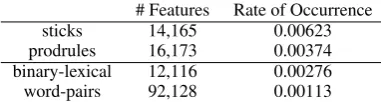
First, Table 2 illustrates the contrast in sparsity among the lexical, production rule and stick repre-sentations. The table gives the rate of occurrence of each feature class, which is defined as the av-erage fraction of features with non-zero values in the representation of instances in the entire train-ing set. Specifically, letN be the total number of features,mibe the number of features triggered in
instancei, then the rate of occurrence is mi
N .
The table clearly shows that the number of fea-tures in the three representations is comparable, but they vary notably in their rate of occurrence.
# Features Rate of Occurrence
sticks 14,165 0.00623
prodrules 16,173 0.00374
binary-lexical 12,116 0.00276
[image:4.595.316.507.62.113.2]word-pairs 92,128 0.00113
Table 2: Number of features and rate of occur-rence for binary lexical representation, production rules and sticks.
Avg. F Avg. Accuracy
sticks 34.73 64.89
prodrules 33.69 63.55 binary-lexical 31.79 60.42 word-pairs 29.46 57.22
Table 3: F-scores and average accuracies of pro-duction rules and propro-duction sticks.
Sticks have almost twice the rate of occurrence of that of full production rules. Both syntactic rep-resentations have much larger rate of occurrence than lexical features, and the rate of occurrence of word pairs is more than twice smaller than that of the binary lexical representation.
Next, in Table 3, we give binary classifica-tion predicclassifica-tion results based on both full rules and sticks. The first two rows of Table 3 com-pare full production rules (prodrules) with produc-tion sticks (sticks) using the binary representation. They both outperform the binary lexical represen-tation. Again our results confirm that the better performance of production rule features is partly because they are less sparse than lexical represen-tations, with an average of 1.04% F-score increase. Individually the F scores of 6 of the 7 relations are improved as shown in Table 8.
6 How important are lexical features? Production rules or sticks include lexical items with their part-of-speech tags. These are the sub-set of features that contribute most to sparsity is-sues. In this section we test if these lexical fea-tures contribute to the performance or if they can be removed without noticeable degradation due to its intrinsic sparsity. It turns out that it is not ad-visable to remove the lexical features entirely, as performance decreases substantially if we do so.
6.1 Classification without lexical items
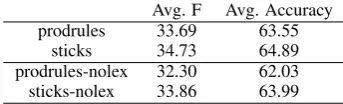
Avg. F Avg. Accuracy
prodrules 33.69 63.55
sticks 34.73 64.89
[image:5.595.337.489.61.144.2]prodrules-nolex 32.30 62.03 sticks-nolex 33.86 63.99
Table 4: F-scores and average accuracies of pro-duction rules and sticks, with (rows 1-2) and with-out (rows 3-4) lexical items.
# Features Rate of Occurrence
prodrules 16,173 0.00374
sticks 14,165 0.00623
prodrules-nolex 3470 0.00902
sticks-nolex 922 0.0619
Table 5: Number of features and rate of occur-rence for production rules and sticks, with (rows 1-2) and without (rows 3-4) lexical items.
scores and accuracies. Table 8 provides detailed results for individual relations. Here prodrules-nolexandsticks-nolexdenote full production rules without lexical items, and production sticks with-out lexical items, respectively. In all but two re-lations, lexical items contribute to better classifier performance.
When lexical items are not included in the rep-resentation, the number of features is reduced to fewer than 30% of that in the original full produc-tion rules. At the same time however, including the lexical items in the representation improves performance even more than introducing the less sparse production stick representation. Production sticks with lexical information also perform bet-ter than the same representation without the POS-word sticks.
The number of features and their rates of occur-rences are listed in Table 5. It again confirms that the less sparse stick representation leads to better classifier performance. Not surprisingly, purely syntactic features (without the lexical items) are much less sparse than syntax features with lexical items present. However the classifier performance is worse without the lexical features. This contrast highlights the importance of a reasonable tradeoff between attempts to reduce sparsity and the need to preserve lexical features.
6.2 Feature selection
So far our discussion was based on the behavior of models trained on a complete set of relatively frequent syntactic and lexical features (occurring more than five times in the training data). Feature selection is a way to reasonably prune out the set
Relation %-nonlex %-allfeats
Temporal 25.56 10.95
Comparison 25.40 15.51 Contingency 20.12 25.05 Conjunction 21.15 19.20 Instantiation 25.08 16.16 Restatement 22.16 17.35 Expansion 18.36 18.66
Table 6: Non-lexical features selected using fea-ture selection. %-nonlex records the percentage of non-lexical features among all features selected; %-allfeats records the percentage of selected non-lexical features among all non-non-lexical features.
and reduce sparsity issues in the model. In fact feature selection has been used in the majority of prior work (Pitler et al., 2009; Lin et al., 2009; Park and Cardie, 2012).
Here we perform feature selection and exam-ine the proportion of syntactic and lexical features among the most informative features. We use the
χ2 test of independence, computed on the follow-ing contfollow-ingency table for each featureFi and for each relationRj:
Fi∧Rj |Fi∧ ¬Rj
¬Fi∧Rj |¬Fi∧ ¬Rj
Each cell in the above table records the num-ber of training instances in whichFi and Rj are
present or absent. We set our level of confidence top <0.1.
Table 6 lists the proportions of non-lexical items among the most informative features selected (col-umn 2). It also lists the percentage of selected non-lexical items among all the 922 purely syntactic features from production rule and production stick representations (column 3). For all relations, at most about a quarter of the most informative fea-tures are non-lexical and they only take up 10%-25% of all possible non-lexical features. The pre-diction results using only these features are either higher than or comparable to that without feature selection (sticks-χ2 in Table 8). These numbers suggest that lexical terms play a significant role as part of the syntactic representations.
In Table 8 we record the F scores and accura-cies for each relation under each feature represen-tation. The representations are sorted according to descending F scores for each relation. Notice that
[image:5.595.90.262.62.114.2]This finding led us to look into the selected lex-ical features for these three classes. We found that these most prominent features in fact capture some semantic information. We list the top ten most pre-dictive lexical features for these three relations be-low, with examples. Somewhat disturbingly, many of them are style or domain specific to the Wall Street Journal that PDTB was built on.
Comparison a1a2 NN share a1a2 NNS cents a1a2 CC or a1a2 CD million a1a2 QP $ a1a2 NP $ a2 RB n’t a1a2 NN % a2 JJ year a2 IN of
For Comparison(contrast), the top lexical fea-tures are words that occur in both argument 1 and argument 2. Contrast within the financial domain, such as “share”, “cents” and numbers between ar-guments are captured by these features. Consider the following example:
Ex. Analyst estimate the value of the BellSouth proposal at about$115 to$125 a share. [Implicit=AND] They value McCaw’s bid at $112 to $118 a share .
Here the contrast clearly happens with the value estimation for two different parties.
Instantiationa2 SINV “ a2 SINV , a2 SINV ” a2 SINV . a1 DT some a2 S a2 VBZ says a1 NP , a2 NP , a1 DT a
For Instantiation (arg2 gives an example of arg1), besides words such as “some” or “a” that sometimes mark a set of events, many attribution features are selected. it turns out many Instanti-ation instances in the PDTB involve argument 2 being an inverted declarative sentence that signals a quote as illustrate by the following example: Ex. Unease is widespread among exchange members. [Im-plicit=FOR EXAMPLE]“ I can’t think of any reason to join Lloyd’s now, ”says Keith Whitten, a British business-man and a Lloyd’s member since 1979.
Temporal a1 VBD plunged a2 VBZ is a2 RB later a1 VBD was a2 VBD responded a1a2 PRP he a1 WRB when a1 PRP he a1 VBZ is a2 VBP are
ForTemporal, verbs likeplungeandresponded
are selected. Words such asplungedare quite do-main specific to stock markets, but words such as
laterandrespondedare likely more general indi-cators of the relation.
The presence of pronouns was also a predictive feature. Consider the following example:
Ex.A Yale law school graduate , he began his career in cor-porate law and then put in years at Metromedia Inc. and the William Morris talent agency.[Implicit=THEN]In 1976, he joined CBS Sports to head business affairs and, five years later, became its president.
Overall, it is fairly easy to see that certain se-mantic information was captured by these fea-tures, such as similar structures in a pair of sen-tences holding a contrast relation, the use of verbs in aTemporalrelation. However, it is rather unset-tling to also see that some of these characteristics are largely style or domain specific. For exam-ple, for anInstantiationin an educational scenario where the tutor provides an example for a concept, it is highly unlikely that attribution features will be helpful. Therefore, part of the question of finding a general class of features that carry over to other styles or domains of text still remain unanswered.
7 Per-relation evaluation
Table 8 lists the F-scores and accuracies of each representation mentioned in this work for predict-ing individual relation classes. For each relation, the representations are ordered by decreasing F-score. We tested the results for statistical signifi-cance of the change in F-score. We compare all the representations with the best and the worse representations for the relation. A “Y” marks a significance level ofp ≤0.05for the comparison with the best or worst representation, a “T” marks a significance level of p ≤ 0.1, which means a tendency towards significance.
For all relations, production sticks, either with or without feature selection, is the top represen-tation. Sticks without lexical items also under-perform those including the lexical items for 6 of the 7 relations. Notably, production rules without lexical items are among the three worst represen-tations, outperforming only the pure lexical fea-tures in some cases. This is a strong indication that being both a sparse syntactic representation and lacking lexical information, these features are not favored in this task. Pure lexical features give the worst or second to worst F scores, significantly worse than the alternatives in most of the cases.
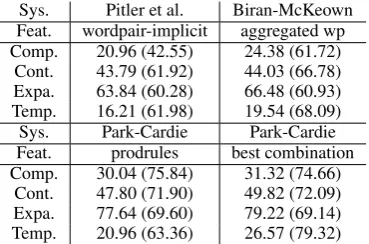
Sys. Pitler et al. Biran-McKeown Feat. wordpair-implicit aggregated wp Comp. 20.96 (42.55) 24.38 (61.72)
Cont. 43.79 (61.92) 44.03 (66.78) Expa. 63.84 (60.28) 66.48 (60.93) Temp. 16.21 (61.98) 19.54 (68.09) Sys. Park-Cardie Park-Cardie Feat. prodrules best combination Comp. 30.04 (75.84) 31.32 (74.66)
[image:7.595.86.271.62.184.2]Cont. 47.80 (71.90) 49.82 (72.09) Expa. 77.64 (69.60) 79.22 (69.14) Temp. 20.96 (63.36) 26.57 (79.32)
Table 7: F-score (accuracy) of prior systems. Note that the absolute numbers are not exactly compa-rable with ours because of the important reasons explained in this section.
and testing sets are different; howExpansion, En-tRel/NoRelandAltLexrelations are treated differ-ently in each work. The only meaningful indicator here is the absolute size of improvement. The table shows that our introduction of production sticks led to improvements comparable to those reported in prior work.
The aggregated word pair is a less sparse ver-sion of the word pair features, where each pair is converted into weights associated with an ex-plicit connective. Just as the less sparse binary lexical representation presented previously, the ag-gregated word pairs also gave better performance. None of the three lexical features, however, sur-passes raw production rules, which again echoes our finding that binary lexical features are not bet-ter than the full production rules. Finally, we note that a combination of features gives better F-scores.
8 Discussion: are the features complementary?
So far we have discussed how different represen-tations for lexical and syntactic features can af-fect the classifier performances. We focused on the dilemma of how to reduce sparsity while still preserving the useful lexical features. An impor-tant question remains as whether these representa-tions are complementary, that is, how different is the classifier behaving under different feature sets and if it makes sense to combine the features.
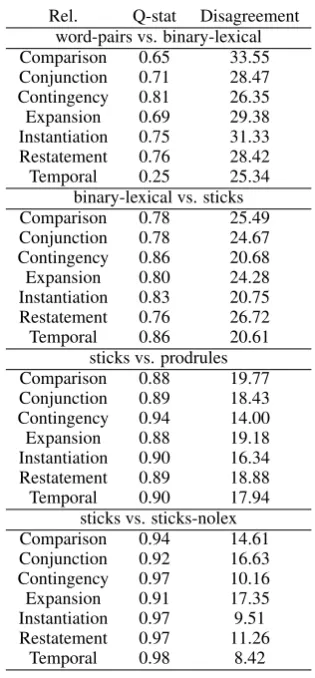
We compare the classifier output on the test data with two methods in Table 9: the Q-statistic and the percentage of data which the two classifiers disagree (Kuncheva and Whitaker, 2003).
sig- sig-Representation F (A) best worst
Comparison sticks-χ2 27.78 (62.83) N/A Y prodrules 27.65 (59.5) - Y
sticks 27.50 (60.73) - Y
sticks-nolex 27.01 (59.63) - Y prodrules-nolex 26.40 (58.47) T Y binary-lexical 24.73 (58.32) Y
-word-pairs 22.68 (45.03) Y N/A Conjunction sticks 27.55 (63.82) N/A T sticks-χ2 27.53 (64.06) - T prodrules 27.02 (63.91) - -sticks-nolex 26.56 (61.03) T -binary-lexical 25.90 (61.77) Y -prodrules-nolex 25.20 (62.83) T N/A
word-pairs 25.18 (74.51) T -Contingency sticks 48.90 (67.49) N/A Y sticks-χ2 48.55 (67.76) - Y sticks-nolex 48.08 (67.69) - Y prodrules 47.14 (65.61) T Y prodrules-nolex 45.79 (63.99) Y Y binary-lexical 44.17 (62.68) Y Y word-pairs 40.57 (50.53) Y N/A
Expansion sticks 56.48 (61.75) N/A Y sticks-χ2 56.30 (62.26) - Y sticks-nolex 55.43 (60.56) - Y prodrules 55.42 (61.05) - Y binary-lexical 54.20 (59.26) Y
-word-pairs 53.65 (56.64) Y -prodrules-nolex 53.53 (58.79) Y N/A
Instantiation sticks-χ2 30.34 (74.54) N/A Y
sticks 29.93 (73.80) - Y
prodrules 29.59 (72.20) - Y sticks-nolex 28.22 (72.66) Y Y prodrules-nolex 27.83 (70.72) Y Y binary-lexical 27.29 (70.05) Y Y word-pairs 20.22 (51.00) Y N/A
Restatement sticks 35.74 (61.45) N/A Y sticks-χ2 34.93 (61.42) - Y sticks-nolex 34.62 (61.08) T Y prodrules 33.52 (58.54) T Y prodrules-nolex 32.05 (56.84) Y
-binary-lexical 31.27 (57.41) Y T word-pairs 29.81 (47.42) Y N/A
Temporal sticks-χ2 17.97 (66.67) N/A Y sticks-nolex 17.08 (65.27) T Y
sticks 17.04 (65.22) T Y
[image:7.595.318.509.66.648.2]prodrules 15.51 (64.04) Y -prodrules-nolex 15.29 (62.56) Y -binary-lexical 14.97 (61.92) Y -word-pairs 14.10 (75.38) Y N/A
Table 8: F-score (accuracy) of each relation for each feature representation. The representations in each relation are sorted in descending order. The column “sig-best” marks the significance test result against the best representation, the col-umn “sig-worst” marks the significance test re-sult against the worst representation. “Y” denotes
Q-statistic is a measure of agreement between two systemss1ands2formulated as follows:
Qs1,s2 =
N11N00−N01N10
N11N00+N01N10
WhereN denotes the number of instances, a sub-script 1 on the left meanss1is correct, and a sub-script 1 on the right meanss2is correct.
There are several rather surprising findings. Most notably, word pairs and binary lexical repre-sentations give very different classification results in each relation. Their predictions disagree on at least 25% of the data. This finding drastically con-trast the fact that they are both lexical features and that they both make use of the argument annota-tions in the PDTB. A comparison of the percent-ages and their differences in F scores or accuracies easily shows that it is not the case that binary lex-ical models correctly predict instances word pairs made mistakes on, but that they are disagreeing in both ways. Thus, given the previous discussion that lexical items are useful, it is possible the most suitable representation would combine both views of lexical distribution.
Even more surprisingly, the difference in classi-fier behavior is not as big when we compare lex-ical and syntactic representations. The disagree-ment of production sticks with and without lexi-cal features are the smallest, even though, as we have shown previously, the majority of production sticks are lexical features with part-of-speech tags. If we compare binary lexical features with produc-tion sticks, the disagreement becomes bigger, but still not as big as word pairs vs. binary lexical.
Besides the differences in classification, the big-ger picture of improving implicit discourse rela-tion classificarela-tion is finding a set of feature repre-sentations that are able to complement each other to improve the classification. A direct conclusion here is that one should not limit the focus on fea-tures in different categories (for example, lexical or syntax), but also features in the same category represented differently (for example, word pairs or binary lexical).
9 Conclusion
In this work we study implicit discourse relation classification from the perspective of the interplay between lexical and syntactic feature representa-tion. We are particularly interested in the trade-off between reducing sparsity and preserving lex-ical features. We first emphasize the important
Rel. Q-stat Disagreement word-pairs vs. binary-lexical Comparison 0.65 33.55 Conjunction 0.71 28.47 Contingency 0.81 26.35
Expansion 0.69 29.38
Instantiation 0.75 31.33 Restatement 0.76 28.42
Temporal 0.25 25.34
binary-lexical vs. sticks Comparison 0.78 25.49 Conjunction 0.78 24.67 Contingency 0.86 20.68
Expansion 0.80 24.28
Instantiation 0.83 20.75 Restatement 0.76 26.72
Temporal 0.86 20.61
sticks vs. prodrules Comparison 0.88 19.77 Conjunction 0.89 18.43 Contingency 0.94 14.00
Expansion 0.88 19.18
Instantiation 0.90 16.34 Restatement 0.89 18.88
Temporal 0.90 17.94
sticks vs. sticks-nolex Comparison 0.94 14.61 Conjunction 0.92 16.63 Contingency 0.97 10.16
Expansion 0.91 17.35
Instantiation 0.97 9.51 Restatement 0.97 11.26
[image:8.595.333.491.59.399.2]Temporal 0.98 8.42
Table 9: Q statistic and disagreement of different classes of representations
role of sparsity for traditional word-pair represen-tations and how a less sparse representation could improve performance. Then we proposed a less sparse feature representation for production rules, the best feature category so far, that further im-proves classification. We study the role of lexical features and show the contrast between the spar-sity problem they brought along and their domi-nant presence in the highly ranked features. Also, lexical features included in syntactic features that are most informative to the classifiers are found to be style or domain specific in certain relations. Fi-nally, we compare the representations in terms of classifier disagreement and showed that within the same feature category different feature representa-tion can also be complementary with each other.
References
Or Biran and Kathleen McKeown. 2013. Aggregated word pair features for implicit discourse relation
dis-ambiguation. In Proceedings of the 51st Annual
Sasha Blair-Goldensohn, Kathleen McKeown, and
Owen Rambow. 2007. Building and refining
rhetorical-semantic relation models. InHuman
Lan-guage Technologies: The Conference of the North American Chapter of the Association for Computa-tional Linguistics (NAACL), pages 428–435.
Hugo Hernault, Danushka Bollegala, and Mitsuru Ishizuka. 2010. A semi-supervised approach to im-prove classification of infrequent discourse relations using feature vector extension. InProceedings of the 2010 Conference on Empirical Methods in Natural Language Processing (EMNLP), pages 399–409.
Thorsten Joachims. 1999. Making large-scale support
vector machine learning practical. In Advances in
kernel methods, pages 169–184.
Ludmila I. Kuncheva and Christopher J. Whitaker. 2003. Measures of diversity in classifier ensembles and their relationship with the ensemble accuracy.
Machine Learning, 51(2):181–207, May.
Ziheng Lin, Min-Yen Kan, and Hwee Tou Ng. 2009. Recognizing implicit discourse relations in the Penn
Discourse Treebank. In Proceedings of the 2009
Conference on Empirical Methods in Natural Lan-guage Processing (EMNLP), pages 343–351.
Ziheng Lin, Hwee Tou Ng, and Min-Yen Kan. 2014. A
PDTB-styled end-to-end discourse parser. Natural
Language Engineering, 20:151–184, 4.
Daniel Marcu and Abdessamad Echihabi. 2002. An unsupervised approach to recognizing discourse
re-lations. In Proceedings of the 40th Annual
Meet-ing on Association for Computational LMeet-inguistics (ACL), pages 368–375.
Mitchell P. Marcus, Mary Ann Marcinkiewicz, and Beatrice Santorini. 1993. Building a large
anno-tated corpus of English: The Penn Treebank.
Com-putational Linguistics - Special issue on using large corpora, 19(2):313–330.
Joonsuk Park and Claire Cardie. 2012. Improving im-plicit discourse relation recognition through feature set optimization. InProceedings of the 13th Annual Meeting of the Special Interest Group on Discourse and Dialogue (SIGDIAL), pages 108–112.
Emily Pitler, Annie Louis, and Ani Nenkova. 2009. Automatic sense prediction for implicit discourse re-lations in text. InProceedings of the Joint Confer-ence of the 47th Annual Meeting of the ACL and the 4th International Joint Conference on Natural Language Processing of the AFNLP (ACL-IJCNLP), pages 683–691.
Rashmi Prasad, Nikhil Dinesh, Alan Lee, Eleni Milt-sakaki, Livio Robaldo, Aravind Joshi, and Bonnie Webber. 2008. The Penn Discourse TreeBank 2.0. InProceedings of the Sixth International Conference on Language Resources and Evaluation (LREC).
Caroline Sporleder and Alex Lascarides. 2008. Using automatically labelled examples to classify
rhetori-cal relations: An assessment. Natural Language
En-gineering, 14(3):369–416, July.