MANY improvements for WMT’11
Lo¨ıc Barrault
LIUM, University of Le Mans Le Mans, France.
Abstract
This paper describes the development op-erated into MANY for the 2011 WMT system combination evaluation campaign. Hypotheses from French/English and En-glish/French MT systems were combined with a new version of MANY, an open source system combination software based on confusion networks decoding currently developed at LIUM. MANY has been up-dated in order to optimize decoder pa-rameters with MERT, which proves to find better weights. The system combi-nation yielded significant improvements in BLEU score when applied on system com-bination data from two languages.
1 Introduction
This year, the LIUM computer science laboratory participated in the French-English system combi-nation task at WMT’11 evaluation campaign. The system used for this task is MANY1 (Barrault,
2010), an open source system combination soft-ware based on Confusion Networks (CN).
For this year evaluation, rather more technical than scientific improvements have been added to MANY. The tuning process has been improved by using MERT (Och, 2003) as a replacement of the numerical optimizer Condor (Berghen and Bersini, 2005). The impact of such change is de-tailed in section 3.
After the evaluation period, some experiments have been performed on the English-French sys-tem combination task. The results are presented in the section 5. Before that, a quick description of MANY, including recent developments, can be found in section 2.
1
MANY is available at the following addresshttp:// www-lium.univ-lemans.fr/˜barrault/MANY
2 System description
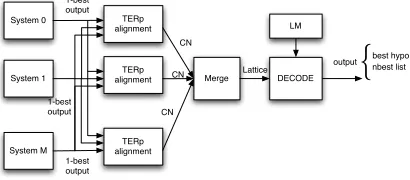
MANY is a system combination software (Bar-rault, 2010) based on the decoding of a lattice made of several Confusion Networks (CN). This is a widespread approach in MT system combina-tion (Rosti et al., 2007; Shen et al., 2008; Karakos et al., 2008; Rosti et al., 2009). MANY can be decomposed in two main modules. The first one is the alignment module which actually is a modi-fied version of TERp (Snover et al., 2009). Its role is to incrementally align the hypotheses against a backbone in order to create a confusion network. Those confusion networks are then connected to-gether to create a lattice. This module uses dif-ferent costs (which corresponds to a match, an in-sertion, a deletion, a substitution, a shift, a syn-onym and a stem) to compute the best alignment and incrementally build a confusion network. In the case of confusion network, the match (substi-tution, synonyms, and stems) costs are considered when the word in the hypothesis matches (is a sub-stitution, a synonyms or a stems of) at least one word of the considered confusion sets in the CN.
System 0
System 1
TERp
alignment LM
output 1-best
output
1-best output
TERp
alignment Merge DECODE
System M 1-best output
TERp alignment
{
best hypo nbest list LatticeCN
CN
[image:1.612.313.518.509.599.2]CN
Figure 1: System combination based on confusion network decoding.
The second module is the decoder. This decoder is based on the token pass algorithm and it accepts as input the lattice previously created. The proba-bilities computed in the decoder can be expressed as follow :
log(PW) =
X
i
αilog
hi(t)
(1)
wheretis the hypothesis, theαiare the weights of the feature functionshi. The following features are considered for decoding:
• The language model probability: the proba-bility given by a 4-gram language model.
• The word penalty: penalty depending on the size (in words) of the hypothesis.
• The null-arc penalty: penalty depending on the number of null-arcs crossed in the lattice to obtain the hypothesis.
• System weights: each word receive a weight corresponding to the sum of the weights of all systems which proposed it.
3 Tuning
As mentioned before, MANY is made of two main modules: the alignment module based on a modi-fied version of TERp and the decoder. Considering a maximum of 24 systems for this year evaluation, 33 parameters in total have to be optimized. By default, TERp costs are set to 0.0 for match and 1.0 for everything else. These costs are not correct, since a shift in that case will hardly be possible. TERp costs are tuned with Condor (a numerical optimizer based on Powell’s algorithm, (Berghen and Bersini, 2005)). Decoder feature functions weights are optimized with MERT (Och, 2003). The 300-best list created at each MERT iteration is appended to the n-best lists created at previous iterations. This proves to be a more reliable tuning as shown in the following experiments.
During experiments, data from WMT’09 eval-uation campaign are used for testing the tuning approach.news-dev2009ais used as development set, andnews-dev2009bas internal test, these cor-pora are described in Table 1.
NAME #sent. #words #tok
[image:2.612.315.547.262.340.2]news-dev2009a 1025 21583 24595 news-dev2009b 1026 21837 24940
Table 1: WMT’09 corpora : number of sentences, words and tokens calculated on the reference.
For the sake of simplicity, the five best systems (ranking given by score on dev) are considered
only. Baseline systems performances on dev and test are presented in Table 2.
Corpus Sys0 Sys1 Sys2 Sys3 Sys4
Dev 18.20 17.83 20.14 21.06 17.72
Test 18.53 18.33 20.43 21.35 18.15
Table 2: Baseline systems performance on WMT’09 data (%BLEU).
The 2-step tuning protocol applied on news-dev2009a, when using MERT to optimize decoder feature functions weights provides the set of pa-rameters presented in Table 3.
Costs: Del Stem Syn Ins Sub Shift
0.87 0.91 0.94 0.90 0.98 1.21
Dec.: LM weight Word pen. Null pen.
0.056 0.146 0.042
Wghts.: Sys0 Sys1 Sys2 Sys3 Sys4
-0.03 -0.21 -0.23 -0.28 -0.02
Table 3: Parameters obtained with tuning decoder parameters with MERT.
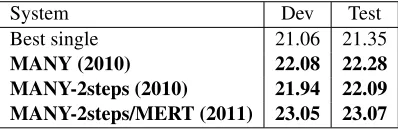
Results on development corpus of WMT’09 (used as test set) are presented in Table 4. We can
System Dev Test
Best single 21.06 21.35
[image:2.612.316.515.433.498.2]MANY (2010) 22.08 22.28 MANY-2steps (2010) 21.94 22.09 MANY-2steps/MERT (2011) 23.05 23.07
Table 4: System Combination results on WMT’09 data (%BLEU-cased).
observe that 2-step tuning provides almost +0.9 BLEU point improvement on development corpus which is well reflected on test set with a gain of more than 0.8 BLEU. By using MERT, this im-provement is increased to reach almost +2 BLEU point on dev corpus and +1.7 BLEU on test.
[image:2.612.102.292.609.648.2]4 2011 evaluation campaign
A development corpus, newssyscombtune2011, and a test set,newssyscombtest2011, described in Table 5, were provided to participants.
NAME #sent. #words #tok
newssyscombtune2011 1003 23108 26248 newssyscombtest2011 2000 42719 48502
Table 5: Description of WMT’11 corpora.
Language model: The English target language models has been trained on all monolingual data provided for the translation tasks. In addition, LDC’s Gigaword collection was used for both lan-guages. Data corresponding to the development and test periods were removed from the Gigaword collections.
Sys. # BLEU TER Sys. # BLEU TER
Sys0 29.86 52.46 Sys11 27.23 53.48
Sys1 29.74 51.74 Sys12* 26.82 54.23
Sys2 29.73 52.90 Sys13 26.25 55.60
Sys3 29.58 52.73 Sys14* 26.13 55.65 Sys4* 29.39 52.91 Sys15 25.90 55.69
Sys5 28.89 53.74 Sys16 25.45 56.92
Sys6 28.53 53.27 Sys17 25.23 56.09
Sys7* 28.31 54.22 Sys18 23.63 60.25 Sys8* 28.08 54.47 Sys19 21.90 63.65 Sys9* 27.98 53.92 Sys20 21.77 60.78 Sys10 27.46 54.60 Sys21 20.97 64.00 Sys22 16.63 65.83
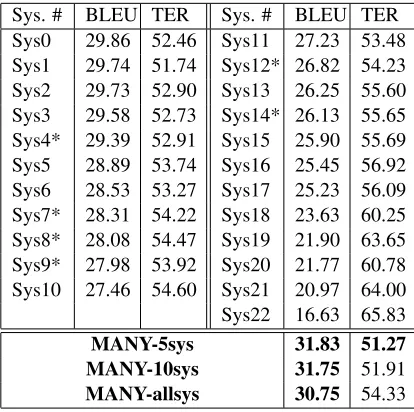
[image:3.612.98.305.321.527.2]MANY-5sys 31.83 51.27 MANY-10sys 31.75 51.91 MANY-allsys 30.75 54.33
Table 6: Systems performance on newssyscomb-tune2011development data (%BLEU-cased). (* indicate a contrastive run)
Choosing the right number of systems to com-bine: Table 6 shows the performance of the in-put systems (ordered by BLEU score comin-puted on
newssyscombtune2011) and the result of 3 system combination setups. The difference in these se-tups only reside on the number of inputs to use for combination (5, 10 and all system outputs). Notice that the contrastive runs have not been used when combining 5 and 10 systems. The motivation for this is to benefit from the multi-site systems
de-velopment which more likely provide varied out-puts (i.e. different ngrams and word choice). The results show that combining 5 systems is slightly better than 10, but give more than 1 BLEU point improvement compared to combining all systems. Still, the combination always provide an improve-ment, which was not the case in last year evalua-tion.
The results obtained by combining 5 and 10 sys-tems are presented in Table 7.
Sys. # BLEU TER Sys. # BLEU TER
Sys0 29.43 52.01 Sys6 28.08 53.19
Sys1 29.15 51.30 Sys11 27.24 53.74
Sys2 28.87 52.82 Sys13 26.74 52.92
Sys3 28.82 52.57 Sys15 26.31 54.61
Sys5 28.08 53.19 Sys16 25.23 55.38
MANY (5sys) 30.74 51.17 MANY (10sys) 30.60 51.39
Table 7: Baseline systems performance on WMT’11 syscomb test data (%BLEU-cased).
Optimizing MANY on newssyscombtune2011
corpus produced the parameter set presented in Ta-ble 8. We can see that the weights of all system are not proportional to the BLEU score obtained on the development corpus. This suggest that a bet-ter system selection could be found. This is even more probable since the weight of system Sys2 is positive (which imply a negative impact on each word proposed by this system), which means that when an hypothesis contains a word coming from this system, then its score is decreased.
Costs: Del Stem Syn Ins Sub Shift
0.90 0.88 0.96 0.97 1.01 1.19
Dec.: LM weight Null pen. Len pen.
0.0204 0.26 0.005
Wghts.:Sys0 Sys1 Sys2 Sys3 Sys5 -0.16 -0.30 0.008 -0.16 -0.09
Table 8: Parameters obtained after tuning the sys-tem parameter using 5 hypotheses.
Table 9 contains the BLEU scores computed be-tween the outputs of the five systems used during combination. An interesting observation is that the system which receive the bigger weight is the one which ”distance”2against all other system outputs
2
[image:3.612.314.525.500.577.2]Sys0 Sys1 Sys2 Sys3 Sys5 mean Sys0 - 53.59 62.67 64.60 62.50 60.84 Sys1 53.51 - 54.19 52.42 51.69 52.95 Sys2 62.72 54.28 - 65.49 63.09 61.40 Sys3 64.63 52.51 65.47 - 61.35 60.99 Sys5 62.55 51.78 63.10 61.37 - 59.70 mean 60.85 53.04 61.36 60.97 59.66
Table 9: Cross-system BLEU scores computed on WMT’11 French-English test corpus outputs (%BLEU-cased).
is the highest, whereas the ”closest” system get the smallest weight. This suggests that systems closer to other systems tends to be less useful for sys-tem combination. This is an interesting behaviour which has to be explored deeper and validated on other tasks and corpora.
5 MANY for french outputs
After the evaluation period, some experiments have been conducted in order to combine french outputs. The main difference lie in the fact that linguistic resources are not easily or freely avail-able for that kind of language. Therefore, instead of using TERp with relax3 shift constraint, the
strictconstraint was used (shifts occur only when a match is found).
The available data are detailed in the Table 10.
NAME #sent. #words #tok
syscombtune 1003 24659 29171
syscombtest 2000 45372 53970
Table 10: Description of WMT’11 corpora for system combination in french.
The results obtained are presented in Table 11. The BLEU score increase by more than 0.8 point but the TER score decrease by 0.58. The metric targeted during tuning is BLEU, which can ex-plain the improvement in that metric. When deal-ing with english text, the only case where such be-haviour is observed is when combining all systems (see Table 6.
6 MANY technical news
Several improvements have been performed on MANY. The decoder is now based on a fully
log-3
Shifts can occur when a match, a stem, a synonym or a paraphrase is found.
Corpus syscombtune2011 syscombtest2011
BLEU TER BLEU TER
Sys0 35.99 49.16 34.36 49.78
Sys1 32.99 51.90 30.73 52.52
Sys2 32.41 52.77 29.85 53.61
Sys3 32.40 51.26 30.48 52.20
Sys4 32.30 52.21 31.02 52.49
MANY 36.81 49.74 34.51 50.54
Table 11: Systems and combination performance on WMT’11 french data (%BLEU-cased).
linear model (whereas before, the word and null penalties were applied linearly). Using MERT to tune the decoder parameters is therefore possible and allows to reach bigger improvement compared to using Condor. This is probably due to the fact that MERT uses several heuristics useful for tun-ing on BLEU score.
In order to facilitate the use of MANY, it has been integrated in the Experiment Management System, EMS - (Koehn, 2010). An experiment can now be setup/modified/re-run easily by modifying a single configuration file. The default behavior of this framework is to perform 3 runs of MERT in parallel (using torque) and take the best optimiza-tion run. Apart from avoiding local maximum, the procedure allows to see the variability of the opti-mization process and report more realistic results (for example, by taking the average).
7 Conclusion and future work
For WMT’11 system combination evaluation cam-paign, several rather technical improvements have been performed into MANY. By homogenizing the log-linear model used by the decoder and uti-lizing MERT for tuning, MANY achieves im-provements of more than 2 BLEU points on WMT’09 data and about 1.3 BLEU point on
newssyscombtest2011relatively to the best single system. Moreover, a dry-run operated on french data shows a promising result with an improve-ment of more than 0.8 BLEU points. This will be further explored in the future.
priors. These confidences measures have to be re-lated to the system performances, but also to the complementarity of the systems considered.
8 Acknowledgement
This work has been partially funded by the Eu-ropean Union under the EuroMatrix Plus project (http://www.euromatrixplus.net, IST-2007.2.2-FP7-231720)
References
[Barrault, 2010] Barrault, L. (2010). MANY : Open source machine translation system com-bination.Prague Bulletin of Mathematical Lin-guistics, Special Issue on Open Source Tools for Machine Translation, 93:147–155.
[Berghen and Bersini, 2005] Berghen, F. V. and Bersini, H. (2005). CONDOR, a new parallel, constrained extension of Powell’s UOBYQA algorithm: Experimental results and compari-son with the DFO algorithm. Journal of Com-putational and Applied Mathematics, 181:157– 175.
[Karakos et al., 2008] Karakos, D., Eisner, J., Khudanpur, S., and Dreyer, M. (2008). Ma-chine translation system combination using ITG-based alignments. In46th Annual Meeting of the Association for Computational Linguis-tics: Human Language Technologies., pages 81–84, Columbus, Ohio, USA.
[Koehn, 2010] Koehn, P. (2010). An experimental management system. The Prague Bulletin of Mathematical Linguistics, 94:87–96.
[Och, 2003] Och, F. (2003). Minimum error rate training in statistical machine translation. In
ACL, Sapporo, Japan.
[Rosti et al., 2007] Rosti, A.-V., Matsoukas, S., and Schwartz, R. (2007). Improved word-level system combination for machine translation. InAssociation for Computational Linguistics, pages 312–319.
[Rosti et al., 2009] Rosti, A.-V., Zhang, B., Mat-soukas, S., , and Schwartz, R. (2009). In-cremental hypothesis alignment with flexi-ble matching for building confusion networks: BBN system description for WMT09 system combination task. InEACL/WMT, pages 61– 65.
[Shen et al., 2008] Shen, W., Delaney, B., An-derson, T., and Slyh, R. (2008). The MIT-LL/AFRL IWSLT-2008 MT System. In Inter-national Workshop on Spoken Language Trans-lation, Hawaii, U.S.A.