OUscoil Atha Cliath The University of Dublin
Terms and Conditions of Use of Digitised Theses from Trinity College Library Dublin Copyright statement
All material supplied by Trinity College Library is protected by copyright (under the Copyright and Related Rights Act, 2000 as amended) and other relevant Intellectual Property Rights. By accessing and using a Digitised Thesis from Trinity College Library you acknowledge that all Intellectual Property Rights in any Works supplied are the sole and exclusive property of the copyright and/or other I PR holder. Specific copyright holders may not be explicitly identified. Use of materials from other sources within a thesis should not be construed as a claim over them.
A non-exclusive, non-transferable licence is hereby granted to those using or reproducing, in whole or in part, the material for valid purposes, providing the copyright owners are acknowledged using the normal conventions. Where specific permission to use material is required, this is identified and such permission must be sought from the copyright holder or agency cited.
Liability statement
By using a Digitised Thesis, I accept that Trinity College Dublin bears no legal responsibility for the accuracy, legality or comprehensiveness of materials contained within the thesis, and that Trinity College Dublin accepts no liability for indirect, consequential, or incidental, damages or losses arising from use of the thesis for whatever reason. Information located in a thesis may be subject to specific use constraints, details of which may not be explicitly described. It is the responsibility of potential and actual users to be aware of such constraints and to abide by them. By making use of material from a digitised thesis, you accept these copyright and disclaimer provisions. Where it is brought to the attention of Trinity College Library that there may be a breach of copyright or other restraint, it is the policy to withdraw or take down access to a thesis while the issue is being resolved.
Access Agreement
By using a Digitised Thesis from Trinity College Library you are bound by the following Terms & Conditions. Please read them carefully.
Prediction of Fatigue Failure in
Engineering Components Using the
Finite Element Method
Ge W ang
Submitted in fulfilment of the requirements for the award of the degree of Doctor of
Philosophy to The University of Dublin, Trinity College, October 1999.
Supervisor:
Professor David Taylor
Table o f Contents
...
i
Declaration
...v
Acknowledgements
...
vi
Summary
...
vii
Nomenclature
...
viii
Chapter 1 Introduction.
...
1
Chapter 2 Review o f the Literature
...
3
2.1 Traditional Approaches for Prediction of Fatigue FaUure... 3
2.1.1 Stress life method...3
2.1.2 Strain life method... 4
2.1.3 Critical distance m ethods... 5
2.2 Fracture Mechanics Methods...6
2.2.1 Smith and Miller method... 7
2.2.2 Crack Modelling M ethod... 9
2 3 Consideration of Crack Closure and Defect Effects...11
2.3.1 Newman’s model, considering crack closure...11
2.3.2 Murakami and Endo’s model: considering defects and hardness... 12
2.4 Short Crack Problems... 14
2.4.1 Kitagawa and Takahashi Curve...15
2.4.2 ElHaddad Model; parameter Uo...16
Chapter 3 Further Study o f the Crack Modelling Method.
...
19
3.1 Introduction...19
3 2
The Focus Path---...--- 19
3.2.1 Path orientation, the rule of lowest AKf e
... 19
3.4 Conclusions...39
Chapter 4 Modification o f CMMfor the Short Crack Problem
...
40
4.1 Introduction...40
4.2 Method 1 — Comparing with
Acr^
... 40
4 3 Method 2 —Using a„ as the equivalent crack length...44
4.4 Method 3 — Adding ao or extrapolating the stress/distance curve... 48
4.5 Method 4 - Average of NM & CMM...— ..—...— ...—.— ..—.— ...—..51
4.6 Conclusions... ...
...54
Chapter 5 A New Method o f Prediction
...
56
5.1 Introduction...56
5.2 Background of the Theoretical Model ...56
5 3 New Approach to Find the Critical Distance... 57
5.3.1 Point Method... 59
5.3.2 Line Method... 60
5.3.3 Area Method... 61
5.4 Application o f the Model to Short C racks... 63
5.5 Application of the Model to Notches
...65
5.6 Discussion...66
5.6.1 Input parameters needed... 66
5.6.2 Comparison of the new methods with previous approaches... 66
5.6.3 Extension to other loading modes... 67
5.6.4 Further work...68
5.7 Conclusions...*.—....—... 69
Chapter 6 Notched Specimen Verification
...
70
6.2.1 Steel samples...71
6.2.2 Aluminium alloy samples... 73
6.2.3 Cast iron samples... 74
6 3
Stress Analysis...75
6.3.1 Element type...75
6.3.2 Load condition... 76
6.4 Definition of Prediction Error... 77
6.5 Prediction Results...78
6.5.1 Verification of steel samples... 79
6.5.2 Verification of aluminium alloy samples... 89
6.5.3 Verification of cast iron samples...92
6.5.4 Summary of verification...93
6.6 Discussion...
94
6.7 Conclusions...97
Chapter 7 Prediction o f The Fatigue Failure in Engineering Components...
99
7.1 Marine Component
... 99
7.1.1 Fatigue feilure description... 99
7.1.2 Prediction results from CMM, PM and N M ... 101
7.1.3 Conclusions... 102
7J2 Crankshaft... 102
7.2.1 Introduction... 102
7.2.2 Material and experimental data...103
7.2.3 Prediction result...105
7.2.4 Conclusions...106
7 3 Camshaft...107
7.3.1 Introduction...107
7.3.2 Experimental details... 107
7.3.5 Prediction of fetigue limit...113
7.3.6 Discussion... 116
7.3.7 Conclusions... 117
7.4 Al-alloy Components...118
7.4.1 Introduction...118
7.4.2 Experimental details...118
7.4.3 Results...123
7.4.4 Estimation of threshold
AK.th
... 126
7.4 4.1 Short crack effect...126
7.4.4.2 Procedure... 126
7.4.4.3 Prediction results... 127
7.4.4.4 Kitagawa and Takahashi curves of LM 25...127
7.4.5 Fatigue failure prediction... 128
7.4.5.1 Definition of
(J-r
curve path... 128
7.4.5.2 Prediction results and discussion... 131
7.4.6 Conclusions...133
7.5 General Conclusions for the Application to Engineering Components ... 133
Chapter 8 Discussion, General Methodology and Conclusions
...
135
8.1 Discussion... 135
8.1.1 Overview o f Chapters 6 and 7...135
8.1.2 Critical distance methods... 137
8.1.3 Crack Modelling Method combined with the Notch Method...138
8.2 General Methodology... 139
8 3 Conclusions...143
I declare that the present work has not been submitted as an exercise for a degree at any other
University. This thesis consists entirely of my own work except where references indicate
otherwise.
I would like to thank all those who helped in this research. In particular I would like to thank
and congratulate my supervisor Professor David Taylor, for his guidance, suggestions,
advice, insight and help in creating this thesis. I would also like to thank him for my
involvement in the Rover Group and E)AC Ltd, which were beneficial to my research.
I am very grateful to all the technical staff, Frank, John, Ray, Tom, Gabriel, Gerry and Danny
for all their help and friendship. A special thanks to Peter and Sean who were always willing
to give up their time to help with my research. I am very grateful to Virginia and Joan for
their kind help.
The financial support provided by Materials Ireland, Enterprise Ireland and Rover are
gratefully acknowledged.
I am also very grateful to all the postgraduates and staff at Trinity College, for it was they
who made my stay enjoyable, in particular I would like to thank Conor, Magali, Carlos,
Peter, Damien, Liam, Darren, Gavin, Bruce, Suzanne and Linda. I would especially like to
thank Jeff Badger and Toman MacGinley for their advice, letter writing abilities, computer
skill and their friendship. I would also like to thank Dr. Youhe Zhang for his kind help and
friendship.
I would like to convey my deepest appreciation to my mother and father, my parents in law,
for their continuous support, encouragement, help, advice and patience.
Prediction of fatigue failure in engineering artefacts is becoming increasingly important as
we enter the third millennium; more catastrophic fatigue failures will occur as engineers push
the limits of design even further due to demands for greater efficiency. This thesis describes a
methodology for predicting fetigue feilure in engineering components subjected to high cycle
fatigue using the finite element analysis method.
The research started fi'om a previous theory known as the “crack modelling method” , which
considers the whole stress field and models a geometrical discontinuity as a crack. Further
study of the theory was carried out and improvements were made for application to the short
crack/notch problem. Because of the difficulty o f judging whether a defect in a given
component would behave as a short crack or not in practice, a new approach was developed.
The method was still based on a consideration of the stress field of the component, but
attention was focussed on a small region close to the stress concentration. The method avoids
the problem because it inherently allows for short crack effects. The basic theory was
formulated and tested, with respect to standard test specimens, for which data was found
fi'om the literature. The effect of notch depth, of notch acuity, of notch and specimen type, of
load ratio, and of material properties on the notched fatigue limit were considered. The
theory showed good predictions. The implication of this research is that there is no
fundamental difference between the fatigue limit of an uncracked body and that of a body
which already contains a crack. The theory was also tested on real components used in
vehicles, including a crankshaft, camshaft, pump bracket and C-shaped bracket. Good
predictions were achieved in all cases.
Symbol
'^jarea
a
d oau <^2
C ieqaw
AM
A„
Ave.
C
CMM
CMMscr
CNB
CNP
D
da/dN
DENP
dp
drElHaddad
F
/v Hh
Unit
Definition
mm
Murakami defect geometrical parameter
mm
Crack length
mm
ElHaddad crack-length constant
mm
Taylor and Knott crack length related to short crack
mm
Equivalent crack length
mm
Half crack length of a central crack in an infinite plate
Area Method
Constant whose value depends on the strength and ductility of
the material
Average Method
Constant factor in the Paris equation
Crack Modelling Method
Crack Modelling Method with short crack correction
Circumferential notch cylindrical bar
Centre notch in a flat plate
mm
Notch depth
Crack growth rate
Double edge notch in flat plate
Peripheral density factor
Radial density factor
LEFM prediction modified using ElHaddad’s correction
Geometrical factor in the stress intensity equation
Volume fi'action of graphite
mm
Notched specimen height
Hv,gross
Gross Vickers hardness value including the contribution
graphite nodules
K
MPam^'^
Stress intensity factor
K&L
Klesnil and Lucas Method
K f
Fatigue notch factor
K ,
Theoretical elastic stress concentration fector
k:
Critical value of
Kt
Ke
Strain concentration factor
Ka
Stress concentration factor
L
mm
Notched specimen length
I
mm
Effective length of plain specimen
LEFM
Standard crack prediction method following Smith and Mil
when applied to notches
LM
Line Method
h
mm
Average element length round a fillet or a notch root
Irmm
Average element length along the radial direction
n
Empirical exponent in the Paris equation
N f
Fatigue cycles to failure
NM
Notch Method
PM
Point Method
r
mm
Distance from notch/crack tip or stress concentration
R
Load ratio
fmint ^m ax
mm
Minimum and maximum distance of a stress-distance curve
SENP
Single edge notch in flat plate
W
mm
Notched specimen thickness
AFy
N
Axial input force applied to a finite element model
A KMPam^^
Range of the stress intensity factor
A Kfe
M Pam '^
Predicted threshold stress intensity factor range using FEA
AKthMPa m '^
Threshold stress intensity factor range
APo
Predicted fatigue limit load range
A Pt
Experimental value of fatigue limit range
Act
MPa
Stress range
AcTo
MPa
Fatigue limit of plain specimens
A Goc
MPa
Fatigue limit of cracked specimens (nominal stress)
^^on
MPa
Fatigue limit of notched specimens (nominal stress)
ACTPRED
MPa
Predicted fetigue limit
AcTth
MPa
Threshold stress range
Act gross
MPa
Fatigue limit in gross-section
T
mm
Plain specimen thickness
a ,p
Degrees
Angle of the path of a stress-distance curve
X
mm
Distance measured from centre of a hole
5
mm
Distance between the axis and the point where
A F yis applied
<
!>
mm
Specimen diameter
Correcting factor for short crack effect
P
mm
Notch root radius
*
P
mm
Critical value of
pCT
MPa
Stress
CTcy
MPa
Cyclic yield stress
CT-r
Stress-distance curve
Ow
MPa
Tensile stress applied to an infinite plate in Westergaard’s
equation
Fatigue is the most common cause of failure of engineering structures and components.
Making reliable fatigue predictions is very difficult because knowledge about fatigue
mechanisms in all stages of the fatigue process must be developed much further. Despite the
huge volume of research which has been conducted in this area and many hundreds of papers
and reports published each year on the problem of fatigue life prediction, it remains the
principal limitation on the life prediction of components, especially components such as
aircraft, vehicles, medical devices and machine tools.
The aim of the present research has been to develop methods of analysis for the prediction of
the high cycle fatigue (HCF) behaviour in engineering components using the finite element
analysis (FEA) method. Traditional methods, which compute fatigue life on a point-by-point
basis, could not give a satisfied prediction when applied to high stress concentrations (e.g.
sharp notches) or to materials of low notch-sensitivity (e.g. cast iron). The reason is that very
high stresses can be tolerated by a component provided they are restricted to small regions of
the component and then there is no one to one relationship between stress and life.
The crack modelling method developed by Taylor [1996], which considers the whole stress
field and models the geometrical feature, such as a notch, a hole and a corner, as a crack, was
tried in this thesis. Further study was done on the method, such as the path determination, the
minimum and maximum distance. With these improvements the method was tested using
some simple specimens from the literature and in-house. The method was also tested on a
real engineering component which was used by Rover car company. The results were very
promising in many cases.
materials such as cast irons, cast aluminium alloys. Several attempts were tried to modify the
method in order to overcome the difficulties. These included adding a material constant,
adding a short crack length in a notched body and combining the method with a traditional
stress-life method. Different modifications were made for different situations and the revised
method was tested on notched specimens showing short crack effect. The prediction results
on the simple geometrical specimens showed a good agreement with the experimental data.
However, a problem arose when feced with real engineering components with complex
geometry. The difficulty was how to know whether a given geometrical feature would be a
short crack problem or not. We went back to basics and made big modifications to the
previous theory. The new theory was devised based on a consideration o f the stress field of
the component, but now attention was focussed on a small region close to the stress
concentration. Three methods were formulated: the point method, the line method and the
area method. Each of them has its own advantage. They inherently allowed for the short
crack effect, so they should avoid the problem found in the previous approach theoretically.
Ten methods including traditional stress-life methods, the crack modelling method and its
revised versions and the new methods were tested on standard test specimens, for which data
can be found from the literature. The effect of notch depth, of notch acuity, of notch and
specimen type, of load ratio, and of material properties on the threshold stresses were
considered. The theory showed good predictions on 90 percent of forty-six data sets.
Furthermore, four types of real components were used for testing thanks to Rover Car
Company and GEC Ltd. Some of the components had surfece effects and for some of them
we needed to measure the fatigue threshold. All these difficulties were overcome and good
results were obtained, showing that the new methods can be applied to real components.
Engineering structures invariably contain stress concentrations which are the principal sites
for the inception of fatigue flaws. The stress and deformation fields in the immediate vicinity
of the stress concentration have a strong bearing on how the fetigue cracks nucleate and
propagate. Continuum approaches on this topic can be divided into four categories. They are
traditional approaches (which include stress-life, strain-life and critical distances), fracture
mechanics concepts, crack closure & defect effects and the short crack problem.
The effect of stress concentrators on fetigue limit and high-cycle endurance has traditionally
been studied using notches. The simplest approach - using the elastic stress-concentration
fector
Kt
- is reasonably accurate for blunt notches under low applied stress, but ATt is found
to diverge from the experimentally measured fatigue strength reduction,
Ki,
when notches are
sharp or when the notch depth,
D,
is small. Relevant factors include the existence of the
plastic zone and the relatively small stressed volume ahead of a sharp notch.
2.1 Traditional Approaches for Prediction of Fatigue Failure
2.1.1 Stress life method
The stress-life approach is used for high-cycle fatigue failures ahead of stress concentrations.
High cycle fatigue (HCF) is caused by low, nominally elastic fluctuating stresses. The
prediction of fatigue failure is made by appropriately modifying the smooth specimen
(unnotched) endurance limit.
(2-
1-
1)
where
p
is the radius at the ends of the ellipse and
D
is the depth (half width) of the elliptical
hole.
The stress-life method is unsuitable for situations where considerable plastic deformation
occurs ahead of the stress concentration.
2.1 .2 Strain life m ethod
The local strain approach relates deformation occurring in the immediate vicinity of a stress
concentration to the remote stresses and strains using the constitutive response determined
from fetigue tests on simple laboratory specimens. The method predicts the life expectancy
of a machine part which is under low cycle fatigue loads. Low cycle fatigue (LCF) is caused
by high, fluctuating stresses and strains. The method has its beginning in the early 1950s.
Today it is still in frequent use by machine designers in LCF and HCF analyses and it is
recommended by ASME [ASME, 1989], SAE [Rice, 1988] and ASTM [ASTM, 1980].
The strain concentration factor
is the ratio of the maximum local strain to the nominal
strain. The stress and strain concentration factors are of the same value when only elastic
deformation occurs at the tip of the notch. However, once the material yields at the notch tip,
the stress and strain concentration factors take different values. Under conditions of plastic
deformation, the theoretical elastic stress concentration factor is given approximately by the
geometrical mean of the stress ATcrand strain concentration factors
K^.
This is the well-known
Neuberrule [Neuber, 1961]:
First, the local stress and strain histories at the notch tip must be known. Second, the fetigue
life that can be expected for the local stress and strain histories must be determined. For the
first part, either simple analytical expressions or detailed finite element simulations o f the
notch tip deformation (using constitutive laws and hardening rules) are developed to relate
the local stresses and strains to far-field loading. Alternatively, the notch tip deformation is
experimentally monitored with the aid of strain gauges or other displacement/strain
measurement techniques.
2.1.3 Critical distance methods
Under fatigue loading conditions, the elastic stress concentration factor is replaced by the so-
called fatigue notch factor;
Kf = unnotched bar endurance limit / notched bar endurance limit
(2-1 -3)
The Peterson equation for ferrous wrought alloys has the form
(2-1-4)
... where
is a constant whose value depends on the strength and ductility of the material
and p
is the notch-root radius. By considering the threshold condition for a crack of length oo
at the notch root, Klesnil and Lucas [1980] derived an equation as follows;
where
is the EHaddad crack-length constant (see Section 2.4.2).
2.2 Fracture Mechanics Methods
The most successful application of the theory of fracture mechanics is in the characterisation
of fatigue crack propagation. One of the known methods is the method of linear elastic
fracture mechanics (LEFM). It is designated to compute the crack propagation based on the
fiindamental assumption that the material is linearly elastic. This method basically
approaches the crack propagation problems in 2-D space. For more complex cases an
adaptation of the basic correlations is used. A very important parameter, called the stress
intensity factor (SIF), was introduced, which signifies the relationship of three factors; the
geometry of the plate, the loading, and the length of the crack. The stress intensity factor is
defined as follows
In the above, F is a compliance function that describes the geometry of the part, cris a stress
in a remote distance which designates the loading and a is the crack length. The crack growth
can be expressed in the form of
^ \ + 4 . 5 a J p
(2-1-5)
—
^C{ AKy
(
2
-2
-2
)where C is a constant factor,
AK
is the range o f the stress intensity factor and
n
an empirical
exponent. The equation is known as the fatigue crack propagation law [Paris and Endoyan,
1963], Crack propagation ceases if
AK < AKth,
the threshold value, which depends on the
load ratio, i? [Taylor, 1989]
2.2 .1 Sm ith and Miller m eth od
Smith and M illers model [Smith and Miller, 1978] can be used for the prediction o f fatigue
failure on notched specimens including the prediction o f non-propagating cracks. It is
illustrated in Fig. 2.2.1, concerning notches with variable radius and constant depth
D.
We
called it the Notch M ethod (NM). For low
Kt
(between A and B) the fetigue limit is given by
where Aoo is the fetigue limit o f plain specimens and Aaon is the fetigue limit o f notched
specimens. For high
Kt
(between B and C) the notch is assumed to behave like a crack, so
the fatigue limit is given by
(2-2-3)
(2-2-4)
X Typical experimental resiills H - - - '
Failure zone
b <
B '
1.0
Stress concentration &ctnr
Fig. 2.2.1 The boundary conditions between failure and non-failure of variously notched
specimens
This model gives good predictions for many materials such as mild steels and alloy steels
[Taylor, 1994] in laboratory tests.
The curve will move up or down in the figure if the notch depth decreases or increases for a
component. So there is not a fixed critical value for the varying notch depths. However there
will be a critical value of the fector,
K*t,
existing at point B in the figure for a certain notch
depth,
D.
At that point, both Eqs. (2-2-3) and (2-2-4) should give the same predictions. So the
critical value can be determined by
(2-2-5)
So for elliptical notches, for example;
AoF-yJnD
[image:20.491.15.455.21.341.2]where p* is a critical value of the notch tip ratio for the given D. Eq. (2-2-6) deals not only
with the material properties (fatigue limit and material threshold) but also with geometry
characteristics.
The value of
p* can be defined directly using Eq. (2-2-6), if the material properties, such as
fatigue limit and material threshold, are known. This is quite useful for engineering design.
Normally Eqs. (2-2-3) and (2-2-4) are both conservative so they can be used simultaneously
at the point B in Fig.2.2.1.
A problem that remains is that this method could not be directly employed for components
that do not contain notches, but instead have comers or other geometric features where the
stress concentration occurs. This is because neither D nor F
can be defined in these cases.
This greatly reduces the use of this method in engineering applications.
2.2.2 Crack Modelling Method
The crack modelling method [Taylor, 1996] is an extension of the Smith and Miller model.
This extension made the model available for the prediction of engineering components not
only with notches but also with other geometric features.
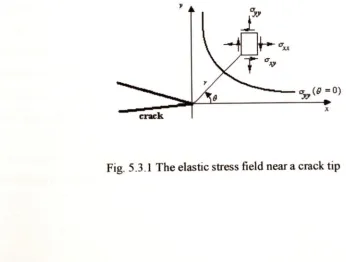
The method examines the stress field in the region of the stress concentration, and compares
this with the stress field that is knovm to exist around an ideal crack. Figure 2.2.2 describes
the approach schematically. From an FE model of the component, loaded with some system
of loads, L, a plot is obtained of stress as a function of distance, r, measured fi'om the point of
maximum stress. The curve in the plot was named as the Stress-Distance curve or
a-r curve
for short. The curve is compared with the stress-distance plot from an ideal crack; the
particular crack geometry chosen is the one examined by Westergaard [1939]: a central,
through crack of length
2a^, in an infinite plate subjected to a tensile stress Ow. This stress
field is described by
The values of
cr„
and
can be varied to obtain a best fit between the stress-distance curve
of Eq. (2-2-7) and the curve obtained from FE data. When the best fit has been found, the
appropriate
K
value is given by
K = (
2
-2
-8
)This method assumes that if the equivalent
AK
is less than the threshold value of the material,
at the appropriate
R
ratio, fetigue feilure will not occur.
lifiiSiMIII
Component FEA
H
Applied Loads, L
Stress
^Ikid^Iioads.L
X‘
r
X
Stresses along X-X' (S-D curve)
Centre-Cracked Infinite Plate
Stress
Stress Inteosit;, K
Stresses along Y-Y*
Best ft ^ves a K prediction
correspondiogto loads L
Fig. 2.2.2 Schematic illustration of the methodology used in the crack modelling
technique
2.3 Consideration of Crack Closure and De^ct Effects
2.3.1 Newman’s model, considering crack closure
Fatigue crack closure is understood to play an important role in many aspects of fetigue crack
growth (FCG) [Elber, 1968], Although closure is not equally important in all FCG problems,
and although closure does not provide a complete explanation of every problem where it is
important, the closure phenomenon is an intrinsic feature of crack tip behaviour that must be
The earliest investigations of closure based on the finite element method were published
independently fi-om 1973 to 1977. One of them is Newman’s model [Newman, 1974; 1981;
1982; 1994], which is called a plasticity-induced crack-closure model. He believed that
crack-closure effects are also one of the key elements in small-crack growth. His model is
based on Elber’s crack-closure phenomenon [Elber, 1970] and the Dugdal model [Dugdale,
I960], Crack-opening stresses were calculated in the model. The J-integral [Rice, 1968], one
of the commonly used parameters for non-linear crack-growth analyses, was used to define
an equivalent plastic stress intensity factor in the elastic-plastic firacture mechanics regime.
The model agreed well with test data on unnotched and notched specimens made of two
aluminium alloys [Wu and Newman, 1993].
Many real closure problems are 3-D, but the computational expense of FE closure analysis
has limited most previous investigations to 2-D. Chermhimi et al. [1988; 1989] performed
the first 3-D FE closure analysis, studying closure through the thickness of a centre-cracked
plate, and more recently publishing some very elementary results for a semi-elliptical surface
crack [Chermhimi et al., 1993]. They generally found higher opening levels at the specimen
surface, similar to plane stress behaviour, and lower opening levels in the specimen interior,
similar to plane strain behaviour. As computational power continues to increase, 3-D FE
closure analysis should become more practical, and many important problems are waiting to
be solved. However, careful study of 3-D modelling issues will be required before the results
can be fiilly trusted.
2.3.2 Murakami and Endo’s model: considering defects and hardness
Murakami and Endo [1983] proposed a model, which considered the defect effect, by
introducing a new geometrical parameter
^jarea for two-dimensional and three-dimensional
defects. This parameter is based on both microscopic observation of cracking fi-om small
surface defects and 3-D numerical stress analysis. From their experiences, they derived the
projecting a defect or a crack onto the plane perpendicular to the maximum tensile stress, n
and c are constants that have to be determined through fatigue tests.
The choice of
^jarea comes from stress intensity factor considerations. Its application has
been widespread, not only to the fatigue problems of small cracks and holes, but also to those
of surfece scratches and roughness, non-metallic inclusions, corrosion-pits, carbides in tool
steels, second phases in Al-Si eutectic alloys and spheroidal graphites in cast irons.
Murakami and colleagues [Murakami
et ah, 1990] further revised the model and proposed
the following equations:
Act^ = 1.4 3 (//,+ 1 2 0 )(> /W a )'^ * (2 - 3 -1 )
AA:^ = 3.3*10-'(//,+120)(V^)''’
(2-3-2)
Here
is the Vickers micro-hardness;
AKth = threshold stress intensity fector range under
the stress ratio R = -I (MPa m’”^);
^area is in
fxm. The extended equation to predict the
fetigue limit for various values of stress ratio R is expressed by including a fector,
in Eq. (2-3-1), where a = 0.226 + //v x 10"^. In predicting
Aoy, by using Eq. (2-3-1), no
fatigue test is necessary. It is sufficient to measure the values of
-\larea and
Hy and to
estimate R at the place where the defect exists. They reported that the prediction error was
less than 15% for //v = 100-740.
In 1991, Endo [1991] proposed a modified equation of this method for nodular cast iron.
Instead of introducing a parameter C, he used the matrix hardness and the percentage of
graphite to predict the fatigue limit ^cr^and AIQh-
This method therefore unifies both effects
of defects and matrix structures:
where //v,
gross
is the gross Vickers hardness value including the contribution o f graphite
nodules and fv is the volume fraction o f graphite. On the other hand,
AKth
is defined as
follows:
^K^=3.3*\0-^
+
(2-3-4)
Murakami and E ndo’s model is valid over a
sjarea
range which is dependent on the
material. The valid upper limit of
^a re a
is considered to be ~ 1000 nm. [Murakami and
Endo, 1994],
2.4
Short Crack Problem s
The fatigue life o f a structure goes through several stages from crack initiation, through crack
propagation, to the final failure. M iller [1993] indicated three categories o f crack growth
regimes for the whole period. They are the micro-structural fracture mechanics (MFM)
regime, the elastic-plastic fracture mechanics (EPFM) regime and the linear elastic fracture
mechanics (LEFM) regime. In the M FM and EPFM regimes, cracks are short and require a
high stress range to propagate. Suresh and Ritchie [1984] suggested the following definitions
by which short cracks can be broadly classified; microstructurally small, mechanically small,
physically small and chemically small cracks. “Small cracks” and “short cracks” are often
used interchangeably. However there is sometimes a distinction between the two cases. The
former definition is employed for flaws that are small in all three dimensions. The latter types
are taken to denote through-thickness flaws that are small in all but one dimension.
Over the past decade, the propagation of short cracks in fatigue has received considerable
attention. The behaviour of short fatigue cracks was reviewed in three books [Miller and de
los Rios, 1986; Ritchie and Lankford, 1986; Suresh, 1991]. Quantitative attempts have been
used to try to explain the propagation and have achieved some success in the correction of
the propagation behaviour.
2.4.1 Kitagawa and Takahashi Curve
Kitagawa and Takahashi [1976] presented a figure similar to Fig. 2.3.1, which shows the
boundary between propagating and non-propagating cracks.
AK. = Y A a (* a )* '^ O
LEFM or loi»g crack-low
.stiess re^ n e
physically small cracks short cracks
shoit crack resiine
lo g
Crack Leii;^h a
Fig.2.3.1. Schematic of the Kitagawa-Takahashi curve showing the boundary between
propagating and non-propagating cracks
less than AKth, but it should also be appreciated that cracks have been reported as growing on
surfaces o f plain specimens at stress levels below the fatigue limit. However, such cracks
eventually stop propagating. This has made some people modify the curve in the
microstructurally short region.
Several other lines can be drawn on the plot, i.e., d\^ (J2, d^, etc., to represent the size of
microstructural units such as grain sizes, inclusion spacing, precipitation spacing, surface
finish, etc., and these too w ill be expected to affect crack growth behaviour. The lengths at
which the experimental data points merge with the plain specimen lim it and the long-crack
threshold were defined by Taylor and Knott [1981] as a \ and uj, respectively. The so-called
the short crack problem is concemed with any crack length that is within a \ and az.
But at crack lengths beyond microstructural effects, i.e., a >«2, it is to be expected that a
continuum mechanics approach w ill represent crack growth behaviour. However, LE FM
analyses o f crack tip fields may not be o f sufficient accuracy at these stresse levels to
describe fatigue crack growth behaviour permitting correspondence between large structures
and small laboratory specimens.
Therefore, fatigue cracks fall into three categories:
(1) microstructurally short cracks: a < oi;
(2) long cracks sometimes termed as LEFM -type cracks: a>az;
(3) transition length cracks: a \ < a < 0 2.
The first category o f short cracks require high stresses for continuous propagation to failure,
i.e., A < j> Acto. The second category is essentially for cracks in low elastic stress fields. The
third category is essentially the short-crack category.
2.4.2
EIHaddad Model: parameter ao
ElHaddad et a l proposed a method for dealing with the short crack problem [EIHaddad et a l ,
which the elastic stress intensity factor (SIF) of a crack is modified by giving it an effective
length of
(a+ao)
AK =
A(TyJn:{a + a^)
(2-4-1)
where
Actis the applied nominal stress range, and a o
is a constant for a given material and
heat treatment. Actually it was Smith [1977] who first introduced the concept of the
parameter
Oo
and named it as intrinsic crack length. The threshold stress at a very short crack
length will approach the fatigue limit of the material
('AcTo),
based on small smooth
specimens, and from Eq. (2-4-1) the threshold stress intensity
AKt/,
can be obtained as
These equations assume a geometry fector,
F,
equal to unity. Following this model, for any
crack of length a, the threshold stress Aath is then obtained as.
This relationship was tested with a series of experiments on steel and aluminium alloys by
the authors. Short cracks were initiated at notches in these experiments and then they
machined away the notches and determined the threshold stress levels for the cracks. Because
cracks fi-equently start from notches, brittle materials that often break due to crack growth
were sometimes referred to as notch sensitive. As stated in their papers, agreement of the
(2-4-2)
or
a.O
(2-4-3)
prediction of the model (Eq. (2-4-4)) and the test data were very good. Taylor and O ’Donnell
[1994] also tested this theory and found it to apply to a wide range of materials.
For many materials such as mild steels, alloy steels and other alloys, the values of
Oo
are very
small [Ting and Lawrence, 1993] and can be neglected compared with notch depth. For
example, A533B Steel,
ao=0.0762
mm; AISI4340 Steel,
ao=0.0508
mm; AL2024-T351 Alloy
[DuQuesnay
et al, 1986], Oo =0.1016 mm. Therefore, when
K ^ K ^ , the sharp notched
specimens are ‘crack-like’, and Smith and Miller’s model is quite efficient for predicting the
fatigue failure. However, the correlation with experimental data was found to be very poor
when Smith and Miller s model was used to test for the data o f some other materials, like cast
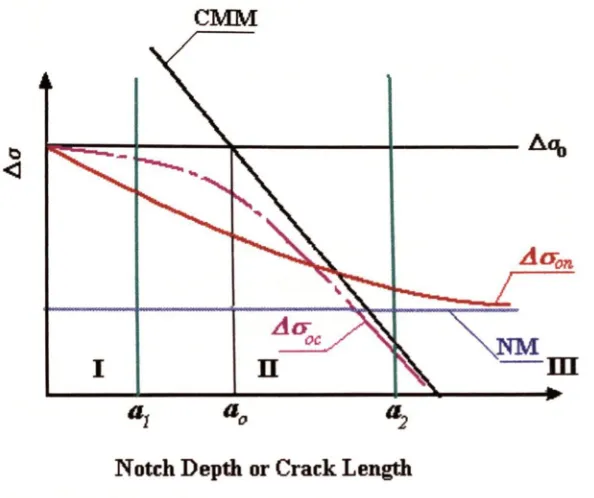
iron. Taylor and colleagues [Taylor
et al, 1996] solved this problem by introducing a
material constant, Uc. The notch depth is augmented by it, thus modelling the notch as a crack
of length (D+ ac). It was shown that the value of Oo is similar to the short crack parameter Oo.
In ElHaddad s model the physical meaning of
a„
is unclear. However it is a reasonable
approximation. And the addition of the geometry factor, F, which contains Oo, to Eq. (2-2-8),
may be better for getting a material constant, ao. Combinations of Smith s model and
ElHaddad s model could be used for prediction of fatigue failure in notched specimens or
Method
3.1 Introduction
The research in this thesis started from the crack modelling method (CMM). The previous
work made by Taylor and his colleagues [Taylor and Lawless, 1996] had showed its success
in 2-D problems and potential advantages in application on engineering components. Further
work needed to be carried out in order to make the technique more suitable for a wide range
of applications for both scientific and engineering usage. This work included the study o f the
path distance effect, the mesh density effect, and the path orientation effect. In this chapter,
all these effects will be examined.
3.2 The Focus Path
The prerequisite for the application o f CMM is that the geometric feature o f a specimen or
component has some features of a real crack, such as a
I N rsingularity. The method
examines the stress field in the region o f this feature. Furthermore only one path on which a
stress-distance (o=-r) curve is determined in this region is needed for evaluating the stress
intensity from the FEA,
A K f e .This specific path is defined as the “ focus path”. Although
previous work had shown some characteristics o f the focus path, it is still worth discussing
how to choose this path, in order to develop a systematic way of choosing this path which
will be used throughout this work.
3.2.1 Path orientation, the mle of lowest A Kf e
The path for CMM is a straight line which radiates from the stress concentration point.
Assuming that a fatigue crack is loaded in M ode I, where the crack’s sides move
perpendicularly apart, the opening stress, i.e. the maximum principal stress (MPS), will drive
the crack to grow. So the path direction should represent the direction on which the crack will
direction [Taylor
et a l,
1997], In that case, the direction of crack growth could be understood
by examining a failed component. The prediction agreed well with the experimental data usin
the path direction. Also if the MPS direction is perpendicular to the crack front, the path
direction should be normal to the MPS direction. It is true that the MPS direction will change
during the crack propagation. Keeping the path normal to the MPS direction from the
beginning to the end will be very difficult, and in doing so the path will be a curve instead of
a straight line. However, we will not make the path like this. We concentrate on the total life
of a component or specimen, in which crack initiation and early growth takes the most part.
We assume that the MPS is the main driving force for fatigue failure. So the MPS direction
here only refers to the MPS direction at or near to the stress concentration place.
Experimental testing was carried out on a single-edge notched specimen, which was
subjected to pull-push loads; the notch depth was 3 mm; the material of the specimen was a
cast Al-alloy, LM25; the fetigue limit o f plain specimens
ACo
was 77.48MPa; the threshold
AKth
was 5.97 MPa m*^^ [Wang
et a l,
1999]. The stress field was analysed using the finite
element method. Fig. 3.2.2 shows MPS contour plot of the specimen. In this case,
p ,which is
defined in Fig. 3.2.1, is equal to zero. Examining a foiled specimen, a crack surface was at a
symmetrical plane a = 0, as shown in Fig.3.2.1. So the path should be at a = 0. A series of
lines are drawn with variable
avalues for comparison. Fig. 3.2.3 shows the
A a-xcurves at
variable a values. Fig.3.2.4 shows the effect of the path orientation on value of
A Kfe,using
applied load equal to the experimental fatigue limit.
At or = 0, the prediction error is only 7.03%. It is evident that our assumption is right.
Moreover, the value of
avaried from 0° to 60° without any large change in
A Kfe-,and even at
60°
the change in
AK/^
was only 15%. This illustrates that the CMM is not sensitive to the
path direction. This character is very good for applications.
Fig. 3.2.1 Path choice on a 3D model of a single-edge notched specimen
140
a = 0 120
0) 100
80 a = 60
60
40
10
0 2 4 6 8
D istance r mm
Fig. 3.2.3
Aa^r
curves of the single notched specimen
S
u
COU.
£ E
V n c Q- - S4- ■
Measured stress intensity
Threshold value
(0
tf)
01b
CO 2 ■ ■
80 60
40 20
0
Angle a
Fig.3.2.4 Path direction eflfect on predicted result using CMM
theoretically; if the value of
AKfe
from the path is more than the threshold value, feilure will
occur. For the above example, the path is at or = 0, which is normal to the MPS direction.
How does this path differ from the others?
2D Stress Fields
The
AcF-r curves in Fig.3.2.3 illustrate important information. For clarity only three curves,« = 0°, 3 0° and 60°, are shown. A distinguishable difference can be seen. Starting from an
identical point, the hot spot, each curve has the same maximum stress value; ending at points
where stress field tends to be uniform, the curves tend to be overlapped after a distance. The
difference among each line is that the rates of the stress reduction with increasing
r value aredifferent. Increasing
a
reduces the rate of reduction; the highest rate is at a = 0. All these
result in variable
AK^e
values when using CMM. The variation in a certain region is
monotonic; a curve with a higher rate brings a lower
AKe^
value. On the path a = 0, the
stress in the
Act ~ rcurve decreases fester than from a path drawn at any other angle, as
shown in the figure. This results in the lowest value o f
AKfe
from any other path. We call this
phenomenon the “Rule of lowest
AKfe'.
For a component with a complex geometry, a set of stress/distance curves would be drawn
from the stress concentration point and the CMM could give a
AKpe
value on each curve.
However, only one from the path that is normal to the MPS direction is the right answer. The
rule of lowest
AKfe
can be used to identify the MPS direction and give the solution at the
same time.
3D Stress Fields
hi order to test the rule being available in a 3D stress field, two examples are shown below.
The first example is a 3D model of the single-edge notched bar shown in Fig. 3 .2.1. The size
of the bar is 12x18x140 mm. A tensile stress of 60 MPa is applied to the end of the bar. The
stress concentration place is located at the point F which can be seen if the figure, actually on
contour plot. Fig.3.2.5 shows the evaluation o f
A Kfevalues using CMM on variable lines.
The path o f or = 0 and
P = 0produces the lowest
A K f eas expected. It proves that the Rule o f
lowest
A K f eis right in this case. Also the results show that the diflference on each path is
small.
In a general 3D case where the crack path is not known, the path choice can be divided into
two steps; the first step is drawing a plane which is normal to the MPS direction; the second
step is drawing a series o f lines in this plane, radiating fi-om the hot-spot, and then selecting
the line on which the A K f e
value is found to be lowest. Fig. 3.2.6 shows the detail o f the path
choice. The body is subjected to a load P; the hot spot is at
F; n-n’
is the plane normal to the
MPS direction.
CM
(0 Q .
12
10
8
6
4
40
30
20
10
0
Angle p
y77777777777
Stress contours
Fig. 3 .2.6 Schematic illustration o f choosing the path
The second example is a notched bar subjected to a torsion load (actually an automotive
camshaft). The details o f the fatigue test and the finite element analysis will be shown in
Section 7.3. Fig. 3.2.7 shows the schematic illustration o f the path choice in this situation.
Considering a brittle material bar, such as a cast iron, subjected to torsion, M, the crack
plane,
n-n,
is 45” from an axis o f the bar. This plane is normal to the MPS direction
according to stress analysis. Assuming the fatigue failure starts from a point
F,the stress
condition at the point is illustrated in the figure; a series o f lines are drawn radiating from this
point; then the
A K fevalues are evaluated using CMM. It is expected that the path o f
0"
will give the lowest
A Kf evalue. On the camshaft, the same process was carried out. The
evaluating
AK fevalues on each line are shown in Fig. 3.2.8. Because a notch existed, the
path which gives the lower
A K fevalue is not
tit0°; it is about at /? = 15°. However the
difiference in
A K febetween the two lines is very small, only 3.7%, Even at /? = 45°, the
difference is still only 9.1%. This proves again that CMM is not sensitive to the path
n-n
<F.,
c
\ \ v
F
Fig. 3.2.7 Schematic illustration of the path choice in a bar subjected a torsion load,
assuming a stress concentration at
F.
18
17.5
17
16.5
16
50
40
30
Fig. 3 .2.8 Evaluating
AKfe
values on variable lines for the camshaft
3.2.2 Minimum distance
For any
Aa-r
curve, the focus path is that part of the curve to be examined, which will be
limited by the minimum distance
r„,i„
and maximum distance
rmax,
shown in Fig. 3.2.9.
Westergaard equation and a
Acr-r
curve from the path mentioned above. The fit error, defined
as the percentage difference between the area under the crack curve and the area under the
Ac-r
curve, is minimised. Eq. (2-2-6) gives a stress value of infinity at r = 0, whereas the FE
data gives a finite stress at this point. If
were zero, the fit error would be infinite. This
implies that the comparison of curves must begin at some value,
rmm,
shown in Fig. 3.2.9.
Theoretically,
rmm
should be as small as possible, but avoid being zero. Numerically, it is
impossible due to the limit of the FE mesh density. Three examples will now be highlighted,
which show the effect of
on different materials, geometry and loads.
Westergaard function
A o-r curve of a component
<
r
r
Fig. 3.2.9 Definition of the minimum distance and maximum distance
The first example is a single-edge notched specimen, as shown in the last section. The
previous work suggested using r„,„ =
Oo
[Taylor, 1996]. The underlying logic of this was that
short fatigue cracks would initiate from the notch at an early stage. These cracks would
typically grow to a length «« and would disrupt the stress field over this distance. In this case,
Oo
is 1.89 mm and the error of the prediction is only 3%, as shown in Fig. 3 .2.10. This result
bring much difference on the prediction for a constant w of 17 mm. Compared with
AKth,the biggest difference is less than 17%. It implies that CMM is not sensitive to the choice of
rmin,
at least in this case.
Tension
u
(0 L i. CMc
^
0 ) (Q^ i
(0 (0
£
♦ -I (0
8
6
4
A K FEThreshold
2
0
5
3
4
1
2
r mln
mm
Fig. 3.2.10 Effect o f o n the prediction ofLM25 specimen subjected to tension load,
f max
1 "7 mm
ao
= 0.05 mm. Fig. 3.2.11 shows the r„,„ efifect on the evaluation
o iA K p s,with a constant
o f 5.05 mm. This data will be used in a later chapter.
Bending
u
(B
U - M
^
f
2 I
® I?
</) t f >
0>
(0
8
6
4
A K FE
2
Threshold0
3
1
2
0
r
minmm
Fig. 3.2.11 Effect o f
on the prediction of a mild steel specimen subjected to bending,
= 5.05 mm
The third example is the camshaft subjected to torsion loads, as mentioned in the last
section. The material constant
aoo f this cast iron is 2.24 mm. Fig. 3.2.12 shows the
variation o f
A Kfewhen increasing rm,„. The
r^axvalue is kept as a constant, 11.25 mm.
Again a good prediction is obtained when
rmm - do.Starting at 0.093 mm, the valid
region for
rmmextends to approx 3.5 mm. In this region the error from any
rmmis less
Torsion
2
18
A K FEThreshold
^ ^ ■ ■ I
0
2
4
6
8
rmin
mm
Fig. 3.2.12 Effect of
rmm
on the prediction of a camshaft subjected to torsion load,
11.25 mm
maxIn general, these three examples include three kinds of materials, three kinds of geometries
from the previous examples, all indicate a common trend, i.e. CMM is not sensitive to the
choice of rmm. The conclusion supports Taylor’s suggestion. Furthermore, any selection of 0
<
r„i„
^ «o is valid in all these situations.
3.2.2 Maximum distance
include all information about the stress concentration, i.e. the part over which the geometrical
feature raises stresses above their nominal values. However, in the general case of complex
component geometry, it may not be clear what these nominal stress values are. With this in
mind, a series of
r^ax
values was analysed on a
cr-r
curve in order to find a general rule.
Fig. 3.2.13 shows three typical Acr-r curves; (a) is a common curve firom a stress
concentration in a tensile stress field, such as a single notch plate subjected to tensile stress;
(b) represents a curve from more than two stress concentrations in a body; (c) behaves as a
body subjected to bending; the stress goes negative beyond a neutral axis.
and three kinds of load conditions. They cover a wide range o f applications. The conclusions
According the analysis above and the previous work, it was decided to use the entire tensile
stress distribution for (a) and (c). For (b), it is necessary to examine the curve; the focus part
should be in the region where the <T-r curve is consistently decreasing; several values should
be tested if possible; the final rmax value should give the lowest K
value. The three examples
are still used to verify the decision above. We did not have an example for (b) at this stage, so
this was not considered.
Fig. 3.2.14 shows the predicted
AK
fevalues of the first example, the LM25 single-edge
notched specimen. AK
fealmost remains a constant on variable Kmax
from 1 mm to 17 mm; the
fit error also keeps about the same level, between 7 and 11 %; the biggest prediction error
comparing with the test data is less than 15%. This means that the choice of rmax
does not
have much effect in this case.
The second example is used to verify the type (c) Aa-r curve, which is from a body subjected
to bending load. Due to the existence of bending loads, the remote stress in the notched mild
0<
steel bar did not tend to some unique value, but continued to decrease, passing through zero
at the neutral axis and becoming negative. In this case the neutral axis was 5.05 mm away
from the notch root. Fig. 3.2.15 shows the
A a - rcurve and the best-fit curve at
Vmax -6 mm;
the former goes negative whereas the latter still keeps positive; the fit error is 40%. This
implies that CMM treats negative as zero. Fig. 3.2.16 shows the
A Kfechanging with variable
rmcDc-
The prediction error in a range of
Vmcafrom 1 mm to 6 mm is less than 20%. This proves
that CMM is not sensitive to the
rmaxchoice in the bending condition.
10
To (0
u - <M
II
H
in
0)
s
8
■6
4
2
■ ■
A K f B
— Threshold
I - I I L .
10
r max
mm
15
20
600 -r
Stress from FE model
Westergaard stress
500
400
s 300
S 200
100
-100
D istance r mm
Fig. 3.2.15 A
g- rcurve and its best-fit curve on the notched mild steel bar
o
RS*£.
r
=
I
0)«
11
tf)
(0
0>
s
1 0 -r
8
- I
6 -t
4
2
Bending
■ ■
- A K FE
-Threshold
. . |_ i I i _ i