Towards Annotating Narrative Segments
Nils Reiter
Institute of Natural Language Processing, Stuttgart University
Abstract
We report on first annotation experiments on narrative segments. Narrative seg-ments are a pragmatic intermediate layer that allows studying more complex nar-ratological phenomena. Our experiments show that segmenting on limited context information alone is difficult. High inter-annotator agreement on this task can be achieved by coupling the segmentation with summarization and aligning parts of the summaries to segments of the text. 1 Introduction
In this paper, we present ongoing work and first in-sights into the manual annotation of narrative ments. We introduce the notion of narrative seg-ments as a pragmatic intermediate layer, that is a first step towards annotation of more complex narratological phenomena and has the prospects of being identifiable automatically. Furthermore, narrative segments can serve as an abstraction layer for applications such as social network ex-traction. If narratives describe connected events (Mani, 2012), we define a narrative segment as a coherent and separable sub-sequence of the events in a full narrative. A narrative segment ends, e.g., when place or time of the events change.
(1) [. . . ] With a whirl of skirts and with the bril-liant sparkle still in her eyes, she cluttered out of the door and down the stairs to the street. Where she stopped the sign read: “[. . . ]” In (1), (O. Henry: The Gift of the Magi), an un-defined amount of time passes between the char-acter running down the stairs and stopping at the sign. Since the time and place of the events change, this would be the beginning of a new seg-ment. Coincidentally, there is also a paragraph boundary at this position.
Working quantitatively with a specific theory requires annotations of text(s). Unfortunately, in-stantiating a theory such that it is annotatable is challenging (Hovy and Lavid, 2010), especially within Digital Humanities. The annotation pro-cess, however, can also be a productive way of validating and objectifying a theory. In this paper, we showcase how to systematically explore differ-ent ways of formalizing and annotating narrative segments, a category that is implicitly present in narratological theory, but not spelled out in detail.
2 Related Work
Related work to this paper falls in three areas: Seg-mentation of narrative texts (and the correspond-ing annotation efforts), narratology-driven anno-tation and discourse annoanno-tation. In the project Heurecl´ea1, a corpus of German and English
lit-erary texts is being annotated (Gius and Jacke, 2014), following closely the narratological the-ories (Genette, 1980; Lahn and Meister, 2008). To our knowledge, annotations are still work in progress and not yet released.
There are publications about topical segmenta-tion of narratives, for which annotated data has been created. Kazantseva and Szpakowicz (2014) have used a novel that has been annotated with topical segments by 3-6 people (differing by chap-ters). The authors report a mean pairwise segmen-tation similarity of0.79. The evaluation data set used by Kauchak and Chen (2005) consists of two novels and is based on the chapter segmentation done by the authors of the novels. To our knowl-edge, there are no previous works on segmenting narrative texts into plot parts, which does not pre-sume a topical shift.
There are annotated news corpora in the area of discourse, (Carlson et al., 2002; Prasad et al., 2008) that feature fine-grained discourse relations
1http://heureclea.de
between relatively small text spans. Although larger structures have been discussed in the liter-ature (J. Grosz and L. Sidner, 1986) but not (yet) annotated. Move analysis (Biber et al., 2007) pro-vides a framework for corpus-based study of dis-course structures, but assumes disdis-course moves to be defined functionally and not by plot content. 3 Annotating Narratological Theory
3.1 Narratological Theory
Three time-related phenomena can be discerned: Order, duration and frequency (Genette, 1980). Narratives often deviate from the chronologi-cal order and include anachronies, e.g., flash-forwards (prolepsis). The emphasized sentence in (2), from Chris Farrington: Able Seaman (Jack London) shows a flash-back.
(2) The boats could not be back before midnight. Since noon the barometer had been falling [. . . ], [and signs were ripe for a storm.] Many narratives contain slow and fast parts since the durationof different parts of the narra-tive varies. This is formalized as the relation be-tween story time (ST, the time that passes within the story) and narrating time (NT, the time “con-suming” the story takes). The phenomenapause (ST = 0),slow down (ST < NT),scene (ST =
NT),summary(ST >NT) andellipsis(NT =0)
are straightforwardly distinguished. The empha-sized sentence in (2) is also a summary, because the falling of the barometer (ST) has been taking a lot longer than to read the sentence (NT).
The termFrequency is used to describe the re-lation between the number of times an event hap-pens (n) within the story and the number of times it is narrated (m). Schematically, one can distin-guish five cases: (i)n=1=m, (ii)n=1, m>1,
(iii) n > 1, m = 1, (iv) n = m > 1 and (v)
n>1, m>1, m=/n.
These categories – anachrony, pause, . . . – are not categories of the entire text, but of specific “narrative segments” (Genette, p. 35). These im-plicitly assumed narrative segments are not fined in any way by Genette. However, the de-tection of such segments is a prerequisite in order to investigate these phenomena.
3.2 Annotation Setup
To formalize the notion of narrative segments, there are a number of aspects to consider. Our aim
Exp. Context Autom. Task Annotators 1 10 sent. classification non-experts 2 full text segmentation students 3 full text summ. align. students
Table 1: Experiment Overview
is developing a formalization that is both theoreti-cally motivated and can be annotated reliably.
Context Knowledge In contrast to most linguis-tic concepts, which are done with a limited amount of context, full text knowledge is an underlying as-sumption in literary studies. Requiring annotators to have full text knowledge makes the annotation process slower. In crowd sourcing, it is hard to control whether annotators will have read the en-tire (possibly long) text.
Annotation Unit and Task The annotation unit is the text portion that is annotated, i.e., assigned to a given category. In NLP, these are usually de-fined in linguistic terms, e.g., sentences, phrases, or tokens. The theoretical literature in narratol-ogy does not presume a fixation on a linguistic unit, but instead allows freedom on the selection of the actual unit. The examples shown by Genette (1980) range from noun phrases (“the prospect of a war”, prolepsis) to multiple sentences. The de-cision on the annotation unit also influences the task this problem can be cast as for automatiza-tion: Annotating full sentences would allow cast-ing as a classification task in the future, while al-lowing free spans to be annotated would lead to a segmentation task.
Annotator Selection Crowd sourcing experi-ments allow asking non-experts for their intu-itions. This requires to break down the annotation task such that knowledge of theory or terminology are no longer required. Also, the amount of time that workers spend can not be fully controlled. Ex-pert annotations are harder to organize, but ideally allow annotating higher level concepts and use of domain terms.
4 Annotation Experiments
Does the yellow sentence start a new narr. unit?
A narrative unit starts, whenever
• the speed of narration changes (e.g., more time passing than before as in “Ten days later, . . . ”),
• time and place change (e.g., flashbacks as in “Ten years ago, I was a successful businessman in . . . ”), or • the narrator changes (e.g., longer segments of direct or
indirect speech, attributed to a character in the narra-tion; internal monologue).
Figure 1: Worker instructions in Exp. 1
the “annotatability”. Table 1 shows a schematic overview of the experiments.
4.1 Experiment 1: Crowd Sourcing
The first experiment was conducted as a crowd sourcing classification task using CrowdFlower2.
The workers were presented a sentence (in yellow) within a context of ten sentences before and after. They were given a yes/no question, but with an additional “I can’t tell” option. The workers anno-tated all sentences from two narrative texts,Chris Farrington: Able Seaman (J. London) and The Winepress (J. Essberger), in random order. The exact definitions are shown in Fig. 1. Due to diffi-culties in automatic parsing, we opted for annotat-ing full sentences in this experiment.
Results and Discussion In total, we collected 1,763 ratings from 315 different workers, for $ 64. Of these ratings, 1,406 (79.8%) are of the non-new class, 339 (19.2%) of the non-new class. Our data set included eleven test questions and the follow-ing results are based on the five ratfollow-ings for each item from the most trust-worthy workers (mea-sured against the test questions).
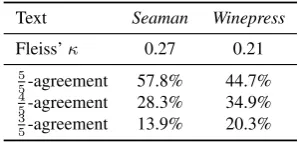
We evaluate the workers’ performance using inter-annotator agreement Fleiss’κ(Fleiss, 1971) and show the fraction of different kinds of ma-jority cases. The results can be seen in Table 2. The workers achieve a κ-agreement of 0.27 and 0.21. In part, the low score can be explained by skewedness of the task – most sentences are of the same category (not starting a new segment), which makes the chance-agreement very high (0.67 and 0.73). There is a large portion (57.8%and44.7%) of sentences where all workers are in agreement.
2https://www.crowdflower.com
Text Seaman Winepress
Fleiss’κ 0.27 0.21
5
5-agreement 57.8% 44.7% 4
5-agreement 28.3% 34.9% 3
[image:3.595.341.491.62.133.2]5-agreement 13.9% 20.3%
Table 2: Quantitative analysis results of Exp. 1
Manual inspection revealed that most disagree-ment cases are sentences involving direct speech and thoughts representation or giving background information (3). These cases were not covered by the guidelines.
(3) The Sophie Sutherland was a seal-hunter, registered out of San Francisco, [. . . ].
4.2 Experiment 2: Student Annotators
In this experiment, we collected two annotations for each of 19 short stories from (paid) students of German literature. As a general design change, we asked the annotators to first read the entire text and only make boundary annotations in a second step. We also made several definitions for cases that were difficult in previous experi-ments: a) Dramatic scenes (dialogues) typically belong to a narrative segment, b) encyclopedic parts (e.g., landscape descriptions) and c) events that are not “really” happening in the narrative (e.g., thoughts, possibilities) can constitute seg-ments on their own.
Additionally, we allowed the annotators to mark segment boundaries on different levels. This al-lows finer distinction between segment boundaries of different granularities. We asked the annotators to first mark the most clear, top-level segmenta-tions and in a second (and third) step subdivide the segments into smaller pieces. A boundary of levelnis also a boundary of leveln+1.
Corpus The stories have been selected ran-domly out of the TextGrid3 corpus, the only
restrictions being on the genre (narratives) and length (2k−12ktokens). In total, the corpus
con-tains 4.692 sentences (avg. length: 21.9 tokens).
Agreement We calculated κ agreement using boundary similarity (Fournier, 2013) as a measure for observed agreement4. Boundary similarity is
3http://www.textgridrep.de 4Since chance agreement is very low (
κ-Agreement per level
Text 1 2 3
[image:4.595.310.530.63.138.2]1009 0.409 0.517 0.478 14 0.393 0.375 0.28 weighted avg. 0.263 0.384 0.347
Table 3: Annotator agreement in Experiment 2
based on an edit distance measure and penalizes near misses less than full misses. We used a near miss window of two avgerage sentences (44).
Results and Discussion Theκagreement scores for two individual and all texts can be seen in Ta-ble 3, separated by level. In general, we take these results as an indicator that narrative segments are something that annotators can agree upon, but that there is some room for improvement of our guide-lines and definitions. Regarding the different lev-els of segmentation, we have to note that the an-notators did have different understandings of these levels and used them very differently. This can be seen in the fact that the agreement on level 3 is higher than on level 1.
Interestingly, the total number of boundaries annotated by the annotators do not differ that much: A1 added 3.825 boundaries, while A2 added 4.293. Although it was not required or sug-gested, the majority of boundaries fall on sentence boundaries (A1: 67.4%, A2: 80.2%). Most of the remaining boundaries are annotated on clause boundaries.
4.3 Experiment 3: Summary Annotations
In the third experiment, we asked the annotators from the second experiment to summarize the text and then align parts of the summary with specific text segments. The idea behind this experiment was to couple the segmentation task with a “real” task that makes sense outside of the annotation task and guides decisions on granularity. We eval-uated only the (now implicit) segmentation of the texts, using the same measures as before. An ad-vantage of this setup is that the summaries allow insight into the annotators’ intentions.
Results and Discussion Figure 2 shows the re-sulting segmentations of the two annotators and the corresponding agreement scores on the right side. In terms of the scores, the agreement is much higher than in Exp. 2. All annotated segment boundaries fall on sentence boundaries. Since the annotators have participated in Exp. 2, they are
Exp.
2 1009A1A2
14A1A2
Exp.
3 1009A1A2 κ=0.8
[image:4.595.100.264.65.129.2]14A1A2 κ=0.5
Figure 2: Segmentation Annotations
more trained than before. As the two stories were not discussed in group meetings, they should not be biased towards specific segmentations.
In the figure, we can also compare the segmen-tations of the same texts in Exp. 2 for each annota-tor. As can be seen, the annotators produced much larger segments in the third experiment, while an-notator A2 still created a finer segmentation. The only remaining difference among the segmenta-tions on text 1009 can be explained with the help of the summaries: An event that is deemed impor-tant by one annotator is not even mentioned by the other and therefore, not summarized separately. In this way, the two segmentations reflect also on dif-ferent literary interpretations of the texts.
5 Conclusions and Future Work
We presented first annotation experiments on nar-rative segmentation. We see it as i) a prerequi-site step towards quantitative analyses of complex phenomena from narratological theory and ii) use-ful for applications (e.g., social network extrac-tion). Furthermore, systematically exploring dif-ferent possibilities in formalizing concepts from humanities theories in this way can help bridge the gap between theoretical concepts and annotatable categories. Although events play a major role in narratives, we are aiming for pragmatic annota-tions that tap into intuitive understanding of nar-ratives without presuming event annotations.
Our annotation experiments indicate that anno-tating segment boundaries in isolation is difficult. However, when coupled with a more involved task (like summarizing a narrative), higher agreement can be achieved and also allows insight into the in-tention of annotators. In the future, we will extend these experiments on annotation and use these an-notations as test and training data for automatic segmentation of narrative texts.
Acknowledgements
References
Douglas Biber, Ulla Connor, and Thomas A. Upton. 2007.
Discourse on the Move. Number 28 in Studies in Corpus Linguistics. John Benjamins Publishing Company, Ams-terdam.
Lynn Carlson, Daniel Marcu, and Mary Ellen Okurowski. 2002. Rst discourse treebank, ldc2002t07. Technical re-port, Philadelphia: Linguistic Data Consortium.
J.L. Fleiss. 1971. Measuring nominal scale agreement among many raters. Psychological Bulletin, 76(5):420– 428.
Chris Fournier. 2013. Evaluating text segmentation using boundary edit distance. InProceedings of the 51st Annual Meeting of the Association for Computational Linguistics (Volume 1: Long Papers), pages 1702–1712. Association for Computational Linguistics.
G´erard Genette. 1980. Narrative Discourse. Cornell Uni-versity Press, Ithaca, New York. Translated by Jane E. Lewin.
Evelyn Gius and Janina Jacke. 2014. Zur annotation narra-tologischer kategorien der zeit. Annotation Manual 1.0, Hamburg University, January.
Eduard Hovy and Julia Lavid. 2010. Towards a ‘science’ of corpus annotation: A new methodological challenge for corpus linguistics. International Journal of Translation Studies, 22(1), January.
Barbara J. Grosz and Candace L. Sidner. 1986. Attention, Intentions, and the Structure of Discourse. Computational Linguistics, 12(3):175–204, July.
David Kauchak and Francine Chen. 2005. Feature-based segmentation of narrative documents. InProceedings of the ACL Workshop on Feature Engineering for Machine Learning in Natural Language Processing, pages 32–39, Ann Arbor, Michigan, June. Association for Computa-tional Linguistics.
Anna Kazantseva and Stan Szpakowicz. 2014. Hierarchical topical segmentation with affinity propagation. In Pro-ceedings of COLING 2014, the 25th International Con-ference on Computational Linguistics: Technical Papers, pages 37–47, Dublin, Ireland, August. Dublin City Uni-versity and Association for Computational Linguistics. Silke Lahn and Jan Christoph Meister. 2008. Einf¨uhrung in
die Erz¨ahltextanalyse. Metzler, Stuttgart, Germany. Inderjeet Mani. 2012. Computational Modeling of