Creating an Annotated Tamil Corpus as a Discourse Resource
Ravi Teja Rachakonda
Dipti Misra Sharma
International Institute of
International Institute of
Information Technology
Information Technology
Hyderabad, India
Hyderabad, India
[email protected]
[email protected]
Abstract
We describe our efforts to apply the Penn Discourse Treebank guidelines on a Tamil corpus to create an annotated corpus of dis-course relations in Tamil. After conducting a preliminary exploratory study on Tamil discourse connectives, we show our obser-vations and results of a pilot experiment that we conducted by annotating a small portion of our corpus. Our ultimate goal is to develop a Tamil Discourse Relation Bank that will be useful as a resource for further research in Tamil discourse. Fur-thermore, a study of the behavior of dis-course connectives in Tamil will also help in furthering the cross-linguistic under-standing of discourse connectives.
1
Introduction
The study of discourse structure in natural lan-guage processing has its applications in emerging fields such as coherence evaluation, question an-swering, natural language generation and textual summarization. Such a study is possible in a given human language only if there are sufficient dis-course annotated resources available for that lan-guage. The Penn Discourse Treebank (PDTB) is a project whose goal is to annotate the discourse re-lations holding between events described in a text. The PDTB is a lexically grounded approach where discourse relations are anchored in lexical items wherever they are explicitly realized in the text
(Miltsakaki et al. 2004, Prasad et al., 2008). To foster cross-linguistic studies in discourse rela-tions, projects similar to the PDTB in discourse annotation were initiated in Czech (Mladová et al., 2008), Chinese (Xue, 2005), Turkish (Zeyrek and Webber, 2008) and Hindi (Prasad et al., 2008). We explore how the underlying framework and annota-tion guidelines apply to Tamil, a morphologically rich, agglutinative, free word order language.
In this paper, we present how a corpus of Tamil texts was created on which we performed our pilot experiment. Next, in Section 3 we cover the basics of the PDTB guidelines that we followed during our annotation process. In Section 4, we show var-ious categories of Tamil discourse connectives that we identified after a preliminary study on dis-course connectives in Tamil, illustrating each with examples. In Section 5, we discuss some interest-ing issues specific to Tamil that we encountered during discourse annotation and present the results of the pilot experiment that we performed on our source corpus. We conclude this paper in Section 6 by discussing about challenges that were unique to our work and our plans for the future.
2
Source Corpus
We collected Tamil encyclopedia articles from the June 2008 edition of the Wikipedia static HTML dumps1. Elements such as HTML metadata, navi-gational links, etc. were then removed until only the text of the articles remained. A corpus was then built by collecting the texts from all the articles in the dump. The corpus thus created consists of
1 http://static.wikipedia.org/
about 2.2 million words from approximately 200,000 sentences.
Since the texts used in building the corpus were all encyclopedia articles featured in the Tamil lan-guage version of Wikipedia, the corpus covers a wide variety of topics including arts, culture, biog-raphies, geography, society, history, etc., written and edited by volunteers from around the world.
3
Penn Discourse Treebank Guidelines
The PDTB is a resource built on discourse struc-ture in (Webber and Joshi, 1998) where discourse connectives are treated as discourse-level predi-cates that always take exactly two abstract objects
such as events, states and propositions as their ar-guments. We now describe the types of connec-tives and their senses from the PDTB framework and provide examples from Tamil sentences.
3.1 Annotation Process
The process of discourse annotation involves iden-tifying discourse connectives in raw text and then annotating their arguments and semantics. Dis-course connectives are identified as being explicit,
implicit, AltLex, EntRel or NoRel (Prasad et al. 2008). These classes are described in detail in Sec-tion 4. By convenSec-tion, annotated explicit connec-tives are underlined and implicit connectives are shown by the marker, “(Implicit=)”. As can be seen in example (1), one of the arguments is shown enclosed between {} and the other argument is shown in []. The AltLex, EntRel or NoRel relations are shown by underlining, i.e., as “(AltLex=)”, “(EntRel)” and “(NoRel)”, respectively.
(1) {eN kAl uDaindadaN}Al [eNNAl viLayADa
muDiyAdu].
„{My leg broke}, hence [I cannot play].‟
3.2 Sense Hierarchy
The semantics of discourse relations are termed as
senses and are then classified hierarchically using four top-level classes „Comparison‟,
„Contingen-cy‟, „Expansion‟ and „Temporal‟. Each class is refined by its component types and these, in turn, are further refined by the subtype level.
It is interesting to note that some connectives have multiple senses. In example (2) the affixed –
um connective carries the sense of type
Expan-sion:Conjunction „also‟ whereas in example (3) the same affix carries the sense of the subtype Contin-gency:Concession „however‟.
(2) {idaN mUlam avar oru nAL pOttiyil oNba-dAyiram OttangaLai kaDanda pattAvadu vIrar eNra perumaiyai pettrAr}. [inda OttangaLai kaDanda mudal teNNAppirikka vIrar eNra sAdaNaiyaiy]um [nigaztiNAr].
„{By this, he became the tenth player to cross nine thousand runs in one-day internationals}. [He] also [attained the record of becoming the first South African player to cross these many runs].‟
(3) {seNra murai kirikket ulagakkOppaiyiN pOthu pangu pattriyadai vida iraNDu aNigaL immurai
kUDudalAga pangu pattriya pOd}um,
[motthap pOttigaL inda muraiyil kuraivAN-adAgum.]
„Though {two more teams participated when compared to last Cricket World Cup}, [the total matches played during this time were fewer].‟
4
Discourse Connectives in Tamil
Tamil is an agglutinative language where mor-phemes are affixed to the roots of individual words, a trait that it shares with many other Dra-vidian languages and languages like Turkish, Esto-nian and Japanese. Here, each affix represents information such as discourse connective, gender,
number, etc. We now describe how we try to cap-ture various types of Tamil discourse connectives using a proposed scheme which is based on the existing PDTB guidelines proposed by (Prasad et al., 2007).
4.1 Explicit Discourse Connectives
(4) {avaradu uDalnalam sariyillAmaiy}Al [nAngu mAdangaL avarAl viLayADa iyalavillai]. „{He was suffering from ill health} so [he could not play for four months].‟
(5) {tirukkuraL aNaittu madattiNarum paDittu payaNaDaiyum vagaiyil ezudappattuLLadu}. eNavE [innUl palarAl pArAttappaDuginradu]. „{Thirukkural has been written in such a way that people from all religions can benefit from it}. Hence, [this book is praised by many].‟
Syntactically, explicit connectives can be coordi-nating conjunctions e.g., alladu („or‟), subordinat-ing conjunctions e.g., -Al („so‟), sentential relatives
e.g., -adaNAl („because of which‟), particles e.g., -um („also‟) or adverbials e.g., -pOdu („just then‟).
Explicit connectives also occur as conjoined connectives where two or more instances of nectives share the same two arguments. Such con-nectives are annotated as distinct types and are annotated discontinuously, as seen in example (6) where the connectives -um and -um are paired to-gether to share the same arguments.
(6) {mANavargaLukku sattuNavu aLikkav}um
[avargaL sariyAga uDarpayirchi seiyyav]um arasup paLLigaL udava vENDum.
„Government schools should help in {providing nutritious food to the students} and [making sure they perform physical exercises].
4.2 Implicit Discourse Connectives
Implicit discourse connectives are inserted be-tween adjacent sentence pairs that are not related explicitly by any of the syntactically defined set of explicit connectives. In such a case, we attempted to infer a discourse relation between the sentences and a connective expression that best conveys the inferred relation is inserted. In example (7), the implicit expression uthAraNamAga („for example‟) has been inserted as an inferred discourse relation between the two sentences.
(7) {IyOrA iNa makkaLiN moziyil irundu iNru Angilattil vazangum sorkaL uLLaNa}. (Implic-it=uthAraNamAga) [dingO, vUmErA, vAlabi pONra sorkaL IyOravilirindu tONriya sorkaL dAN].
„{There are words that are present in English that originated from the language of the Eora people}. (Implicit= For example) [Dingo,
Woomera and Wallaby are words with their or-igins in Eora].‟
4.3 AltLex, EntRel and NoRel
In cases where no implicit connective was appro-priately found to be placed between adjacent sen-tence-pairs, we now look at three distinct classes.
AltLex relations, as seen in example (8) are dis-course relations where the insertion of an implicit connective leads to a redundancy in its expression as the relation is already alternatively lexicalized by some other expression that cannot be labeled as an explicit connective. Example (9) shows an En-tRel relation where no discourse relation can be inferred and the second sentence provides further description of an entity realized in the first sen-tence. When neither a discourse relation nor entity-based coherence can be inferred between the two adjacent sentences, it is described as a NoRel, shown in example (10).
(8) {mudalAvadAga mAgim, jOgEshwari,
pUrivilla rayil nilayangaLil guNDu vedittadu}. (AtlLex=idai toDarndu) [mErku rayilvEyiN aNaittu rayilgaLum niruttappaTTaNa].
„{Initially, bombs exploded in Mahim, Joge-shwari and Poorivilla}. (AltLex=following this) [all the trains from the western railway were halted].‟
(9) {ivvANDu kirikket ulagakkOppai mErkindiyat tIvugaLil mArc padimUnril irundu Epral iru-battu-ettu varai naDaipettradu}. (EntRel)
[in-dap pOttiyil pangupattriya padiNAru
nADugaLaic cArnda aNigaLum ovvoru kuzu-vilum nANgu aNigaL vIdamAga nANgu kuzukkaLAga pirikkapattu pOttigaL iDampet-traNa].
„{This year‟s Cricket World Cup was held in West Indies from the thirteenth of March to the twenty-eight of April}. (EntRel) [In this com-petition, the teams representing the sixteen na-tions were grouped into four groups with four teams in each group].‟
(10) {caccin TeNdUlkar ulagiNilEyE migac ciranda
mattai vIccALarAga karudappadugirAr}.
(NoRel) [indiya pandu vIccALargaL sariyANa muraiyil payirci peruvadillai].
5
Observations and Results
5.1 Combined connectives
There is a paired connective -um … -um (…) that sometimes expresses an Expansion:Conjunction
relation between the events where each -um is suf-fixed to the verb that describes each event (see ex-ample (6)). Also, there is a connective -Al which usually never occurs more than once and some-times expresses a Contingency:Cause relation be-tween two events.
It is interesting to see that in sentences like (11), the -Al combines with the -um … -um to ex-press something like a new type of relation. In the process, the -um … -um causes the -Al, which is usually not doubled, to become doubled, thereby forming an -Alum … -Alum. We call this special type of connectives as combined connectives, as shown in example (11).
(11) {kirikket viLayADiyad}Alum {uDarpayirci
seidad}Alum [sOrvaDaindEN].
„Because {I played cricket} and because {I did exercise} [I am tired].‟
5.2 Redundant connectives
The connective -O … -O (…) that conveys a dubi-tative relation also combines with the -Al connec-tive in a way similar to what was shown in Section 5.1 to form the combined connective -AlO … -AlO (…).
However, in example (12), alladu, an equiva-lent of the -O … -O connective has also occurred in addition to the combined -AlO … -AlO connective. This may be purely redundant, or could serve a purpose to emphasize the dubitative relation ex-pressed by both alladu and -O … -O.
(12) {pOtti samappatt}AlO alladu {muDivu pera-paDAmal pON}AlO [piNvarum muraigaL mU-lam aNigaL tarappaDuttapaDum].
„If {a game is tied} or if {there is no result}, [the qualified teams are chosen using the fol-lowing rules].‟
5.3 Results of Pilot Study
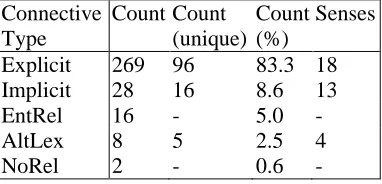
In this experiment, we looked at 511 sentences from the corpus mentioned in Section 2 and anno-tated a total of 323 connectives. Table 1 shows the distribution of the annotated connectives across the
different types such as Explicit, Implicit, EntRel, AltLex and NoRel.
Connective Type
Count Count (unique)
Count (%)
Senses
[image:4.612.332.523.95.187.2]Explicit 269 96 83.3 18 Implicit 28 16 8.6 13 EntRel 16 - 5.0 - AltLex 8 5 2.5 4 NoRel 2 - 0.6 -
Table 1: Results of Pilot Experiment
While a higher percentage of the connectives annotated are those of the Explicit type, it can also be seen that there is a higher proportion of unique connectives in the Implicit and AltLex types. Note that since EntRel and NoRel connectives are not associated with a sense relation or a lexical item, their counts are left blank.
6
Challenges and Future Work
The agglutinative nature of the Tamil language required a deeper analysis to look into suffixes that act as discourse connectives in addition to those that occur as unbounded lexical items. We also found certain interesting examples that were dis-tinct from those observed during similar approach-es in relatively lapproach-ess morphologically rich languagapproach-es like English.
While this was a first attempt at creating a dis-course annotated Tamil corpus, we are planning to conduct future work involving multiple annotators which would yield information on annotation met-rics like inter-annotator agreement, for example. Our work and results would also be useful for similar approaches in other morphologically rich and related South Indian languages such as Mala-yalam, Kannada, Telugu, etc.
We will also work on a way in which the dis-course annotations have been performed will help in augmenting the information provided during dependency annotations at the sentence-level.
Acknowledgments
We would like to thank Prof. Rajeev Sangal of IIIT Hyderabad for his timely guidance and useful inputs. We also acknowledge the role of Sudheer Kolachina in the discussions we had in the writing of this paper.
References
Eleni Miltsakaki, Rashmi Prasad, Aravind Joshi and Bonnie Webber. 2004. The Penn Discourse Tree-bank. Proceedings of LREC-2004.
Rashmi Prasad, Samar Husain, Dipti Mishra Sharma and Aravind Joshi. 2008. Towards an Annotated Corpus of Discourse Relations in Hindi. Proceedings of IJCNLP-2008.
Rashmi Prasad, Eleni Miltsakaki, Nikhil Dinesh, Alan Lee, Aravind Joshi, Livio Robaldo and Bonnie Web-ber. 2007. The Penn Discourse Tree Bank 2.0 Anno-tation Manual. December 17, 2007.
Bonnie Webber and Aravind Joshi. 1998. Anchoring a lexicalized tree-adjoining grammar for discourse. In Manfred Stede, Leo Wanner, and Eduard Hovy, edi-tors, Discourse Relations and Discourse Markers: Proceedings of the Conference, pages 86-92. Associ-ation of ComputAssoci-ational Linguistics.
Nianwen Xue. 2005. Annotating Discourse Connectives in the Chinese Treebank. Proceedings of the ACL Workshop on Frontiers in Corpus Annotation II: Pie in the Sky.