Urdu Spell Checking: Reverse Edit Distance Approach
Saadat Iqbal, Waqas Anwar, Usama Ijaz Bajwa, Zobia Rehman COMSATS Institute of Information Technology, Abbottabad, Pakistan {saadat,waqas,usama,zobiarehman}ciit.net.pkemail@domain
Abstract
Spelling of words of a language are standard-ized by language authorities or consortiums and available in dictionaries or lexicons. For instance, “produkt” does not belong to English dictionary. Similarly “نايمرد“ is a correctly spelled word, while “رنايمرد “ is a non-word in Urdu. Electronic representation of text is commonly used in today’s computing envi-ronment. The rich resourced languages like English have many applications with added tools. On the other hand, application develop-ment is in its infancy for less resourced lan-guage like Urdu. Spelling plays a vital role while humans write text electronically in com-puters. It is oblivious that terabytes of text is added in form of corpus or otherwise that is required to be spell checked, which is practi-cally impossible to be done manually. In this work, various techniques for spellchecking have been studied and analyzed. All of them separately or a combination thereof can be used for the process of spell checking. Edit Distance technique has been widely used in spell checkers of various language, and a vari-ation of this technique i.e. Reverse Edit Dis-tance technique selected for suggesting correct words for nonwords. For Urdu, candidates are found by making 86n+41 comparisons for an ’n character’ length Urdu word.
1 Introduction
Usage of computers became an essential compo-nent in human lives. In today’s computing envi-ronment, text processors, search engines, short messaging services, chatting applications, and many more are widely used. Google auto com-plete feature starts giving options; For instance when “morp” is typed options like: morphine, morphology, morphine drug, and morphological choices appear. On the other hand the user does
not know the exact spelling, Google will make a search based on closed matched words and will display the message as well. All this happens in a fraction of second. This reveals that Google and other applications are using spell error detections and correction algorithms which are implement-ed in applications for user facilitation. Terabytes of text added to the internet resource daily is required to be spellchecked. A single book re-quires multilevel readers for spell checking and correction, if performed manually. Thus auto-mated spell checkers and correctors are required. Spell checking is process of matching a given word with alphabetically ordered words in a dic-tionary or lexicon. For instance, in Urdu, a given word نيہاش is compared with words in Urdu lexi-con, if we get a match then the word is consid-ered to be correctly spelled. On the other hand if we compare نيحاش with words in lexicon, if we do not get a match then the word is considered to be misspelled. However it is worth mentioning here that the automated spell checking process is reasonably complex in case of Urdu as compare to English. The complex process of spell check-ing in Urdu is due to its morphologically rich-ness, word space problem, and scarcely available electronic resources.
2 Challenges of Urdu Spell Checking Tokenization in Urdu, Diction problem, Loan Words, Morphological nature, Grammatical words and Initial letter Capitalization are some of the challenges that makes the Urdu Spell checking complex. Tokenization is process of to break text at word level.
2.1 Word Separator – space character
In English text, words are separated by spaces characters, as tokens (Sara Stymne 2011). To separate words in Urdu, spaces are not used after every word as in case of English language. The natives of Urdu language separate the words from each other by cognitive knowledge of the language while reading or writing text. For in-stance, in the following example same sentence is written in three variation of space usage: Space is only used after a word that ends with joiner letter. ۔ےھت ےہر ليھک ںيمرازاب مہ [We were playing in the bazaar]. Space is not used at all after any of the word that ends with joiner let-ter.۔ےھتےہرليھکنيمرازابمہ Space is used after each word. ۔ےھتےہرليھکںيمرازابمہ
2.2 Morphological Nature
In contrast to languages like English, Urdu lan-guage bends toward agglutinative lanlan-guages due to its complex morphological nature. The lan-guages like Turkish and Finnish are agglutinative languages as multiple words generates from a single word by affixation, derivational, and in-flectional suffixes. From the Turkish word “ug-gar” (means civilized) a word “uggarlastira-mayabileceklerimizdenmissinizcesine” is derived (Kemal Oflazer and Cemaleddin 1994). “Heat-er”, “heated”, “heats” are the word forms that are inflected from the root word “heat”. Urdu is morphological rich language and multiple words are inflected from a root word. The following are few inflected words that are inflected from the root word of Urdu لوب (speak).
لوبوت ولوبمت انلوبمت لوبپآ ںي
پآ لوب ےئي ےتلوبپآ ولوبپآ
2.3 Diction Problem
Diction problem is defined as using choice of words from a set of word which has same mean-ings. The Urdu language is considered to be
computationally complex due to its diction prob-lem as well. Example words in Urdu that are dif-ferent in spelling but having same meanings are: ( ہيکت،ايکت )
2.4 Loan Words
The native speakers of the Urdu language take advantage of loan words from other languages like English. Engine: (نجنا), O-Level
(ءابلطےکلويل-O). Paragraph (فارگاريپ)
2.5 Initial letter Capitalization
In English proper nouns, start of sentences can be recognized with the words with letter capitalized. For instance,
• The world is shrinking …. [initial letter of “The” is capitalized at the beginning of sen-tence]
• The delegation will meet Abu Bakar at Is-lamabad …. [initial letter of proper nouns “Abu Bakar” and “Islamabad” are capital-ized.
لامںيمداباملاساےسرکبوبادفو
۔اگےرکتاق [proper nouns
starting with a normal character].
2.6 Grammatical Words
Grammatical words are prepositions, adverbs, conjunctions etc. they themselves have not a very clear meaning. However, these words are used to complete sentences and there meanings are ex-pressed in dictionaries with the help of examples. For instance, for, with, the, of, etc. In Urdu the examples of grammatical words are, ےس ،ےن ،اک etc. say, nay, kaa respectively.
3 Literature Review
3.1 Historic perspective of Spell Checking
Insertion; a letter is wrongly inserted at some posi-tion,
Deletion; a letter is wrongly deleted from some posi-tion,
Transposition; two letters are wrongly transposed. Few examples words that are taken from the test data of Damerau are given in a Table 1.
Error type Correct word Misspelled word Substitution Absorbent Absorbant Insertion Commitment Committment Deletion Governmentt Government Transposition Wierd Weird
[image:3.595.303.513.127.239.2]Table 1: Extracts from Damerau Test data In a test conducted by Damrau, a data of 964 spell errors was taken for conducting a test. The results are presented in Table 2.
Table 2: Major error types for spelling errors
3.2 Spelling Error classification
Spelling errors are classified into two types, namely typographic errors and cognitive errors (Kyongho Min, William H. Wilson, Yoo-Jin Moon), (Tahira Naseem 2004). Typographic er-rors are those erer-rors in which the person typing the text knows spelling, however mistype the word. For instance, a user intends to type “listen” but wrongly types “listyen”. The additional adja-cent key ‘y’ is pressed while the typist intended to type ‘t’ in the word “listen”. Thus, the “listyen” example pertains to insertion as ex-plained by Damerau. In case of cognitive error, spelling of word is not known to the writer. Due to existence of homophone alphabet set in Urdu language, cognitive errors are found in the Urdu written text. For instance [ذ ,ض ]
For Urdu spelling errors trends, a study was con-ducted by (Tahira Naseem et al). The data for the study was taken from newspaper text, and stu-dents term papers. In English, [s, c] are phoneti-cally equivalent, or termed as homophone alpha-bets; given in example [race, rase]. In case of Urdu text, there are several homophones charac-ters sets. For instance [ ض،ز،ذ ]. Similarly،
visually similar character also exists in Urdu text [ذ،د]. Their study exhibited the results illustrat-ed in Table 3.
Newspaper Text Total
errors
Visually Similar
Phonetically similar
Substitution 75 40 12
Deletion 42 4 5
Insertion 21 2 1
Transposition 12 3 0
Total 150 49 18 Table 3: Single Edit Distance Errors in Urdu
3.3 Spelling Error correction techniques
The spelling correction solution comprises of three phases:
• Detection of Spelling error
• Finding candidate word(s) for the mis-spelled words
• Order candidate according to match strength
The following are the techniques that are em-ployed by various spell correction tools in many languages.
• Minimum Edit Distance technique • Similarity Key technique
• Neural Networks technique
3.3.1 Minimum Edit Distance Technique In 1965, the Minimum Edit Distance technique was given by Vladimir Levenshtein, to compute minimum edit distance or edit operation required to transform one string str1 to another string str2.
In this technique, a matrix is taken of dimension
m x n, where m, and n represents the length of
two strings str1, and str2. One of the string say str1, is placed at the top row of matrix, and the str2 is placed at leftmost column. On execution
of Edit Distance algorithm, each cell of the ma-trix is filled with the difference of edit operations performed.
The Minimum Edit Distance algorithm measures distance between two strings. An insertion
op-eration takes place, when a alphabet is inserted in a non-word sequence to make it correct word. Similarly, deletion operation takes place, when a
alphabet is deleted from a non-word sequence to make it correct word, substitution operation takes
place when a alphabet is substituted in a non-word sequence to make it correct non-word. If there are w number of words in a lexicon, the
mini-mum edit distance algorithm performs w
compar-isons of a misspelled word with all w words in dictionary. To minimize the comparisons,
re-S
ubst
itu-ti
on Delet
ion
Tra
nspo-sit
ion
In
se
rt
ion
Mu
lt
ip
le
er
rors
Total
Correctly
identi-fied 549 143 23 97 0 812 Incorrectly
iden-tified 18 10 0 2 0 30
Not identified 0 0 0 0 122 122
[image:3.595.79.296.299.436.2]verse edit distance algorithm (Eric Brill and Robert C. Moore), (M. D. Kernighan, K. W. Church, and W. A. Gale 1990) is proposed. In modified algorithm only 53n + 25 words com-parisons are performed, where n is length of mis-spelled English word.
3.3.2 Similarity Key Technique
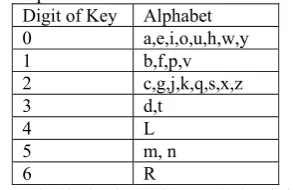
This technique is based upon the key assignment to the words of a language. Words are composed of alphabet. In this technique a set of alphabet is taken based on sound similarity. It is to be noted that the key is not unique, and will be explained shortly. The following are the sets in Similarity Key technique.
Digit of Key Alphabet
0 a,e,i,o,u,h,w,y 1 b,f,p,v 2 c,g,j,k,q,s,x,z 3 d,t
4 L
5 m, n
[image:4.595.114.261.271.366.2]6 R
Table 4: Similarity keys for English Alphabets
In this technique, the key is calculated for a mis-spell word. Then the words from the lexicon that have the same key value are extracted for candi-dature of a correctly spelled word. The key are generated by keeping the first letter of the word followed by digits mapped from the Table 4. For instance the key t0140 is generated for the word
table. The zero and are eliminated from the key.
Similarly repetition of a character is collapsed. Thus in second step the key t0140 becomes t14 for the word table.
The Urdu character set is also composed of many homophones. A study has been conducted (Ta-hira Naseem 2004) on spelling mistakes of Urdu words in context to soundex.
The similar Urdu sounded letter are shown in Table 5, and Table 6 of soundex scheme 0-F, and 0-9 respectively.
code Alphabet 0 ث،ص،ش،س
1 ٹ،ط،ت 2 ~ D ۔۔۔۔۔۔۔۔۔
E ل
[image:4.595.104.272.598.747.2]F و
Table 5: Similar sounded letters – Urdu (Scheme 0 ~ F)
code Alphabet 0 ث،ص،ش،س
1 ٹ،ط،ت
2 ~ 8 ۔۔۔۔۔۔۔۔۔
9 ل
Table 6: Similar sounded letters – Urdu (Scheme 0 ~ 9)
3.3.3 Neural Networks Technique
Neural networks are used in environments where systems are trained on specific error patterns (O. Matan, C. J. C. Burges, Y. LeCun, and J. S. Denker 1992). Thus neural networks can be used for spell correction. The neural network is trained in for spell errors for a specific domain in which the spell correction system will be used. The back propagation method is commonly used in neural network training (V. J. Hodge and J. Austin 2003). The method comprised of three layers; the input, hidden, and output layer. The nodes from inner to output layer are connected through a link through hidden layer. In the train-ing phase, weights are computed and assigned to the nodes from input layer to output layer. The weights represent the relation between the nodes.
4 Proposed Technique for Urdu Spell Checking - Reverse Edit Distance It is obvious that q linear comparisons are re-quired for a misspelled word with all words of lexicon containing q words. 70,000 words lexi-con, requires 70,000 comparisons. Reverse edit distance technique is proposed (M. D. Ker-nighan, K. W. Church, and W. A. Gale 1990) in which permutation of edit distance one are gen-erated and compared with lexicon words which are in alphabetic order. Urdu has 42 characters, and for a Urdu word of length n, a total of 86n + 41 strings are checked, which is far below than lexicon words q. The break-up is as under: Insertions ofے،ی ..،ب،اat n+1 positions in a
word. 42(n+1)
Deletion of one alphabet in turn from word. n Substitution ofے،ی …..،ب،اin turn at each
position in word 42n
Transpositions of adjacent alphabets in word n-1
--- --- Total comparisons 86n + 41
============== ========
The reverse edit distance technique can be em-ployed for Urdu Spell system. The usage of this technique is selected due to its efficient ap-proach.
The first letter ‘ن’ of Urdu misspelled word کھن is substituted with ے،ی …..،ب،اin turn result-ing:
'کھا', ,'کھب' ,'کھپ' ,'کھت' ,۔۔۔۔۔۔۔۔۔۔۔۔۔'کھے Likewise, The second letter ‘ھ’ of misspelled word کھن is substituted with alphabet ے،ی …..
،ا ،ب in turn resulting: ،۔۔۔۔۔۔۔۔۔۔۔کمن،۔۔۔۔۔۔۔۔۔کےن کان،کبن،کپن،کتن
Likewise, The third, and fourth letter get substi-tuted.
Inserts :
In next set of permutations, characters ے،ی …..،ب،اare inserted in turn at position 1,2,3, and 4 of the misspelled word کھن.
کھنا, کھنب, کھنپ, کھنت, ………. ،کھني Transposes
کنھ, ھکن Deletes کھ،کن,
ھن
4.1 Dictionary lookup
Finite State Automata (FSA) are based on alphabets U of a language L. A string S, comprises of alphabet from U. If S belongs to U, then there will be a path from the initial state to the final state of the Finite state automata, else will declare mispelled word. If a correct word that is not available in the lexicon would be required to be added while the spell check-ing application highlight as a misplelled word.
4.2 Edit Distance (Two operations)
Despite the fact that misspelled words are cor-rected by one edit operation. Thus it may happen that out of 86n + 41 permutations generated from an Urdu non-word may lead to zero match in the lexicon. Thus in our proposed work, edit distance is procedure is called again on all the permuta-tion generated by the edit distance one operapermuta-tion. This drastically slows down the system as per-mutations (2nd cycle ) for each of the permutation generated at edit distance 1 will be generated.
4.3 Candidate Generation
Candidates are selected upon the existence of any match of the permuted word in lexicon. In our example case two candidates are generated: c
=
[‘
کمن
’, ‘
کين
’
]4.4 Reverse Edit Distance Efficiency
The Reverse Edit Distance algorithm is grossly better than the conventional Edit Distance
algo-rithm. This can be explained with simple calcula-tion on data.
Lexicon size (q) = 100,000 words Misspelled word length (n) = 6 letters Edit Distance Reverse Edit
Distance Comparisons 100,000 86n + 41
=86(6) + 41 = 557
Thus in this example the reverse edit distance performs 180 times better as compare to edit dis-tance technique.
4.5 Methodology Digest
This work presents spell checking for Urdu non-words employing lexicon lookup. Spell checkers are not available in the Urdu text processors, and the most important among them is the widely used Urdu Word processor still lacking the spell checking and correcting feature.
The Levenshtein distance or most commonly minimum edit distance algorithm is used as a basic and acceptable technique for spell correc-tion. In our work, the same algorithm has been selected for getting candidate words for an Urdu non-word.
The working model of the proposed system is kept simple, being the system is build on basic works, as very scarce resources are available on Urdu Language and specifically the Urdu spell checking and correction. A three step approach has been employed in the system: Lexicon lookup, candidates’ generation, and ranking can-didates.
mis-spelled word based on the frequency of candi-dates word exists in the underlying corpus. The methodology is explained in the illustration: Misspelled
word Corpus Candidate words Top ranked word
ردا Urdu
corpus
ا اد (34)
رتا (23)
رثا (2)
ردص (40)
رگا (12)
[image:6.595.80.293.127.218.2]ردص get selected.
Table 7. Illustration explaining methodology
[image:6.595.318.491.194.431.2]In the above illustration, for the misspelled Urdu word ردا we have taken few candidate words ،ادا رتا،رثا ،ردص ، رگا shown in the third column of Table 7 which are at edit distance one, that is one edit operation we can get these words from the misspelled word. Now to decide which of these candidate words is intended correct word that typist wanted to write cannot be flatly decided.
Figure 1. Flow chart depicting the process of spell checking and correction
5 Results and Discussions
5.1 Training Corpus
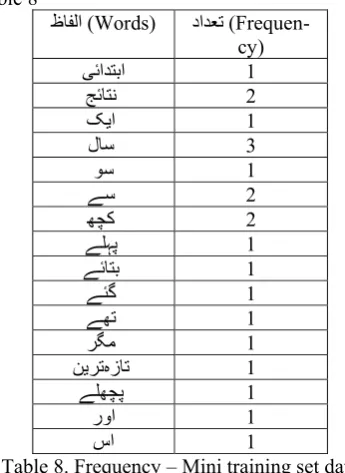
Two corpuses of 54,440 words, and 56,142 words [Center For Research In Urdu Language Processing] are taken that has been used as train-ing lexicon. In subsequent work later, a compre-hensive corpus will be taken for results. The training data is used for frequency count of the words. The frequency count is used for analysis of candidate words from a misspelled word. Let’s take a simple corpus of 20 Urdu words to understand the training set concept:
یئادتبا جئاتن کيا وس لاس ےس ھچک ےلہپ ےئاتب ےئگ ےھت
رگم هزات نيرت لاسےلھچپجئاتن ےلہپےسلاسساروا
In the work presented, small hypothetical data is taken to understand the concept. In future, with implemantation of algorithms, accuracy will be also bw calculated.
The frequency of these words is shown in the Table 8
ظافلا (Words) دادعت (Frequen-cy)
یئادتبا 1
جئاتن 2
کيا 1
لاس 3
وس 1
ےس 2
ھچک 2
ےلہپ 1
ےئاتب 1
ےئگ 1
ےھت 1
رگم 1
هزات
نيرت 1
ےلھچپ 1
روا 1
سا 1
Table 8. Frequency – Mini training set data
Now taking misspelled word قس, let the spell correction system generate two candidates; the word وس [frequency count = 1], and the word ےس [frequency count = 2]. Based on frequency, sug-gested word is calculated which comes to be ےس for the misspelled word قس
Taking another example of few misspelled words and executing our algorithm on a training set corpus of 54,400 words. We would see abstract behavior of algorithm and make a little discus-sion on the result generated. The following non-words are provided to the system for generation of candidate words, there after highlighting one word.
5.2 Urdu Non-words example
طک لاعتسا ی
پتاج ی ت ی م يي ں ششک سشج ی
ا ہگشج ي کش
رشسود ی رٹشلفےشکمسشق
Test word –i لاعتسا Candidate word(s) لاعتسا Suggested word لاعتسا
[image:6.595.157.219.336.544.2]Candidate word(s) یرک یئک یسک Suggested word یسک
=================================== Test word - iii یپتاج
Candidate word(s) یتاج یھتاس Suggested word یتاج
=================================== Test word –iv ںييم
Candidate word(s) ںيم ںيلم ںيہن Suggested word ںيم
===================================
Test word-v سشج
Candidate word(s) ساب سج ادج Suggested word سج
=================================== Test word - vi یششک
Candidate word(s) یرسک یترک Suggested word یترک
=================================== Test word-vii ہگشج
Candidate word(s) ہگج ہکبج Suggested word ہکبج
=================================== Test word-viii ےشک
Candidate word(s) ےتک ےئک ےرک Suggested word ےرک
=================================== Test word-ix رٹشلف
Candidate word(s) رٹسوف رٹلف Suggested word رٹلف
=================================== In the above example, we have taken 09 non-words of Urdu and pass through the reverse edit distance algorithm. Candidate words in the range of one to three words are generated for each of the non word. These are words are at edit dis-tance of one or two from the corresponding non-word. The candidate words are generated by
in-sertions, deletion, substitution, or transposition operations.
5.3 Correct word suggestion
In the corpus the c(یتاج) = 22, and c(یھتاس) = 5, Thus c(یتاج) > c(یھتاس) thus the word یتاج is suggested as the top ranked word for the misspel-led word w = یپتاج
Insertion
The following are selected non-words examples specifically for insertion of alphabet that are passed through the proposed system to get can-didate results:
Test word تحلاصا
Candidate word(s) تاحلاصا [Other candi-dates are removed]
Action: اis inserted between حand ت
Deletion
The following are selected non-words examples specifically for deletion of alphabet that are pas-sed through the propopas-sed system to get candidate results:
Test word ٔواھتجلا Candidate word(s) ٔواھجلا Suggested word ٔواھجلا
Substitution
The following are selected non-words examples specifically for Substitution of alphabet that are passed through the proposed system to get can-didate results:
Test word اسيق
Candidate word(s) اديپ اريم اسيا اتيل اسيج بسين سايق Suggested word اسيج
Transposition
alphabets that are passed through the proposed system to get candidate results:
Test word دلنب
Candidate word(s) رلٹب دنلب دنب Suggested word دنلب
================================= We have noticed that the transposition errors are poorly corrected using reverse edit distance as compared to edit distance algorithm. In above results, the words لليق, ےھيچپ, لديبت are not proper-ly corrected by the algorithm.
6 Conclusion
Urdu language has rich literature, sponken in south asia, however having scarce resources in context of computer based applications. In this work, focus is on spelling error detection and correction feature in these electronic applica-tions. Our this work is concentrated on gathering various spell checking and correction techniques that are suitable for correcting Urdu spelling er-rors . Reverse Edit Distance algorithm complexi-ty is computed to be 86n + 41. The algorithm has been implememnted in other languages like Eng-lish, and has to be implemented for Urdu.
References
Sara Stymne, Spell Checking Techniques for Re-placement of Unknown Words and Data Cleaning for Haitian Creole SMS Translation, Association for Computational Linguistics, Proceedings of the 6th Workshop on Statistical Machine Translation, pages 470–477, Edinburgh, Scotland, UK, July 30– 31, 2011.
Kemal Oflazer and Cemaleddin, Spelling correc-tion in agglutinative languages. In Proceedings of the fourth conference on Applied natural language processing (ANLC '94). Association for Computa-tional Linguistics, Stroudsburg, PA, USA, 1994. Fred J. Damerau. 1964. A technique for computer detection and correction of spelling errors. Com-mun. ACM 7, 3 (March 1964), 171-176. DOI=10.1145/363958.363994.
Tahira Naseem A Hybrid Approach for Urdu Spell Checking, MS Thesis 2004.
David Gries et al. Presenting an algorithm to find the minimum edit distance Department of Comput-er Science, Cornell UnivComput-ersity NSF Project 1988. Eric Brill and Robert C. Moore, Microsoft Re-search, An Improved Error Model for Noisy Chan-nel Spelling Correction YR + JNL.
M. D. Kernighan, K. W. Church, and W. A. Gale. A spelling correction program based on a noisy channel model. In Proceedings of the 13th Interna-tional Conference on ComputaInterna-tional Linguistics, volume 2, 1990.
O. Matan, C. J. C. Burges, Y. LeCun, and J. S. Denker. Multi-digit recognition using a space dis-placement neural network, Neural Information Processing Systems, volume 4, pages 488{495. Morgan Kaufmann Publishers, San Mateo,C.A., 1992.
V. J. Hodge and J. Austin. A comparison of stand-ard spell checking algorithms and a novel binary neural approach. IEEE Transactions on Knowledge and Data Engineering, 2003.