Proceedings of the NAACL HLT Workshop on Unsupervised and Minimally Supervised Learning of Lexical Semantics, pages 10–17,
Utilizing Contextually Relevant Terms in Bilingual Lexicon Extraction
Azniah Ismail
Department of Computer Science University of York
York YO10 5DD UK
Suresh Manandhar Department of Computer Science
University of York York YO10 5DD UK
Abstract
This paper demonstrates one efficient tech-nique in extracting bilingual word pairs from non-parallel but comparable corpora. Instead of using the common approach of taking high frequency words to build up the initial bilin-gual lexicon, we show contextually relevant terms that co-occur with cognate pairs can be efficiently utilized to build a bilingual dictio-nary. The result shows that our models using this technique have significant improvement over baseline models especially when highest-ranked translation candidate per word is con-sidered.
1 Introduction
Bilingual lexicons or dictionaries are invaluable knowledge resources for language processing tasks. The compilation of such bilingual lexicons remains as a substantial issue to linguistic fields. In gen-eral practice, many linguists and translators spend huge amounts of money and effort to compile this type of knowledge resources either manually, semi-automatically or semi-automatically. Thus, obtaining the data is expensive.
In this paper, we demonstrate a technique that uti-lizes contextually relevant terms that co-occur with cognate pairs to expand an initial bilingual lexi-con. We use unannotated resources that are freely available such as English-Spanish Europarl corpus (Koehn, 2005) and another different set of cognate pairs as seed words.
We show that this technique is able to achieve high precision score for bilingual lexicon extracted
from non-parallel but comparable corpora. Our model using this technique with spelling similarity approach obtains 85.4 percent precision at 50.0 per-cent recall. Precision of 79.0 perper-cent at 50.0 perper-cent recall is recorded when using this technique with context similarity approach. Furthermore, by using a string edit-distance vs. precision curve, we also reveal that the latter model is able to capture words efficiently compared to a baseline model.
Section 2 is dedicated to mention some of the re-lated works. In Section 3, the technique that we used is explained. Section 4 describes our experimental setup followed by the evaluation results in Section 5. Discussion and conclusion are in Section 6 and 7 respectively.
2 Related Work
Koehn and Knight (2002) describe few potential clues that may help in extracting bilingual lexi-con from two monolingual corpora such as identi-cal words, similar spelling, and similar context fea-tures. In reporting our work, we treat both identical word pairs and similar spelling word pairs as cog-nate pairs.
and Yarowski, 2001). However, Koehn and Knight (2002) point out that majority of their word pairs do not show much resemblance at all since they use German-English language pair. Haghighi et al. (2008) mention one disadvantage of using edit dis-tance, that is, precision quickly degrades with higher recall. Instead, they propose assigning a feature to each substring of length of three or less for each word.
For approaches based on contextual features or context similarity, we assume that for a word that occurs in a certain context, its translation equivalent also occurs in equivalent contexts. Contextual fea-tures are the frequency counts of context words oc-curring in the surrounding of target wordW. A con-text vector for eachWis then constructed, with only context words found in the seed lexicon. The context vectors are then translated into the target language before their similarity is measured.
Fung and Yee (1998) point out that not only the number of common words in context gives some similarity clue to a word and its translation, but the actual ranking of the context word frequencies also provides important clue to the similarity between a bilingual word pair. This fact has motivated Fung and Yee (1998) to usetfidfweighting to compute the vectors. This idea is similar to Rapp (1999) who proposed to transform all co-occurrence vectors us-ing log likelihood ratio instead of just using the frequency counts of the co-occurrences. These val-ues are used to define whether the context words are highly associated with theWor not.
Earlier work relies on a large bilingual dictionary as their seed lexicon (Rapp, 1999; Fung and Yee, 1998; among others). Koehn and Knight (2002) present one interesting idea of using extracted cog-nate pairs from corpus as the seed words in order to alleviate the need of huge, initial bilingual lex-icon. Haghighi et al. (2008), amongst a few oth-ers, propose using canonical correlation analysis to reduce the dimension. Haghighi et al (2008) only use a small-sized bilingual lexicon containing 100 word pairs as seed lexicon. They obtain 89.0 percent precision at 33.0 percent recall for their English-Spanish induction with best feature set, using top-ically similar but non-parallel corpora.
3 The Utilizing Technique
[image:2.612.342.511.216.459.2]Most works in bilingual lexicon extraction use lists of high frequency words that are obtained from source and target language corpus to be their source and target word lists respectively. In our work, we aim to extract a high precision bilingual lexicon us-ing different approach. Instead, we use list of con-textually relevant terms that co-occur with cognate pairs.
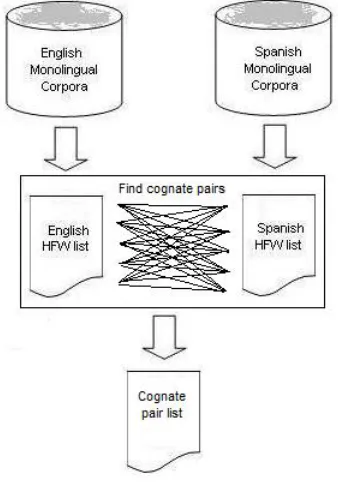
Figure 1: Cognate pair extraction
These cognate pairs can be derived automatically by mapping or finding identical words occur in two high frequency list of two monolingual corpora (see Figure 1). They are used to acquire list of source wordWsand target wordWt.WsandWtare contex-tually relevant terms that highly co-occur with the cognate pairs in the same context. Thus, log likeli-hood measure can be used to identify them.
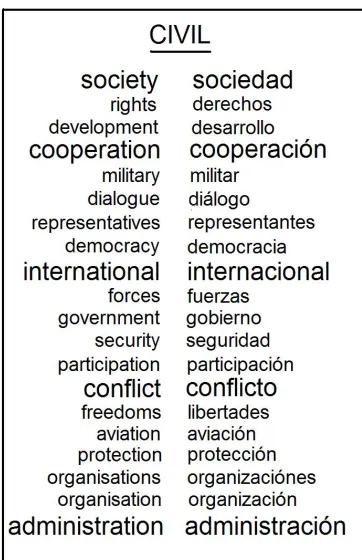
Next, bilingual word pairs are extracted among words in these Ws andWt list using either context similarity or spelling similarity. Figure 2 shows some examples of potential bilingual word pairs, ofWs andWt, co-occurring with identical cognate pairs of word ’civil’.
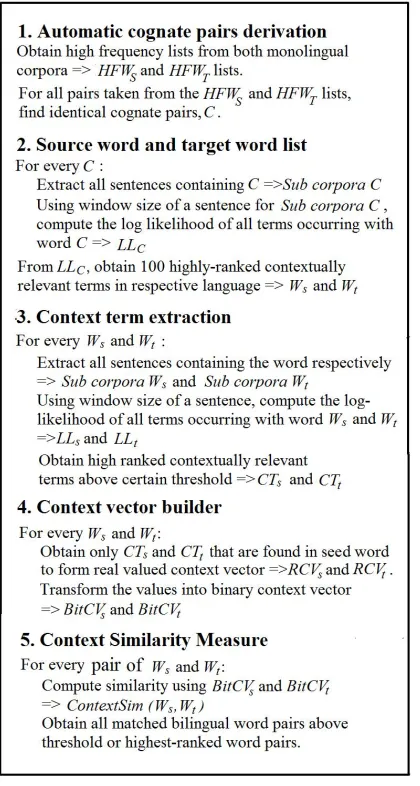
and Wt. Figure 3 outlines the algorithm using spelling similarity in more detail.
Using the sameWsandWtlists, we extract bilin-gual lexicon by computing the context similarity be-tween each {Ws,Wt} pair. To identify the context
similarity, the relation between each{Ws, Wt}pair
can be detected automatically using a vector similar-ity measure such ascosine measureas in (1). TheA
andBare the elements in the context vectors, con-taining either zero or non-zero seed word values for
WsandWt, respectively.
Cosinesimilarity=cos(θ) = A×B
||A|| × ||B|| (1)
The cosine measure favors {Ws,Wt} pairs that share the most number of non-zero seed word val-ues. However, one disadvantage of this measure is that the cosine value directly proportional to the ac-tual Ws and Wt values. Even though Ws and Wt
might not closely correlated with the same set of seed words, the matching score could be high ifWs
[image:3.612.335.516.90.370.2]orWthas high seed word values everywhere. Thus, we transform the context vectors from real value into binary vectors before the similarity is computed. Figure 4 outlines the algorithm using context simi-larity in more detail.
In the algorithm, after theWsandWtlists are ob-tained, eachWsandWtunits is represented by their context vector containing log likelihood (LL) values of contextually relevant words, occurring in the seed lexicon, that highly co-occur with theWsandWt re-spectively. To get this context vector, for each Ws
andWt, all sentences in the English or Spanish cor-pora containing the respective word are extracted to form a particular sub corpus, e.g. sub corpus soci-etyis a collection of sentences containing the source wordsociety.
Using window size of a sentence, the LL value of term occurring with the wordWs orWt in their respective sub corpora is computed. Term that is highly associated with theWs orWt is called con-textually relevant term. However, we consider each term with LL value higher than certain threshold (e.g. threshold≥15.0) to be contextually relevant.
Contextually relevant terms occurring in the seed lexicon are used to build the context vector for the
Figure 2: Bilingual word pairs are found within context of cognate wordcivil
[image:3.612.325.528.444.678.2]Figure 4: Utilizing technique with context similarity
WsorWtrespectively. For example, word participa-tionandeducationoccurring in the seed lexicon are contextually relevant terms for source wordsociety. Thus, they become elements of the context vector. Then, we transform the context vectors, from real value into binary, before we compute the similarity with cosine measure.
4 Experimental Setup 4.1 Data
For source and target monolingual corpus, we de-rive English and Spanish sentences from parallel Eu-roparl corpora (Koehn, 2005).
• We split each of them into three parts; year
1996 - 1999, year 2000 - 2003 and year 2004 - 2006.
• We only take the first part, about 400k sen-tences of Europarl Spanish(year 1996 - 1999)
and 2nd part, also about 400k from Europarl English(year 2000 - 2003). We refer the partic-ular part taken from the source language corpus asS and the other part of the target language corpus asT.
This approach is quite common in order to ob-tain non-parallel but comparable (or same domain) corpus. Examples can be found in Fung and Che-ung (2004), followed by Haghighi et al. (2008). For corpus pre-processing, we only use sentence boundary detection and tokenization on raw text. We decided that large quantities of raw text requir-ing minimum processrequir-ing could also be considered as minimal since they are inexpensive and not limited. These should contribute to low or medium density languages for which annotated resources are limited. We also clean all tags and filter out stop words from the corpus.
4.2 Evaluation
We extracted our evaluation lexicon fromWord Ref-erence∗ free online dictionary . For this work, the word types are not restricted but mostly are con-tent words. We have two sets of evaluation. In one, we take high ranked candidate pairs whereWscould have multiple translations. In the other, we only con-sider highest-ranked Wt for each Ws. For evalua-tion purposes, we take only the top 2000 candidate ranked-pairs from the output. From that list, only candidate pairs with words found in the evaluation lexicon are proposed. We use F1-measure to evalu-ate proposed lexicon against the evaluation lexicon. The recall is defined as the proportion of the high ranked candidate pairs. The precision is given as the number of correct candidate pairs divided by the to-tal number of proposed candidate pairs.
4.3 Other Setups
The following were also setup and used:
• List of cognate pairs
We obtained 79 identical cognate pairs from the
top 2000 high frequency lists of ourSandTbut we chose 55 of these that have at least 100 con-textually relevant terms that are highly associ-ated with each of them.
• Seed lexicon
We also take a set of cognate pairs to be our seed lexicon. We defined the size of a small seed lexicon ranges between 100 to 1k word pairs. Hence, our seed lexicon containing 700 cognate pairs are still considered as a small-sized seed lexicon. However, instead of acquir-ing this set of cognate pairs automatically, we compiled the cognate pairs from a few Learn-ing Spanish Cognates websites †. This ap-proach is a simple alternative to replace the 10-20k general dictionaries (Rapp, 1999; Fung and McKeown, 2004) or automatic seed words (Koehn and Knight, 2002; Haghighi et al., 2008). However, this approach can only be used if the source and target language are fairly related and both share lexically similar words that most likely have same meaning. Other-wise, we have to rely on general bilingual dic-tionaries.
• Stop list
Previously (Rapp, 1999; Koehn and Knight, 2002; among others) suggested filtering out commonly occurring words that do not help in processing natural language data. This idea sometimes seem as a negative approach to the natural articles of language, however various studies have proven that it is sensible to do so.
• Baseline system
We build baseline systems using basic context similarity and spelling similarity features.
5 Evaluation Results
For the first evaluation, candidate pairs are ranked after being measured either with cosine for context similarity or edit distance for spelling similarity. In this evaluation, we take the first 2000 of{Ws, Wt}
candidate pairs from the proposed lexicon whereWs
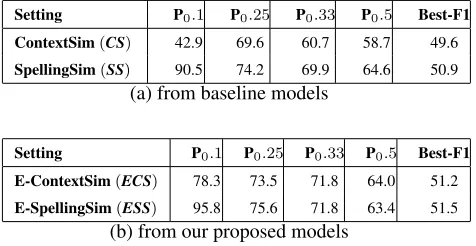
[image:5.612.312.550.73.196.2]may have multiple translations or multipleWt. See Table 1.
†such as http://www.colorincolorado.org and
http://www.language-learning-advisor.com
Setting P0.1 P0.25 P0.33 P0.5 Best-F1 ContextSim(CS) 42.9 69.6 60.7 58.7 49.6
SpellingSim(SS) 90.5 74.2 69.9 64.6 50.9
(a) from baseline models
Setting P0.1 P0.25 P0.33 P0.5 Best-F1 E-ContextSim(ECS) 78.3 73.5 71.8 64.0 51.2
E-SpellingSim(ESS) 95.8 75.6 71.8 63.4 51.5
(b) from our proposed models
Table 1: Performance of baseline and our model for top 2000 candidates below certain threshold and ranked
Setting P0.1 P0.25 P0.33 P0.5 Best-F1 ContextSim-Top1(CST) 58.3 61.2 64.8 55.2 52.6
SpellingSim-Top1(SST) 84.9 66.4 52.7 34.5 37.0
(a) from baseline models
Setting P0.1 P0.25 P0.33 P0.5 Best-F1
E-ContextSim-Top1(ECST) 85.0 81.1 79.7 79.0 57.1
E-SpellingSim-Top1(ESST) 100.0 93.6 91.6 85.4 59.0
[image:5.612.313.549.243.367.2](b) from our proposed models
Table 2: Performance of baseline and our model for top 2000 candidates of top 1
Using either context or spelling similarity ap-proach on S and T (labeled ECS and ESS respec-tively), our models achieved about 51.2 percent of best F1 measure. Those are not a significant im-provement with only 1.0 to 2.0 percent error reduc-tion over the baseline models(labeledCSandSS).
For the second evaluation, we take the first 2000 of{Ws,Wt}pairs whereWsmay only have the
high-est rankedWt as translation candidates (See Table 2). This time, both of our models (with context similarity and spelling similarity, labeledECSTand
ESST respectively) yielded almost 60.0 percent of best F1 measure. It is noted that usingESST alone recorded a significant improvement of 20.0 percent in the F1 score compared to SST baseline model.
ESST obtained 85.4 percent precision at 50.0 per-cent recall. Precision of 79.0 perper-cent at 50.0 perper-cent recall is recorded when using ECST. However, the
ECSThas not recorded a significant difference over
Figure 5: String Edit Distance vs. Precision curve
range of recalls, for these four models are illustrated inAppendix A.
It is important to see the inner performance of the
ECST model with further analysis. We present a string edit distance value(EDv)vs. precision curve for ECSTandCST in Figure 5 to measure the per-formance of theECSTmodel in capturing bilingual pairs with less similar orthographic features, those that may not be captured using spelling similarity.
The graph in Figure 5 shows that even though
CST has higher precision score thanECST at EDv
of 2, it is not significant (the difference is less than 5.0 percent) and the spelling is still similar. On the other hand, precision for proposed lexicon withEDv
above 3 (where theWsand the proposed translation equivalent Wt spelling becoming more dissimilar) usingECSTis higher thanCST. The most significant difference of the precision is almost 35.0 percent, whereECSTachieved almost 75.0 percent precision compared toCSTwith 40.0 percent precision atEDv
of 4. It is followed byECST with almost 50.0 per-cent precision compared toCSTwith precision less than 35.0 percent, offering about 15.0 percent preci-sion improvement atEDvof 5.
6 Discussion
As we are working on English-Spanish language pair, we could have focused on spelling similar-ity feature only. Performance of the model using this feature usually record higher accuracy other-wise they may not be commonly occurring in a cor-pus. Our models with this particular feature have
recorded higher F1 scores especially when consid-ering only the highest-ranked candidates.
We also experiment with context similarity ap-proach. We would like to see how far this approach helps to add to the candidate scores from our corpus
SandT. The other reason is sometimes a correct tar-get is not always a cognate even though a cognate for it is available. OurECSTmodel has not recorded significant improvement overCSTbaseline model in the F1-measure. However, we were able to show that by utilizing contextually relevant terms,ECST gath-ers more correct candidate pairs especially when it comes to words with dissimilar spelling. This means thatECSTis able to add more to the candidate scores compared to CST. Thus, more correct translation pairs can be expected with a good combination of
ECSTandESST.
The following are the advantages of our utilizing technique:
• Reduced errors, hence able to improve preci-sion scores.
• Extraction is more efficient in the contextual boundaries (see Appendix B for examples).
• Context similarity approach within our tech-nique has a potential to add more to the can-didate scores.
Yet, our attempt using cognate pairs as seed words is more appropriate for language pairs that share large number of cognates or similar spelling words with same meaning. Otherwise, one may have to rely on bilingual dictionaries.
Nevertheless, we are still concerned that many spurious translation equivalents were proposed be-cause the words actually have higher correlation with the input source word compared to the real target word. Otherwise, the translation equivalents may not be in the boundaries or in the corpus from which translation equivalents are to be extracted. Haghighi et al (2008) have reported that the most common errors detected in their analysis on top 100 errors were from semantically related words, which had strong context feature correlations. Thus, the issue remains. We leave all these for further discus-sion in future works.
7 Conclusion
We present a bilingual lexicon extraction technique that utilizes contextually relevant terms that co-occur with cognate pairs to expand an initial bilin-gual lexicon. We show that this utilizing technique is able to achieve high precision score for bilingual lexicon extracted from non-parallel but comparable corpora. We demonstrate this technique using unan-notated resources that are freely available.
Our model using this technique with spelling sim-ilarity obtains 85.4 percent precision at 50.0 percent recall. Precision of 79.0 percent at 50.0 percent re-call is recorded when using this technique with con-text similarity approach. We also reveal that the latter model with context similarity is able to cap-ture words efficiently compared to a baseline model. Thus, we show contextually relevant terms that co-occur with cognate pairs can be efficiently utilized to build a bilingual dictionary.
References
Cranias, L., Papageorgiou, H, and Piperidis, S. 1994. A matching technique in Example-Based Machine Translation. In International Conference On Compu-tational Linguistics Proceedings, 15th conference on Computational linguistics, Kyoto, Japan.
Diab, M., and Finch, S. 2000. A statistical word-level translation model for comparable corpora. In Proceed-ings of the Conference on Content-based multimedia information access (RIAO).
Fung, P., and Cheung, P. 2004. Mining very non-parallel corpora: Parallel sentence and lexicon extraction via bootstrapping and EM. In Proceedings of the 2004
Conference on Empirical Method in Natural Language Processing (EMNLP), Barcelona, Spain.
Fung, P., and Yee, L.Y. 1998. An IR Approach for Translating New Words from Nonparallel, Compara-ble Texts. In Proceedings of COLING-ACL98, Mon-treal, Canada, 1998.
Fung, P., and McKeown, K. 1997. Finding Terminology Translations from Non-parallel Corpora. In The 5th Annual Workshop on Very Large Corpora, Hong Kong, Aug 1997.
Haghighi, A., Liang, P., Berg-Krikpatrick, T., and Klein, D. 2008. Learning bilingual lexicons from monolin-gual corpora. In Proceedings of The ACL 2008, June 15 -20 2008, Columbus, Ohio
Koehn, P. 2005. Europarl: a parallel corpus for statistical machine translation. In MT Summit
Koehn, P., and Knight , K. 2001. Knowledge sources for word-level translation models. In Proceedings of the Conference on Empirical Methods in Natural Lan-guage Processing (EMNLP).
Koehn, P., and Knight , K. 2002. Learning a translation lexicon from monolingual corpora. In Proceedings of ACL 2002, July 2002, Philadelphia, USA, pp. 9-16. Rapp, R. 1995. Identifying word translations in
non-parallel texts. In Proceedings of ACL 33, pages 320-322.
Appendix A. Precision scores with different recalls