Modelling the
ziji
Blocking Effect and Constraining Bound Variable
Derivations in MC-TAG with Delayed Locality
Dennis Ryan Storoshenko
University of Calgary
Craigie Hall C205, 2500 University Dr NW Calgary, AB, Canada
Abstract
MC-TAG derivations using delayed local-ity (i.e. non set-local composition) have been used to model long distance binding in natural language. In this paper, I ex-plore the possibility within Synchronous TAG that tree sets composing via delayed locality may have many possible syntac-tic derivations for a single semansyntac-tic form. Using the Mandarin (Chinese) anaphorziji as a test case, I show that the blocking effect which is described in other gener-ative frameworks as a constraint on covert movement can be modelled as arising from constraints across possible derivation fam-ilies for a given tree set. Further ob-serving the interaction of ziji with other bound variables in the language, I propose that anti-locality effects in variable bind-ing arise when a more specialized bound variable is available. This has conse-quences for the definition of a typology of bound variables.
1 Variable Binding in STAG
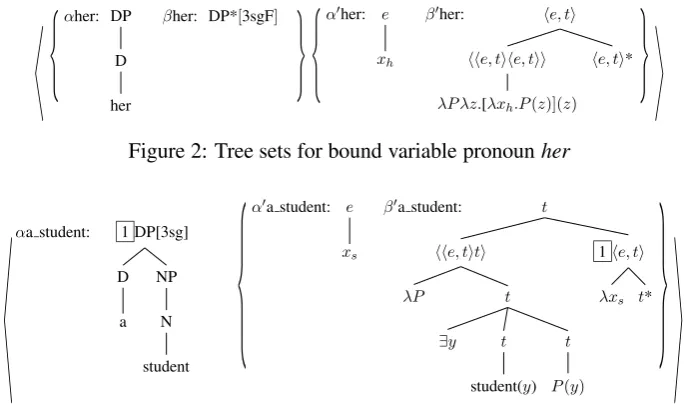
Variable binding in Synchronous TAG (STAG) has been modelled as a phenomenon which exploits delayed locality. Building on the definition of delayed-local derivations presented in Chiang and Scheffler (2008), bound variables can be modelled as multi-component sets (MCSs) in both the syn-tax and semantics. As formulated in Storoshenko and Han (2015), Figure 2 shows that the bound variable obligatorily composes non-locally, with the α components substituting into the argument
position of the predicate selecting the variable, while theβcomponents compose directly with the
antecedent. This is most crucial on the seman-tics side, where the variable’s auxiliary tree
com-poses with the “scope part” of a STAG general-ized quantifier, as in Figure 3. The bound vari-able carries a function fromhe,titohe,tiwhich ac-complishes the variable binding, in a form similar to B¨uring’s (2005) Binder Index Evaluation Rule. On the syntax side, theβcomponent acts as solely
an agreement check. The English bound variable pronounheris lexically specified for third person feminine ϕ-features; in this case there is no
gen-der specification ona student, so the combination goes through. For nominals with inherent gender specification, for example every boy, the result-ing feature clash would block the derivation. In this way, agreement is treated as a purely syntactic phenomenon, with no manifestation in the seman-tics. As written, these trees could compose into a sentence such asA student loves her father.
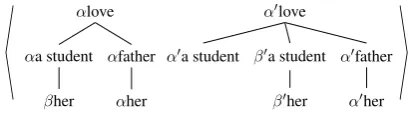
αloveαfather
αher
αa student
βher
α′love
α′father
α′her
β′a student
β′her
α′a student
[image:1.595.313.519.451.508.2]Figure 1: Derivation trees for A student loves her father
Following the derivation trees in Figure 1, de-layed locality is observed in the composition of the members of theherMCS, while the only other MCS present has composed tree-locally1.
Chi-ang and Scheffler define a delay as the set of derivation tree nodes including the members of the MCS, and all nodes on a path between members of the MCS, but excluding the common dominat-ing node. Storoshenko and Han extend this notion into a measure for the size of a delay by taking the cardinality of that set. The derivations in Figure 1 will have a delay (d) value of four for the pronoun.
her
βher: DP*[3sgF]
α′her: e xhβ′her: he, ti he, ti* hhe, tihe, tii
λP λz.[λxh.P(z)](z)
[image:2.595.124.468.48.253.2]Figure 2: Tree sets for bound variable pronounher
αa student: 1 DP[3sg] NPN
student D
a
α′a student: exs
β′a student: t
1he, ti
t* λxs hhe, titi
t
t
P(y)
t
student(y) ∃y
λP
Figure 3: Sample Quantifier Tree Set
Beyond referring to the delay as a whole, they fur-ther define the length l of a delayed local MCS
combination asd−n, wherenis the number of MCS members. Thus, for the bound variable pro-noun in the derivation trees of Figure 1, l=2. The
reason for applying this characterization of a de-lay becomes clear when considering the quantifier tree sets. As defined, even a tree-local MCS com-bination will have a trivial delay consisting only of its own derivation tree nodes, yielding advalue of
two, though thelvalue for this MCS combination
will be zero. This is a more intuitive match with a singleton tree combination on the syntax side, as it is not immediately obvious at a glance that the two derivations are in fact isomorphic. With deriva-tional isomorphism defined based on the equiva-lency oflvalues for any given lexical item’s
com-binations on both sides of the STAG derivation, as well as respecting all linked nodes, the quantifier’s combination can be said to be maximally isomor-phic (borrowing the term from Storoshenko and Han (2015)), asl=0 in both cases. It is this notion
of “maximal” isomorphism that I will assume to underlie all further claims of isomorphism.
2 Zijiand The Blocking Effect
The key data modelled in this paper all derive from the behaviour of the Mandarin (Chinese) anaphor ziji, described extensively in the literature since Cole et al. (1990). In brief, there are five differ-ent phenomena which need to be accounted for. The first is the fact that ziji can allow both local and long-distance antecedents, as shown in (1).
(1) Zhangsani
Zhangsan renweithink [LisiLisijzhidaoknow [WangwuWangwuk
xihuan
like zijiselfi/j/k.]]
‘Zhangsan thinks that Lisi knows that Wangwu likes self.’
In this respect, zijiis not dissimilar to its Korean cognate caki, which is discussed in Storoshenko and Han (2015). Where the two diverge is in the manifestation of the so-called blocking effect il-lustrated in (2):
(2) Zhangsani
Zhangsan renweithink [woI j
zhidao
know [WangwuWangwuk
xihuan
like zijiself∗i/∗j/k.]]
‘Zhangsan thinks that I know that Wangwu likes self.’
In this sentence where the subject of the middle clause is a first person pronoun, ziji is restricted not only to a third person antecedent, but only to the most local one. Descriptively, the presence of an intervening antecedent with mismatchedϕ
-features blocks the anaphor from binding by the highest subject, even though that subject is also third person. However, the situation is different in the local domain:
(3) Zhangsani
Zhangsan yiweithought[woI jhuiwillbaBA
nik
youdaitake
hui
backzijiself’s∗i/j/kdeDE
jia.] home
As seen in (3), ziji is not inherently restricted to third person antecedents (unlike cakiand the En-glish her from above). In the local domain, ziji may be bound by either the first or the second person antecedent. This is a more general prop-erty ofziji, which can be bound by an antecedent of any ϕ-feature value, within the constraints of
the blocking effect. For example, a version of (1) where all clauses had first person subjects would equally be grammatical. Finally, there is the obser-vation that even when the blocking condition is re-spected,zijimay not take a non-local non-subject antecedent:
(4) Zhangsani
Zhangsan gaosutell LisiLisij[WangwuWangwuk
piping-le
criticize-ASP
zijii/∗j/k.]
self
‘Zhangsan told Lisi that Wangwu criti-cized self.’
Again unlike Korean, the anaphor may not take Lisi as a potential antecedent. However, even though Lisi is not considered a possible an-tecedent, a first person pronoun in that position in-duces a blocking effect, even though this was not observed in the local domain. Based on these data, the five different properties ofzijiwhich need to be modelled are enumerated again below:
1. Local and long distance antecedents are pos-sible
2. ϕ-feature mismatch in a c-command chain induces blocking across clauses
3. Any antecedent may be viable in the lowest clause
4. The anaphor can in principle take any ϕ
-feature valued antecedent
5. Higher clause antecedents must be subjects
Sohng’s (2004) analysis of ziji follows the tradi-tion of the original Cole et al. analysis in making use of covert movement to capture all of the rel-evant facts, accounting for the various differences between Korean caki and Mandarin ziji as being the result of the difference in ϕ-features between
the two. While the formal mechanisms here will of course be different, STAG not having any notion of covert movement to fall back on, the final anal-ysis will draw on Sohng’s key insight. The intri-cate pattern of data observed will be here be mod-elled as an interplay between the mechanisms used to capture agreement and a set of well-formedness constraints on STAG derivations.
3 Modelling Core Cases
Above, I showed the agreement checking mecha-nism that has been previously proposed for bound variables in STAG: a feature value on the degen-erate DP node which combines in the syntax with the variable’s antecedent. However, this is not the only agreement-checking mechanism which has been proposed in the TAG literature. Working in LTAG, Kallmeyer and Romero (2007) provide an account for reflexive pronouns where agreement is checked via a degenerate T′ node, part of the
MCS for the reflexive. The intuition here is that by having agreement check with the functional pro-jection of the verb, a tree-local derivation for the reflexive is ensured. My proposal is simple: the unique ϕ-feature deficiency of ziji versus caki is derived by adding this additional degenerate node to the syntax side of the bound variable’s MCS, as in Figure 4.
Based on these MCS definitions, it is clear where the notion of delay length will become rel-evant, as there are asymmetric sets on the syntax and semantic sides. Ultimately, the semantics will define the minimum lvalue for any given
deriva-tion, as the delay needed for semantic composi-tion will be directly determined by the intended meaning of the sentence: α′ziji will substitute
at the appropriate argument position while β′ziji
will adjoin to the scope part of the desired an-tecedent2Between the two MCSs in Figure 4, I
as-sume the following symmetric compositions:αziji
and α′ziji will need to substitute at linked nodes, whileβzijiDP∗ andβ′ziji will also be required to
adjoin into the tree sets of the antecedent. With no matched component to force a fully isomor-phic derivation via a linked node,βzijiT∗is
essen-tially free to attach at any node with a matching label, constrained only by the ϕ-feature value. I will begin with the assumption that both adjoin-ing sites must have no incompatible features, with theαvariables valued via unification with features
at the adjoining sites. However, to capture all the facts within a single account, it will emerge that the equivalence of the two feature unifications is relaxed under certain structural relationships be-tween the two agreeing members of thezijiMCS. Moving forward, I will not be presenting any in-formation on the semantic derivations, choosing to focus exclusively on the syntax. Full STAG
ziji
βzijiDP∗ DP*[φ=α] βzijiT′∗ T′*[φ=α] α′ziji: e
xa
β′ziji: he, ti he, ti* hhe, tihe, tii
λP λz.[λxa.P(z)](z)
Figure 4: Tree Sets forziji
derivations in the syntax and semantics for many of the predicates used here can be found in existing work, and no changes in the mechanics of deriving variable binding are being proposed in this paper.
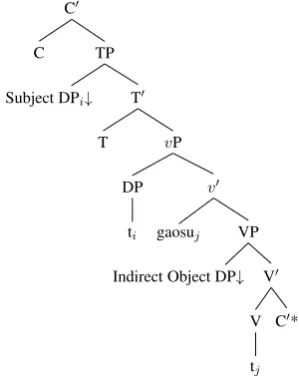
For the sake of illustration, one syntactic pred-icate tree appears in Figure 5. Predpred-icates such as renwei“think” andzhidao“know” will be simpler transitive verbs, still recursive on C′, with all of
these able to either recursively join to each other, or a CP-rooted embedded clause such as xihuan “like” or piping “criticize” having a DP terminal node at the object position which will be the sub-stitution site forαziji. The ditransitivegaosu“tell” is represented using a standard VP-shell structure. The only crucial detail to note is that in a ditransi-tive predicate, the T′node is c-commanded by the
subject, but not the indirect object.
C′
TP
T′
vP
v′
VP
V′
C′* V
tj Indirect Object DP↓
gaosuj DP
ti T Subject DPi↓
C
Figure 5: Sample Embedding Predicate gaosu “tell”
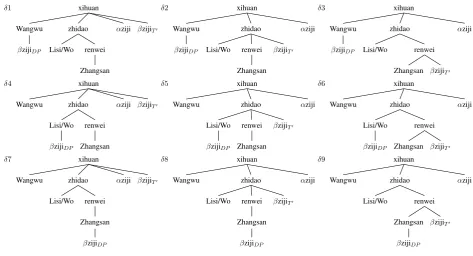
The three readings for (1) will emerge from the DPs into whichβzijiDP∗and its associated
seman-tic tree adjoin. Multiplying this out by the three clauses each with their own T′ nodes yields nine
possible derivation trees, three for each reading. These are given in full in Figure 6, though all fur-ther examples will be summarized as in Table 1. In these tables, thelvalue for the semantic
[image:4.595.92.499.50.111.2]combi-nation ofzijiwill correspond to the cell matching the predicate of whichzijiis an argument with the intended antecedent for that reading; the leftmost column in all cases.
Table 1: Tabular representation of Figure 6
T′* at: xihuan zhidao renwei
DP* at: Wangwu δ1:l=1 δ2:l=2 δ3:l=3
Lisi/Wo δ4:l=2 δ5:l=2 δ6:l=3
Zhangsan δ7:l=3 δ8:l=3 δ9:l=3
Based on this table, it is immediately clear that not all possible derivations are licit. For the situa-tion whereWangwuis the antecedent, placing the
βzijiT′∗in any clause higher than the one
contain-ing αziji will create a longer delay in the syntax
than the semantics, making δ2 and δ3 not
(maxi-mally) isomorphic STAG derivations. Conversely, when Zhangsan is the antecedent, all placements ofβzijiT′ yield a formally isomorphic derivation,
under the terms defined above. I label this set of isomorphic derivations as a derivational fam-ily: a set of isomorphic derivations (as defined by sharing equal lvalues for all MCS compositions)
which yield identical semantic outputs. Remov-ing spurious derivations yields the final set of pos-sible derivations for (1) in Table 2. The lowest antecedent is derived via a singleton derivation, while the other two are represented with deriva-tional families.
Table 2: Isomorphic Derivations for (1)
T′* at: xihuan zhidao renwei
DP* at: Wangwu δ1:l=1
Lisi δ4:l=2 δ5:l=2
Zhangsan δ7:l=3 δ8:l=3 δ9:l=3
[image:4.595.99.249.401.591.2]δ1 xihuan
βzijiT′
αziji zhidao
renwei
Zhangsan Lisi/Wo
Wangwu
βzijiDP
δ2 xihuan
αziji zhidao
βzijiT′
renwei
Zhangsan Lisi/Wo
Wangwu
βzijiDP
δ3 xihuan
αziji zhidao
renwei
βzijiT′
Zhangsan Lisi/Wo
Wangwu
βzijiDP
δ4 xihuan
βzijiT′
αziji zhidao
renwei
Zhangsan Lisi/Wo
βzijiDP Wangwu
δ5 xihuan
αziji zhidao
βzijiT′
renwei
Zhangsan Lisi/Wo
βzijiDP Wangwu
δ6 xihuan
αziji zhidao
renwei
βzijiT′
Zhangsan Lisi/Wo
βzijiDP Wangwu
δ7 xihuan
βzijiT′
αziji zhidao
renwei
Zhangsan
βzijiDP Lisi/Wo Wangwu
δ8 xihuan
αziji zhidao
βzijiT′
renwei
Zhangsan
βzijiDP Lisi/Wo Wangwu
δ9 xihuan
αziji zhidao
renwei
βzijiT′
Zhangsan
[image:5.595.70.544.52.308.2]βzijiDP Lisi/Wo Wangwu
Figure 6: Derivation Trees for (1) and (2)
and δ8 (indicated in bold in the table), will result in a feature clash as theβziji components will
ad-join at locations with differentϕfeature values.
Table 3: Isomorphic Derivations for (2)
T′* at: xihuan zhidao renwei
DP*: at Wangwu δ1:l=1
Wo δ4:l=2 δ5:l=2
Zhangsan δ7:l=3 δ8:l=3 δ9:l=3
This clash is what I propose to be at the root of the blocking effect. Following on the definition of a derivational family, I propose the Fully Functional Family (FFF) constraint:
(5) FULLY FUNCTIONAL FAMILY (FFF): If
one member of a derivational family vio-lates a syntactic constraint, all members of the family are rendered infelicitous.
Applying this constraint to the set of derivations in Table 3, only the derivation belonging to the most local antecedent survives.
(3) presents a more complex situation. Here, the lowest clause is a ditransitive, whilezijiis further embedded inside of a possessive DP structure. The partial derivation for this this example is presented in Figure 7. With three possible antecedents and
dai hui
jia
αziji yiwei
Zhangsan ni
wo
Figure 7: Partial Derivation Tree for (3)
[image:5.595.336.500.533.598.2]two clauses, here there are six possible derivations, presented in Table 4. Non-isomorphic derivations have already been removed, and those creating a feature clash are again bolded.
Table 4: Isomorphic Derivations for (3) T′* at: dai hui yiwei
DP* at: Ni δ1:l=2
Wo δ3:l=2
Zhangsan δ5:l=3 δ6:l=3
Recall that the possible antecedents here were ni and wo. The correct prediction is made for Zhangsan, whose derivational family is elimi-nated by virtue of the FFF, and for wo, where the first person subject values T′ in the only
iso-morphic derivation. Note that a hypothetical δ4
would exist, whereβzijiT′∗ attaches to the higher
clash. A similar δ2 would exist, but is also
non-isomorphic. The unexpected result here is thatδ1
yields a feature clash, and yet the reading is gram-matical.
Refining the definition of how a feature clash results resolves this issue. The distinction to make here is in the relationship of the elements in the fi-nal derived syntax tree; I assume the higher clause to be a transitive verb auxiliary tree recursive on C′, while the embedded clause is a CP-rooted
ditransitive-like structure. In δ5, βzijiDP∗ is
ad-joined to the subject in the higher clause, at a po-sition c-commanding βzijiT′∗ adjoined to the T′
node of the lower clause. This c-command rela-tionship, I claim, is required for the feature clash to be triggered. Looking atδ1, an opposite
relation-ship occurs, where βzijiT′∗ dominates βzijiDP∗.
Here, the features do not enter into the necessary configuration to be checked, and δ1 is not
actu-ally a clash. To fully implement this would re-quire a revision to the original zijitrees such that it is not a formal part of the MCS that the two fea-ture unifications must match: βzijiDP∗ would
re-ceive a value for itsα, while βzijiT′∗ would have
a distinct valueβ for itsϕfeatures, and the
con-straint described here would be that ifβzijiDP∗
c-commandsβzijiT′∗, thenα=β.
This c-command relationship comes into play when it comes to discussing (4) and the closely-related (6):
(6) Zhangsani
Zhangsan gaosutell woI jWangwuWangwuk
piping-le
criticize-ASP
ziji∗i/∗j/k.
self
‘Zhangsan told me that Wangwu criticized self.’
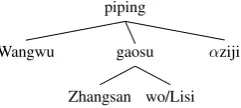
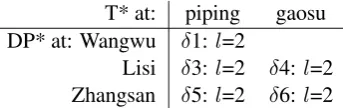
Recall that (4) indicated that the non-subject is not a possible antecedent, but having ziji bound by Zhangsanwas still possible. (6) has the same structure, but replaces the indirect object with a first person pronoun. Note that even though it is not considered a viable antecedent, it still induces a blocking effect. The partial derivation tree for (4) and (6) is as in Figure 8. Again, with three po-tential antecedents, and two clauses, there are six possible derivations to consider. Table 5 presents only the isomorphic families for (6).
In this case, the lowest antecedent is correctly predicted to be fine, and the first person indirect object is ruled out because in δ3 βzijiDP∗ will
c-commandβzijiT′∗ with mismatched ϕ-features.
piping
αziji gaosu
[image:6.595.358.479.51.105.2]wo/Lisi Zhangsan Wangwu
Figure 8: Partial Derivation Tree for (4) and (6)
Table 5: Isomorphic Derivations for (6) T′* at: piping gaosu
DP* at: Wangwu δ1:l=2
Wo δ3:l=2 δ4:l=2
Zhangsan δ5:l=2 δ6:l=2
With one derivation ruled out, FFF will block all derivations in the same family. What is not im-mediately obvious is howδ5 andδ6 are also ruled
out. To fully lay out the issue, I also present the derivations for (4) in Table 6. In this case, the data conform with the prediction forZhangsan, who is a viable antecedent, but there is no obvious rea-son that Lisiis ruled out. Given that δ3 is
well-formed and satisfies the c-command requirement for feature checking, δ4 should be examined for
the cause of the unacceptability. The intuition here is that as (4) most clearly shows the subject ori-entation ofziji, that effect should fall out from the one derivation whereβzijiT′∗ends up in a position
to dominate βzijiDP∗. However, fully ruling out
this relationship would block exactly the config-uration in the unexpectedly grammatical δ1 from
(3). So, just the right constraint which predicts the grammaticality of (3) and (4) with the reported readings, and possibly offer some insight into the so-far unexplained blocking effect in (6) needs to be found.
Looking at (3) and (4), the most obvious dif-ference is that the first case dealt with a single-ton family, while the unavailable Lisi reading of (4) has two isomorphic derivations. An additional structural constraint on the two degenerate nodes of the syntactic ziji set obtains the correct result:
βzijiT′∗may only dominateβzijiDP∗if there is no
other isomorphic derivation where the c-command relationship which enables feature checking ob-tains. Framing the constraint in this way allows an escape hatch forzijito have different properties in the most local domain, as the lowest clause attach-ment ofβzijiT′∗will always reduce any derivation
[image:6.595.331.503.168.223.2]Table 6: Isomorphic Derivations for (4) T* at: piping gaosu DP* at: Wangwu δ1:l=2
Lisi δ3:l=2 δ4:l=2 Zhangsan δ5:l=2 δ6:l=2
a larger family of isomorphic derivations. This constraint isolates exactly the derivations where subject orientation and blocking appear to be sus-pended. Applying this constraint to the derivations in Table 6,δ4 will be ruled out, which in turn
elim-inates the derivational family associated with the antecedentLisi, following the FFF.
There is an additional consequence for (6). Fol-lowing this new well-formedness constraint on the combination of theβziji components,δ4 in Table
5 is also blocked. This leads to another situation which has so far not been seen: one in which all members of an isomorphic family of derivations are separately ill-formed. My final proposal is that this triggers another constraint between deriva-tions: the Poisoned Path Principle, or PPP.
(7) POISONED PATHPRINCIPLE: If one
iso-morphic family consists entirely of ill-formed derivations, no other family of the same or greaterlvalue is licit.
This principle captures the distinction between (4) and (6) where the same derivations are licit in one case but not the other. The distinction lies not in those derivations, but in the status of another family of derivations with the samelvalue. In (4),
it is actually the well-formedness ofδ3 which
al-lows theδ5/δ6 family to survive.
This set of constraints yields the desirable result of capturing the distinction between (4) and (6), but other analytic options are available. Indeed, (Huang et al., 2009) describe the distinctions be-tween local and long-distancezijias so intractable that they suggest treating the two as distinct forms with different properties. A reviewer points out that following such a path would allow for a sim-pler characterization of subject orientation in the long distance domain as falling out from a require-ment thatβzijiDP∗ must c-command βzijiT′∗. It
is also suggested that the blocking effect in (6) can be captured by adding another component to the zijiMCS which will check for agreement at some position in the predicate tree where the indirect ob-ject’sϕfeatures are checked. While this certainly
has a precedent in the literature (Kallmeyer and Romero use a similar device to check for agree-ment with an indirect object), its use in this context would be hard to stipulate. Assuming that all three of βzijiDP∗, βzijiT′∗, and the proposed βzijiV′∗
would have to match in ϕ features, then a clash
would result if bothβzijiT′∗andβzijiV′∗adjoined
at the highest clause in the derivation of the un-grammatical matrix subject reading of (6). Recall-ing that Storoshenko and Han (2015) uses a min-imumlvalue to force long distance binding, then
a dedicated tree set for long distance ziji would need a minimumlbased on the distance between βzijiDP∗ and αziji in the derivation tree, but the
position of βzijiV′∗ does not change the l value.
As such, there is no way to force βzijiV′∗ to
at-tach to the higher clause rather than the lower one (which could potentially avoid the clash) short of writing in a stipulation that βzijiV′∗ and βzijiT′∗
must have a relativelof zero with respect to each
other (tree local) and a relative l of one with
re-spect toβzijiDP∗ (in the same clause as the
sub-ject), all within an overall lof two for the whole
MCS (the anaphor is in an embedded clause). This is just to say that no treatment of these data will be devoid of stipulations somewhere in the account; it is left to further debate which are more likely. Furthermore, the local domain is no less complex, as (3) has a close counterpart in which subject ori-entationdoesobtain in the local domain:
(8) Wangwui
Wangwu shuosay ZhangsanZhangsanjzengsonggive geito
Lisik
Lisi yipianone guanyuabout zijiselfi/j/∗kdeDE
wenzhang. article
‘Wangwu says that Zhangsan gave an ar-ticle about self to Lisi.’
Unlike in (3), the lower clause indirect object of (8) cannot be an antecedent. So, just as a distinct long-distance account would require some deriva-tional stipulations, a dedicated local treatment of ziji would need to be sensitive to the distinction between a “true” ditransitive as in (8) and the so-calledba-construction of (3).
In closing this discussion of the core analysis, it’s worth pointing out that all of the cases dis-cussed under the initially proposed analysis do scale to longer sentences than those used here. Looking at the core blocking example (2), it’s clear to see how any reading where the antecedent c-commands aϕ-feature mismatched element will
isomor-phic derivations. Similarly, even though the con-straints obviate blocking in the lowest clause, any clause higher with a mismatched antecedent will be blocked. In the case of (6), a mismatched non-subject at any embedding level will have no viable derivations: all attachments of βzijiT′ in lower
clauses will incur feature mismatches because they are c-commanded by the antecedent, while at-tachments to the local clause or higher will all be ruled out becauseβzijiT′ will c-command its own
antecedent DP within a family where other iso-morphic derivations are available. By the PPP, this will block all antecedents in the same or higher clauses. Conversely, in (4), only derivations where
βzijiT′ attaches to a position c-commanding a
matched non-subject in an embedding clause will be ruled out, while the lower attachments will be felicitous derivations. While the FFF is triggered to rule out the non-subject antecedent, the exis-tence of some well-formed derivations will obvi-ate application of the PPP, allowing other longer derivation families to go through.
4 Interaction with Other Forms
When blocking occurs, and a bound variable use ofzijiis impossible, Mandarin is similar to English in that it allows third person pronouns to act as bound variables:
(9) Mei-ge
every-CL
reni
mandouall renweithink [woI jpiping-lecriticize-ASP
tai/∗j.]
he
‘Every man thought that I criticized him.’ I assume that bound variabletawill have tree sets similar to English. Lacking the extra T′*
compo-nent, no blocking effect obtains, and the derivation goes through. However, in the local domain, ta may not be used:
(10) *Mei-ge
every-CL
ren
mandouall piping-lecriticize-ASP
tai.
he
‘Every man criticized himself.’
Even though there should be nothing formally constraining the use oftain (10), native speakers report zijito be preferable in this context3. Tais also dispreferred in a non-blocking version of (9): 3The bimorphemic tazijiis also acceptable, though re-stricted only to local uses similar to Englishhimself. A re-viewer correctly points out that the example could be ruled out by Condition B of the standard binding theory; the same does not however apply to the boundtain (11), which sug-gests more than just Condition B would be at play. Further-more, the only implementations of Condition B for TAG that
(11) Mei-ge
every-CL
reni
mandouall renweithink tashej piping-lecriticize-ASP
ta.?i/∗j/k
he
‘Every man thought that she criticized him.’
For the long distance bound variable reading in (11),zijiis the clear choice, even though it would be ambiguous between a local or long distance reading. While it would be simple to character-ize taas an anti-local bound variable, examining the full set of data suggests this to be an overstate-ment. It is not merely that tacannot be used as a bound variable locally, the facts are thattais only ever used when no other form is available. One could make the same claim about bound variable uses of the English third person pronouns, which are not used in local reflexive contexts. Keeping in mind that TAG accounts of English reflexive pro-nouns have treated them as tree-local derivations (see for example Kallmeyer and Romero (2007) and and Frank (2008), among others), one could imagine a derivational economy account restrict-ing uses ofher: a derivation that yields the same meaning without resorting to delayed locality is available. Similarly, while isomorphic derivations using either taorziji will have identicall values in (10) and (11), the ambiguity introduced by the fact ta also has a non-bound referential use may block its use: the obligatorily boundzijiwins out. Given that this paper argues for constraints over sets of derivations, it is not unreasonable to pro-pose that the same types of comparisons come into play when selecting the optimal expression of a desired meaning.
This reasoning calls for a re-examination the ty-pological conclusions reached in Storoshenko and Han (2015), where three types of bound variable are defined: ones similar tozijiorcakiwhich can be used locally or long distance, ones restricted to non-local uses formalized as anlvalue greater
than one, and finally ones restricted only to the most local use wherel=1. Firstly, that the present paper explains the nonexistence of any bound vari-ables with minimum l values of two or greater.
These would be hyper-anti-local bound variables whose antecedents need to be two or more clauses
removed. As seen here, this would amount to rul-ing out entire families of derivations with smallerl
values, which would trigger the PPP. The account for why non-subjects are not antecedents and yet induce blocking with a feature mismatch is cap-tured by exactly the derivational constraint which would rule out such a bound variable. However, one may wonder whether the anti-local category exists at all, or should rather just be re-cast as an epiphenomenon falling out from the fact that bet-ter local derivations are available?
Still, there is no compelling reason to eliminate the category of bound variable wherel=1. While
it could be the case that apparent local bound variables may warrant closer examination to see whether a tree-local derivation is available, there may be other cases where a certain MCS is forced to make use of delayed locality, but is constrained to using only as much as possible for a felicitous composition. One possibility for such a case out-side the realm of binding would be subextraction inwh-movement:
(12) Whati did you take a picture of ti?
While it has been compellingly argued that wh -extraction should be treated as tree-local move-ment (Frank, 2002), such an analysis is untenable for (12), as the trace is in a different lexical pro-jection than the wh-word’s landing site. Treating thiswh-movement as a MCS consisting of thewh -word and its trace would need a derivation with an
l value of one, but the use of such a MCS would
need to be held to that value, or else numerous sub-jacency violations would become possible. This analysis is held over for future work.
5 On Trans-Derivational Constraints
The analysis presented in this paper relies cru-cially on a set of trans-derivational constraints (TDCs) which run the risk of extending the gen-erative capacity of the grammar. Here, I ad-dress this concern by comparing the present anal-ysis with that presented in Freedman (2012). In that paper, two constraints are presented, along with a proof that a TAG with restricted TDCs is no more expressive than one without those con-straints. The first constraint Freedman proposes is the DERIVATIONAL COMPLEXITY CONSTRAINT ONSEMANTIC INTERPRETATION or DCCSI: “A
derivation dproducing meaningm is ruled out if
another shorter derivation d′ also produces m.”
The maximal isomorphism constraint I have as-sumed to act as an initial filter on possible deriva-tions has essentially this effect, militating against derivations with identical semantic outputs but larger l values in the syntactic derivation. This
seems to be a reasonable comparison class for derivations where an uneven syntactic and seman-tic MCS pairing is allowed to combine using de-layed locality. The FFF proposed above uses a subset of the same comparison class, the fam-ily of maximally isomorphic derivations. The second constraint Freedman proposes is a means of limiting the comparison class for TDCs. His LOCALITYCONSTRAINT ONCOMPETITION
dic-tates that any two derivation trees may only be compared if the are identical save for the daughters of one node, which may be either excised or re-placed. The comparisons within families required by the FFF are similarly restricted in that they are identical in all measures save for the position in the tree of the βzijiT′ component. Applying the
constraint symmetrically to the pair δ4 andδ5 in
Table 2, each derivation differs from the other by the daughters of one node. Moving on to the PPP, there is a similar constraint on comparison classes when looking at the whole families being com-pared. Examining the relevant derivations in Table 5, theδ3/δ5 andδ4/δ6 pairs differ only by the po-sitions of αziji. While TDCs are definitely tools
to be used sparingly, restricting these constraints to applying within families or at most between ad-jacent families (allowing the PPP to apply transi-tively) provides similar restrictions as those dis-cussed by Freedman.
6 Conclusion
Acknowledgments
I would like to the TAG+ reviewers for their com-ments and suggestions, all which have improved the quality of this paper, and also the audiences at Yale University and the University of Delaware who heard preliminary versions of the work con-tained here. This work was started at Yale un-der SSHRC Postdoc Fellowship 756-2010-067, and has been completed under a Faculty Start-Up Grant from the University of Calgary. My thanks also to Peng Han for providing some new data and confirming judgements. All errors are my own.
References
Daniel B¨uring. 2005. Binding Theory. Cambridge,
UK: Cambridge University Press.
Lucas Champollion. 2008. Binding theory in LTAG.
In Claire Gardent and Anoop Sarkar, editors,
Pro-ceedings of the 9th International Workshop on Tree Adjoining Grammars and Related Formalisms,
pages 1–8.
David Chiang and Tatjana Scheffler. 2008. Flexi-ble composition and delayed tree-locality. In Claire
Gardent and Anoop Sarkar, editors,Proceedings of
the 9th International Workshop on Tree Adjoining Grammars and Related Formalisms, pages 17–24.
Peter Cole, Gabriella Hermon, and Li-May Sung. 1990. Principles and parameters of long-distance
re-flexives.Linguistic Inquiry, 21(1):1–22.
Robert Frank. 2002. Phrase Structure Composition
and Syntactic Dependencies. Cambridge, MA: MIT
Press.
Robert Frank. 2008. Reflexives and TAG seman-tics. In Claire Gardent and Anoop Sarkar, editors,
Proceedings of the 9th International Workshop on Tree Adjoining Grammars and Related Formalisms,
pages 97–104.
Michael Freedman. 2012. Scope economy and TAG
locality. InProceedings of the 11th International
Workshop on Tree Adjoining Grammars and Related Formalisms, pages 223–231.
James C.T. Huang, Yen-hui Audrey Li, and Yafei Li.
2009.The Syntax of Chinese. Cambridge University
Press.
Laura Kallmeyer and Maribel Romero. 2007. Reflex-ives and reciprocals in LTAG. In Jeroen Geertzen, Elias Thijsse, Harry Bunt, and Amanda Schiffrin,
editors, Proceedings of the Seventh International
Workshop on Computational Semantics, pages 271–
282.
Rebecca Nesson. 2009. Synchronous and
Multicom-ponent Tree-Adjoining Grammars: Complexity, Al-gorithms, and Linguistic Applications. Ph.D. thesis,
Harvard University.
Hong-Ki Sohng. 2004. A minimalist analysis of X0
reflexivization in Chinese and Korean. Studies in
Generative Grammar, 14(3):375–396.
Dennis Ryan Storoshenko and Chung-hye Han. 2015. Using Synchronous Tree Adjoining Grammar to
de-rive the typology of bound variable pronouns.
Jour-nal of Logic and Computation, 25(2):371–403.
Dennis Ryan Storoshenko, Chung-hye Han, and David Potter. 2008. Reflexivity in English: An STAG analysis. In Claire Gardent and Anoop Sarkar,
ed-itors, Proceedings of the 9th International