Multilingual Summarization with Polytope Model
Natalia Vanetik
Department of Software Engineering Shamoon College of Engineering
Beer Sheva, Israel
Marina Litvak
Department of Software Engineering Shamoon College of Engineering
Beer Sheva, Israel
Abstract
The problem of extractive text summa-rization for a collection of documents is defined as the problem of selecting a small subset of sentences so that the con-tents and meaning of the original docu-ment set are preserved in the best possi-ble way. In this paper we describe the lin-ear programming-based global optimiza-tion model to rank and extract the most relevant sentences to a summary. We in-troduce three different objective functions being optimized. These functions define a relevance of a sentence that is being maxi-mized, in different manners, such as: cov-erage of meaningful words of a document, coverage of its bigrams, or coverage of fre-quent sequences of words. We supply here an overview of our system’s participation in the MultiLing contest of SIGDial 2015. 1 Introduction
Automated text summarization is an active field of research in various communities, including Infor-mation Retrieval, Natural Language Processing, and Text Mining.
Some authors reduce summarization to the maximum coverage problem (Takamura and Oku-mura, 2009; Gillick and Favre, 2009) which, despite positive results, is known as NP-hard (Khuller et al., 1999). Because linear pro-gramming (LP) helps to find an accurate ap-proximated solution to this problem it has re-cently become very popular in the summarization field (Gillick and Favre, 2009; Woodsend and La-pata, 2010; Hitoshi Nishikawa and Kikui, 2010; Makino et al., 2011).
Trying to solve a trade-off between summary quality and time complexity, we propose a sum-marization model solving the approximated maxi-mum coverage problem by linear programming in
polynomial time. We measure information cover-age by an objective function and strive to obtain a summary that preserves its optimal value as much as possible. Three objective functions considering different metrics ofinformationare introduced and evaluated. The main achievement of our method is a text representation model expanding a clas-sic vector space model (Salton et al., 1975) to hy-perplane and half-spaces and making it possible to represent an exponential number of extracts with-out computing them explicitly. This model also enables us to find the optimal extract by simple op-timizing an objective function in polynomial time, using linear programming over rationals. For the first time, the frequent sequence mining was in-tegrated with the maximal coverage approach in order to obtain a summary that best describes the summarized document. One of the introduced ob-jective functions implements this idea.
Our method ranks and extracts significant sen-tences into a summary, without any need in morphological text analysis. It was applied for both single-document (MSS) and multi-document (MMS) MultiLing 2015 summarization tasks, in three languages–English, Hebrew, and Arabic. In this paper we present experimental results in com-parison with other systems that participated in the same tasks, using the same languages.
2 Preprocessing and definitions
We are given a document or a set of related doc-uments in UTF-8 encoding. Docdoc-uments are split into sentences S1, ..., Sn. All sentences undergo
tokenization, stop-word removal, and stemming. For some languages, stemming may be very ba-sic or absent, and a list of stop-words may be un-available. All these factors affect summarization quality.
Unique stemmed words are calledtermsand are denoted byT1, ..., Tm. Every sentence is modeled
as a sequence of terms fromT1, ..., Tmwhere each
term may appear zero or more times in a sentence. We are also given the desired number of words for a summary, denoted byMaxWords.
The goal of extractive summarization is to find a subset of sentencesS1, ..., Sn that has no more
than MaxWords words and conveys as much in-formation as possible about the documents. Be-cause it is difficult, or even impossible, to know what humans consider to be the best summary, we approximate the human decision process by opti-mizing certain objective functionsover represen-tation of input documents constructed according to our model. The number of words in a sum-mary, sentences, and terms, are represented as constraintsin our model.
3 Polytope model
3.1 Definitions
In the polytope model (Litvak and Vanetik, 2014) a document is viewed as an integer sentence-term matrixA = (aij), where aij denotes the number
of appearances of termTjin sentenceSi. A rowi
of matrixAis used to define a linear constraint for sentenceSi as follows:
m X
j=1
aijxij ≤ m X
j=1
aij (1)
Equation (1) also defines the lower half-space in Rmn corresponding to sentence Si. Together
with additional constraints, such as a bound MaxWords on the number of words in the sum-mary, we obtain a system of linear inequalities that describes the intersection of corresponding lower half-spaces ofRmn, forming a closed convex
poly-hedron called apolytope:
Pm
j=1aijxij ≤Pjm=1aij, ∀i= 1..n
0≤xij ≤1, ∀i= 1..n, j= 1..m Pn
i=1
Pm
j=1aijxij ≤MaxWords
(2)
All possible extractive summaries are represented by vertices of the polytope defined in (2).
It remains only to define an objective function which optimum on the polytope boundary will de-fine the summary we seek. Because such an op-timum may be achieved not on a polytope vertex but rather on one of polytope faces (because we use linear programming over rationals), we need only to locate the vertex of a polytope closest to the point of optimum. This task is done by find-ing distances from the optimum to every one of the sentence hyperplanes and selecting those with
minimal distance to the point of optimum. If there are too many candidate sentences, we give prefer-ence to those closest to the beginning of the docu-ment.
The main advantage of this model is the rela-tively low number of constraints (comparable with the number of terms and sentences in a document) and both the theoretical and practical polynomial running times of LP over rationals (Karmarkar, 1984).
3.2 Objective functions
In this section, we describe the objective functions we used in our system. Humans identify good summaries immediately, but specifying summary quality as a linear function of terms, sentences, and their parameters is highly nontrivial. In most cases, additional parameters, variables, and con-straints must be added to the model.
3.3 Maximal sentence relevance
The first objective function maximizes relevance of sentences chosen for a summary, while mini-mizing pairwise redundancy between them.
We define relevancecosreliof a sentenceSias a
cosine similaritybetween the sentence, viewed as a weighted vector of its terms, and the document. Relevance values are completely determined by the text and are not affected by choice of a sum-mary. Every sentenceSi is represented by a
sen-tence variable:
si =Pmj=1aijxij/Pm
j=1aij (3)
Formally, variable si represents the hyperplane
bounding the lower half-space ofRmn related to
sentence Si and bounding the polytope. Clearly,
si assumes values in range[0,1], where0 means
that the sentence is completely omitted from the summary and 1 means that the sentence is defi-nitely chosen for the summary. Relevance of all sentences in the summary is described by the ex-pression
n X
i=1
cosrelisi (4)
Redundancy needs to be modeled and computed for every pair of sentences separately. We use ad-ditional redundancy variablesredij for every pair
Si, Sj of sentences where i < j. Every one of
the summary with the help of these constraints:
0≤redij ≤1, 0≤i < j ≤n
redij ≤si, redij ≤sj
si+sj−redij ≤1
(5)
The numerical redundancy coefficient for sen-tencesSiandSj is their cosine similarity as term
vectors, which we compute directly from the text and denote bycosredij. The objective function we
use to maximize relevance of the chosen sentences while minimizing redundancy is
maxXn
i=1
cosrelisi− n X
i=1
n X
j=1
cosredijredij (6)
3.4 Sum of bigrams
The second proposed objective function maxi-mizes the weighted sum of bigrams (consecu-tive term pairs appearing in sentences), where the weight of a bigram denotes its importance.
The importancecountij of a bigram(Ti, Tj)is
computed as the number of its appearances in the document. It is quite possible that this bigram ap-pears twice in one sentence, and once in another, andi=jis possible as well.
In order to represent bigrams, we introduce new bigram variablesbgij fori, j= 1..m, covering all
possible term pairs. An appearance of a bigram in sentenceSk is modeled by a0−1bounded
vari-ablebgk
ij, andckij denotes the number of times this
bigram appears in sentenceSk. A bigram is
repre-sented by anormalized sum of its appearancesin various sentences as follows:
0≤bgk
ij ≤1, ∀i, j, k
bgij =Pnk=1ckijbgkij/Pn
k=1ckij (7)
Additionally, the appearance bgk
ij of a bigram in
sentenceSk is tied to termsTiandTj composing
it, with the help of variablesxki andxkj denoting
appearances of these terms inSk:
bgk ij ≤xki
bgk ij ≤xkj
xki+xkj−bgijk ≤1
(8)
The constraints in (8) express the fact that a bi-gram cannot appear without the terms composing it, and appearance of both terms causes, in turn, the appearance of a bigram. Our objective func-tion is:
max :
m X
i=1
m X
j=1
countijbgij (9)
3.5 Maximal relevance with frequent itemsets
The third proposed objective function modifies the model so that only the most important terms are taken into account.
Let us view each sentence Si as a sequence
(Ti1, . . . , Tin) of terms, and the order of terms
preserves the original word order of a sentence. Source documents are viewed as a database of sen-tences. Database size isn. Lets= (Ti1, . . . , Tik)
be a sequence of terms of size k. Support of s in the database is the ratio of sentences containing this sequence, to the database sizen.
Given a user-defined support boundS ∈[0,1], a term sequencesisfrequentifsupport(s) ≥ S. Frequent term sequences can be computed by a multitude of existing algorithms, such as Apri-ori (Agrawal et al., 1994), FreeSpan (Han et al., 2000), GSP (Zaki, 2001), etc.
In order to modify the generic model described in (2), we first find all frequent sequences in the documents and store them in setF. Then we sort F first by decreasing sequence size and then by decreasing support, and finally we keep only top Bsequences for a user-defined boundaryB.
We modify the general model (2) by represent-ing sentences as sums of their frequent sequences fromF. LetF ={f1, . . . , fk}, sorted by
decreas-ing size and then by decreasdecreas-ing support. A sen-tenceSi is said tocontainfj if it contains it as a
term sequence and no part offj inSi is covered
by sequencesf1, . . . , fj−1.
Let countij denote the number of times
sen-tenceSicontains frequent term sequencefj.
Vari-ablesfij denote the appearance of sequencefj in
sentenceSi. We replace the polytope (2) by: Pk
j=1countijfij ≤Pjk=1countij, ∀i= 1..n
0≤fij ≤1,∀i= 1..n, j= 1..k
(10) We add variables describing the relevance of each sentence by introducing sentence variables:
si =Pkj=1countijfij/Pk
j=1countij (11)
Defining a boundary on the length of a summary now requires an additional constraint because fre-quent sequences do not contain all the terms in the sentences. Summary size is bounded as follows:
n X
i=1
lengthisi≤MaxWords (12)
Relevancefreqreliof a sentenceSiis defined as
acosine similaritybetween the vector of terms in Si covered by members ofF, and the entire
doc-ument. The difference between this approach and the one described in Section 3.3 is that only fre-quent terms are taken into account when comput-ing sentence-document similarity. The resultcomput-ing objective function maximizes relevance of chosen sentences while minimizing redundancy defined in (5):
maxXn
i=1
freqrelisi− n X
i=1
n X
j=1
cosredijredij (13)
4 Experiments
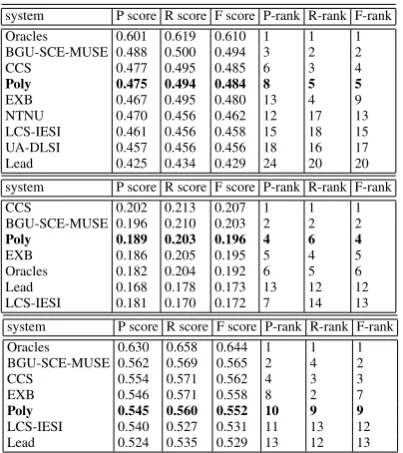
Tables 4, 4, and 1 contain the summarized re-sults of automated evaluations for MultiLing 2015, single-document summarization (MSS) task for English, Hebrew, and Arabic corpora, respec-tively. The quality of the summaries is mea-sured by ROUGE-1 (Recall, Precision, and F-measure).(Lin, 2004) We also demonstrate the ab-solute ranks of each submission–P-Rank, R-Rank, and F-Rank–when their scores are sorted by Pre-cision, Recall, and F-measure, respectively. Only the best submissions (in terms of F-measure) for each participated system are presented and sorted in descending order of their F-measure scores. Two systems–Oracles and Lead–were used as top-line and basetop-line summarizers, respectively. Ora-cles compute summaries for each article using the combinatorial covering algorithm in (Davis et al., 2012)–sentences were selected from a text to max-imally cover the tokens in the human summary, us-ing as few sentences as possible until its size ex-ceeded the human summary, at which point it was truncated. Because Oracles can actually “see” the human summaries, it is considered as the optimal algorithm and its scores are the best scores that extractive approaches can achieve. Lead simply extracts the leading substring of the body text of the articles having the same length as the human summary of the article.
Below we summarize the comparative results for our summarizer (denoted in the following ta-bles byPoly) in both tasks, in terms of Rouge-1, F-measure. For comparisons, we consider the best result out of 3 functions: coverage of frequent se-quences for English and coverage of meaningful words for Hebrew and Arabic.English:4thplaces
out of9participants in both MSS and MMS tasks.
Hebrew: 3rd place out of7 and out of9
partici-system P score R score F score P-rank R-rank F-rank Oracles 0.601 0.619 0.610 1 1 1 BGU-SCE-MUSE 0.488 0.500 0.494 3 2 2 CCS 0.477 0.495 0.485 6 3 4
Poly 0.475 0.494 0.484 8 5 5
EXB 0.467 0.495 0.480 13 4 9 NTNU 0.470 0.456 0.462 12 17 13 LCS-IESI 0.461 0.456 0.458 15 18 15 UA-DLSI 0.457 0.456 0.456 18 16 17 Lead 0.425 0.434 0.429 24 20 20 system P score R score F score P-rank R-rank F-rank CCS 0.202 0.213 0.207 1 1 1 BGU-SCE-MUSE 0.196 0.210 0.203 2 2 2
Poly 0.189 0.203 0.196 4 6 4
EXB 0.186 0.205 0.195 5 4 5 Oracles 0.182 0.204 0.192 6 5 6 Lead 0.168 0.178 0.173 13 12 12 LCS-IESI 0.181 0.170 0.172 7 14 13 system P score R score F score P-rank R-rank F-rank Oracles 0.630 0.658 0.644 1 1 1 BGU-SCE-MUSE 0.562 0.569 0.565 2 4 2 CCS 0.554 0.571 0.562 4 3 3 EXB 0.546 0.571 0.558 8 2 7
Poly 0.545 0.560 0.552 10 9 9
[image:4.595.316.518.73.300.2]LCS-IESI 0.540 0.527 0.531 11 13 12 Lead 0.524 0.535 0.529 13 12 13
Table 1: MSS task. Rouge-1. English,Hebrew, andArabic, top-down.
pants in MSS and MMS tasks, respectively; and the highest recall score in MMS task. Arabic:
5th place out of 7systems in MSS task, and 4th
place out of9 participants and the highest recall score in MMS task. As can be seen, the best per-formance for our summarizer has been achieved on the dataset of Hebrew documents. For exam-ple, only the top-line Oracles and the supervised MUSE summarizers outperformed our system in MSS task. Poly also outperformed Gillick (2009) model using ILP. The average running time for Poly is500ms per document.
5 Conclusions and Future Work
References
Rakesh Agrawal, Ramakrishnan Srikant, et al. 1994. Fast algorithms for mining association rules. In Proc. 20th int. conf. very large data bases, VLDB, volume 1215, pages 487–499.
S.T. Davis, J.M. Conroy, and J.D. Schlesinger. 2012. OCCAMS – An Optimal Combinatorial Covering Algorithm for Multi-document Summarization. In Proceedings of the IEEE 12th International Confer-ence on Data Mining Workshops, pages 454–463. Dan Gillick and Benoit Favre. 2009. A Scalable
Global Model for Summarization. InProceedings of the NAACL HLT Workshop on Integer Linear Pro-gramming for Natural Language Processing, pages 10–18.
Jiawei Han, Jian Pei, Behzad Mortazavi-Asl, Qim-ing Chen, Umeshwar Dayal, and Mei-Chun Hsu. 2000. Freespan: frequent pattern-projected sequen-tial pattern mining. In Proceedings of the sixth ACM SIGKDD international conference on Knowl-edge discovery and data mining, pages 355–359. ACM.
Yoshihiro Matsuo Hitoshi Nishikawa, Takaaki Hasegawa and Genichiro Kikui. 2010. Opinion Summarization with Integer Linear Pro-gramming Formulation for Sentence Extraction and Ordering. In Coling 2010: Poster Volume, pages 910–918.
N. Karmarkar. 1984. New polynomial-time algorithm for linear programming. Combinatorica, 4:373– 395.
Samir Khuller, Anna Moss, and Joseph (Seffi) Naor. 1999. The budgeted maximum coverage problem. Information Precessing Letters, 70(1):39–45. Chin-Yew Lin. 2004. Rouge: A package for
auto-matic evaluation of summaries. InProceedings of the Workshop on Text Summarization Branches Out (WAS 2004), pages 25–26.
Marina Litvak and Natalia Vanetik. 2014. Efficient summarization with polytopes. Innovative Docu-ment Summarization Techniques: Revolutionizing Knowledge Understanding: Revolutionizing Knowl-edge Understanding, page 54.
Takuya Makino, Hiroya Takamura, and Manabu Oku-mura. 2011. Balanced coverage of aspects for text summarization. In TAC ’11: Proceedings of Text Analysis Conference.
G. Salton, C. Yang, and A. Wong. 1975. A vector-space model for information retrieval. Communica-tions of the ACM, 18.
Hiroya Takamura and Manabu Okumura. 2009. Text summarization model based on maximum coverage problem and its variant. In EACL ’09: Proceed-ings of the 12th Conference of the European Chap-ter of the Association for Computational Linguistics, pages 781–789.
Kristian Woodsend and Mirella Lapata. 2010. Auto-matic Generation of Story Highlights. InACL ’10: Proceedings of the 48th Annual Meeting of the As-sociation for Computational Linguistics, pages 565– 574.