Effect of surface conditions on internal oxidation and nitridation of HVOF MCrAlY coatings
H. Chen, D.G. McCartney, K.T. Voisey
Faculty of Engineering, The University of Nottingham, UK. Abstract
This study deals with the isothermal oxidation behaviour of high velocity oxy-fuel sprayed MCrAlY coatings. Both free-standing coatings and
coatings attached to IN738 and CMSX4 substrates undergo isothermal oxidation at 1100°C for up to 100h. The effect of surface conditions (as-sprayed and polished) has been investigated. Scanning electron
microscopy and energy dispersive X-ray analysis were used to
characterise the details of oxidation behaviour. The results have shown that both surface conditions and substrate type have a pronounced effect on oxidation behaviour. Extensive internal oxidation and nitridation is observed for polished coatings on Inconel 738 and is attributed to the combined effects of titanium diffusion from the substrate and enhanced surface diffusion due to polishing.
Keywords: HVOF; surface conditions; titanium diffusion; internal oxidation
Introduction
Thermal barrier coatings (TBCs)[1, 2] are used to protect turbine blades
and similar components from the harsh conditions encountered in the hot
gas stream. TBCs are layered structures, consisting of an outer, ceramic,
layer which thermally insulates the underlying metallic component and a
bond coat. As well as enhancing the adhesion of the ceramic top coat a
key role of the bond coat is to provide corrosion and oxidation resistance.
This is done by the generation of a protective thermally grown oxide
(TGO), predominantly alumina, at the interface of the top coat and bond
coat. The presence of the TGO is vital to the function of the TBC. However
failure of TBCs is frequently associated with the TGO [3-5]. Ideally a TGO
It is known that the surface roughness can affect TGO growth, and that
the initial TGO formed can go on to affect further TGO behaviour [6, 7].
To maintain a protective alumina TGO an aluminium reservoir is needed
within the TBC. In MCrAlY bond coats, such as those considered in this
paper, a two phase, γ/β, microstructure is frequently seen, with the β
phase acting as an aluminium reservoir [8].
This paper studies the effect of substrate and surface condition on the
oxidation behaviour of high velocity oxy-fuel sprayed CoNiCrAlY coatings.
Experimental Methods
All coatings included in this work were generated from a
Co–31.7%Ni-20.8%Cr-8.1%Al-0.5%Y feedstock powder from Praxair (CO-210-24).
This had a nominal size range of -45+20 µm and a chemically analysed
oxygen content of 0.037 wt%O. Spraying was carried out using a Met Jet
III liquid fuel HVOF gun. Full details of the spraying process and
procedures are given elsewhere [9].
The coatings were deposited onto substrates with approximate
dimensions of 60 × 25 × 1.8 mm. Two different superalloy substrates
were used: Inconel 738 and CMSX4, with compositions as given in Figure
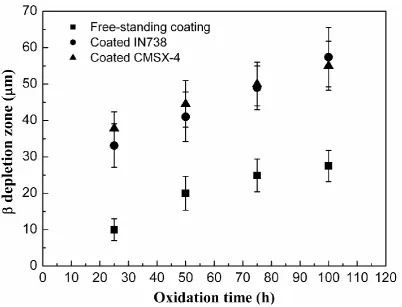
2 depletion zones as a function of oxidation time for as-sprayed
coatings.
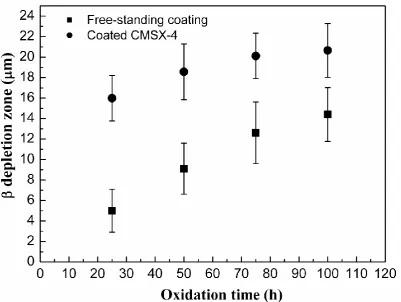
Figure 3 depletion comparison of polished coatings as a function of oxidation time.
Figure 5 Internal oxidation of polished coated IN738 after 2 h exposure to air at 1100 C
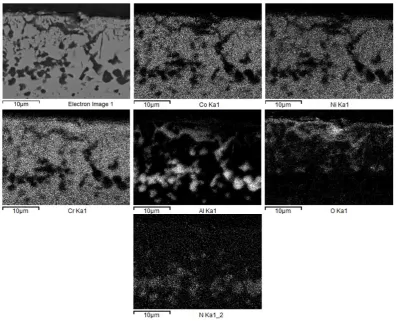
Figure 6 EDS mapping of near surface region of polished IN738 after 2 h exposure at 1100°C
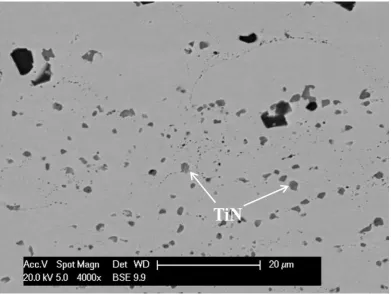
Figure 7 Titanium nitrides near the coating/substrate interface of polished coating on Inconel 738 after 100 h exposure at 1100 C
Table 1.
Free-standing coatings were generated by spraying onto mild steel
samples to a thickness of approximately 0.5 mm. These coatings were
then debonded from the mild steel by bending around a mandrel.
The as-sprayed coatings had a surface roughness Ra value of
6.1 ± 0.2 µm, for the polished coatings the Ra decreased to
0.2 ± 0.1 µm.
Prior to oxidation all samples underwent a vacuum heat treatment for 2h
at 1100°C. Samples were exposed to air at 1100°C for times up to 100h.
Sample characterisation was carried out using an SEM equipped with
energy dispersive x-ray spectroscopy.
Results
For most samples β depletion zones were clearly seen to develop
zones as a function of oxidation time are shown in Figure 9 and Figure 10
for as-sprayed and polished samples respectively. It can be seen that the
depletion zones for as-sprayed coatings on both substrates are very
similar, and that both are notably greater than those observed for the
free-standing coating (Figure 9). For the polished coatings the measured
β depletion zones for free-standing coatings and coatings on CMSX4 are
all approximately twice are large as what was observed for the equivalent
sprayed coatings. EDS analysis of the β and γ phases in the
as-sprayed coatings after 100h oxidation showed the presence of titanium in
the coating on Inconel 738: ~0.6 wt% was found in the γ phase and
~0.2wt% was found in the β phase. EDS results could not confirm the
presence of Ti in the 100h oxidised coating on the CMSX4 substrate. No
results for Inconel 738 are included in Figure 10 because it was not
possible to make meaningful measurements of any β depletion zone due
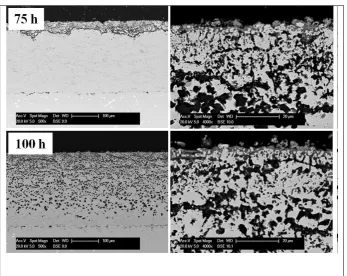
to the extensive internal oxidation attack seen in Figure 11. Additional
phases are seen to have formed in the near surface region. The depth to
which these phases extend increases with the oxidation time. This type of
internal attack was only observed for the polished coatings on Inconel 738
substrates.
Results from additional, shorter term, oxidation experiments are shown in
Figure 12 where the samples have been exposed for only 2h but the same
EDS analysis (Figure 13) reveals that the phases formed are enriched in
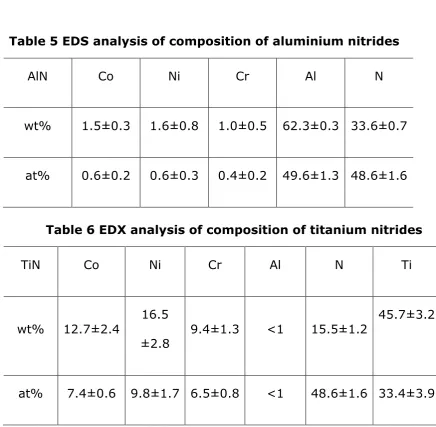
Al, O and N, with the EDS maps and compositions (Table 5) being
consistent with the outermost region containing alumina the region below
that containing Al rich nitrides.
For the polished coatings on Inconel 738 a third phase was noted within
the coating near the coating/substrate interface after 100h oxidation
(Figure 14). EDS analysis of the phase was consistent with it being TiN
(Table 6).
Discussion
An increased extent of β depletion is seen for all attached coatings
compared to the free-standing coatings (Figure 9 & Figure 10). It is well
known that thermal sprayed coatings contain residual stresses. On impact
any molten regions of the particles solidify and then the splat cools and
contracts, however the attachment to the underlying coating layers and
substrate constrains this contraction. This can result in tensile stresses in
the coating, with the magnitude of the tensile stresses being greatest at
the outer surface. Detachment from a substrate would be expected to
relieve the majority of the tensile stresses. So this means that the stress
states in the free-standing and attached coatings will be different. It is
suggested that the tensile stresses in the attached coatings enhance
diffusion rates, thereby resulting in the observed larger depletion regions
For the coatings on CMSX4 substrates it is seen that the polished coatings
have smaller β depletion zones than the as-sprayed coatings. This can at
least partially be attributed to the increased roughness, and
correspondingly larger real surface area, of the as-sprayed coatings.
It is clear that the polished coatings on Inconel 738 behave very
differently to all other samples. Extensive internal oxidation occurs for
these coatings. This was not seen for the same type of coatings on the
same substrate in the as-sprayed rather than polished condition. In
addition to changing the surface roughness polishing introduces
mechanical work to the surface and can thereby increase the dislocation
density. Dislocations are known to act as fast diffusion paths. Polishing
can therefore enhance diffusion in the surface and near surface regions.
This enhanced diffusion is thought to be a contributing factor to the
internal oxidation seen in the polished coatings on Inconel 738.
The polished coatings on CMSX4 were prepared in the same way so would
have also undergone the same enhancement in diffusion however no
internal oxidation or nitridation was seen for those coatings. The
difference between these two cases is the substrate. EDS results proved
that titanium from the Inconel 738 substrate diffused into the coating.
Titanium is of particular interest as it has been previously reported to be
alumina scale [10]. CMSX4 has a significantly lower titanium content than
Inconel 738, hence no titanium diffusion was expected, or observed, for
coatings on CMSX4.
It is suggested that the observed extensive internal oxidation and
nitridation of the polished samples on Inconel 738 is due to the
combination of two factors: the enhanced diffusion due to increased
dislocation density resulting from polishing and the presence of titanium.
The absence of internal oxidation and nitridation in both the as-sprayed
coatings on Inconel 738 and the polished coatings on CMSX4 supports the
proposition that both enhanced surface diffusion and the presence of
titanium are required for the observed effects to occur.
The precise role of titanium requires further study. It seems that the
presence of titanium, combined with fast inward diffusion routes for
oxygen and nitrogen prevent a protective alumina film from forming. It is
possible that TiO forms within the coating, promoting nucleation of
internal alumina. Once this internal oxidation, and nitridation, starts it
continues, assisted and even accelerated by the volume expansion upon
reaction [11]. However, it should be noted that no TiO was detected in
this work and more detailed study is required to elucidate the precise
mechanisms at work.
Conclusions
More extensive β depletion occurred during oxidation of coatings
attached to superalloy substrates compared to free-standing
coatings.
For attached and free-standing coatings, a larger surface roughness
produces more extensive β depletion zones.
For polished coatings on the, Ti rich, Inconel 738 substrate
extensive internal oxidation and nitridation occurs during oxidation.
This is attributed to the combined effects of enhanced surface
diffusion and the presence of titanium.
References
1. Evans, A.G., et al., Mechanisms controlling the durability of thermal
barrier coatings. Progress in Materials Science, 2001. 46(5): p. 505-553.
2. Miller, R.A., Thermal barrier coatings for aircraft engines: History and
directions. Journal of Thermal Spray Technology, 1997. 6(1): p. 35-42.
3. Rabiei, A. and A.G. Evans, Failure Mechanisms Associated with the
Theramlly Grown Oxide in Plasma-Sprayed Thermal Barrier Coatings. Acta Mater, 2000. 48: p. 3963-3976.
4. Rabiei, A. and A.G. Evans, Failure mechanisms associated with the
thermally grown oxide in plasma-sprayed thermal barrier coatings. Acta Materialia, 2000. 48(15): p. 3963-3976.
5. Shillington, E.A.G. and D.R. Clarke, Spalling failure of a thermal barrier
coating associated with aluminum depletion in the bond-coat. Acta Materialia, 1999. 47(4): p. 1297-1305.
6. Gil, A., et al., Effect of surface condition on the oxidation behaviour of
MCrAlY coatings. Surface & Coatings Technology, 2006. 201(7): p. 3824-3828.
7. Tang, F., et al., Effects of surface oxidation during HVOF processing on
the primary stage oxidation of a CoNiCrAlY coating. Surface & Coatings Technology, 2004. 185(2-3): p. 228-233.
8. Brandl, W., et al., The oxidation behaviour of sprayed MCrAlY coatings.
Surface & Coatings Technology, 1996. 86(1-3): p. 41-47.
9. Saeidi, S., in Faculty of Engineering. 2010, The University of Nottingham.
10. Krupp, U. and H.J. Christ, Internal Nitridation of Nickel-Base Alloys. Part
I. Behavior of Binary and Ternary Alloys of the Ni-Cr-Al-Ti System. Oxidation of Metals, 1999. 52(3-4): p. 277-298.
11. Litz, J., A. Rahmel, and M. Schorr, SELECTIVE CARBIDE OXIDATION AND
Figure and table captions
Figure 1 Microstructure of as-sprayed coated IN738 (top row) and coated CMSX4 (bottom row) after 100 h oxidation at 1100 C
Figure 2 depletion zones as a function of oxidation time for as-sprayed coatings.
Figure 3 depletion comparison of polished coatings as a function of oxidation time.
Figure 4 Back scattered SEM micrographs showing effect of oxidation on the polished coating on Inconel 738.
Figure 5 Internal oxidation of polished coated IN738 after 2 h exposure to air at 1100 C
Figure 6 EDS mapping of near surface region of polished IN738 after 2 h exposure at 1100°C
Figure 7 Titanium nitrides near the coating/substrate interface of polished coating on Inconel 738 after 100 h exposure at 1100 C
Table 1 Nominal compositions (wt%) of the substrates used in this work. Table 2 EDS analysis of composition of aluminium nitrides
Figures
Figure 11 Back scattered SEM micrographs showing effect of oxidation on the polished coating on Inconel 738.
[image:14.595.131.466.400.525.2]Figure 14 Titanium nitrides near the coating/substrate interface of polished coating on Inconel 738 after 100 h exposure at
Tables
Table 4 Nominal compositions (wt%) of the substrates used in this work.
Ni Cr C
o Mo Al Ti Ta W Zr C B Nb Hf Re La+Y Incon
el 738
B
al 16 8.5 1.7 3.5 3.5 7 1. 25 0.05 0.09 0.10 2
CMSX
[image:17.595.63.500.265.692.2]4 bal 6.5 9 0.6 5.6 1 6.5 6 0.1 3 0.002
Table 5 EDS analysis of composition of aluminium nitrides
AlN Co Ni Cr Al N
wt% 1.5±0.3 1.6±0.8 1.0±0.5 62.3±0.3 33.6±0.7
at% 0.6±0.2 0.6±0.3 0.4±0.2 49.6±1.3 48.6±1.6
Table 6 EDX analysis of composition of titanium nitrides
TiN Co Ni Cr Al N Ti
wt% 12.7±2.4 16.5
±2.8 9.4±1.3 <1 15.5±1.2
45.7±3.2