Bread Stories: Understanding the drivers of bread consumption for
digital food customisation
Nadia Pantidi School of Applied Psychology
University College Cork Ireland [email protected]
Paris Selinas School of Design Royal College of Art
United Kingdom [email protected]
Martin Flintham School of Computer Science
University of Nottingham United Kingdom [email protected]
Sharon Baurley School of Design Royal College of Art
United Kingdom [email protected]
Tom Rodden School of Computer Science
University of Nottingham United Kingdom [email protected]
ABSTRACT
Consumer demand for food that satisfies specific needs rather than generic mass produced food is growing. In response, the food industry is actively investigating techniques for efficient and comprehensive food customisation. Digital approaches to food customisation are starting to emerge, however, the majority is currently limited to the ingredient level thus excluding consumption drivers such as people’s practices and values around food. Using the approach of cultural probes, we identified four distinct narratives around bread consumption: the healthy bread, the fresh bread, the ethical bread, and the exceptional bread. These themes encapsulate drivers of bread consumption, which we argue can inform the design of digital food innovation platforms.
CCS CONCEPTS
• Human-centered computing → Empirical studies in HCI
KEYWORDS
Cultural probes; food innovation; customisation; values ACM Reference format:
Nadia Pantidi, Paris Selinas, Martin Flintham, Sharon Baurley, Tom Rodden, 2017, Bread Stories: Understanding the drivers of bread consumption for digital food customisation. In Proceedings of the 29th Australian Conference on Human-Computer Interaction, Brisbane, QLD, Australia, November 2017 (OzCHI 2017), 9 pages. https://doi.org/0000001.0000001
1
INTRODUCTION
In the last few years product design and manufacturing has undergone a significant shift in the development of products. Companies have increasingly turned to the public as a source of inspiration and drawn upon their customers for the genesis of new products. This has led to the development of a number of open innovation models that open up new possibilities for how big manufacturing companies can communicate with their customers. Consumers are increasingly having more input into the processes that shape products. Companies as diverse as Ikea, Fiat and Nike
have leveraged digital technologies and used on-line communication to turn to the crowd, developing innovation approaches where customers have a direct say in creating personalised products. Companies such as Volvo have even established dedicated ‘hack spaces’ inside their manufacturing plants to promote greater communication with consumers to draw upon their insights and preferences for the customisation and design of new products. Apart from the marketing value of such open innovation approaches for manufacturers, there are significant benefits for the consumers, especially if one considers applications in the food industry. Food open innovation and customisation can provide consumers with products that are tailored to their preferences, needs and lifestyle.
Despite the obvious benefits, the success of open innovation across a range of industries stands in contrast to food manufacturing. Large food companies currently face a situation where products routinely fail in the marketplace at some considerable cost. They lack approaches to effectively communicate with the consumers and struggle to exploit digital technologies to open up their process to innovation. One of the key reasons for this lies in the complexity of food experiences, particularly in translating its multisensory and cultural situatedness for the digital realm. Despite the plethora of existing research in the area, introducing an open, web based media interface for consumers to communicate their needs and preferences around food is still one of the important challenges ahead [16, 23, 37].
2
BACKGROUND
2.1
Customisation in Food Manufacturing
The food industry, from agriculture to hospitality, is probably the largest business in the world [23] and a very competitive sector. In food manufacturing successful innovation is critical for a company’s survival and growth, yet challenging. Unlike mechanical products, food faces a number of challenges that limit the ability to (mass) customise; for example, food products are perishable, they need to be processed and distributed quickly, entail complex handling requirements, and are produced under demanding legal provisions [19]. That is not to say however that there are no successful ventures in mass customisation in food. In the fast food industry, for example, the chain Burger King introduced burger customisation at the level of assembly by having customers select burger toppings, which did not increase labor costs. That was one of the most prolific examples of mass customisation being used to gain strategic business advantage. Nowadays, however, technological advances have triggered a shift in the food industry towards considering open food innovation and customisation through online digital tools.
2.2
Digital
platforms for open innovation and
customisation in food manufacturing
Recent digital developments are opening up new avenues for food customisation [35, 2, 14, 33, 9]. For example, food printing technologies enable consumers to personalise the shape and filling of products [18] or print their desired food at home. Recent work in this area also suggests that food printing can be used for socially engaging consumers, addressing issues of food literacy [36] and as a playful approach to physical activity self-monitoring [17]. However, while food printing seems very promising, it is still very new, not commercially available and also has been met with suspicion by consumers [18]. Another recent approach in customisation is that of data driven innovation where food companies leverage existing online user information (e.g. social media) to recommend specific products [14, 33]. For example, ice-cream company Talenti aggregates data from users’ social
media profiles to suggest personalised flavours
(http://flavorize.me/).
The most established online mass customisation approach to date involves consumers interacting with digital configurators, where they can parameterise product attributes [16,19]. A survey of the available configurators shows that food customisation falls under three categories: a) personalisation whereby a consumer chooses one of several ready made food products and simply adds a personal element such as an image on a cake or a label on a wine bottle (customwinesource.com), b) packaging personalisation (e.g. gift boxes), c) assemblers, where the consumer is allowed to assemble an individual product by choosing various ingredient options for the different components. Examples of the latter include choosing base and toppings for pizzas or choosing sponge, topping and filling for cakes (e.g. fergusonplarre.com.au) or type of grain and fruit for a muesli mix (e.g. www.mymuesli.com).
In the above open food innovation and customisation approaches, the focus is primarily on customising the product through a manipulation of ingredients. This is because it is far easier to communicate with a consumer about ingredients they wish to have in their product than it is to inquire about other aspects of that experience (e.g. taste, smell). However, it is recognised that successful innovation requires a move beyond ingredients to develop new more comprehensive ways for consumers to communicate their requirements and preferences [37, 5] and finding ways for people to communicate their socially situated and sensorial experiences of food. Both still present major challenges and are particularly problematic in an online context. In the next section we review existing work that seeks to digitally represent sensorial aspects to highlight some of the key difficulties currently faced.
2.
3
Digital representations of sensorial food
aspects
Finding ways to digitally represent multisensory attributes such as the ones involved in the experience of food can have tremendous impact in various areas of applications from food manufacturing to entertainment and can provide new ways of interacting with and experiencing the world around us [5, 24, 25].
Research to date in this area with respect to taste has primarily focused in simulating multisensory experiences digitally. One example of this is the Virtual Cocoon, a virtual reality helmet, developed to simulate all five human senses [7]. The helmet releases chemicals in order to stimulate both smell and taste senses, while hearing, sight, and touch senses are stimulated digitally. Furthermore, Narumi et al. [25] developed a system that overlays visual and olfactory information on existing cookies and conducted studies on cross-sensory interactions. The cookies have edible markers printed on top of them, that the system identifies and overlays relevant visual and olfactory information. The experimental results show that users perceive different tastes of cookies based on the virtual information overlaid [25]. Another approach uses electrical and thermal stimulation on people’s tongues to simulate taste. Examples of this approach include the Digital Taste Interface [29] which was limited to only primary taste sensations and the Digital Flavor Synthesising Device, a technology which created virtual flavours that people could enjoy digitally by actuating taste and smell sensation again by electrical and thermal stimulation [28].
elicited through eating and tasting food and provided descriptions of variables related to food-evoked emotions, such as sensory features, product type and food-related activities.
It is evident that there is a diverse body of work that is currently trying to address how best to represent the multisensory experience of food in a digital manner. The approaches detailed above focus on sensorial and perceptual features of food that once addressed will allow for a more direct communication of consumers’ food preferences. However, people’s preferences and behaviours around food are equally driven by the social context where these are situated and taught. While there are clear benefits in representing sensorial aspects of food experiences digitally, the focus on sensory aspects has been questioned with respect to its impact on product acceptance in the real world [11, 4, 23]. Much of the existing work in this area is also primarily lab based which has also been considered limited. In this respect, there is a shift with companies increasingly trying to understand people, their behaviours and values around food in a real world context in order to tailor those more comprehensibly and generate more successful products [11]. Our works aims to contribute in this space by employing a cultural probes approach to understand people’s bread consumption drivers.
3
CULTURAL PROBES: BREAD STORIES
The study presented here aimed tounderstand people’s values and
interactions around bread in order to inform and potentially refine
the design of digital platforms that enable more direct communication between consumers and manufacturers and engage consumers more actively in the food production chain. This study focused primarily on bread due to its cultural and
economic significance: it is a staple food for several cultures
across the world and it represents one of the biggest markets. In the next section, we present the study design and the cultural
probes kit developed for the purposes of the study.
3.1
Study design and procedure
The study followed a qualitative methodological approach deploying a cultural probes kit to people’s homes followed by semi-structured interviews that investigated further people’s everyday practices regarding bread consumption. Cultural probes were chosen as, similar to diary or observational studies they allow for culturally situated data to be collected, but have the additional benefit of being interactive and playful which can facilitate engagement and prompt creative, unexpected responses. Fifteen participants took part in the study, twelve females and three males; lived in various households (5 on their own, 4 with family, 6 with roommates) and their age ranged between 20-50 years old; seven were of British nationality and the rest originated from various countries across Europe and Asia. Participants were recruited using the snowballing method [13]. The study was advertised through mailing lists and also posted on a dedicated recruitment website (www.callforparticipants.com). Interested participants were asked to contact the lead researcher via email and following that, they were informed about the purpose of the study over email and in person and were given the chance to ask
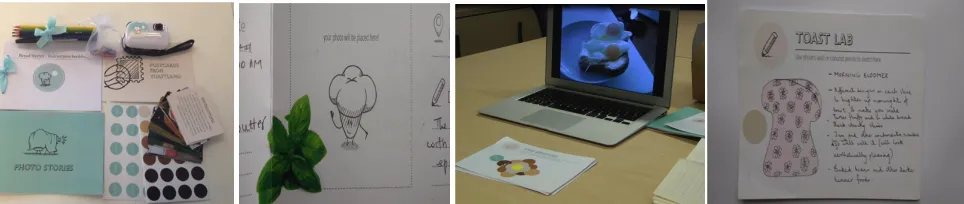
questions before agreeing to participate in the study. Upon consent, participants received the cultural probes kit along with instructions to the tasks included. Participants were instructed to engage with the kit over a period of seven days and after the designated duration, arrangements were made for participants to return the kit. Upon the return of the kit, participants were asked to participate in a follow up semi-structured interview. All participants returned the probes kit and were interviewed. The interview was scheduled for a later date so that researchers had a chance to review the cultural probes material as the collected data from the probes’ kit was used to guide the interviews. The collected materials from each participant were used as discussion prompts during the interviews. For example, the photographs participants took of their bread meals were used to prompt them to talk about how often they have such meals, on which occasions etc. (see Fig. 1). The interviews allowed participants to explain and discuss their responses and engagement with the tasks in the kit and in this way provided researchers with insight into the nuances of their practices, perceptions and consumption drivers. The interviews took place in a university meeting room, lasted approximately one hour each, were video-recorded and later transcribed. Collected data included the resulting artefacts from the cultural probes kit (e.g. digital photos taken by the participants, postcards) and the transcribed interview data.
The collected data was analysed using thematic analysis as described by [3]. The data analysis was conducted by multiple researchers. Two researchers independently coded and analysed the data resulting from the cultural probes kit and the interviews. These two sets of independent analyses were followed by a data session where the two researchers were joined by an additional two researchers in scrutinizing and synthesising the resulting analytic themes, ensuring they represented accurately the patterns of meaning within the data..In the next section, we provide a brief description of the probes kit contents and tasks.
3
.2
The probes kit
Figure 1 From left to right: the probes kit materials; the hand drawn mascot; the photo of a breakfast sandwich and the beloved postcard being used as prompts for the follow up interview; an example of a completed ‘Toast Lab’ postcard
1) “Take a photo of…” : Participants were provided with a cheap digital camera and asked to take a series of photos during the week. There was a list of specific photos to be captured (e.g.your bread, your toaster, things you have with your bread, the place where you normally buy your bread) and also open themes for them to capture freely whatever they wanted. The given list of photos to be taken asked participants to document their everyday bread and bread products in general, things that go with them, where they are stored and from where they are bought, as well as the meals they are associated with, thus covering a wide range of people’s daily consumption of and interaction with bread. For each photo they took, they were asked to write a short commentary in the photo journal (e.g. what they took a picture of, why, when). Stickers with frequency expressions (e.g. often, rarely, very often) were also provided. Participants could use the stickers in combination with the photos to indicate how often they have this meal or this sandwich etc. This particular activity aimed to capture everyday behaviours and interactions around bread but equally allow for the capturing of unanticipated content that participants saw as relevant to bread.
2) Postcards: Participants were given five postcards on which they were asked to draw or write a response. Each postcard had a task description on the front and a blank space at the back. On the blank space participants could draw, write and/or use stickers to respond to the task. The five postcards were:
- The beloved - Draw your favourite toast or sliced bread sandwich: This postcard asked participants to draw or write about their favourite bread item.
- The visionary - Draw your ideal bread: This postcard caption encouraged participants to think outside the box (“Don’t worry if it doesn’t fit the toaster”) and draw their ideal bread.
- The quicky - Draw a toast or bread sandwich you have when you are in a hurry.
- Toast in translation - Describe how you make your toast. The aim of this task was to have people articulate how they toast or grill their bread.
- Toast Lab: Describe here any non-ordinary things you might do or have done in the past with toast/ bread. 3) Free association card game: Participants were provided with a deck of cards of three types: 5 cards containing questions, 29 cards containing images and one card containing the instructions of the game. The instructions card encouraged
participants to free associate and choose images from the deck that best represented their thoughts, emotions or mental imagery, without overthinking their choice, and write down any words that might help them explain their choice later in the interviews. The 5 question cards contained the following questions: i)What comes to mind when you think of bread; ii) What comes to mind when you think of toast?; iii) Think of the last time you had toast or bread and choose a card that best represents this experience; iv) What you think is good about toast?; v)What you think is not good about toast?. The images on the cards were sourced via Flickr and following, albeit loosely, the tradition of free association, we chose the images to be as ambiguous and abstract as possible and not include any bread imagery. A specific process and set of criteria were established for the selection of the images that due to limited space, we will not be presenting here.
4
FINDINGS
The cultural probes allowed participants to self-report on their preferences, habits, values, experiences and other behaviours around bread in a playful way, and further provided nuanced situated – often tacit – accounts of values and drivers of bread consumption to be made explicit. Participants reported enjoying interacting with the kit and doing the tasks and even asked if they could keep it after the end of the study. All tasks were completed by all participants with the exception of two participants who did not complete the Toast Lab postcard as they felt they had not done anything extraordinary with bread to write about. Of the 73 postcards, 35 were returned by post, and 30 photos were contributed in addition to the ones on the list. In this section we present our main analytic themes through four narratives: the healthy bread, the fresh bread, the ethical bread and the exceptional bread. These themes emerged from a synthesized analysis of the collected materials from the probes and the data from the interviews.
4.1
The healthy bread
contents, 2) how they go about evaluating a healthy bread, and 3) processes that are seen to either improve or detract from the healthiness of bread.
4.1.1 Desirable Contents. While shopping for a healthy bread, participants talked about contents they look for, often inspecting the bread’s packaging for information in order to inform their choice. While calories were certainly noticed and mentioned, other nutrients found to be relevant to bread consumption were fiber and protein content. These were discussed by participants as “something they look for” and prioritise when buying bread: “I check the content, I am looking for a lot of fibre and protein (…) I am conscious about what I am eating, trying to have all the nutrients and I try to consume a lot of protein cause I believe it is important in the diet, a low carb diet and high protein, I don’t care about fat so much” [P6]
Nutritional aspects, such as salt, and sugar were also considered with respect to bread buying:
“I look at salt quite a bit, it is easier now that they have this traffic light system just to know oh that is a lot of salt per slice” [P12]
“And I do look, if some things had a big high salt I’d probably try and find another bread that wasn’t so high in salt.” [P9]
“sugar content and things…can make you feel very sluggish and things like that, which, again, I associate with quite unhealthy and unfit.” [P3]
Healthy bread also involved avoiding foods that contained additives. In particular, participants stressed how bread is traditionally made out of very few ingredients, so the use of additives was seen as unnecessary and therefore concerning. Participants described checking the packaging and not buying the products if they felt it included unnecessary additives:
“The actual ingredients in the bread would be flour pinch of salt, maybe a spoon of oil and water and you would know that would be the bread, now when I am reading ingredients on packaging they put gelatin in it, why would you need gelatin in bread? Gelatin in bread, what is wrong with you?” [P11]
“I am very much against all these additions, if you read the label of a bread…I actually have this rule that if the list of ingredients gets too boring to read then I drop the food cause that is way too many ingredients anyway. [P14]
4.1.2 Evaluating healthy bread. During the interviews participants also described applying elaborate rules and calculations to those desirable nutrients as part of their decision-making process for buying bread:
“I don’t buy bread that has less than 10grams of protein per 100grams and less than 6 grams of fibre. If I have bread that has the same amount of fibre and protein - which happened recently - then I look at the rest. Of those two one had more fat than the other so I went for the low fat. But this is just the next step. Fibre, protein, fat, sodium.” [P13]
Nutritional value would be the most important. I prefer no salt, no sugar and then I kinda ignore the carbs because this is the necessary evil.” [P9]
“the sugar, like, sugar content, whereas this Hovis [bread], when I bought it I checked the sugar content and, like, was a bit higher in salt.” [P2]
4.1.3 Processes affecting healthy bread. Participants discussed their appraisals of processes that can be applied to the bread’s ingredients or the bread itself that make it more or less healthy. One participant explained that her preference is to have toasted bread as it is healthier (i.e. has less calories):
“Toasted bread is healthier than just the plain breads...because if you toast the bread that burns a bit of calories, and if you eat, like, without toasted bread that has more calories, so you gain more calories. [P1]
Another participant explained how baking and toasting the bread actually makes it more processed:
“I try to only rarely eat bread, because it’s the carbs, basically. And because you bake it, it’s processed carbs as well. So I wouldn't (...) because I read somewhere that when you toast it it becomes super-processed, and it’s very bad for you. [P10]
Packaged bread was also perceived as not nutritious: “(…) cause I have forbidden packaged bread at home. I told them 'you cannot eat this cause there is no nutrition in it, there is just ingredients and it is something you put in your body but it does not feed you so don't do it.” [P14]
Notions around healthy bread also involved a strong dichotomy between white and wholemeal bread with the former being perceived as less healthy. White bread was discussed as “bad” and sometimes this was attributed to the white flour being “overly processed” [P1]. These established notions of white being non-healthy were shown to guide people’s consumption with respect to bread but also extended to other products such as pasta and rice:
“I like the taste of white bread but obviously dating a doctor they say to you all the time white bread is bad for you, get wholemeal” [P5]
“And again, it’s the same considerations, so like with rice, we always buy the brown rice, stuff like that. Brown pasta. Yes, I try to go down that line. Yes, just trying to be a bit healthier, I suppose.” [P12]
4
.2
The fresh bread
Freshness was found to be an important consideration driving the purchase and consumption of bread. Similarly, to health and nutrition, our findings uncovered participants’ interpretations of what fresh bread means to them. Fresh bread was described and evaluated for the most part based on desirable sensorial attributes and a set of processes that affect freshness were discussed.
4.2.1 Desirable sensorial attributes. For our participants fresh bread was any bread that has just come out of the oven, that felt and smelled a certain way:
“a bread which is like homemade and these are the cracks in the crust and this is the fluffiness inside” [P12].
“freshly baked, fresh bread and that kind of represents my childhood and those memories” [P15]
4.2.2 Evaluating fresh bread. To decide whether bread was fresh or not fresh, participants described relying on sensorial attributes, such as feeling if it is warm or soft: “I squeeze and smell it before buying” [P15]
“Is nice when it’s fresh, and then when... after one or two days it’s just, it loses its sponginess, or it’s just drier” [P13]
Another criterion was checking the expiration date, where that was possible, but several participants pointed out how knowing when it expires is not the same as knowing when it was made:
“check it’s in date and if everything looks okay.” [P9]
“I mean, we know the expiry on these breads, but then I always think that you don’t know when it was made.” [P13]
A clear distinction was also made between dough that is freshly baked but not freshly made:
“It is like the fresh baked cake in Starbucks which comes in a dough which yes it is fresh baked but it is not really freshly made.” [P14]
P7 expressed an interest in knowing when the bread had been made and also being prepared to pay more for knowing this: “I would definitely pay more to know that it was fresh [made] and that it was like ethically sourced.”
Fresh bread also was described as preferred with specific ingredient pairings, such as chocolate bars and honeycomb: “I also eat chocolate with fresh white bread, it works very well. one piece of one and one of the other, together.” [P13]
“The actual honeycomb…I put with the fresh white bread.” [P8]
4.2.3 Processes affecting fresh bread. Freshness appraisals also depended on several processes such as packaging and toasting. Packaged bread was seen as manufactured and therefore not fresh, while toasting was a process attributed to non-fresh bread: “Sometimes it can be quite manufactured I just think the fresh bread you get from Morissons is much better. I don't like bread like Hovis, which is all pre-wrapped.” [P9]
“My mum never bought packaged bread so I grew up with fresh bread so there is that myth in my head that it is all processed and you don't know what is in it” [15]
“I guess it is processed because I think of toast as, kind of, quite inferior to bread because bread is fresh; toast is what you do with stale bread so, I mean, you can toast fresh bread as well but it seems like a bit of a waste almost, if you’ve got good bread, to toast it. [P8]
The quality and provenance of ingredients used to make the bread dough was also considered an indicator of fresh bread with a clear emphasis on locally sourced ingredients:
“I guess it is about where the ingredients come I guess if they are locally sourced or not.” [P3]
“I just sometimes prefer to know where it is coming from rather than not knowing where is it coming from. and feeling warm I quite like that. [P9]
4.
3
The ethical bread
The consumption of bread (and food in general) was also very strongly guided by concerns and considerations around ethical (and non ethical) practices. Notions of ethical bread entailed the sourcing of ingredients and locality, the processes of manufacturing and also the overall perceived ethos of the producers and manufacturers, which guided participants’ perceptions and consumption choices.
4.3.1 Locally sourced ingredients. Participants emphasized their preferences for local bread, which involved bread both being made locally and bread whose ingredients are locally sourced: “A lot of the flour, I think, is coming from the US or somewhere else. So for me, that’s something that I also think and I try to buy like, there are a few independent bakers, to go into Farmer’s Markets or pop up shops here and there. And some of them are using local kind of flour, local wheat (...) But also the fact that you know where it’s kind of coming and supporting local” [P12] “I’d like to try bread from local bakeries if there was local bread I’d like to try that” [P9]
4.3.2 Evaluating ethical bread. Participants discussed how it is difficult to ascertain the origin of the ingredients and/or the processes that take place as part of bread making and expressed a strong interest in that information being more publicly available and easily accessible. Knowing who made the bread, was also discussed as something that would be helpful. In the absence of information, about provenance, choosing ethical bread involves opting for bread that is sold in local bakeries and farmers’ markets even if that means that participants are also missing detailed nutritional information:
“Yes, it’s weighing that up, isn’t it? Yes. I mean, because often, like, when we buy from the Farmer’s Market, or the, Birds, the bakery shop. I mean, you don’t have any nutritional information on that. But you know that care and effort has been taken, and, I don’t know, that it’s more of that homemade type feel to it, rather than your generic, sort of mass produced type stuff.” [P12] The dough kind of process, and whether the quality of the ingredients that go there,(...) yes there will still be some calories, but they would be probably better calories” [P10]
4.3.2 Manufacturing processes and concerns. Participants expressed strong concerns about the ethos of bread making with respect to the mass manufacturing processes. These concerns revolved around mistrust about the disclosure and quality of ingredients and processes:
“So it’s that scepticism, I don’t know how it’s been made, if it’s been made well” [P11]
“Because all I am concerned is what is in it, how much processing has been done If I knew and had some input then probably be quite happy.”[P10]
“it’s all the same bag of goo that just goes in different oven. I think that’s how they make bread at chain supermarkets; they just get a big bag of goo, pump it into moulds and then put that in the oven. It’s no different from the goo that you get at the factory so I wouldn’t buy fresh bread from a supermarket because what’s the point? you might as well just go to the bakery.” [P8]
Participants also discussed how their choices are guided by the company’s overall ethos, which is equally about the quality of processes and ingredients as it is about the labour conditions: “I don’t want to see a person who has been working there from seven am in the morning till nine am at night and has to drive two miles and then when he sees us, he’s like, oh I’m dying here because of you. You know, you’re eating so much bread and I’m giving my life here. I don’t have any personal life and, you know, it’s those ethical things which I want to make sure that it doesn’t happen” [P11].
4
.4
The exceptional bread
While health, freshness and ethical manufacturing were all very big drivers in our participants’ choices and consumption of bread, equally it was discussed how in their day to day lives, they often make exceptions as part of special occasions or for the sake of pleasure and others.
4.4.1 Cravings and treats. Bread was talked about as a comfort food that participants often craved even when they were on a diet regime. Participants talked about craving white bread even though it is not healthy, or having bread as a treat and also about how they make up for these slipups, e.g., by compromising to have a smaller loaf or eating earlier in the day:
“White bread in my mind is not very healthy, it would be something more like if I have a real craving” [P12]
“Having bread always in the morning, not with meals but sometimes will have bread as a treat in the afternoon” [P6] “And, like I say, it’s comfort food, great for a hangover.” [P8] “I like the ones with the seeds but then I have sort of made that compromise just to have the smaller loaf I guess, because it is less calories per slice, so you don’t have to think my god it is 130 calories per slice just for bread” [P12]
4.4.2 Eating out and eating with others. Exceptions were also made when participants would eat outside the home or have bread at a special occasion that involves others e.g. a dinner party: “When I eat outside I usually enjoy it and I don't pay too much attention as it doesn't happen very often” [P6]
“No, I would eat them. I would buy them if friends were coming round, I tend to buy different breads like that.” [P9]
Participants also described how they make exceptions to their bread buying and eating routines as part of living with others and being considerate to the needs and enjoyment of those others. For example, one participant described how she has to compromise despite being on a diet to accommodate for her husband:
“And, so, I sort of have to find compromises often, I suppose. So, we might, say, go with the more calorific option, knowing that
he’s happy, but I’ll just have to have it in absolute moderation, or something like that” [P12]
While another participant talked about having more calorific bread against their preference, as they share the bread with their housemate: “pretty much my housemate, so it makes sense for me to just use that one, as well, instead of going out and getting another one because, then, both of them would get wasted.” [P8]
5
DISCUSSION
In this study we harnessed the method of cultural probes to gain an understanding of what drives people’s bread consumption choices and in turn inform the design of digital platforms for food customisation. Our archetypal bread stories encapsulate four drivers of bread consumption decisions: health, freshness, ethics and exceptional circumstances. Here, we discuss our findings and the insights they hold for HCI and for improving
consumer-manufacturer communication, reconsidering consumer
preferences at the ingredient level and consumer preferences at the behavioural level.
5
.1
Designing for
consumer-
manufacturer
communication
Providing avenues for improved communication between consumers and manufacturers in the food industry has significant benefits both for the consumers – in that they will be able to tailor products according to their preferences, habits and values – and the manufacturers – as it opens up opportunities for new product development and makes it less likely for products to fail [16]. New opportunities are opening up for HCI research as digital approaches to food customisation are starting to emerge, such as leveraging social media information to recommend specific products [14, 33], food printing technologies to personalise the shape and filling of products [18] and to build food literacy and encourage physical activity [17, 36].
Our Bread Stories provided insights into the behaviours and meanings participants held with regard to bread, but they are also illustrative of the communicative elements that digital food customisation platforms need to include in order to ensure consumers can adequately convey their needs and preferences using such platforms. The consistent structure into which the healthy bread, the fresh bread and the ethical bread stories cohere, can provide an initial framework for designing digital
platforms for communication between consumer and
which suggests that digital platforms also need to incorporate ways for trade-offs and co-dependencies to be made explicit.
5
.2
Reconsidering ingredients: How much and
where do they come from?
While allowing consumers to choose what ingredients make up their food is an important aspect of food customisation, our study has highlighted that there are further refinements in consumers’ choices concerning ingredients that could inform food customisation decisions. The first is that our participants held preferences around quantities and ratios of ingredients, which in turn held particular meanings for health and nutrition – as seen in the healthy bread. A practical application of this, can involve e.g. producing a wholegrain loaf with customised quantities of salt and sugar that can be more appealing to consumers who are sensitive to quantities of salt and sugar intake. This distinction is particularly relevant to those consumers monitoring their diet for health reasons. For manufacturers this opens up new ways of identifying consumer segments for improved target marketing purposes. This is also directly relevant for HCI and specifically the design of mobile apps and wearables as there is a huge array of healthy lifestyle technologies and apps marketed to support people in their exercising and dieting (e.g. MyfitnessPal), but these technologies and apps primarily focus on calories as the main nutritional representation (e.g. 27, 32) and do not capture more nuanced categories of nutrients or interdependencies between nutrients.
The second is that consumers want to know where the ingredients originate from – most evident in the ethical bread. Our findings are in line with other recent studies, e.g. [34] that show consumers are increasingly demanding to know the provenance of their food. HCI research has provided several conceptual tools to support ethical food decision making (e.g. 1, 22) but these have not been taken up by the food industry and could provide starting points for the design of digital assemblers
5.3
Contextual food practices: What can I do
with it and who/what can I have it with?
In our findings (e.g. in the healthy and fresh bread) there were clear indications that for participants’ consumption choices, bread was not considered as an isolated food item, but as a food in the presence of and in possible combinations with other foods. For example, fresh bread was seen to combine particularly well with chocolate bars (P13) or honeycomb (P8). This provides insights into how consumers view their food item as part of a larger set of food options available and possible preferred combinations which can inform the design of digital open food platforms. Participants also based their bread choices around what they intended to do with the bread, i.e., toast it, make sandwiches etc. and under what circumstances they will eat it (the exceptional bread). Finding ways for consumers to communicate these special circumstances as part of digital food customisation is important. Some of these exceptional aspects are already incorporated in customisation platforms e.g. consumers can indicate that their food is forcelebratory occasions, but others, such as the compromises that result from co-habitation, are not currently depicted in assemblers or mobile interfaces despite being very commonplace.
6
CONCLUDING REMARKS
Our findings highlighted four drivers of food consumption as well as an initial framework that can be used to inform the design of digital food customisation platforms. To conclude, we would like to briefly consider the possible impacts of our design recommendations:
Effects of opening up the value chain. Digital food customisation platforms as conceived in light of our findings require “opening up” potentially sensitive information to consumers’ scrutiny, i.e., provenance information of ingredients. While this might be welcomed by consumers, we foresee significant implications for food manufacturers potentially having to find new arrangements within what [31] call the “value chain architecture” (i.e., in their procurement, transformation and distribution channels), in order to remain competitive and ensure consumers continue to choose their products. This also bears implications for designers of digital food platforms in their new role as the infrastructural and informational mediators of food provenance.
Effects of converging industries. Another effect is that of convergence which occurs when consumers use products from two initially non-competing industries for the same purpose, e.g. in the food and pharmaceutical industries where food is being used as medicine (nutriceuticals) [31]. Our data has highlighted how consumers of bread think about nutrition and make choices based on complex balances with regards to health benefits and drawbacks. Designers of digital innovation platforms need to consider how their platforms may take account of existing convergence trends and how consumers make those trade-offs.
Effects of food customisation on sustainable production and consumption. Food manufacturing and consumption impacts our environment. Customising the food we eat could encourage new ways of utilising resources in order to build new food systems and reduce waste. Digital customisation platforms can form part of the new data infrastructures, which satisfies consumers’ demands for traceability of food to particular people and places [15]. Further, customised food manufacturing can support preciseness in producing only what consumers actually need can help reduce waste and consequently preserve environmental resources. Equally, understanding a food product and the processes it undergoes can facilitate a redesign of manufacturing processes to reduce environmental impact.
ACKNOWLEDGMENTS
This work was supported by the EPSRC funded project EP/K014234/2 “Prototyping Open Innovation Models for ICT -Enabled Manufacturing in Food and Packaging”. A big thank you to all our participants for sharing their time and food experiences with us, this study would have not been possible without you.
REFERENCES
[1] Joon S. Baek, Anna Meroni and Giulia Simeone. 2014. A Relational Food Network: Strategy and Tools to Co-design a Local Foodshed, In Eat, Cook, Grow: Mixing Human-Computer Interactions with Human-Food Interactions,
Jaz Hee-jeong Choi, Marcus Foth and Greg Hearn (eds.). MIT Press, London, UK, 13-31.
[2] Belz, F.M. and Baumbach, W. 2010, “Netnography as a method of lead user identification”,Creativity and Innovation Management, Vol. 19, pp. 304-13
[3] Braun, V. and Clarke, V. (2006) Using thematic analysis in psychology.
Qualitative Research in Psychology, 3 (2). pp. 77-101. ISSN1478-0887
Available from: http://eprints.uwe.ac.uk/11735
[4] Buck, D. and MacFie, H. 2007. Methods to understand consumer attitudes and
motivations in food product development. Consumer-led food product
development, pp.141-157.
[5] Cardello, A.V., 1996. The role of the human senses in food acceptance. In Food
choice, acceptance and consumption (pp. 1-82). Springer US
[6] Munmun De Choudhury, Sanket Sharma, and Emre Kiciman. 2016. Characterizing Dietary Choices, Nutrition, and Language in Food Deserts via
Social Media. In Proceedings of the 19th ACM Conference on Computer
-Supported Cooperative Work & Social Computing(CSCW '16). ACM, New
York, NY, USA, 1157-1170. DOI: https://doi.org/10.1145/2818048.2819956
[7] D. Derbyshire. Revealed: The headset that will mimic all five senses and make
the virtual world as convincing as real life, March 2009
[8] Desmet, P.M.A., Schifferstein, H.N.J. Sources of positive and negative emotions in food experience. Appetite, 50(2-3), (2008), 290-301.
[9] Marketa Dolejšová. 2016. Deciphering a Meal through Open Source Standards: Soylent and the Rise of Diet Hackers. In Proceedings of the 2016 CHI Conference Extended Abstracts on Human Factors in Computing Systems (CHI
EA '16). ACM, New York, NY, USA, 436-448. DOI: https://doi.org/10.1145/2851581.2892586
[10] Cha Eunseok, Kim Kevin, Lerner Hannah, Dawkins Colleen, Bello Morenike,
Umpierrez Guillermo, Dunbar Sandra. 2014. Health Literacy, Selfefficacy, Food Label Use, andDiet in Young Adults. American Journal of Health Behavior, 38 (3): 331-339.
[11] Furst, T. Connors, M., Bisogni, C.A., Sobal, J., and Falk, L.W. 1996. Food choice: a conceptual model of the process. Appetite, 23(3), pp. 247-266
[12] Bill Gaver, Dunne, T., & Pacenti, E. (1999). Design: cultural probes.
interactions, 6(1), 21-29.
[13] Leo Goodman 1961. A. Snowball Sampling. Annual Mathematical Statistics. 32, no. 1, 148-170. doi:10.1214/aoms/1177705148
[14] He, W., Zha, S. and Li, L., 2013. Social media competitive analysis and text
mining: A case study in the pizza industry. International Journal of Information
Management, 33(3), pp.464-472
[15] Ilbery, Brian, and Damian Maye. "Food supply chains and sustainability: evidence from specialist food producers in the Scottish/English borders." Land Use Policy 22.4 (2005): 331-344.)
[16] Kemp, S.E., 2013. Consumers as part of food and beverage industry innovation.
Open innovation in the food and beverage industry, pp.109-138
[17] Rohit Ashok Khot, Deepti Aggarwal, Ryan Pennings, Larissa Hjorth, and Florian 'Floyd' Mueller. 2017. EdiPulse: Investigating a Playful Approach to
Self-monitoring through 3D Printed Chocolate Treats. In Proceedings of the 2017 CHI Conference on Human Factors in Computing Systems (CHI '17).
ACM, New York, NY, USA, 6593-6607. DOI:
https://doi.org/10.1145/3025453.3025980
[18] Rohit Ashok Khot, Deborah Lupton, Markéta Dolejšová, and Florian 'Floyd' Mueller. 2017. Future of Food in the Digital Realm. In Proceedings of the 2017 CHI Conference Extended Abstracts on Human Factors in Computing Systems (CHI EA '17). ACM, New York, NY, USA, 1342-1345. DOI: https://doi.org/10.1145/3027063.3049283
[19] Monika Kolb, Paul Blazek, and Clarissa Streichsbier. 2014. Food Customisation: An Analysis of Product Configurators in the Food Industry, In Proceedings of the 7th World Conference on Mass Customization, Personalization, and Co-Creation (MCPC 2014), 229-239 http://dx.doi.org/10.1007/978-3-319-04271-8
[20] Bokyung Lee, Jiwoo Hong, Jaeheung Surh, and Daniel Saakes. 2017. Ori-mandu: Korean Dumpling into Whatever Shape You Want. In Proceedings of
the 2017 CHI Conference Extended Abstracts on Human Factors in Computing
Systems (CHI EA '17). ACM, New York, NY, USA, 456-456. DOI:
https://doi.org/10.1145/3027063.3049777
[21] Levidow, Les, Kean Birch, and Theo Papaioannou. "Divergent paradigms of European agro-food innovation: The knowledge-based bio-economy (KBBE) as an R&D agenda." Science, Technology, & Human Values 38.1 (2013): 94-125
[22] Ann Light. 2014. The Allure of Provenance: Tracing Food Through
User-Generated Production Information, In Eat, Cook, Grow: Mixing Human -Computer Interactions with Human-Food Interactions, Jaz Hee-jeong Choi, Marcus Foth and Greg Hearn (eds.). MIT Press, London, UK, 213-226. [23] Meiselman, H.L. and MacFie, H. 2007. Integrating consumer responses to food
products. Consumer-led food product development, Pp. 3-33.
[24] Takuji Narumi, Shinya Nishizaka, Takashi Kajinami, Tomohiro Tanikawa, and Michitaka Hirose. 2011. Augmented reality flavors: gustatory display based on edible marker and cross-modal interaction. InProceedings of the SIGCHI
Conference on Human Factors in Computing Systems (CHI '11). ACM, New York, NY, USA, 93-102. DOI: https://doi.org/10.1145/1978942.1978957
[25] T. Narumi, M. Miyaura, T. Tanikawa, and M. Hirose. Simplification of olfactory stimuli in pseudo-gustatory displays. IEEE transactions on
visualization and computer graphics, 20(4):504–512, 2014
[26] Marianna Obrist, Rob Comber, Sriram Subramanian, Betina Piqueras-Fiszman, Carlos Velasco, and Charles Spence. 2014. Temporal, affective, and embodied characteristics of taste experiences: a framework for design. In Proceedings of
the SIGCHI Conference on Human Factors in Computing Systems (CHI '14).
ACM, New York, NY, USA, 2853-2862. DOI:
https://doi.org/10.1145/2556288.2557007
[27] Koichi Okamoto and Keiji Yanai. 2016. An Automatic Calorie Estimation
System of Food Images on a Smartphone. In Proceedings of the 2nd International Workshop on Multimedia Assisted Dietary Management (MADiMa '16). ACM, New York, NY, USA, 63-70. DOI: https://doi.org/10.1145/2986035.2986040
[28] Nimesha Ranasinghe, Gajan Suthokumar, Kuan-Yi Lee, and Ellen Yi-Luen Do.
2015. Digital Flavor: Towards Digitally Simulating Virtual Flavors. In Proceedings of the 2015 ACM on International Conference on Multimodal
Interaction (ICMI '15). ACM, New York, NY, USA, 139-146. DOI:
http://dx.doi.org/10.1145/2818346.2820761
[29] Nimesha Ranasinghe, Adrian Cheok, Ryohei Nakatsu, and Ellen Yi-Luen Do.
2013. Simulating the sensation of taste for immersive experiences. In
Proceedings of the 2013 ACM international workshop on Immersive media
experiences (ImmersiveMe '13). ACM, New York, NY, USA, 29-34.
DOI=http://dx.doi.org/10.1145/2512142.2512148
[30] N. Ranasinghe, R. Nakatsu, H. Nii, and P. Gopalakrishnakone. Tongue
mounted interface for digitally actuating the sense of taste. In Wearable Computers (ISWC), 2012 16th International Symposium, pages 80–87. IEEE, 2012.
[31] Lee, Sang M., David L. Olson, and Silvana Trimi. "Co-innovation:
convergenomics, collaboration, and co-creation for organizational values." Management Decision 50.5 (2012): 817-831
[32] Sanket S. Sharma and Munmun De Choudhury. 2015. Measuring and
Characterizing Nutritional Information of Food and Ingestion Content in Instagram. In Proceedings of the 24th International Conference on World Wide
Web (WWW '15 Companion). ACM, New York, NY, USA, 115-116. DOI: http://dx.doi.org/10.1145/2740908.2742754
[33] Sigala, M., 2012. Social networks and customer involvement in new service development (NSD) The case of www. mystarbucksidea. com. International Journal of Contemporary Hospitality Management, 24(7), pp.966-990. [34] Ekaterina Sysoeva, Ivan Zusik, and Oleksandr Symonenko. 2017. Food
-to-Person Interaction: How to Get Information About What We Eat?. In
Proceedings of the 2017 ACM Conference Companion Publication on
Designing Interactive Systems (DIS '17 Companion). ACM, New York, NY,
USA, 106-110. DOI: https://doi.org/10.1145/3064857.3079128
[35] Claudia Wagner, Philipp Singer, and Markus Strohmaier. 2014. Spatial and temporal patterns of online food preferences. In Proceedings of the 23rd International Conference on World Wide Web (WWW '14 Companion). ACM,
New York, NY, USA, 553-554. DOI:
http://dx.doi.org/10.1145/2567948.2576951
[36] Yun Wang, Xiaojuan Ma, Qiong Luo, and Huamin Qu. 2016. Data
Edibilization: Representing Data with Food. In Proceedings of the 2016 CHI Conference Extended Abstracts on Human Factors in Computing Systems (CHI EA '16). ACM, New York, NY, USA, 409-422. DOI: https://doi.org/10.1145/2851581.2892570
[37] Zoran, A., & Coelho, M. (2011). Cornucopia: the concept of digital