The effects of rTMS on impulsivity in normal adults: a systematic review
and meta-analysis
Authors
Cheng-Chang Yang1*, Birgit Völlm1, Najat Khalifa1
1Division of Psychiatry and Applied Psychology, School of Medicine,
University of Nottingham, UK
*Author for correspondence
Contact information: Institute of Mental Health
University of Nottingham Innovations Park Triumph Road
Nottingham, NG7 2TU UK
Cheng-Chang Yang Email: [email protected] Birgit Völlm Email: [email protected]
The effects of rTMS on impulsivity in normal adults: a systematic review and meta-analysis
Abstract
Background: Impulsivity is a multi-dimensional construct that is regarded as a symptom of many psychiatric disorders. Harm resulting from impulsive
behaviour can be substantial for the individuals concerned, people around them and the society they live in. Therefore, the importance of developing therapeutic interventions to target impulsivity is paramount.
Aims and methods:We conducted a systematic review and meta-analysis of the literature from AMED, Embase, Medline, and PsycINFO databases on the use of repetitive transcranial magnetic stimulation (rTMS) in healthy adults to modulate different subdomains (motor, temporal and reflection) of impulsivity. Results:The results indicated that rTMS has distinct effects on different impulsivity subdomains. It has a significant, albeit small, effect on modulating motor impulsivity (g= 0.30, 95% CI, 0.17 to 0.43,p< .001) and a moderate effect on temporal impulsivity (g= 0.59, 95% CI, 0.32 to 0.86,p< .001). Subgroup analyses (e.g., excitatory vs. inhibitory rTMS, conventional rTMS vs. theta burst stimulation, analyses by stimulation sites, and type of outcome measure used) identified key parameters associated with the effects of rTMS on motor and temporal impulsivity. Age, sex, stimulation intensity and the number of pulses were not significant moderators for effects of rTMS on motor impulsivity. Due to lack of sufficient data to inform a meta-analysis, it has not been possible to assess the effects of rTMS on reflection impulsivity.
Further studies are required to extend the use of rTMS to modulate impulsivity in those at most risk of engaging in harmful behaviour as a result of
impulsivity, such as patients with offending histories and those with a history of self-harming behaviour.
Key words:
Introduction
Impulsivity is an important behavioural aspect of our daily life. It encompasses such actions as making premature decisions, favouring immediate over
delayed reward, and failure to inhibit prepotent motor responses. Impulsivity is a multi-dimensional concept (Caswell, Celio, Morgan, & Duka, 2016;
Evenden, 1999) for which three different facets have been identified based on recent laboratory findings, including motor, temporal and reflection impulsivity. Motor impulsivity, also known as response inhibition, reflects the inability to inhibit a prepotent behavioural response. Delay-discounting (also referred to as temporal impulsivity) reflects failure to delay gratification. Reflection or cognitive impulsivity refers to the tendency to make premature decisions without sampling enough information or disadvantageous decisions which favour risky options (Verdejo-Garcia, Lawrence, & Clark, 2008).
Several brain areas have been implicated in impulsivity (Fineberg et al. 2014). A fronto-subcortical network encompassing the right inferior frontal gyrus (rIFG) and basal ganglia (Aron & Poldrack, 2005; Chambers, Garavan, & Bellgrove, 2009; Juan & Muggleton, 2012; Wilbertz et al., 2014) has been implicated in motor impulsivity, whereas a fronto-limbic network
Impulsivity plays a prominent role in psychopathology (Cyders, 2013) and has been regarded as a symptom of several psychiatric disorders, such as
attention deficit hyperactivity disorder (Musser, Galloway-Long, Frick, & Nigg, 2013), schizophrenia (Matsuzawa, Shirayama, Niitsu, Hashimoto, & Iyo, 2015), obsessive compulsive disorder (Endrass et al., 2010), impulse-control disorders, borderline personality disorder, antisocial personality disorder, bipolar affective disorder, and substance use disorders (American Psychiatric Association, 2013; Fineberg et al., 2014). Impulsivity may partly explain the high rates of suicide and offending behaviour associated with some of these disorders particularly borderline personality disorder (Brevet-Aeby, Brunelin, Iceta, Padovan, & Poulet, 2016). In addition, impulsivity in early life is
regarded as a significant predictor of future physical health and delinquent behaviour (Moffitt et al., 2011). Furthermore, impulsivity has been included as a core criminogenic factor in classical criminology theories (Gottfredson (Gottfredson & Hirschi, 1990) and an important risk factor of violence among both normal (Chamorro et al., 2012) and clinical populations (Bjørkly, 2013; Singh, Serper, Reinharth, & Fazel, 2011).
The literature reviewed above indicates that in some clinical populations, impulsivity may play a role in such behaviours as aggression, self-harm or suicidality and substance abuse and this in conjunction with other emotional and psychological factors, may cause significant distress for the individual concerned and people around them. Given such consequences, the importance of developing interventions to target impulsive behaviour is paramount. While conventional psychological and pharmacological
dysfunctional behaviour (Tomko, Bountress, & Gray, 2016), there currently exist no specific interventions to target impulsivity.
Evidence is accumulating that Transcranial Magnetic Stimulation (TMS) can be used to modulate impulsivity. TMS is a non-invasive technique that has been used to modulate brain activity via brief, high-intensity magnetic pulses delivered through an electromagnetic coil placed on the surface of scalp over the brain area of interest. The stimulation pulses are generated by passing currents with a stimulator through the coil, producing a focal magnetic field which induces localised neuronal depolarization in the area beneath the coil (Wagner, Valero-Cabre, & Pascual-Leone, 2007). Repetitive TMS (rTMS) refers to delivering multiple stimuli in trains instead of single-pulse stimulation over the target cortical region. The frequency of rTMS determines its effect on the neurons of the targeted brain regions. Low frequency rTMS of about 1 Hz, exerts an inhibitory function by reducing cortical excitability, whereas high frequency rTMS of about 5 Hz or more typically has a facilitatory effect, which tends to increase cortical excitability. Recently, a newer form of
The utility of TMS in modulating brain activity has been demonstrated in the field of neuroscience (Luber & Lisanby, 2014). Additionally, over the past two decades, rTMS has widely been used to treat a variety of neurological and psychiatric disorders (Wassermann & Zimmermann, 2012), including depression (Sabesan et al., 2015), obsessive-compulsive disorder (Mantovani, Simpson, Fallon, Rossi, & Lisanby, 2010), migraine, and Parkinson’s disease (Benninger et al., 2012). It has also been used to
modulate impulsivity with some promising results (Brevet-Aeby et al., 2016). Existing reviews have paid attention to the excitatory or inhibitory effect of rTMS on various dimensions of impulsivity, but to our knowledge, no meta-analysis has been conducted to comprehensively assess the efficacy of rTMS in the neuromodulation of impulsivity. There is a dearth of literature on the use of rTMS to modulate impulsivity in clinical populations, and the extant
literature in the field is not sufficiently large to inform a meta-analysis.
Therefore, studies involving healthy subjects are potentially relevant and can help elucidate the effects of rTMS on specific domains of impulsivity and provide comparison data for groups diagnosed with specific disorders. This is supported by the view that symptoms of mental disorders are displayed on a continuum along normality, and the difference between the two is one of degree (Holroyd & Umemoto, 2016). In support of this view, Zisner and Beauchaine (2016) found that normal variations in impulsive tendencies are reflected in core aspects of personality while variations in trait impulsivity confer vulnerability to clinical psychopathology.
Methods
We followed the Preferred Reporting Items for Systematic Review and Meta-Analysis (PRISMA) statement (Liberati et al., 2009; Moher, Liberati, Tetzlaff, Altman, & The PRISMA Group, 2009) in the reporting of our findings. The predetermined criteria, in terms of population, interventions, comparators, outcomes and study designs (PICOS), were followed to identify potentially eligible studies for the systematic review and meta-analyses.
Eligibility Criteria
Empirical studies were included in the review if they (1) involved healthy adult participants, (2) used rTMS as an active intervention, (3) had a comparison group or control condition, and (4) used at least one behavioural task to measure impulsivity. Studies involving children or people with
neuropsychiatric disorders were excluded. The definitions of impulsivity and its subdomains were in accordance with previous literature (Caswell, Bond, Duka, & Morgan, 2015; Verdejo-Garcia et al., 2008). The behavioural tasks measuring impulsivity included, but were not limited to, the following tasks. Tasks measuring motor impulsivity included the Stop Signal Task (SST; Logan, 1994), the Go-No-Go task (GNG; Conners, Epstein, Angold, & Klaric, 2003), and the Stroop Colour and Word Test (SCWT; Stroop, 1935) and their variant versions. Tasks measuring temporal impulsivity included the Delay Discounting Task. The Information Sampling Task (Clark, Robbins, Ersche, & Sahakian, 2006) and tasks involving risky or disadvantageous decisions, such as the Ballon Analogue Risk Task (Lejuez et al., 2002) and the Iowa
included to index reflection impulsivity. No restrictions were imposed in respect of publication date or language.
Information Sources and Search
The literature search was performed on four electronic databases (AMED, Embase, Medline, PsycINFO) until 17th February 2017. ”Transcranial
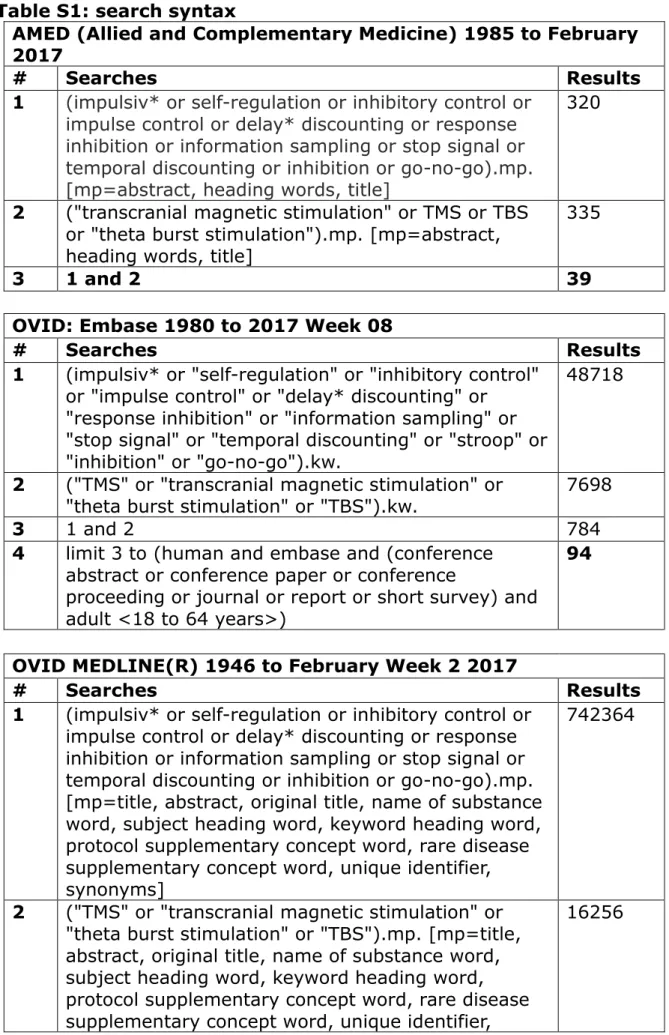
magnetic stimulation”, ”TMS“, "theta burst stimulation" or "TBS" combined with “impulsiv*”, "self-regulation", "inhibitory control", "impulse control", "delay discounting", "response inhibition", "information sampling", "stop signal", "temporal discounting", "stroop", "inhibition", "go-no-go" were searched as keywords. The first author (CCY) performed the search and the search terms were confirmed after discussion with the other two authors (NK and BV). Filters regarding the age of participants (adult) and publication type were added where applicable. No language restriction was set. The full search strings are shown in Table S1. References of candidate citations were searched manually for potentially eligible studies missed by the electronic searches.
Study Selection
Data Collection Process and Data Items
Data extraction was performed by the first author (CCY) in discussion with the other authors. The authors regularly discussed the data collection process to resolve disagreements and to ensure consistency. A standardised form was used to extract information concerning authors, study objectives, sample characteristics, inclusion and exclusion criteria, study design, experimental processes, rTMS protocols, outcome variables, and analytic strategy. In cases where the means and standard deviations of key outcome measures were only presented in the diagrams, these parameters were estimated from the available figures.
Risk of Bias in Individual Studies
The methodological quality and the risk of bias for each study were assessed using the Quality Assessment Tool for Quantitative Studies (National
Collaborating Centre for Methods and Tools, 2008). This was in accordance with recommendations by the Cochrane Collaboration (Armstrong, Waters, & Doyle, 2011). The domains of assessment included selection bias, study design, confounders, blinding, data collection method, and withdrawals and dropouts. The quality assessments included supplementary information on adverse effects. This quality assessment allowed us to classify studies as having a low, moderate, or high quality. Study quality was assessed by a single reviewer with verification by a second reviewer (BV).
Summary Measures
direction. For example, post inhibitory rTMS performance would be expected to be worse than the baseline one. Moreover, in cases where a study entailed stimulation of multiple sites within the same study, stimulation at each site was regarded as a standalone trial for the purpose of effect size calculation. Each trial was used as the unit of analysis to obtain the effect size in the meta-analysis. Since some studies included more than one effect, this nesting of effects within studies violates assumptions of independence and may contribute to imprecise effect size calculations (Borenstein, Hedges, Higgins, & Rothstein, 2009b). To adjust for the correlation of effects within studies, a multi-level model analysis was conducted using the Generalized Linear Latent and Mixed Model (gllamm) in STATA (Rabe-Hesketh, Skrondal, & Pickles, 2002, 2005) for meta-analysis. For studies involving more than one control group or condition (e.g., one group receiving rTMS at a control site and another receiving sham stimulation), only the comparison between experimental and sham group (condition) was selected. The effect sizes, represented as unbiased Hedges ’gand 95% confidence intervals (CIs), were computed by dividing the pre- and post-stimulation differences between
experimental (real stimulation) and control (sham stimulation) conditions by the pooled pre-stimulation standard deviation (Morris, 2008).
Synthesis of Results & Measures of Inconsistency
impulsivity; namely motor, temporal and reflection impulsivity. TheQ, I2andT2
statistics (Higgins & Thompson, 2002; Higgins, Thompson, Deeks, & Altman, 2003) were used to assess heterogeneity between studies.Q provides
significance testing for heterogeneity (p-value ≤ .05) which is calculated as the
weighted sum of squared deviations of each study’s effect size from the overall mean effect size (Borenstein, Hedges, Higgins, & Rothstein, 2009a). I2estimates the percentage of the variability in effect estimates that is due to
heterogeneity rather than chance. AnI2value of greater than 50% was
deemed as indicative of moderate heterogeneity (Deeks, Higgins, & Altman, 2011). AsI2is a measure of relative heterogeneity,T2is the variance of the
true effect sizes, as an estimate of absolute heterogeneity. When T2
increases, the observed variance increases or the variance within-studies decreases (Borenstein, Hedges, & Rothstein, 2007).
Risk of Bias - Publication Bias
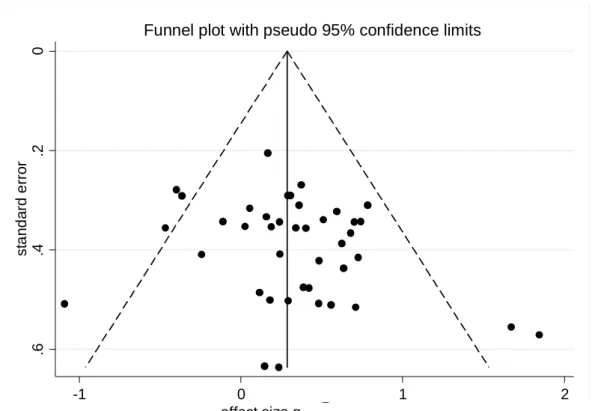
Funnel plots (Egger & Smith, 1995), the Egger test (Egger, Smith, Schneider, & Minder, 1997), and Begg and Mazumdar rank correlation tests (Begg & Mazumdar, 1994) were used to test for the presence of a potential publication bias.
Additional Analyses
To identify variables contributing to alternation of impulsivity, pre-specified subgroup analyses were performed with the unit of trial by merging the data according to the rTMS parameters, including effects (“excitatory” vs.
examine the impact of between-study variation on study effect sizes using mean age and male ratio of the participants, intensity of stimulation, and total number of pulses per condition as predictor variables. All quantitative
Results
Study Selection
Of the 3423 citations originally identified, 28 publications met the study inclusion criteria and were included in the systematic review; however, one article (Upton, Cooper, Laycock, Croft, & Fitzgerald, 2010) was excluded from the meta-analyses due to inability to obtain the effect size (Fig. 1).
Insert Figure 1 Here
Study Characteristics
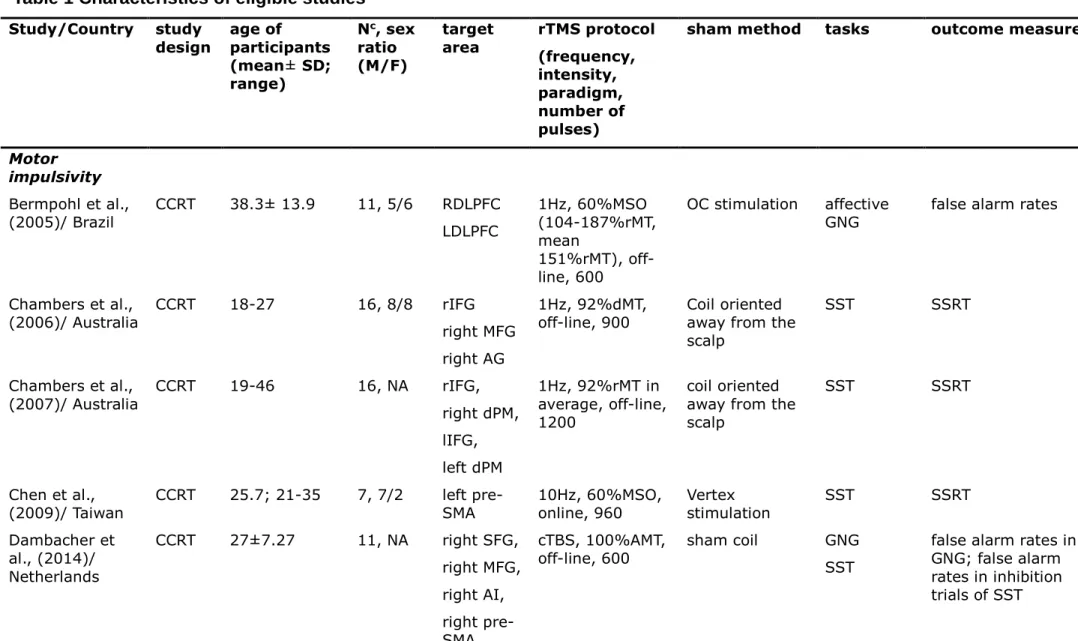
Characteristics of selected studies categorised by the subtypes of impulsivity are summarised in Table 1.
Insert Table 1 Here
In summary, 28 studies involving a total of 599 participants (51.6% male; mean age: 30.16 years; range: 18-70 years) were included in the quantitative synthesis. Eleven of the included studies were conducted in Europe, seven in East Asia, six in North America, three in Australia, and one in Brazil.
The most common study design employed was a counterbalanced crossover design (19 studies), followed by randomised crossover (6 studies) and
twelve studies, GNG in six studies, SCWT in five studies, and the Negative Affective Priming task (NAP) in one study (Leyman, De Raedt, Vanderhasselt, & Baeken, 2009). Five different computerised delay-discounting tasks were used in the studies exploring temporal impulsivity and one risk-taking task (Rogers et al., 1999) was selected to index reflection impulsivity in one study (Knoch et al., 2006). All studies delivered a single rTMS session per condition, except for one study (Kim, Han, Ahn, Kim, & Kim, 2012) which applied five rTMS sessions over five consecutive days. The number of pulses within each experimental session ranged from 150 (Cho et al., 2015) to 1600 (Huang, Su, Shan, & Wei, 2004).
Regarding the stimulation sites, the dorsolateral prefrontal cortex (DLPFC) was the most commonly targeted area; the right DLPFC (RDLPFC) was selected in six studies and the left DLPFC (LDLPFC) in fourteen studies. The rIFG (6 studies) and pre-supplementary motor area (pre-SMA; 5 studies) were targeted in several studies. The most common control condition (17 studies) entailed tilting the coil to divert the magnetic pulses away from the scalp. Six studies (Dambacher et al., 2014; Figner et al., 2010; Muggleton, Chen, Tzeng, Hung, & Juan, 2010; Sheffer et al., 2013; Watanabe et al., 2015) used a sham coil, three (Bermpohl (Bermpohl et al., 2005; Chen, Muggleton, Tzeng, Hung, & Juan, 2009; Cho et al., 2015) used a control site stimulation, one
(Grossheinrich et al., 2009) used another stimulation mode, and one study (Knoch et al., 2006) did not report details about the sham method.
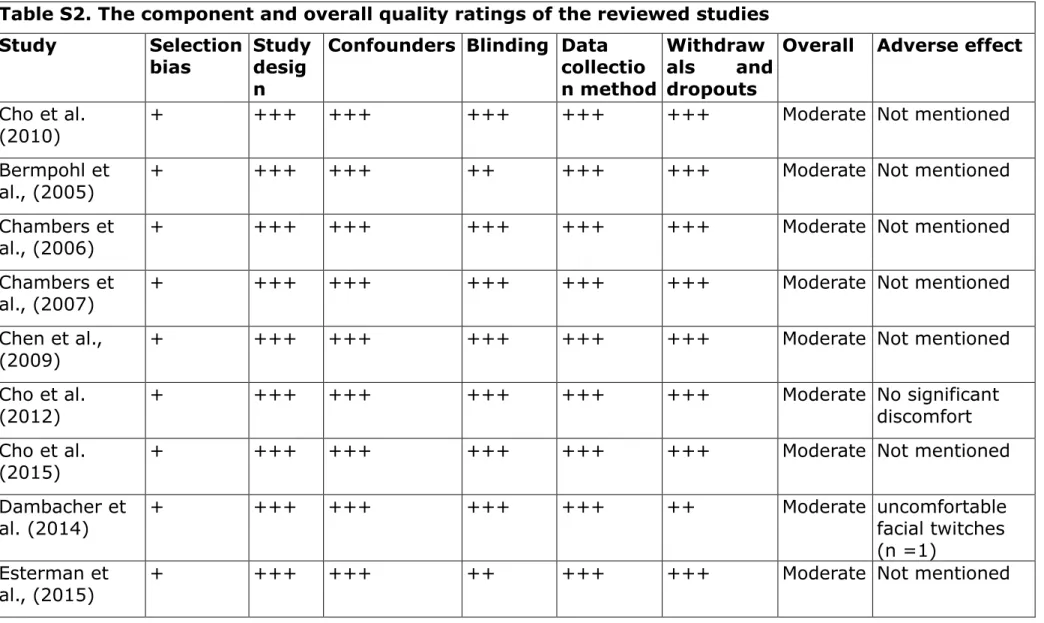
All 28 included studies attracted a “moderate” quality rating (Table S2). This was largely due to poor ratings on selection bias. Only eleven studies
reported on adverse effects relating to rTMS administration, of which eight studies found no significant adverse effects (Cho et al., 2012; Figner et al., 2010; Huang et al., 2004; Hwang, Kim, Park, Bang, & Kim, 2010; Knoch et al., 2006; Obeso, Robles, Marron, & Redolar-Ripoll, 2013; Verbruggen, Aron, Stevens, & Chambers, 2010; Zandbelt, Bloemendaal, Hoogendam, Kahn, & Vink, 2013), and three studies (Dambacher et al., 2014; Grossheinrich et al., 2009; Wagner, Rihs, Mosimann, Fisch, & Schlaepfer, 2006) reported adverse events in seven participants whereas the other seventeen studies did not provide any information regarding tolerability or adverse events (Table S2).
Synthesis of Results
Separate meta-analyses were conducted for studies involving the subdomains of impulsivity as described below.
Insert Figures 2a to 2b Here
Effects of rTMS on Motor Impulsivity
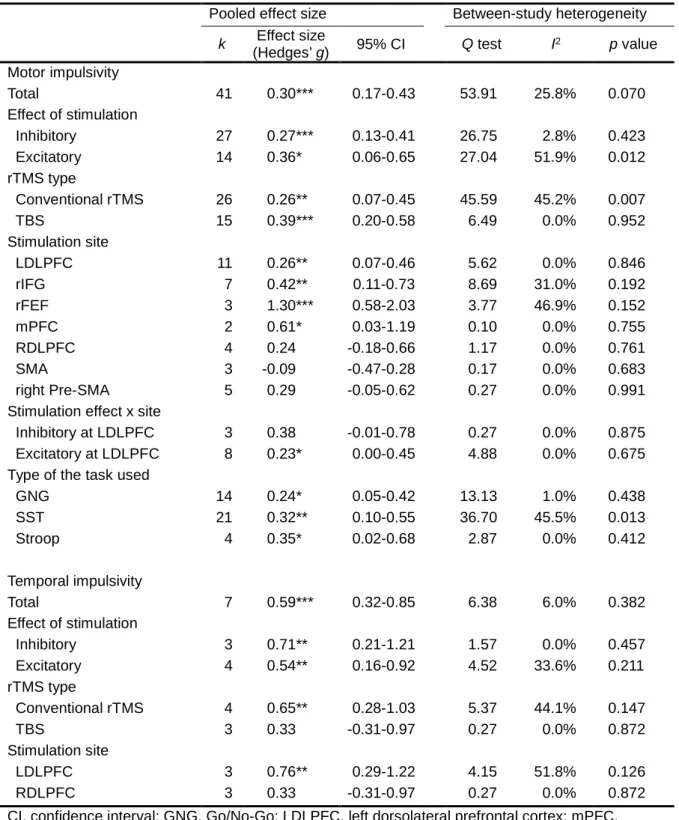
The meta-analysis of 41 effect sizes from 21 studies on the effects of rTMS on motor impulsivity showed a positive and significant mean effect size (g =0.30, 95% CI, 0.17 to 0.43,p< .001; see also Fig. 2a). No significant heterogeneity was found across trials (Q40= 53.91,p= .070; I2= 25.8%; Τ2= 0.047). The
results were further confirmed using multi-level modelling analysis to adjust for potential bias resulting from within-studies correlation of multiple effects (g = 0.29, 95% CI, 0.15 to 0.43,p< .001). The between-studies (Τ2= 0.026) and
was indexed by the funnel plot (Fig. S2a), the Begg's test (z= 1.20,p= .23), or the Egger's test (intercept41= 1.188, t= 1.64, 2-tailedp= .109).
Insert Table 2 Here
Additional Analyses
The subgroup analyses (Table 2) revealed positive and significant mean effects for both inhibitory (g =0.27, 95% CI, 0.13 to 0.41, p< .001) and
excitatory rTMS (g =0.36, 95% CI, 0.06 to 0.65,p= .018), and the magnitude of effect sizes did not significantly differ between inhibitory and excitatory rTMS (β= 0.051,p= .730). Moreover, subgroup analysis by rTMS type
revealed significant mean effect sizes for both conventional rTMS (g = 0.26, 95% CI, 0.07 to 0.45,p= .009) and TBS (g =0.39, 95% CI, 0.20 to 0.58, p < .001), with no significant difference between the magnitude of these effects (β= -0.056,p= .694). Sub-analysis by stimulation site revealed significant
mean effect sizes only for the LDLPFC (g =0.26, 95% CI, 0.07 to 0.46,p = .007), rIFG (g =0.42, 95% CI, 0.11 to 0.73,p= .008), medial prefrontal cortex (MPFC;g =0.60, 95% CI, -0.16 to 1.36,p= .040), and right frontal eye field (rFEF;g =1.30, 95% CI, 0.58 to 2.03,p< .001), while the mean effect sizes for RDLPFC (g =0.24, 95% CI, -0.18 to 0.66,p= .267), SMA (g =-0.09, 95% CI, -0.47 to 0.28,p= .626) and right Pre-SMA (g =0.29, 95% CI, -0.05 to 0.62,p= .098) were non-significant. Only the magnitude of effect sizes from rFEF significantly differed from those in other locations (β = 1.291,p< .001).
and rIFG, brain areas that have been consistently implicated in impulsivity. The inhibitory rTMS at LDLPFC yielded an insignificant effect (g= 0.38, 95% CI, -0.01 to 0.78, p = .055). In contrast with this, excitatory rTMS at LDLPFC revealed a small but significant effect (g= 0.23, 95% CI, 0.00 to 0.45, p = .047). However, there was no significant difference between the magnitude of these effects (β = -0.158,p= .508). It has not been possible to conduct
similar subgroup analysis in relation to the effects of TMS of the rIFG due to lack of sufficient data. Finally, the subgroup analysis for type of outcome measure used revealed significant mean effect sizes for GNG (g =0.24, 95% CI, 0.05 to 0.42,p= .012), SST (g =0.32, 95% CI, 0.10 to 0.55,p = .005) and SCWT tasks (g =0.35, 95% CI, 0.02 to 0.68,p= .036). However, SST (β= 0.086,p= .826), SCWT (β= 0.041, p= .924), and GNG (β = -0.142,p= .721) were not significantly more sensitive to detect changes than other
measurements, combined.
The meta-regression analysis across trials showed that none of the between-study variables significantly predicted the effects of rTMS (mean age of participants:β = 0.008,p= .509; male ratio:β= -0.300,p = .444; intensity of stimulation:β = -0.004,p= .229; number of pulses per condition:β= 0.000,p = .525).
Effects of rTMS on Temporal Impulsivity
confirmed using the multi-level model analysis after adjusting for the nesting of multiple effects within studies (g= 0.59, 95% CI, 0.31 to 0.87, p< .001) where the between-studies (Τ2< 0.001) and between-trials (Τ2= 0.017)
variances were all very small. The funnel plot (Fig. S2b), the Egger's test (intercept7= -0.655,t = -0.54, 2-tailedp= .615), and the Begg's test (z= 0.00,
p= 1.00) did not show evidence of publication bias.
Additional Analyses
The subgroup analyses (Table 2) revealed significant mean effects for both inhibitory (g =0.71, 95% CI, 0.21 to 1.21,p= .005) and excitatory rTMS (g = 0.54, 95% CI, 0.16 to 0.92,p= .006). Moreover, the subgroup analysis by rTMS type revealed a significant mean effect size for conventional rTMS (g = 0.65, 95% CI, 0.28 to 1.03,p= .001) but not for TBS (g =0.33, 95% CI, -0.31 to 0.97,p= .315). Furthermore, the subgroup analysis by stimulation sites revealed a significant mean effect size for the LDLPFC (g = 0.76, 95% CI, 0.29 to 1.22,p= .002) but a non-significant mean effect size for the RDLPFC (g =0.33, 95% CI, -0.31 to 0.97,p= .315). The meta-regression analysis and further comparison of the subgroup analysis were not conducted because there were fewer than ten effects in the meta-analysis (Deeks et al., 2011).
Effects of rTMS on Reflection Impulsivity
The only one study (Knoch et al., 2006) conducted in the field consisted of two effect sizes (1 Hz rTMS at LDLPFC:g =-0.24, 95% CI, -1.42 to 0.95; 1 Hz rTMS at RDLPFC:g = 0.95, 95% CI, -0.21 to 2.12); therefore, no further
Discussion
To our knowledge, this is the first systematic review and meta-analysis focusing on the evidence for the effectiveness of rTMS on impulsivity and its subdomains. Our results are broadly compatible with the suggestion (e.g., Zaman, 2014) that rTMS is an efficient tool for modulating impulsivity. Overall, the current evidence is sufficiently robust to determine the effect of rTMS on motor impulsivity in healthy participants, our current positive finding of rTMS on temporal impulsivity might be updated with accumulating literature
considering only a limited number of studies in this field. Moreover, a dearth of research on reflection impulsivity was noted and all reviewed studies focused on short-term effect. The findings of differential effects for rTMS on
subdomains of impulsivity support the idea that these subdomains are heterogeneous in nature (Bari & Robbins, 2013).
The meta-analysis of rTMS studies relating to motor impulsivity revealed a small but positive and significant effect size, which is consistent with previous review literature (Juan & Muggleton, 2012). A non-significant level of
compared to those found following conventional rTMS (Thut & Pascual-Leone, 2010). Subgroup analysis by the stimulation sites revealed significant effects on certain brain areas including the LDLPFC, rIFG, rFEF and MPFC. A recent review (Brevet-Aeby et al., 2016) has favoured the rIFG as a potential site for stimulation when using rTMS to modulate impulsivity and the
functional activation of the rIFG has been consistently linked to response inhibition (Bari & Robbins, 2013). It is notable that no studies to date have examined the effects of excitatory rTMS on the rIFG, an important area for future studies to explore. As the right pre-SMA has been commonly identified in the network connecting the IFG and subthalamic nucleus involved in response inhibition, it is noteworthy that only a non-significant effect was found on the right pre-SMA stimulation. One possible explanation is that the pre-SMA may not play the same role as rIFG during the process of response inhibition and the conventional SST outcome measures may not directly link to the activation level of the pre-SMA (Cai, Cannistraci, Gore, & Leung, 2014). Other studies identified the rFEF as a potential site for stimulation (Hung, Driver, & Walsh, 2011). It is notable that this study entailed the use of visual stimuli, indicating that the rFEF may have a specific role in the top-down control of visual attention. The role of rFEF in controlling motor impulsivity, as indexed by use of non-visual stimuli, is yet to be established. While the
DLPFC is regarded as a crucial region implicated in executive control of response inhibition (Bari & Robbins, 2013) and reward-anticipation (Ehrlich et al., 2015), only the stimulation of the LDLPFC was found to have a significant effect on motor impulsivity. It may be too simplistic to deduce that brain
Yalcin, Baughman, Vanman, & Hagger, 2015). One possible explanation for this is that in normal healthy participants, the finding may be attributable to changes in the interhemispheric balance of activation across the DLPFC. Another possible explanation is that, contrary to conventional views, LDLPFC may play a more important role in motor impulsivity than RDLPFC. For
example, reduced LDLPFC activation has been associated with poor
response control in obese populations (Brooks, Cedernaes, & Schiöth, 2013). In addition, findings from recent structural neuroimaging studies (e.g., Cho et al., 2013; Tu, Kuan, Li, & Su, 2017) suggest that only the grey matter volume in LDLPFC but not RDLPFC correlates with self-report measures of
impulsivity. The third possible explanation is that the rTMS modulation effect on DLPFC may be only reflected by the tasks measuring proactive rather than reactive motor inhibition (Brevet-Aeby et al., 2016). Moreover, neuroimaging studies (e.g., Floden, Vallesi, & Stuss, 2011) have shown that the degree of activation in the LDLPFC correlates with proactive motor inhibition
performance. In conclusion, given that both excitatory and inhibitory rTMS exhibit similar effects at LDLPFC in motor impulsivity, LDLPFC is suggested to be a prioritised target for neurostimulation in relation to motor impulsivity.
2008) and GNG and SCWT as measures of proactive motor control (Aron, 2011; Smittenaar et al., 2015), future studies should select appropriate outcome measures according to their objectives.
The results of the meta-regression revealed no differential effects in relation to participant characteristics, such as mean age and sex ratio, or stimulation parameters, in terms of intensity and number of pulses. Some commentators (e.g., Thompson & Higgins, 2002) have argued that using mean age or sex ratio within trials may not be appropriate since the information is averaged and may not reflect the true relationship between the parameters of interest. Caution is required when using the same parameters from conventional rTMS and TBS as covariates in the regression analysis because these paradigms deliver magnetic pulses in different ways. Another possibility is that such relationship may be manifested when a sufficient number of sessions or pulses per session reached since the effects of TMS are dose-dependent. Therefore, to test these hypotheses, future research in this field recruiting a variety of age groups with multiple rTMS sessions is warranted.
associations between the activation of the LDLPFC and temporal impulsivity. Future studies concerning motor impulsivity and temporal impulsivity may therefore consider selecting the LDLPFC as the brain regions of interest.
We were not able to perform a meta-analysis of the effects of rTMS on reflection impulsivity due to the dearth of studies in the field. Although there are a considerable number of transcranial Direct Current Stimulation (tDCS) studies aiming at the neuromodulation effect on reflection impulsivity with inconsistent findings (Brevet-Aeby et al., 2016), the innate limitation of tDCS with low spatial resolution and poor localisation restricts its utility and using rTMS studies to explore the issue is still preferred.
Strengths and Limitations
due to lack of sufficient studies in the field. Nevertheless, studies involving healthy controls are relevant and can provide invaluable information in regard to the effects of rTMS on domains of impulsivity. Moreover, there is a relative dearth of studies involving the use of excitatory rTMS paradigms and those involving temporal and reflection impulsivity. Furthermore, whilst the study applied a rigorous search strategy, it is still possible that it failed to capture all relevant studies due to variations in the conceptualisation of impulsivity across studies. Finally, whilst meta-analytic reviews have inherent advantages, it still holds that pooling data through meta-analysis can cause problems such as non-linear correlations (Greco, Zangrillo, Biondi-Zoccai, & Landoni, 2013).
In addition to addressing the limitations highlighted above, future research should define impulsivity consistently and use a range of outcome measures to better define the differential effects of rTMS on subdomains of impulsivity. It should consider using multiple stimulation sessions as opposed to a single session. It should also consider combining rTMS with neuroimaging
Conclusions
In conclusion, this meta-analysis provides preliminary evidence that rTMS can be used to modulate impulsivity in healthy individuals, particularly motor
impulsivity and temporal impulsivity. Further studies are required to extend the use of rTMS to modulate impulsivity to those who experience most harm from impulsive behaviour such as people with a history of offending or
self-harming. Applying excitatory rTMS to clinical populations and tailoring
parameters of the rTMS, such as the intensity, location, and stimulation mode (conventional rTMS or TBS), implementation of ecologically validated
instruments assessing impulsivity are also strongly recommended.
Acknowledgement
References
American Psychiatric Association. (2013).Diagnostic and Statistical Manual of Mental Disorders (DSM-5)(5 ed.). Washington: American Psychiatric Publishing.
Armstrong, R., Waters, E., & Doyle, J. (2011). Chapter 21: Reviews in Public Health and Health Promotion. In J. P. Higgins & S. Green (Eds.), Cochrane Handbook for Systematic Reviews of Interventions Version 5.1.0 (updated March 2011): The Cochrane Collaboration. Retrieved from www.handbook.cochrane.org.
Aron, A. R. (2011). From Reactive to Proactive and Selective Control: Developing a Richer Model for Stopping Inappropriate Responses. Biological Psychiatry, 69(12), E55-E68. doi:
10.1016/j.biopsych.2010.07.024
Aron, A. R., & Poldrack, R. A. (2005). The cognitive neuroscience of response inhibition: Relevance for genetic research in
attention-deficit/hyperactivity disorder.Biological Psychiatry, 57(11), 1285-1292. doi: 10.1016/j.biopsych.2004.10.026
Ballard, K., & Knutson, B. (2009). Dissociable neural representations of future reward magnitude and delay during temporal discounting. Neuroimage, 45(1), 143-150. doi: 10.1016/j.neuroimage.2008.11.004
Bari, A., & Robbins, T. W. (2013). Inhibition and impulsivity: Behavioral and neural basis of response control.Progress in Neurobiology, 108, 44-79. doi: DOI 10.1016/j.pneurobio.2013.06.005
Prefrontal Cortex.Cognition, 50(1-3), 7-15. doi: Doi 10.1016/0010-0277(94)90018-3
Begg, C. B., & Mazumdar, M. (1994). Operating characteristics of a rank correlation test for publication bias.Biometrics, 50(4), 1088-1101. Benninger, D. H., Iseki, K., Kranick, S., Luckenbaugh, D. A., Houdayer, E., &
Hallett, M. (2012). Controlled Study of 50-Hz Repetitive Transcranial Magnetic Stimulation for the Treatment of Parkinson Disease.
Neurorehabilitation and Neural Repair, 26(9), 1096-1105. doi: 10.1177/1545968312445636
Bermpohl, F., Fregni, F., Boggio, P. S., Thut, G., Northoff, G., Otachi, P. T., . . . Pascual-Leone, A. (2005). Left prefrontal repetitive transcranial
magnetic stimulation impairs performance in affective go/no-go task. Neuroreport, 16(6), 615-619.
Bjørkly, S. (2013). A systematic review of the relationship between impulsivity and violence in persons with psychosis: Evidence or spin cycle? Aggression and Violent Behavior, 18(6), 753-760. doi:
10.1016/j.avb.2013.08.001
Borenstein, M., Hedges, L., & Rothstein, H. (2007). Meta-Analysis: Fixed effect vs. random effects. Retrieved from
https://www.meta-analysis.com/downloads/M-a_f_e_v_r_e_sv.pdf.
Borenstein, M., Hedges, L. V., Higgins, J. P. T., & Rothstein, H. R. (2009a). Identifying and Quantifying HeterogeneityIntroduction to Meta-Analysis (pp. 107-125): John Wiley & Sons, Ltd. Retrieved from
Borenstein, M., Hedges, L. V., Higgins, J. P. T., & Rothstein, H. R. (2009b). Multiple Outcomes or Time-Points within a StudyIntroduction to Meta-Analysis (pp. 225-238): John Wiley & Sons, Ltd. Retrieved from http://dx.doi.org/10.1002/9780470743386.ch25. doi:
10.1002/9780470743386.ch25
Brevet-Aeby, C., Brunelin, J., Iceta, S., Padovan, C., & Poulet, E. (2016). Prefrontal cortex and impulsivity: Interest of noninvasive brain stimulation.Neuroscience and Biobehavioral Reviews, 71, 112-134. doi: 10.1016/j.neubiorev.2016.08.028
Brooks, S. J., Cedernaes, J., & Schiöth, H. B. (2013). Increased Prefrontal and Parahippocampal Activation with Reduced Dorsolateral Prefrontal and Insular Cortex Activation to Food Images in Obesity: A Meta-Analysis of fMRI Studies.Plos One, 8(4), e60393. doi:
10.1371/journal.pone.0060393
Cai, W. D., Cannistraci, C. J., Gore, J. C., & Leung, H. C. (2014).
Sensorimotor-independent prefrontal activity during response inhibition. Human Brain Mapping, 35(5), 2119-2136. doi: 10.1002/hbm.22315 Caswell, A. J., Bond, R., Duka, T., & Morgan, M. J. (2015). Further evidence of
the heterogeneous nature of impulsivity.Personality and Individual Differences, 76, 68-74. doi: 10.1016/j.paid.2014.11.059
Caswell, A. J., Celio, M. A., Morgan, M. J., & Duka, T. (2016). Impulsivity as a Multifaceted Construct Related to Excessive Drinking Among UK Students.Alcohol and Alcoholism, 51(1), 77-83. doi:
10.1093/alcalc/agv070
McNaught, E., . . . Mattingley, J. B. (2007). Dissociable mechanisms of cognitive control in prefrontal and premotor cortex.Journal of
Neurophysiology, 98(6), 3638-3647. doi: 10.1152/jn.00685.2007
Chambers, C. D., Bellgrove, M. A., Stokes, M. G., Henderson, T. R., Garavan, H., Robertson, I. H., . . . Mattingley, J. B. (2006). Executive "brake failure" following deactivation of human frontal lobe.Journal of Cognitive Neuroscience, 18(3), 444-455. doi:
10.1162/jocn.2006.18.3.444
Chambers, C. D., Garavan, H., & Bellgrove, M. A. (2009). Insights into the neural basis of response inhibition from cognitive and clinical
neuroscience.Neuroscience & Biobehavioral Reviews, 33(5), 631-646. doi: 10.1016/j.neubiorev.2008.08.016
Chamorro, J., Bernardi, S., Potenza, M. N., Grante, J. E., Marsh, R., Wang, S., & Blanco, C. (2012). Impulsivity in the general population: A national study.Journal of Psychiatric Research, 46(8), 994-1001. doi:
10.1016/j.jpsychires.2012.04.023
Chen, C. Y., Muggleton, N. G., Tzeng, O. J. L., Hung, D. L., & Juan, C. H. (2009). Control of prepotent responses by the superior medial frontal cortex.Neuroimage, 44(2), 537-545. doi: DOI
10.1016/j.neuroimage.2008.09.005
Cho, S. S., Ko, J. H., Pellecchia, G., Van Eimeren, T., Cilia, R., & Strafella, A. P. (2010). Continuous theta burst stimulation of right dorsolateral prefrontal cortex induces changes in impulsivity level.Brain Stimulation, 3(3), 170-176. doi: DOI 10.1016/j.brs.2009.10.002
Strafella, A. P. (2015). Investing in the future: stimulation of the medial prefrontal cortex reduces discounting of delayed rewards.
Neuropsychopharmacology, 40(3), 546-553. doi: https://dx.doi.org/10.1038/npp.2014.211
Cho, S. S., Pellecchia, G., Aminian, K., Ray, N., Segura, B., Obeso, I., & Strafella, A. P. (2013). Morphometric Correlation of Impulsivity in Medial Prefrontal Cortex.Brain Topography, 26(3), 479-487. doi: DOI
10.1007/s10548-012-0270-x
Cho, S. S., Pellecchia, G., Ko, J. H., Ray, N., Obeso, I., Houle, S., & Strafella, A. P. (2012). Effect of continuous theta burst stimulation of the right dorsolateral prefrontal cortex on cerebral blood flow changes during decision making.Brain Stimulation, 5(2), 116-123. doi: DOI
10.1016/j.brs.2012.03.007
Clark, L., Robbins, T. W., Ersche, K. D., & Sahakian, B. J. (2006). Reflection impulsivity in current and former substance users.Biological
Psychiatry, 60(5), 515-522. doi: 10.1016/j.biopsych.2005.11.007 Conners, C. K., Epstein, J. N., Angold, A., & Klaric, J. (2003). Continuous
performance test performance in a normative epidemiological sample. Journal of Abnormal Child Psychology, 31(5), 555-562. doi: Doi
10.1023/A:1025457300409
Cyders, M. A. (2013). Impulsivity and the Sexes: Measurement and Structural Invariance of the UPPS-P Impulsive Behavior Scale.Assessment, 20(1), 86-97. doi: 10.1177/1073191111428762
Dambacher, F., Sack, A. T., Lobbestael, J., Arntz, A., Brugmann, S., &
response inhibition: interfering with action restraint and action
cancellation using transcranial magnetic brain stimulation.Journal of Cognitive Neuroscience, 26(8), 1775-1784. doi:
https://dx.doi.org/10.1162/jocn_a_00595
Deeks, J. J., Higgins, J., & Altman, D. G. (2011). Analysing data and
undertaking meta-analyses. In J. Higgins & S. Green (Eds.), Cochrane Handbook for Systematic Reviews of Interventions Version 5.1.0: The Cochrane Collaboration. Retrieved from http://handbook.cochrane.org. Egger, M., & Smith, G. D. (1995). Misleading meta-analysis.British Medical
Journal, 310(6982), 752-754.
Egger, M., Smith, G. D., Schneider, M., & Minder, C. (1997). Bias in meta-analysis detected by a simple, graphical test.British Medical Journal, 315(7109), 629-634.
Ehrlich, S., Geisler, D., Ritschel, F., King, J. A., Seidel, M., Boehm, I., . . . Kroemer, N. B. (2015). Elevated cognitive control over reward
processing in recovered female patients with anorexia nervosa. Journal of Psychiatry & Neuroscience : JPN, 40(5), 307-315. doi:
10.1503/jpn.140249
Endrass, T., Schuermann, B., Kaufmann, C., Spielberg, R., Kniesche, R., & Kathmann, N. (2010). Performance monitoring and error significance in patients with obsessive-compulsive disorder.Biological Psychology, 84(2), 257-263. doi: 10.1016/j.biopsycho.2010.02.002
https://dx.doi.org/10.1016/j.neuroimage.2015.01.044
Evenden, J. L. (1999). Varieties of impulsivity. Psychopharmacology, 146(4), 348-361. doi: 10.1007/Pl00005481
Figner, B., Knoch, D., Johnson, E. J., Krosch, A. R., Lisanby, S. H., Fehr, E., & Weber, E. U. (2010). Lateral prefrontal cortex and self-control in
intertemporal choice.Nature Neuroscience, 13(5), 538-539. doi: 10.1038/nn.2516
Fineberg, N. A., Chamberlain, S. R., Goudriaan, A. E., Stein, D. J.,
Vanderschuren, L. J. M. J., Gillan, C. M., . . . Potenza, M. N. (2014). New developments in human neurocognition: clinical, genetic, and brain imaging correlates of impulsivity and compulsivity.Cns Spectrums, 19(1), 69-89. doi: 10.1017/S1092852913000801
Floden, D., Vallesi, A., & Stuss, D. T. (2011). Task Context and Frontal Lobe Activation in the Stroop Task.Journal of Cognitive Neuroscience, 23(4), 867-879. doi: DOI 10.1162/jocn.2010.21492
Gottfredson, M. R., & Hirschi, T. (1990).A general theory of crime. California: Stanford University Press.
Greco, T., Zangrillo, A., Biondi-Zoccai, G., & Landoni, G. (2013). Meta-analysis: pitfalls and hints.Heart, Lung and Vessels, 5(4), 219-225. Grossheinrich, N., Rau, A., Pogarell, O., Hennig-Fast, K., Reinl, M., Karch,
S., . . . Padberg, F. (2009). Theta Burst Stimulation of the Prefrontal Cortex: Safety and Impact on Cognition, Mood, and Resting
Electroencephalogram.Biological Psychiatry, 65(9), 778-784. doi: http://dx.doi.org/10.1016/j.biopsych.2008.10.029
meta-analysis.Statistics in Medicine, 21(11), 1539-1558. doi: 10.1002/sim.1186
Higgins, J. P., Thompson, S. G., Deeks, J. J., & Altman, D. G. (2003).
Measuring inconsistency in meta-analyses.BMJ, 327(7414), 557-560. doi: 10.1136/bmj.327.7414.557
Holroyd, C. B., & Umemoto, A. (2016). The research domain criteria
framework: The case for anterior cingulate cortex.Neuroscience and Biobehavioral Reviews, 71, 418-443. doi:
10.1016/j.neubiorev.2016.09.021
Huang, C. C., Su, T. P., Shan, I. K., & Wei, I. H. (2004). Effect of 5 Hz repetitive transcranial magnetic stimulation on cognition during a Go/NoGo task.Journal of Psychiatric Research, 38(5), 513-520. doi: 10.1016/j.jpsychires.2004.01.006
Huang, Y. Z., Edwards, M. J., Rounis, E., Bhatia, K. P., & Rothwell, J. C. (2005). Theta burst stimulation of the human motor cortex.Neuron, 45(2), 201-206. doi: 10.1016/j.neuron.2004.12.033
Hung, J., Driver, J., & Walsh, V. (2011). Visual Selection and the Human Frontal Eye Fields: Effects of Frontal Transcranial Magnetic Stimulation on Partial Report Analyzed by Bundesen's Theory of Visual Attention. The Journal of Neuroscience, 31(44), 15904-15913. doi:
10.1523/jneurosci.2626-11.2011
Juan, C. H., & Muggleton, N. G. (2012). Brain stimulation and inhibitory control.Brain Stimulation, 5(2), 63-69. doi: 10.1016/j.brs.2012.03.012 Kim, S. H., Han, H. J., Ahn, H. M., Kim, S. A., & Kim, S. E. (2012). Effects of
five daily high-frequency rTMS on Stroop task performance in aging individuals.Neuroscience Research, 74(3-4), 256-260. doi:
https://dx.doi.org/10.1016/j.neures.2012.08.008
Knoch, D., Gianotti, L. R. R., Pascual-Leone, A., Treyer, V., Regard, M.,
Hohmann, M., & Brugger, P. (2006). Disruption of right prefrontal cortex by low-frequency repetitive transcranial magnetic stimulation induces risk-taking behavior.Journal of Neuroscience, 26(24), 6469-6472. doi: Doi 10.1523/Jneurosci.0804-06.2006
Lee, H. W., Lu, M. S., Chen, C. Y., Muggleton, N. G., Hsu, T. Y., & Juan, C. H. (2016). Roles of the pre-SMA and rIFG in conditional stopping revealed by transcranial magnetic stimulation.Behavioural Brain Research, 296, 459-467. doi: 10.1016/j.bbr.2015.08.024
Lejuez, C. W., Read, J. P., Kahler, C. W., Richards, J. B., Ramsey, S. E., Stuart, G. L., . . . Brown, R. A. (2002). Evaluation of a behavioral measure of risk taking: the Balloon Analogue Risk Task (BART). Journal of Experimental Psychology: Applied, 8(2), 75-84. Leyman, L., De Raedt, R., Vanderhasselt, M. A., & Baeken, C. (2009).
Influence of high-frequency repetitive transcranial magnetic stimulation over the dorsolateral prefrontal cortex on the inhibition of emotional information in healthy volunteers.Psychological Medicine, 39(6), 1019-1028. doi: https://dx.doi.org/10.1017/S0033291708004431
J. P. A., . . . Moher, D. (2009). The PRISMA Statement for Reporting Systematic Reviews and Meta-Analyses of Studies That Evaluate Health Care Interventions: Explanation and Elaboration.PLoS Medicine, 6(7). <Go to ISI>://WOS:000268452400006
Loftus, A. M., Yalcin, O., Baughman, F. D., Vanman, E. J., & Hagger, M. S. (2015). The impact of transcranial direct current stimulation on inhibitory control in young adults.Brain and Behavior, 5(5), e00332. doi: 10.1002/brb3.332
Logan, G. D. (1994). On the ability to inhibit thought and action. A users’ guide to the stop signal paradigm. In D. Dagenbach & T. H. Carr (Eds.), Inhibitory processes in attention, memory and language(pp. 189--236). San Diego (CA): Academic Press.
Lowe, C. J., Hall, P. A., & Staines, W. R. (2014). The effects of continuous theta burst stimulation to the left dorsolateral prefrontal cortex on executive function, food cravings, and snack food consumption. Psychosomatic Medicine, 76(7), 503-511. doi:
https://dx.doi.org/10.1097/PSY.0000000000000090
Luber, B., & Lisanby, S. H. (2014). Enhancement of human cognitive performance using transcranial magnetic stimulation (TMS).
Neuroimage, 85, 961-970. doi: DOI 10.1016/j.neuroimage.2013.06.007 Mantovani, A., Simpson, H. B., Fallon, B. A., Rossi, S., & Lisanby, S. H.
Matsuzawa, D., Shirayama, Y., Niitsu, T., Hashimoto, K., & Iyo, M. (2015). Deficits in emotion based decision-making in schizophrenia; a new insight based on the Iowa Gambling Task.Progress in Neuro-Psychopharmacology and Biological Psychiatry, 57, 52-59. doi: 10.1016/j.pnpbp.2014.10.007
Moffitt, T. E., Arseneault, L., Belsky, D., Dickson, N., Hancox, R. J.,
Harrington, H., . . . Caspi, A. (2011). A gradient of childhood self-control predicts health, wealth, and public safety.Proceedings of the National Academy of Sciences of the United States of America, 108(7), 2693-2698. doi: 10.1073/pnas.1010076108
Moher, D., Liberati, A., Tetzlaff, J., Altman, D. G., & The PRISMA Group. (2009). Preferred Reporting Items for Systematic Reviews and Meta-Analyses: The PRISMA Statement.PLoS Medicine, 6(7), e1000097. doi: 10.1371/journal.pmed.1000097
Morris, S. B. (2008). Estimating Effect Sizes From Pretest-Posttest-Control Group Designs.Organizational Research Methods, 11(2), 364-386. doi: 10.1177/1094428106291059
Muggleton, N. G., Chen, C. Y., Tzeng, O. J. L., Hung, D. L., & Juan, C. H. (2010). Inhibitory Control and the Frontal Eye Fields.Journal of Cognitive Neuroscience, 22(12), 2804-2812. doi: DOI
10.1162/jocn.2010.21416
Najib, U., & Horvath, J. C. (2014). Transcranial Magnetic Stimulation (TMS) Safety Considerations and Recommendations. In A. Rotenberg, J. C. Horvath, & A. Pascual-Leone (Eds.),Transcranial Magnetic Stimulation (pp. 15-30). New York, NY: Springer New York.
National Collaborating Centre for Methods and Tools. (2008).Quality Assessment Tool for Quantitative Studies Method. McMaster University. Hamilton, ON. Retrieved from
http://www.nccmt.ca/registry/view/eng/15.html
Obeso, I., Robles, N., Marron, E. M., & Redolar-Ripoll, D. (2013). Dissociating the role of the pre-SMA in response inhibition and switching: a
combined online and offline TMS approach.Frontiers in Human Neuroscience, 7, 150.
http://doi.org.secure.sci-hub.cc/10.3389/fnhum.2013.00150 doi:10.3389/fnhum.2013.00150 Peters, J., & Buchel, C. (2011). The neural mechanisms of inter-temporal
decision-making: understanding variability.Trends in Cognitive Sciences, 15(5), 227-239. doi: DOI 10.1016/j.tics.2011.03.002
Rabe-Hesketh, S., Skrondal, A., & Pickles, A. (2002). Reliable estimation of generalized linear mixed models using adaptive quadrature. Stata Journal, 2(1), 1-21.
Rabe-Hesketh, S., Skrondal, A., & Pickles, A. (2005). Maximum likelihood estimation of limited and discrete dependent variable models with nested random effects.Journal of Econometrics, 128(2), 301-323. doi: 10.1016/j.jeconom.2004.08.017
likely rewards and large, unlikely rewards activates inferior and orbital prefrontal cortex.Journal of Neuroscience, 19(20), 9029-9038.
Rossi, S., Hallett, M., Rossini, P. M., Pascual-Leone, A., & The Safety of TMS Consensus Group. (2009). Safety, ethical considerations, and
application guidelines for the use of transcranial magnetic stimulation in clinical practice and research.Clinical Neurophysiology, 120(12), 2008-2039. doi: 10.1016/j.clinph.2009.08.016
Rossini, P. M., Burke, D., Chen, R., Cohen, L. G., Daskalakis, Z., Di Iorio, R., . . . Ziemann, U. (2015). Non-invasive electrical and magnetic stimulation of the brain, spinal cord, roots and peripheral nerves: Basic principles and procedures for routine clinical and research application. An updated report from an IFCN Committee.Clinical Neurophysiology, 126(6), 1071-1107. doi: 10.1016/j.clinph.2015.02.001
Sabesan, P., Lankappa, S., Khalifa, N., Krishnan, V., Gandhi, R., &
Palaniyappan, L. (2015). Transcranial magnetic stimulation for geriatric depression: Promises and pitfalls.World J Psychiatry, 5(2), 170-181. doi: 10.5498/wjp.v5.i2.170
Sheffer, C. E., Mennemeier, M., Landes, R. D., Bickel, W. K., Brackman, S., Dornhoffer, J., . . . Brown, G. (2013). Neuromodulation of delay
discounting, the reflection effect, and cigarette consumption.Journal of Substance Abuse Treatment, 45(2), 206-214. doi: DOI
10.1016/j.jsat.2013.01.012
content of 10 available instruments.Schizophrenia Bulletin, 37(5), 899-912. doi: 10.1093/schbul/sbr093
Smittenaar, P., Rutledge, R. B., Zeidman, P., Adams, R. A., Brown, H., Lewis, G., & Dolan, R. J. (2015). Proactive and Reactive Response Inhibition across the Lifespan.Plos One, 10(10).
https://doi.org/10.1371/journal.pone.0140383 doi:https://doi.org/10.1371/journal.pone.0140383
StataCorp. (2017). Stata Statistical Software: Release 15. College Station, TX: StataCorp LLC.
Stroop, J. R. (1935). Studies of interference in serial verbal reactions.Journal of Experimental Psychology, 18, 643-662. doi: Doi 10.1037/0096-3445.121.1.15
Thompson, S. G., & Higgins, J. P. T. (2002). How should meta-regression analyses be undertaken and interpreted?Statistics in Medicine, 21(11), 1559-1573. doi: 10.1002/sim.1187
Thut, G., & Pascual-Leone, A. (2010). A Review of Combined TMS-EEG Studies to Characterize Lasting Effects of Repetitive TMS and Assess Their Usefulness in Cognitive and Clinical Neuroscience.Brain
Topography, 22(4), 219-232. doi: 10.1007/s10548-009-0115-4
Tomko, R. L., Bountress, K. E., & Gray, K. M. (2016). Personalizing substance use treatment based on pre-treatment impulsivity and sensation
seeking: A review.Drug and Alcohol Dependence, 167, 1-7. doi: https://doi.org/10.1016/j.drugalcdep.2016.07.022
surface-based morphometry study.Psychological Medicine, 47(7), 1292-1299. doi: 10.1017/S0033291716003299
Upton, D. J., Cooper, N. R., Laycock, R., Croft, R. J., & Fitzgerald, P. B. (2010). A combined rTMS and ERP investigation of dorsolateral prefrontal cortex involvement in response inhibition.Clinical EEG & Neuroscience: Official Journal of the EEG & Clinical Neuroscience Society (ENCS), 41(3), 127-131.
Vanderhasselt, M.-A., De Raedt, R., Baeken, C., Leyman, L., & D’haenen, H. (2006). The influence of rTMS over the left dorsolateral prefrontal cortex on Stroop task performance.Experimental Brain Research, 169(2), 279-282. doi: 10.1007/s00221-005-0344-z
Vanderhasselt, M. A., De Raedt, R., Baeken, C., Leyman, L., Clerinx, P., & D'Haenen, H. (2007). The influence of rTMS over the right dorsolateral prefrontal cortex on top-down attentional processes.Brain Research, 1137(1), 111-116.
Verbruggen, F., Aron, A. R., Stevens, M. A., & Chambers, C. D. (2010). Theta burst stimulation dissociates attention and action updating in human inferior frontal cortex.Proceedings of the National Academy of
Sciences of the United States of America, 107(31), 13966-13971. doi: 10.1073/pnas.1001957107
Verbruggen, F., & Logan, G. D. (2008). Response inhibition in the stop-signal paradigm.Trends in Cognitive Sciences, 12(11), 418-424. doi:
10.1016/j.tics.2008.07.005
from high-risk research, problem gamblers and genetic association studies.Neuroscience and Biobehavioral Reviews, 32(4), 777-810. doi: 10.1016/j.neubiorev.2007.11.003
Wagner, M., Rihs, T. A., Mosimann, U. P., Fisch, H. U., & Schlaepfer, T. E. (2006). Repetitive transcranial magnetic stimulation of the dorsolateral prefrontal cortex affects divided attention immediately after cessation of stimulation.Journal of Psychiatric Research, 40(4), 315-321.
Wagner, T., Valero-Cabre, A., & Pascual-Leone, A. (2007). Noninvasive human brain stimulation.Annual Review of Biomedical Engineering, 9, 527-565. doi: 10.1146/annurev.bioeng.9.061206.133100
Wassermann, E. M., & Zimmermann, T. (2012). Transcranial magnetic brain stimulation: therapeutic promises and scientific gaps.Pharmacology & Therapeutics, 133(1), 98-107. doi: 10.1016/j.pharmthera.2011.09.003 Watanabe, T., Hanajima, R., Shirota, Y., Tsutsumi, R., Shimizu, T., Hayashi,
T., . . . Konishi, S. (2015). Effects of rTMS of pre-supplementary motor area on fronto basal ganglia network activity during stop-signal task. Journal of Neuroscience, 35(12), 4813-4823. doi:
https://dx.doi.org/10.1523/JNEUROSCI.3761-14.2015
Wilbertz, T., Deserno, L., Horstmann, A., Neumann, J., Villringer, A., Heinze, H. J., . . . Schlagenhauf, F. (2014). Response inhibition and its relation to multidimensional impulsivity. Neuroimage, 103, 241-248. doi:
10.1016/j.neuroimage.2014.09.021
Brain Research, 347, 1-7. doi: 10.1016/j.bbr.2018.02.047
Zaman, R. (2014). Role of Transcranial magnetic stimulation (TMS & rTMS) in investigation and possible treatment of Impulsivity in neuropsychiatric disorders with ADHD and BPD as examples.Psychiatria Danubina, 26 Suppl 1, 347-350.
Zandbelt, B. B., Bloemendaal, M., Hoogendam, J. M., Kahn, R. S., & Vink, M. (2013). Transcranial magnetic stimulation and functional MRI reveal cortical and subcortical interactions during stop-signal response inhibition.Journal of Cognitive Neuroscience, 25(2), 157-174. doi: 10.1162/jocn_a_00309
Zisner, A., & Beauchaine, T. P. (2016). Neural substrates of trait impulsivity, anhedonia, and irritability: Mechanisms of heterotypic comorbidity between externalizing disorders and unipolar depression.Development and Psychopathology, 28(4pt1), 1177-1208. doi:
Figure captions
Figure 1.The Process of Study Selection and Search Results
Figure 2.(a) Statistical summary and forest plot of effect sizes for motor impulsivity. (b) Statistical summary and forest plot of effect sizes for temporal impulsivity.
Abbreviations: AG, angular gyrus; rAI, right anterior insula; cTBS, continuous theta burst ;stimulation; ES, effect size; iTBS, intermittent theta burst
Figure 1
Search results = 3423 hits AMED - 39
Embase - 94 PsycInfo - 1260 Medline - 2030
99 papers were checked in abstract and full-text
27 papers (50 trials) were included in the meta-analysis
1 article added by hand search
Reasons for exclusion: Removal of 1074 duplicates Rejection of 1024 publications by title
Removal of 892 studies recruiting patients
Removal of 1044 tDCS studies Exclusion of 4 single-pulse TMS and 27 paired-pulse TMS studies
28 papers were included in quality assessment
Reasons for exclusion: 1 study recruiting patients 33 studies not rTMS
35 studies not assess impulsivity 2 review articles
1 study was not eligible for
Table 1 Characteristics of eligible studies Study/Country study
design age ofparticipants (mean± SD; range)
Nc, sex
ratio (M/F)
target
area rTMS protocol(frequency, intensity, paradigm, number of pulses)
sham method tasks outcome measure
Motor impulsivity
Bermpohl et al.,
(2005)/ Brazil CCRT 38.3± 13.9 11, 5/6 RDLPFCLDLPFC 1Hz, 60%MSO(104-187%rMT, mean
151%rMT), off-line, 600
OC stimulation affective
GNG false alarm rates
Chambers et al., (2006)/ Australia
CCRT 18-27 16, 8/8 rIFG
right MFG right AG
1Hz, 92%dMT, off-line, 900
Coil oriented away from the scalp
SST SSRT
Chambers et al.,
(2007)/ Australia CCRT 19-46 16, NA rIFG,right dPM,
lIFG, left dPM
1Hz, 92%rMT in average, off-line, 1200
coil oriented away from the scalp
SST SSRT
Chen et al.,
(2009)/ Taiwan CCRT 25.7; 21-35 7, 7/2 left pre-SMA 10Hz, 60%MSO,online, 960 Vertexstimulation SST SSRT Dambacher et
al., (2014)/ Netherlands
CCRT 27±7.27 11, NA right SFG,
right MFG, right AI, right pre-SMA cTBS, 100%AMT, off-line, 600
sham coil GNG
SST
Esterman et al.,
(2015)/ USA CCRT 20.4 ± 2.4;RFEF(19.43 ± 1.70); LFEF (21.50 ± 2.79) 14, (RFEF: 10/4, 14, LFEF: 5/9) RFEF, LFEF 1Hz, 110%RMT,
off-line, 480 coil oriented180° away from the scalp
GNG commission error
Grossheinrich et al., (2009) / Germany exp1:
RCRTb 20-35 12, 5/7 LDLPFC iTBS, 80% AMT,
off-line, 600 cTBS, 80%AMT, off-line, 600,
imTBS GNG commission error
exp2: 22-38 12, 4/8 MPFC iTBS, 80% AMT,
off-line, 600 cTBS, 80%AMT, off-line, 600,
imTBS GNG commission error
Huang et al., (2004)/ Taiwan
RCRTb 27.0± 4.7;
20-37
24, 12/12
LDLPFC 5Hz, 100%RMT, offline, 1600
Tilt coil at 90° GNG Percentage of shortening choice reaction time Hwang et al.,
(2010)/ South Korea
RCRTb 23.53± 2.12 17, 17/0 LDLPFC 10Hz, 90%MT,
off-line, 900 Tilt coil at 90° Conners'CPT (GNG) mean commissionerrors
Kim et al., (2012)/ South Korea
RCTb 63.13± 4.90 16, 0/16 LDLPFC 10Hz, 30%MSO,
off-line, 780 (5 sessions, 3900 in total)
Tilt coil at 90° modified
Stroop reaction time ofincongruent condition
Lee et al.,
(2016) / Taiwan CCRT 23±2 24, 18/6 right pre-SMA rIFG
cTBS, 40%MSO,
off-line, 600 Tilt coil at 90° conditionalSST SSRT
Leyman et al., (2009)/
RCRTb 21.1± 1.45;
19-24
18, 0/18 LDLPFC 10Hz, 110%RMT, off-line, 1560
Tilt coil at 90° NAP NAP scores
Belgium 24± 2.33;
Lowe et al.,
(2014)/ Canada CCRT 21.10±1.86 21, 0/21 LDLPFC cTBS, 80%RMT,off-line, 600 Tilt coil at 90° StroopGNG
SST
interference time d’ sensitivity proportion of incorrect responses on stop trials Muggleton et al.,
(2010)/ Taiwan exp1
RCRTb 25.7; 21-35 9, 7/2 rFEF 10Hz, 65%MSO,
online, 960
sham coil SST SSRT
exp2 22.9; 20-27 9, 5/4 rFEF 10Hz, 65%MSO,
online, 960 no stimulation modifiedSST SSRT Obeso et al.,
(2013)/ Spain
CCRT 35.40±7.7; 24-44
16, 7/9 rIFG cTBS, 80%AMT,
off-line, 600
Tilt coil at 90° at M1
modified SST
SSRT
Upton et al., (2010)a/
Australia
CCRT 26± 3.4;
18-39 14, NA RDLPFCLDLPFC 1Hz, 110%RMT,off-line, 900 Tilt coil at 90° SST NA
Vanderhasselt et al., (2006)/ Belgium
CCRT 23± 4.4;
18-60 28, 0/28 LDLPFC 10Hz, 110%MT,off-line, 1560 Tilt coil at 90° computerised Stroop reaction time ofincongruent condition
Vanderhasselt et al., (2007)/ Belgium
CCRT 24± 2.6;
18-25 20, 0/20 LDLPFC 10Hz, 110%MT,off-line, 1560 Tilt coil at 90° computerised Stroop reaction time ofincongruent condition (high expectancy) Verbruggen et
al., (2010)/ UK CCRT 25.9; 20-38 18, 9/9 rIFGrIFJ
right pre-SMA
cTBS, 70%
distance-adjusted MT, off-line,
unknown
coil oriented away from the scalp
SST SSRT
Wagner et al., (2006)/ Switzerland
RCRTb 22.3±2.1;
19-26
17, 17/0 LDLPFC 20Hz, 100%RMT, off-line, 1600
(2015)/ Japan SMA off-line, 1440 Zandbelt et al.,
(2013)/ Neitherlands
CCRT 24.1; 20-38 24,
12/12
rIFG SMA
1 Hz,(special), 90% RMT, for 6 Hz and
110%RMT, for 1Hz, off-line, 600 6Hz,(pulses), 600 1Hz,(pulses)
Sham coil at right superior parietal lobe stop-signal anticipation task SSRT Temporal impulsivity
Cho et al., (2010)/ Canada
CCRT 22.4±4.3; 18-29
7, 3/4 RDLPFC iTBS, 80%AMT, off-line, 600 cTBS, 80%AMT, off-line, 600
Tilt coil at 90° computeris ed DDT
k-value
Cho et al., (2012)/ Canada
CCRT 22.6±2.7; 18-27
8, 4/4 RDLPFC cTBS, 80%AMT,
off-line, 600
Tilt coil at 90° computeris ed DDT
k-value
Cho et al.,
(2015)/ Canada CCRT 22.1±2.9; 18-27 24,13/11 MPFC 10Hz, 80%AMT,off-line, 150 vertexstimulation computerised DDT k-value
Figner et al., (2010)/
USA/Switzerland
RCTb 19-33 52, 52/0 LDLPFC
RDLPFC
1Hz, 54%MSO,
off-line, 900 Sham coil choice task preferencereversals
Sheffer et al.,
(2013)/ USA CCRT 41.3±10.4;19-55 66,40/26 LDLPFC 20Hz, 110%MT,off-line, 900 10 Hz, 110%MT, off-line, 900
sham coil DDT Ln(k-value)
Reflection impulsivity
Knoch et al., (2006)/ Switzerland
RCTb 23.8; 21-31 27, 27/0 RDLPFC
LDLPFC
1Hz, 100%MT, off-line, 900
anot included in meta-analysis;bno randomisation method reported;cnumber of participants start of study
Table 2 Subgroup analyses
Pooled effect size Between-study heterogeneity
k Effect size
(Hedges’g) 95% CI Qtest I
2 pvalue
Motor impulsivity
Total 41 0.30*** 0.17-0.43 53.91 25.8% 0.070
Effect of stimulation
Inhibitory 27 0.27*** 0.13-0.41 26.75 2.8% 0.423
Excitatory 14 0.36* 0.06-0.65 27.04 51.9% 0.012
rTMS type
Conventional rTMS 26 0.26** 0.07-0.45 45.59 45.2% 0.007
TBS 15 0.39*** 0.20-0.58 6.49 0.0% 0.952
Stimulation site
LDLPFC 11 0.26** 0.07-0.46 5.62 0.0% 0.846
rIFG 7 0.42** 0.11-0.73 8.69 31.0% 0.192
rFEF 3 1.30*** 0.58-2.03 3.77 46.9% 0.152
mPFC 2 0.61* 0.03-1.19 0.10 0.0% 0.755
RDLPFC 4 0.24 -0.18-0.66 1.17 0.0% 0.761
SMA 3 -0.09 -0.47-0.28 0.17 0.0% 0.683
right Pre-SMA 5 0.29 -0.05-0.62 0.27 0.0% 0.991
Stimulation effect x site
Inhibitory at LDLPFC 3 0.38 -0.01-0.78 0.27 0.0% 0.875
Excitatory at LDLPFC 8 0.23* 0.00-0.45 4.88 0.0% 0.675
Type of the task used
GNG 14 0.24* 0.05-0.42 13.13 1.0% 0.438
SST 21 0.32** 0.10-0.55 36.70 45.5% 0.013
Stroop 4 0.35* 0.02-0.68 2.87 0.0% 0.412
Temporal impulsivity
Total 7 0.59*** 0.32-0.85 6.38 6.0% 0.382
Effect of stimulation
Inhibitory 3 0.71** 0.21-1.21 1.57 0.0% 0.457
Excitatory 4 0.54** 0.16-0.92 4.52 33.6% 0.211
rTMS type
Conventional rTMS 4 0.65** 0.28-1.03 5.37 44.1% 0.147
TBS 3 0.33 -0.31-0.97 0.27 0.0% 0.872
Stimulation site
LDLPFC 3 0.76** 0.29-1.22 4.15 51.8% 0.126
RDLPFC 3 0.33 -0.31-0.97 0.27 0.0% 0.872
CI, confidence interval; GNG, Go/No-Go; LDLPFC, left dorsolateral prefrontal cortex; mPFC,
medial prefrontal cortex; RDLPFC, right dorsolateral prefrontal cortex; rFEF, right frontal eye field;
rIFG, right inferior frontal gyrus; rTMS, repetitive transcranial magnetic stimulation; SMA,
supplementary motor area; SST, Stop-signal task; Stroop, Stroop interference colour task, TBS,
Table S1: search syntax
AMED (Allied and Complementary Medicine) 1985 to February 2017
# Searches Results
1 (impulsiv* or self-regulation or inhibitory control or impulse control or delay* discounting or response inhibition or information sampling or stop signal or temporal discounting or inhibition or go-no-go).mp. [mp=abstract, heading words, title]
320
2 ("transcranial magnetic stimulation" or TMS or TBS or "theta burst stimulation").mp. [mp=abstract, heading words, title]
335
3 1 and 2 39
OVID: Embase 1980 to 2017 Week 08
# Searches Results
1 (impulsiv* or "self-regulation" or "inhibitory control" or "impulse control" or "delay* discounting" or
"response inhibition" or "information sampling" or "stop signal" or "temporal discounting" or "stroop" or "inhibition" or "go-no-go").kw.
48718
2 ("TMS" or "transcranial magnetic stimulation" or
"theta burst stimulation" or "TBS").kw. 7698
3 1 and 2 784
4 limit 3 to (human and embase and (conference abstract or conference paper or conference
proceeding or journal or report or short survey) and adult <18 to 64 years>)
94
OVID MEDLINE(R) 1946 to February Week 2 2017
# Searches Results
1 (impulsiv* or self-regulation or inhibitory control or impulse control or delay* discounting or response inhibition or information sampling or stop signal or temporal discounting or inhibition or go-no-go).mp. [mp=title, abstract, original title, name of substance word, subject heading word, keyword heading word, protocol supplementary concept word, rare disease supplementary concept word, unique identifier, synonyms]
742364
2 ("TMS" or "transcranial magnetic stimulation" or "theta burst stimulation" or "TBS").mp. [mp=title, abstract, original title, name of substance word, subject heading word, keyword heading word, protocol supplementary concept word, rare disease supplementary concept word, unique identifier,
synonyms]
3 1 and 2 2639
4 limit 3 to (humans and "all adult (19 plus years)") 2030
OVID: PsycINFO 1806 to February Week 2 2017
# Searches Results
1 (impulsiv* or "self-regulation" or "inhibitory control" or "impulse control" or "delay* discounting" or
"response inhibition" or "information sampling" or "stop signal" or "temporal discounting" or "stroop" or "inhibition" or "go-no-go").mp. [mp=title, abstract, heading word, table of contents, key concepts, original title, tests & measures]
113070
2 ("TMS" or "transcranial magnetic stimulation" or "theta burst stimulation" or "TBS").mp. [mp=title, abstract, heading word, table of contents, key concepts, original title, tests & measures]
8961
3 1 and 2 1625
4 limit 3 to (human and adulthood <18+ years> and "300 adulthood <age 18 yrs and older>" and
human)