ORGANIC
CHEMISTRY
F R O N T I E R S
FRONTIERS
RESEARCH ARTICLE
Cite this:Org. Chem. Front., 2016,3, 661
Received 16th January 2016, Accepted 8th March 2016
DOI: 10.1039/c6qo00024j
rsc.li/frontiers-organic
Conformations of large macrocycles and
ring-in-ring complexes
†
Jeremy K. Klosterman,
‡
aJanis Veliks,
aDerik K. Frantz,
aYoshizumi Yasui,
aMichael Loepfe,
aEli Zysman-Colman,
§
aAnthony Linden
aand Jay S. Siegel*
a,bA kinetically directed, stepwise approach towards molecular Borromean links enabled the isolation and structural characterization of synthetic intermediates along the way. Here we report the synthesis and crystal structures of threeflexible macrocyclic intermediates and a new ring-in-ring complex, anchored together through ruthenium(II) centers, which contains open terpyridine caps in the inner Ring II.
Terpyri-dines circumvent the conformationalcis/translimitations of bipyridines and the new ring-in-ring complex forms tetrametallic complexes with Zn(II), Pt(II) and Ru(III) metal ions. Analysis of the four macrocyclic
structures provides a good foundation for the conformationalflexibility in these complexes and demon-strates the robust applicability of the terpyridine design elements towards the engineered synthesis of ring-in-ring topologies.
Introduction
Thanks to a variety of chemical template methodologies,1 ring-in-ring threaded molecules (catenanes) are now routine design elements and products of chemical synthesis;2however, directed inclusion of one macrocycle within another to form non-inter-twined ring-in-ring complexes remains an interesting and chal-lenging molecular target. In one strategy for the synthesis of such complexes, a rigid open-host ring, such as a cyclodextrin,3 curcurbituril,4calixarene,5pyridinium6or metal–organic7 macro-cycle houses a guest macromacro-cycle. In another strategy, metal– ligand complexes serve as anchoring points between the two macrocycles or curved ligands.8 Phenomenal examples of ring-in-ring elements within higher order structures include: the ther-modynamic assembly of a Borromean link (B-link),9 in which three rings form a topological link without concatenation, Borro-mean networks,10and the assembly of curved-aromatic carbon materials in onion-like ring and shell hierarchies.11
Focusing on B-links as topologically special targets of mole-cular synthesis,12a stabilized single ring-in-ring element could
serve as a key intermediate in a general design strategy for a kinetic, stepwise synthesis of B-links (Scheme 1).13One embo-diment of this intermediate comprises an outer macrocycle with two inward pointing (endo) terpyridine (terpy) elements and an inner macrocycle with two outward (exo) pointing terpy Scheme 1 A conceptual stepwise kinetic strategy for an interlocked Borromean link that begins with a single macrocycle (Ring I) which tem-plates formation of the second ring (Ring II) as the key ring-in-ring inter-mediate (2-Ring).
†Electronic supplementary information (ESI) available: Synthetic details and characterization. CCDC 1437407–1437409 and 1432774. For ESI and crystallo-graphic data in CIF or other electronic format see DOI: 10.1039/c6qo00024j
‡Current address: Department of Chemistry and Center for Photochemical Sciences, Bowling Green State University, Bowling Green, OH 43403, USA. §Current address: Organic Semiconductor Centre, EaStCHEM School of Chem-istry, University of St Andrews, St Andrews, Fife, KY16 9ST, UK.
aDepartment of Chemistry, University of Zurich, Winterthurerstrasse 190,
8057 Zurich, Switzerland
b
School of Pharmaceutical Science and Technology, Tianjin University, 92 Wejin Road, Nankai District Tianjin, 300072, P. R. China. E-mail: [email protected]
Open Access Article. Published on 23 March 2016. Downloaded on 09/11/2016 11:22:13.
This article is licensed under a
Creative Commons Attribution 3.0 Unported Licence.
View Article Online
elements, plus two bipyridine (bipy) elements (2-bipy) (Scheme 2). Failed attempts to extend this entity into a B-link motivate structural studies to better understand these inter-mediates. This work details such studies and reports the syn-thesis of2-terpywith two open terpyridine moieties.
Results
A thermodynamically controlled approach to ring-in-ring struc-tures employs the spontaneous assembly of two macrocycles, stabilized by the strength of non-covalent bonding between them. A kinetically controlled approach13to ring-in-ring struc-tures differs by employing the stepwise construction of each ring and requires a virtually irreversible anchoring point (e.g.a [Ru(terpy)2]2+ complex) to hold the pieces together. One
reduction to practice of this latter strategy starts by forming a macrocycle1withendoterpy segments (Ring I). Treatment of1 with two equivalents of monoleptic [Ru(terpy)Cl3] reagent,
gen-erates threaded structure 2 with two heteroleptic terpy/terpy′
Ru complexes in which the two terpy′ units are threaded
within Ring I and lie proximal to each other (Scheme 2). In the final step, the two terpy′units are connected to form an inner macrocycle (Ring II) and afford the representative ring-in-ring complex. Specifically, 2,2′-bipyridine units were used to link the terpy′units and form Ring II, in the hope of iterating the process to form a B-link.13
Macrocycle1was first presented as the key intermediate in a stepwise synthetic approach to a B-link topology. Although macrocycle 1 is a quite flexible and large ring – formally 66-membered– its immediate tetraalkyne precursor forms in high overall yield by Eglington macrocyclization of two halves (A) assisted by metal coordination.13The assumption has been that the intermediate is a figure-eight shaped metal complex CuA2, which then springs open to release the metal after ring formation; subsequent hydrogenation yields 1. A kinetically inert cognate of the putative figure-eight intermediate (1a) forms during the reaction of 1with one equivalent of
Ru(II)-Cl2(DMSO)4(Scheme 3). Structural elucidation of1ashows the
expected overall structure and a linearcrankshaftconformation of the hexamethylene unit, where the linear methylenediyne-methylene unit would have been in the intermediate, thus pro-viding little evidence of any specific strain that could be the
“loaded spring”. Nonetheless, the formation of a preorganized complex that reduces the degrees of freedom and favours cycli-zation seems reasonable.
Scheme 2 Synthesis of ring-in-ring structure2-bipyviathe doubly threaded Ring I intermediate2. Reaction conditions: (a) 2 : 1 : 1 CH2Cl2: EtOH :
ethylene glycol, reflux, 12 h, 65%; (b) Cs2CO3, acetonitrile, reflux, 72 h, 49%.13
Scheme 3 Synthesis of bis-terpyridine macrocycle1and metal com-plexes 1aand 1b. Reaction conditions: (a) Cu(OAc)2·H2O (0.5 equiv.),
ethanol, RT, 1 h; (b) Cu(OAc)2·H2O (10 equiv.), ethanol, reflux, 72 h, 91%;
(c) H2, 80 psi, Pd/C (10%), 1 : 1 ethanol : CH2Cl2, 6 h, 91%; (d) Ru
(DMSO)4Cl2, 10 : 4 : 1 ethylene glycol : dichloroethane : ethanol, reflux,
16 h, 96%; (e) Zn(OTf )2, 1 : 1 ethanol : CH2Cl2, RT, 6 h, 97%.
Research Article Organic Chemistry Frontiers
Open Access Article. Published on 23 March 2016. Downloaded on 09/11/2016 11:22:13.
This article is licensed under a
Creative Commons Attribution 3.0 Unported Licence.
In contrast, treating macrocycle 1 with one equivalent of Zn(II)OTf2, a more kinetically-labile metal, gave a complex mix
of spectroscopic signatures, while increasing the amount of metal to greater than a two-fold excess of the Zn(II)OTf2
reagent transformed1cleanly into1b(Scheme 3). The ease of formation of complexes1a/band their crystal structure geome-tries support the notion of a conformationally flexible macro-cycle1.
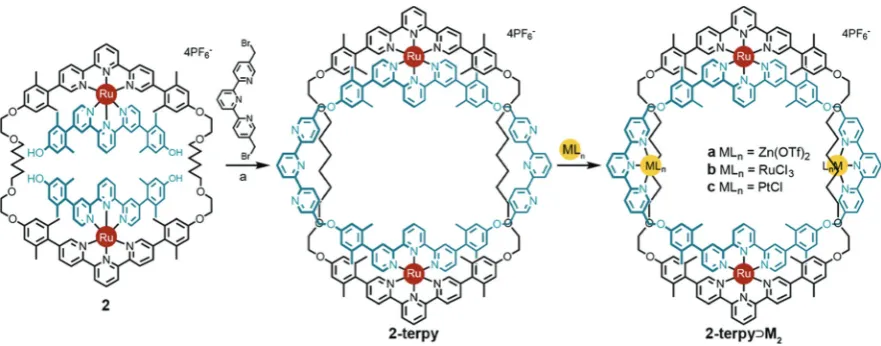
Scheme 4 Synthesis of new ring-in-ring structure2-terpyand the subsequent coordination of metal ions to give tetrametallic two-ring structures
2-terpy.Ma–c. Reaction conditions: (a) Cs2CO3, dimethylformamide, reflux, 4 h, 56%; (b) Zn(OTf )2, acetonitrile, RT, 3 h, 94%; (c) RuCl3·3H2O, 1 : 1
ethanol : 1,2-dichloroethane, 80 °C, 16 h, 99%; (d) PtCl2(COD), AgBF4, acetonitrile, RT, 30 min, 70%.
Fig. 1 Side and top views of macrocyclic cation structures from crystal diffraction analyses emphasizing the conformationalflexibility of macrocycle
1(black) in complexes1aRu(II);1b’Zn(II); doubly threaded complex2; and ring-in-ring structures2-bipyand2-terpywith Ring II highlighted in
yellow and blue, respectively. Disordered atoms, solvent molecules, and anions removed for the sake of clarity.
Open Access Article. Published on 23 March 2016. Downloaded on 09/11/2016 11:22:13.
This article is licensed under a
[image:4.595.77.518.48.221.2]The terpy elements in macrocycle 1 are 5,5″-diaryl substi-tuted and sometimes denoted as V-terpys in reference to their overall shape. An alternative form is the 4,4″-diaryl substi-tution, which then becomes a W-terpy by analogy. The reaction of macrocycle1with two equivalents of an appropriate W-ter-pyRuCl3 complex gives the doubly threaded ring-in-ring
pre-cursor2(Scheme 2). The structure of2further exemplifies the conformational manifold accessible to the alkyl chains in these systems. From the crystal structure of2, one also sees that the strategy of using V-shaped and W-shaped terpy deriva-tives to direct the ends of the segments makes ring-selective coupling more feasible. Combined with the insight from the structure 1b, one gets a feeling for the dynamic range of metrics suitable for a coupling bridge.
Previously, intermediate2was shown to react with 6,6′ -bis-bromomethyl-2,2′-bipyridine to give the bipy ring-in-ring complex2-bipy (Scheme 2).13In the present context, one can see that although the metrics of thetransconformation of 6,6′ -bis-bromomethyl-2,2′-bipyridine fit the structural model well, thecis-conformation is too short; therefore the idea of using the bipy bridge for further coordination complex formation was ill-fated, as was the use of this bridge in a strategic syn-thesis of the B-link.
The V-terpy bridged ring-in-ring structure2-terpyremoves the shape ambiguity associated with s-cis/s-transbipy confor-mations. s-cis/s-trans conformations of the V-terpy leave the linking vectors essentially unchanged in their position and direction. The 5-to-5″ distance in 5,5″-dimethylterpy fits the structural model and was added as a new design element. The new ring-in-ring structure was thus prepared from pre-cursor 2 and 5,5″-bis(bromomethyl)-terpyridine under Wil-liamson ether synthesis conditions in dimethylformamide (Scheme 4). Addition of aqueous potassium hexafluoro-phosphate resulted in a red precipitate, which was purified
by column chromatography to provide pure 2-terpy in 56%
yield. Characteristic benzylic signals corresponding to the ter-pyridine units appeared in the complex but highly symmetri-cal (D2h)1H and13C NMR spectra (Fig. S6 and S7, ESI†). The
robust ring-in-ring complex was stable under ESI-MS con-ditions and the sequential loss of PF6− counter-ions was
observed. Final structural confirmation was supplied by single crystal X-ray analysis using synchrotron radiation (Fig. 1).
Circumventing the previous conformational issues arising from s-cis/s-trans isomerisation of 2,2′-bipyridine in 2-bipy, enabled ring-in-ring structure2-terpyto coordinate additional metal ions. To demonstrate this, treatment of ring-in-ring complex2-terpywith two equivalents of Zn(II), Ru(II), or Pt(II)
gave high yields of the mixed tetra-metal complexes
2-terpy.Ma–c, respectively (Scheme 4).
Structural studies
X-ray diffraction quality crystals of 1a, 1b′, 2, and 2-terpy were grown using solvent diffusion
tech-niques.¶14 The crystal structure of macrocyclic complex 1a confirmed the figure-eight helical structure wound upon a central Ru(II) ion (centrosymmetric space group P21/n)
(Fig. 1). The kinetically inert character of the Ru(II) complex should impose configurational stability in the molecule. As such, it should be possible to resolve these complexes into
the pure, time-averaged D2 symmetric enantiomers,
analo-gous to Prelog’s vesperines.15
Macrocycle complex1bcrystallizes as1b′in space groupP1ˉ, with each macrocyclic cation resting across a crystallographic centre of inversion. Each terpyridine subunit binds a single Zn(II) cation with the remaining coordination sites occupied by one triflate anion and two water molecules that displaced the weakly bound, second triflate anion of 1b. The macrocycle adopts a collapsed conformation with the two Zn(II) cations offset; the Zn⋯Zn distance is ca. 13 Å (Fig. 1). This slipped structure is further characterized by intramolecular and anti-parallel offset aromatic–aromatic contacts between the manisyl groups of opposing V-terpy elements.16Whereas the Ru(II) in 1aholds the opposing V-terpy planes of Ring I roughly orthog-onal, the planes of the V-terpy units in 1b′ are parallel but offset (Fig. 1). Complex1b′is achiral by virtue of a centre of inversion in the crystal; in solution, the dynamic symmetry consistent with the NMR data is time-averagedD2h.
The crystal structure of threaded two-ring precursor 2 adopts space groupP1ˉwith the macrocycle again sitting across a crystallographic centre of inversion. The two W-terpyRu(II) elements clearly thread Ring I, forming a double pseudo-rotax-ane (Fig. 1). Outer Ring I adopts an expanded conformation withca. 25 Å between the apical 4′-terpyridine H’s. The planes of the two terpyridine units in Ring I are parallel but slightly offset avoiding steric congestion of the two 4′-hydrogen atoms.
¶Crystal data for 1a: C82H90F12N6O8P2Ru·5CH3CN, Mr= 1883.87, red prism:
0.07 × 0.20 × 0.32 mm, monoclinic,P21/n,a= 20.3614(3),b= 15.5902(3),c=
30.5936(5) Å,β= 94.4504(9)°,V= 9682.3(3) Å3,Z= 4,ρ= 1.292 g cm−3, Mo Kα
radiation,F(000) = 3920,μ= 0.276 mm−1,T= 160 K, 2θmax= 50°, 141 740 measured
reflections, 17 083 unique reflections used, 9660 withIo> 2σ(Io),Rint= 0.120, 1455
parameters, 4603 restraints, GoF = 1.032,R(F) = 0.1001 [Io> 2σ(Io) reflections],
wR(F2) = 0.3174 (all reflections), 2.05 >Δρ>−0.70 e Å−3. Crystal data for1b′:
C86H98F12N6O24S4Zn2·4CH3CN·2C4H10O,Mr= 2399.14, colourless plate: 0.13 × 0.30
× 0.30 mm, triclinic,P1ˉ,a = 11.0301(2),b= 12.3939(4),c= 21.8715(7) Å,α= 76.878(1),β= 78.788(2),γ= 87.305(2)°,V= 2856.3(1) Å3,Z= 1,ρ= 1.395 g cm−3,
Mo Kαradiation, F(000) = 1252, μ = 0.587 mm−1, T = 160 K, 2θmax = 50°,
43 549 measured reflections, 10 053 unique reflections used, 7931 withIo> 2σ(Io),
Rint= 0.060, 783 parameters, 153 restraints, GoF = 1.035,R(F) = 0.0495 [Io> 2σ(Io)
reflections], wR(F2) = 0.1256 (all reflections), 0.70 >Δρ>−0.59 e Å−3. Crystal data
for2: C144H144F24N12O12P4Ru2·11CH2Cl2,Mr= 3950.91, red plate: 0.05 × 0.32 ×
0.35 mm, triclinic,P1ˉ, a = 15.0040(5),b = 15.1525(4),c = 21.5611(7) Å,α = 98.402(2),β= 98.012(1),γ= 108.321(2)°,V= 4513.0(2) Å3,Z= 1,ρ= 1.454 g cm−3,
Mo Kαradiation, F(000) = 2014, μ = 0.611 mm−1, T = 160 K, 2θmax = 50°,
77 052 measured reflections, 15 898 unique reflections used, 11 033 with Io >
2σ(Io),Rint= 0.103, 930 parameters, 271 restraints, GoF = 1.033,R(F) = 0.0627 [Io>
2σ(Io) reflections], wR(F2) = 0.1674 (all reflections), 0.59 >Δρ>−0.45 e Å−3. Crystal
data for2-terpy: C178H166F24N18O12P4Ru2·12C6H6,Mr= 4468.59, red plate,
ortho-rhombic,Pnnn,a= 22.824(1), 22.583(1), 47.813(1) Å,V= 24 645(2) Å3,Z= 4,ρ=
1.204 g cm−3,λ= 0.8000 Å,F(000) = 9296,μ= 0.309 mm−1,T= 100 K, 2θmax= 55°,
93 055 measured reflections, 13 465 unique reflections used, 9226 withIo> 2σ(Io),
Rint= 0.048, 1087 parameters, 852 restraints, GoF = 2.178,R(F) = 0.1536 [Io> 2σ(Io)
reflections], wR(F2) = 0.4940 (all reflections), 1.19 >Δρ>−0.65 e Å−3.
Research Article Organic Chemistry Frontiers
Open Access Article. Published on 23 March 2016. Downloaded on 09/11/2016 11:22:13.
This article is licensed under a
Creative Commons Attribution 3.0 Unported Licence.
As a result, the two Ru(II) centres are ca. 13 Å apart and, as expected, the phenol oxygen atoms of the threaded terpyri-dines are preorganized suggesting a favoured macrocyclization O⋯O distance of around 8 Å.
The crystal structure of the bipyridine-containing two-ring complex2-bipyhas been reported previously, but is discussed here for comparison (space groupP1ˉ).13Macrocyclization with 6,6′-substituted 2,2′-bipyridines resulted in an expanded Ring I as the bridging bipyridines adopt the extended trans -confor-mation (Fig. 1). Rings I and II adopt a chair-like confor-confor-mation where the planes defined by the two V-terpy (in Ring I) and two W-terpy (in Ring II) elements are parallel relative to each other, but offset roughly by 5 Å. As a result, the expanse of Ring I is on the order of 26 Å and the two Ru(II) centres are 16 Å apart.
The crystal structure of 2-terpy adopts space group Pnnn
and confirmed the new ring-in-ring topology. The limited quality of the diffraction data precludes a detailed analysis of the geometry,17but an overview of the cation topology, which is not unlike that of2-bipy, is depicted in Fig. 1. The new tetra-terpyridine Ring II (blue) assumes a rhomboidal shape tilted relative to thez-axis of Ring I. The two coordinated exotopic terpyridine subunits are offset, but the octahedral geometries of the Ru(II) centres ensure a parallel orientation relative to the longz-axis of Ring I. Concomitantly, Ring I distorts into a pro-nounced S or Z-shape where coordinated V-terpy subunits are parallel but displaced. The newly installed V-terpy elements of Ring II span the distance between the W-terpy elements well, consistent with the structural design model.
Overall, the expanse of the new ring-in-ring structure 2-terpyalong the arbitraryz-axis of Ring I is on the order of 25 Å, and is comparable to the two-ring structure 2-bipy. V-terpy-bridged Ring II in2-terpyis a 64-atom macrocycle, 10 atoms larger than Ring II in 2-bipy (Fig. S1, ESI†), and although distorted, the semi-rigid structure of Ring II appears to generate two large pockets suggestive of binding sites for the coordination of subsequent metal ions; unlike in the bipy
elements of 2-bipy the flanking pyridines of the V-terpy
elements in2-terpycan simply rotate into the requisite s-cis -binding conformation with minimal structural rearrangement (Scheme 4).
Discussion and conclusions
The general ring-in-ring strategy for a kinetically directed syn-thesis of the B-link is enhanced by the ability to isolate and structurally characterize synthetic intermediates along the way. The analysis of four macrocyclic structures has provided a good foundation for the dimensional scope in these complexes and the V-terpy/W-terpy design elements are now robust in terms of their chemical synthesis and their applicability as design elements toward an engineered synthesis of ring-in-ring topologies. Remarkably, even with the apparent space available within the open V-terpy loops of 2-terpy and the ability to bind additional simple ligated metals, additional
bipy or terpy metal complexes have not been successful thread-ing partners for advancthread-ing to the final phase of the B-link syn-thesis. New strategies are needed, among them building the loops with the threading elements already in place.18 This strategy may be facilitated by the design of newer laterally extended terpy analogues.19
Overall, the future for directed synthesis of higher-order topological molecular structures is positive. Soon chemists will have the ability to design in local active sites in these topologi-cal molecules. The prospect of catalysis with biologitopologi-cal activity and specificity in this class of supramolecules seems well within reach of our design capabilities.
Acknowledgements
This work was supported by the Swiss National Science Foun-dation. We thank Dr Meitian Wang of the Swiss Light Source (Paul Scherrer Institute) for access to time on a PX beamline.
Notes and references
1 (a) J. E. Beves, B. A. Blight, C. J. Campbell, D. A. Leigh and R. T. McBurney, Angew. Chem., Int. Ed., 2011, 50, 9260; (b) Templated organic synthesis, ed. F. Diederich and P. J. Stang, Wiley-VCH, Weinheim, New York, 2000; (c)Modern supramolecular chemistry: strategies for macrocycle synthesis, ed. F. Diederich, P. J. Stang and R. R. Tykwinski, Wiley-VCH, Weinheim, 2008.
2 (a) G. Gil-Ramírez, D. A. Leigh and A. J. Stephens,Angew. Chem., Int. Ed., 2015, 54, 6110; (b) C. Schouwey, J. J. Holstein, R. Scopelliti, K. O. Zhurov, K. O. Nagornov, Y. O. Tsybin, O. S. Smart, G. Bricogne and K. Severin,
Angew. Chem., Int. Ed., 2014, 53, 11261; (c) D. A. Leigh, R. G. Pritchard and A. J. Stephens,Nat. Chem., 2014,6, 978; (d) S. P. Black, A. R. Stefankiewicz, M. M. J. Smulders,
D. Sattler, C. A. Schalley, J. R. Nitschke and
J. K. M. Sanders, Angew. Chem., Int. Ed., 2013, 52, 5749; (e) S. Freye, J. Hey, A. Torras-Galán, D. Stalke, R. Herbst-Irmer, M. John and G. H. Clever, Angew. Chem., Int. Ed., 2012, 51, 2191; (f) Molecular catenanes, rotaxanes, and knots: a journey through the world of molecular topology, ed. J.-P. Sauvage and C. Dietrich-Buchecker, Wiley-VCH, Wein-heim, New York, 1999.
3 (a) S.-Y. Kim, I.-S. Jung, E. Lee, J. Kim, S. Sakamoto, K. Yamaguchi and K. Kim,Angew. Chem., Int. Ed., 2001,40, 2119; (b) S. Kamitori, K. Hirotsu and T. Higuchi, J. Am. Chem. Soc., 1987,109, 2409; (c) S. Kamitori, K. Hirotsu and
T. Higuchi, J. Chem. Soc., Chem. Commun., 1986, 690;
(d) F. Vögtle and W. M. Müller,Angew. Chem., Int. Ed. Engl., 1979,18, 623.
4 (a) Y. Liu,Tetrahedron Lett., 2007,48, 3871; (b) T. Iwanaga, R. Nakamoto, M. Yasutake, H. Takemura, K. Sako and T. Shinmyozu, Angew. Chem., Int. Ed., 2006, 45, 3643; (c) A. I. Day, R. J. Blanch, A. P. Arnold, S. Lorenzo,
Open Access Article. Published on 23 March 2016. Downloaded on 09/11/2016 11:22:13.
This article is licensed under a
G. R. Lewis and I. Dance,Angew. Chem., Int. Ed., 2002,41, 275.
5 S. J. Dalgarno, J. Fisher and C. L. Raston,Chem. –Eur. J., 2006,12, 2772.
6 (a) R. S. Forgan, C. Wang, D. C. Friedman, J. M. Spruell, C. L. Stern, A. A. Sarjeant, D. Cao and J. F. Stoddart,Chem.
– Eur. J., 2012, 18, 202; (b) R. S. Forgan, J. M. Spruell, J.-C. Olsen, C. L. Stern and J. F. Stoddart, J. Mex. Chem. Soc., 2009,53, 134; (c) S.-H. Chiu, A. R. Pease, J. F. Stoddart, A. J. P. White and D. J. Williams, Angew. Chem., Int. Ed., 2002,41, 270.
7 (a) V. Vajpayee, Y. H. Song, T. R. Cook, H. Kim, Y. Lee, P. J. Stang and K.-W. Chi, J. Am. Chem. Soc., 2011, 133, 19646; (b) R. S. Forgan, D. C. Friedman, C. L. Stern, C. J. Bruns and J. F. Stoddart, Chem. Commun., 2010, 46, 5861.
8 (a) J.-H. Fu, Y.-H. Lee, Y.-J. He and Y.-T. Chan, Angew. Chem., Int. Ed., 2015, 54, 6231; (b) M. Schmittel, A. Ganz and D. Fenske,Org. Lett., 2002,4, 2289.
9 (a) S.-L. Huang, Y.-J. Lin, Z.-H. Li and G.-X. Jin, Angew. Chem., Int. Ed., 2014,53, 11218; (b) S.-L. Huang, Y.-J. Lin, T. S. A. Hor and G.-X. Jin, J. Am. Chem. Soc., 2013, 135, 8125; (c) K. S. Chichak, S. J. Cantrill, A. R. Pease, S.-H. Chiu, G. W. V. Cave, J. L. Atwood and J. F. Stoddart,
Science, 2004,304, 1308.
10 (a) F. L. Thorp-Greenwood, A. N. Kulak and M. J. Hardie,
Nat. Chem., 2015,7, 526; (b) M. Pan and C.-Y. Su, CrystEng-Comm, 2014, 16, 7847; (c) L. Carlucci, G. Ciani and D. M. Proserpio,CrystEngComm, 2003,5, 269.
11 (a) T. Kawase, Y. Nishiyama, T. Nakamura, T. Ebi,
K. Matsumoto, H. Kurata and M. Oda,Angew. Chem., Int. Ed., 2007, 46, 1086; (b) T. Kawase, K. Tanaka, N. Shiono,
Y. Seirai and M. Oda, Angew. Chem., Int. Ed., 2004, 43, 1722.
12 (a) R. S. Forgan, J.-P. Sauvage and J. F. Stoddart,Chem. Rev., 2011,111, 5434; (b) S. J. Cantrill, K. S. Chichak, A. J. Peters
and J. F. Stoddart, Acc. Chem. Res., 2005, 38, 1;
(c) J. S. Siegel,Science, 2004,304, 1256.
13 J. C. Loren, M. Yoshizawa, R. F. Haldimann, A. Linden and J. S. Siegel,Angew. Chem., Int. Ed., 2003,42, 5702.
14 For a detailed analysis of crystal packing see:
J. K. Klosterman, PhD Thesis, Universität Zürich, 2007. 15 (a) G. Haas and V. Prelog,Helv. Chim. Acta, 1969,52, 1202;
(b) G. Haas, P. B. Hulbert, W. Klyne, V. Prelog and
G. Snatzke,Helv. Chim. Acta, 1971,54, 491; (c) O. S. Mills,
et al., unpublished results cited in: V. Prelog and D. Bedeković,Helv. Chim. Acta, 1979,62, 2285.
16 J. K. Klosterman, A. Linden, D. K. Frantz and J. S. Siegel,
Dalton Trans., 2010,39, 1519.
17 The crystals of ring-in-ring complex2-terpywere very weakly diffracting. The data were recorded on a protein beamline at the Swiss Light Source where only a single phi scan was possible. The limited data quality and completeness led to a model that is far from the quality usually obtained for routine small-molecule crystal structure determinations; however, for 2-terpy at ca. 4 kD we believe these results provide a reliable overall impression of the morphology and topology of the cation. Full details are in the deposited CIF. 18 J. Veliks, H. M. Seifert, D. K. Frantz, J. K. Klosterman,
J.-C. Tseng, A. Linden and J. S. Siegel, Org. Chem. Front., 2016, DOI: 10.1039/c6qo00025h.
19 (a) J. Veliks, J.-C. Tseng, K. I. Arias, F. Weisshar, A. Linden and J. S. Siegel, Chem. Sci., 2014, 5, 4317; (b) J. Veliks, O. Blacque and J. S. Siegel,Inorg. Chem., 2014,53, 12122.
Research Article Organic Chemistry Frontiers
Open Access Article. Published on 23 March 2016. Downloaded on 09/11/2016 11:22:13.
This article is licensed under a
Creative Commons Attribution 3.0 Unported Licence.