Modified Two-Slit Experiments and Complementarity
Tabish Qureshi
Centre for Theoretical Physics, Jamia Millia Islamia, New Delhi, India Email: [email protected]
Received March 17,2012; revised April 25, 2012; accepted May 5, 2012
ABSTRACT
Some modified two-slit interference experiments claim to demonstrate a violation of Bohr’s complementarity principle. A typical such experiment is theoretically analyzed using wave-packet dynamics. The flaw in the analysis of such ex-periments is pointed out and it is demonstrated that they do not violate complementarity. In addition, it is quite gener-ally proved that if the state of a particle is such that the modulus square of the wave-function yields an interference pat-tern, then it necessarily loses which-path information.
Keywords: Complementarity; Wave-Particle Duality; Two-Slit Experiment
1. Introduction
It is generally accepted that the wave and particle aspects of quantum systems are mutually exclusive. Niels Bohr elevated this concept, which is probably born out of the uncertainty principle, to the status of a separate principle, the principle of complementarity [1].
Since then, the complementarity principle has been demonstrated in various experiments, the most common of which is the two-slit interference experiment. It has been shown that if the which-way information in a dou- ble-slit experiment is stored somewhere, the interference pattern is destroyed, and if one chooses to “erase” the which-way information after detecting the particle, the
interference pattern comes back. This phenomenon goes by the name of quantum erasure [2,3].
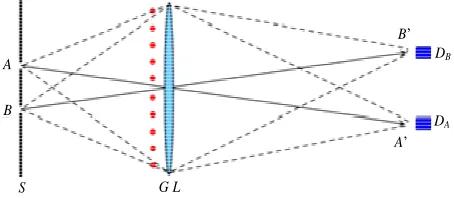
Recently, some interesting experiments were proposed and carried out which claim to violate the complement- tarity principle [4-6]. A schematic diagram of a typical such experiment is shown in Figure 1. Basically, it con- sists of a standard two-slit experiment, with a converging lens L behind the conventional screen for obtaining the interference pattern. Although the experiments use pin- holes instead of slits, we will continue to refer to them as slits. If the screen is removed, the light passes through the lens and produces two images of the slits, which are captured on two detectors DA and DB respectively. Open-ing only slit A results in only detector DA clicking, and opening only slit B leads to only DB clicking. The authors argue that the detectors DA and DB yield information about which slit, A or B, the particle initially passed through. If one places a screen before the lens, the inter-ference pattern is visible.
Conventionally, if one tries to observe the interference
pattern, one cannot get the which-way information. The authors have a clever scheme for establishing the exis- tence of the interference pattern without actually observ- ing it. First, the exact locations of the dark fringes are determined by observing the interference pattern. Then, thin wires are placed in the exact locations of the dark fringes. The argument is that if the interference pattern exists, sliding in wires through the dark fringes will not affect the intensity of light on the two detectors. If the interference pattern is not there, some photons are bound to hit the wires, and get scattered, thus reducing the pho- ton count at the two detectors. This way, the existence of interference pattern can be established without actually disturbing the photons in any way. This is similar in spirit to the so called “interaction-free measurements” where the non-observation of a particle along one path establishes that it followed the other possible path, with-out actually measuring it [7]. The authors carried with-out the
A B
S G L
A’
B’
DA
DB
Figure 1. A schematic representation of the modified two- slit experiment. Light emerges from two pin-holes (not slits) A and B and interferes. Thin wires are placed carefully in the exact locations of the dark fringes of the interference pattern. The lens L collects the light and obtains the images of the two slits A’ and B’, respectively. The detectors DA
[image:1.595.311.538.558.657.2]experiment and found that sliding in wires in the ex- pected locations of the dark fringes, doesn’t lead to any significant reduction of intensity at the detectors. Hence they claim that they demonstrated a violation of com- plementarity.
The complementarity principle is at the heart of quan- tum mechanics, and its violation will be deeply disturb- ing to its established understanding. As expected, there has been scepticism towards the modified two-slit ex- periment, and a heated debate followed [8-16]. Interest- ingly, different criticisms do not agree with each other on why complementarity is not violated in this experiment. None of the criticisms has been satisfactorily able to point out any flaw in the interpretation of the experiments. Most agree that if the introduction of wires has no effect on the intensity, it shows that interference exists. Almost every- body seems to agree that detecting a photon at (say) DA means that it came from slit A. However, just because blocking slit B leads to only detector DA clicking and blocking slit A leads to only detector DB clicking, quan- tum mechanics doesn’t say that when both slits are open, detector DA clicking implies that the photon came from slit A. This has also been pointed out by Kastner [9].
Some authors [13,15] have tried to argue along the following line. Blocking dark fringes also blocks out parts of the bright fringes. They believe, when both slits are open, the photons contain full which-slit information, which is partially destroyed by partially blocking the bright fringes. They argue that since without the wires completely blocking the dark fringe, one cannot infer the existence of the interference pattern, when one tries to increase the information about the existence of the inter- ference, the which-slit information is proportionately decreased. However, in these works, the calculation shows
the existence of full interference, without any blocking wires. Without the blocking wires, the photons are claimed to have full which-slit information (distinguishability = 1, in their language). So, if one were to take their calcula- tion of distinguishablity as correct, then the existence of full interference in the calculation (in the sense of
2x
yielding an interference pattern) seems to imply that quantum formalism allows existence of interference pat- tern for photons for which full which-slit informa-tion exists. This clearly goes against the spirit of com-plement- tarity. In our view, the calculation of distin-guishability in these works is fundamentally flawed.
Many authors have fallen back to a more formal inter- pretation of Bohr’s principle, namely that the wave and particle nature cannot be seen in the same experiment, for the same photons. They argue that authors have to do not one, but two experiments to prove their point—one without the wires, one with the wires. Some argue that the existence of fringes has already been assumed, and that the argument of the experiment is circular. However, a reader who respects empirical facts, doesn’t see it as
two experiments if putting in the wires is not changing the results. One would say, the interference is out there in the middle, and one can check out that the photons are not passing through certain regions, the dark fringes.
Let us understand what is happening in the experiment slightly better by simplifying the experiment. One might argue that a two-slit experiment is the simplest experi- ment one can imagine. But this experiment still has a large number of degrees of freedom, and the Hilbert space is large. We will show in the following that the simplest interference (thought) experiment can be just carried out using a spin-1/2 particle.
2. A Simplified “Two-Slit” Experiment
Let there be a spin-1/2 particle traveling along x-axis. For our purpose, its physical motion is unimportant—we will only be interested in the dynamics of its spin. In the two-slit experiment, the particle emerges from the slits in a superposition of two physically separated, localized wave-packets, which are orthogonal to each other. Their physical separation guarantees their orthogonality. Any subsequent unitary evolution will retain their orthogo- nality. We assume the initial state of the spin to be
0
1
. 2
(1)Here, the states and are the eigenstates of
SZ, and play the role of the two wave-packets that emerge from the double-slit. The time evolution, in the conven- tional two-slit experiment, spreads the wave-packets so that they overlap. In our thought experiment, we employ a homogeneous magnetic field B, acting along the y-axis, to evolve the two states and . Thus the Hamil-tonian of the system is H BSy.
The time evolution operator can be written as
exp icos sin
2 y 2
U t
Bt Bt
i
y
BS t
(2)
where y is the usual Pauli matrix. The time evolution
operator, for a time π 2B has the form
1
2 y
U 1 i . (3)
It is straight forward to see that the time evolution transforms the states and as
1 2 1 ( )
2 U
U
(4)
the states as
2
U 2
U
(5)
After an evolution through a total time 2 , if one puts a spin detector, one will either get a “spin-down” or a “spin-up”. In the beginning, if we started out with a state
, the detector at the end will register a state. On the other hand, if we started with a state, the detec-tor at the end will register a state. Thus, the detec-tor at the end obtains a which-initial-state information about the spin, exactly as the detectors in the modified two-slit experiment obtain a which-slit information.
So, now we carry out our thought experiment, with the initial state 0, as given by (1). After a time we get into a state which is equivalent to the interference region in the modified two-slit experiment:
0 1
1
.2 2
U (6)
Equation (6) represents an interference pattern, be- cause the “down-spins” cancel out to give destructive interference, while the “up-spins” add up to give con- structive interference. So, in our two-state interference experiment, there is one dark fringe and one bright fringe. After parts of the states have been destroyed by the “de- structive interference”, what is left is just
01 1
2 2
U . (7)
Now, these two contributions from the two initially orthogonal states are identical. States which are not or- thogonal, are naturally not distinguishable. Thus the which-way or which-initial-state information is lost at this stage. It might serve some useful purpose by keeping the two contributions separate and evolving them for a further time to see what they yield at the spin detector.
2 0 1 12 2 2 2
U
(8)
So, we see that each part of the initial state leads to a superposition of and states. So, although the spin-detector at the end still gives either a “spin-up” or a “spin-down”, it gives no information about whether the initial state was a or . Yet, if one started out with either a or initial state, which is equiva- lent of closing one slit, (5) tell us that each will go to only its corresponding detector, thus giving the which- initial-state information.
Taken in isolation, this over-simplified thought experi- ment may not prove anything substantial, but it does pro-vide a clue to where the problem lies in the modified two-slit experiments. It appears that the very existence of interference destroys which-way information.
3. Interference and Which-Way Information
3.1. Which-Way Information DestroysInterference
There have been some recent developments in under- standing the origins of complementarity. It has been ar- gued, and demonstrated, that one need not actually carry out a which-way measurement in order that the interfe- reence disappears. Mere existence of which-way infor- mation in the state is sufficient to destroy any potential interference [3,17]. In other words, one can say that mere existence of the possibility of getting which-way infor- mation is enough to destroy the interference pattern. This can be simply demonstrated as follows. Suppose that the state of a particle having passed through a double-slit, just before hitting the screen, is given by
x A
x B
x (9)
where A
x and B
x represent the amplitude ofthe particle passing through slit 1 and 2, respectively. Probability of finding the particle at a point x on the
screen, is given by
2 2 2
* *
A B
A B B A
x x x
x x x
x
(10)
The last two terms represent interference. Now, let us suppose that in a slightly modified version of this ex- periment, the state is given by
x A
x 1 B
x 2 (11) where 1 and 2 are certain orthonormal eigenstates of a suitable observable, which get entangled with the par- ticle, and hence carry which-way information. A mea- surement of that observable yielding 1 will lead to a definitive conclusion that the particle passed through slit 1, and likewise for 2 . In this case the probability of finding the particle at a point x, is given by
2
2
.
A B
2
x x x
(12) The two terms which would have given interference, are killed by the orthogonality of 1 and 2 . One would notice that a which-way measurement is not even needed here—mere existence of which-way information, or mere possibility of a which-way measurement, is enough to destroy interference.
3.2. Interference Destroys Which-Way Information
which-way information.
In any variant of the conventional two-slit experiment, the initial state has to be in a superposition of two or-thogonal states. This follows simply from the fact that the two slits are distinguishable. In the case of a Mach- Zehnder interferometer, a half-silvered mirror splits the beam into superposition of two spatially separated beams. Thus the initial (unnormalized) state 0 can be writ- ten as
0 A 0 B .
0 (13) These states then evolve and reach the region where they spatially overlap. A 0 and B 0 evolve to
A
and B respectively, so that in the region of
overlap, the state looks like
.
A B
(14) The time evolution being unitary, these two parts re-tain their orthogonality, so that A B 0. Let us assume that in the region where they interfere, they have the form:
, ,
A B
(15) where is chosen to be normalized, keeping A
and B unnormalized, which can always be done.
Here, , and need not be simple states— each may involve a multitude of degrees of freedom. However, A and B have to have this form, so
that there are parts from the two which cancel out exactly, to give the so-called dark-fringes. In the case of the con-ventional two-slit experiment, would constitute the pattern involving all the dark fringes (a specific example of this appears in the next section). For the case of a Mach-Zehnder interferometer, represents the part of the state from one beam, reaching one of the two detec-tors. Interference happens when parts reaching one detector, from both the beams, cancel out. The result is, that particular detector does not detect any particles (dark fringe). Thus, if a state described by (14), (15) has a non-zero , one can be sure that a measurement will lead to an interference pattern. One can thus associate a non-zero with the existence of interference, even without doing an actual measurement.
If complementary could indeed be violated, the parts of the two initial states which are left (after the destruc- tive interference), namely and , should be or-thogonal, so that they can contain a which-way informa-tion. States which are not orthogonal, cannot lead to dis- tinguishable outcomes in a measurement. In order that
describes the pattern of dark fringes, it should be orthogonal to and , so that it is distinguishable from the other parts. However, the following analysis goes through even without that restriction.
The norm of is given by
| | | |
| | | |
| | | |
| | 2
A A B B
(16)
Using orthogonality of A and B , we get
| | 1 | .
(17) Substituting this in (16) yields
| | | | |
4. (18) In the region of overlap the state has the actual form
.
Using this, the norm of can be written as
| | | | | .
(19) Combining (18) and (19), we get
| |
2. (20) From the above equation it is obvious that and
can never be orthogonal. Hence in overlap region contains no which-way information.
This general analysis shows that if the state has a form which could yield interference, it cannot contain any which-way information. In other words, existence of in- terference necessarily destroys which-way information.
So, complementarity is robust, and cannot be violated in any such interference experiment where one tries to look for which-way information after interference.
4. Two-Slit Experiment with Wave-Packets
Coming back to the modified two-slit experiment, let us see what implication the preceding analysis has on it. Clearly, in the modified two-slit experiment, after the particle passes through the interference region, the which-way information is lost. The detector DA clicking doesn’t mean that the particle came from slit A. It may appear hard to visualize that a wave-packet which travels in a straight line from slit A can contribute to a click on detector DB , which is not in its direct path. However, the argument of momentum conservation will hold only if we knew that the particle started out from slit A—in that situation it would never reach detector DB . In order to demonstrate the validity of these arguments for the modified two-slit experiment, let us look at the two-slit experiment in more detail.
the y-direction, whereas the x-axis motion just serves the purpose of transporting the particle from the slits to the detectors. Let us assume that when the particle emerges from the double-slit, its state is given by a superposition of two distinct, spatially localized wave-packets. The state at this time, which we choose to call , can be written as
0
t
2
0 0 2 2 1/4 ,0 1 , π 2
y y y y
y ae be 2 (21)
where is the width of the wave-packets, 2y0 is the slit
separation, and a and b are the amplitudes of the two
wave-packets.
The wave-packets evolve in time, during which they spread, and reach the region where they overlap, and thus, interfere. This state can just be obtained by evolving (21), using the Hamiltonian H p2 2m. Hence, the state at time t can be written as
2 0 2 2 0 2 y , exp 2 yexp 2 ,
y
y t aC t
i t m y bC t i t m
(22)
where
1/4π 2 2
C t
i t m
1 . (23)
Now, this state can also be rewritten as
2 2 0 2 2 0Ω 0 0
Ω 0 0
, 2 2 cosh sinh Ω Ω 2 2 cosh sinh Ω Ω y y t y y t y t yy yy
aC t e
t t
yy yy
bC t e
t t (24)
where Ω
2 2t i t m. The term involving
02 sinh Ω yy t
in this expression is an example of
introduced in the preceding section.
In the usual case of a two-slit experiment, the ampli-tudes coming from the two slits are approximately equal,
i.e., a b 1 2. In this case, the sinh terms cancel out
to give the dark fringes, and what is left is
2 2 0 0 2 0 0 Ω Ω Ω Ω 1 , 2 1 2y y y y
t t
y y y y
t t
y t aC t e e
bC t e e
2 (25)
In this state, the parts of the state coming from the two slits are equal. So, there is no which-way information in the state any more. If a lens is used after this stage, which takes the part y y02/Ω( )t
e to one detector and the other
part to the other detector, one can easily see from (25) that a part coming from one slit, becomes a superposition of two parts going to the two detectors. So, each detector receives equal contribution from the two slits, and regis-tering a particle gives no information on which slit the particle came from. To a mind used to classical way of thinking, it might appear that the particle received at a particular detector came from a particular slit, but the preceding analysis shows that this presumption is erro-neous.
Note however, that if one of the slits is closed, say, if a
= 1 and b = 0 the state at time t will be
2 0 /Ω( )
y y
C t e t ,
which goes to only one detector when a lens is used. A critic might argue that instead of cancelling out some parts of the two wave-packets, one might just evolve them separately, and because they were initially orthogo- nal, they will give distinct result at the end. The answer to that is, if one really looks for interference by putting thin wires, one is blocking those very parts of the wave- packets which are cancelling out. So, those parts will not reach the detectors, even if one insists on not cancelling them out. On the other hand, the argument of bringing in wires is not really needed. The state (25) as such, has no which path information.
5. Conclusion
of the two-slit experiment. We see yet again that in deal-ing with quantum systems, trustdeal-ing classical intuition can easily lead one to wrong conclusions.
6. Acknowledgements
The author thanks R. Srikanth for very useful discussions. The author thanks the Centre for Philosophy and Foun- dations of Science, New Delhi, for organizing annual meetings on foundations of quantum mechanics, which provide a platform for exchange of ideas.
REFERENCES
[1] N. Bohr, “Albert Einstein Philosopher-Scientist,” 3rd Edition, Open Court, Evanston, 1949.
[2] M. O. Scully and K. Druhl, “Quantum Eraser: A Pro-posed Photon Correlation Experiment Concerning Ob-servation and Delayed Choice in Quantum Mechanics,” Physical Review A, Vol. 25, No. 4, 1982, pp. 2208-2213. doi:10.1103/PhysRevA.25.2208
[3] M. O. Scully, B.-G. Englert and H. Walther, “Quantum Optical Tests of Complementarity,” Nature, Vol. 351, 1991, pp. 111-116. doi:10.1038/351111a0
[4] M. Chown, “Quantum Rebel,” New Scientist, Vol. 183, No. 2457, 2004, pp. 30-35.
[5] S. S. Afshar, “Violation of the Principle of Complemen- tariry and Its Implications,” Proceedings of SPIE, Vol. 5866, 2005, pp. 229-244. doi:10.1117/12.638774
[6] S. S. Afshar, E. Flores, K. F. McDonald and E. Knoesel, “Paradox in Wave-Particle Duality,”Foundations of Phy- sics, Vol. 37, No. 2, 2007, pp. 295-305.
doi:10.1007/s10701-006-9102-8
[7] P. G. Kwiat, H. Weinfurter, T. Herzog, A. Zeilinger and M. A. Kasevich, “Interaction-Free Measurement,” Physi- cal Review Letters, Vol. 74, No. 24, 1995, pp. 4763-4766. doi:10.1103/PhysRevLett.74.4763
[8] W. Unruh, “Shahriar Afshar—Quantum Rebel?” 2004. http://www.theory.physics.ubc.ca/rebel.html
[9] R. E. Kastner, “Why the Afshar Experiment Does Not Refute Complementarity,” Studies in History and Philo- sophy of Science Part B, Vol. 36, No. 4, 2005, pp. 649- 658. doi:10.1016/j.shpsb.2005.04.006
[10] R. E. Kastner, “On Visibility in the Afshar Two-Slit Ex-periment,” Foundations of Physics, Vol. 39, No. 10, 2009, pp. 1139-1144. doi:10.1007/s10701-009-9329-2
[11] T. Qureshi, “Comment on ‘On Visibility in the Afshar Two-Slit Experiment’,” arXiv:1002.3686v1 [quant-ph], 2010.
[12] R. Srinivasan, “Logical Analysis of the Bohr Comple- mentarity Principle in Afshar’s Experiment under the NAFL Interpretation,” International Journal of Quantum Information, Vol. 8, No. 3, 2010, pp. 465-491.
doi:10.1142/S021974991000640X
[13] V. Jacques, N. D. Lai, A. Drau, D. Zheng, D. Chauvat, F. Treussart, P. Grangier and J-F. Roch, “Illustration of Quantum Complementarity Using Single Photons Inter- fering on a Grating,” New Journal of Physics, Vol. 10, No. 10, 2008, Article ID: 123009.
doi:10.1088/1367-2630/10/12/123009
[14] A. Drezet, “Complementarity and Afshar’s Experiment,” 2005. http://arxiv.org/pdf/quant-ph/0508091.pdf
[15] O. Steuernagel, “Afshar’s Experiment Does Not Show a Violation of Complementarity,” Foundations of Physics, Vol. 37, No. 9, 2007, pp. 1370-1385.
doi:10.1007/s10701-007-9153-5
[16] P. O’Hara, “Entanglement and Quantum Interference,” 2006.http://arxiv.org/pdf/quant-ph/0608202.pdf