Auditory information for spatial location and pitch–height correspondence support young infants’ perception of object persistence
Diana S.Y. Tham, Alison Rees, and J. Gavin Bremner Lancaster University
Alan Slater University of Exeter
Scott Johnson UCLA
Abstract
Perception of object persistence across occlusion emerges at around 4 months for objects moving horizontally or vertically. Also, congruent auditory information for movement enhances perception of persistence of an object moving horizontally. In two experiments we examined the effect of presenting bi-modal (visual and auditory) sensory information, both congruently and incongruently, for a vertical moving object occlusion event. Sixty-eight 4-month-old infants (34 female) were tested for
perception of persistence of an object moving up and down, passing at each
translation behind a centrally placed occluder. Infants were exposed to these visual events accompanied by no sound, spatially co-located sound, congruent or
Auditory information for spatial location and pitch–height correspondence support young infants’ perception of object persistence
The importance of taking a multisensory approach to research on infant perception is now widely recognised (Bahrick, 2010). A multisensory approach is realistic, because object perception in the real world does not usually occur through stimulation of a single sensory channel, and multisensory cues will often be available to the infant, particularly when an object is moving within the natural environment. Indeed, when looking at the nature of many toys designed specifically to be used by young infants the multisensory (moving/flashing/musical) nature is apparent. A number of studies have illustrated sensitivity in young infants to auditory–visual synchrony in discrete events (Bahrick, 1992; Spelke, 1976; 1981), and there is compelling evidence that presentation of information through more than one sensory channel enhances perception. In particular, presenting the same information about the world redundantly to more than one sense recruits attention and leads to more rapid perceptual learning (Bahrick, 2010; Bahrick, Lickliter, & Flom, 2004).
Bremner et al. (2012) examined the effects of presentation of multisensory information in a moving object occlusion event. They presented different forms of auditory information (e.g., spatially colocated sound, static continuous sound,
spatially dislocated sound, discontinuous sound) alongside a visual representation of a moving object undergoing periodic occlusion. The occluder width in the study was selected so as to be wide enough that 4-month-olds would not have been able to perceive trajectory continuity during events based on visual information alone (cf. Bremner et al., 2005). Bremner et al. (2012) found that the addition of a colocated sound significantly enhanced perception of trajectory continuity at 4 months. It was also found that presentation of a static continuous sound during habituation resulted in a slight positive enhancement of perception of trajectory continuity. In contrast, when a dislocated spatial sound (i.e. the sound localisation presented at opposites to the point of travel of the visual display), there was a trend towards an opposite effect on infants’ perception of persistence. In other words, auditory–visual spatial
incongruence slightly impaired 4-month-olds' performance.. The fact that this was a relatively weak effect is in keeping with our previous finding that it is easier to support veridical perception than to interfere with it (Bremner et al., 2005).
These findings are in keeping with the intersensory redundancy hypothesis (IRH; Bahrick, 2010; Bahrick, Lickliter, & Flom, 2004) according to which
presentation of redundant information across two or more sensory channels enhances infants' attention to and perception of events. In the case of the moving object
location of the object. It seems likely that the second level of redundancy was primary in Bremner et al. (2012), because only spatially congruent auditory information enhanced perception of trajectory continuity, despite the fact that common onset and offset applied in both conditions. In addition, in a condition in which the sound ceased and recommenced as the object disappeared and reappeared at the occluder, there was a negative effect on perception of continuity, although in this case onset and offset correspondence was maximised.
Despite our increasing knowledge of the conditions necessary for enhancing 4-month-olds' perception of trajectory continuity across the horizontal dimension, we do not know whether perception of persistence of objects moving vertically will be enhanced by exposure to multisensory information. Given that auditory localisation in the vertical dimension develops more slowly than localisation in the horizontal
dimension (Morongiello & Rocca, 1987a; 1987b), it is possible that any effect of sound in the vertical dimension will be smaller than is the case with horizontal trajectories, if indeed there is any effect seen at all.
More importantly, examination of the effects of multisensory cues on
high-pitched vowels being associated with small objects and low with large) in 4-month-olds. Two- to 3-month-olds appear to associate certain colours and shapes (Wagner & Dobkins, 2011) and 4-month-olds spontaneously associate pitch (sound) with height in the visual field, and with object angularity (Walker et al., 2010) and object thickness (Dolscheid, Hunnius, Casasanto, & Majid, 2014). The pitch–height correspondence may well be fundamental because it has been detected in newborns (Walker et al., 2018). Thus, in addition to the possibility that spatially colocated auditory information may enhance 4-month-olds' perception of vertical trajectory continuity, it is also possible that presenting a sound that varies in pitch congruently with the changing vertical location of the object could have a similar effect.
Furthermore, given that auditory localisation in the vertical dimension develops more slowly than localisation in the horizontal dimension, a pitch–height cue to movement in the vertical dimension might be even more effective in enhancing perception of persistence than a colocated sound because it does not rely on direct locational cues to elevation.
The two experiments reported in this paper examine how these two types of auditory information affect young infants' perception of object persistence.
Specifically, we examine how the addition of auditory information for vertical
examination of the effect of adding a vertical movement cue based on the pitch– height correspondence, in Experiment 2 we investigate the effects of congruent and incongruent pitch information on perception of continuity.
If young infants' perception of vertical localisation of an auditory stimulus is sufficiently developed, we expect that a spatially colocated sound will enhance 4-month-olds’ perception of persistence of an object moving on a vertical trajectory, as it did in the case of an object moving horizontally (Bremner et al., 2012). Further, we predict that a pitch-height congruent sound will enhance perception of persistence of an object moving vertically. However, an alternative possiblity is that any effect of pitch-height correspondence manipulation is located in the fact that both pitch and height change 'direction' at the end points of the cycle, and that it is the congruence of these changes that supports trajectory continuity. In the terms of the intersensory redundancy hypothesis (Bahrick et al., 2004), this temporal co-occurrence constitutes redundant intersensory information about the timing of reversal, and as such would not rely on pitch–height correspondence. However, such an effect would apply equally in a condition in which sound pitch fell as the object rose, and vice versa, because reversals co-occur in this case as well. Thus, it is particularly important to include this incongruent pitch–height condition in order to be able to distinguish between these alternative possibilities.
Experiment 1
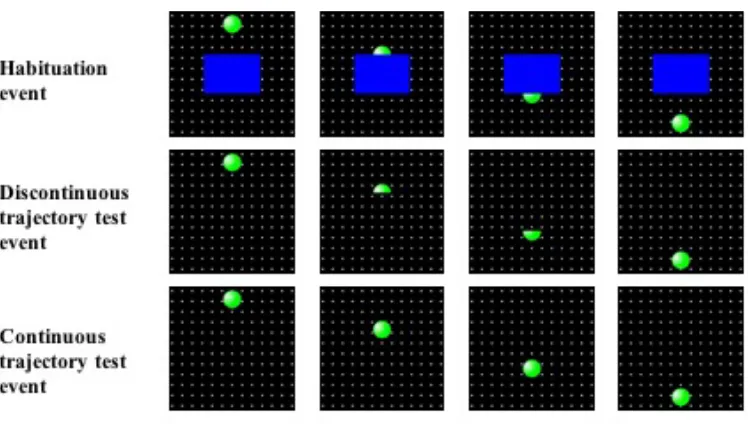
habituation–novelty technique that has proved successful in previous work on object persistence/trajectory continuity. Infants are habituated to an event in which an object moves on a linear path, disappearing and reappearing behind a centrally placed
occluder (see Figure 1). Following habituation, they are presented with alternating test trials with the occluder absent and the object moving either continuously or
discontinuously, in the latter case disappearing and reappearing as it did during habituation. The rationale is that if infants perceive trajectory continuity during habituation, they should then show a novelty preference for the discontinuous test display, reflected in longer looking, whereas if they perceive a discontinuous trajectory during habituation they should show a novelty preference for the
continuous test display. A preference in these test trials can be safely attributed to habituation trial experience because previous work (Bremner et al., 2005; Bremner et al., 2007), including with vertical trajectory conditions (Bremner et al., 2017), has revealed no pre-existing preference for one test trial over the other when infants were exposed only to test trials. Given these numerous findings of null baseline preference, we therefore chose not to run an additional control condition in which infants were only exposed to test trials. As in Bremner et al. (2012), we presented test trials in silence because we were specifically interested in the effect of sound during
habituation trials. Although removal of sound for test trials could lead infants to treat test trials as new and unrelated to habituation trials, no such effect (which would lead to the usual null baseline preference between test trials) was obtained in Bremner et al. (2012).
Method
due to fussiness. Sixteen infants were assigned to the experimental and baseline conditions respectively.
Apparatus and stimuli. Adobe Animate software was used to create the visual displays and to input sound files for presentation alongside the visual display. The stimuli consisted of a habituation display and two test displays (detailed in Figure 1), and an attention getter in the form of a sounding oscillating rattle image for
presentation between trials. The frame rate of each display was 48 frames per second. A Macintosh computer with HABIT software (Cohen, Atkinson, & Chaput, 2000) and a Samsung 100cm colour monitor were used to present stimuli and collect looking time data. An observer viewed the infant on a second monitor and infants were recorded onto videotape for later independent coding of looking times by a second observer. HABIT software presented the displays on the color monitor,
recorded looking time judgements, calculated the habituation criterion for each infant, and changed display after criteria were met. The observer’s judgments were input with a key press on the computer keyboard.
The habituation display consisted of a stationary centrally placed blue
occluder with vertical extent 14.8cm (8.5° visual angle) and horizontal extent 21.5cm (12.3°) and a 6.7cm (3.8°) green ball undergoing continuous vertical cyclic motion at a rate of 16.8cm/s (10.4°/s), the center of the trajectory concealed by the occluder. The ball was visible in its entirety for 1,067ms and was completely occluded for 667ms. The display was run as a continuous loop for the duration of the trial. In the experimental condition, a repetitive musical stereo sound (Bremner et al., 2012; Experiment 1) was presented through two speakers located to the top and bottom of the display monitor, so that it appeared to a small sample of adults to move
localisation of the sound it was necessary to position the speakers 172cm apart
(measured from the center of one speaker to the center of the other) with each speaker equidistant from the center of the display monitor (a distance of 86cm from monitor centre to each speaker). As in Bremner et al. (2012), the effect was achieved through varying the balance at constant rate from one extreme in which the sound came from only one speaker (located at the top of the display), through equal volume at each speaker, to the other extreme when sound only came from the other speaker (located at the bottom of the display). In the baseline condition habituation trials were presented in silence.
The test displays omitted the blue occluder but showed the green ball cycling up and down in the same way as on habituation trials, and were presented in silence. In the continuous test display, the ball was always visible and moved continuously. In the discontinuous test display, the ball disappeared and reappeared by progressive deletion and accretion at horizontal linear boundaries in the same positions as the edges of the occluder in the habituation display (see Figure 1). In all displays, objects were presented against a black background with a 12 X 12 grid of white dots
measuring 48cm x 48cm (27° x 27°) serving as texture elements.
Procedure. Timing of habituation trials commenced when the infant fixated the screen after display onset. The observer pressed a key as long as the infant fixated the screen, and released it when the infant looked away. A trial was terminated when the infant looked away for 2s or 60s had elapsed.
the infants in each condition viewed the continuous trial first, and half viewed the discontinuous trial first. Test trials alternated thereafter until a total of six (three continuous and three discontinuous) had occurred. As with the habituation trials, a trial was terminated when the infant looked away for longer than 2s, or when 60s (the maximum trial length) had elapsed. Between trials, the attention getter was shown to attract attention back to the screen.
At a later date a second observer coded looking times from videotape for the purpose of assessing reliability of looking time judgments. Data for a third of the sample was subject to second coding, with participant cases selected at random from across the whole sample. Interobserver correlations ranged from 0.978 to 0.985 (M = 0.982) across the two experiments in this report.
Results and Discussion. To investigate whether the presence of auditory information affected infants' attention during habituation trials, we first compared total habituation trial looking time between sound and silent conditions. Infants in the sound condition looked significantly longer (M = 108.94 sec; SD = 50.80) than infants in the silent condition (M = 77.71 sec; SD = 22.60), t (30) = 2.25, p = .032.
Figure 2 displays mean looking times to the discontinuous and continuous test displays by infants in the sound and silent conditions. A condition (colocated sound vs. silent) x test trial type (discontinuous vs. continuous) x test trial order x test trial block mixed ANOVA yielded a significant interaction between test trial type and condition, F (1, 28) = 4.83, p = .036, ηp2 = .15. Infants looked longer at the
discontinuous than the continuous test display in the colocated sound condition, F (1, 14) = 9.20, p = .009, ηp2 = .4, but there was no reliable difference in the silent
was marginally more looking at the discontinuous test display in the sound condition than in the silent condition, F (1, 30) = 3.59, p = .068.
There was also a significant interaction between order and condition, F (1, 28) = 5.56, p = .026, ηp2 = .17. The effect of order was significant in the silent condition, F (1, 14) = 7.58, p = .016, ηp2 = .35 but not the sound condition, F (1, 14) = 1.47, p = .25, ηp2 = .095. Infants in the silent condition looked longer when presented with the discontinuous test trial first than when presented with the continuous test trial first. Such effects are hard to interpret but are common, particularly in cases where there is no overall effect of test trial type.
The finding that infants in the colocated sound condition looked longer during habituation than infants in the silent condition is in keeping with the basic principle of the IRH, namely that presentation of redundant information across sensory channels recruits attention. The significant novelty preference for the discontinuous test display in the colocated sound condition indicates that in the presence of auditory information congruent with the object’s visual trajectory infants perceived trajectory continuity in the vertical dimension. In contrast, the lack of an effect of test trial type in the silent condition indicates that infants did not perceive trajectory continuity in the absence of auditory information. This pattern of results corresponds with those obtained by Bremner et al. (2012) in the case of an object moving on a horizontal trajectory. The null effect in the silent condition coincides with the results obtained for horizontal movement by Johnson, Bremner et al. (2003) and Bremner et al. (2012) for that occluder width. In summary, just as in the case of an object moving
information for object movement enhanced perception of the visual event. It appears likely that it was colocation of auditory and visual information that was important here, rather than some less specific effect of the presentation of sound, because Bremner et al. (2012) did not obtain significant perception of continuity of a horizontal trajectory when the sound was stationary.
Experiment 2
In our second experiment, we investigated whether auditory–visual pitch–height correspondence would also enhance perception of trajectory continuity in the vertical dimension. Although this might appear a less direct cue to vertical location than a colocated sound, it does not rely on auditory localization as such. Thus, although the results of Experiment 1 suggest that infants' vertical localisation is sufficient to detect changing location of sound, pitch–height correspondence might be a particularly effective cue through not relying on precise localization of sound. Consequently, in one condition, instead of stereophonically simulating a sound moving vertically, we presented a sound that varied in pitch congruently with the vertical location of the object, such that the pitch rose and fell in accordance with the ball’s movement. Our prediction is that, similarly to the effect in Experiment 1, presentation of this
effect, it should apply equally to congruent and incongruent conditions. Additionally, the inclusion of this condition allows us to assess whether any effect of the pitch– height cue is symmetrical, that is, whether it supports perception of trajectory
continuity when it is congruent but interferes with it when it is incongruent. In other words, does the incongruent pitch-height cue have a negative effect, leading to perception of trajectory discontinuity?
Method
Participants. Thirty-six 4-month-old infants (M = 123 days, range = 112-142 days; 18 girls and 18 boys) took part in the experiment. Eighteen infants were
assigned to each condition. A further 9 did not complete testing due to fussiness. Apparatus, stimuli, design, and procedure. These were identical to
Experiment 1 in all respects other than the form of the auditory information presented during habituation trials. In piloting, we initially investigated using the musical sound from Experiment 1, imposing an overall rising and falling pitch on this. However, a lack of any clear effect of this sound on perception of continuity suggested that it was too complex to yield a simple percept of rising and falling pitch. Thus, we adopted a sound similar to the sound used by Dolscheid et al. (2014). Piloting suggested that the uppermost pitch of this sound (pitch range 1633.333Hz to 830.609HZ) was too high for infants to tolerate in a habituation setting, with infants quickly becoming upset with repeated presentation of the sound. Therefore the pitch range was lowered to give a new frequency range of 830.609Hz to 415.301Hz. This resulted in a pitch range that infants appeared to tolerate well. Infants were assigned randomly to one of two habituation sound conditions: congruent or incongruent. In the case of the
movement. The sound was presented at equal volume from the two speakers, such that it appeared to emanate from the center of the visual display.
Results and Discussion. There was no difference in the time infants in the congruent condition (M = 122.57 sec; SD = 44.78) and incongruent condition (M = 114.10 sec; SD = 60.63) spent looking during habituation, t (34) = .48, p = .64.
Figure 3 displays mean looking times to the discontinuous and continuous test displays by infants in the congruent and incongruent conditions. A condition
(congruent vs. incongruent) x test trial type (discontinuous vs. continuous) x test trial order x test trial block mixed ANOVA yielded no significant effect of test trial type, F (1, 32) = 1.43, p = .24, ηp2 = .04. However, there was a significant interaction between test trial type and condition, F (1, 32) = 5.08, p = .031, ηp2 = .14. Infants looked longer at the discontinuous test trial in the congruent condition, F (1, 16) = 6.4, p = .022, ηp2 = .29 but not in the incongruent condition, F (1, 16) = .52, p = .48, ηp = .032. There was also a significant interaction between test trial type and order, F (1, 32) = 8.88, p = .005, ηp2 = .22. Across congruent and incongruent conditions, the effect of test trial type was significant when the discontinuous test trial was displayed first, F (1, 18) = 18.16, p < .001, ηp2 = .50, and not when the continuous test trial was displayed first (p = .36). This was likely due to the contribution of a reduction of looking across trials, because there was a main effect of test trial block, F (2, 64) = 3.7, p = .03, ηp2 = .10. Post-hoc comparison showed that looking times in block 1 (M = .73.1s) were marginally longer than in block 3 (M = 46.14s, p = .054) but not block 2 (M = 54.88s).
and the incongruent condition, t (32) = 2.26, p = .031. A condition (congruent, incongruent, vs. silent) x test trial type (discontinuous vs. continuous) x test trial order x test trial block mixed ANOVA yielded a significant interaction between test trial type and condition, F (2, 46) = 3.46, p = .04, ηp2 = .13. The effect of test trial type was significant in the congruent condition, F (1, 16) = 6.4, p = .022, ηp2 = .29 but not in the incongruent condition, F (1, 16) = .52, p = .48, ηp =. 032, or the silent condition, F (1, 14) = .36, p = .56, ηp = .025. Post-hoc Tukey tests showed that the comparison between conditions was not significant for discontinuous test trials (p ≥ .125) or continuous test trials (p ≥ .991). Although it is not ideal to rely on comparisons between experiments run sequentially, the result in the silent condition corresponds to the null results obtained for horizontal trajectories with that occluder width (Johnson, Bremner et al., 2003; Bremner et al., 2012). However, analysis of preference data (total looking to discontinuous trials divided by total looking to discontinuous plus continuous test trials) confirms this comparison, indicating that whereas in the congruent pitch–height condition there was a significant preference for the discontinuous test trial, t (18) = 2.34, p = .032, there was a null preference in the incongruent pitch–height condition, t (18) = .26, p = .80.
Interestingly, total looking across habituation trials did not differ between congruent and incongruent conditions, but was significantly greater than in the silent baseline condition of Experiment 1. This suggests that the presence of auditory information increased attention whether or not it provided congruent information about the visual event.
The results on test trials confirmed our prediction that presentation of
significant effect was obtained. Interestingly, when the silent condition from
Experiment 1 was included in the analysis, no difference emerged between silent and incongruent sound conditions. Thus, incongruent pitch–height information does not lead to a decrement in performance relative to baseline.
There was also a general interaction between test trial type and order such that there was a preference across both congruent and incongruent conditions for the discontinuous test display when it occurred first. Again, this effect is relatively common in this sort of work, probably due to the contribution of a reduction in looking across test display.
General discussion
In keeping with our predictions, the results of these experiments indicate that perception of continuity of an object moving on a vertical trajectory can be supported by both spatially colocated sounds and sounds that are congruent in terms of pitch– height correspondence. The first finding is striking given evidence that in early infancy, vertical localisation is underdeveloped relative to horizontal localisation (Morongiello & Rocca, 1987a; 1987b). Clearly, vertical localisation is well enough developed for dynamic auditory information for location to be used to support perception of object persistence. It is unlikely that the effect was due simply to the fact that the sound was continuous across occlusion, firstly because a static
continuous sound condition in Bremner et al. (2012) did not lead to significant
perception of continuity for a horizontally moving object, and secondly because sound continuity cannot explain the differential results obtained between congruent and incongruent conditions in Experiment 2.
pitch–height condition. Thus there was no evidence that object persistence was supported simply by the fact that auditory information specified the sudden changes in direction at the end of each upward or downward transit through a reversal from rising to falling pitch or vice versa. This cue was present equally in congruent and
incongruent conditions, so it should have had a similar effect in both cases.
Interestingly, there was no evidence that incongruent pitch–height information had a negative effect on perception of trajectory continuity. That is, a null result was obtained just as in the silent condition of Experiment 1. The lack of any negative effect is in keeping with previous evidence that negative effects of incongruence have either been absent (Bremner, et al., 2005) or weak (Bremner et al., 2012). Thus there appears to be an asymmetry in the effects of congruent and incongruent cues.
Our positive results for the congruent mapping are also in keeping with the finding that congruent relations between visual size and auditory duration facilitate 5-month-olds' learning more than incongruent relations (Hyde, Porter, Flom, & Stone, 2013). Interestingly, their effect could not be explained in terms of differences between conditions in redundancy of intersensory information, and Hyde et al. (2013) suggest that infants are biased to learn certain relations. We would suggest that this bias may extend to intersensory correspondences such as investigated in Experiment 2.
accounts of intersensory perception. The auditory–visual colocation information presented in Experiment 1 may be described as redundant in the sense that at every instant, auditory and visual information specify the same object location. However, the auditory and visual information presented by pitch–height correspondence in Experiment 2 is non-redundant (Spence, 2011). This correspondence would conventionally be identified as an arbitrary relation (Bahrick, Netto, & Hernandez-Reif, 1998) or as involving modality-specific information (Bahrick, 2010), and so assumed to be necessarily a learned relation. Although there are those who argue that intersensory correspondences are learned from correlations that exist in the
environment (Spence & Deroy, 2012), there is growing evidence that they exist early and without a clear basis in experience for their learning (Dolscheid et al., 2014; Walker et al., 2010; Walker et al., 2018). If the pitch–height correspondence is learned from experience, this must happen within the first few days after birth or in utero (Walker et al., 2018). It appears that the appropriate pitch–height correlations may be available in the environment, because Parise, Knorre, and Ernst (2014) demonstrated that ambient sounds emanating from higher in space were on average higher in pitch than those emanating from lower in space. Learning from these correlations within days of birth seems to imply impressive intersensory sensitivity. Thus, if detection of these relations is not innate, it would appear that even newborns are strongly biased to be sensitive and learn such relations. It may therefore be
important to add a category of relations that infants are predisposed to detecting. This category likely includes metathetic correspondences (concerned with different
information) such as the relation between auditory duration and visual extent (Hyde et al., 2013).
References
Bahrick, L. E. (1992). Infants’ perceptual differentiation of amodal and specific audio-visual relations. Journal of Experimental Child Psychology, 53, 180-199.
Bahrick, L.E. (2010). Perception and attention to intersensory redundancy. In J.G. Bremner & T.D. Wachs (Eds.) Wiley-Blackwell Handbook of Infant
Development 2nd Edition. Chichester: Wiley-Blackwell, pp 120-166. Bahrick, L.E., Lickliter, R., & Flom, R. (2004). Intersensory redundancy guides
infants’ selective attention, perception, and cognition in infancy. Current Directions in Psychological Science, 13, 99-102.
Bahrick, L.E., Netto, D., & Hernandez-Reif, M. (1998). Intermodal perception of adult and child faces and voices by infants. Child Development, 69, 1263-1275.
Bremner, J.G., Slater, A.M., & Johnston, S.P. (2015). Perception of object
persistence: the origins of object permanence in infancy. Child Development Perspectives, 9, 7-13. DOI: 10.1111/cdep.12098.
Bremner, J. G., Johnson, S. P., Slater, A. M., Mason, U. C., Foster, K., Cheshire, A.,
& Spring, J. (2005). Conditions for young infants’ perception of object
trajectories. Child Development,74, 1029-1043.
Bremner, J. G., Johnson, S. P., Slater, A. M., Mason, U., Cheshire, A., & Spring, J.
(2007). Conditions for young infants’ failure to perceive trajectory continuity.
Developmental Science, 10, 613-624.
Bremner, J. G., Slater, A. M., Johnson, S. P., Mason, U. C., Spring, J., & Bremner, M.
E. (2011). Two- to Eight-Month-Old Infants’ Perception of Dynamic
Bremner, J. G., Slater, A. M., Johnson, S. P., Mason, U. C., Spring, J. (2012). The
effects of auditory information on 4-month-olds’ perception of trajectory
continuity. Child Development,83, 954–964.
Bremner, J.G., Slater, A.M., Mason, U., Spring, J., & Johnson, S.P. (2017). Limits of object persistence: Young infants perceive continuity of vertical and horizontal trajectories, but not 45-degree oblique trajectories. Infancy, 22, 303-322. DOI: 10.1111/infa.12170.
Cohen, L. B., Atkinson, D. J., & Chaput, H. H. (2000). Habit 2000: A new program for testing infant perception and cognition. (Version 1.0) [Computer software]. Austin: The University of Texas.
Dolscheid, S., Hunnius, S., Casasanto, D., & Majid, A. (2014). Prelinguistic Infants are Sensitive to Space-Pitch Associations Found Across Cultures.
Psychological Science, 25, 1256-1261.
Grossman, G. E., & Robinson, D. A. (1988). Ambivalence in modelling oblique saccades. Biological Cybernetics, 58, 13-18.
Hyde, D.C., Porter, C.L., Flom, R., & Stone, S.A. (2013). Relational congruence facilitates neural mapping of spatial and temporal magnitudes in preverbal infants. Developmental Cognitive Neuroscience, 6, 102-112.
Johnson, S. P., Amso, D., & Slemmer, J. A. (2003). Development of object concepts in infancy: Evidence for early learning in an eye-tracking paradigm.
Proceedings of the National Academy of Sciences of the United States of America, 100, 10568-10573.
Morongiello, B. A., & Rocca, P. T. (1987a). Infants’ localization of sounds in the horizontal plane: Effects of auditory and visual cues. Child Development, 58, 918-927.
Morongiello, B. A., & Rocca, P. T. (1987b). Infants’ localization of sounds in the median vertical plane: Estimates of minimum audible angle. Journal of Experimental Child Psychology, 43, 181-193.
Ozturk, O., Krehm, M., & Vouloumanos, A. (2013). Sound symbolism in infancy: Evidence for sound-shape cross-modal correspondences in 4-month-olds. Journal of Experimental Child Psychology, 114, 173-186.
Parise, C.V., Knorre, K., & Ernst, M.O. (2014). Natural auditory scene statistics shapes human spatial hearing. Proceedings of the National Academy of Sciences, 111, 6104-6108.
Peña, M., Mehler, J., & Nespor, M. (2011). The role of audiovisual processing in early conceptual development. Psychological Science, 22, 1419-1421.
Spelke, E. S. (1976). Infants’ intermodal perception of events. Cognitive Psychology, 8, 553-560.
Spelke, E. S. (1981). The infant’s acquisition of knowledge of bimodally specified events. Journal of Experimental Child Psychology, 31, 279-299.
Spence, C. (2011). Crossmodal correspondences: A tutorial review. Attention,
Perception, & Psychophysics, 73, 971-995. DOI: 10.3758/s13414-010-0073-7 Spence, C., & Deroy, O. (2012). Crossmodal correspondences: Innate or learned?
i-Perception, 3, 316-318. DOI: org/10.1068/j0526ic
Walker, P., Bremner, J.G., Lunghi, M., Dolscheid, S., Dalla Barba, B., & Simion, F. (2018). Newborns are sensitive to the correspondence between auditory pitch and visuospatial elevation. Developmental Psychobiology, 60, 216-223. DOI: 10.1002/dev.21603
Figure 2. Mean looking times to the two test displays in sound and silent conditions. Note. Error bars in this and the subsequent figure display standard errors.
0 10 20 30 40 50 60 70 80 90 100
Colocated sound Silent
Me
an
lo
ok
in
g
ti
m
es
Condition
Figure 3. Mean looking times to the two test displays in the pitch-height congruent and incongruent conditions.
0 10 20 30 40 50 60 70 80 90 100
Congruent pitch-height sound Incongruent pitch-height sound
Me
an
lo
ok
in
g
ti
m
es
Condition