ISSN Online: 2160-5920 ISSN Print: 2160-5912
DOI: 10.4236/iim.2018.104009 Jul. 17, 2018 108 Intelligent Information Management
Generate Faces Using Ladder Variational
Autoencoder with Maximum Mean Discrepancy
(MMD)
Haoji Xu
Tianjin Nankai High School, Tianjin, China
Abstract
Generative Models have been shown to be extremely useful in learning fea-tures from unlabeled data. In particular, variational autoencoders are capable of modeling highly complex natural distributions such as images, while ex-tracting natural and human-understandable features without labels. In this paper we combine two highly useful classes of models, variational ladder au-toencoders, and MMD variational auau-toencoders, to model face images. In particular, we show that we can disentangle highly meaningful and interpret-able features. Furthermore, we are interpret-able to perform arithmetic operations on faces and modify faces to add or remove high level features.
Keywords
Generative Models, Ladder Variational Autoencoders, Facial Recognition
1. Introduction
Generative Models have been highly successful in a wide variety of tasks by ge-nerating new observations from an existing probability density function. These models have been highly successful in various tasks such as semi-supervised learning, missing data imputation, and generation of novel data samples.
Variational Autoencoder is a very important class of models in Generative Models [1] [2]. These models map a prior on latent variables to conditional dis-tributions on the input space. Training by maximum likelihood is intractable, so a parametric approximate inference distribution is jointly trained, and surpri-singly, jointly training the generative model for maximum likelihood, and the inference distribution to approximate the true posterior is tractable, through a “reparameterization trick” [1]. These models have been highly successful in
How to cite this paper: Xu, H.J. (2018) Generate Faces Using Ladder Variational Autoencoder with Maximum Mean Dis-crepancy (MMD). Intelligent Information Management, 10, 108-113.
https://doi.org/10.4236/iim.2018.104009
Received: November 22, 2017 Accepted: July 14, 2018 Published: July 17, 2018
Copyright © 2018 by author and Scientific Research Publishing Inc. This work is licensed under the Creative Commons Attribution International License (CC BY 4.0).
DOI: 10.4236/iim.2018.104009 109 Intelligent Information Management
modeling complex natural distributions such as natural images. In addition it has been observed that these models can make use of the latent space in a mea-ningful manner. For example, it can learn to map different regions of the latent variable space into different object classes.
Ladder Variational Autoencoders [3] have been recently proposed to further augment this ability. In particular, it is able to disentangle high level and low level features. It utilizes the assumption that high level features require deeper networks to model, so that latent variables that are connected with the input with deep neural networks learn complicated, high level features while low level features are represented by low level variables.
It has also been observed that the evidence lower bound (ELBO) used in tradi-tional variatradi-tional autoencoders suffers from uninformative latent feature prob-lem [4] where these models tend to under-use the latent variables. Multiple me-thods have been proposed to alleviate this [4] [5]. In particular, [5] showed that this problem can be avoided altogether if an MMD loss is used instead of the KL divergence in the original ELBO variational autoencoders.
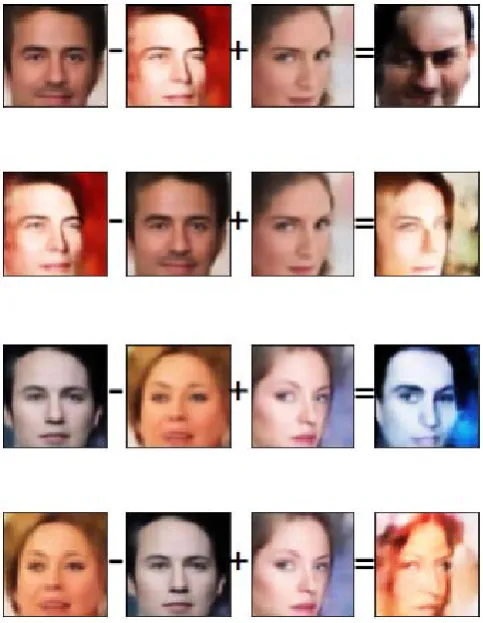
In this paper we combine these ideas to build a variational ladder autoencoder with MMD loss instead of KL divergence, and utilize this model to analyze of structure and hidden features of human faces. As an application we use this model to perform “arithmetic” operations on faces. For example, we can per-form arithmetic operations such as: men with pale skin − men with dark skin + women with dark skin = women with pale skin. The way we do this is by per-forming arithmetic operations in the feature space, and transform the results back into image space. This can be potentially useful in games and virtual reality where arbitrary features can be added to a face through the above process of analogy. This further demonstrates the effectiveness of our model in learning highly meaningful latent features.
2. Model Definition
2.1. Generative Modeling and Variational Autoencoders
Generative models seek to model a distribution pdata (x) in some input space X. The model is usually a parameterized family of distribution pθ(x) trained by
maximum likelihood
( )
( )
max Epdata x logp xθ θ
Intuitively this encourages the model distribution to place probability mass where pdata is more likely.
DOI: 10.4236/iim.2018.104009 110 Intelligent Information Management
( )
( )
( )
z
p xθ =
∫
p x z p z dzθHowever maximum likelihood training is intractable because p xθ
( )
re-quires an integration which is very difficult to compute. The solution is by joint-ly defining an inference distribution q z xϕ
( )
parameterized by φ toapprox-imate p z xθ
( )
. Jointly training both criteria give the following optimizationfunction, called the evidence lower bound (ELBO)
( ) ( )
(
)
(
( )
( )
)
( )
( )
(
)
( )
( )
LELBO KL KL pdata KL log
q z x p z x x p x
q z x p z Eq z x p z x
ϕ θ θ
ϕ ϕ θ
= − −
= − +
where KL denotes the Kullback-Leibler divergence. Intuitively this model achieves its goal by first applying an “encoder” q z xϕ
( )
to the input, then“decode” the generated latent code by p x zθ
( )
and compare the generatedre-sults with the original data x using the cost function logp z xθ
( )
.2.2. Ladder Variational Autoencoder
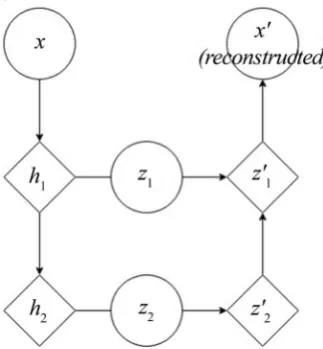
Ladder variational autoencoders [3] add additional structure into the latent code by adding multiple layers to the model. The model is shown in Figure 1. High level latent features are connected with the input through a deep network while low level features are connected through a shallow network. The intuition is that complicated features require deeper networks to model, so that high level latent variables will be used to model the high-level features, and vice versa. This makes it possible to disentangle simple and sophisticated features.
2.3. MMD Regularization
It has been observed that the KL
(
q z x p zϕ( )
( )
)
term in ELBO criteria result [image:3.595.291.453.508.683.2]in under-used latent features (Chen et al., 2016; Zhao et al., 2017a). A solution is to use the MMD (q(z), p(z)) instead, which is defined by
DOI: 10.4236/iim.2018.104009 111 Intelligent Information Management
( ) ( )
(
)
( ) ( ) (
)
( ) ( ) (
)
( ) ( ) (
)
0 0 0 0
0
MMD , , , , ,
2 , , 0
q z p z Eq z q z k z z Ep z p z k z z
Ep z q z k z z
= +
−
where k(z, z0) is a kernel function such as Gaussian.
(
)
2 2
2
, z z
k z z′ =e− −′ σ
Intui-tively k(z, z0) measures the distance between z and z0, and Ep(z), q(z0) [k(z, z0)]
measures the average distance between samples from distributions p(z) and
q(z0). If two distributions are identical, then the average distance between
sam-ples from p, samples from q, and samples from p, q respectively, should all be identical, so MMD distance should be zero. This can be used to replace
( )
( )
(
)
KL q z x p zϕ in ELBO VAE to achieve better properties.
2.4. MMD Variational Ladder Autoencoder
We apply MMD regularization to Variational Ladder Autoencoders. In particu-lar, we regularize all the latent features respectively
( )
( )
(
( ) ( )
)
( ) ( )
(
)
0 0
1 1
LMMD VLAE log MMD ,
,
Eq z x p x z p z q z
MMD p z q z
ϕ θ ϕ
ϕ
− = −
−
This combines the advantage of both models and learns meaningful hierar-chical features.
3. Experiments
To verify the effective of our method we performed experiments on MNIST and CelebA [6]. We visualize the manifold learned for each dataset, and observe ex-tremely rich disentangled features.
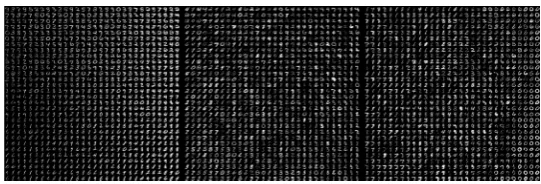
Samples from MNIST are shown in Figure 2. We are able to disentangle visu-al features such as digit width, inclination, digit identity, etc. For example, bottom layer represents style of the stroke, such as the width. Middle layer represents in-clination while top layers mostly represent digit identity.
Samples from CelebA are shown in Figure 3. We are able to disentangle fea-tures such as lighting, hair style, face identity and pose.
4. Arithmetic Operations on Faces
[image:4.595.237.508.570.662.2]We observed that by adding or subtracting values from latent code, we can modify
DOI: 10.4236/iim.2018.104009 112 Intelligent Information Management
Figure 3. Training results over CelebA after roughly 8 hours on a GTX1080Ti. Left: Represents lighting and white balance. Middle Left: Represents hair color, face color, and minor variations of facial feature. Middle Right: Represents face identity. Right: Represents pose and expression of the face.
Figure 4. Faces of the fourth column are acquired by subtracting the second column from first column, then by adding the third column to the first column.
certain properties of faces. In addition, we can blend multiple faces together by adding or subtracting latent codes from or to each other.
[image:5.595.254.496.221.533.2]DOI: 10.4236/iim.2018.104009 113 Intelligent Information Management
5. Conclusions/Discussion
In this paper we proposed MMD Variational Ladder Autoencoder and its appli-cations on various tasks, especially on facial recognition and modification on the CelebA dataset. It is capable of disentangling various features of human face and also capable of modifying or blending different faces.
Possible future works might include further discussion on the accuracy and readability of its latent code, its overfitting tendency, and its application on more unlabeled datasets.
References
[1] Kingma, D.P. and Welling, M. (2013) Auto-Encoding Variational Bayes.
https://arxiv.org/abs/1312.6114
[2] Rezende, J.D., Mohamed, S. and Wierstra, D. (2014) Stochastic Backpropagation and Approximate Inference in Deep Generative Models.
https://arxiv.org/abs/1401.4082
[3] Zhao, S., Song, J. and Ermon, S. (2017) Learning Hierarchical Features from Gener-ative Models. http://arxiv.org/abs/1702.08396
[4] Chen, X., Kingma, D.P., Salimans, T., Duan, Y., Dhariwal, P., Schulman, J., Suts-kever, I. and Abbeel, P. (2016) Variational Lossy Autoencoder.
https://arxiv.org/abs/1611.02731
[5] Zhao, S., Song, J. and Ermon, S. (2017) InfoVAE: Information Maximizing Varia-tional Autoencoders. http://arxiv.org/abs/1706.02262
[6] Liu, Z., Luo, P., Wang, X. and Tang, X. (2015) Deep learning face attributes in the wild. https://arxiv.org/abs/1411.7766