--Manuscript
Draft--Manuscript Number: PONE-D-19-22438R1
Article Type: Research Article
Full Title: Measuring individual differences in cognitive abilities in the lab and on the web
Short Title: Measuring individual differences on the web
Corresponding Author: Simon Ruiz
Eberhard Karls Universitat Tubingen Tübingen, GERMANY
Keywords: web-based testing; measurement equivalence; cognitive individual differences; Working Memory; declarative memory
Abstract: The present study compared lab-based and web-based versions of cognitive individual difference measures widely used in second language research (working memory and declarative memory). Our objective was to validate web-based versions of these tests for future research and to make these measures available for the wider second language research community, thus contributing to the study of individual differences in language learning. The establishment of measurement equivalence of the two
administration modes is important because web-based testing allows researchers to address methodological challenges such as restricted population sampling, low statistical power, and small sample sizes. Our results indicate that the lab-based and web-based versions of the tests were equivalent, i.e., scores of the two test modes correlated. The strength of the relationships, however, varied as a function of the kind of measure, with equivalence appearing to be stronger in both the working memory and the verbal declarative memory tests, and less so in the nonverbal declarative memory test. Overall, the study provides evidence that web-based testing of cognitive abilities can produce similar performance scores as in the lab.
Order of Authors: Simon Ruiz
Xiaobin Chen Patrick Rebuschat Detmar Meurers Opposed Reviewers:
Response to Reviewers: 2nd November 2019
Thank you for the specific feedback on the manuscript entitled “Measuring individual differences in cognitive abilities in the lab and on the web”. Here is our response on how we took the feedback into account in revising the paper:
Reviewer #2: Thank you for the opportunity to review this paper. It is an interesting study that compares lab-based and web-based versions of memory tests in a sample of adults with the aim of validating the web-based version.
The article is well-written and the study is set up well in general. I listed a few specific comments below:
*P3, l.59: when referring to the benefits of web-based testing it would be interesting to refer to other possible simultaneous testing strategies available. For instance, there are many tests that can be answered by individuals in school or university settings that might have similar benefits compared to web-based versions, so it would be important to emphasize what is the specific advantage of this type of tool.
While the established paper-and-pencil tests naturally can be administered by individuals in a formal education setting, conducting such tests during class time instead of conducting individualized web-based testing outside of class uses up class
than in the US. We added a new paragraph that discusses other methodological advantages of (remote) web-based testing in comparison to other forms of
simultaneous delivery of tests, such as traditional paper-pencil and (offline) computer-based testing (p. 3).
*P4, l.75: please provide an argument of why are you only looking at one type of equivalence.
The following argument was added (p. 5):
Considering that this study is a subcomponent of the dissertation research of the first author, limiting funding and time (see limitations below), we focused the investigation on one type of measurement equivalence, the first type: Do people who have relatively high values in one of tests also have relatively high values on the other test, and the other way around?
*P5, l.92: throughout the paper there are several mentions to L2 research, however the issue of small sample size and low power are not restricted to that research area. I would expand the claim to many other situations where methodological issues related to testing are a challenge.
The discussion of the methodological issues was expanded, including reference to low statistical power and small sample sizes being problematic in other research fields and the ongoing debate in the so-called replication crisis in psychology (p. 5-6).
*P8, l.165: the fact that the sample was not full due to technical reasons requires more explanation. Is this related to possible flaws of web-based testing? If so, it should be included in the discussion.
We added the following explanation (p. 9):
Additionally, participant numbers differed across test versions due to technical difficulties (i.e., participants erroneously entered their responses using the keyboard [Web-based CVMT]; and data was missing for one participant [Web-based MLAT5]; see description and Table 1 below, and Discussion).
and a discussion of these technical shortcomings is included in the Discussion section (p. 18).
*Dicussion: I think it would be important to discuss the limitations of the study and also of the findings.
We added limitations of the study and findings in the Discussion section (p. 18).
Yours sincerely,
Simón Ruiz, Xiaobin Chen, Patrick Rebuschat, and Detmar Meurers Additional Information:
Question Response
Financial Disclosure
Enter a financial disclosure statement that describes the sources of funding for the work included in this submission. Review the submission guidelines for detailed
Our research was supported by the LEAD Graduate School and Research Network (grant DFG-GSC1028), a project of the Excellence Initiative of the German federal and state governments. We also acknowledge support by Deutsche
Forschungsgemeinschaft and Open Access Publishing Fund of University of Tübingen. The funders had no role in study design, data collection and analysis, decision to publish, or preparation of the manuscript.
examples.
This statement is required for submission and will appear in the published article if the submission is accepted. Please make sure it is accurate.
Unfunded studies
Enter: The author(s) received no specific funding for this work.
Funded studies
Enter a statement with the following details: Initials of the authors who received each award
•
Grant numbers awarded to each author •
The full name of each funder •
URL of each funder website •
Did the sponsors or funders play any role in the study design, data collection and analysis, decision to publish, or preparation of the manuscript?
•
NO - Include this sentence at the end of your statement: The funders had no role in study design, data collection and analysis, decision to publish, or preparation of the manuscript.
•
YES - Specify the role(s) played. •
* typeset
Competing Interests
Use the instructions below to enter a competing interest statement for this submission. On behalf of all authors, disclose any competing interests that could be perceived to bias this
work—acknowledging all financial support and any other relevant financial or non-financial competing interests.
This statement will appear in the published article if the submission is accepted. Please make sure it is
accurate. View published research articles from PLOS ONE for specific examples.
The authors have declared that no competing interests exist.
competing interests exist.
Authors with competing interests
Enter competing interest details beginning with this statement:
I have read the journal's policy and the authors of this manuscript have the following competing interests: [insert competing interests here]
* typeset
Ethics Statement
Enter an ethics statement for this submission. This statement is required if the study involved:
Human participants •
Human specimens or tissue •
Vertebrate animals or cephalopods •
Vertebrate embryos or tissues •
Field research •
Write "N/A" if the submission does not
require an ethics statement.
General guidance is provided below.
Consult the submission guidelines for
detailed instructions. Make sure that all
information entered here is included in the
Methods section of the manuscript.
This research was approved by the Commission for Ethics in Psychological Research, University of Tübingen, and all participants provided written informed consent prior to commencement of the study.
participants and/or tissue)
Give the name of the institutional review board or ethics committee that approved the study
•
Include the approval number and/or a statement indicating approval of this research
•
Indicate the form of consent obtained (written/oral) or the reason that consent was not obtained (e.g. the data were analyzed anonymously)
•
Animal Research (involving vertebrate
animals, embryos or tissues)
Provide the name of the Institutional Animal Care and Use Committee (IACUC) or other relevant ethics board that reviewed the study protocol, and indicate whether they approved this research or granted a formal waiver of ethical approval
•
Include an approval number if one was obtained
•
If the study involved non-human primates, add additional details about animal welfare and steps taken to ameliorate suffering •
If anesthesia, euthanasia, or any kind of animal sacrifice is part of the study, include briefly which substances and/or methods were applied
•
Field Research
Include the following details if this study
involves the collection of plant, animal, or
other materials from a natural setting: Field permit number
•
Name of the institution or relevant body that granted permission
•
Data Availability
Authors are required to make all data underlying the findings described fully available, without restriction, and from the time of publication. PLOS allows rare exceptions to address legal and ethical concerns. See the PLOS Data Policy and FAQ for detailed information.
Yes - all data are fully available without restriction
submission. Your answers to this question constitute the Data Availability Statement and will be published in the article, if accepted.
Important: Stating ‘data available on request from the author’ is not sufficient. If your data are only available upon request, select ‘No’ for the first question and explain your exceptional situation in the text box.
Do the authors confirm that all data
underlying the findings described in their
manuscript are fully available without
restriction?
Describe where the data may be found in full sentences. If you are copying our sample text, replace any instances of XXX
with the appropriate details.
If the data are held or will be held in a public repository, include URLs, accession numbers or DOIs. If this information will only be available after acceptance, indicate this by ticking the box below. For example: All XXX files are available from the XXX database (accession number(s) XXX, XXX.). •
If the data are all contained within the manuscript and/or Supporting Information files, enter the following: All relevant data are within the manuscript and its Supporting Information files.
•
If neither of these applies but you are able to provide details of access elsewhere, with or without limitations, please do so. For example:
Data cannot be shared publicly because of [XXX]. Data are available from the
XXX Institutional Data Access / Ethics Committee (contact via XXX) for researchers who meet the criteria for access to confidential data.
The data underlying the results presented in the study are available from (include the name of the third party •
All relevant data are within the manuscript and its Supporting Information files.
owned by a third party and authors do not have permission to share the data.
* typeset
Additional data availability information:
LEAD
Graduate School & Research Network
8th August 2019
We would like our manuscript entitled “Measuring individual differences in cognitive abilities in the lab and on the web” to be considered for publication in PLOS ONE.
Our manuscript reports the results of a study that compared lab-based and web-based versions of individual difference measures that are widely investigated in language learning research (working memory and declarative memory). Our objective was to validate web-based versions of these cognitive tests for future research and to make these measures freely available for the wider community, thus contributing to the study of individual differences in language learning. The establishment of measurement equivalence of the two administration modes is important because web-based testing allows researchers to address methodological challenges such as restricted population sampling, low statistical power, and small sample sizes.
Our results indicate that the lab-based and web-based versions of the tests were equivalent, i.e. scores of the two test modes correlated. The strength of the relationships, however, varied as a function of the kind of measure, with equivalence appearing to be stronger in both the working memory and the verbal declarative memory tests, and less so in the nonverbal declarative memory test. Overall, the study provides evidence that web-based testing of cognitive abilities can produce similar performance scores as in the lab.
We believe that this manuscript is particularly suitable for the audience of PLOS ONE because it concerns measuring cognitive abilities on the web, which could be a feasible alternative to tackle some of the current methodological issues found in language learning research conducted in lab-based settings.
We suggest Michael Thomas Ullman be an Academic Editor for this work.
The data presented here has not previously been published, and has not been submitted for publication to another journal.
Many thanks in advance for considering our manuscript for your journal.
Yours sincerely,
1
Measuring individual differences in cognitive abilities in the lab and on the web 1
2 3
Simón Ruiz1*, Xiaobin Chen2, Patrick Rebuschat1,3 Detmar Meurers1,4
4 5 6 7 8
1¶LEAD Graduate School and Research Network, University of Tübingen, Tübingen, Germany
9 10
2¶Department of Theoretical and Applied Linguistics, University of Cambridge, United Kingdom
11 12
3 ¶Department of Linguistics and English Language, Lancaster University, Lancaster, United
13
Kingdom 14
15
4Department of Linguistics, University of Tübingen, Tübingen, Germany
16 17
* Corresponding author 18
E-mail: [email protected] (SR) 19
20 21
¶These authors contributed equally to this work.
Abstract
25The present study compared lab-based and web-based versions of cognitive individual 26
difference measures widely used in second language research (working memory and declarative 27
memory). Our objective was to validate web-based versions of these tests for future research and 28
to make these measures available for the wider second language research community, thus 29
contributing to the study of individual differences in language learning. The establishment of 30
measurement equivalence of the two administration modes is important because web-based testing 31
allows researchers to address methodological challenges such as restricted population sampling, 32
low statistical power, and small sample sizes. Our results indicate that the lab-based and web-33
based versions of the tests were equivalent, i.e., scores of the two test modes correlated. The 34
strength of the relationships, however, varied as a function of the kind of measure, with 35
equivalence appearing to be stronger in both the working memory and the verbal declarative 36
memory tests, and less so in the nonverbal declarative memory test. Overall, the study provides 37
evidence that web-based testing of cognitive abilities can produce similar performance scores as 38
in the lab. 39
40
Introduction
41Individual differences can greatly affect how we acquire and process language [1-3] and 42
mediate and/moderate the effectiveness of instruction [4]. In adult language learning, for example, 43
learners’ cognitive abilities have great explanatory power in accounting for differences in learning 44
outcomes ([5-6]). Among these, working memory and declarative memory are considered to be 45
The effect of working memory and declarative memory on language learning has been 47
primarily studied in lab settings, i.e., in well-controlled environments where participants are tested 48
individually. While this choice is methodologically sound, it can also negatively affect sample size 49
and population sampling [13, 14]. Lab-based testing generally means testing participants 50
individually and sequentially, which is labor-intensive and could explain why lab studies tend to 51
have (too) few participants to allow for meaningful generalization. For example, Plonsky [13] 52
found that the typical sample size in L2 studies was 19 participants, and Lindstromberg [15] 53
recently reported a similar small average sample size of 20 participants. Moreover, many (if not 54
most) lab studies in L2 research draw their sample from the surrounding student population, which 55
is understandable given the ease of access, but also means that samples are often not representative 56
of the population of interest. 57
Conducting second language research by means of remote testing via the web could 58
alleviate some of these concerns. For example, web-based testing facilitates the acquisition of large 59
amounts of data since participants can be tested simultaneously, and test administration can also 60
be more cost-effective than research conducted in the lab [15]. Importantly, web-based 61
experimenting has been found to be a reliable and effective research tool [16,17, 18]. 62
The present study compared lab-based and web-based versions of cognitive tests that are 63
widely used in second language research. The intent was to compare performance of measures as 64
they are originally used in the lab with their corresponding online versions. In doing so, our 65
objective was to validate the web-based tests for use in subsequent research and to make these 66
available to the wider second language research community. The sharing of tasks, especially of 67
tasks that permit the collection of substantial amounts of data via the web, will be an important 68
contribute directly to our understanding of individual differences in L2 acquisition. To support 70
such task sharing and use, it is essential to first establish the validity of the online versions of the 71
tasks (on a par with what is established about the offline versions). With this in mind, the study set 72
out to establish measurement equivalence between lab-based and web-based tests of working 73
memory and declarative memory. 74
According to Gwaltney, Shields and Shiffman ([19], p. 323), measurement equivalence can 75
be established if “1) the rank orders of scores of individuals tested in alternative modes closely 76
approximate each other; and 2) the means, dispersions, and shapes of the score distributions are 77
approximately the same”. The first type of equivalence is related to whether differences found in 78
one measurement are also systematically found in the other. This means that, although the two 79
measurements estimate two different numbers, these numbers have a systematic and very clear 80
relationship to each other. The second type concerns whether two measurements yield the same 81
numbers. Here, we focus on the former type of equivalence. More specifically, we compare the 82
differential performance generated by two versions of tests measuring working memory and 83
declarative memory capacities in lab-based and web-based settings, with the aim to determine 84
whether the two versions are equivalent with respect to the relationships between scores. 85
Establishing measurement equivalence between these two administration modes is essential for 86
several reasons. First, it is necessary to show that the results of web-based studies are comparable 87
to those of previous research, which have predominantly obtained from data gathered in lab-based 88
settings. Second, it is imperative to ensure that cognitive constructs are measured in the same way 89
in both test modes. Finally, it is important to ascertain whether lab-based and web-based measures 90
some of the current methodological issues found in L2 research conducted in lab-based settings, 92
such as underpowered studies and small sample sizes, among others [13, 14]. 93
94
Working memory 95
Working memory refers to the capacity to simultaneously process and retain information 96
while carrying out complex cognitive tasks such as language learning, comprehension and 97
production [20]. Following Baddeley and colleagues (e.g., [21]), working memory is a 98
multicomponent system that consists of storage subsystems that are responsible for holding visual-99
spatial and auditory information, an episodic buffer that acts as a link between the storage 100
subsystems and long-term memory, and a central executive that functions as an attentional control 101
system. 102
In L2 learning, working memory appears to assist learners to jointly process form, meaning 103
and use of language forms at the same time. More specifically, working memory is involved in 104
key cognitive processes such as decision making, attention control, explicit deduction, information 105
retrieval and analogical reasoning [4]. Moreover, working memory is also important for retaining 106
metalinguistic information while comprehending and producing L2 language [22]. In this regard, 107
meta-analytic work has reported the important role of working memory in L2 comprehension and 108
production (e.g., [23-25]). For example, Linck et al. ([25], p. 873) found that working memory has 109
a positive impact on L2 comprehension outcomes (r = 0.24). Likewise, Jeon and Yamashita’s [24] 110
meta-analysis also showed that working memory is related to L2 reading comprehension (r = 0.42). 111
Regarding production, meta-analytic research has, too, indicated a significant association with 112
working memory (e.g., [25]). In this case, Linck et al. ([25], p. 873) found a positive correlation 113
Working memory is often measured by means of simple or complex span tasks. Simple 115
span tasks (e.g., digit span and letter span) involve recalling short lists of items, and they seek to 116
gauge the storage aspect of working memory [26]. Complex span tasks, such as the operation span 117
task (OSpan; [27]), on the other hand, entail remembering stimuli while performing a secondary 118
task, and are thought to tax both processing (attention) and storage (memory) components of 119
working memory [21]. Here, we focus on a complex task, namely the OSpan. This complex task 120
has been found to be a valid and reliable measure of working memory capacity [28], and has also 121
been recommended as a more accurate measure to examine the association between working 122
memory and L2 processing and learning [29]. 123
124
Declarative memory 125
Declarative memory is the capacity to consciously recall and use information [30]. The 126
declarative memory system is one of the long-term memory systems in the brain [31]. It is mainly 127
responsible for the processing, storage, and retrieval of information about facts (semantic 128
knowledge) and events (episodic knowledge;[32, 33]). Learning in the declarative memory system 129
is quick, intentional, and attention-driven [34]. 130
Substantial research has now investigated the role of declarative memory in first and 131
second language acquisition [35]. In first language acquisition, declarative memory appears to be 132
involved in the processing, storage and learning of both arbitrary linguistic knowledge (e.g., word 133
meanings) as well as rule-governed aspects of language (e.g., generalizing grammar rules [36,37]). 134
In the case of L2 acquisition, declarative memory appears to underpin the learning, storage and 135
38]. Several studies (e.g., [2, 9, 38, 39]) has confirmed the predictive ability of declarative memory 137
to explain variation in L2 attainment. 138
Declarative memory has been tested through recall and recognition tasks (e.g., 38, 39), both 139
verbal, such as the paired associates subtest of the Modern Language Aptitude Test (MLAT5; 140
[40]), and nonverbal, such as the Continuous Visual Memory Task (CVMT; [41]). 141
142
The present study 143
The main goal of the present study was to provide web-based versions of commonly employed 144
individual difference measures in second language research, in order to make them usable in large-145
scale intervention studies (generally in authentic, real-life learning contexts). To that end, we 146
examined whether lab-based and web-based versions of working memory and declarative memory 147
tests yield similar performance scores, i.e., whether the two versions were equivalent or 148
comparable. More specifically, we assessed whether the values of one type of mode of 149
administration corresponded to the values in the other mode (i.e., first type of equivalence). In 150
other words, are the differences in scores constant, or parallel in the two ways of measuring? The 151
web-based versions are freely available; to use the test, please send an email to the first author. 152
153
Methods
154Ethics statement 155
This research was approved by the Commission for Ethics in Psychological Research, 156
University of Tübingen, and all participants provided written informed consent prior to 157
commencement of the study. 158
Participants 160
Fifty participants (37 women and 13 men), with a mean age of 26.4 years (SD = 4.2), took 161
part in the study. Most participants were native speakers of German (72%), followed by Russian 162
(8%), Spanish (6%), Chinese (4%), English, Hungarian, Persian, Serbian and Vietnamese (2% 163
each). Seven (14%) participants did not complete the second half of the study (i.e., web-based 164
testing). Additionally, participant numbers differed across test versions due to technical difficulties 165
(see Results; Table 1). Twenty-seven participants were graduate students (54%), and twenty-three 166
were undergraduates (46%). Participants self-reported English proficiency, with most being 167
advanced learners (82%), followed by intermediate (18%). All subjects gave informed consent and 168
received €20 for participating. 169
170
Materials 171
Three cognitive tests were administered, one assessing working memory capacity, and 172
two indexing verbal and nonverbal declarative memory capacity, respectively. In the lab-based 173
context, working memory and nonverbal declarative memory tests were programmed and 174
delivered via E-Prime v2.0 [42]; the verbal declarative memory test was applied in paper-pencil 175
form, as originally developed and delivered. For the web-based mode, versions of the three 176
cognitive tests were developed for this study using Java with the GoogleWeb Toolkit 177
(http://www.gwtproject.org), and were accessible from all browsers. The tests are described 178
below. 179
180
Working memory. To assess participants’ working memory capacity, an adapted version of the 181
created by Turner and Engle [27], was used [9, 17]. This adaptation was based on the Klingon 183
Span Task developed by Hicks et al. [17], and consisted of replacing letters (the original stimuli 184
to be remembered in the OSpan task) with Klingon symbols. Hicks et al. implemented this 185
change because their research showed that participants were cheating by writing down the letter 186
memoranda in the web-based version of the classic OSpan. 187
The task took approximately 25 minutes to complete, and was divided into a practice phase 188
and a testing phase. In the practice phase, participants were first presented with a series of Klingon 189
symbols on the screen, and were asked to remember them in the order they had appeared at the 190
end of each trial (i.e., symbol recall). Next, participants were asked to solve a series of simple math 191
operations (e.g., 5 * 2+ 1 = ?). Finally, subjects performed the symbol recall while also solving the 192
math problems, as they would do later in the actual testing phase. After the practice phase, 193
participants were presented with the real trials, which consisted of a list of 15 sets of 3–7 194
randomized symbols that appeared intermixed with the equations, totaling 75 symbols and 75 math 195
problems. At the end of each set, participants were asked to recall the symbols in the sequence 196
they had been shown. An individual time limit to answer the math problems in the real trials was 197
derived from the average response time plus 2.5 standard deviations taken during the math practice 198
section. Following Unsworth et al. [46], a partial score (i.e., total number of correct symbols 199
recalled in the correct order) was taken as the OSpan score (see [28], for a description of scoring 200
procedures). The highest possible score was 75. 201
202
Verbal declarative memory.
The Modern Language Aptitude Test, Part 5, Paired 203Associates (MLAT5; [40]), was used as a verbal measure of declarative memory [9, 38, 39]. The 204
in English. Participants first studied 24-word association pairs for two minutes, and then 206
completed a two-minute practice section. During the practice section, the list of foreign words 207
and their English equivalents were made available for participants to refer back if they needed to. 208
Finally, subjects completed a timed multiple-choice test (four minutes), in which they were 209
asked to select the English meaning of each of the 24 pseudo-Kurdish words from five options 210
previously seen at the memorization stage. For each correct response, one point was awarded, 211
yielding a total score of 24 points. The test duration was 8 minutes. 212
213
Nonverbal declarative memory.
The Continuous Visual Memory Task (CVMT; [46]) 214was included as an assessment of nonverbal declarative memory [9, 38, 39]. The CVMT is a 215
visual recognition test that involves asking participants to first view a collection of complex 216
abstract designs on the screen, and then to indicate whether the image they just saw was novel 217
(“new”) in the collection, or they had seen the image before (“old”). Seven of the designs were 218
“old” (target items), and 63 were “new” (distractors). Throughout the task, the target items 219
appeared seven times (49 trials), and the distractors only once (63 trials). All items were 220
presented in a random but fixed order, each one appearing for two seconds. After the two 221
seconds, participants were instructed to respond to the “OLD or NEW?” prompt on the screen. In 222
the lab-based setting, subjects indicated their choice by mouse clicking either left for “NEW”, or 223
right for “OLD”. In the web-based setting, they responded by pressing either the “N” key for 224
“NEW”, or the “O” key for “OLD” on the keyboard. Overall, the CVMT required 10 minutes to 225
be completed. For each participant, a d’(d-prime) score [44] for CVMT was computed. The d’ 226
score was used to account for the possible participants’ response bias toward choosing “OLD” or 227
229
Procedure
230As previously noted, participants completed two cognitive testing sessions, one in the lab 231
and one on the web. In the lab-based session, in the presence of a proctor, each subject was tested 232
individually. After providing informed consent, participants took the three cognitive tests under 233
investigation in fixed order: OSpan, CVMT, and MLAT5. They were then asked to fill in a 234
background questionnaire. The whole lab-based session took about 40 minutes. 235
For the web-based session, each subject was sent an email containing a unique web link with a 236
personalized code, that when clicked, took them to an interface housing the web-based versions of 237
the cognitive tests. To prevent participants from taking the tests multiple times, the link became 238
nonfunctional once they had submitted their responses in the last test (i.e., MLAT5). In the email, 239
participants were also informed that the web-based session lasted about 40 minutes, and had to be 240
completed within a week. On the interface, following informed consent, subjects were given 241
general instructions in accordance with the web-based nature of the experiment. These instructions 242
included completing the experiment in a quiet place without interruption, and from start to finish 243
in one sitting. Participants were also instructed not to use the browser’s back button, or refresh the 244
browser page, or close the browser window. Importantly, they were told not to take any notes 245
during the entire experiment. The tests were taken in the same fixed order as in the lab-based 246
session. The mean period between the first and second testing was 45.7 days (SD = 4.1). 247
248
Results
249All data were analyzed using the statistical software package R version 3.3.2 (R Core 250
lab scores were used to predict web scores in the linear regression models. To verify normality, 252
model residuals were visually inspected. Reliability was assessed using Cronbach's alpha. 253
Following Kane et al. [45], for the lab-based working memory test (OSpan-Lab-based), 254
reliability was assessed by calculating the proportion of correctly recalled Klingon symbols per 255
each of the 15 trials in the test (e.g., one out of four symbols correctly recalled corresponded to a 256
proportion of .25). For the web-based working memory test (OSpan-Web-based), however, 257
internal consistency is not reported, since it was not technically possible to perform a detailed 258
item-based analysis. Descriptive statistics are presented first, followed by correlations, internal 259
consistency estimates (Cronbach's alpha), and the results of linear regression analyses. 260
261
Descriptive statistics 262
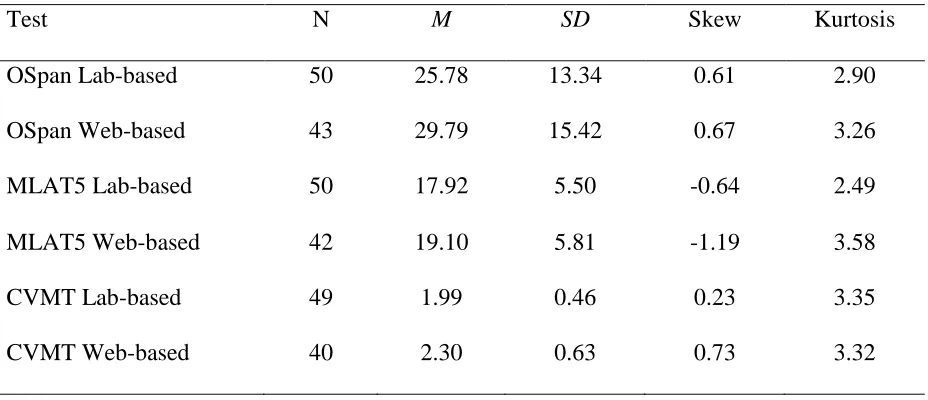
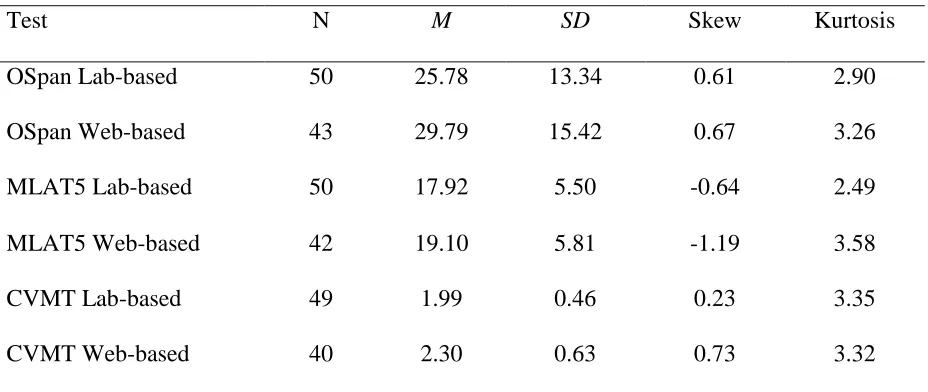
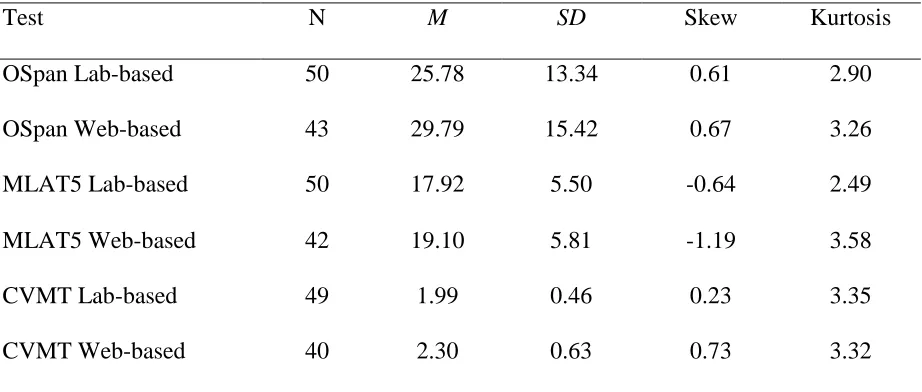
Table 1 presents the descriptive statistics summarizing participants’ performance on the 263
three cognitive tests under investigation in both test modes. 264
[image:20.612.76.540.484.684.2]265
Table 1. Descriptive statistics for comparison of lab-based and web-based testing. 266
Test N M SD Skew Kurtosis
OSpan Lab-based 50 25.78 13.34 0.61 2.90
OSpan Web-based 43 29.79 15.42 0.67 3.26
MLAT5 Lab-based 50 17.92 5.50 -0.64 2.49
MLAT5 Web-based 42 19.10 5.81 -1.19 3.58
CVMT Lab-based 49 1.99 0.46 0.23 3.35
Note: OSpan = Automated Operation Span Task; Verbal declarative memory test: MLAT5 =
Modern Language Aptitude Test, Part 5; Nonverbal declarative memory test: CVMT =
Continuous Visual Memory Task.
267
Correlations 268
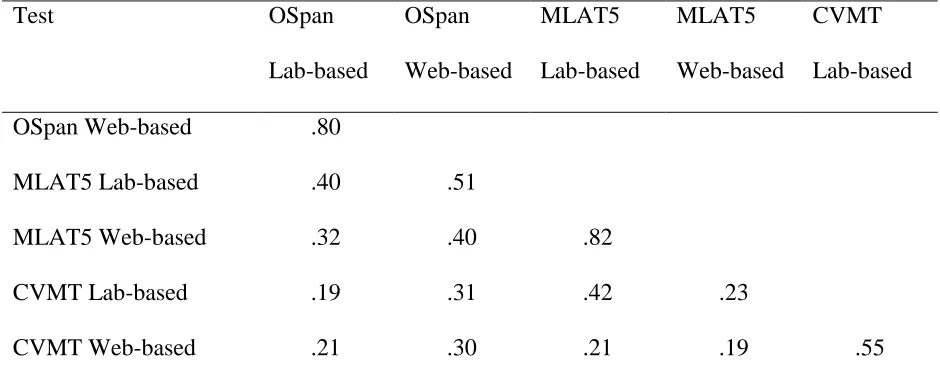
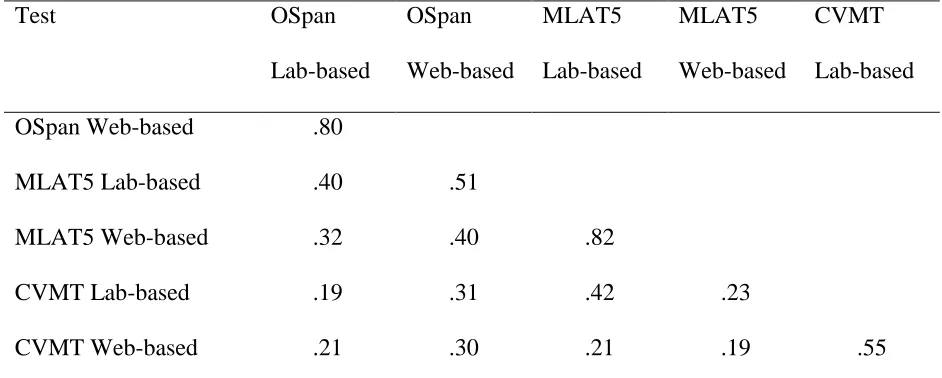
Table 2 and Fig 1 show the correlations between/among the different versions of the 269
individual difference tests. 270
[image:21.612.70.536.353.545.2]271
Table 2. Correlations between lab-based and web-based scores for individual difference 272
tests. 273
Test OSpan
Lab-based
OSpan
Web-based
MLAT5
Lab-based
MLAT5
Web-based
CVMT
Lab-based
OSpan Web-based .80
MLAT5 Lab-based .40 .51
MLAT5 Web-based .32 .40 .82
CVMT Lab-based .19 .31 .42 .23
CVMT Web-based .21 .30 .21 .19 .55
Note: OSpan = Automated Operation Span Task; Verbal declarative memory test: MLAT5 =
Modern Language Aptitude Test, Part 5; Nonverbal declarative memory test: CVMT =
Continuous Visual Memory Task.
274
Fig 1. Scatterplots of the correlation of each pair of lab-based and web-based versions of 275
OSpan = Automated Operation Span Task; Verbal declarative memory test: MLAT5 = Modern 277
Language Aptitude Test, Part 5; Nonverbal declarative memory test: CVMT = Continuous 278
Visual Memory Task. 279
280
Reliability 281
Table 3 presents Cronbach's alpha values of individual test versions. 282
[image:22.612.76.539.288.458.2]283
Table 3. Cronbach’s alphas for cognitive test versions. 284
Test Cronbach’s alpha
OSpan Lab-based .86
MLAT5 Lab-based .77
MLAT5 Web-based .93
CVMT Lab-based .63
CVMT Web-based .67
Note: OSpan = Automated Operation Span Task; Verbal declarative memory test: MLAT5 =
Modern Language Aptitude Test, Part 5; Nonverbal declarative memory test: CVMT =
Continuous Visual Memory Task.
285
Regression analysis 286
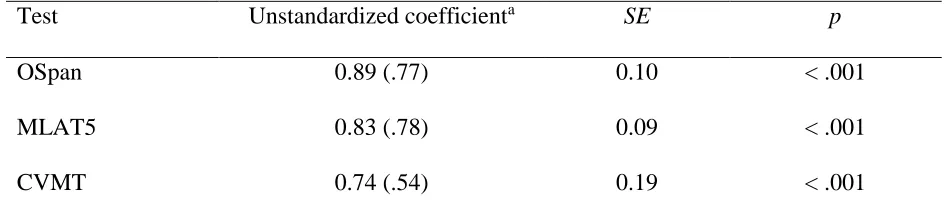
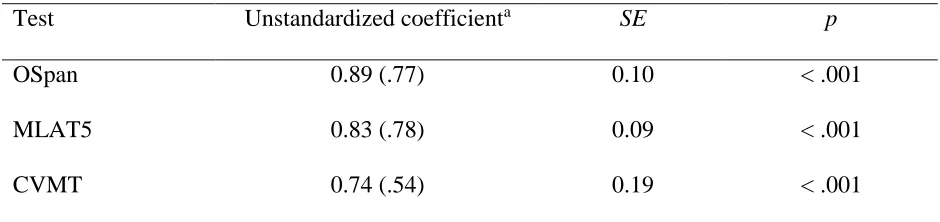
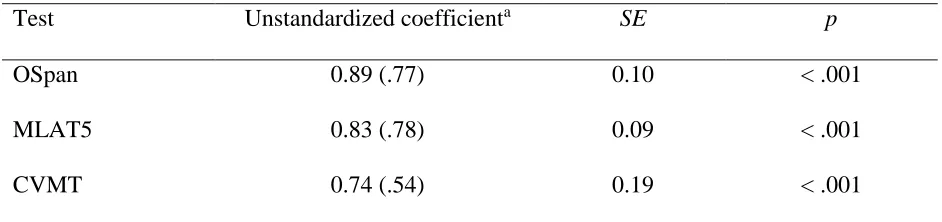
The results of the regression analyses are displayed in Table 4. For the working memory 287
test (OSpan), the unstandardized coefficient was .89 (β = .77, SE = 0.10, p < .001). For the verbal 288
declarative memory test (MLAT5), the unstandardized coefficient was .83 (β = .78, SE = 0.09, p 289
was .74 (β = .54, SE = 0.19, p < .001). Overall, the results indicated that the lab-based and web-291
based scores are substantially related. 292
[image:23.612.69.541.182.291.2]293
Table 4. Regression for comparison of lab-based and web-based scores. 294
Test Unstandardized coefficienta SE p
OSpan 0.89 (.77) 0.10 < .001
MLAT5 0.83 (.78) 0.09 < .001
CVMT 0.74 (.54) 0.19 < .001
Note: OSpan = Automated Operation Span Task; Verbal declarative memory test: MLAT5 =
Modern Language Aptitude Test, Part 5; Nonverbal declarative memory test: CVMT =
Continuous Visual Memory Task. aThe standardized coefficient (β) in parentheses.
295
Discussion
296Studies on individual differences in language learning frequently assess the working 297
memory and declarative memory capacities of their participants in order to determine the effect 298
of these cognitive variables on learning outcomes. Most of this research, however, is conducted 299
in lab-based settings, which often implies relatively small sample size and a restricted population 300
sampling. Both of these methodological challenges can be addressed by means of remote testing 301
via the web. In the present study, we compared lab-based and web-based individual difference 302
measures in order to validate web-based tests for future research. The type of comparison 303
contributes significantly to ongoing efforts to improve the methodological robustness of current 304
lab-based testing, researchers will be able to reach more participants for their studies, which, in 306
turn, can help alleviate some of the current concerns in L2 research (e.g., low statistical power, 307
non-representative population samples, and small sample sizes). In addition, demonstrating the 308
equivalence of lab-based and web-based measures of the same individual difference constructs is 309
essential for the comparability of results across studies. Crucially, establishing measurement 310
equivalence between lab-based and web-based versions will also provide assurance that the tests 311
are measuring cognitive constructs the same way regardless of administration mode [16, 48]. 312
The results indicated that the scores in the lab-based and web-based versions of three 313
cognitive tests (MLAT5, CVMT, OSpan) were equivalent in the sense that differences in 314
performance were constant in the two versions. This suggests that participants who had relatively 315
high values in one task also had relatively high values in the second, or the other way around. 316
However, the strength of the association depended on the test. In both the working memory test 317
(OSpan) and the verbal declarative memory test (MLAT5) the scores were more strongly 318
correlated (𝛽 = .77 and 𝛽 = .78, respectively); for the nonverbal declarative test (CVMT), 319
equivalence appears to be weaker (β = .54). On the whole, the correlations reported here between
320
lab-based and web-based scores are consistent with the assumption that both versions seem to 321
likely measure the same cognitive construct, at least for the working memory test (OSpan) and 322
the verbal declarative memory test (MLAT5), and, to a lesser extent, for the nonverbal 323
declarative test (CVMT). 324
A possible explanation for the weaker equivalence found for the versions of the 325
nonverbal declarative test (CVMT) is perhaps the difference in the way responses to the visual 326
used left (“NEW”) or right (“OLD”) mouse clicking to enter their response, whereas in the web-328
based version, they used the keyboard (“N” and “O” keys). This modification was made to the 329
web-based version because of technical reasons, i.e., the browser window may not register the 330
participants’ response if the cursor is not over a certain area on the page, which in itself may 331
cause problems of missing data. It has been previously reported that participants in web-based 332
research are prone to make errors when using the keyboard to enter their responses [49], which 333
in this case might have affected the results of the comparison between lab-based and web-based 334
versions of CVMT. Further studies comparing performance between the two versions may 335
benefit from gathering data via touch input instead, which might overcome the technical 336
difficulty of employing mouse clicking for web-based data collection reported here. 337
338
Conclusion 339
This study aimed to establish the validity of using web-based versions of established 340
offline tasks. As such, the study has provided evidence that it is possible to measure individual 341
differences in cognitive abilities on the web and obtain similar performance as in the lab. The 342
lab-based and web-based versions of the three cognitive tests are comparable or equivalent. 343
However, given that they do not perfectly correlate, we recommend using one of the two modes 344
within one study and not comparing individual scores from one mode with scores from the other. 345
Moreover, the extent to which the measures are equivalent varies according to the test. In this 346
sense, we are confident that the two versions for the working memory test (OSpan) and the 347
verbal declarative memory (MLAT5) are fairly possibly measuring the same construct, but we 348
the two modes might still plausibly measure strongly different aspects as well. Our research has 350
shown that collecting experimentally controlled data on cognitive individual differences typically 351
used in L2 research in the Internet is feasible and comparable to lab-based collection. 352
Consequently, some of these web-based versions could very well be incorporated, for example, 353
in future web-based intervention studies on second language learning, thereby contributing to the 354
scaling up of data collection in the field [50-52]. 355
356
Acknowledgements
357
358
We would like to thank Johann Jacoby,for his invaluable for his valuable suggestions that 359
strengthened our experimental design and analysis. 360
361
References
362
1. Kidd E, Donnelly S, Christiansen MH. Individual differences in language acquisition and 363
processing. Trends in cognitive sciences. 2018;22(2):154-69. doi: 364
10.1016/j.tics.2017.11.006 365
2. Hamrick P. Declarative and procedural memory abilities as individual differences in 366
incidental language learning. Learning and Individual Differences. 2015;44:9-15. doi: 367
10.1016/j.lindif.2015.10.003. 368
3. Ruiz S, Tagarelli KM, Rebuschat P. Simultaneous acquisition of words and syntax: Effects 369
of exposure condition and declarative memory. Frontiers in Psychology. 2018 12;9:1168. 370
4. Li S. Cognitive differences and ISLA. In: Loewen S, Sato M, editors. The Routledge 372
handbook of instructed second language acquisition. New York: Routledge; 2017. pp. 396-373
417. 374
5. Pawlak M. Overview of learner individual differences and their mediating effects on the 375
process and outcome of interaction. In Gurzynski-Weiss L., editor. Expanding individual 376
difference research in the interaction approach: Investigating learners, instructors, and 377
other interlocutors. Amsterdam: John Benjamins; 2017. pp. 19-40. 378
6. Larsen‐ Freeman D. Looking ahead: Future directions in, and future research into, second 379
language acquisition. Foreign language annals. 2018;51(1):55-72. doi: 10.1111/flan.12314 380
7. Hamrick P, Lum JA, Ullman MT. Child first language and adult second language are both 381
tied to general-purpose learning systems. Proceedings of the National Academy of 382
Sciences. 2018;115(7):1487-92. 383
8. Lado B. Aptitude and pedagogical conditions in the early development of a nonprimary 384
language. Applied Psycholinguistics. 2017;38(3):679-701. 385
9. Faretta-Stutenberg M, Morgan-Short K. The interplay of individual differences and context 386
of learning in behavioral and neurocognitive second language development. Second 387
Language Research. 2018;34 (1): 67-101. doi: 10.1177/0267658316684903. 388
10.Tagarelli KM, Ruiz S, Moreno Vega JL, Rebuschat P. Variability in second language 389
learning: The roles of individual differences, learning conditions, and linguistic 390
complexity. Studies in Second Language Acquisition. 2016;38(2):293-316. doi: 391
10.1017/S0272263116000036. 392
11.Buffington J, Morgan-Short K. Declarative and procedural memory as individual 393
editors. Language aptitude: Multiple perspectives and emerging trends. New York: 395
Routledge; 2019. pp. 215–237. 396
12.Marsden E, Morgan‐ Short K, Thompson S, Abugaber D. Replication in second language 397
research: Narrative and systematic reviews and recommendations for the field. Language 398
Learning. 2018;68(2): 321-91.doi:10.1111/lang.12286. 399
13.Plonsky L. Study quality in SLA: An assessment of designs, analyses, and reporting 400
practices in quantitative L2 research. Studies in Second Language Acquisition. 2013;35(4): 401
655-87. doi: 10.1017/S0272263113000399 402
14.Plonsky L. Quantitative research methods. In: Loewen S, Sato M, editors. The Routledge 403
handbook of instructed second language acquisition. New York: Routledge; 2017. pp. 505-404
521. 405
15.Lindstromberg S. Inferential statistics in Language Teaching Research: A review and ways 406
forward. Language Teaching Research. 2016;20(6): 741-68. doi:
407
10.1177/1362168816649979. 408
16.Krantz JH, Reips UD. The state of web-based research: A survey and call for inclusion in 409
curricula. Behavior Research Methods. 2017;49(5): 1621-1619. doi: 10.3758/s13428-017-410
0882-x 411
17.Hicks KL, Foster JL, Engle RW. Measuring working memory capacity on the web with 412
the online working memory lab (the OWL). Journal of Applied Research in Memory and 413
Cognition. 2016;5(4): 478-89. doi: 10.1016/j.jarmac.2016.07.010. 414
18.Wolfe CR. Twenty years of Internet-based research at SCiP: A discussion of surviving 415
concepts and new methodologies. Behavior research methods. 2017;49(5): 1615-1620. doi: 416
19.Gwaltney CJ, Shields AL, Shiffman S. Equivalence of electronic and paper-and-pencil 418
administration of patient-reported outcome measures: a meta-analytic review. Value in 419
Health. 2008;11(2): 322–333. doi: 10.1111/j.1524-4733.2007.00231.x. 420
20.Cowan N. Working memory maturation: Can we get at the essence of cognitive growth?. 421
Perspectives on Psychological Science. 2016;11(2): 239-64. doi:
422
10.1177/1745691615621279 423
21.Baddeley AD. Modularity, working memory and language acquisition. Second Language 424
Research. 2017;33(3): 299-311. doi: 10.1177/0267658317709852. 425
22.Roehr K. Linguistic and metalinguistic categories in second language learning. Cognitive 426
Linguistics. 2008;19(1): 67-106. doi: 10.1515/COG.2008.005. 427
23.Grundy JG, Timmer K. Bilingualism and working memory capacity: A comprehensive 428
meta-analysis. Second Language Research. 2017;33(3): 325-40. doi: 429
10.1177/0267658316678286. 430
24.Jeon EH, Yamashita J. L2 reading comprehension and its correlates: A meta‐ analysis. 431
Language Learning. 2014;64(1):160-212. doi: 10.1111/lang.12034. 432
25.Linck JA, Osthus P, Koeth JT, Bunting MF. Working memory and second language 433
comprehension and production: A meta-analysis. Psychonomic Bulletin & Review. 434
2014;21(4): 861-83. doi: 10.3758/s13423-013-0565-2. 435
26.Bailey H, Dunlosky J, Kane MJ. Contribution of strategy use to performance on complex 436
and simple span tasks. Memory & cognition. 2011;39(3): 447-61. doi: 10.3758/s13421-437
010-0034-3. 438
27.Turner ML, Engle RW. Is working memory capacity task dependent?. Journal of memory 439
28.Conway ARA, Kane , MJ , Bunting MF, Hambrick DZ, Wilhelm O, et al. (2005) Working 441
memory span tasks: A methodological review and user's guide. Psychonomic Bulletin and 442
Review 12(12): 769–786. doi: 10.3758/BF03196772. 443
29.Zhou H, Rossi S, Chen B. Effects of working memory capacity and tasks in processing L2 444
complex sentence: evidence from Chinese-English bilinguals. Frontiers in psychology. 445
2017;8: 595. doi: 10.3389/fpsyg.2017.00595 446
30.Reber PJ, Knowlton BJ, Squire LR. Dissociable properties of memory systems: differences 447
in the flexibility of declarative and nondeclarative knowledge. Behavioral Neuroscience. 448
1996;110(5): 861. doi: 10.1037/0735-7044.110.5.861. 449
31.Squire LR. Memory systems of the brain: a brief history and current perspective. 450
Neurobiology of learning and memory. 2004;82(3): 171-7. doi: 10.1016/j.nlm.2004.06.005 451
32.Eichenbaum H. Hippocampus: cognitive processes and neural representations that underlie 452
declarative memory. Neuron. 2004;44(1):109-20. 453
33.Squire LR. Memory systems of the brain: a brief history and current perspective. 454
Neurobiology of learning and memory. 2004;82(3): 171-7. doi:
455
10.1016/j.nlm.2004.06.005. 456
34.Knowlton BJ, Siegel AL, Moody TD. Procedural learning in humans. In Byrne JH, editor. 457
Learning and memory: A comprehensive reference. 2nd ed. Oxford: Academic Press; 458
2017. pp. 295–312. 459
35.Hamrick P, Lum JA, Ullman MT. Child first language and adult second language are both 460
tied to general-purpose learning systems. Proceedings of the National Academy of 461
36.Ullman MT. The declarative/procedural model: A neurobiologically motivated theory of 463
first and second language. In: VanPatten B, Williams J, editors. Theories in second 464
language acquisition: An introduction. 2nd ed. New York: Routledge; 2015. pp. 135-158. 465
37.Ullman MT. The declarative/procedural model: A neurobiological model of language 466
learning, knowledge, and use. In: Hickok G, Small SA, editors. Neurobiology of language. 467
Amsterdam: Elsevier; 2016. pp. 498–505. 468
38.Morgan-Short K, Faretta-Stutenberg M, Brill-Schuetz KA, Carpenter H, Wong PC. 469
Declarative and procedural memory as individual differences in second language 470
acquisition. Bilingualism: Language and Cognition. 2014;17(1):56-72. doi: 471
10.1017/S1366728912000715. 472
39.Carpenter, HS. A behavioral and electrophysiological investigation of different aptitudes 473
for L2 grammar in learners equated for proficiency level. Ph.D. Thesis, Georgetown 474
University. 2008. Available from: http://hdl.handle.net/10822/558127. 475
40.Carroll JB, Sapon SM. Modern Language Aptitude Test: Manual. New York: 476
Psychological Corporation; 1959. 477
41.Trahan DE, Larrabee GJ. Continuous visual memory test. Odessa, FL: Assessment 478
Resources. 1988. 479
42.Schneider W, Eschman A, Zuccolotto A. EPrime user’s guide. Pittsburgh, PA: Psychology 480
Software Tools Inc. 2002. 481
43.Unsworth N, Heitz RP, Schrock JC, Engle RW. An automated version of the operation 482
span task. Behavior Research Methods. 2005;37(3): 498-505. doi: 10.3758/BF03192720. 483
44.Wickens TD. Elementary signal detection theory. New York: Oxford University Press; 484
45.Kane MJ, Hambrick DZ, Tuholski SW, Wilhelm O, Payne TW, Engle RW. The generality 486
of working memory capacity: a latent-variable approach to verbal and visuospatial memory 487
span and reasoning. Journal of Experimental Psychology: General. 2004;133(2): 189-217. 488
doi: 10.1037/0096-3445.133.2.189. 489
46.Marsden E, Morgan‐ Short K, Thompson S, Abugaber D. Replication in second language 490
research: Narrative and systematic reviews and recommendations for the field. Language 491
Learning. 2018;68(2): 321-391. doi: 10.1111/lang.12286. 492
47.Marsden E, Morgan‐ Short K, Thompson S, Abugaber D. Replication in second language 493
research: Narrative and systematic reviews and recommendations for the field. Language 494
Learning. 1;68(2): 321-391. doi: 10.1111/lang.12286. 495
48.Gelman A. The failure of null hypothesis significance testing when studying incremental 496
changes, and what to do about it. Personality and Social Psychology Bulletin. 2018;44(1): 497
16-23. doi: 10.1177/0146167217729162. 498
49.Leidheiser W, Branyon J, Baldwin N, Pak R, McLaughlin A. Lessons learned in adapting 499
a lab-based measure of working memory capacity for the web. In: Proceedings of the 500
Human Factors and Ergonomics Society Annual Meeting 2015. Los Angeles: Sage CA; 501
2015. pp. 756-760. 502
50.MacWhinney B. A shared platform for studying second language acquisition. Language 503
Learning. 2017;67(S1): 254-75. doi: 10.1111/lang.12220. 504
51.Meurers D, Dickinson M. Evidence and interpretation in language learning research: 505
Opportunities for collaboration with computational linguistics. Language Learning. 506
52.Ziegler N, Meurers D, Rebuschat P, Ruiz S, Moreno‐ Vega JL, Chinkina M, Li W, Grey 508
S. Interdisciplinary research at the intersection of CALL, NLP, and SLA: Methodological 509
implications from an input enhancement project. Language Learning. 2017;67(S1): 209-510
1
Measuring individual differences in cognitive abilities in the lab and on the web 94
95 96
Simón Ruiz1*, Xiaobin Chen1, Patrick Rebuschat1,2 Detmar Meurers1,3
97 98 99 100 101
1¶LEAD Graduate School and Research Network, University of Tübingen, Tübingen, Germany
102 103
2 ¶Department of Linguistics and English Language, Lancaster University, Lancaster, United
104
Kingdom 105
106
3Department of Linguistics, University of Tübingen, Tübingen, Germany
107 108
* Corresponding author 109
E-mail: [email protected] (SR) 110
111 112
¶These authors contributed equally to this work.
Abstract
116The present study compared lab-based and web-based versions of cognitive individual 117
difference measures widely used in second language research (working memory and declarative 118
memory). Our objective was to validate web-based versions of these tests for future research and 119
to make these measures available for the wider second language research community, thus 120
contributing to the study of individual differences in language learning. The establishment of 121
measurement equivalence of the two administration modes is important because web-based testing 122
allows researchers to address methodological challenges such as restricted population sampling, 123
low statistical power, and small sample sizes. Our results indicate that the lab-based and web-124
based versions of the tests were equivalent, i.e., scores of the two test modes correlated. The 125
strength of the relationships, however, varied as a function of the kind of measure, with 126
equivalence appearing to be stronger in both the working memory and the verbal declarative 127
memory tests, and less so in the nonverbal declarative memory test. Overall, the study provides 128
evidence that web-based testing of cognitive abilities can produce similar performance scores as 129
in the lab. 130
131
Introduction
132Individual differences can greatly affect how we acquire and process language [1-3] and 133
mediate and/moderate the effectiveness of instruction [4]. In adult language learning, for example, 134
learners’ cognitive abilities have great explanatory power in accounting for differences in learning 135
outcomes ([5-6]). For instance, working memory and declarative memory are considered to be 136
The effect of working memory and declarative memory on language learning has been 138
primarily studied in lab settings, i.e., in well-controlled environments where participants are tested 139
individually. While this choice is methodologically sound, it can also negatively affect sample size 140
and population sampling [12, 13, 14]. Lab-based testing generally means testing participants 141
individually and sequentially, which is labor-intensive and could explain why lab studies tend to 142
have (too) few participants to allow for meaningful generalization. As an example, in second 143
language (L2) research, Plonsky [13] found that the typical sample size in L2 studies was 19 144
participants, and Lindstromberg [15] recently reported a similar small average sample size of 20 145
participants. In the same vein, [16] reported that, in psychology, median sample sizes have not 146
increased considerably in the last two decades, and are generally too small to detect small effect 147
sizes, which are distinctive of many psychological effects. Moreover, many (if not most) lab 148
studies in research draw their sample from the surrounding student population, which is 149
understandable given the ease of access, but also means that samples are often not representative 150
of the population of interest. Conducting research by means of remote testing via the web could 151
alleviate some of these concerns. For example, web-based testing facilitates the acquisition of large 152
amounts of data since participants can be tested simultaneously, enabling researchers to run higher-153
powered studies. Likewise, test administration can also be more cost-effective than research 154
conducted in the lab [17]. 155
The use of (remote) web-based testing can also offer other important methodological 156
advantages over other forms of simultaneous delivery of tests, such as traditional paper-pencil and 157
(offline) computer-based testing [18, 19]. Particularly, it allows researchers to standardize and 158
optimize testing procedures, which can contribute to more consistent and uniform test-taking 159
of studies [21]. Moreover, remote testing via the web can reduce experimenter effects, as testing 161
can occur in more ecologically-valid settings, and without any direct contact between 162
experimenters and participants [20, 21]. Finally, and more importantly, web-based experimenting 163
has been found to be a reliable and effective research tool [17, 22, 23]. 164
The present study compared lab-based and web-based versions of cognitive tests that are 165
widely used in disciplines such as psychology and second language research. Particularly, our 166
intent was to compare performance of measures as they are originally used in the lab with their 167
corresponding online versions. In doing so, our objective was to validate the web-based tests for 168
use in subsequent research and to make these available to the wider research community, and 169
especially to researchers working on the area of L2 acquisition. The sharing of tasks, especially of 170
tasks that permit the collection of substantial amounts of data via the web, will be an important 171
component in alleviating the data collection issues associated with lab-based research . Moreover, 172
making these specific tasks available will also contribute directly to our understanding of 173
individual differences in L2 acquisition. To support such task sharing and use, it is essential to first 174
establish the validity of the online versions of the tasks (on a par with what is established about 175
the offline versions). With this in mind, the study set out to establish measurement equivalence 176
between lab-based and web-based tests of working memory and declarative memory. 177
According to Gwaltney, Shields and Shiffman ([24], p. 323), measurement equivalence can 178
be established if “1) the rank orders of scores of individuals tested in alternative modes closely 179
approximate each other; and 2) the means, dispersions, and shapes of the score distributions are 180
approximately the same”. The first type of equivalence regards to whether differences observed in 181
one measurement are also systematically found in the other, meaning that, even when the two 182
associated with each other. The second type concerns whether two measurements yield the same 184
numbers. Considering that this study is a subcomponent of the dissertation research of the first 185
author, limiting funding and time (see limitations below), we focused the investigation on one type 186
of measurement equivalence, the first type: Do people who have relatively high values in one of 187
tests also have relatively high values on the other test, and the other way around? More specifically, 188
we compare the differential performance generated by two versions of tests measuring working 189
memory and declarative memory abilities in lab-based and web-based settings, in order to assess 190
whether the two versions are equivalent regarding the relationships between scores. 191
Assessing equivalence between lab and web-based measurements is essential for several 192
reasons. Firstly, it is necessary to demonstrate that the findings obtained in web-based studies are 193
comparable to those of previous research, which have been mainly collected in lab-based settings. 194
Secondly, it is important to ensure that cognitive constructs are similarly gauged in both testing 195
modalities. Likewise, it is crucial to establish whether lab-based and web-based tests are 196
equivalent, given that web-based testing could prove to be a viable way to tackle some of the 197
current methodological issues found in research conducted in lab-based settings, such as 198
underpowered studies, restricted population sampling, and small sample sizes [17, 22, 23]. Of 199
these methodological issues, in particular, low statistical power and small sample sizes have been 200
identified as key factors in the ongoing discussions about the reproducibility of research findings 201
in life and social sciences [25-27]. In psychology, for example, there is currently considerable 202
debate about the so-called replication crisis [28], that is, failure to reproduce significant findings 203
when replicating previous research [27]. In this regard, and considering that much research is 204
underpowered [29, 30], web-based testing can enable the collection of larger sample sizes, and 205
the ease of access, cost-effectiveness, and practicality of web-testing can also increase the attempts 207
to reproduce results from previous studies, and thus making (large-scale) replication studies more 208
appealing for researchers to undertake [30]. 209
210
Working memory 211
Working memory is the capacity to process and hold information at the same time while 212
performing complex cognitive tasks such as language learning, comprehension and production 213
[31]. According to Baddeley and colleagues (e.g., [32]), working memory is a multicomponent 214
system that includes storage subsystems responsible for retaining both visual-spatial and auditory 215
information, an episodic buffer that serves as a link between the storage subsystems and long-term 216
memory, and a central executive that acts as an attentional control system. 217
Regarding L2 learning, working memory assists learners to simultaneously process form, 218
meaning and use of language forms. More specifically, working memory is involved in key 219
cognitive processes such as decision making, attention control, explicit deduction, information 220
retrieval and analogical reasoning [4]. Moreover, working memory is also important for retaining 221
metalinguistic information while comprehending and producing L2 language [33]. In this regard, 222
meta-analytic work has reported the important role of working memory in L2 comprehension and 223
production (e.g., [34-36]). For example, Linck et al. ([36], p. 873) found that working memory has 224
a positive impact on L2 comprehension outcomes (r = 0.24). Likewise, Jeon and Yamashita’s [35] 225
meta-analysis also showed that working memory is related to L2 reading comprehension (r = 0.42). 226
Regarding production, meta-analytic research has, too, indicated a significant association with 227
working memory (e.g., [36]). In this case, Linck et al. ([36], p. 873) found a positive correlation 228
Working memory is often measured by means of simple or complex span tasks. Simple 230
span tasks, such as digit span and letter span, entails recalling short lists of items, and they seek to 231
measure the storage component of working memory [37]. Complex span tasks, such as the 232
operation span task (OSpan; [38]), on the other hand, include remembering stimuli while 233
performing a another task. This type of tasks taxes both processing (attention) and storage 234
(memory) aspects of working memory [32]. Here, we focus on a complex task, namely the OSpan. 235
This complex task has been found to be a valid and reliable measure of working memory capacity 236
[39], and has also been recommended as a more accurate measure to examine the association 237
between working memory and L2 processing and learning [40]. 238
239
Declarative memory 240
Declarative memory is the capacity to consciously recall and use information [41]. The 241
declarative memory system is one of the long-term memory systems in the brain [42]. It is mainly 242
responsible for the processing, storage, and retrieval of information about facts (semantic 243
knowledge) and events (episodic knowledge;[43, 44]). Learning in the declarative memory system 244
is quick, intentional, and attention-driven [45]. 245
Substantial research has now investigated the role of declarative memory in first and 246
second language acquisition [46]. In first language acquisition, declarative memory is involved in 247
the processing, storage and learning of both arbitrary linguistic knowledge (e.g., word meanings) 248
as well as rule-governed aspects of language (e.g., generalizing grammar rules [47, 48]). In the 249
case of L2 acquisition, declarative memory underpins the learning, storage and processing of L2 250